Showing posts with label São Tomé and Príncipe. Show all posts

Tuesday, November 1, 2022

[Ornithology • 2022] Otus bikegila • A New Species of Scops-owl (Strigiformes: Strigidae) from Príncipe Island (Gulf of Guinea, Africa) and Novel insights into the Systematic Affinities within Otus


 Otus bikegila
Melo, Freitas, Verbelen, da Costa, Pereira, Fuchs, Sangster, Correia, de Lima & Crottini, 2022 
 
Principe Scops-Owl | Kitóli-do-príncipe || Mocho-do-príncipe || DOI: 10.3897/zookeys.1126.87635
Original artwork by Marco N. Correia.

Abstract
A new species of scops-owl (Aves, Strigiformes, Strigidae, Otus) is described from Príncipe Island, São Tomé and Príncipe (Gulf of Guinea, Africa). This species was discovered for science in 2016, although suspicions of its occurrence gained traction from 1998, and testimonies from local people suggesting its existence could be traced back to 1928. Morphometrics, plumage colour and pattern, vocalisations, and molecular evidence all support the species status of the scops-owl from Príncipe, which is described here as Otus bikegila sp. nov. Phylogenetic analyses suggest that this species descended from the first colonisation of the Gulf of Guinea islands, being sister to the clade including the mainland African Scops-Owl O. senegalensis, and the island endemics Sao Tome Scops-Owl O. hartlaubi and Pemba Scops-Owl O. pembaensis. The most diagnostic trait in the field is its unique call which, curiously, is most similar to a distantly related Otus species, the Sokoke Scops-Owl O. ireneae. The new species occurs at low elevations of the old-growth native forest of Príncipe, currently restricted to the south of the island but fully included within Príncipe Obô Natural Park. Otus bikegila sp. nov. takes the number of single-island endemic bird species of Príncipe to eight, further highlighting the unusually high level of bird endemism for an island of only 139 km2.

Keywords: Biodiversity, endemism, exploration, Gulf of Guinea, integrative taxonomy, Otus bikegila sp. nov., Prin­cipe Scops-Owl, systematics


The candidate species of  Otus from Príncipe
 A female specimen MHNC-UP-AVE7000, showing colouration in life (available also in the Macaulay library (ML): ML470442301; grey-brown morph) B female (left, sample P9-037) and male (right, sample P9-038) grey-brown morphs captured at Boca do Inferno on January 28, 2019 (ML470438621) C rufous morph individual photographed at Ribeira Porco area on July 04, 2016 D daytime sighting of a grey-brown morph individual between Rio São Tomé and Ribeira Porco on January 19, 2019 (ML470443361, only the rufous upperparts are clearly seen) E grey-brown morph individual photographed in the Ribeira Porco area on January 21, 2019 F fully developed brood patch of a female rufous morph (sample P8-001) captured in the Ribeira Porco area on January 20, 2019 (ML470440211). ML – Macaulay Library.
Photographs: A – HP B, D, F – MM and BF C – PV E – Paul van Giersbergen.

 Otus bikegila sp. nov.

Diagnosis: The new species (Figs 2, 9) is assigned to the genus Otus based on genetic and morphological similarities to other known species of this genus. Phylogenetic analyses place it within the Afro-Palearctic clade, making generic placement unambiguous. Placement of the new species in Otus is further supported by its morphological characters: small size, distinctive ear-tufts, facial disc, short rounded wings, and short tail. The new species differs from the other described taxa of the Afro-Palearctic Otus clade (O. hartlaubi, O. senegalensis, including O. s. feae sometimes treated as a distinct species, O. pembaensis, O. pamelae, O. scops, O. brucei) by high genetic differentiation (pairwise ND2 distance ranging from 4.1% to 9.1%), by the lack of haplotype sha­ring at the KIAA1239 and TGFB2 nuclear markers, as well as from a combination of morphological, genetic and natural history (bioacoustics) traits.

Principe Scops-Owl  Otus bikegila sp. nov. from Príncipe Island, Africa.
 Left: Adult rufous morph in the typical posture. Right: Adult grey-brown morph in a stress posture, when it raises the ear tufts to increase the efficiency of camouflage.
Original artwork by Marco N. Correia.

Etymology: 
The species name is a patronym honouring Ceciliano do Bom Jesus, known as ‘Bikegila’ (Suppl. material 5). The species epithet name is intentionally defined as an invariable noun in apposition (not a noun in the genitive case) for better pronunciation; no confusion with the species authority is possible because the noun is an oral nickname.

Bikegila, a native of Príncipe Island, began the ‘Príncipe Scops-Owl saga’ in 1998, when he shared with MM reports of two sightings of birds that looked like owls in parrot nests. Since then, Bikegila took part in every field effort that led to the bird’s discovery for science; he also led the capture of all sampled individuals, including the holotype, which required ingenious ways to erect canopy nets. For almost 25 years, Bikegila has put all his resources, including bottomless fieldwork skills and a vast knowledge of Príncipe, towards the successful completion of innumerable research projects in a terrain that the collector José Correia considered to be the “bad among the bad or the worse among the worse” [sic] (Diary, 2 September 1928, Archives AMNH, New York). Besides his skills, Bikegila’s “cheerful temperament, possibly the first requirement for an undertaking in inhospitable regions” (von Humboldt 1841), coupled with an unbeatable gift for story-telling and an underlying quiet wisdom, contributes as much to making the expeditions he leads memorable and successful. A former parrot harvester, Bikegila became a warden of Prín­cipe Obô Natural Park soon after its creation; he is now a much sought-after nature guide.

We believe that most field researchers are grateful to the ‘Bikegilas’ with whom they are/were honoured to work with. As such, the name is also in recognition of all the people, around the world, who through their deep relationship with and knowledge of the regions they inhabit, play key roles in the description of new species and of new sites to science.

Common name: We propose the English common name Principe Scops-Owl, the name for São Tomé and Príncipe as Kitóli-do-príncipe, and the name for the Portuguese list of the birds of the world as Mocho-do-príncipe. All common names refer to Príncipe Island, from where it is endemic.


Martim Melo, Bárbara Freitas, Philippe Verbelen, Sátiro R. da Costa, Hugo Pereira, Jérôme Fuchs, George Sangster, Marco N. Correia, Ricardo F. de Lima and Angelica Crottini. 2022. A New Species of Scops-owl (Aves, Strigiformes, Strigidae, Otus) from Príncipe Island (Gulf of Guinea, Africa) and Novel insights into the Systematic Affinities within OtusZooKeys. 1126: 1-54. DOI: 10.3897/zookeys.1126.87635

Resumo: Descrevemos uma nova espécie de mocho-de-orelhas ou kitóli (Strigiformes: Strigidae: Otus) da Ilha do Príncipe, São Tomé e Príncipe (Golfo da Guiné, África). Esta espécie foi descoberta para a ciência apenas em 2016, embora suspeitas da sua existência tenham ganho força a partir de 1998, e testemunhos de habitantes locais sobre a sua ocorrência já estarem documentados em 1928. A morfometria, a cor e padrão da plumagem, as vocalizações e dados moleculares demonstram que esta população de mocho no Príncipe é uma espécie nova, que foi batizada de mocho-do-príncipe (lista mundial) ou kitóli-do-príncipe (nome nacional), Otus bikegila sp. nov. As análises filogenéticas indicam que esta espécie descende da primeira colonização das ilhas do Golfo da Guiné, sendo irmã do clado que inclui o mocho-d’ore­lhas-africano O. senegalensis, do continente, o mocho-de-são-tomé (ou kitóli-de-são-tomé) O. hartlaubi e o mocho-de-pemba O. pembaensis, ambos endémicos das ilhas que lhes dão o nome. No campo, a característica mais diagnóstica é o seu canto único que, curiosamente, é mais parecido com o da espécie de Otus mais afastada, o mocho-de-sokoke O. ireneae. A nova espécie ocorre nas zonas baixas da floresta nativa do Príncipe, atualmente restrita ao sul da ilha, mas totalmente inserida no Parque Natural do Obô do Príncipe. Otus bikegila sp. nov. eleva o número de espécies de aves endémicas restritas ao Príncipe para oito, sublinhando ainda mais o nível extremamente elevado de aves endémicas para uma ilha de apenas 139 km2.
Palavras-chave: Biodiversidade, endemismo, exploração, Golfo da Guiné, Kitóli-do-príncipe, Mocho-do-príncipe, Otus bikegila sp. nov., sistemática, taxonomia integrada


Monday, February 7, 2022

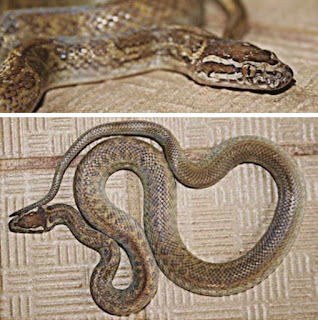
[Herpetology • 2021] Boaedon mendesi • Taxonomic Revision of the Jita Snakes (Serpentes: Lamprophiidae: Boaedon) from São Tomé and Príncipe (Gulf of Guinea), with the Description of A New Species


Boaedon mendesi  
Ceríaco, Arellano, Jadin, Marques, Parrinha & Hallermann, 2021


ABSTRACT
The taxonomic status of the São Tomé and Príncipe islands ‘Cobras Jitas’, genus Boaedon, has been a subject of confusion. Historically, these island populations have been referred to as part of either the Boaedon fuliginosus species complex or Boaedon capensis species complex, two of the most taxonomically challenging groups of African snakes, or considered a distinct taxonomic entity, B. bedriagae. Here we review the São Tomé and Príncipe populations through a combination of morphological and molecular data. Our results suggest that each island population represents a unique species. After a thorough review of the taxonomic and nomenclatural history of the group, we revalidate B. bedriagae, restricting the application of this name to the São Tomé population by the designation of a lectotype. We also describe the Príncipe population as a new species, Boaedon mendesi sp. nov. This description has implications to our understanding of the diversity and phylogeographic patterns of the Gulf of Guinea Oceanic Islands.

KEY WORDS: Boaedon bedriagae, Boaedon mendesi sp. nov., Boaedon fuliginosus complex, endemism, island biodiversity

 Live photo of the holotype of Boaedon mendesi sp. nov. 
(MUHNAC/MB03-977).

Boaedon mendesi sp. nov. 

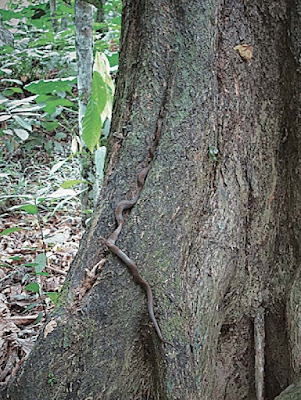
Live photo of the holotype of Boaedon mendesi sp. nov. (MUHNAC/MB03-977), basking in a tree during daytime.
Photo by Luis M.P. Ceríaco.


Luis M.P. Ceríaco, Ana Lisette Arellano, Robert C Jadin, Mariana P Marques, Diogo Parrinha and Jakob Hallermann. 2021. Taxonomic Revision of the Jita Snakes (Lamprophiidae: Boaedon) from São Tomé and Príncipe (Gulf of Guinea), with the Description of A New Species. African Journal of Herpetology. 70(1)  DOI: 10.1080/21564574.2020.1832152

Tuesday, April 17, 2018

[Botany • 2018] Afropectinariella (Vandeae, Orchidaceae), A New Genus of the Angraecum Alliance


Afropectinariella doratophylla   (Summerh.) M.Simo & Stévart

in Simo-Droissart, Sonké, Droissart & Stévart, 2018.

photo: Tariq Stévart  twitter.com/PhytoKeys   iucnredlist.org

Abstract
A recent phylogenetic study showed that species assigned to the newly recognised genus Pectinariella Szlach., Mytnik & Grochocka (previously treated as Angraecum Bory sect. Pectinaria Benth.) are polyphyletic, comprising a clade with species primarily in Madagascar and the Western Indian Ocean islands (including the type) and another non-sister clade whose members occur in continental Africa and the Gulf of Guinea islands. In order to render Pectinariella monophyletic, the five continental African species must therefore be removed. A new genusAfropectinariella M.Simo & Stévart, is described and the following combinations are made: Afropectinariella atlantica (Stévart & Droissart) M.Simo & Stévart, Afropectinariella doratophylla (Summerh.) M.Simo & Stévart, Afropectinariella gabonensis (Summerh.) M.Simo & Stévart, Afropectinariella pungens (Schltr.) M.Simo & Stévart and Afropectinariella subulata (Lindl.) M.Simo & Stévart.

Keywords: Angraecoid orchids, continental Africa, Malagasy and Indian Ocean islands, Pectinaria, phylogenetics, taxonomy


Taxonomy
Afropectinariella M.Simo & Stévart, gen. nov.
 Type: Afropectinariella doratophylla (Summerh.) M.Simo & Stévart
[≡ Angraecum doratophyllum Summerh.].

Etymology: The name of the genus is based on the geographic distribution of its five species, all of which occur in Africa and the generic name Pectinariella in which they were previously placed.

Diagnosis: Afropectinariella resembles the related genera Dolabrifolia and Pectinariella in having a sessile ovary, i.e. without a pedicel and with a very short peduncle that is hardly developed, but differs from Dolabrifolia by its elongate leaves that are never compressed laterally (vs. imbricate and laterally compressed) and from Pectinariella by its transversely oval lip that is wider than long (vs. the lip longer that wide) and its occurrence in continental Africa and Gulf of Guinea islands (vs. Madagascar and adjacent islands).


Afropectinariella atlantica (Stévart & Droissart) M.Simo & Stévart, comb. nov.
 Angraecum atlanticum Stévart et al. (2010: 253). 

Type: Equatorial Guinea (Rio Muni). Monte Alén National Park: Engong inselberg, ....


Afropectinariella doratophylla (Summerh.) M.Simo & Stévart, comb. nov .  
Angraecum doratophyllum Summerhayes (1937: 465). 

Type: São Tomé and Príncipe (São Tomé Island) Vanhulst (Macambrará): virgin forest, 1,050–1,200 m alt., ....


Afropectinariella gabonensis (Summerh.) M.Simo & Stévart, comb. nov.
Angraecum gabonense Summerhayes (1954: 587). 
Type: Gabon. Upper Ngounyé River, Nimalaba, N. E. of Les Echiras, ....


Afropectinariella pungens (Schltr.) M.Simo & Stévart, comb. nov.
Angraecum pungens Schlechter (1906: 163). 
Type: Cameroon. Man O’War Bay, auf Baümen bei Kriegschiffhafen, ....


Afropectinariella subulata (Lindl.) M.Simo & Stévart, comb. nov. 
Angraecum subulatum Lindley (1837: 206). 
Type: Nigeria. Nun River: s. d., ....


 Murielle Simo-Droissart, Bonaventure Sonké, Vincent Droissart and Tariq Stévart. 2018. Afropectinariella (Vandeae, Orchidaceae), A New Genus of the Angraecum Alliance. PhytoKeys. 96: 79-86.   DOI:  10.3897/phytokeys.96.23933

Résumé: Une analyse phylogénétique récente a montré que les espèces attribuées au nouveau genre Pectinariella Szlach., Mytnik & Grochocka (anciennement Angraecum Bory sect. Pectinaria Benth.) forment un groupe polyphylétique, comprenant un clade avec des espèces présentes principalement à Madagascar et dans les îles de l'ouest de l'Océan Indien (incluant le type) et un autre clade qui ne lui est pas apparenté et dont les espèces sont distribuées en Afrique continentale et dans les îles du Golfe de Guinée. Afin de rétablir la monophylie du genre Pectinariella, les cinq espèces d’Afrique continentale et des îles du Golfe de Guinée doivent donc en être exclues. Un nouveau genre, Afropectinariella M.Simo & Stévart, est décrit et les combinaisons suivantes sont proposées: Afropectinariella atlantica (Stévart & Droissart) M.Simo & Stévart, Afropectinariella doratophylla (Summerh.) M.Simo & Stévart, Afropectinariella gabonensis (Summerh.) M.Simo & Stévart, Afropectinariella pungens (Schltr.) M.Simo & Stévart et Afropectinariella subulata (Lindl.) M.Simo & Stévart.


Tuesday, September 26, 2017

[Herpetology • 2017] Naja peroescobari • A New Species of Naja Laurenti, 1768 (Squamata: Elapidae): The “Cobra-preta” of São Tomé Island, Gulf of Guinea


Naja (Boulengerina) peroescobari  
Ceríaco, Marques, Schmitz & Bauer, 2017

Photo: T. Pisoni. 
DOI: 10.11646/zootaxa.4324.1.7 

Abstract

The Cobra-Preta (black snake in Portuguese) of Sao Tomé Island in the Gulf of Guinea has historically been referred to as Naja (Boulengerina) melanoleuca (Squamata: Elapidae). Its presence on the island has been traditionally explained as an introduction from the mainland by Portuguese settlers, supposedly to control the rat population. This explanation has been widely accepted by local authorities and even international conservation agencies. The taxonomic identity of this snake has remained undisputed by all taxonomists who have published about it, with the exception of L. Capocaccia in 1961. Arguments supporting the human introduction hypothesis are weak and are contradicted by historical, morphological and molecular data. Further, the biogeographic history of the Gulf of Guinea oceanic islands and recent insights on the taxonomic identity and evolutionary history of other taxonomic groups occurring there suggest that the Cobra-Preta, in fact, represents a distinct lineage of the melanoleuca group, endemic to São Tomé. We here describe the Cobra Preta as a new species. The new species differs from N. (B.) melanoleuca, its sister species, by a distinct coloration ventral pattern and the type of contact of the sublingual scales. Data on the toxicology, distribution, ecology, folklore and conservation status of the new species are presented.

Keywords: Reptilia, NajaBoulengerina, taxonomy, São Tomé & Príncipe, conservation, Naja (Boulengerina) peroescobari sp. nov.


FIGURE 4. Holotype of Naja (Boulengerina) peroescobari sp. nov. (MUHNAC / MB 03 – 001065).

FIGURE 5. Live picture of Naja (Boulengerina) peroescobari  sp nov. from near Santa Josefina. Specimen not collected. Photo by Tiziano Pisoni. 


Luis M. P. Ceríaco, Mariana P. Marques, Andreas Schmitz and Aaron M. Bauer. 2017. The “Cobra-preta” of São Tomé Island, Gulf of Guinea, is A New Species of Naja Laurenti, 1768 (Squamata: Elapidae). Zootaxa. 4324(1); 121–141.  DOI: 10.11646/zootaxa.4324.1.7


Tuesday, June 20, 2017

[Crustacea • 2017] Strongly Carinate Species of Alpheopsis Coutière, 1897 (Malacostraca: Decapoda: Alpheidae) of the Tropical Atlantic and eastern Pacific, with Redescription of A. trigona (Rathbun, 1901) and Description of Three New Species


Alpheopsis paratrigona  Anker, 2017 


Abstract

The present study deals with four species of the alpheid shrimp genus Alpheopsis Coutière, 1897 characterised by the presence of at least one strong carina on the dorsal surface of the carapace. Alpheopsis trigona (Rathbun, 1901) is redescribed based on the holotype from Puerto Rico and additional material from US Virgin Islands and Florida. Two new species closely related to A. trigona, viz. Alpheopsis paratrigona sp. nov. and Alpheopsis gotrina sp. nov., are described, the first based on material from several localities in the tropical western Atlantic, and the second from the Pacific coast of Panama and Colombia. The three species together form a distinctive transisthmian clade within Alpheopsis, the A. trigona species complex, characterised by the presence of several strong longitudinal carinae on the carapace and very distinctive colour pattern. A more distantly related species, Alpheopsis aristoteles sp. nov., characterised by the presence of only one strong mid-dorsal carina in the anterior region of the carapace, is described based on material from São Tomé Island in the tropical eastern Atlantic.

Keywords: Crustacea, Caridea, marine shrimp, biodiversity, East Pacific, West Atlantic, East Atlantic, Caribbean Sea, Gulf of Guinea

Taxonomy 
Family Alpheidae Rafinesque, 1815 
Alpheopsis Coutière, 1897 

Alpheopsis paratrigona sp. nov.

Etymology. The specific name refers to the general resemblance of the new species to A. trigona.

Alpheopsis paratrigona sp. nov., male holotype (cl 4.5 mm) from Portobelo, Caribbean coast of Panama (MZUSP34222).
Photograph: A. Anker. 

Alpheopsis gotrina sp. nov.

Etymology. The new species’ name is an anagram of the specific epithet of its presumed closest relative, A. trigona.


Alpheopsis aristoteles sp. nov.

Etymology. The new species is named after the great Greek philosopher and scientist, Aristoteles (384–322BCE), and also the first naturalist who attempted a classification of animals based on morphology, anatomy and reproductive systems, in his famous “History of Animals” (Aristoteles 350 BCE).


Arthur Anker. 2017. Strongly Carinate Species of Alpheopsis Coutière, 1897 of the Tropical Atlantic and eastern Pacific, with Redescription of A. trigona (Rathbun, 1901) and Description of Three New Species (Malacostraca: Decapoda: Alpheidae). Zootaxa. 4277(2); 199–227. DOI:  10.11646/zootaxa.4277.2.2

Friday, May 13, 2016

[Herpetology • 2016] A Review of the Genus Trachylepis (Sauria: Scincidae) from the Gulf of Guinea, with Descriptions of Two New Species in the Trachylepis maculilabris (Gray, 1845) Species Complex


Trachylepis principensis 
Ceríaco, Marques & Bauer, 2016  
  DOI: 10.11646/zootaxa.4109.3.2

Abstract

The scincid genus Trachylepis is represented in the oceanic islands of the Gulf of Guinea by four species, Trachylepis maculilabris, T. affinis, T. adamastor and T. ozorii. Here we describe two new species, Trachylepis thomensis sp. nov., endemic to São Tomé Island and Rolas Islet, and Trachylepis principensis sp. nov., endemic to Príncipe Island. Phylogenetic analysis using the mitochondrial gene 16S shows that both new species are genetically divergent and reciprocally monophyletic, and confirms evidence for the uniqueness of these lineages presented in previous studies. Morphological data (scalation and morphometry) identify consistent phenotypic differences between these two island species. We were also able to confirm that the T. affinis population of Príncipe Island is conspecific with the African mainland population and most probably the result of recent introductions. These findings raise the number of known Trachylepis species in the Gulf of Guinea islands group to five, four of which are endemic, although the phylogenetic and phylogeographic relationships of T. adamastor and T. ozorii remain unknown and require further investigation.

Keywords: Gulf of Guinea, São Tomé & Príncipe, endemism, Trachylepis thomensis sp. nov., Trachylepis principensis sp. nov., skink, Reptilia


Luis M. P. Ceríaco, Mariana P. Marques and Aaron M. Bauer. 2016. A Review of the Genus Trachylepis (Sauria: Scincidae) from the Gulf of Guinea, with Descriptions of Two New Species in the Trachylepis maculilabris (Gray, 1845) Species Complex.
Zootaxa. 4109(3); DOI: 10.11646/zootaxa.4109.3.2

Tuesday, January 12, 2016

[Herpetology • 2015] Trachylepis adamastor Lost in the Middle of the Sea, Found in the Back of the Shelf: A New Giant Species of Trachylepis (Squamata: Scincidae) from Tinhosa Grande Islet, Gulf of Guinea


Trachylepis adamastor Ceríaco, 2015
Lagartixa-adamastor | Adamastor Skink

Abstract

A new species of Trachylepis is described from Tinhosa Grande islet, São Tomé e Príncipe, Gulf of Guinea. Tinhosa Grande islet is a small (20.5 ha), isolated desert islet used by several bird communities as a nesting place. The new species is distinguished from its congeners by its color pattern, size and lepidosis. Due to its limited geographical distribution the new species appears to be one of the most vulnerable vertebrate species on the planet. In this study we provide a brief discussion on the natural history of the new species, as well as conservation concerns and suggestions.

Keywords: Conservation, São Tomé e Príncipe, taxonomy, Tinhosas, Trachylepis adamastor

FIGURE 3. Live photo of Trachylepis adamastor sp. nov. (specimen not collected), from Tinhosa Grande.
Photo by Ross Wanless.


The islanders of Tinhosa Great and Small Tinhosa
photographed by plane LUÍS CERÍACO

Distribution. As far as presently known, the species distribution is restricted to Tinhosa Grande Islet, Republic of São Tomé e Príncipe, West Africa.

Habitat and natural history notes. The habitat used by the species is the rocks and rock outcrops of the islet. The trophic ecology of the species is currently unknown. The habitat is almost deprived of any type of vegetation and very few invertebrates occur in the islet, although live specimens were observed eating the yolk of recently broken bird eggs (Nuno Barros & Simon Valle pers. comm.; Fig. 4). The population appears stable and reaching high densities (Nuno Barros & Simon Valle pers. comm.). The ecological relations between the newly-described species and the nesting birds is unknown, but trophic relationships can be suspected, namely the predation of arthropods associated with bird nests, as the case of other reptiles from small oceanic islands and atolls (Ineich et al. 2009). The species appear to share the islet with another reptile, a still unidentified Hemidactylus sp. (Nuno Barros, António Monteiro pers. comm.).

Etymology. The specific epithet 'adamastor' refers to the mythical giant inhabiting a rock "in the end of the sea" present in the Luis de Camões famous odyssey 'Os Lusíadas', and is applied here as a substantive in apposition. We propose the Portuguese common name Lagartixa-adamastor and the English common name of Adamastor Skink.


Ceríaco, Luis M. P. 2015. Lost in the Middle of the Sea, Found in the Back of the Shelf: A New Giant Species of Trachylepis (Squamata: Scincidae) from Tinhosa Grande Islet, Gulf of Guinea. Zootaxa.  3973(3): 511–527. DOI: 10.11646/zootaxa.3973.3.6


FIGURE 4. Trachylepis adamastor sp. nov. feeding on a recently broken egg (specimen not collected).
Photo by Ross Wanless.

On a rocky deserted islet off the coast of São Tomé e Príncipe, Gulf of Guinea, lives a lizard new to Science. A Portuguese scientist has just described this new species in a paper publish in Zootaxa science magazine. It’s the Adamastor Skink.

Num rochedo perto da ilha do Príncipe habita a inigualável lagartixa-adamastor http://www.publico.pt/n1702382