Showing posts with label Liberia. Show all posts

Tuesday, February 3, 2026

[Botany • 2025] Keetia magassoubiana (Rubiaceae: Vanguerieae) • A threatened evergreen forest Climber and an updated key to Keetia in West Africa


Keetia magassoubiana Cheek, 
 
in Cheek, Yasuda, Jongkind et Bowden-Pickstock, 2025.

Summary
Keetia magassoubiana Cheek, an evergreen rainforest climber, is described and illustrated from the Republic of Guinea, Sierra Leone, Liberia and Ivory Coast. Previously indicated as being close to, but different from, K. tenuiflora (Hiern) Bridson, it differs in the glossy, black, glabrous, epidermis of the distal stem internodes; the first internode rarely with very sparse, red adpressed hairs (vs epidermis pale white-brown, with dense, pale yellow, spreading hairs); abaxial leaf surfaces with domed domatia with a central aperture (vs domatia absent or obscure); secondary stem leaf bases acute (vs obtuse to truncate); bracts forming a laciniate sheath on the distal peduncle (vs two opposite triangular bracts) and the pyrene surface honeycombed with pits (vs entire). The species was earlier included within Canthium multiflorum (Schum. & Thonn.) Hiern, now K. multiflora (Schum. & Thonn.) Bridson, in the Flora of West Tropical Africa, second edition. An updated key is presented to the 16 species of the genus from West Africa. Keetia magassoubiana is provisionally assessed using the IUCN standard as Endangered [EN B1ab(iii)] due to only five of the recorded 14 locations having extant forest habitat, and because of ongoing threats of habitat clearance, mainly for agriculture but also for mining.

Key Words: Conservation, extinction, liana


Keetia magassoubiana Cheek sp. nov.

Recognition. Keetia magassoubiana Cheek sp. nov. is close to but differs from K. tenuiflora in the glossy, black, glabrous epidermis of the distal stem internodes, rarely with very sparse red hairs (vs epidermis pale white-brown, densely pale yellow hairy in K. tenuiflora), abaxial leaf surface with domatia domed, with a central aperture (vs domatia absent or obscure), the secondary stem leaf bases acute (vs obtuse to truncate), the bracts forming a laciniate sheath on the distal peduncle (vs two opposite triangular bracts) and the pyrene surface honeycombed with pits (vs smooth).

Etymology. Named for Dr Sekou Magassouba, Director-General of the National Herbarium of Guinea (HNG) in the University of Gamal Abdel Nasser – Conakry, Republic of Guinea. Under his careful, tireless and diligent administration, HNG has increased greatly in its capacity to devise and manage projects, attract grants, to train students, including now at doctorate level for the first time and to develop publication of research and publicise the conservation of the threatened plant species and habitats of his country.


Martin Cheek, Shigeo Yasuda, Carel C. H. Jongkind and Joel Bowden-Pickstock. 2025. Keetia magassoubiana sp. nov. (Rubiaceae - Vanguerieae), a threatened evergreen forest climber and an updated key to Keetia in West Africa. Kew Bulletin. DOI: doi.org/10.1007/s12225-024-10234-z

Friday, December 31, 2021

[Mammalogy • 2021] Shrews (Eulipotyphla: Soricidae) from A Biodiversity Hotspot, Mount Nimba (West Africa), with A Field Identification Key to Species


in Denys, Jacquet, Kadjo, ... et Monadjem, 2021. 

In this study, we collected 226 shrew specimens originating from 16 localities on the Guinean and Liberian sides of Mount Nimba. We surveyed all major vegetation zones from 400 to 1600 m above sea level (asl), including forest and savannah habitats. We recorded 11 species, whose identifications were confirmed by genetic analyses and classical morphometrics. Furthermore, we provide cytogenetic data for five of these species. The shrew community at Mount Nimba is composed of a mix of both savannah- and forest-dependent species, which is related to the peculiar position of Mount Nimba situated at the transition between lowland rainforest to the south and Guinean woodlands to the north. We recorded 11 species of shrews in syntopy in lowland rainforest, seven in edaphic savannah and mountain forest, and five in high-altitude savannah at 1600 m asl. Based on morphometric analyses, we show that these syntopic species separate along a size axis, allowing species to occupy different ecological niches, which we speculate allows them to access different food resources. We also highlight that Crocidura theresae Heim de Balsac, 1968 from Mount Nimba has a different karyotype from that described in Côte d’Ivoire. Finally, we develop a novel identification key for shrews from Mount Nimba using external characters and standard body measurements, allowing it to be used in the field on live specimens. In total 12 shrew species are now known from Mount Nimba, which highlights its exceptional position as a tropical African biodiversity hotspot.

KEYWORDS: Soricidae, CrociduraSuncus, community, cytogenetics, barcoding, morphometrics, morphology, Africa, Guinea, Liberia, biosphere reserve


Examples of habitats where pitfall traps were placed on the Guinean and Liberian Nimba:
A, gallery forest and swamp, camp 4 (Liberia); B, pitfall, altitude savannah with Loudetia kagerensis, Mare d’hivernage site (1642m) (Guinea);
C, pitfall, Selingbala (Guinea): mesophyllous secondary forest; D, pitfall, Gbie (Guinea): gallery forest with Parinari excelsa Sabine,1824, Carapa procera DC., 1824 and Pseudospondias microcarpa (A. Rich.) Engl., 1883, Maranthochloa purpurea (Ridl.) Milne-Redh.

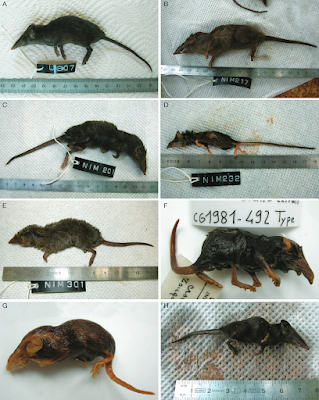
Nimba shrews skins with field numbers:
A, MNHN-ZM-2014-900 (LB07) C. buettikoferi Jentink, 1888 Camp 4;
B, MNHN-ZM-2012-1079 (NIM217) C. grandiceps Hutterer, 1983 Gouan;
C, MNHN-ZM-2012-1158 (NIM201) C. olivieri (Lesson, 1827) Gbié;
D, MNHN-ZM-2012-1111 (NIM232) C. muricauda (Miller, 1900) Gouan;
E, MNHN-ZM-2012-1180 (NIM 301) C. theresae Heim de Balsac, 1968 Gouan;
F, MNHN-ZM-MO-1981-492 C. nimbae Heim de Balsac, 1956 Holotype Zouguepo;
G, MNHN-ZM-MO-1981-483 C. eburnea Heim de Balsac, 1958 Mt Tonkui;
H, MNHN-ZM-2012-1123 (NIM 219) C. obscurior Heim de Balsac, 1958 Gouan. 

 
Christiane Denys, François Jacquet, Blaise Kadjo, Alain Didier Missoup, Vladimir Aniskine, Joelle Goüy de Bellocq, Barré Soropogui, Mory Douno, Morlaye Sylla, Violaine Nicolas, Aude Lalis and Ara Monadjem. 2021. Shrews (Mammalia, Eulipotyphla) from A Biodiversity Hotspot, Mount Nimba (West Africa), with A Field Identification Key to Species.   ZOOSYSTEMA. 43(30); 729-757.