Showing posts with label Advertisement Call. Show all posts

Monday, March 9, 2026

[Herpetology • 2026] Ololygon paracatu • A New Species of the Ololygon catharinae group (Anura: Hylidae: Scinaxini) from the Brazilian Cerrado


Ololygon paracatu 
 Carvalho, Valencia-Zuleta, Araujo-Vieira, Faivovich, Maciel & Brandão,  2026

 
Abstract
We describe a new species of the Ololygon catharinae group from the Cerrado biome, in the state of Minas Gerais, Brazil. Ololygon paracatu sp. nov. is morphologically similar to O. goya and O. skaios, although in phylogenetic analyses, it is recovered as the poorly supported sister taxon of O. pombali. It is distinguished from other species of the O. catharinae group by having a canthus rostralis marked and curved; subovoid snout in dorsal view and protruding in profile; inverted triangle shaped interocular blotch, exceeding the posterior margin of the eyes; inguinal region and hidden areas of thighs with dark brown irregular blotches on a pale yellow background in life; and advertisement call composed of 3–5 pulsed notes and dominant frequency of 2.5–3.5 kHz. Ololygon paracatu sp. nov. inhabits gallery forests associated with streams in the Cerrado biome.

Amphibia, Hylinae, taxonomy, phylogeny, calls, gallery forest
 
 
Ololygon paracatu sp. nov.


Daniele CARVALHO, Alejandro VALENCIA-ZULETA, Katyuscia ARAUJO-VIEIRA, Julián FAIVOVICH, Natan M. MACIEL and Reuber A. BRANDÃO. 2026. A New Species of the Ololygon catharinae group from the Brazilian Cerrado (Anura, Hylidae, Scinaxini). Zootaxa. 5757(6); 522-542. DOI: doi.org/10.11646/zootaxa.5757.6.2 [2026-02-11]

Sunday, November 30, 2025

[Herpetology • 2025] Ololygon paulofreirei • Taxonomic Assessment of Ololygon gr. argyreornata (Anura: Hylidae) from northern Atlantic Forest reveals A New Species from the Pernambuco Endemism Centre, northeastern Brazil


Ololygon paulofreirei
Roberto, Ávila, de Lima & Santos, 2025 
 

Abstract
The Atlantic Forest in Brazil is a highly threatened biome, recognized as a biodiversity hotspot that hosts numerous endangered species with restricted distributions and facing intense human pressures. The Pernambuco Endemism Centre (PEC), located in Northeastern Brazil, represents one of the most concerning regions within the Atlantic Forest, as it comprises small, fragmented patches of pristine forest harboring several endangered species. Additionally, many species may be threatened but remain undocumented due to a lack of taxonomic studies, particularly within cryptic species complexes. In this study, we assessed the taxonomic status of populations assigned to the genus Ololygon from the state of Pernambuco. This genus presents several cryptic species with subtle morphological differences. Based on morphological, molecular, and acoustic data, we conclude that the populations from the state of Pernambuco constitute a previously undescribed species. Furthermore, we update the geographic distribution of the Ololygon gr. argyreornata species group, providing new morphological and acoustic data for O. skuki from the northern coast of Bahia state, and redescribe the advertisement call of O. argyreornata from Linhares, Espírito Santo.

Keywords: cryptic species; integrative taxonomy; Ololygon skuki; Scinaxinae; vocalization


Ololygon paulofreirei


  Igor Joventino Roberto, Robson Waldemar Ávila, Marcelo G. de Lima and Ednilza Maranhão dos Santos. 2025. Taxonomic Assessment of Ololygon gr. argyreornata (Anura, Hylidae) from northern Atlantic Forest reveals A New Species from the Pernambuco Endemism Centre, northeastern Brazil. Amphibia-Reptilia. DOI: doi.org/10.1163/15685381-bja10241 [23 Oct 2025] 
 facebook.com/aldeiadagente/posts/1371425611660473


Wednesday, October 8, 2025

[Herpetology • 2025] Ranitomeya hwata • A New Species of Bamboo-dwelling Ranitomeya (Anura: Dendrobatidae) from the Upper Purus River Basin of Brazil and Peru


Ranitomeya hwata
 Twomey, Melo-Sampaio, Brown, Castroviejo-Fisher, Gagliardi-Urrutia, Padial, Poblete & Chaparro, 2025
 
 
Abstract
A new species of Ranitomeya from Amazonian lowland forests in western Brazil and southeastern Peru is described and named. This species was formerly considered to be an outlying population of R. sirensis on the far eastern periphery of its geographic distribution. We analyze new and existing phylogenomic data and infer that the new species is not part of, or closely related to R. sirensis, but is sister to a clade including R. aetherea, R. aquamarina, R. cyanovittata, R. flavovittata, and R. yavaricola. The new species can be distinguished from species in its sister clade by its color pattern (yellow dorsal stripes, finely spotted ventral pattern, and a distinctive black band separating the gular and belly regions), and from R. sirensis by the presence/absence of a ventral color patch (absent in the new species, present in R. sirensis). Calls of the new species are longer in duration, with more pulses per call, and a slightly higher pulse rate, than any of the species in its sister clade for which call data are available. The new species is strongly associated with native Guadua bamboo, which it uses for reproduction. Based on museum records the new species also occurs in northern Bolivia. Unlike other close relatives, which are mostly monogamous, males of the new species appear to be polygynous, recruiting multiple females per breeding site.

Amphibia, Anura, poison dart frog, ultraconserved elements, phylogenomics, bioacoustics


Ranitomeya hwata sp. nov.


Evan TWOMEY, Paulo R. MELO-SAMPAIO, Jason L. BROWN, Santiago CASTROVIEJO-FISHER, Giussepe GAGLIARDI-URRUTIA, José M. PADIAL, Roberto Gutierrez POBLETE and Juan C. CHAPARRO. 2025. A New Species of Bamboo-dwelling Ranitomeya (Anura: Dendrobatidae) from the Upper Purus River Basin of Brazil and Peru. Zootaxa. 5701(4); 428-446. DOI: doi.org/10.11646/zootaxa.5701.4.2 [2025-10-06]

Tuesday, May 27, 2025

[Herpetology • 2025] Ranitomeya aquamarina • An Amazonian Hidden Gem: A New Metallic-colored Species of Ranitomeya (Anura: Dendrobatidae) from Juruá River Basin forests, Amazonas State, Brazil


Ranitomeya aquamarina
Mônico, Koch, Dayrell, Moravec & Lima, 2025


Abstract  
The genus Ranitomeya has 16 known species, and the last of them was described 13 years ago. The forests of the Juruá River basin are known for their enormous vertebrate diversity, despite being one of the least sampled regions in the entire Amazonia. Our recent expeditions to the region resulted in the discovery of a Ranitomeya species with blue-green dorsal stripes and quite peculiar behavior. Here, it is described as a new species using morphological, morphometric, advertisement call, natural history, and genetic data. This new species is strongly nested within the R. vanzolinii clade, with interspecific p-distances ranging from 2.94 to 3.91%, and it was confirmed in all the delimitation methods used. It differs from its closest relatives mainly by (i) its size (male SVL 15.4–17.7 mm, n = 8; female SVL 17.3–18.5 mm, n = 5), (ii) its unique color pattern that is metallic pale yellowish green to metallic pale turquoise-green dorsal stripes pattern, limbs metallic chrome with dark carmine spotting), (iii) presence of a conspicuous sulfur yellow spot on the dorsal surface of the thighs, (iv) tadpoles with posterior tooth rows P1 > P2 > P3 in all stages, head translucent brownish and lack of emarginate lateral papillae, and (v) its advertisement call (composed of 21–45 notes, call duration of 647–1,424 ms, note rate of 28–36 notes/s and dominant frequency of 4,996–6,288 Hz).

Key words: Advertisement call, Amphibia, biodiversity, integrative taxonomy, morphology, phylogeny


Adult individuals of Ranitomeya aquamarina sp. nov. in natural posture
A holotype, male INPA-H 47568 B paratype, female INPA-H 47569
C paratype, male MPEG 45223 D paratype, male INPA-H 47570 E Paratype, female MPEG 45222.
Photographs A.T. Mônico.
  
 Ranitomeya aquamarina sp. nov.
 
Chresonymy. Ranitomeya sp. Envira – Twomey et al. (2023); 
Ranitomeya aff. sirensis – Lima et al. (2024).

Vernacular names.  Suggested English name: Metallic poison frog.
Suggested Spanish name: Rana venenosa metálica.
Suggested Portuguese name: Rãzinha-venenosa-metalizada.

Etymology. The specific epithet ‘aquamarina’ is a Latin adjective that means “pale blue-green”, referring to the coloration of the dorsal-lateral stripes of the new species. Another aspect that led us to use this epithet was the metallic blue and greenish tones of the stripes, which resemble seawater. Additionally, aquamarine is a gemstone, which philosophically conveys the value of this discovery.


 Alexander Tamanini Mônico, Esteban Diego Koch, Jussara Santos Dayrell, Jiří Moravec and Albertina Pimentel Lima. 2025. An Amazonian Hidden Gem: A New Metallic-colored Species of Ranitomeya (Anura, Dendrobatidae) from Juruá River Basin forests, Amazonas State, Brazil. ZooKeys. 1236: 51-83. DOI: doi.org/10.3897/zookeys.1236.146533 

Thursday, May 15, 2025

[Herpetology • 2025] Ranitomeya aetherea • A remarkable New blue Ranitomeya Species (Anura: Dendrobatidae) with copper metallic legs from Open Forests of Juruá River Basin, Amazonia


Ranitomeya aetherea 
Koch, Mônico, Dayrell, Ferreira, Dantas, Moravec & Lima, 2025


 Abstract

Poison dart frogs (Dendrobatidae) are known for their aposematic coloration and toxic skin, making them a frequent subject of interest and research. However, descriptions of new species of Ranitomeya were interrupted for more than a decade. The implementation of a RAPELD (Rapid Assessment surveys of Long-Term Ecological Research) module in the Juruá River basin, a highly biodiverse and underexplored region, led to the record of a Ranitomeya species with blue dorsal stripes and coppery limbs. Herein we use morphological, morphometric, advertisement call, natural history, tadpole data and genetic data to describe the new species. Our phylogenetic analysis places the species within the Ranitomeya vanzolinii clade, and all delimitation methods confirmed its status as a new species. The species is characterized by its (i) small size (snout-vent length: males 15.2–17.0 mm, females 14.4–16.9 mm), (ii) dorsum with light sky-blue stripes on a reddish-brown ground, and metallic copper limbs with reddish-brown spots, (iii) ring-shaped granular region on the belly, (iv) toes with poorly developed lateral fringes, (v) later tadpole stages with tooth rows P1 = P2 > P3, P3 of 83–87% of P1, and conspicuous light sky-blue dorsal stripes, and (vi) cricket-like advertisement call consisting of 16–35 notes, call duration of 490–1,005 ms, note duration of 8.2–16.9 ms and dominant frequency of 5,168–6,029 Hz. The discovery of the new species emphasizes the significance of researching under-sampled regions like the Juruá River basin, and the usefulness of using a multidisciplinary approach to reveal new dendrobatid species. 

In life holotype of Ranitomeya aetherea sp. nov. (INPA-H 47581, APL 24826):
(A) lateral and (B) dorsal view, (C) lateral view showing the spots in lateroventral and inguinal region. Photographs: A. T. Mônico.

Dorsal and ventral color pattern variation of the Ranitomeya aetherea sp. nov. in life:
Males (A) Holotype - INPA-H 47581, (B) INPA-H 47575, (C) INPA-H 47584;
females (E) INPA-H 47580, (F) INPA-H 47583, (G) INPA-H 47584.
Photographs: A.T. Mônico.


Ranitomeya aetherea sp. nov. 

Etymology: The specific epithet aetherea is a Latin adjective meaning “heavenly”, which philosophically refers to the coloration of the species’ dorsal stripes: a shade of blue reminiscent of the sky. In addition, we attribute this name to one’s feeling of enchantment and delicacy when encountering these frogs, as if they were from outside this world.


Ranitomeya aetherea sp. nov. natural history and breeding aspects:
 [A] ombrophilous open forests with palms inhabited by the new species; [B] habitat of the new species in detail; [C] single tadpole within a phytotelma; [D] tadpole with a partly developed dorsal pattern of the adult individuals; [E] metamorph displaying adult coloration; [F] juvenile; [G] calling male with inflated vocal sac.
 Photographs: A.T. Mônico (A, B, C, F and G), A.P. Lima (D), S. Dantas (E).


 Esteban Diego Koch, Alexander Tamanini Mônico, Jussara Santos Dayrell, Anthony Santana Ferreira, Silionamã Pereira Dantas, Jiří Moravec and Albertina Pimentel Lima. 2025. A remarkable New blue Ranitomeya Species (Anura: Dendrobatidae) with copper metallic legs from Open Forests of Juruá River Basin, Amazonia. PLoS One. 20(5): e0321748. DOI: doi.org/10.1371/journal.pone.0321748 [May 14, 2025]

Monday, February 24, 2025

[Herpetology • 2025] Dendropsophus cannatellai • Systematics of the Dendropsophus leucophyllatus species group (Anura: Hylidae) from the Chocó region of Ecuador, with Description of a new species


Dendropsophus cannatellai 
 Aguirre, Apunte & Ron, 2025


Abstract
The Dendropsophus leucophyllatus group is composed by 19 species distributed from Central America to the Atlantic Forest of Brazil. Only one species is known from the Chocó region, D. ebraccatus, which is also distributed in Central America. Previous studies suggested the existence of two species masked under “D. ebraccatus”. The only other species of Dendropsophus in the Chocó lowlands of Ecuador is D. gryllatus, an elusive species never included in phylogenetic analyses. In the present study, we review the systematics of both species based on morphological, genetic, and bioacoustic data. For phylogenetic analyses, we sequenced four mitochondrial genes (12S, 16S, COI, ND1, including flanking tRNAs) and two nuclear genes (TYR, POMC). Our results indicate that the populations of “D. ebraccatus” from the Chocó of Ecuador represent a new species, not most closely related to D. ebraccatus from Central America, but to D. gryllatus. The new species inhabits tropical rainforest and piedmont evergreen forest of NW Ecuador and SW Colombia. Populations of the new species differ from D. gryllatus by having larger body size and by the presence of an hourglass-shaped dorsal mark. The new species differs from D. ebraccatus from Central America by the absence of a clear band under the eye, by having well defined dorsal spots and by having a distinct advertisement call. Both species appear to be allopatric and, according to our time-tree, diverged from each other during the late Pliocene.

Key Words: Advertisement calls, Chocó rainforest, Colombia, Dendropsophus cannatellai sp. nov., Dendropsophus gryllatus, phylogeny

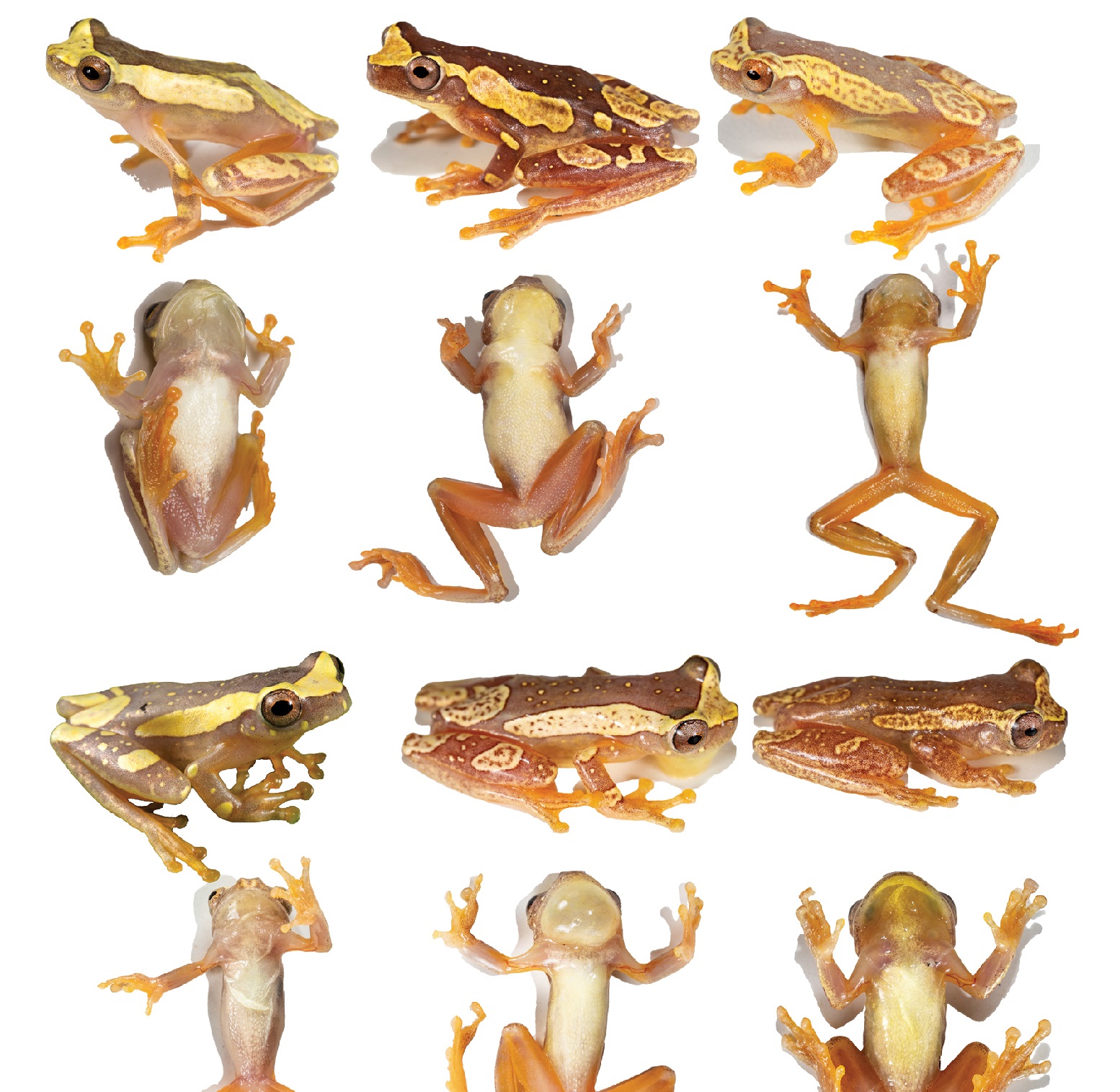
Life coloration of Dendropsophus cannatellai sp. nov.
First and third rows, dorsolateral views; second and fourth, ventral views. From left to right, first and second rows: QCAZ 51877 (SVL = 22.26 mm, male); QCAZ 78809 (SVL = 33.61 mm, female); QCAZ 55558 (SVL = 21.96 mm, male); third and fourth rows: QCAZ 40847 (holotype; SVL = 22.32 mm, male); QCAZ 78812 (SVL = 25.86 mm, male); QCAZ 78813 (SVL = 24.94 mm, male). See type series for locality data. All specimens are shown at the same scale.

 Dendropsophus cannatellai sp. nov.

Common names: English: Cannatella’s treefrog. 
Spanish: Ranita de Cannatella.

Definition: (Figs 8, 9). In this section, we describe coloration in life. We assign the new species to the genus Dendropsophus based on the phylogeny (Fig. 1). The new species is characterized by: (1) mean SVL 23.4 mm in males (range 21–26; n = 115); 30.7 mm in females (range 28–33; n = 14); (2) axillary membrane reaching arm halfway to elbow; (3) reduced webbing on fingers; (4) webbing on feet; (5) palmar tubercle single; (6) pectoral glands present; (7) dorsal background coloration brown with white to bright yellow dorsolateral bands, extending to the eyes and top of head; white or bright yellow well defined sacral mark, fused with dorsolateral bands in some individuals; (8) absence of a light labial stripe in contact with the orbit; (9) dorsal surfaces of the limbs brown, with white to bright yellow ovoid marks, with the forearm typically bearing one to two marks, and the shank one to three; (10) webbing and ventral surfaces vary from orange to yellow; (11) iris dull bronze to coppery bronze, and (12) advertisement call pulsed with a mean dominant frequency = 3274.7 Hz (range 3169.0–3498.7) and mean pulse rate of the primary note = 95 pulses/s (range 87–100).

Etymology: The specific name cannatellai is a noun in the genitive case and is a patronym for David C. Cannatella, who collected type specimens of the new species. Moreover, during his career he has contributed extensively to the study of systematics and evolution of neotropical amphibians. He has been integral part of scientific societies, exemplified by his presidencies of the American Society of Ichthyologists and Herpetologists (2002–2003) and the Society of Systematic Biologists (2004–2005). Currently he is Dean of the Department of Integrative Biology at the University of Texas at Austin, USA.


 P. Doménica Aguirre, Katherine Apunte and Santiago R. Ron. 2025. Systematics of the Dendropsophus leucophyllatus species group (Anura, Hylidae) from the Chocó region of Ecuador, with Description of a new species. Evolutionary Systematics. 9(1): 7-31. DOI: doi.org/10.3897/evolsyst.9.135431 

Friday, September 20, 2024

[Herpetology • 2024] Cacosternum cederbergense • A New Species of Dainty Frog (Anura: Pyxicephalidae: Cacosternum) and the first endemic anuran to the Cederberg Region of South Africa


Cacosternum cederbergense 
Angus, Telford, Ping & Conradie, 2024

Cederberg Dainty Frog or Cederberg Caco  || DOI: 10.11646/zootaxa.5512.1.1
 
Abstract
Within the genus Cacosternum, the species C. capense and C. namaquense form a clade defined by their robust morphology, large size, and distinct dorsolateral glands. In this study, we describe a third member of the group endemic to the Cederberg region of South Africa. Specimens from this area have historically been assigned to C. karooicum, but here we show that this population is genetically unrelated. Using a combination of molecular, morphological, and acoustic data, we provide evidence to show that the Cederberg population of C. karooicum represents an undescribed species within the C. capense group. The new species can be diagnosed from its closest phylogenetic relatives, C. capense and C. namaquense, by the absence of a dark streak running downwards from the pupil into the iris, the presence of large rictal glands that form an uninterrupted arc with the angle of the jaw, heart-shaped palmar tubercles, and an advertisement call with a dominant frequency below 2 kHz. We further discuss their natural history, distribution, and conservation.

Amphibia, endemic, conservation, arid, southwestern Cape


Oliver Angus, Nicolas Telford, Tyrone Ping and Werner Conradie. 2024. A New Species of Dainty Frog (Anura: Pyxicephalidae: Cacosternum) and the first endemic anuran to the Cederberg Region of South Africa.  Zootaxa. 5512(1); 1-21. DOI: doi.org/10.11646/zootaxa.5512.1.1

Tuesday, May 7, 2024

[Herpetology • 2021] Xenorhina ventrimaculata • A New Xenorhina species (Anura: Microhylidae) from northwestern Papua New Guinea

Xenorhina ventrimaculata
 Günther, Dahl & Richards, 2021


Abstract
We describe a new species of the asterophryine microhylid genus Xenorhina from the lowlands of northwestern Papua New Guinea. It is a medium-sized species (SUL of two males 29.2 and 29.9 mm; of four females 29.9–33.0 mm) that can be distinguished from congeners by having a single short, triangular odontoid spike (palatal tooth) on each vomeropalatine bone, moderately short legs (TL/SUL 0.40–0.44) and ventral surfaces heavily spotted with reddish-brown blotches or reticula. The advertisement call comprises 7–10 loud, melodious hooting notes lasting 141–165 ms and produced at a repetition rate of 2.19–2.35 notes/s. Description of this species brings to 41 the number of Xenorhina known from New Guinea and surrounding islands.

Key words: Amphibia, New Guinea, Sepik River Basin, new species, advertisement call, taxonomy, ecofaunistics

 Holotype (SAMA R71741) of Xenorhina ventrimaculata sp. nov. (a) dorsolateral view in life, (b) ventral view in life; (c) ventral view of right hand of preserved specimen, (d) ventral view of right foot of preserved specimen.
 Ventral view of the preserved type series of Xenorhina ventrimaculata sp. nov.  

Xenorhina ventrimaculata sp. nov.
 
Diagnosis: A species of Xenorhina characterized by the unique combination of: medium size (SUL of two males 29.2–29.9 mm; of four females 29.9–33.0 mm); vomeropalatines each with one short triangular odontoid spike; legs moderately short (TL/SUL 0.40–0.44); all fingers and toe 1 without, and toes 2–5 with, expanded terminal discs; eye-naris distance greater than internarial distance (END/IND 1.10–1.21); tympanum about same size as eye (TyD/ED 0.95–1.16); dorsal surfaces in life different tones of brown with small blackish spots; ventral surfaces light ivory heavily spotted with reddish-brown blotches or reticula; advertisement calls uttered in series containing 7–10 loud hooting calls = notes each lasting 141–165 ms and produced at a rate of 2.19–2.35 calls/s.

Etymology: The specific epithet is an adjective compound of two Latin words. Venter is a substantive and means belly or underside of the body and maculata is a feminine adjective meaning flecked or spotted. The specific epithet refers to the conspicuously spotted ventral surfaces of most specimens of the new species.
 

 Rainer Günther, Chris Dahl and Stephen J. Richards. 2021. Description of A New Xenorhina species (Anura, Microhylidae) from northwestern Papua New Guinea. Vertebrate Zoology. 71: 621-630. DOI: 10.3897/vz.71.e66954


Saturday, March 30, 2024

[Herpetology • 2024] Systematics and Taxonomy of the Northern Banjo Frog (Anura: Limnodynastidae: Limnodynastes terraereginae) and Allied Taxa


 the Northern Banjo Frog (Limnodynastes terraereginae) and Allied Taxa

in Parkin, Rowley, Gillard, Sopniewski, Shea & Donnellan, 2024

Abstract
The Australian banjo frogs are a distinctive group of medium to large, terrestrial, and burrowing limnodynastid frogs known for their conspicuous, single-note advertisement calls which are often likened to the pluck of a banjo string. Preliminary analyses of mitochondrial DNA sequences had previously indicated that the present taxonomy of the group, based primarily on morphology and advertisement calls, may not best reflect the true evolutionary relationships among taxa. In this study, we use comprehensive geographic sampling and integrative analyses of mitochondrial DNA sequences, nuclear single-nucleotide polymorphisms, adult morphology, and advertisement call data to re-evaluate the systematics and taxonomy of the Northern Banjo Frog (Limnodynastes terraereginae) and allied taxa. Our study reveals the presence of three evolutionarily distinct, morphologically divergent, and narrowly allopatric lineages that replace each other in a north–south series from the tip of Cape York Peninsula to the Sydney Basin in the south. Our findings demonstrate that our understanding of the systematics and taxonomy of Australian frogs remains incomplete, even for large and apparently “well-known” species that live in densely populated areas.

Distribution of genotyped samples for the eastern Australian Limnodynastes dorsalis group examined in this study. Purple circles = CYP lineage; red circles = WS lineage; green circles = EC lineage; gray circles = L. dumerilii (including all subspecies); and black circles = L. interioris. Surface hydrology in blue.

 
Tom Parkin, Jodi J. L. Rowley, Grace L. Gillard, Jarrod Sopniewski, Glenn M. Shea and Stephen C. Donnellan. 2024. Systematics and Taxonomy of the Northern Banjo Frog (Anura: Limnodynastidae: Limnodynastes terraereginae) and Allied Taxa. Ichthyology & Herpetology. 112(1); 76-105. DOI: 10.1643/h2023025

Monday, March 25, 2024

[Herpetology • 2024] Pyxicephalus beytelli • A New Bullfrog (Anura: Pyxicephalidae, Pyxicephalus Tschudi, 1838) from southern Africa


 Pyxicephalus beytelli
 du Preez, Netherlands, Rödel & Channing, 2024


ABSTRACT
Four species of African bullfrogs are currently recognised. We describe a new species from southern Africa, which can be distinguished on the basis of morphology, advertisement call and DNA sequences. Morphologically it differs from other bullfrogs by a combination of characteristics including a tympanum that is smaller or equal in size to the eye, and smaller in diameter than the space between eye and tympanum, presence of a white dot on the tympanum, longitudinal skin ridges with speckling between dorsal mottles, pale vertebral line usually present, absence of cream coloured lateral stripes, absence of a pale interorbital-bar, upper jaw-barring absent or faint. It has been confirmed from north-eastern Namibia, southern Angola and north-western Botswana. Three further undescribed species are recognised but not formally named, pending further investigation. We confirm the genetic distinctiveness of P. angusticeps.

KEYWORDS: 16S rRNA, tyrosinase exon 1, advertisement calls, Khaudum National Park, new species, Pyxicephalus beytelli sp. nov., taxonomy


  (A) Male Holotype of Pyxicephalus beytelli, NMNW R11398. (B) Right foot. (C) Right hand. Scales both 10 mm.

  Colour pattern variation in  Pyxicephalus beytelli: (A) male specimen from the Okavango, Botswana; (B) from Khaudum National Park, Namibia
(Photos L du Preez).

Pyxicephalus beytelli sp. nov. 
Beytell's bullfrog

Diagnosis: 
The new species is similar to all other species of bullfrogs in morphology and burrowing behaviour. We assign it to the genus Pyxicephalus based on the presence of teeth on the maxilla, two large sharp projections on the lower jaw, the inner metatarsal tubercle strongly flanged, no outer metatarsal tubercle, the outer metatarsals bound into the sole, and the presence of vomerine teeth, all characters that distinguish the genus Pyxicephalus from other pyxicephalids (Poynton Citation1964).

Pyxicephalus beytelli is a large frog, maximum SVL 208 mm. The large size distinguishes it from P. angusticeps (maximum SVL 78.7 mm), P. edulis (maximum SVL 103 mm) and P. sp 2. (maximum SVL 120 mm). It has strongly developed dorsal skin ridges, differing from the oval dorsal warts of P. angusticeps and P. obbianus. There is speckling between the dorsal mottles separating it from P. angusticeps and P. obbianus which ...

 Pyxicephalus beytelli male. (A) Widely-spaced recurved teeth. (B) Open mouth showing teeth and odontoids.


Etymology: We have the pleasure in naming this species for the late Mr Ben Beytell, Director of Parks and Wildlife Management in Namibia. He was instrumental in the proclamation of the Khaudum National Park, Namibia.

 type locality of  Pyxicephalus beytelli, Khaudum National Park, Namibia.

 
Louis H du Preez, Edward C Netherlands, Mark-Oliver Rödel and Alan Channing. 2024. A New Bullfrog from southern Africa (Pyxicephalidae, Pyxicephalus Tschudi, 1838). African Journal of Herpetology.  DOI: 10.1080/21564574.2023.2296654 

Wednesday, March 22, 2023

[Herpetology • 2023] Litoria lakekamu • A New Species of Small Green Treefrog (Anura: Pelodryadidae) from the Lakekamu Basin in Southern Papua New Guinea


Litoria lakekamu 
Richards & Bickford, 2023


Abstract
We describe a new species of very small (male body length 22.0–22.8 mm), green treefrog in the pelodryadid genus Litoria Tschudi from lowland rainforest on the southern margin of Papua New Guinea's central cordillera. The new species is morphologically most similar to Litoria leucova, a small green treefrog known only from the north-flowing Sepik River catchment in western Papua New Guinea. It differs from that species by having longer limbs (TL/SVL 0.56–0.60 vs. 0.53–0.55), a poorly defined (vs. prominent) tympanum, in having a distinct lemon yellow mid-lateral line, and in its unique advertisement call comprising a slowly repeated series of short clicks followed by a discrete group of pulses produced rapidly but with highly variable inter-pulse intervals. Although genetic data are not available, the new species' association with a fast-flowing rocky stream suggests that its relationships may lie with other torrent-dwelling Litoria species.

KEYWORDS: advertisement calls, frog, Litoria lakekamu sp. nov, morphology, taxonomy
 

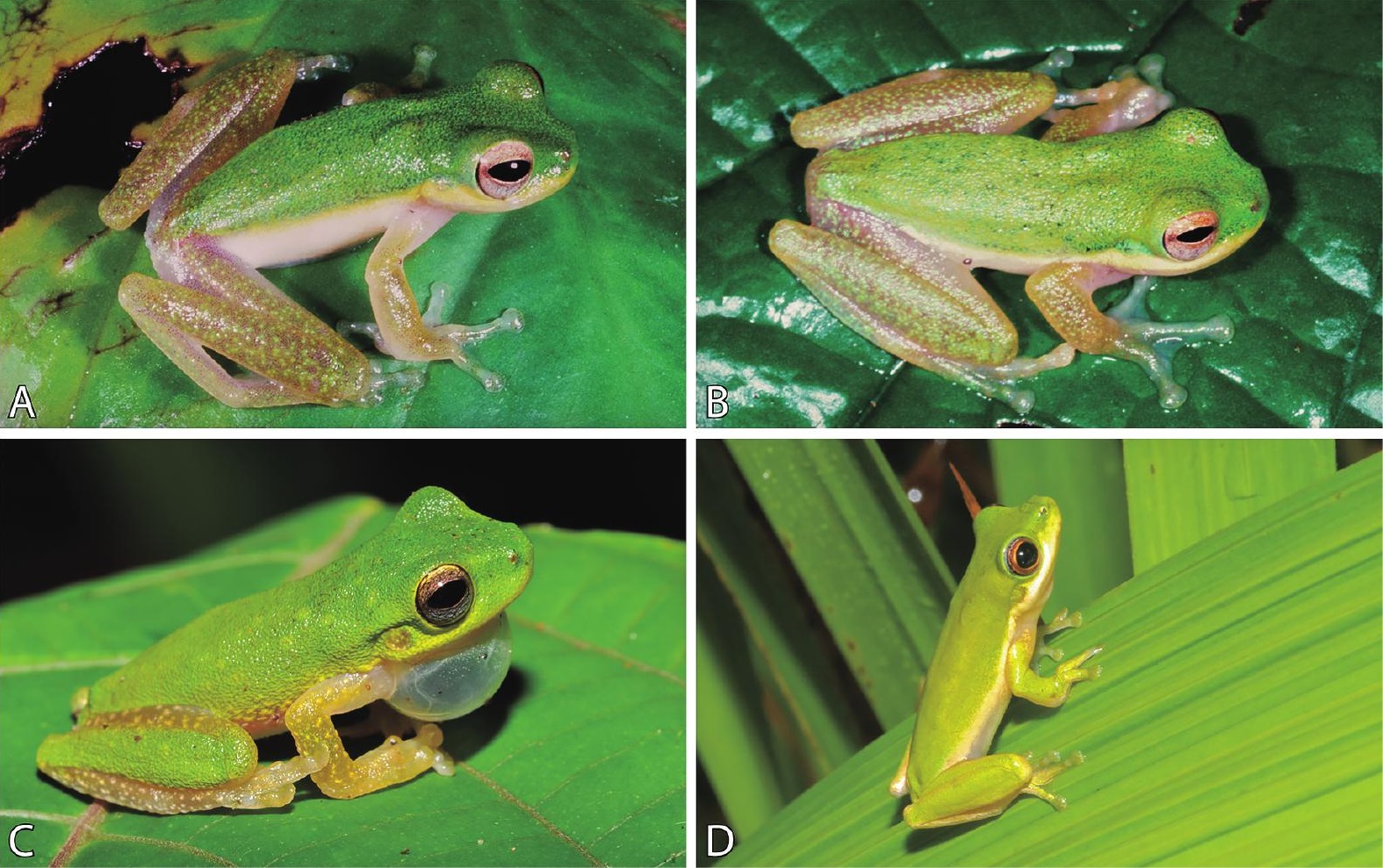
Images in life of: (A) Litoria lakekamu sp. nov. paratype SAMA R70114, (B) Litoria lakekamu sp. nov. paratype PNGNM (FN: 11625),
(C) Litoria leucova SAMA R71844 from the Sepik River catchment, northern Papua New Guinea, (D) Litoria lodesdema SAMA R64772 from New Britain Island, Papua New Guinea.
Photographs by S. Richards.

Litoria lakekamu sp. nov.
(English name: Lakekamu pygmy treefrog)

Diagnosis: The new species is distinguished from all other Litoria by the following unique combination of characters: size very small (SVL of four males 20.0–22.8 mm, females unknown); dorsum in life predominantly green; vomerine teeth absent; tympanum indistinct; finger webbing extensive, reaching distal edge of subarticular tubercle at base of penultimate phalanx on outer edge of Finger 3 and inner edge of Finger 4; finger discs slightly larger than or same size as toe discs; webbing on toes extending nearly to base of all discs except Toe 4 where it reaches midway between subarticular tubercle at base of penultimate phalanx and disc on both sides of digit; dermal fringes on limbs and below vent absent; pigmentation on nictitating membrane restricted to scattered flecks at dorsal margin; advertisement call a series of short (0.017–0.053 s) distinctly pulsed rasping notes repeated at 2.1–6.5 s intervals, followed by a discrete group of rapidly repeated pulses with highly variable inter-pulse intervals.

Etymology: The specific name lakekamu is a noun in apposition referring to the type and only known locality [Lakekamu Basin, Gulf Province, Papua New Guinea] of this species.

Torrential stream habitat of Litoria lakekamu sp. nov. on the Sapoi River near Ivimka Camp, Lakekamu Basin, Gulf Province, Papua New Guinea. Males were calling from vegetation along the stream bank.
Photograph by S. Richards.


Stephen J. Richards and David Bickford. 2023. A New Species of Small Green Treefrog (Pelodryadidae: Litoria) from the Lakekamu Basin in Southern Papua New Guinea. Current Herpetology. 42(1);  43-54. DOI: 10.5358/hsj.42.43

Sunday, March 20, 2022

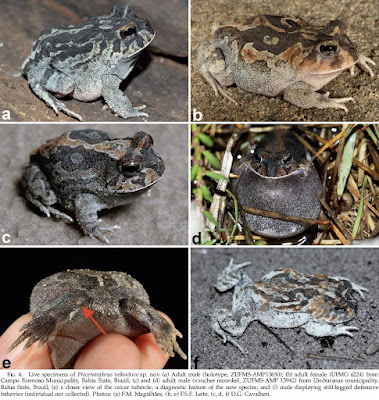
[Herpetology • 2022] Proceratophrys velhochico • A New Species of Proceratophrys (Anura: Odontophrynidae) from Boqueirão da Onça, Northern Bahia State, Brazil


Proceratophrys velhochico

Mângia, de M. Magalhães, Leite, Cavalheri & Garda, 2022

Abstract
The genus Proceratophrys currently comprises 40 species, of which five are distributed within the Caatinga domain and associated phytophysiognomies along northeastern Brazil. During field surveys at high altitudinal sites in Boqueirão da Onça region, northern Bahia state, we collected individuals of Proceratophrys that could not be assigned to any species currently known to occur within the Caatinga, which we describe herein. The new species can be diagnosed from remaining congeners based on vocalization, adult and tadpole morphology, and is also supported by molecular data (mitochondrial 16S, cytochrome b, and nuclear rhodopsin). We recovered the new species nested in the clade composed of species distributed within the Caatinga domain and associated phytophysiognomies, exhibiting a minimum of 7% of genetic divergence for the 16S gene in comparison to all its congeners. The new species seems to be restricted to high altitude locations (above 800 m) at the Boqueirão da Onça region, which represents the largest remaining contiguous Caatinga remnant (∼986,000 ha) being classified as of extreme biological importance.


Proceratophrys velhochico


Sarah Mângia, Felipe de Medeiros Magalhães, Felipe Sá Fortes Leite, Diego Gomiero Cavalheri and Adrian Antonio Garda. 2022. A New Species of Proceratophrys (Anura: Odontophrynidae) from Boqueirão da Onça, Northern Bahia State, Brazil. J. of Herpetology. 56(1); 120-136. DOI: 10.1670/20-070
    

Sunday, February 20, 2022

[Herpetology • 2022] Synapturanus danta • A Needle in A Haystack: Integrative Taxonomy reveals the Existence of A New Small Species of Fossorial Frog (Anura, Microhylidae) from the vast lower Putumayo Basin, Peru


 Synapturanus danta
 Chávez, Thompson, Sánchez, Chávez-Arribasplata & Catenazzi, 2022


Abstract
We describe a new species of microhylid frog of the genus Synapturanus from the lower Putumayo basin in Loreto, Perú. Specimens inhabited the soils of stunted pole forests growing on peat. The new species is distinguished from other species of Synapturanus through morphology, genetics, and acoustic characteristics. This species differs from most nominal congeners by having a head flat in lateral view (vs convex in the rest of species), a characteristic only shared by S. rabus and S. salseri. The new species can be distinguished from S. rabus and S. salseri by a combination of morphological characters and by having an advertisement call with a note length of 0.05–0.06 seconds (vs 0.03 seconds in S. rabus) and a dominant frequency ranging from 1.73 to 1.81 kHz (vs 1.10–1.47 kHz in S. salseri). Principal component analyses of 12 morphological characters and three acoustic variables further support differences between the new species and its described and undescribed congeners.

Key Words: Acoustic, genetic, Loreto, morphology, peatland


Type series of Synapturanus danta sp. nov. in life.
 A, B. Dorsal and ventral view of male CORBIDI 21050 (holotype, SVL=17.9 mm);
C, D. Dorsal and ventral view of male CORBIDI 21051 (SVL=17.6 mm);
E, F. Dorsal and ventral view of male CORBIDI 21013 (SVL=7.5 mm).
 Photographs by Germán Chávez.


 Synapturanus danta sp. nov.

Definition and diagnosis: 
(1) A small-sized Synapturanus (SVL of 17.6–17.9 mm in adult males, females unknown); (2) head dorsally flat in lateral view; (3) eyes small, slightly larger than half the size of the eye-naris distance; (4) fingertips tapering without discs; (5) subarticular tubercles not visible on fingers; (6) thenar tubercle indistinct, palmar tubercle distinct; (7) fingers with preaxial and postaxial fringes (except preaxially on Finger IV), strongly visible on Fingers II and III pre and post axially; (8) toe tips slightly expanded in toes II and III; (9) inner metatarsal tubercle indistinct, outer metatarsal tubercle indistinct; (10) dorsal color pattern chocolate brown without spots or blotches, a stripe along the canthus rostralis and upper eyelid only present in juveniles; (11) throat and ventral surface of limbs cinnamon brown or pinkish brown, chest and belly cyan white; (12) call consisting of a tonal note 0.054–0.063 seconds in length with a slight downward frequency modulation (delta 0–94 Hz) and a dominant frequency at 1.73–1.81 kHz (Table 3).
...

Etymology: The specific epithet is a noun in apposition and refers to the Amazon Tapir (Tapirus terrestris), a large mammal locally known as “Danta”. During our expedition, the first time that local people and other researchers in the team spotted one of these frogs, they called it “Rana Danta”, because its head profile reminded them of the head of the Amazon Tapir.


 Germán Chávez, Michelle E. Thompson, David A. Sánchez, Juan Carlos Chávez-Arribasplata and Alessandro Catenazzi. 2022. A Needle in A Haystack: Integrative Taxonomy reveals the Existence of A New Small Species of Fossorial Frog (Anura, Microhylidae, Synapturanus) from the vast lower Putumayo Basin, Peru. Evolutionary Systematics 6(1): 9-20. DOI: 10.3897/evolsyst.6.80281