Showing posts with label Actiniaria - Sea Anemone. Show all posts

Sunday, December 21, 2025

[Cnidaria • 2025] Endolobactis simoesii (Cnidaria: Actiniaria) • A New Species of Sea Anemone from the Yucatán Peninsula, Mexico


Endolobactis simoesii
 González-Muñoz, Rodríguez, Durán-Fuentes & Acuña, 2025


Abstract
A new genus and species of sea anemone belonging to the family Actiniidae, Endolobactis simoesii gen. et sp. nov., is described. A comprehensive description is provided, including information on its external and internal anatomical features, cnidome, and size ranges and distribution of cnidae, accompanied by images of live specimens and their histological characteristics. The most distinctive feature of E. simoesii gen. et sp. nov. is the frond-like marginal projections located on exclusively endocoelic lobes. This contrasts with other genera in Actiniidae that exhibit similar marginal projections, which are commonly referred to as a “marginal ruff.” In addition, E. simoesii gen. et sp. nov. has more mesenteries proximally than distally. These and other differences between E. simoesii gen. et sp. nov. and other genera within Actiniidae with similar features are discussed in detail. With the inclusion of E. simoesii gen. et sp. nov., the number of documented sea anemone species along the Mexican Atlantic coast increases to 24.
 
Coelenterata, Actiniidae, sea anemone, Endolobactis simoesii


 Endolobactis simoesii gen. et sp. nov.


Ricardo GONZÁLEZ-MUÑOZ, Estefanía RODRÍGUEZ, Jefersón DURÁN-FUENTES and Fabián H. ACUÑA. 2025. Endolobactis simoesii gen. et sp. nov. (Cnidaria: Actiniaria), A New Species of Sea Anemone from the Yucatán Peninsula, Mexico.  Zootaxa. 5722(3); 391-407. DOI: doi.org/10.11646/zootaxa.5722.3.5 [2025-11-20]

Sunday, December 8, 2024

[Mollusca • 2024] Fissidentalium aurae • A New Species of Fissidentalium (Scaphopoda: Dentaliidae) in association with an actinostolid Anemone from the abyssal Labrador Sea


 Fissidentalium aurae
 Linse & Neuhaus, 2024 


Abstract
The benthic biodiversity of the abyssal Labrador Sea was investigated using Agassiz trawl and in situ imagery. A megafaunal scaphopod associated with an epizoic anemone was recovered from soft sediments. Morphological and molecular investigations revealed the scaphopod to be an undescribed species in the dentaliid genus Fissidentalium P. Fischer, 1885. The new scaphopod species is characterised by a large size for the genus, is moderately curved, with numerous narrow, longitudinal ribs (60 ribs at 11 mm diameter ventral aperture), a dentaliid radula, and is described herein as Fissidentalium aurae sp. nov. The new species shows a close genetic relationship to congeners of Fissidentalium and separates from the sister genera Dentalium Linnaeus, 1758 and Antalis H. Adams & A. Adams, 1854. Genetic COI barcoding of the epizoic anemone suggests the species is a member of the family Actinostolidae Carlgren, 1932. The discovered association of a burrowing scaphopod with an epifaunal anemone at abyssal depth is a new record for the region and is indicative of how little is known about symbioses in the deep sea.

Keywords: Species-pair-associations, Ocean seafloor observation system, Abyssal plain, Taxonomy, Lebensspuren


In situ and life images of scaphopod-actinostolid symbiosis;
a Scaphopod (black arrow) hosting anemone with retracted tentacles and its Lebenspur (grey arrows).; b Anemone with extended tentacles (white arrow) and scaphoid created Lebensspur (grey arrow);
c Scaphopod (Paratype 1 SMF 366429) with an epizoic actinostolid anemone

Class Scaphopoda Bronn, 1862
Order Dentaliida Starobogatov, 1974

Family Dentaliidae Children, 1834

Genus Fissidentalium P. Fischer, 1885

Type species: Dentalium ergasticum P. Fischer, 1883: 275–277; 
accepted as Fissidentalium capillosum (Jeffreys, 1877) type by monotypy.

Fissidentalium aurae sp. nov.

Diagnosis: A large-sized, over 60 mm in length and 10 mm in ventral aperture width, Fissidentalium with numerous regular, fine longitudinal ribs. The white shells are robust and no posterior slit on the dorsal aperture was observed in the examined specimens. Most live specimens with shell lengths of 32–63 mm have a sea anemone attached to the concave, anterior surface of the shell. The ventral and dorsal apertures are slightly wider than high. Preserved, unrelaxed soft body dividable into a ventral buccal, a middle gut and a dorsal gonad region (following Shimek and Moreno 1996) and is about 2/3 of total shell lengths. Buccal and gonadal regions are of similar size and each about 3 times longer than the gut region.

Etymology: aura” means breeze in Latin and used in genitive case. This name refers to the windy conditions during SO286 as well as to the shipping company Briese Research operating RV Sonne.

 
Katrin Linse and Jenny Neuhaus. 2024. A New Species of Fissidentalium (Scaphopoda: Dentaliidae) in association with an actinostolid Anemone from the abyssal Labrador Sea. Marine Biodiversity.  54, 88. DOI: doi.org/10.1007/s12526-024-01481-1  


Sunday, October 29, 2023

[Cnidaria • 2023] Bellactis lux • A New Sea Anemone (Anthozoa: Actiniaria: Aiptasiidae) from the Gulf of Mexico


Bellactis lux 
Delgado, Larson, Sheridan & Daly, 2023

 
Abstract
Here we describe a new species of sea anemone from the family Aiptasiidae based on specimens collected from the Gulf of Mexico (USA: Florida & Alabama). Accounts of this species have been known since the early 1990’s, primarily from an underwater field guide and hobbyist aquarium literature under the name “Lightbulb Anemone.” We describe it as a new species from the genus Bellactis based on anatomy, histology, and cnidom. Members of this species are small in size, with a smooth, typically contracted column divided into regions based on color and bearing rows of two or three elevated cinclides in the mid column. Their tentacles are distinctive, translucent, distally inflated and can be bulbous in shape, with sub annular rings. This description synthesizes information about Bellactis and contextualizes what is known about its diversity in light of other members of the Aiptasiidae.

Keywords: Coelenterata, Cnidaria, Anthozoa, Actiniaria, Aiptasiidae 


 Bellactis lux n. sp. 


Alonso Delgado, Paul Larson, Nancy Sheridan and Marymegan Daly. 2023. Bellactis lux n. sp. (Cnidaria: Anthozoa: Actiniaria: Aiptasiidae), A New Sea Anemone from the Gulf of Mexico.  Zootaxa. 5353(4); 379-392. DOI: 10.11646/zootaxa.5353.4.5


Tuesday, August 29, 2023

[Cnidaria • 2023] Macrodactyla fautinae • Taxonomy and Molecular Phylogeny of the Sea Anemone Macrodactyla (Haddon, 1898) (Hexacorallia: Actiniaria), with A Description of A New Species from Singapore


Macrodactyla fautinae Yap, Mitchell, Quek & Huang, 

in Yap, Mitchell, Quek, Tan, Tan et Huang, 2023.

Sea anemones (Cnidaria, Actiniaria) are a successful group of marine invertebrates found in a diverse range of environments globally. In spite of their ubiquity, identities for many sea anemones remain unverified, especially those from the Indo-West Pacific region. Here, we clarify the taxonomy of the poorly known Macrodactyla aspera, a shallow-water species first described from the Torres Straits in northern Australia. We re-describe M. aspera based on new morphological and molecular data gathered from the type specimen, other museum vouchers, and from fresh material collected from Singapore. We tested the monophyly of Macrodactyla using three mitochondrial (12S, 16S and cox3) and one nuclear (28S) marker based on three congeners, recovering this genus to be polyphyletic. As a consequence, we transferred M. doreensis to the genus Heteractis, and describe a new species, Macrodactyla fautinae sp. nov. While both M. aspera and M. fautinae sp. nov. share the same arrangement and number of complete mesenteries, a similar distribution of cnidae, and are not symbiotically associated with any other biota, M. fautinae sp. nov. has perforated, lobe-like verrucae on its column, and lacks nematocyst batteries on its tentacles, unlike M. aspera. These two species also occur in similar habitats in Singapore. Finally, because M. aspera strongly resembles Dofleinia armata, the latter species flagged as a danger to public health due to its ability to inflict painful stings, we tested the relationship between these species and found them not to be closely related. However, tentacles of M. aspera, like D. armata, are densely covered with nematocyst batteries and harbour large nematocysts; we infer that M. aspera may also be capable of delivering stings that endanger public health. This study builds upon a growing number of studies that aim to ascertain identities and systematics of sea anemones historically reported from the Indo-West Pacific. Our findings will facilitate accurate species identification, which is crucial for advancing research, formulating conservation measures, and protecting public health.

Key words: Actinioidea, Anthozoa, Intertidal, Integrative taxonomy, Southeast Asia.
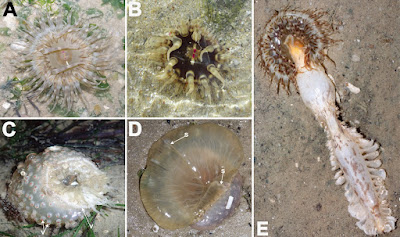

Living individuals of Macrodactyla fautinae sp. nov., external morphology, in situ, top view.
A, an expanded individual with a pale oral disc. B, another expanded colour morph with a dark-brown oral disc. Note that in both A and B, a pair of diametric bright pink dots marks the position of the siphonoglyphs. C, a contracted individual with adhesive, papillae-like verrucae at its distal end. Note that shell fragments are attached to the verrucae. D, an individual with much of its actinopharynx everted, obscuring the animal.
 E, a sea pen (Pteroeides sp.) being swallowed whole by a M. fautinae sp. nov. individual.
Abbreviation: s, siphonoglyph; v, verrucae. Photographs by R Tan.


Macrodactyla fautinae, sp. nov. Yap, Mitchell, Quek, and Huang

Natural history: Occurs as solitary individuals, at the middle intertidal in soft silty, sandy areas, and also found in seagrass meadows (Fig. 8A– E). Animal partially buried in substratum, distal end of animal exposed during the low tides, with small shell pieces, sand and/or rocks adhering to verrucae (Fig. 8C). Oral disc and tentacles typically expanded, with actinopharynx often everted and inflated outwards, in many instances obscuring the animal (Fig. 8D). This species has also been observed to swallow its prey whole (Fig. 8E). When disturbed, animal does not retract completely, tips of tentacles remaining partially exposed (Fig. 8C). In the process of contraction, water may also be expelled from verrucae-like structures, akin to a watering can.

Etymology: The name Macrodactyla fautinae sp. nov. honours the late Emeritus Professor Daphne Gail Fautin. Throughout her career, she had worked tirelessly to advance the knowledge of sea anemones.  
 

CONCLUSIONS: 
In this study, morphological and molecular evidence were integrated to re-diagnose the genus Macrodactyla and redescribe M. aspera. Furthermore, we provided historical, nomenclatural evidence to support the continued usage of the genus name. Since its first description by Haddon and Shackleton (1893), there have been very few published accounts of M. aspera, despite its wide geographical range across the Indo-West Pacific. The reason for this, we suspect, is that this species may have been misidentified as D. armata, due to its strong superficial resemblance. Museum vouchers we have examined support this assertion; some were indeed misidentified as D. armata. Herein, we provided molecular evidence to demonstrate that these two species are distantly related. 
Findings from this study add to a growing number of sea anemone species recorded from Singapore. Previous studies have already documented 37 species to occur on the shores and islands of this city-state (e.g., England 1987; Fautin et al. 2009; Yap et al. 2021). Affirming the identities of these sea anemones primes new avenues where more Indo-West Pacific species may be included in future research.


Nicholas Wei Liang Yap, Michela Lee Mitchell, Zheng Bin Randolph Quek, Ria Tan, Koh Siang Tan and Danwei Huang. 2023. Taxonomy and Molecular Phylogeny of the Sea Anemone Macrodactyla (Haddon, 1898) (Cnidaria, Actiniaria), with a Description of A New Species from Singapore. Zool Stud. 62:29. DOI:10.6620/ZS.2023.62-29 

Saturday, April 22, 2023

[Cnidaria • 2023] Telmatactis profundigiganticaGigantic Anemone Species in the Deep ‘Churaumi’—Description of A New Species of the Genus Telmatactis (Anthozoa: Actiniaria: Metridioidea) from the deep sea off Okinawa Island, Japan


 Telmatactis profundigigantica  
Izumi & Higashiji, 2023 
many shrimps of Plesionika sp. 
are observed around the anemones (arrows).
 
Abstract
Although the members of the genus Telmatactis Gravier, 1916 have been reported from broad area of the world including Japanese waters, the localities of the species have been limited to shallow areas. In this study, we report a new species in this genus, Telmatactis profundigigantica sp. nov., collected from the deeper area than 200 m of the East China Sea off Okinawa Island, discovered by ROV, and taken care of in Okinawa Churaumi Aquarium. This new species is chiefly characterized by its comparatively huge size of its body, over 10 cm in diameter and height, far larger than the other known species of this genus. Moreover, this species has characteristic multiple-headed tentacles and large cnidae in its acrospheres. In the present article, we also discuss the severe toxicity of this species and touch on the ecology of deep-sea anemones.

Keywords: sea anemone, Andvakiidae, Okinawa Churaumi Aquarium, deep sea, capitate, multiple-headed, hemolytic toxin, sting, taxonomy

External morphology of the holotype (NSMT-Co 1820) of  Telmatactis profundigigantica sp. nov. 
 A, Living polyp of T. profundigigantica sp. nov.; B, oral view of the specimen; C, aboral view (basal disc is damaged); D, enlarged view of a double-headed tentacle.
Bold scale bars indicate 5 cm and a narrow bar 1 cm. 
Abbreviations: Acr, acrosphere; Bd, basal disc; Mo, mouth; Te, tentacle.


Living images of Telmatactis profundigigantica sp. nov. in situ.
 A, A polyp adhering to a rock; B, a polyp buried in sponge. In both pictures, many shrimps of Plesionika sp. are observed around the anemones (arrows).
Dates and Localities: A, [polyp no. 1], 19 September 2017, northeast off Ie island, Okinawa Pref.; B, [polyp no. 2], 7 January 2019, off Motobu-cho Town, Okinawa Island.

Taxonomy
Order Actiniaria Hertwig, 1882
Suborder Enthemonae Rodríguez and Daly in Rodríguez et al., 2014

Superfamily Metridioidea Carlgren, 1893
Family Andvakiidae Danielssen, 1890

Genus Telmatactis Gravier, 1916
[Japanese common name: Mamire-isoginchaku-zoku]

Telmatactis profundigigantica sp. nov.
 
Taxonomic remarks. The morphological features of this anemone are corresponded to the latest diagnosis of Telmatactis in den Hartog (1995) as below: body wall without any structures; clavate 96 tentacles; mesogleal sphincter; two siphonoglyphs on actinopharynx; and presence of acontia. In this genus, Telmatactis profundigigantica sp. nov. is characterized by three characters: (1) enormously large body sizes (Fig. 2A–C); (2) numerous tentacles (Fig. 2A) with some peculiar multiple-headed ones (Fig. 2D); and (3) large tentacle basitrichs (Fig. 3C). As mentioned below, Telmatactis is distributed across a broad area of the world, and thus in this study we have mainly compared with the species of Telmatactis living in the western Pacific.
...


Etymology. This new species is characterized by its comparatively far larger size and its deep-sea habitat. Thus, the species epithet is an adjective, composed of “profund-” (Latin profundus = deep) + “gigantica” [latinized Ancient Greek giganticus (gigantikos) = huge].

 Japanese name: Ryugu-no-goten  
Derivation of Japanese name. Ryugu (= castle under the deep sea) + no (= of) + goten (= palace). Associated the reddish color to the palaces of Okinawa covered with red roof tiles.
  

Takato Izumi and Takuo Higashiji. 2023. Gigantic Anemone Species in the Deep ‘Churaumi’—Description of A New Species of the Genus Telmatactis (Cnidaria: Anthozoa: Actiniaria: Metridioidea), Telmatactis profundigigantica sp. nov. Species Diversity. 28(1); 99-106. DOI  10.12782/specdiv.28.99

Sunday, July 31, 2022

[Cnidaria • 2022] Stylobates calcifer • Carcinoecium-Forming Sea Anemone (Actiniaria, Actiniidae) from the Japanese Deep-Sea Floor: A Taxonomical Description with Its Ecological Observations


 Stylobates calcifer sp. nov. with host hermit crab Pagurodofleinia doederleini.

 Stylobates calcifer  Yoshikawa & Izumi, 
in Yoshikawa, Izumi, Moritaki, Kimura & Yanagi, 2022.
ヒメキンカライソギンチャク  ||  DOI: 10.1086/719160 

 
Abstract
Here we describe Stylobates calcifer sp. nov. (Cnidaria, Actiniaria, Actiniidae), a new carcinoecium-forming sea anemone from the deep-sea floor of Japan. Stylobates produces a carcinoecium that thinly covers the snail shells inhabited by host hermit crabs Pagurodofleinia doederleini. The new species is distinct from other species by the shape of the marginal sphincter muscle, the distribution of cnidae, the direction of the oral disk, and host association. The species’ novelty is supported by the data of its mitochondrial genes 12S, 16S, and COIII and nuclear genes 18S and 28S. Also, we conducted behavioral observation of this new species, focusing on the feeding behavior and interaction with the specific host hermit crab. Our observations suggest that this sea anemone potentially feeds on the suspended particulate organic matter from the water column or the food residuals of hermit crabs. When the host’s shell changed, intensive manipulation for transference of S. calcifer sp. nov. was recorded. However, although the hermit crab detached and transferred the sea anemone to the new shell after shell change, the sea anemone did not exhibit active or cooperative participation. Our data suggest that the sea anemone may not produce a carcinoecium synchronously to its host’s growth, contrary to the anecdotal assumption about carcinoecium-forming sea anemones. Conversely, the host hermit crab’s growth may not depend entirely on the carcinoecium produced by the sea anemone. This study is perhaps the first observation of the behavioral interaction of the rarely studied carcinoecium-forming mutualism in the deep sea.


Order ACTINIARIA
Suborder ENTHEMONAE

Superfamily ACTINIOIDEA Rafinesque, 1815
Family ACTINIIDAE Rafinesque, 1815

Genus Stylobates Dall, 1903


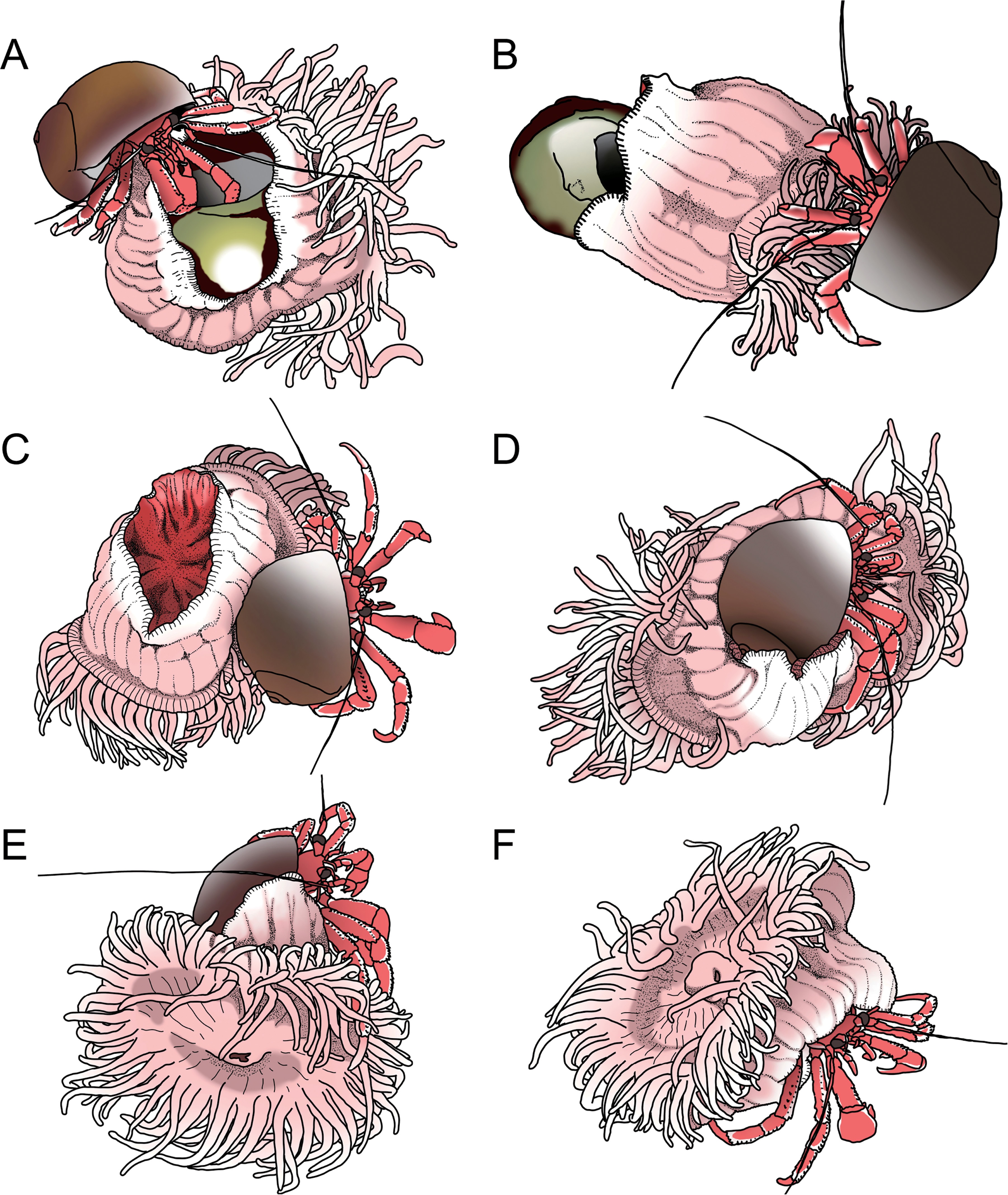
 External morphology of Stylobates calcifer sp. nov. (holotype: NSMT-Co 1794) with host hermit crab Pagurodofleinia doederleini.
The upper (A) and posterior (B) views and the marginal views of the right and left sides (C, D, respectively) of the living specimen.
The upper and marginal views (E, F, respectively) of the preserved specimen.
Scale bars = 5 mm.

Stylobates calcifer sp. nov. Yoshikawa and Izumi
[Japanese name: Hime-kin-kara-isoginchaku
ヒメキンカライソギンチャク]


  Behavioral sequence of the hermit crab Pagurodofleinia doederleini transferring the sea anemone  Stylobates calcifer sp. nov. from the original snail Glossaulax reiniana shell to a new one.
(A) The hermit crab begins tapping the pedal disk and column of the sea anemone with its walking legs and chelipeds. (B) The hermit crab uses one or both of its chelipeds to pinch and remove S. calcifer sp. nov. from the G. reiniana shell. (C) Stylobates calcifer sp. nov. displays no shell-mounting action after being removed from the original shell. (D) The sea anemone is turned to the upside-down position (facing up the pedal disk) by the crab. (C) The hermit crab rides on the pedal disk of the sea anemone and fits the shell to the curved line of the pedal disk. (E) The sea anemone settles down in a new shell of the host hermit crab with a usual position.

Ecological note: Stylobates calcifer sp. nov. was exclusively found on the shells inhabited by Pagurodofleinia doederleini, consistent with previous studies (Uchida and Soyama, 2001; Yanagi, 2006; Yoshikawa et al., 2019). However, P. doederleini without S. calcifer sp. nov. was sometimes collected in this study. One individual was usually attached to one host hermit crab, consistent with previous studies (Uchida and Soyama, 2001; Yanagi, 2006; Yoshikawa et al., 2019).

Distribution and habitat: All of the samples were collected from the Sea of Kumano (Uchida and Soyama, 2001; Yoshikawa et al., 2019) and Suruga Bay. All of the previous records were from the Pacific Ocean facing the middle of Honshu Island to Kyushu (Uchida and Soyama, 2001; Yanagi, 2006). The specimens were distributed at 100–400 m from the fine sand and soft mud (Fig. 1; Table 1).


Etymology: The specific name “calcifer” is driven from the name of a resident fire-demon Calcifer, which appeared in Howl’s Moving Castle, a fantasy novel by British author Diana Wynne Jones, published in 1986; the story is the original version of the Japanese animated film of the same name, directed by Hayao Miyazaki (animated by Studio Ghibli). The shell-making ability of the new species in the species-specific relationship appears as if Calcifer was in a magical contract with the Wizard Howl, constructing his Moving Castle.


Akihiro Yoshikawa, Takato Izumi, Takeya Moritaki, Taeko Kimura and Kensuke Yanagi. 2022. Carcinoecium-Forming Sea Anemone Stylobates calcifer sp. nov. (Cnidaria, Actiniaria, Actiniidae) from the Japanese Deep-Sea Floor: A Taxonomical Description with Its Ecological Observations. The Biological Bulletin. 242;  DOI: 10.1086/719160 [2 April 2022]
 Researchgate.net/publication/360192582_Stylobates_calcifer_sp_nov__from_the_Japanese_Deep-Sea_Floor

第65回 瀬戸海洋生物学セミナー
「ヤドカリの“宿”を作るヒメキンカライソギンチャクの分類・共生生態と進化学的研究への展望」
吉川 晟弘 特任研究員(東京大学 大気海洋研究所附属国際・地域連携研究センター) 


Monday, April 18, 2022

[Crustacea • 2022] Actinimenes koyas • A New Species of the Genus Actinimenes Ďuriš & Horká, 2017 (Decapoda: Palaemonidae) from the Arabian Sea, Lakshadweep Islands, India


 Actinimenes koyas 
Paramasivam, Dhinakaran, Kumar & Lal, 2022


Abstract
A new species, Actinimenes koyas sp. nov. (Decapoda: Palaemonidae) was collected at a depth of 1.0-2.0 m from the coral atoll of Agatti Island, Lakshadweep, Arabian Sea. The species was associated with the sea anemone, Heteractis magnifica (Quoy and Gaimard, 1833). It is the second representative of the genus Actinimenes Ďuriš and Horká, 2017 described from the Arabian Sea. Actinimenes koyas sp. nov. is closely related to A. ornatellus in terms of morphological traits. Actinimenes koyas sp. nov. is distinguished from Actinimenes ornatellus (Bruce, 1979) by the presence of a biramous outer antennular flagellum with three proximal segments fused, a shorter free ramus consisting of 7 to 8 segments with 12-14 groups of aesthetascs, a fourth thoracic sternite with V-shaped median incision and features of the telson and third maxilliped. The present new species is easily distinguished from the other three described species in the genus Actinimenes by the structural variation in the fourth sternal plate with a median notch. Additionally, a phylogenetic analysis inferred by Maximum Likelihood using the mitochondrial genes COI and 16S rRNA shows a close relationship of Actinimenes koyas sp. nov. with Actinimenes inornatus (Kemp, 1922). Pairwise genetic distances estimated using the COI and 16S data provided divergences between A. koyas sp. nov. and other congeneric species.

Keywords: Actinimenes koyas sp. nov.; anemone associated fauna; Arabian Sea; Lakshadweep; morphology; phylogenetic tree

SYSTEMATICS
Order Decapoda Latreille, 1802
Infraorder Caridea Dana, 1852

Superfamily Palaemonoidea Rafinesque, 1815
Family Palaemonidae Rafinesque, 1815

Genus Actinimenes Ďuriš and Horká, 2017

 Actinimenes koyas sp. nov. from Agatti island, India.
(a) Holotype: ovigerous female (CL 3.5 mm, NBFGR/PALAKOY─01);
(b) paratype, male (CL 3.2 mm, NBFGR: DBTLDA62, Ethanol preserved).

Collection site, assemblages of Heteractis magnifica at Agatti Island, Lakshadweep, India
with live coloration of Actinimenes koyas sp. nov. (Depth 1-2 m).

Actinimenes koyas sp. nov.

Etymology. Koyas are an important ethnic community of Lakshadweep. Koyas have made a significant contribution to the development and preservation of the heritage of the society at Lakshadweep. The present species is named “Koyas” to honor the local community at Lakshadweep.
 
Map showing (a-d) location of Agatti Island, Lakshadweep, India, the type locality of  Actinimenes koyas sp. nov.

CONCLUSION: 
A new symbiotic species from the palaemonid shrimp genus Actinimenes is described and illustrated from Lakshadweep, India. Actinimenes koyas sp. nov. was obtained from the magnificent sea anemone Heteractis magnifica (Actiniaria). Sea anemone-associated species of the genus Actinimenes are widely distributed in the tropical regions of the Indo-West Pacific, and A. koyas sp. nov. is reported for the first time from the Arabian Sea. Additionally, molecular information from mitochondrial markers (COI and 16S) are provided and the ML tree suggests that A. koyas sp. nov. is sister to a clade of A. inornatus.


Purushothaman Paramasivam, A. Dhinakaran, T. T. Ajith Kumar and Kuldeep K. Lal. 2022. A New Species of the Genus Actinimenes Ďuriš and Horká, 2017 (Crustacea: Decapoda: Palaemonidae) from the Arabian Sea, Lakshadweep Islands, India.  Nauplius. 30. DOI: 10.1590/2358-2936e2022008  


Thursday, February 28, 2019

[Cnidaria • 2019] First Inventory of Sea Anemones (Actiniaria) from La Paz Bay, southern Gulf of California (Mexico)


Anthopleura dowii Verrill, 1869

Barragán, Sánchez & Rodríguez, 2019.

Abstract
Sea anemones from the Mexican Pacific are poorly known. We report and redescribe eight species of sea anemones from La Paz Bay in the southern Gulf of California, Mexico. As a result of this inventory, we validate records for 30 species from the Mexican Pacific, 23 of them from the Gulf of California and 15 of those present in La Paz Bay. We provide taxonomic diagnoses, images of internal and external anatomy, size ranges and types of cnidae, and geographic and bathymetric distribution, and discuss the taxonomic diagnostic characters for each species. This study is the first illustrated inventory of sea anemones from La Paz Bay.

Keywords: Coelenterata, Anthozoa, Hexacorallia, Taxonomy, Mexican Pacific Ocean


Anthopleura dowii Verrill, 1869


Yamaly Barragán, Carlos Sánchez and Estefanía Rodríguez. 2019. First Inventory of Sea Anemones (Cnidaria: Actiniaria) from La Paz Bay, southern Gulf of California (Mexico). Zootaxa. 4559(3); 501–549.  DOI:  10.11646/zootaxa.4559.3.4