Showing posts with label Congo. Show all posts

Monday, November 27, 2023

[Ichthyology • 2023] Brachyalestes jackiae • Phylogenomics and Morphology of the African Fish Genus Brycinus with Revalidation of Brachyalestes (Characiformes: Alestidae) and Description of A New Species from the Congo Basin


Brachyalestes jackiae 
 Stiassny, Keane, Mbimbi & Melo, 2023


A time-calibrated phylogeny, based on nuclear ultraconserved elements and including representatives of all major alestid lineages, strongly supports two distantly related clades within the currently accepted concept of Brycinus. The first, which includes the type species of the genus, B. macrolepidotus (herein Brycinus), and a second, composed of taxa previously referred to as the B. nurse group (herein Brachyalestes), are both resolved as monophyletic. These results provide strong evidence for the restriction of the genus Brycinus to nine species, and for the revalidation of the genus Brachyalestes to accommodate 20 valid species. Within Brachyalestes, a new species from the Lulua River basin, initially misidentified as Brycinus kingsleyae, is described and resolved as sister to the widespread, central Congolese lowland species, Brachyalestes bimaculatus. Within Brachyalestes, a subclade mostly restricted to the Central Congo basin is estimated to have undergone diversification within the last 10 million years, suggesting that Late Neogene riverine reorganization likely influenced their allopatric speciation. The split of the new species, endemic to high elevation tributaries of the Lulua River, from its lowland sister species, Brachyalestes bimaculatus, suggests a Late Miocene/Early Pliocene colonization into the upland river ecosystems of the Katanga plateau in the southwestern Democratic Republic of Congo.


Brachyalestes jackiae 


Melanie L. J. Stiassny; Cooper Keane; José J. M. M. Mbimbi and Bruno F. Melo. 2023. Phylogenomics and Morphology of the African Fish Genus Brycinus with Revalidation of Brachyalestes and Description of A New Species from the Congo Basin (Teleostei: Alestidae). Ichthyology & Herpetology. 111(4); 597–611. DOI: 10.1643/i2023033 

Wednesday, August 2, 2023

[Ichthyology • 2023] Chiloglanis fortuitus & C. frodobagginsi • Two New Species of Suckermouth Catfishes (Siluriformes: Mochokidae) from Upper Guinean Forest Streams in West Africa


Chiloglanis frodobagginsi Schmidt, Friel, Bart & Pezold,

Schmidt, Bragança, Friel, Pezold, Tweddle & Bart, 2023.
Photographs by S. Raredon.

Abstract
Suckermouth catfishes of the genus Chiloglanis are found throughout tropical Africa. Recent studies highlighted the diversity within this genus remains incompletely documented and nearly 20 new species have been described in the past ten years. Here we describe two new species of Chiloglanis from streams in the Upper Guinean Forest. Chiloglanis fortuitus, new species, is only known from one specimen collected in the St. John River drainage in Liberia and is readily distinguished from other species of Chiloglanis by the number of mandibular teeth and the length of the barbels associated with the oral disc. Chiloglanis frodobagginsi, new species, from the upper Niger River was previously considered to be a disjunct population of C. micropogon. A combination of several characters diagnoses C. frodobagginsi, new species, from topotypic C. micropogon in the Lualaba River (Congo River basin) and from Central African populations of Chiloglanis cf. micropogon in the Benue, Ndian, and Cross River drainages. The biogeographical implications of the recognition of C. frodobagginsi, new species, the likelihood of finding additional diversity in the streams of the Upper Guinean Forests, and the taxonomy of C. micropogon and C. batesii are also discussed.

Dorsal, lateral, and ventral views of the holotype of Chiloglanis fortuitus, SAIAB 202292, 35.0 mm SL, Liberia, St. John River drainage, Nimba County, Dayea River, above Yekepa, 7.579333°N, 8.516889°W. Scale bar equals 2 mm.
 Photographs by P. H. N. Bragança.

Chiloglanis fortuitusSchmidt, Bragança, and Tweddle, new species

Diagnosis.—Chiloglanis fortuitus is distinguished from all known species of Chiloglanis, including all species in the Upper Guinean Forest, except C. disneyi, C. microps, C. niger, and C. orthodontus, in having 18 mandibular teeth in the functional row (vs. 6–15 teeth; Table 1). Chiloglanis fortuitus is easily distinguished from C. disneyi, C. microps, and C. niger in having longer mandibular barbels whereas these are absent or reduced in the latter species. Chiloglanis fortuitus is distinguished from C. orthodontus in having a more robust oral disc and its length equal to its width versus length much shorter than width (Friel and Vigliotta, 2011). Chiloglanis fortuitus is further distinguished from C. orthodontus in having a longer dorsal spine (12.8 versus 4.1–7.8 % SL) and shorter maxillary barbels (7.2 versus 9.4–14.8 % SL).

Etymology.—The specific epithet is “fortuitus,” referring to the fortuitous aspect of collecting this one specimen at the type locality. The collector, D. Tweddle, sampled fishes at 36 localities in the upper St. John River drainage in Liberia and collected 69 specimens of Chiloglanis at ten of these localities. Additionally, the lot that contained C. fortuitus was one of the three lots borrowed by the lead author to aid with the description of C. tweddlei (Schmidt et al., 2017). The discovery and formal description of C. fortuitus is fortuitous in several aspects.


Dorsal, lateral, and ventral views of Chiloglanis frodobagginsi holotype, TU 203552, 24.1 mm SL, Guinea, Niger River drainage, Niger River, North of Faranah, on road N29, 10.28382°N, 10.76925°W. Scale bar equals 2 mm.
Photographs by S. Raredon.

Chiloglanis frodobagginsi, Schmidt, Friel, Bart, and Pezold, new species

Diagnosis.—Chiloglanis frodobagginsi is distinguished from all known species of Chiloglanis in the Upper Guinean Forests, and most of the other described species (except C. disneyi, C. harbinger, C. marlieri, C. micropogon, C. microps, C. mongoensis, and C. niger) by the very reduced, or absent, mandibular barbels on the oral disc. Chiloglanis frodobagginsi can be distinguished from C. disneyi, C. harbinger, C. marlieri, C. microps, C. mongoensis, and C. niger in having fewer mandibular teeth in one row (10–12 versus 16–20, 26–30, 26–28, 16–18, 28, and 16–20 respectively). Chiloglanis frodobagginsi is distinguished from C. batesii in having two prominent papillae on the roof of the oral cavity; versus the absence of papillae in C. batesii. This species is further distinguished from C. batesii in having shorter and more blunt mandibular teeth arranged in bunched rows; versus sharper, more elongate, and disordered mandibular teeth. Chiloglanis frodobagginsi also has a fleshy unpapillated ridge posterior to the mandibular teeth versus several large papillae in C. batesii (Friel and Vigliotta, 2011).

A unique combination of characters distinguishes C. frodobagginsi from the closely related C. micropogon and C. cf. micropogon from Central Africa. As compared to C. micropogon from the Lualaba River, C. frodobagginsi has a larger eye diameter (4.2–6.5 versus 4.7–5.5 % SL; Supplemental Fig. A; see Data Accessibility), longer maxillary barbels (3.8–7.2 versus 3.4–6.5 % SL; Supplemental Fig. A; see Data Accessibility), a narrower mandibular tooth row (1.6–2.8 versus 2.4–3.1 % SL; Supplemental Fig. A; see Data Accessibility), a longer distance between dorsal fin and adipose fin (14.4–21.5 versus 14.9–18.8 % SL; Fig. 4A), and a shorter anal-fin base length (8.0–10.8 versus 9.7–12.7 % SL; Supplemental Fig. A; see Data Accessibility). Chiloglanis frodobagginsi is further distinguished from C. micropogon in having fewer premaxillary teeth (36–70 versus 62–103) scattered in three rows versus four (Fig. 4B; Table 2). While the ranges of these measurements and counts overlap, these distinctions hold true when comparing similar sized species (Fig. 4; Supplemental Fig. A; see Data Accessibility). Compared to Chiloglanis cf. micropogon from the Benue, Ndian, and Cross River basins Chiloglanis frodobagginsi has a narrower occipital shield (3.0–4.0 versus 4.0–5.4 % SL), a shorter dorsal fin to adipose fin distance (14.5–21.5 versus 19.3–24.2), and a narrower mandibular tooth row (1.6–2.8 versus 1.8–3.2 % SL).

Etymology.—Chiloglanis frodobagginsi is named after another diminutive traveler, Frodo Baggins, a fictional character well known from J. R. R. Tolkien's The Lord of the Rings series. Roughly 3,000 miles (4,800 km) separate C. frodobagginsi in the upper Niger River drainage and C. micropogon, the sister species, found in the Congo River basin. Another seemingly closely related species, Chiloglanis cf. micropogon, is found in the southern Benue drainage and in several small coastal rivers about 3,000 km from the upper Niger River drainage (e.g., Cross and Ndian Rivers). It is unclear whether these species are descended from a more widespread species, or the result of dispersal from the Congo River basin into the Niger River drainage, via the Benue River, and then up to the headwaters of the Niger River. This was an incredible journey for such a small and seemingly non-vagile fish.


Ray C. Schmidt, Pedro H. N. Bragança, John P. Friel, Frank Pezold, Denis Tweddle and Henry L. Bart Jr. 2023. Two New Species of Suckermouth Catfishes (Mochokidae: Chiloglanis) from Upper Guinean Forest Streams in West Africa. Ichthyology & Herpetology. 111(3); 376-389. DOI: 10.1643/i2022067

Wednesday, May 17, 2023

[Ichthyology • 2023] Parauchenoglanis zebratus • A New Species of Parauchenoglanis (Siluriformes: Auchenoglanididae) from the Upper Lualaba River (Upper Congo), with further evidence of Hidden Species Diversity within the Genus


Parauchenoglanis zebratus
 Sithole, Musschoot, Huyghe, Chakona & Vreven, 2023


 Abstract

Parauchenoglanis zebratus sp. nov. is a new species endemic to the Upper Lualaba in the Upper Congo Basin. It is distinguished from all its congeners known from the Congo Basin and adjacent basins by the presence of (1) distinctive dark-brown or black vertical bars on the lateral side of the body, at least for specimens about ≥120 mm LS, (2) a broad and triangular humeral process embedded under the skin and (3) a well-serrated pectoral-fin spine. Genetic analysis based on mtDNA COI sequences confirmed the genetic distinctiveness (2.8%–13.6% K2P genetic divergence) of P. zebratus sp. nov. from congeners within the Congo and adjacent river basins. The study also revealed additional undocumented diversity within P. ngamensis, P. pantherinus, P. punctatus and P. balayi, indicating the need for further in-depth alpha-taxonomic attention to provide more accurate species delimitations for this genus. The discovery of yet another new species endemic to the Upper Lualaba, and this well outside the currently established protected areas, highlights the critical need for further assessments to accurately document the species diversity to guide freshwater conservation prioritisation and biodiversity management in this region.


Parauchenoglanis zebratus sp. nov. 


Yonela Sithole, Tobias Musschoot, Charlotte E. T. Huyghe, Albert Chakona and Emmanuel J. W. M. N. Vreven. 2023. A New Species of Parauchenoglanis (Auchenoglanididae: Siluriformes) from the Upper Lualaba River (Upper Congo), with further evidence of Hidden Species Diversity within the Genus. Journal of Fish Biology. DOI: 10.1111/jfb.15309

Tuesday, October 18, 2022

[Botany • 2021] Cyrtorchis okuensis (Orchidaceae: Angraecinae) • Taxonomic Description and Pollination Ecology A New Species Endemic to the Cameroon Volcanic Line


Cyrtorchis okuensis Droissart, Azandi & M.Simo, 
  
in Azandi, Stévart, Sonké, ... et Droissart, 2021.

Abstract
Background and aims – A recent taxonomic and molecular study of the genus Cyrtorchis revealed three new species. Here, we describe one of these new species, endemic to the Cameroon Volcanic Line (CVL), and compare it to its closest relatives. Its conservation status is provided along with detailed information on its ecology and reproductive biology.
Material and methods – A detailed examination of 21 herbarium specimens was performed using standard practices of herbarium taxonomy. The conservation status of the new species was assessed using the IUCN Red List Categories and Criteria. Furthermore, we investigated the reproductive biology of the new species in an easily accessible subpopulation in Cameroon and tested the hypothesis of hawkmoth pollination in the genus Cyrtorchis.
Key results – The newly discovered species, here named C. okuensis, is restricted to the montane forest (1600 to 2500 m elevation) of the CVL and is currently assessed as Near Threatened (NT). Among angraecoid orchids in which hawkmoth pollination is recorded (~16 species), C. okuensis has the shortest nectar spur (19–40 mm). In situ observations revealed hawkmoths with short proboscis of the genus Hippotion (H. celerio, H. eson, and H. osiris) as the main pollinators. The rate of pollination and fruiting under natural conditions was low and among the 448 surveyed flowers only 38.8% (174/448 flowers) had their pollinia removed, 19% produced fruits (87/448 flowers), and 16% (70/448 flowers) set mature fruits.
Conclusion – Cyrtorchis okuensis is clearly differentiated from C. submontana by its longer and wider floral bracts, longer anther caps, and wider triangular dorsal sepal.
  
Keywords: angraecoid orchids, epiphyte, hawkmoth, IUCN Red List Categories and Criteria, pollination, systematics


Cyrtorchis okuensis Droissart, Azandi & M.Simo (Azandi 26).
 A. Habit and inflorescence. B. Flower, frontal. C. Flower, side view. D. Fruit (cultivated plant Y 6377 BA, fruit ID 499). E. Labellum with spur frontal. F. Dorsal sepal. G. Lateral sepal. H. Petal. I. Anther cap, side view. J. Anther cap, frontal. K. Viscidium with stipites frontal (Droissart et al. (Ombrière de Yaoundé) 5109). L. Column, frontal. M. Column, side view. N. Ovary section. O. Pollinia.
 Drawing by Tania D’haijère.

Cyrtorchis okuensis Droissart, Azandi & M.Simo
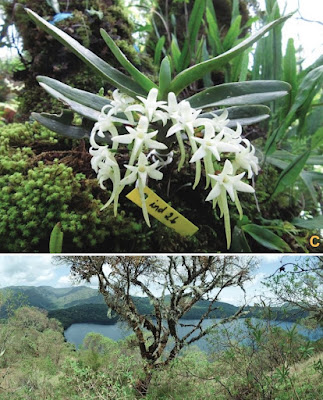
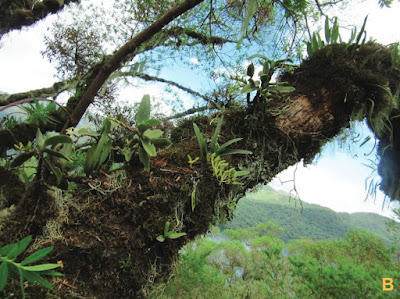
 in its natural habitat, the shrubby savannah around the volcanic lake Oku.
A. Panoramic view of C. okuensis habitat in the survey area.
 B. Individuals of C. okuensis growing on a 2 meter-long branch of Gnidia glauca.
 C. A flowering plant of C. okuensis growing with mosses Leptodontium viticulosoides, and the ferns Lepisorus excavatus and Asplenium theciferum.
 Photographs by Vincent Droissart (A) and Laura Azandi (B, C).

Cyrtorchis okuensis in its natural habitat, the shrubby savannah around the volcanic lake Oku.
A. Panoramic view of C. okuensis habitat in the survey area. 


Cyrtorchis okuensis in its natural habitat, the shrubby savannah around the volcanic lake Oku.
C. A flowering plant of C. okuensis growing with mosses Leptodontium viticulosoides, and the ferns Lepisorus excavatus and Asplenium theciferum.
 Photograph by  Laura Azandi 

Cyrtorchis okuensis Droissart, Azandi & M.Simo, sp. nov.
Cyrtorchis aff. guillaumetii “Oku” (Azandi et al. 2021). 

Diagnosis – Cyrtorchis okuensisis similar to Csubmontana but differs in having wider floral bracts (7–12.5 × 8–13.7 mm vs 4–6.5 × 5–7 mm), longer anther caps (2.5–3 vs 1–2 mm), and wider triangular dorsal sepal (4–5 mm vs 2–3 mm). These species also differ by their habitat; C. submontana is found in submontane and evergreen moist forest (between 550 and 1,200 m), whereas C. okuensis is restricted to the upper montane vegetation (between 1,600 and 2,500 m) along the  Cameroon Volcanic Line.

Distribution – Endemic to the Cameroon Volcanic Line: Nigeria, Cameroon, and Bioko (Equatorial Guinea) (fig. 3).

Habitat and ecology – Restricted to montane vegetation (moist forest, forest-grassland edge, and wooded savannah from 1,600 to 2,500 m), Cyrtorchis okuensis grows on mossy branches of Gnidia glauca (Fresen.) Gilg (Thymelaeaceae), Albizia gummifera (J.F.Gmel.) C.A.Sm. (Fabaceae), and Prunus africana (Hook.f.) Kalkman (Rosaceae). On these phorophytes, C. okuensis is usually found growing with mosses, lichens, ferns, and other orchid species (see details below in “Ecology and reproductive biology”). 

Etymology – The epithet okuensis refers to Oku, a subdivision in the North-West Region of Cameroon where the large, surveyed subpopulation was discovered around Lake Oku. The term Oku also refers to the people who live in this area and their native language.


Laura N. Azandi, Tariq Stévart, Bonaventure Sonké, Murielle Simo-Droissart, Tania D’haijère and Vincent Droissart. 2021. Taxonomic Description and Pollination Ecology of Cyrtorchis okuensis (Orchidaceae, Angraecinae), A New Species Endemic to the Cameroon Volcanic Line. Plant Ecology and Evolution. 154(3); 483-496. DOI: 10.5091/plecevo.2021.1823


Wednesday, August 24, 2022

[Botany • 2022] Vepris teva (Rutaceae) • Chemistry, Taxonomy and Ecology of the potentially Chimpanzee-dispersed Vepris endangered in Coastal Thicket in the Congo Republic


Vepris teva Cheek,  

in Langat, Kami & Cheek​, 2022. 

Abstract 
Continuing a survey of the chemistry of species of the largely continental African genus Vepris, we investigate a species previously referred to as Vepris sp. 1 of Congo. From the leaves of Vepris sp. 1 we report six compounds. The compounds were three furoquinoline alkaloids, kokusaginine (1), maculine (2), and flindersiamine (3), two acridone alkaloids, arborinine (4) and 1-hydroxy-3-methoxy-10-methylacridone (5), and the triterpenoid, ß-amyrin (6). Compounds 1–4 are commonly isolated from other Vepris species, compound 5 has been reported before once, from Malagasy Vepris pilosa, while this is the first report of ß-amyrin from Vepris. This combination of compounds has never before been reported from any species of Vepris. We test the hypothesis that Vepris sp. 1 is new to science and formally describe it as Vepris teva, unique in the genus in that the trifoliolate leaves are subsessile, with the median petiolule far exceeding the petiole in length. Similar fleshy-leathery four-locular syncarpous fruits are otherwise only known in the genus in Vepris glaberrima (formerly the monotypic genus Oriciopsis Engl.), a potential sister species, but requiring further investigation to confirm this phylogenetic position. We briefly characterise the unusual and poorly documented Atlantic coast equatorial ecosystem, where Vepris teva is restricted to evergreen thicket on white sand, unusual in a genus usually confined to evergreen forest. This endemic-rich ecosystem with a unique amphibian as well as plants, extends along the coastline from the mouth of the Congo River to southern Rio Muni, a distance of about 1,000 km, traversing five countries. We map and illustrate Vepris teva and assess its extinction risk as Endangered (EN B1ab(iii)+B2ab(iii)) using the IUCN, 2012 standard. Only three locations are known, and threats include port and oil refinery construction and associated activities, with only one protected location, the Jane Goodall Institute’s Tchimpounga Reserve. Initial evidence indicates that the seeds of Vepris teva are dispersed by chimpanzees, previously unreported in the genus.

Vepris teva Cheek sp. nov.
Shrub with mature (yellow) and immature (green) fruits. Note the sessile leaves.
From Mpandzou et al., 1198 (IEC, K). 
Photo by M. Cheek.

Vepris teva Cheek sp. nov.
 (A) Habit, fruiting stem; (B) detail of leaflet blade showing oil gland dots and nervation, lower surface of blade in foreground; (C) detail of male inflorescence; (D) male flower, side view; (E) as (D), two petals removed to show stamens; (F) pistil of male flower, four-lobed, viewed from above; (G) male flower, two petals and three stamens removed to show pistil; (H) mature fruit, side view (seed on right); (I) fruit, plan view; (J) fruit, transverse section, showing four locules, three aborted and one with seed.
(A and H–J) from Mpandzou et al., 1198, (B and G) from Kami, T. et al 1356; (C–F) from Kami, T. et al., 1227. 
Drawn by Juliet Williamson, CC-BY-NC-ND.

Vepris teva Cheek sp. nov.

Diagnosis: differs from all known trifoliolate species of Vepris in the median petiolule far exceeding the petiole in length (usually by a factor of 2–4 times) on reproductive stems, especially near the stem apex (vs petiole exceeding petiolule in length in all other species). Most similar to Vepris glaberrima (Engl.) J.B.Hall ex D.J. Harris in the soft, leathery-fleshy, four-loculed, and slightly lobed, subverrucate syncarpous fruit, differing in the inflorescences exceeding the petiole in length (vs shorter than the petioles), the secondary nerves (10–)11–16(–18) on each side of the midrib (vs 20–30), the leaflet apices shortly rounded-acuminate (vs long, acutely acuminate) and other characters shown in Table 1 above.

Etymology. Named for Teva Kami, lead collector of the type specimen, who played a key role in the discovery of this species and further research upon it concerning interactions with chimpanzees (see below).

 
Moses K. Langat, Teva Kami and Martin Cheek​. 2022. Chemistry, Taxonomy and Ecology of the potentially Chimpanzee-dispersed Vepris teva sp.nov. (Rutaceae) endangered in Coastal Thicket in the Congo Republic.  PeerJ. 10:e13926. DOI: 10.7717/peerj.13926
 

Tuesday, December 14, 2021

[Ichthyology • 2021] Chiloglanis msirii • A New Species of African Suckermouth Catfish (Siluriformes: Mochokidae) from the Upper Congo Basin


Chiloglanis msirii
Kashindye, Manda, Friel, Chakona & Vreven, 2021


A detailed examination of recently collected specimens of Chiloglanis from the Fungwe and Mwanza rivers and those collected during previous surveys of the Lukuga basin revealed the existence of a new species of African suckermouth catfish in the Upper Congo basin. The new species, herein described as Chiloglanis msirii, is readily distinguished from its congeners in the Congo basin by: the lack of a mid-ventral cleft on the oral disc; the possession of a single row of widely spaced mandibular teeth; and the possession of a forked caudal fin. Outside the Congo basin, the new species closely resembles C. swierstrai from which it is however readily distinguished by having a lower number of total vertebrae and a thicker caudal peduncle. Based on the examined specimens, there was no apparent evidence of sexual dimorphism in shape and size of the fins, body ornamentation, or tuberculation of the skin. This description increases the number of known species of suckermouth catfishes in the Upemba National Park (UNP) to four (C. lufirae, C. microps, C. pojeri and C. msirii). Further surveys and the use of integrative taxonomic approaches will likely uncover additional undocumented species diversity in this park. There are concerns, however, that some of this diversity might be lost even before it is formally documented, because of the excessive use of ichthyotoxins and the construction of impoundments that cause drowning of the riffles which are critical habitats for rheophilic species, particularly those in the genus Chiloglanis and other specialised groups. The present study highlights and discusses the challenges associated with fish protection in the UNP, with emphasis on the Fungwe and Mwanza rivers.


 Chiloglanis msirii


Benedicto Boniphace Kashindye, Bauchet Katemo Manda, John P. Friel, Albert Chakona and Emmanuel Vreven. 2021. Chiloglanis msirii, A New Species of African Suckermouth Catfish (Teleostei: Mochokidae), from the Upper Congo basin. Ichthyological Exploration of Freshwaters. IEF-1158. DOI: 10.23788/IEF-1158

Saturday, January 26, 2019

[Ichthyology • 2018] Enteromius walshae • A New Small Barb (Cyprininae: Smiliogastrini) from the Louesse, Lekoumou (upper Niari basin), and Djoulou (upper Ogowe basin) rivers in the Republic of Congo, west-central Africa


Enteromius walshae
Mamonekene, Zamba & Stiassny, 2018


ABSTRACT
 A new species of smiliogastrin cyprinid is described from the Louesse, Lekoumou (upper Niari basin), and Djoulou (upper Ogowe basin) rivers in the Republic of Congo, west-central Africa. The new species is readily distinguished from congeners by the presence of a flexible, weakly ossified and smooth bordered last unbranched dorsal-fin ray, well-developed barbels, and a straight and complete lateral line in combination with a characteristic pigmentation patterning consisting of a distinctive, rounded black spot at the base of and extending over the first rays of the anal fin and a prominent, darkly pigmented blotch over the base of the anterior dorsal-fin rays. A combination of morphological features and pigmentation patterning that appears to be unique among Enteromius. The new species is widespread throughout the Louesse-Djoulou region, and the fact that such a seemingly common species has gone undetected until now serves to underscore how poorly known this region of the Republic of Congo remains. 


FIGURE 2. Enteromius walshae, new species:
A, AMNH 266856, holotype (female) in preservation; B, individual from the same population in life.
C, AMNH 266858, paratype (male) in preservation; D, individual from same population in life;
E, digestive tract, after removal of liver and adherent tissues (approximately to scale).

Enteromius walshae, new species

Differential diagnosis: While no unambiguous morphological autapomorphies have been located to diagnose Enteromius walshae the species is nonetheless readily distinguished from all congeners by the presence of a flexible, weakly ossified, and smooth-bordered last unbranched dorsal-fin ray, well-developed barbels, and a straight and complete lateral line in combination with a characteristic pigmentation patterning consisting of a distinctive, rounded black spot at the base of and extending over the first rays of the anal fin and a prominent, darkly pigmented blotch over the base of the anterior dorsal-fin rays. 
....


FIGURE 4. A, Known distributional range of Enteromius walshae; yellow stars indicate collection sites and red star indicates collection locality of holotype (AMNH 266856). B, Type locality of holotype, in a small tributary of the Mandoro River (upper Louesse River basin).

Distribution: Found in forested streams and rivers throughout the surveyed region (fig. 4A). Commonly encountered in tributaries and subtributaries of the Louesse River in the Niari basin, and in the Djoulou River, a tributary of the upper Ogowe. The species is not found in tributaries of the lower Kouilou-Niari or in coastal basin systems in the Republic of Congo (Walsh et al., 2014). Although no data are currently available, we anticipate that further collecting in the upper Ogowe basin will extend the species’ distributional range into adjacent forested regions of that basin in Gabon. 

Etymology: We name this new smiliogastrin cyprinid for our colleague Gina Walsh (University of Witwatersrand, South Africa), whose ongoing research continues to enhance conservation efforts throughout the region.


Victor Mamonekene, Armel Ibala Zamba and Melanie L. J. Stiassny. 2018. A New Small Barb (Cyprininae: Smiliogastrini) from the Louesse, Lekoumou (upper Niari basin), and Djoulou (upper Ogowe basin) rivers in the Republic of Congo, west-central Africa.  American Museum Novitates. 3917.  DigitalLibrary.AMNH.org/handle/2246/6921

Thursday, May 3, 2018

[Botany • 2018] Calyptrochilum aurantiacum • New Taxonomic and Conservation Status of Ossiculum (Vandeae, Orchidaceae), A Highly Threatened and Narrow-endemic Angraecoid Orchid from Central Africa


Calyptrochilum aurantiacum 
(P.J.Cribb & Laan) Stévart, M.Simo & Droissart
in Simo-Droissart, Stévart, Sonké, et al., 2018.

photo: V. Droissart flickr.com 

Abstract
In the context of producing a revised phylogenetic Linnean taxonomy of angraecoid orchids, the monotypic and narrow-endemic genus Ossiculum is synonymised with Calyptrochilum. Accordingly, a new combination in Calyptrochilum is proposed for Ossiculum aurantiacum. The morphological and DNA-based evidence for this transfer is discussed. Moreover, Calyptrochilum aurantiacum is here firstly reported outside Cameroon, with a record from the Republic of the Congo. The Red List conservation status of this species is reassessed and it is to be downgraded from “Critically Endangered” (CR) to “Endangered” (EN), following the recent discovery of additional subpopulations in Cameroon.

Keywords: Angraecoid orchids, Calyptrochilum, ex situ conservation, IUCN Red List Categories and Criteria, Mungo River Forest Reserve, Odzala National Park, Ossiculum aurantiacum


Calyptrochilum aurantiacum (P.J.Cribb & Laan)
Stévart, M.Simo & Droissart, comb. nov.

Basionym: Ossiculum aurantiacum van der Laan & Cribb, 1986: 824.

Figure 3. Ecology and habit of natural populations of Calyptrochilum aurantiacum.
A Flowering individual growing on upper branches of a felled kola tree, along with the angraecoid orchid Diaphananthe plehniana and the fern Microgramma owariensis. B Dense population growing on 1 metre long branches of Duguetia staudtii. C Calyptrochilum aurantiacum and Diaphananthe plehniana growing side by side on Salacia sp. (Celastraceae). Photographs by V. Droissart (June 2017).

Figure 4. Seed banking of Calyptrochilum aurantiacum in Yaoundé (Cameroon). In 2017, an ex situ conservation programme was initiated to support the long term preservation of C. aurantiacum.
 A Due to the small size of the flowers, manual pollination has been performed under a stereomicroscope. B Fruit development and maturation takes place in a shadehouse established in Yaoundé. C Finally, viable seeds have been harvested and conserved in the freezer (-20°C). Before being preserved at low temperature, seed viability is assessed using the tetrazolium test (red colouration of living embryo).
Photographs A and C by V. Droissart, B by Gyslène Kamdem.

Conclusion: 
Morphological and DNA-based evidence led to the transfer of the narrow-endemic Ossiculum aurantiacum to the widespread genus Calyptrochilum and, thus, recognises the monotypic genus Ossiculum as a junior synonym of Calyptrochilum. Thanks to recent intensive field trips and laboratory work on central African orchids, new localities of Calyptrochilum aurantiacum have been discovered, a situation that contributed to downgrade the IUCN conservation status of the species. Calyptrochilum aurantiacum is currently known from five locations in two countries (Cameroon and Republic of the Congo) and is assessed as Endangered [EN B2ab(iii,v)] according to the IUCN Red List Categories and Criteria. Fieldwork within and around the Odzala National Park is required to evaluate the species habitat and the state of the subpopulation there. In situ studies on reproductive biology would be necessary for greater efficiency in conservation measures.


 Murielle Simo-Droissart, Tariq Stévart, Bonaventure Sonké, Sandrine Mayogo, Narcisse Kamdem and Vincent Droissart. 2018. New Taxonomic and Conservation Status of Ossiculum (Vandeae, Orchidaceae), A Highly Threatened and Narrow-endemic Angraecoid Orchid from Central Africa.  PhytoKeys. 98: 85-97.  DOI: 10.3897/phytokeys.98.23511

Résumé: En vue de produire une classification taxonomique linnéenne des orchidées angraecoïdes, le genre monotypique Ossiculum, longtemps considéré comme endémique du sud-ouest Cameroun, est placé en synonymie de Calyptrochilum. En conséquence, une nouvelle combinaison dans Calyptrochilum est proposée pour Ossiculum aurantiacum. Les données morphologiques et moléculaires qui justifient cette combinaison sont discutées. L’espèce est signalée pour la première fois hors du Cameroun, en République du Congo. Suite à la découverte récente de sous-populations supplémentaires au Cameroun, le statut de conservation de cette espèce est réévalué selon la liste rouge de l'UICN. Bien que toujours menacée, l’espèce Calyptrochilum aurantiacum est transférée de la catégorie “En danger critique” (CR) vers la catégorie “En danger” (EN).

Wednesday, January 3, 2018

[Ichthyology • 2018] Three New Endemic Aphyosemion Species (Cyprinodontiformes: Nothobranchiidae) from the Massif du Chaillu in the upper Louessé River system, Republic of the Congo; ‘Aphyosemioncyanoflavum, ‘A’. mandoroense & ‘A’. cryptum


Aphyosemion’ cyanoflavum
 van der Zee, Walsh, Mikembi, Jonker, Alexandre & Sonnenberg, 2018


Abstract

Three new ‘Aphyosemion’ species are described from the upper Louessé River in the Massif du Chaillu, Republic of the Congo, based on a combination of DNA, habitat preference, male colour pattern, and morphological data. ‘Aphyosemion’ cyanoflavumnew species, is a member of the ‘A’. ogoense group. It differs from its congeners by a unique colour pattern and cephalic sensory system which contains a wide supra-orbital groove with large, densely pigmented anterior neuromasts and dark frontal neuromasts housed in one pit with one central anterior lobe. ‘Aphyosemion’ mandoroensenew species, and ‘A’. cryptumnew species, are members of the ‘A’. coeleste group. ‘Aphyosemioncryptum, new species, is in appearance very similar to ‘A’. coeleste, but lacks the typical post opercular metallic green blotch and is generally larger in body size. Initial DNA analyses demonstrate that ‘A’. cryptum, new species, is more closely related to ‘A’. mandoroense, new species, than to ‘A’. coeleste, despite similarity in appearance. ‘Aphyosemioncryptum, new species, and ‘A’. coeleste occur syntopic in several locations in a sub-catchment of the upper Louessé system, however differ in microhabitat preference. ‘Aphyosemionmandoroense, new species, differs by male body and fin colour pattern from all species of the ‘A’. coeleste group except ‘A’. citrineipinnis. From the latter, it can be distinguished by the absence of red pigmentation and a dark grey to black margin in the unpaired fins.

Keywords: Pisces, Cyprinodontiformes, Nothobranchiidae


Jouke van der Zee, Gina Walsh, Valdie N. Boukaka Mikembi, Michael N. Jonker, Marco P. Alexandre and Rainer Sonnenberg. 2018. Three New Endemic Aphyosemion Species (Cyprinodontiformes: Nothobranchiidae) from the Massif du Chaillu in the upper Louessé River system, Republic of the Congo. Zootaxa. 4369(1); 63–92. DOI: 10.11646/zootaxa.4369.1.3

Monday, March 20, 2017

[Ichthyology • 2017] Genomewide SNP Data Reveal Cryptic Phylogeographic Structure and Microallopatric Divergence in a Rapids-adapted Clade of Cichlids from the Congo River


Figure 7.  Variation in fin patterning across genetically defined lineages. Top: aquarium-held female and male Teleogramma brichardi.
In panel below (only females shown): (a) 
Teleogramma brichardi, (e) T. gracile, (g) Tobamaorum.  


Abstract

The lower Congo River is a freshwater biodiversity hot spot in Africa characterized by some of the world's largest rapids. However, little is known about the evolutionary forces shaping this diversity, which include numerous endemic fishes. We investigated phylogeographic relationships in Teleogramma, a small clade of rheophilic cichlids, in the context of regional geography and hydrology. Previous studies have been unable to resolve phylogenetic relationships within Teleogramma due to lack of variation in nuclear genes and discrete morphological characters among putative species. To sample more broadly across the genome, we analysed double-digest restriction-associated sequencing (ddRAD) data from 53 individuals across all described species in the genus. We also assessed body shape and mitochondrial variation within and between taxa. Phylogenetic analyses reveal previously unrecognized lineages and instances of microallopatric divergence across as little as ~1.5 km. Species ranges appear to correspond to geographic regions broadly separated by major hydrological and topographic barriers, indicating these features are likely important drivers of diversification. Mitonuclear discordance indicates one or more introgressive hybridization events, but no clear evidence of admixture is present in nuclear genomes, suggesting these events were likely ancient. A survey of female fin patterns hints that previously undetected lineage-specific patterning may be acting to reinforce species cohesion. These analyses highlight the importance of hydrological complexity in generating diversity in certain freshwater systems, as well as the utility of ddRAD-Seq data in understanding diversification processes operating both below and above the species level.


Figure 7.  Variation in fin patterning across genetically defined lineages. At top: aquarium-held female and male Teleogramma brichardi. In panel below (only females shown): (a) Teleogramma brichardi, (b) T. cf. brichardi, (c) T. cf. depressa, (d) T. depressa, (e) T. gracile, (f) T. monogramma, (g) T. obamaorum.   DOI: 10.1111/mec.13973


 S. Elizabeth Alter, Jason Munshi-South and Melanie L. J. Stiassny. 2017. Genomewide SNP Data Reveal Cryptic Phylogeographic Structure and Microallopatric Divergence in a Rapids-adapted Clade of Cichlids from the Congo River. Molecular Ecology. 26(5); 1401–1419. DOI: 10.1111/mec.13973

Water 'Walls' Spur Evolution of New Colorful Fish Species
shar.es/1UfKtg via @LiveScience


Tuesday, February 28, 2017

[Ichthyology • 2017] Pseudocrenilabrus pyrrhocaudalis • A New Species of Pseudocrenilabrus (Perciformes: Cichlidae) from Lake Mweru in the Upper Congo River System


Pseudocrenilabrus pyrrhocaudalis
Katongo, Seehausen & Snoeks, 2017  


Abstract

Pseudocrenilabrus pyrrhocaudalis sp. nov. is described from Lake Mweru in the upper Congo River drainage, on the border of the Democratic Republic of Congo and Zambia. This species, which appears to be endemic to the lake, lives in sympatry with P. philander. Pseudocrenilabrus pyrrhocaudalis sp. nov. is distinguished from P. philander in nuptial males by the presence of an orange colour on the ventral part of the body and the proximal parts of the anal and caudal fins, a broad band of bright white on the distal edge of anal and caudal fins, a uniform grey head and dorsum, and a subtruncate caudal fin. In addition, P. pyrrhocaudalis has a shorter snout, a narrower head, a smaller interorbital distance, a smaller pre-anal distance, a more slender caudal peduncle and fewer scales around the caudal peduncle in both sexes.

Keywords: Pisces, Pseudocrenilabrus pyrrhocaudalis, description, south-eastern Africa


Cyprian Katongo, Ole Seehausen and Jos Snoeks. 2017. A New Species of Pseudocrenilabrus (Perciformes: Cichlidae) from Lake Mweru in the Upper Congo River System. Zootaxa.  4237(1); 181–190.  DOI:  10.11646/zootaxa.4237.1.10

Saturday, November 12, 2016

[Ornithology • 2016] Stiphrornis dahomeyensis, S. inexpectatus & S. rudderi • Three New Species of Stiphrornis (Aves: Muscicapidae) from the Afro-tropics, with A Molecular Phylogenetic Assessment of the Genus


[from top to bottom]    Stiphrornis rudderi, S. dahomeyensis &  S. inexpectatus  
 Voelker, Tobler, Prestridge, Duijm, Groenenberg, Hutchinson,
 Martin, Nieman, Roselaar & Huntley, 2016

 Abstract
We describe three new species of forest robin in the genus Stiphrornis; two from West Africa and one from the Congo Basin. Each species represents a distinct phylogenetic lineage based on genetic analysis. In addition to genetic differentiation, each new species is diagnosable from other Stiphrornis lineages by morphology, and by plumage. One of the new species [Stiphrornis inexpectatus] appears to be restricted to the Central and Brong-Ahafo Regions of Ghana, and another [Stiphrornis dahomeyensis] is restricted to Benin and the Central Region of Ghana. In Ghana, these two new species presumably come into contact with Stiphrornis erythrothorax (Western Region of Ghana and westward), and there is evidence that one of the new species has a distinguishably different song from erythrothorax. The distribution of the third new species [Stiphrornis rudderi] is primarily on the south bank of the Congo River, near the city of Kisangani. Recognition of these species provides additional evidence that Afrotropical forests are harbouring substantial cryptic diversity, and that our knowledge of the drivers of this diversity remains poorly documented across the region.


Key words: Africa, cryptic species, speciation, systematics, tropical forests,


Fig. 1. Visual comparisons of new Stiphrornis taxa and their closest relatives. Column (A) dorsal, lateral and ventral views of (from left to right): erythrothorax, the type specimen of inexpectatus (LSUMZ 168539), the type specimen of dahomeyensis (TCWC 15743) and gabonensis. Column (B) dorsal, lateral and ventral views of (from left to right): the type specimen of rudderi (TCWC 15204) and xanthogaster


Stiphrornis dahomeyensis sp. nov. 
Dahomey Forest Robin

ETYMOLOGY: Named after the Dahomey Gap, that separates the otherwise broadly distributed western and eastern expanses of Guineo-Congolian tropical forests, and in which the isolated Lama Forest is located. The Gap derives its name from the African kingdom of Dahomey, which lasted c. 300 years and was located in the area of what is now Benin.

DISTRIBUTION: The known distributional range of the new species is currently limited to one locality in Benin, the Lama Forest (6 57.61’N, 2 10.12’E) and a second locality from c. 30 km south of Assin Foso, Central Region, Ghana (5 19’59.88“N, 1 13’ 0.1194”E). 


Stiphrornis inexpectatus sp. nov. 
Ghana Forest Robin

ETYMOLOGY:  Named both for the unexpected nature of its distribution, being restricted to two provinces in Ghana, and the fact that there are no obvious geographic barriers that separate it from two other members of the genus.

DISTRIBUTION: The known distributional range of the new species is currently limited to three locations in Ghana, one 30 km south of Assin Foso, Central Region (5 20.300 N, 1 13.58’W), one in Kakum National Park, Central Region (5 210 3000N, 1 230 W) and another 26 km south-west of Goaso, Brong-Ahafo Region (6.71 N, 2.73 W). 


Stiphrornis rudderi sp. nov. 
Rudder’s Forest Robin

ETYMOLOGY: Named in honour of James Earl Rudder, who led the 2nd Ranger Battalion during the invasion of Normandy, and was later President of Texas A&M University; his presidency was a transformative steppingstone in driving A&M’s success.

DISTRIBUTION: The known distributional range of the new species is currently limited to two localities near the city of Kisangani, Democratic Republic of the Congo. The first is Yoko Forest Reserve, Ubundu District (0.29400 , 25.288917 ), on the south side of the Congo River. The second locality is Turumbu, c. 8 km N of Yelenge, Yawenda District (0.633483 , 25.073933 ), on the north side of the Congo River.

Rudder’s Forest Robin, Stiphrornis rudderi   


Gary Voelker, Michael Tobler, Heather L. Prestridge, Elza Duijm, Dick Groenenberg, Mark R. Hutchinson, Alyssa D. Martin, Aline Nieman, Cees S. Roselaar and Jerry W. Huntley. 2016. Three New Species of Stiphrornis (Aves: Muscicapidae) from the Afro-tropics, with A Molecular Phylogenetic Assessment of the Genus.  Systematics and Biodiversity.  DOI: 10.1080/14772000.2016.1226978

Team discovers three new bird species in Africa http://phy.so/397725009 via @physorg_com