Showing posts with label 1970s. Show all posts

Tuesday, March 20, 2018

[Paleontology • 2018] Arkansaurus fridayi • A New Ornithomimosaur from the Lower Cretaceous Trinity Group of Arkansas


Arkansaurus fridayi  Hunt & Quinn, 2018


Illustration by Brian Engh   twitter.com/GreyGriffon 

ABSTRACT
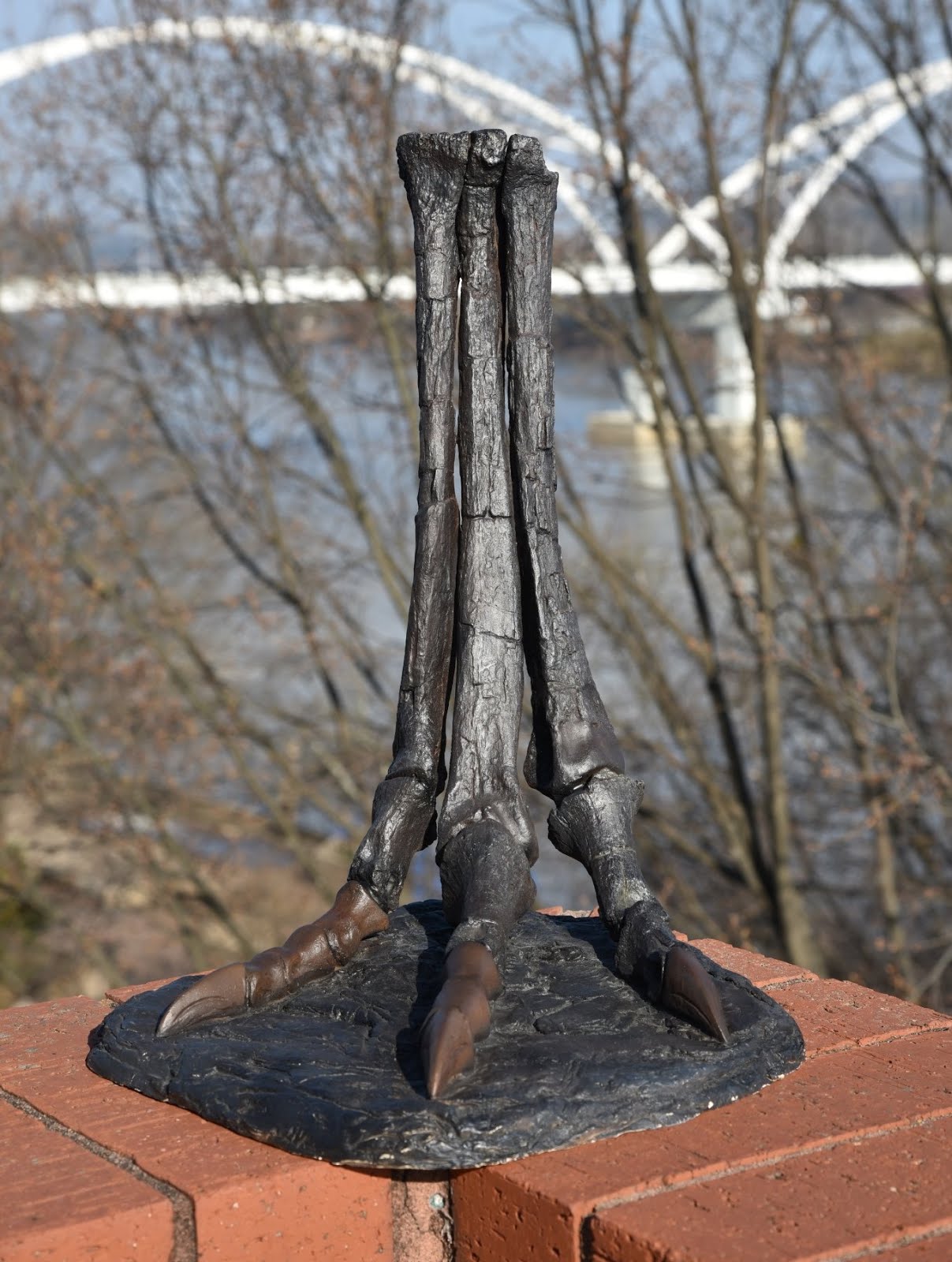
Whereas ornithomimosaurs (ostrich-mimic dinosaurs) are well known from Asia during the Early Cretaceous, they are less well known from this time in North America. Represented by a single specimen consisting of pedal elements, a new North American taxonArkansaurus fridayi, gen. et sp. nov., consists of a nearly complete right foot, recovered from the Lower Cretaceous (Albian–Aptian) Trinity Group of Arkansas. Arkansaurus fridayi can be distinguished from other ornithomimosaurs based on differentiated pedal unguals, a laterally compressed third metatarsal that is ovoid in proximal view, and a distal ungual with a very weak flexor tubercle, lacking spurs. The condition of this third metatarsal suggests that Arkansaurus fridayi is more basal than Asiatic ornithomimosaurs of similar age, but consistent with older North American forms. This specimen provides knowledge of a poorly understood radiation of ornithomimosaurs in Appalachia and is the only known saurischian dinosaurian fossil from the state of Arkansas.


FIGURE 3. Arkansaurus fridayi, UAM-74–16-1 to UAM-74–16-3, holotype,
articulated right metatarsals, in A, proximal and B, anterior views. Scale bar equals 10 cm. 

FIGURE 4. Arkansaurus fridayi, holotype, digital surface scans of pedal phalanges.
 UAM-74–16-5, phalanx II-1, in A, proximal, B, distal, C, extensor, D, flexor, E, lateral, and F, medial views.
UAM-74–16-4, phalanx III-1, in G, proximal, H, distal, I, extensor, J, flexor, K, lateral, and L, medial views.
UAM74–16-6, phalanx IV-1, in M, proximal, N, distal, O, extensor, P, flexor, Q, lateral, and R, medial views.
UAM-74–16-7, phalanx III-2, in S, proximal, T, distal, U, extensor, V, flexor, W, lateral, and X, medial views.
 UAM-74–16-8, large ungual, in Y, extensor, Z, lateral, AA, flexor, BB, medial, and CC, proximal views.
UAM-74–16-8, ungual, in DD, proximal, EE, extensor, FF, lateral, GG, flexor, and HH, medial views.
UAM-74–16-8, small ungual, in II, extensor, JJ, lateral, KK, flexor, and LL, medial views.
Scale bar equals 10 cm.

SYSTEMATIC PALEONTOLOGY 
DINOSAURIA Owen, 1842 
SAURISCHIA Seeley, 1887 
THEROPODA Marsh, 1881; Gauthier, 1986 
ORNITHOMIMOSAURIA Barsbold, 1976; Lee et al., 2014 

ARKANSAURUS FRIDAYI, gen. et sp. nov.

Etymology—The genus is named for the state of Arkansas, where the specimen was discovered. The species name is in honor of Joe B. Friday, who discovered the remains in 1972.

....


 twitter.com/GreyGriffon 


CONCLUSION:
Arkansaurus fridayi currently is one of the oldest basal ornithomimosaurs known from North America. Its occurrence in the southeastern portion of the North American continent is significant biogeographically, because most of the Early Cretaceous basal ornithomimosaurs were flourishing in Asia at the time, but are otherwise not well represented in North America. Further discoveries of similar ornithomimosaur taxa in North America will provide better understanding of additional, currently unknown, characters.


 ReBecca K. Hunt and James H. Quinn. 2018. A New Ornithomimosaur from the Lower Cretaceous Trinity Group of Arkansas. Journal of Vertebrate Paleontology. DOI:  10.1080/02724634.2017.1421209


Monday, August 22, 2011

[Botany • 1979] Thai Impatiens • A comment on the Limestone Flora of Thailand


Thai Impatiens divided into 7 sect.:
Enantiophyllon, Macrocentron, Microcentron, Megalocentron, Brachycentron, Longecalcaratae & Brevicalcaratae


Species of the Thai Impatiens and their habitat:
sect. Enantiophyllon & Macrocentron


Species of the Thai Impatiens and their habitat:
sect. Microcentron


Species of the Thai Impatiens and their habitat:
sect. Megalocentron & Brachycentron
Longecalcaratae & Brevicalcaratae


SHIMIZU Tatemi. 1979. A comment on the limestone flora of Thailand, with special reference to Impatiens : The Lectures on the Flora of Thailand. Acta phytotaxonomica et geobotanica. 30(4〜6), 180-187, 1979-12-20 [PDF File]

Friday, August 19, 2011

[Botany • 1977] Impatiens hongsonensis, I. larsenii & I. siamensis • three new Impatiens from Thailand and some additional notes


เทียนสว่าง Impatiens cardiophylla Hook. f.
วงศ์ : BALSAMINACEAE
ลักษณะลำต้น : ไม้ล้มลุก สูงได้ถึง 60 ซม. ลำต้นอวบน้ำ สีน้ำตาลแดง ผิวเกลี้ยง
ลักษณะใบ : ใบเดี่ยว ออกเรียงสลับเวียนรอบลำต้น หรือเป็นเกลียว รูปใบหอกเกือบกลม ยาว 3-6 ซม. ปลายใบแหลมเป็นหาง ขอบใบหยักเป็นซี่ฟันห่างๆ โคนใบกลม เว้าเล็กน้อย หรือเบี้ยว แผ่นใบอวบน้ำ ก้านใบยาว 2-5 ซม.
ลักษณะดอก : ออกดอกเป็นเดี่ยวตามซอกใบ ดอกสีชมพู หรือสีชมพูอมแดง กลางดอกมีปื้นขาวและแต้มสีเหลือง กลีบดอก5กลีบ ขนาดไม่เท่ากัน กลีบบน1กลีบเว้าเป็นรูปหัวใจ กว้างราว 3 ซม. กลีบคู่ข้างมีขนาดเล็กสุด ปลายกลีบค่อนข้างแหลม กลีบคู่ล่างติดกันดูคล้ายเป็นกลีบเดียวกัน เกสรตัวผู้5อัน อับเรณูติดกัน กลีบเลี้ยง5กลีบ มี2กลีบที่ฝ่อลดขนาดเล็กลง เดือยยาวเป็นหางม้วนงอราว 0.8-1 ซม. ก้านดอกยาว 2-5 ซม. มีใบประดับรูปเส้นด้ายติดอยู่กึ่งกลางก้านดอก ออกดอกในราวเดือน ก.ค. – ก.ย.
ลักษณะผล : รูปกระสวย ยาว 1.5-1.7 ซม. ผิวเกลี้ยง มีเมล็ดเป็นจำนวนมาก ผิวเป็นร่างแห และมีขนปกคลุม
แหล่งที่พบในไทย : พันธุ์ไม้สกุลนี้พบอยู่ในเมืองไทยกว่า 70 ชนิด สำหรับชนิดนี้เป็นพืชหายากชนิดหนึ่ง พบขึ้นตามซอกหินปูนภายใต้ร่มเงาไม้ใหญ่ใกล้ชายทะเลบนภูเขาที่มีความสูงจากระดับน้ำทะเลไม่เกิน 200 เมตร ปัจจุบันมีรายงานการพบที่ จ.ประจวบคีรีขันธ์ และ จ.ชุมพร เท่านั้น
แหล่งกำเนิดและแพร่กระจาย : เป็นพืชถิ่นเดียวของไทย


เทียนหินอ่อน Impatiens larsenii T. Shimizu
วงศ์ : BALSAMINACEAE
ลักษณะลำต้น : ไม้ล้มลุก สูงได้ประมาณ 50 ซม. ลำต้นเกลี้ยง
ลักษณะใบ : ใบเดี่ยว ออกเรียงสลับเวียนรอบลำต้น หรือเป็นเกลียว รูปไข่ หรือรูปไข่แกมรูปขอบขนาน ยาว 4.5-14 ซม. ปลายใบแหลมยาว ขอบใบหยักเป็นฟันเลื่อย โคนใบรูปลิ่มกว้าง มีต่อมใกล้โคนใบ แผ่นใบค่อนข้างบาง เส้นแขนงใบ 6-8 คู่ ก้านใบยาว 5 ซม.
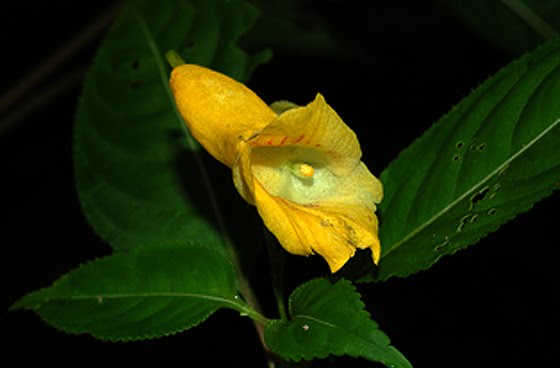
ลักษณะดอก : ออกดอกเดี่ยวหรือเป็นกระจุก 2 ดอก ตามซอกใบใกล้ปลายกิ่ง ดอกสีเหลือง และมีจุดสีแดงด้านใน กลีบดอก5กลีบ ขนาดไม่เท่ากัน กลีบข้าง4กลีบ กลีบคู่นอกรูปไข่กว้าง ยาว 0.7 ซม. กลีบคู่ในขนาดเล็ก รูปรี ยาว 0.1 ซม. กลีบปากเป็นถุงลึก ยาว 0.8-1 ซม. โคนถุงเป็นจงอยสั้นและโค้งงอ ปลายปากเป็นรูปไข่กลับ กว้าง 0.6 ซม. ยาว 0.8-0.9 ซม. เส้นกลางกลีบมีสันที่โคน กลีบเลี้ยง2กลีบ สีเขียวอ่อน ใบประดับขนาดเล็กติดอยู่ที่โคนก้านดอก ก้านดอกยาว 3-4 ซม. ออกดอกในราวเดือน ก.ย. - ต.ค.
ลักษณะผล : รูปแคปซูล ผิวเกลี้ยง มีเมล็ดขนาดเล็กเป็นจำนวนมาก
แหล่งที่พบในไทย : พบขึ้นตามร่มเงาใต้ต้นไม้ในป่าดิบที่มีความสูงจากระดับน้ำทะเลประมาณ 100-250 เมตร ปัจจุบันมีรายงานการพบที่ จ.สุราษฎร์ธานี จ.พังงา และ จ.ตรัง
แหล่งกำเนิดและแพร่กระจาย : เป็นพืชถิ่นเดียวของไทย


SHIMIZU Tatemi. 1977. Some additional notes on Impatiens (Balsaminaceae) of Thailand. Acta phytotaxonomica et geobotanica. 28(1-3), 31-34, 1977-04-30 [PDF File]


รวบรวมสุดยอดไม้หายาก และ ไม้เฉพาะถิ่น:

[Botany • 1970] Impatiens of Thailand and Malaya • Contributions to the Flora of Southeast Asia II


Key to Impatiens of Thailand and Malaya (1970)


Shimizu Tatemi. 1970. Contributions to the Flora of Southeast Asia II : Impatiens of Thailand and Malaya. The Southeast Asian Studies. 8(2), 187-217, 1970-09 [PDF file]


SHIMIZU Tatemi. 1969. Classification and Geography of Impatiens in Thailand and the Malay Peninsula [in Japanese]. Acta phytotaxonomica et geobotanica. 24(1-2), 43-51: 1969-07-20 [PDF file]