Showing posts with label Pterosaur. Show all posts

Monday, November 10, 2025

[Botany • 2025] Bakiribu waridza • A regurgitalite reveals A New filter-feeding Pterosaur (Pterosauria: Ctenochasmatidae) from the Santana Group, Northeast Brazil


Bakiribu waridza 
Pêgas, Aureliano, Holgado, Almeida, Santos & Ghilardi, 2025

Artwork by Julio Lacerda


Abstract
The Santana Group in Northeast Brazil has yielded a remarkable discovery: the first filter-feeding pterosaur from the tropics, named Bakiribu waridza gen. et sp. nov. This new taxon provides key insights into the evolutionary history and ecological diversity of Ctenochasmatidae, a clade known for its specialized feeding adaptations. Bakiribu exhibits extremely elongated jaws and dense, brush-like tooth rows, similar to Pterodaustro but distinct in tooth cross-section and spacing. Paleohistological analysis of the teeth revealed well-preserved dentine and pulp cavities. Phylogenetic analysis recovers Bakiribu as the sister taxon to Pterodaustro, forming a clade more closely related to Ctenochasma than to Gegepterus, which is reinterpreted as a non-ctenochasmatine. Regarding some specific traits such as tooth density, elongation, and count, Bakiribu is intermediate between Ctenochasma and Pterodaustro, thus partially bridging a key evolutionary gap within Ctenochasmatinae. Taphonomic features support the interpretation of the fossil assemblage as a regurgitalite. This discovery brings crucial data for understanding biogeographic dispersal and ecological specialization within Ctenochasmatinae during the Early Cretaceous, and offers rare evidence of predator-prey interactions in the Romualdo Formation paleoecosystem. Together, these findings further underscore the importance of the Araripe Basin as a window into the Early Cretaceous biodiversity.

Keywords: Pterodactyloidea, Ctenochasmatidae, Araripe basin, Romualdo formation, Paleohistology, Regurgitalite

Pterosauria Owen 1842.
Pterodactyloidea Plieninger 1901.

Ctenochasmatidae Kuhn 1967.
Ctenochasmatinae Nopcsa 1928.
Pterodaustrini Andres, Clark and Xu 2014.

Overview of the concretion containing the remains of Bakiribu waridza gen. et sp. nov. (holotype and paratype) and four associated fishes.
 A, Part (MCC 1271.1-V). B, Counterpart (MPSC 7312).
C and D, Schematic drawings of MCC 1271.1-V and MPSC 7312, respectively.
Scale bar equals 50 mm.

Bakiribu waridza gen. et sp. nov.

Diagnosis. Ctenochasmatine pterosaur with the following combination of features, including autapomorphies (marked with an asterisk): jaws extremely elongate (estimated rostral index of ~ 12–16); teeth closely packed together (interdental gaps under tooth diameter); high tooth density (17.6 teeth/cm); high tooth count (between 110 and 142 per jaw, per side, as preserved; total estimate = between 440 and 568); teeth long and slender (elongation index surpassing 1:60); acrodont-like tooth implantation on both jaws*; and tooth crowns subquadrangular in cross-section*.

Holotype. MCC 1271-Va/MPSC 7312a (Figs. 2 and 3A and B), a partial rostrum. Based on position and orientation, fragments b, c, and d most likely belong to the same individual (Fig. 3B).


Horizon and Locality. This fossil was preserved in a calcareous concretion of the Romualdo Formation, Araripe Basin, Northeast Brazil. This unit is late Aptian-early Albian in relative age31. The precise locality of this concretion is unknown, but the Romualdo Formation outcrops east-west along the Araripe Plateau between the states of Pernambuco, Ceará, and Piauí.

Etymology. The generic epithet comes from bakiribú (Kariri word for ‘comb’), in allusion to the typical comb-like dentition of ctenochasmatids. The specific epithet comes from waridzá (Kariri word for ‘mouth’). Together, the binomial name not only highlights the distinctive dental morphology of the taxon but also honors the cultural heritage of the Kariri people, Indigenous inhabitants of the region where the fossil was discovered.

Reconstruction of the type specimens of Bakiribu waridza gen. et sp. nov.
 A, close view of MCC 1271.1-V (main part). B, simplified schematic reconstruction of the holotype based on fragments a, b, c, and d. C, simplified schematic reconstruction of holotype based on fragments e, f, and g. Scale bar equals 10 mm.


Artistic reconstruction of the filter-feeding pterosaur  Bakiribu waridza gen. et sp. nov. in the Early Cretaceous Romualdo Formation environment. The spinosaurid in the background represents the putative predator that produced the regurgitalite described herein.
Artwork by Julio Lacerda.

 
R. V. Pêgas, Tito Aureliano, Borja Holgado, William B. S. Almeida, Claude L. A. Santos and Aline M. Ghilardi. 2025. A regurgitalite reveals A New filter-feeding Pterosaur from the Santana Group. Scientific Reports. 15, 37336. DOI: doi.org/10.1038/s41598-025-22983-3 [10 November 2025]

Sunday, October 19, 2025

[Paleontology • 2025] Recovering lost time in Syria: A gigantic latest Cretaceous azhdarchid Pterosaur from the Palmyrides Mountain Chain


Syrian azhdarchid (LU-GD 0001)

in Alhalabi, Pinheiro, Jaoude, Ismail, Suberbiola, Bardet et Langer, 2025.


Abstract
Azhdarchidae was a diverse group of toothless pterosaurs and one of the few lineages of flying reptiles to survive to the end of the Cretaceous. Despite including medium-sized forms, the group is notable for their gigantic representatives, which correspond to the largest known flying animals. Azhdarchids had a nearly global distribution during the Late Cretaceous, including the Arabian Plate, with records in Lebanon and Jordan, such as the iconic Arambourgiana philadelphiae. Here, we report the first azhdarchid, and indeed the first pterosaur, from Syria, recovered from early Maastrichtian phosphate deposits of the Palmyrides mountain chain, near Palmyra (Tadmur). It corresponds to a fragmentary left humerus, missing both its proximal and distal ends, with a preserved length of 289 mm. The Syrian pterosaur was exceptionally large, with extrapolations suggesting that, if complete, its humerus would be only about 10% smaller than the holotype humerus of Quetzalcoatlus northropi, the largest known pterosaur. The new pterosaur fossil also represents the uncommon record of a giant azhdarchid in marine deposits, confirming that these gigantic animals, though classically considered continental, could also inhabit nearshore environments. The find also underscores the widespread occurrence of gigantic azhdarchids until the latest Cretaceous, just prior to their Cretaceous/Paleogene extinction, and highlights the potential for fossil discoveries in understudied regions such as the Middle East.
 
Keywords: Azhdarchidae, Pterosaurs, Azhdarchids


Syrian azhdarchid (LU-GD 0001)

Conclusions: 
Despite the incompleteness of the Syrian azhdarchid (LU-GD 0001), it is significant given its size and geographic provenance. Firstly, it corresponds to one of the largest known pterosaurs and the first pterosaur found in Syria, adding to previously documented Middle East records from Jordan and Lebanon. It is also an additional record of an azhdarchid from marine strata, adding to the evidence that these gigantic animals were not strictly continental, but also able to live near the coastlines. The Syrian azhdarchid also reinforces the widespread distribution of those gigantic pterosaurs just prior to their extinction at the end of the Cretaceous. Finally, it is a witness that the Palmyrides phosphate mines of Syria are continuously yielding important fossil specimens, so that their exploration is likely to uncover further new finds, expanding our understanding of the Middle East ancient life.

 
Wafa A. Alhalabi, Felipe L. Pinheiro, Issam Bou Jaoude, Mohamad J. Ismail, Xabier Pereda Suberbiola, Nathalie Bardet and Max C. Langer. 2025. Recovering lost time in Syria: A gigantic latest Cretaceous azhdarchid Pterosaur from the Palmyrides Mountain Chain. The Science of Nature.  112 78. DOI: doi.org/10.1007/s00114-025-02032-9 [16 October 2025]

Sunday, September 28, 2025

[Botany • 2025] Galgadraco zephyrius • The First Pterosaur from the Bauru Group: An Azhdarchid from the Upper Cretaceous of Brazil


Galgadraco zephyrius 
Giaretta, Navarro, Marinho & Pêgas, 2025

Artwork by Matheus Gadelha.

Abstract
The vertebrate fossil record of the Bauru Group (Upper Cretaceous, southeastern Brazil) is remarkably rich, with a predominance of titanosaurs and crocodyliforms, alongside theropods, turtles, squamates, fishes and even small mammals. In contrast, pterosaur remains from the Bauru Group have remained elusive until now. Here, we describe a fragmentary jaw from the upper Maastrichtian Serra da Galga Formation, representing the first confirmed pterosaur discovery from the Bauru Group. The specimen was collected in the Serra da Galga Geosite and is interpreted as a rostrum (upper jaw tip), showing diagnostic features that support its identification as a new azhdarchid species: Galgadraco zephyrius gen. et sp. nov. This new taxon represents the first Brazilian azhdarchid and bears striking similarities to the coeval Albadraco tharmisensis from the Haţeg Basin, Romania. Phylogenetic analysis recovered Galgadraco as a sister taxon to Albadraco, both deeply nested within the clade Quetzalcoatlida. Additional indeterminate pterosaur fragments were also recovered from the same level of the fossil site and include another jaw fragment, a diminutive (?hatchling) lower jaw with azhdarchid affinities, a distal metacarpal IV, and ungual fragments. This highlights a previously unrecognized archosaurian diversity, with important implications for the palaeoecology of the Serra da Galga Formation.

Keywords: Azhdarchoidea, systematics, Paraná Basin, Bauru Supersequence, Serra da Galga Formation, Maastrichtian

Holotype of Galgadraco zephyrius gen. et sp. nov. (CPPLIP 1853).
Rostrum fragment in: A, right lateral; B, left lateral; C, palatal; D, dorsal; E, anterior; F, posterior view. G–J, schematic drawings of A–D highlighting the slit-like foramina, the medial longitudinal groove, and broken parts (pattern). K, hypothetical reconstruction of a generalized Hatzegopteryx-like skull, showing the approximate anatomical position of the preserved fragment. Abbreviations: nf, neurovascular foramen; pg, palatal groove; snnf, supernumerary neurovascular foramen.
 Scale bar represents: 10 mm (A–J); 50 mm (K).

SYSTEMATIC PALAEONTOLOGY
PTEROSAURIA Owen 1842
PTERODACTYLOIDEA Plieninger 1901
AZHDARCHOIDEA Unwin 1995 (sensu Kellner 2003)
AZHDARCHIDAE Padian 1986 (sensu Pêgas et al. 2025)

Genus Galgadraco nov. 

Derivation of name: From Galga, referring to the Serra da Galga Formation and the Galga Hill, and draco, Latin for ‘dragon’, a common suffix used to designate pterosaurs.

Type species: Galgadraco zephyrius sp. nov.
 
Galgadraco zephyrius sp. nov.
 
Derivation of name: From Zéphuros (Ζέφυρος), the personification of the west wind in Ancient Greek mythology.

Holotype: CPPLIP 1853, a tridimensional partial rostrum (upper jaw close to tip) fragment (Fig. 3).
 
Type locality: Serra da Galga Geosite, a roadcut located at kilometre 153 of the BR-050 highway, c. 25 km north of Uberaba city (19°35′32.8″S 48°01′42″W).

Horizon & age: Serra da Galga Formation, Bauru Group, late Maastrichtian.

Diagnosis: The new species can be diagnosed based on the following combination of features (autapomorphy marked with an asterisk): edentulous rostrum (upper jaw) tip with lateral divergence of c. 7°; dorsoventral divergence of c. 15°; ventrolateral divergence of c. 18°; roughly triangular cross-section; slit-like occlusal foramina larger than lateral foramina; occlusal foramina mostly organized in a symmetrical pair of rows; relatively dense occlusal foramina (jaw tip foramination index of c. 0.40); low and rounded tomial edges; and a shallow median palatal groove*.


Life reconstruction of a pair of Galgadraco zephyrius gen. et sp. nov. in a late Maastrichtian environment, showcasing the palaeobiota of the Serra da Galga Geosite.
Artwork by Matheus Gadelha.
 

Ariovaldo A. Giaretta, Bruno A. Navarro, Thiago S. Marinho and R. Vargas Pêgas. 2025. The First Pterosaur from the Bauru Group: An Azhdarchid from the Upper Cretaceous of Brazil. Papers in Palaeontology. DOI: doi.org/10.1002/spp2.70039 [23 September 2025]

Tuesday, September 16, 2025

[Paleontology • 2025] Gobiazhdarcho tsogtbaatari & Tsogtopteryx mongoliensis • Azhdarchid Pterosaur Diversity in the Bayanshiree Formation, Upper Cretaceous of the Gobi Desert, Mongolia


 The coexistence between Gobiazhdarcho tsogtbaatari and Tsogtopteryx mongoliensis in the Bayanshiree paleoenvironment.
Pêgas, Zhou​ & Kobayashi, 2025
  
Artwork by Zhao Chuang. 

Abstract 
Pterosaur remains are very rare in Mongolian Mesozoic deposits, in stark contrast with the great abundance of dinosaur fossils in the region. This contribution presents a reassessment of the azhdarchid pterosaur remains from the Bayanshiree Formation’s “upper beds” (Turonian–Santonian), represented by two specimens coming from two distinct localities: the Burkhant and the Bayshin Tsav azhdarchids. These specimens, collected by the Japanese−Mongolian Joint Paleontological Expedition and originally described in 2009, have been previously interpreted as indeterminate azhdarchids. Under the light of current knowledge on the morphological diversity of azhdarchid cervical vertebrae, as well as on the taxonomic and phylogenetic signals these skeletal elements carry, we herein identify diagnostic features and reassess the phylogenetic affinities of the Bayanshiree azhdarchids in further detail. Our results suggest that the Burkhant azhdarchid, hereby named Gobiazhdarcho tsogtbaatari gen. et sp. nov., represents a medium-sized (3.0–3.5 meters in wingspan) basal member of a Quetzalcoatlus-Arambourgiania lineage. The Bayshin Tsav azhdarchid, Tsogtopteryx mongoliensis gen. et sp. nov., is recovered as a basal member of a Hatzegopteryx-lineage and, surprisingly, seems to represent a small form under 2 m in wingspan. Our results shed fresh light on the diversity and phylogeny of azhdarchid pterosaurs, and reinforce the reoccurring pattern of coexistence between multiple, differently-sized azhdarchid species from a same deposit.

Life restoration of the Bayanshiree azhdarchids. The coexistence between Gobiazhdarcho tsogtbaatari and Tsogtopteryx mongoliensis in the Bayanshiree paleoenvironment, with a group of Gobihadros mongoliensis nearby.
Artwork by Zhao Chuang. 

 Gobiazhdarcho tsogtbaatari gen. et sp. nov. 
 Tsogtopteryx mongoliensis gen. et sp. nov.

 
R. V. Pêgas, Xuanyu Zhou​ and Yoshitsugu Kobayashi. 2025. Azhdarchid Pterosaur Diversity in the Bayanshiree Formation, Upper Cretaceous of the Gobi Desert, Mongolia. PeerJ 13:e19711. DOI: doi.org/10.7717/peerj.19711 [September 16, 2025]

Tuesday, July 8, 2025

[Paleontology • 2025] Eotephradactylus mcintireae • Unusual Bone Bed reveals A Vertebrate Community with Pterosaurs and Turtles in equatorial Pangaea before the end-Triassic Extinction


Eotephradactylus mcintireae 
 Kligman, Whatley, Ramezani1, Marsh, Lyson, Fitch, Parker & Behrensmeyer, 2025

artwork: Brian Engh.
 
Significance: 
PFV 393 is the first radioisotopically dated (209.187 ± 0.083 Ma old) high-diversity continental vertebrate fossil assemblage to fill a 12-Ma fossil gap preceding the end-Triassic extinction. The taphonomy and depositional setting of this assemblage show that key members of post–Triassic Mesozoic vertebrate communities, including frogs, lepidosaur reptiles, pterosaurs, and turtles, coexisted with archaic lineages such as metoposaurid amphibians, trilophosaurid archosauromorphs, Vancleavea, doswelliids, phytosaurs, and aetosauriforms in the mesic fluvial environments of aridifying equatorial Pangaea approximately 7 Ma prior to the end-Triassic extinction. A member of this paleocommunity and one of the earliest few pterosaurs found outside of Europe, the newly described Eotephradactylus mcintireae gen. et sp. nov., reveals novel aspects of pterosaur mandibular evolution, ecology, and biogeography.

Abstract
Temporally constrained microvertebrate bone beds are powerful tools for understanding continent-scale biotic change. Such sites are rare globally in nonmarine settings during the 12 million years (Ma) preceding the end-Triassic extinction (ETE; ~201.5 Ma), obscuring patterns of faunal change across this interval. A vertebrate assemblage from Arizona, USA, provides unique insights into community composition and ecology prior to the ETE. PFV 393 is a macro- and microvertebrate bone bed preserved in a volcaniclastic fluvial channel-fill with a high-precision U-Pb zircon age of 209.187 ± 0.083 Ma. The fossil assemblage consists of three-dimensionally preserved, delicate, and small skeletal elements of known and new taxa that document a local paleocommunity including hybodontiformes, actinopterygians, actinistians, metoposaurids, salientians, synapsids, lepidosaurs, testudinatans, trilophosaurids, Vancleavea, doswelliids, Revueltosaurus, loricatans, phytosaurs, and pterosaurs. The new early-diverging pterosaur is one of the few Triassic pterosaurs found outside of Europe and the only one with a documented precise radioisotopic age. The testudinatan material shows the rapid dispersal of terrestrial stem-turtles across the Pangaean supercontinent in the Norian and refines temporal constraints on the origin of the turtle shell. The presence of vertebrate lineages endemic to the Triassic highlights their persistence in a mesic, fluvial paleocommunity through a prolonged phase of environmental change preceding the ETE. These lineages coexisted with frogs, lepidosaurs, turtles, and pterosaurs- all key elements of post–Triassic Mesozoic communities. The arrival of turtles and pterosaurs in west-central Pangaea therefore may have been driven by the northward drift of Laurentia from humid equatorial conditions into more arid subtropical latitudes.

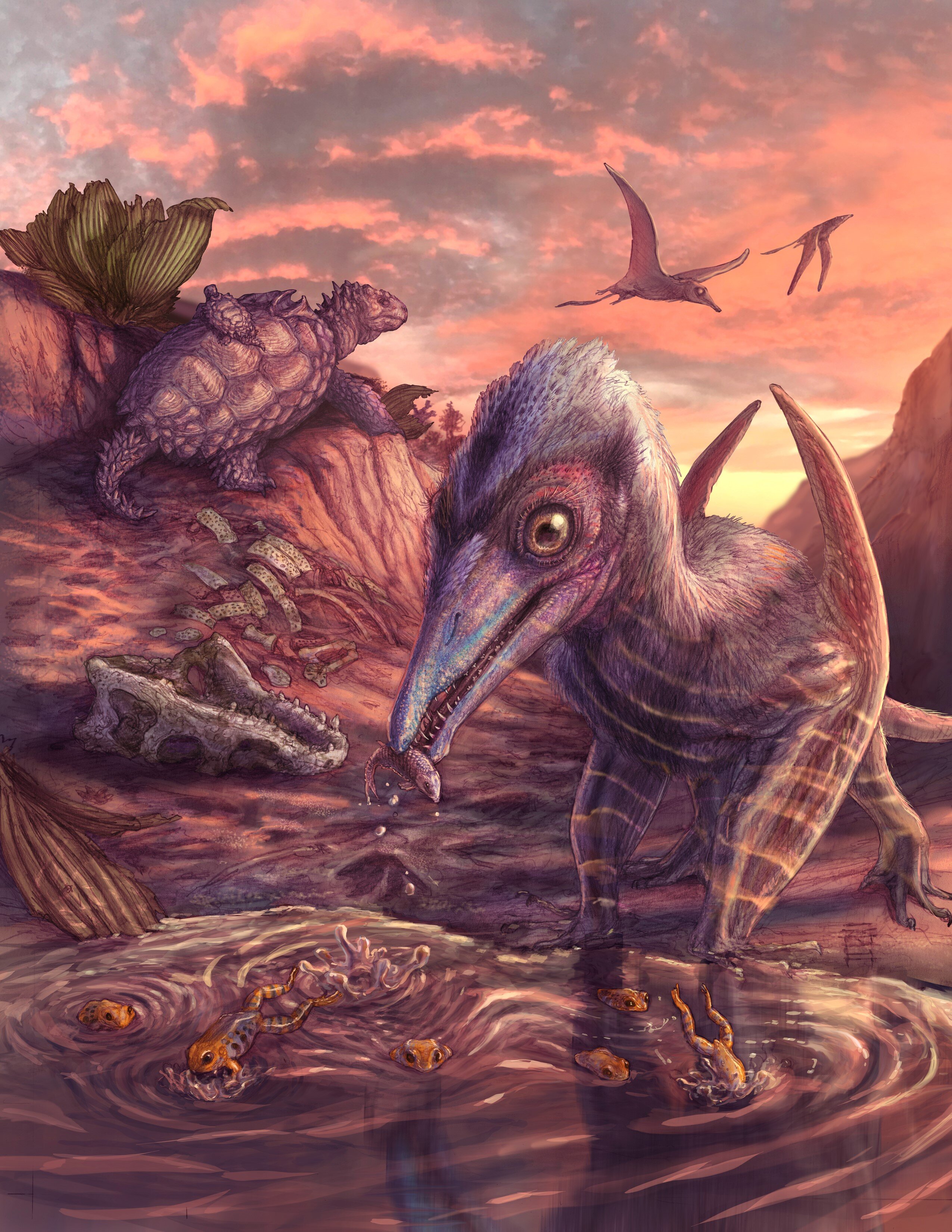
life restoration of Eotephradactylus mcintireae catching a fish in the Chinle Formation environment.
An artist's reconstruction of the fossilized landscape, plants and animals found preserved in a remote bonebed in Petrified Forest National Park in Arizona. Researchers led by paleontologist Ben Kligman,, present the fossilized jawbone of a new pterosaur species and describe the sea gull-sized flying reptile along with hundreds of other fossils they unearthed from the site. These fossils, which date back to the late Triassic period around 209 million years ago, preserve a snapshot of a dynamic ecosystem where older groups of animals lived with evolutionary upstarts.
The newly described pterosaur Eotephradactylus mcintireae is seen eating an ancient ray-finned fish alongside an early species of turtle and an early frog species, with the skeleton of an armored crocodile relative lying on the ground and a palm-like plant growing in the background.
artwork: Brian Engh.

Eotephradactylus mcintireae gen. et sp. nov.


Ben T. Kligman, Robin L. Whatley, Jahandar Ramezani1, Adam D. Marsh, Tyler R. Lyson, Adam J. Fitch, William G. Parker and Anna K. Behrensmeyer. 2025. Unusual Bone Bed reveals A Vertebrate Community with Pterosaurs and Turtles in equatorial Pangaea before the end-Triassic Extinction. Proceedings of the National Academy of Sciences. 122 (29) e2505513122. DOI: doi.org/10.1073/pnas.2505513122 [July 7, 2025]

Friday, June 13, 2025

[Paleontology • 2025] Spathagnathus roeperi • A New Species and the earliest Occurrence of the Gnathosaurinae (Pterosauria) from the Late Kimmeridgian of Brunn, Germany


Spathagnathus roeperi
 Fernandes, Tischlinger, Rothgaenger & Rauhut, 2025

Artistic reconstruction by Alessio Ciaffi
 
Abstract
The so-called “Solnhofen limestones” of southern Germany are widely recognized for their abundance of Late Jurassic fossil vertebrates, with pterosaurs being no exception. Within the recognized plenitude of the pterosaurs within this assemblage, although ctenochasmatid remains are relatively abundant, gnathosaurines are scarce, with only one known Solnhofen representative of the group known thus far. The Late Kimmeridgian locality of Brunn (near Regensburg, Germany) represents the oldest locality of the Solnhofen complex (“Solnhofen Archipelago” in recent literature), with only one pterosaur having been described from this locality to date. Here, a second pterosaur taxon from within this locality and a new gnathosaur is introduced, Spathagnathus roeperi gen. et sp. nov., whose novel tooth and dental enamel features add to the known dental diversity for the group. The new taxon represents the oldest occurrence of a gnathosaurine and contributes to the paleoenvironmental stratigraphic range for the Gnathosaurinae within the overall fossil assemblage of the Solnhofen Archipelago. Furthermore, the new taxon adds to the known diversity of ctenochasmatids in the Late Jurassic and underlines the importance of this early radiation of pterodactyloid pterosaurs during this time.

Keywords: Pterosauria, Gnathosaurinae, Mesozoic, Jurassic, Germany, Solnhofen Archipelago

SNSB-BSPG 1993 XVIII 1006 Spathagnathus roeperi gen. et sp. nov. photographed under normal light (A) and UV light (B).
Scale bar represents: 10 mm

Systematic paleontology
Order PTEROSAURIA Owen, 1842
Suborder PTERODACTYLOIDEA Plieninger, 1901

Family CTENOCHASMATIDAE Nopcsa, 1928 sensu Unwin, 2003
Subfamily GNATHOSAURINAE Nopcsa, 1928 sensu Unwin, 2002

Genus Spathagnathus gen. nov.

Spathagnathus roeperi gen. et sp. nov.

Diagnosis (autapomorphies indicated with asterisk). dorsoventrally compressed rostrum with lateral spatulate expansion on the anterior end of the premaxilla, laterally directed musiform teeth, tooth girth increasing from anterior to posterior end of the rostrum, dental enamel coating approximately half of tooth crowns, strongly veined enamel texture on tooth surface, presence of carinae.

Etymology. From the Latin “spatha” for “spatula”, and “gnath” for “jaw”; “roeperi” in honor of the late Martin Röper, long term director of the Bürgermeister-Müller-Museum in Solnhofen and leader of the excavations at the locality Brunn since the early 1990’s.

Artistic reconstruction of Spathagnathus roeperi by Alessio Ciaffi
 
 
Alexandra E. Fernandes, Helmut Tischlinger, Monika Rothgaenger and Oliver W. M. Rauhut. 2025. A New Species and the earliest Occurrence of the Gnathosaurinae (Pterosauria) from the Late Kimmeridgian of Brunn, Germany. PalZ. DOI: doi.org/10.1007/s12542-025-00725-0 [06 June 2025]


Saturday, March 29, 2025

[Paleontology • 2025] Garudapterus buffetauti • First gnathosaurine (Pterosauria: Ctenochasmatidae) from the Early Cretaceous of eastern Thailand


 Garudapterus buffetauti
 Manitkoon, Pêgas, Nonsrirach, Warapeang, Lauprasert, Deesri, Tumpeesuwan, Wongko & Zhou, 2025
การูแดปเทอรัส บุฟโตติ  ||  
 
Abstract
Pterosaur fossils in the Mesozoic formation of Southeast Asia are very scarce. A few articles reported isolated teeth and a handful of postcranial elements in northeastern Thailand. Here we report on a pterosaur upper jaw from the Early Cretaceous at Phra Prong locality of eastern Thailand, which is considered the lateral equivalent of the Sao Khua Formation of the Khorat Group. This represents the first pterosaur cranial material in Thailand. It comprises a partial rostrum, preserving eleven tooth positions, and four associated tooth crowns. The anterior tip of the rostrum is dorsoventrally flattened and laterally expanded (spoon-shaped), indicating affinities to the Gnathosaurinae (Ctenochasmatidae). Alveoli borders are conspicuously scalloped and collar-like, and the palatal surface exhibits a pair of sinusoidal grooves. These features bear a strong resemblance to the Late Jurassic gnathosaurines Gnathosaurus subulatus, Tacuadactylus luciae, and Lusognathus almadrava. Our phylogenetic analysis indicates that the Thai pterosaur is closely related to these gnathosaurines. Still, the Thai gnathosaurine is unique in exhibiting a kite-shaped rostrum expansion and is recognized as a new taxon herein named Garudapterus buffetauti gen. et sp. nov. This new specimen provides essential information regarding pterosaurs, including updated data for a better understanding of their diversity and distribution throughout Southeast Asia.


Systematic Palaeontology
Pterosauria Owen, 1842
Pterodactyloidea Plieninger, 1901
Ctenochasmatoidea Unwin, 1995

Ctenochasmatidae Nopcsa, 1928
Gnathosaurinae Nopcsa, 1928
 
Garudapterus gen. nov.

Garudapterus buffetauti gen. et sp. nov. 

Conclusions: 
The new specimen, which represents the first pterosaur skull material ever recovered from Southeast Asia, exhibits several anatomical features that allow for a confident assignment to the Gnathosaurinae (Pterodactyloidea, Ctenochasmatoidea), most importantly a spatulate rostrum containing a large number of lateralized alveoli. Being quite distinguishable from other members of this group, the new specimen is herein recognized as a new genus and species, named Garudapterus buffetauti gen. et sp. ...


Sita Manitkoon, Rodrigo V. Pêgas, Thanit Nonsrirach, Prapasiri Warapeang, Komsorn Lauprasert, Uthumporn Deesri, Sakboworn Tumpeesuwan, Kamonlak Wongko and Xuanyu Zhou. 2025. First gnathosaurine (Pterosauria, Pterodactyloidea) from the Early Cretaceous of eastern Thailand. Cretaceous Research. In Press, 106135. DOI: 10.1016/j.cretres.2025.106135
 facebook.com/DinoThaiThai/videos/642396331745015

Wednesday, March 12, 2025

[Paleontology • 2025] Darwinopterus camposi • A New Species of Darwinopterus (Pterosauria: Wukongopteridae) from western Liaoning provides some new information on the Ontogeny of this clade


Darwinopterus camposi
Cheng, Jiang, Bantim, Sayão, Saraiva, Meng, Kellner & Wang, 2025
 

Abstract
The Wukongopteridae is an important pterosaur clade from the Yanliao Biota, combining features of basal and derived pterosaurs. So far, the Wukongopteridae consists of five species divided into three genera: Wukongopterus lii, Darwinopterus modularis, Darwinopterus linglongtaensis, Darwinopterus robustodens, and Kunpengopterus sinensis. Here we report a new species, Darwinopterus camposi sp. nov., based on an almost complete skeleton (IVPP V 17957). The new species is referred to Darwinopterus due to the presence of an elongated posterior region of the skull and the bony premaxillary crest that starts about the anterior margin of the nasoantorbital fenestra. It differs from all other wukongopterids by having the dorsal margin of the premaxillary crest straight, without an extensive dorsal projection and presenting a smooth lateral surface. Furthermore, D. camposi sp. nov. has eighteen and fourteen teeth on each side of the upper and lower jaws, respectively, and the fourth phalanx of the wing finger shorter than the first. IVPP V 17957 shows some fused postcranial bones, like the extensor tendon process to the first wing finger phalanx, but also has unfused premaxilla and frontal, which provides further information about wukongopterid ontogeny.

Key words: Pterosauria; Wukongopteridae; ontogeny; Yanliao Biota; Middle-Late Jurassic; China


SYSTEMATIC PALEONTOLOGY
Pterosauria Kaup 1834
Wukongopteridae Wang, Kellner, Jiang and Meng 2009

Darwinopterus Lü, Unwin, Jin, Liu and Ji 2010

Darwinopterus camposi sp. nov.

 Holotype: Almost complete skeleton lacking the distal end of the tail and hindlimbs, housed at the Institute of Vertebrate Paleontology and Paleoanthropology, Beijing, under the number IVPP V 17957 (Figs. 1-Fig. 4).

Etymology: In honor to Dr. Diogenes de Almeida Campos, an important geologist and vertebrate paleontologist who has contributed to pterosaur research and the cooperation between Brazilian and Chinese paleontologists.


Cheng, X.; Jiang, S.; Bantim, R. A. M.; Sayão, J. M.; Saraiva, A. Á. F.; Meng, X.; Kellner, A. W. A.; Wang, X. 2025. A New Species of Darwinopterus (Wukongopteridae, Pterosauria) from western Liaoning provides some new information on the Ontogeny of this clade. Anais da Academia Brasileira de Ciências. 97 (Suppl. 1). e20240707. DOI: doi.org/10.1590/0001-3765202520240707

Wednesday, March 5, 2025

[Paleontology • 2025] Infernodrakon hastacollis • A New azhdarchid Pterosaur from the Hell Creek Formation of Montana, and the pterosaur diversity of Maastrichtian North America

  
Infernodrakon hastacollis
Thomas, Hone, Gomes & Peterson, 2025

 Illustration by Jun-Hyeok Jang.

ABSTRACT
A considerable number of azhdarchid pterosaur fossils have been recovered from Maastrichtian deposits of North America. Historically, most of these specimens have been referred to Quetzalcoatlus based on a preliminary understanding of the genus. Further study of Quetzalcoatlus and other azhdarchids has increased our understanding of the anatomy and diversity of the clade, and warrants reappraisal of specimens previously referred to this genus. Here we redescribe an azhdarchid cervical vertebra recovered from the Maastrichtian Hell Creek Formation of Montana, U.S.A. Digitization of this specimen via laser scanning allows a more detailed assessment and reconstruction of this specimen’s morphology, revealing both unique characters and unique character combinations. We therefore assign this specimen to a new genus and species of medium-sized azhdarchid, Infernodrakon hastacollis gen. et sp. nov. Phylogenetic analysis recovers Infernodrakon as more closely related to Arambourgiania than to Quetzalcoatlus. Review of Maastrichtian azhdarchid material from North America reveals a high diversity despite the relatively fragmentary fossil record for this clade.

Speculative life restoration of Infernodrakon hastacollis (unknown anatomy based on Quetzalcoatlus lawsoni) foraging.
 Illustration by Jun-Hyeok Jang.

Infernodrakon hastacollis gen. et sp. nov.


Henry N. Thomas, David W. E. Hone, Timothy Gomes and Joseph E. Peterson. 2025. Infernodrakon hastacollis gen. et sp. nov., A New azhdarchid Pterosaur from the Hell Creek Formation of Montana, and the pterosaur diversity of Maastrichtian North America. Journal of Vertebrate Paleontology. e2442476. DOI: doi.org/10.1080/02724634.2024.2442476  
Welcome Infernodrakon – a new azhdarchid

Friday, January 24, 2025

[Paleontology • 2025] Osteology and Functional Morphology of a transitional Pterosaur Dearc sgiathanach from the Middle Jurassic (Bathonian) of Scotland


Dearc sgiathanach
Jagielska, O’Sullivan, Funston, Butler, ... et Brusatte, 2022 

 in Jagielska, O’Sullivan, Butler, Challands, Funston, Ross, Penny et Brusatte, 2025. 
 Illustration: Natalia Jagielska  x.co m/WryCritic

Abstract
Pterosaurs were the first vertebrates to evolve active flight. The lack of many well-preserved pterosaur fossils limits our understanding of the functional anatomy and behavior of these flight pioneers, particularly from their early history (Triassic to Middle Jurassic). Here we describe in detail the osteology of an exceptionally preserved Middle Jurassic pterosaur, the holotype of Dearc sgiathanach from the Isle of Skye, Scotland. We identify new autapomorphies of the flight apparatus (humerus and sternum), which further support the distinctiveness of Dearc compared with other early-diverging pterosaurs and describe features, such as the vertebral morphology, shared with later-diverging pterosaurs that probably developed convergently to support a large body size or as a sign of modular evolution. We used extant phylogenetic bracketing to infer the principal cranial and antebrachial musculature, indicating that Dearc had large and anteriorly placed palatal musculature that compensated for weak temporal jaw adductors and wing musculature suggestive of flight style reliant on powerful adduction and protraction of the humerus. Comparisons with other pterosaurs revealed that non-pterodactyloids such as Dearc, despite their overall conservative bauplans, adapted various flight and feeding styles. The osteology and myology of Dearc are indicative of a large predator that flew and hunted above lagoons and nearshore environments of the Middle Jurassic.

Keywords: Flight, Evolution, Jurassic, Pterosaur, Palaeontology

Systematic paleontology
Pterosauria Owen, 1842  
Breviquartossa Unwin, 2003  
Angustinaripterini He, 1983  
 
Dearc sgiathanach Jagielska et al. 2022  


A photograph and corresponding illustration of NMS G.2021.6.
A a photograph of NMS G.2021.6.1 or “the main slab” showcasing the postcranial material in the dorsal view, presented in white in the illustration; B a photograph of NMS G.2021.6.2, a three-dimensional skull with the anterior-most cervical vertebra, highlighted in blue in the illustration; C a photograph of NMS G.2021.6.3 or “the counterslab” of the postcranial material in ventral orientation, highlighted in orange in the illustration; D a photograph of NMS G.2021.6.4 showcasing a singular third wing phalange in the lateral view, highlighted in green in the illustration. Scale bar 30 mm


Natalia Jagielska, Michael O’Sullivan, Ian B. Butler, Thomas J. Challands, Gregory F. Funston, Dugald Ross, Amelia Penny and Stephen L. Brusatte. 2025. Osteology and Functional Morphology of a transitional Pterosaur Dearc sgiathanach from the Middle Jurassic (Bathonian) of Scotland. BMC Ecology and Evolution. 25: 9.  DOI: doi.org/10.1186/s12862-024-02337-9

Wednesday, December 11, 2024

[Paleontology • 2024] Melkamter pateko • The Oldest monofenestratan Pterosaur from the Queso Rallado locality (Cañadón Asfalto Formation, Toarcian) of Chubut Province, Patagonia, Argentina


 Melkamter pateko
 Fernandes, Pol & Rauhut, 2024 

Artistic reconstruction by Pedro Andrade.
 
Abstract
As the first group of tetrapods to achieve powered flight, pterosaurs first appeared in the Late Triassic. They proliferated globally, and by the Late Jurassic through the Cretaceous, the majority of these taxa belonged to the clade Monofenestrata (which includes the well-known Pterodactyloidea as its major subclade), typified by their single undivided fenestra anterior to the orbit. Here, a new taxon Melkamter pateko gen. et sp. nov., represented by the specimen MPEF-PV 11530 (comprising a partial cranium and associated postcranial elements), is reported from the latest Early Jurassic (Toarcian) locality of Queso Rallado (Cañadón Asfalto Formation) and referred to the clade Monofenestrata, increasing our previously known taxonomic and geographic representations, and temporal range for this clade. This occurrence marks the oldest record of Monofenestrata globally and helps to shed critical light on the evolutionary processes undergone during the ‘non-pterodactyloid’-to-pterodactyloid transition within the Pterosauria. In addition, another single isolated tooth from the same locality shows ctenochasmatid affinities. These finds further elucidate the still-poor Gondwanan Jurassic pterosaur fossil record, underscoring that most of our current ideas about the timing and modes of pterosaur evolution during that period are largely based on (and biased by) the pterosaur fossil record of the Northern Hemisphere.

Keywords: Pterosauria, Monofenestrata, Jurassic, Toarcian, Patagonia, Argentina

  Comparison of (a) Darwinopterus linglongensis (IVPP V16049; mirror-imaged for comparison), (b) Melkamter pateko, and the newly- prepared left side of (c) Cuspicephalus scarfi.
Scale bars are 1 cm.

 Systematic palaeontology
PTEROSAURIA Owen, (1842) 
MONOFENESTRATA Lü et al. (2010) sensu Andres et al. (2014)

Genus Melkamter, gen. nov.

 Melkamter pateko, sp. nov.

  Etymology: Genus name ‘Melkamter’ from the native Tehuelche word ‘mel’ meaning (in Spanish/English) ‘ala/wing’ and ‘kamter’ meaning ‘lagarto grande/big lizard’ (after the original translation of ‘pterosaur’ as ‘winged lizard’); the species epithet ‘pateko’ is derived from ‘pate’ meaning ‘rallado/rasped’ and ‘ko’ meaning ‘conjunto de huesos/set of bones’, an ode to both to the site of Queso Rallado, and the fractured preservational state of the fossil (translations from [60]).

Holotype: MPEF-PV 11530 (Museo Paleontólogico Egidio Feruglio, Trelew, Argentina), consisting of at least a partial cranium (with counterslab) and two associated teeth, four dorsal vertebrae, one metacarpal (either I, II or III) and other bone fragments.

 Type locality and Horizon: Locality Queso Rallado, close to Cerro Cóndor, northern central Chubut Province, Argentina. Lower section of the Cañadón Asfalto Formation, latest Early Jurassic, Toarcian.

 Diagnosis: Non-pterodactyloid monofenestratan with a confluent naris and anteorbital fenestra and quadrate inclined at about 120°. Autapomorphies include: the presence of a small vestigial ascending process in the maxilla that does not reach the nasal or lacrimal dorsally; a maxillary body anterior to the vestigial ascending process that is higher than a posterior portion, with both portions divided by the vestigial ascending process delimited by a marked step; lacrimal and posterior processes of the jugal offset at about 55° angle. The taxon can furthermore be diagnosed by a combination of characters, including the marked dorsal deflection of the dorsal margin of the skull at the beginning of the nasoantorbital fenestra, resulting in a concave rather than straight outline of the dorsal skull margin in this region in lateral view, and the pointed anterior process of the quadratojugal that separates the posterior ends of the jugal and the maxilla.

 Artistic reconstruction of  Melkamter pateko 
by Pedro Andrade.


Alexandra E. Fernandes, Diego Pol and Oliver W. M. Rauhut. 2024. The Oldest monofenestratan Pterosaur from the Queso Rallado locality (Cañadón Asfalto Formation, Toarcian) of Chubut Province, Patagonia, Argentina. R. Soc. Open Sci.11: 241238. DOI: doi.org/10.1098/rsos.241238