Showing posts with label Bangladesh. Show all posts

Tuesday, November 30, 2021

[Herpetology • 2020] Megophrys awuh, M. dzukou & M. numhbumaeng • Taxonomic Review of the Asian Horned Frogs (Anura: Megophryidae: Megophrys) of Northeast India and Bangladesh previously misidentified as M. parva (Boulenger), with Descriptions of Three New Species


Megophrys (Xenophrys)  numhbumaeng 
Mahony, Kamei, Teeling & Biju, 2020


ABSTRACT
Megophrys parva is currently considered to be among the most widely dispersed species within the genus, however, recent studies have provided compelling evidence that this species represents a complex of morphologically similar, deeply divergent taxa. The focus of this paper is to take a closer look at species from Northeast India (NEI) and Bangladesh that are currently, or were until recently, considered to represent M. parva, now comprising the M. (Xenophrysmegacephala species group. We investigate their troublesome taxonomic histories, identify hidden cryptic species diversity using morphological and molecular data, and resolve many of the historical misidentifications that have led to a proliferation of taxonomic confusion in this group. Molecular analyses extend the geographic distribution of the M. (X.) megacephala species group east into northern Myanmar based on available sequence data.

A detailed redescription of the paralectotypes of M. parva is provided to better define this poorly known species. The geographic distributions of the taxonomically obscure species, M. serchhipii and M. zunhebotoensis, are extended far beyond their respective type localities, and both are considerably better defined taxonomically based on detailed descriptions of referred specimens, and comparison with relevant congeners. Significant geographic range extensions are also provided for the recently described species M. oropedion and M. megacephala. Three new species from the Indian states of Nagaland and Manipur are identified using a combination of morphological characters, supported by significant genetic divergence. Examination of historical specimen collections and scrutiny of published literature provide sufficient evidence to remove M. parva and M. wuliangshanensis from the checklist of Indian species. Previous records of M. parva from Bangladesh are demonstrated to represent M. serchhipii. Recent reports of M. glandulosa and M. robusta from Meghalaya are also revised and are considered to be based on misidentifications of known species from the state. The revised distributions of NEI’s small-sized horned frogs provide insights into the biogeography of the group. One of the newly described species known only from the high-elevation Dzükou Valley, Nagaland, might require immediate conservation action due to increased tourist activity at its type locality.

KEYWORDS: Anura, taxonomy, systematics, molecular phylogenetics, conservation


Megophrys (Xenophrysparva (Boulenger, 1893)

Etymology. The specific epithet is Latin, derived from ‘parvus’, meaning ‘little’.

Suggested common name. Many common names have been suggested for M. parva that either describe morphological characters not found on this species (e.g. Burmese Spadefoot Toad [Frank and Ramus 1995]; Brown Spine-Eyed Frog [Nutphund 2001]), or are ambiguously descriptive (e.g. Tubercular Breasted Frog [Chanda 2002]; see Frost [2019, online] for others). We suggest ‘Little Karen Hills Horned Frog’ as the common name for this species since it is currently the only small-sized species of Megophrys named from the Karen Hills.


Megophrys (Xenophrys) ancrae Mahony, Teeling & Biju, 2013 

Suggested common name. We suggest ‘Namdapha Horned Frog’ based on the species’ type locality.

Distribution. This species is thus far known only from the type locality and surrounding foothill areas (330–790 m asl.) in Namdapha National Park and Tiger Reserve in Changlang district of eastern Arunachal Pradesh, NEI (Figure 2; Mahony et al. 2013).


Megophrys (Xenophrys) megacephala Mahony, Sengupta, Kamei & Biju, 2011

Suggested common name. Big Headed Indian Horned Frog (Mahony et al. 2011), since this species attains proportionately the largest head relative to body size of all Indian Megophrys species. 


  Megophrys awuh sp. nov. 
 adult male (SDBDU 2007.111: SVL 35.7 mm) in life
from Jakhama village, Kohima district, Nagaland state, India

Megophrys (Xenophrysawuh sp. nov. 

Etymology. The specific epithet ‘awuh’ is treated as a noun in apposition taken from the Pochury language, meaning ‘frog’. The Pochury tribe are the native inhabitants of Meluri circle in Nagaland state, within which the type locality lies. 

Suggested common name. We suggest ‘Naga Hills Horned Frog’ for this species based on its currently known distribution.


Megophrys dzukou sp. nov.  
 adult male holotype (BNHS 6072: SVL 34.2 mm) in life, 
from Kohima district, Nagaland state, India.

Megophrys (Xenophrysdzukou sp. nov.

Etymology. The specific epithet ‘dzukou’ is a toponym based on the type locality of Dzükou Valley. The name is treated as a noun in apposition. 

Suggested common name. We suggest ‘Dzükou Valley Horned Frog’ as a suitable English language common name. 


Megophrys numhbumaeng sp. nov.
adult male holotype (BNHS 6075: SVL 34.6 mm) in life
from Tamenglong district, Manipur state, India 

Megophrys (Xenophrys) numhbumaeng sp. nov.

Etymology. The specific epithet is treated as a noun in apposition, and the phonetic derivative of a portmanteau word ‘nwmbwmaeng’ from the Rongmei (N-ruangmei) language, the dominant tribal language in the Tamenglong district of Manipur state. The word ‘nwm-’ means forest, and ‘bwmaeng’ means spirit, alluding to the species’ phantomish nature eluding the field researchers on at least three visits to the locality in the presumably (early) breeding season. For correct pronunciation of the species epithet, ‘numhbumaeng’ (pronounced noom-boo-meng) would be the phonetic spelling of the name. 

Suggested common name. We suggest ‘Tamenglong Horned Frog’ based on the species’ type locality being in the Manipur state, Northeast India. 


Megophrys (Xenophrys) oropedion Mahony, Teeling & Biju, 2013

Suggested common name. Since this species is currently endemic to Meghalaya state, and is the smallest species found there, we suggest the common name ‘Little Meghalayan Horned Frog’


Megophrys (Xenophrys) serchhipii (Mathew & Sen, 2007) 

Etymology. According to Mathew and Sen (2007), the specific epithet ‘serchhipii’ is a toponym after the locality where the holotype specimen was collected, but it is unclear how the name was coined. If the locality name was to be treated as a noun in apposition, it would be given as ‘serchhip’, otherwise a typical genitive termination for this toponym would be -ensis (e.g. ‘serchhipensis’ meaning ‘from Serchhip’). However, the suffix -i or -ii are typically used in cases of names formed from personal names. The locality name, Serchhip, means ‘citrus[trees]-on-top [of the first hill of the then Serchhip village, which now included New Serchhip and Chhiahtlang villages]’, and so the specific epithet spelling appears to be a case of incorrect Latinisation. Since it is essentially without meaning, the name falls within the category of an ‘arbitrary combination of letters’ (ICZN 1999: Article 11.3). In any case, the original spelling cannot be emended to correspond with its originally proposed etymology (e.g. to ‘serchhipensis’), and must be retained as the ‘correct original spelling’ according to the Code (ICZN 1999: Articles 11.3 & 32.5.1).

 Suggested common name. The previously suggested common names ‘Serchhipii Horned Frog’ Dinesh et al. (2009) and ‘Serchhip’s Horned Toad’ (Mathew and Sen 2010) are based either on an arbitrary combination of letters (i.e. ‘Serchhipii’), or confusingly indicate that the name might be based on a genitive, as the spelling of the species epithet suggests (see ‘Etymology’ section above). To avoid such confusion, we suggest ‘Common Warty Horned Frog’ as a suitable and simple alternative common name for this species since it is widespread in northeast India south/east of the Brahmaputra River and is so far the only Megophrys species confirmed from Bangladesh. It is also the most tuberculate (or ‘warty’) species found in the region


Megophrys (Xenophrys) zunhebotoensis (Mathew & Sen, 2007)

Etymology. The specific epithet ‘zunhebotoensis’ is a toponym after the locality where the type specimens were collected. 

Suggested common name. ‘Zunheboto Horned Frog’ has been suggested by Dinesh et al. (2009). 


Stephen Mahony, Rachunliu G. Kamei, Emma C. Teeling and S. D. Biju. 2020. Taxonomic Review of the Asian Horned Frogs (Amphibia: Megophrys Kuhl & Van Hasselt) of Northeast India and Bangladesh previously misidentified as M. parva (Boulenger), with Descriptions of Three New Species. Journal of Natural History. 54(1-4 - Amphibian taxonomy: Early 21st century case studies); DOI: 10.1080/00222933.2020.1736679 

Monday, August 23, 2021

[Ichthyology • 2021] Glaucostegus younholeei • A New Species of Giant Guitarfish (Rhinopristiformes: Glaucostegidae) from the northern Bay of Bengal, Bangladesh


Glaucostegus younholeei
Habib & Islam, 2021


Abstract
A new species of giant guitarfish, Glaucostegus younholeei sp. nov., is described from 13 specimens, 730–933 mm total length, collected from fish landing center of Bangladesh Fisheries Development Corporation in Cox’s Bazar district of Bangladesh. The new species is distinguished from congeners in having the following combination of characters: Body brownish or greyish in color with a narrowly wedge-shaped disc, and long narrow bluntly pointed snout (angle 31–40°), and broad oblique nostrils with the narrow anterior opening. Nostrils about half of the mouth width, subequal (0.98–1.33) to internasal width; ~55–57 nasal lamellae; anterior nasal flaps slightly penetrating into internasal space, their interspace 2.20– 2.61 in length of the posterior nasal aperture. Orbit very small in adults, diameter 8.19–11.62 in preorbital length, 2.25–2.69 in interorbital space. Rostral ridges almost joined along their entire length; margin of cranium sharply demarcated before eyes. Spiracular folds very short and widely separated. Skin rough, densely covered with small denticles, more coarsely granular on the dorsal surface than ventrally, enlarged between orbits and in a distinct band between nape and first dorsal fin. Tail relatively longer, length 1.15–1.48 in disc length; dorsal fins narrowly spaced, interspace 1.32–2.11 in base length of the first dorsal fin. Clasper length in adult male 4.37–5.70 in total length. Phylogenetic analysis of DNA barcode sequences also shows the clear divergence of Glaucostegus younholeei from other congeneric species obtained from GenBank. A key is provided to the 8 known members including new species of the genus Glaucostegus.

Keywords: Pisces, Bangladeshi guitarfish, taxonomy, morphology, DNA Barcoding, Vulnerable


Glaucostegus younholeei sp. nov.


Kazi Ahsan Habib and Md Jayedul Islam. 2021. Description of A New Species of Giant Guitarfish, Glaucostegus younholeei sp. nov. (Rhinopristiformes: Glaucostegidae) from the northern Bay of Bengal, Bangladesh. Zootaxa. 4995(1); 129-146. DOI: 10.11646/zootaxa.4995.1.7

Sunday, August 22, 2021

[Herpetology • 2021] Phrynoglossus swanbornorum • A New Species of Phrynoglossus Peters, 1867 (Anura: Dicroglossidae) from southeastern Bangladesh, with Comments on the Genera Occidozyga and Phrynoglossus


Phrynoglossus swanbornorum
Trageser​, Al-Razi​, Maria, Nobel, Asaduzzaman & Rahman, 2021


Abstract 
We describe a new cryptic species of Phrynoglossus from Chattogram Division, Bangladesh based on an integrative taxonomic analysis based on morphology, phylogenetics, and bioacoustics which unambiguously support the placement of the species in the genus Phrynoglossus. We also present a compilation of published morphological characters for all twelve Phrynoglossus species and two species of Occidozyga as well as comments on taxonomy, morphology, and geographic distribution for the two genera. The new species is found to be most morphologically similar to P. martensii, however a provided set of character states visibly differentiates these two species. Finally, habitat for Phrynoglossus swanbornorum sp. nov. is highly fragmented and faces imminent threats from development and agriculture, and although it is confirmed to occur within government protected areas in the southeastern region of Bangladesh, few wildlife regulations are enforced within them. Thus, following IUCN criteria, we consider the new species as Endangered based on criteria B1ab(i,ii,iii,iv) + 2ab(i,ii,iii,iv).


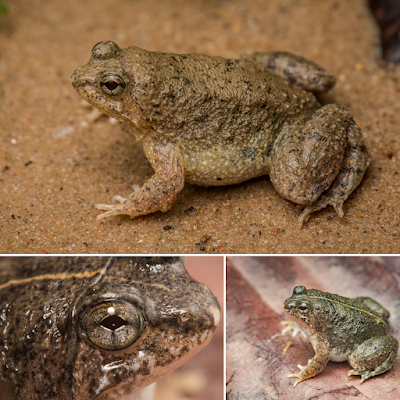
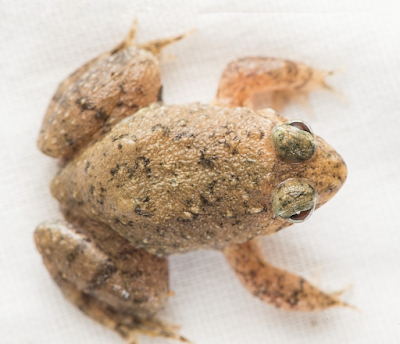
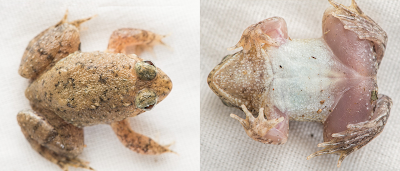
Figure 3:  Phrynoglossus swanbornorum sp. nov.
live holotype JnUZool-A0719.

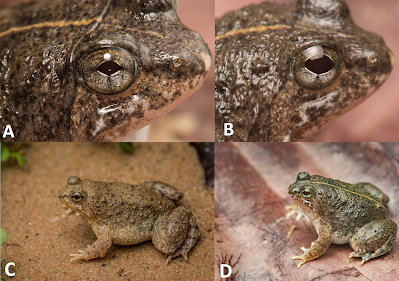
Figure 5: Phrynoglossus swanbornorum sp. nov. individuals, in life.
(A) Individual 1 with diamond shaped pupil (B) individual 1 with ovoid shaped pupil
(C) individual 2 exhibiting no dorsolateral line (D) individual 1 exhibiting dorsolateral line.

Phrynoglossus swanbornorum sp. nov.
 
Recommended vernacular name. English: Swanborn’s Puddle Frog. 
Bangla: “Chattgai ar gata bang,” which translates to
English as “puddle frog from Chattogram.”

Generic placement. The new species is assigned to the genus Phrynoglossus based on the following combination of shared adult characters: lacking vomerine teeth and exhibiting a stocky habitus, flattened snout, dorsum or flanks with scattered tubercles, short arms, nuptial pads, horizontal pupils, bony style, forked omosternum, pigmented eggs, distinct or indistinct supratympanic fold, reduced to absent metacarpal webbing, moderate to extensive metatarsal webbing, an elongated inner metatarsal tubercle, indistinct and small tympanum, feebly to moderately developed toes discs, SVL between 15 mm and 61.6 mm in length, and females are larger than males. These adult characters agree with previous descriptions of the genus (see discussion; Taylor, 1962; Iskandar, 1998; Sailo et al., 2009; Inger et al., 2017; Poyarkov et al., 2020; Köhler et al., 2021). Larval characters are unknown.

Diagnosis. The new species presents the following characteristics: (1) relatively small sized Phrynoglossus (adult males = 23.15–28.56 mm SVL, adult female = 30.56 mm); (2) stocky habitus; (3) short arms relative to body size (FLL/SVL 0.19%; range 0.18−0.20%, n = 5); (4) head wider than long (HL/HW 0.73%; range 0.69−0.77%, n = 5); (5) snout slightly projecting, triangular in ventral aspect, smaller than horizontal diameter of eye, and flat in lateral aspect; (6) nostril closer to tip of snout than to eye (NS 0.48−0.51 mm, EN 0.92–109 mm); (7) brown dorsum transitioning to brownish grey on flanks with black speckling concentrated around scattered tubercles, nares, mouth, and above eyes; (8) venter uniform cream white, becoming brown with white mottling and groups of minute dark-grey flecks present in the gular region; (9) tuberculate dorsum; (10) laterally oriented eyes and nares; (11) horizontal pupils; (12) vomerine teeth absent; (13) tongue rounded without notch behind; (14) vocal sac single, median, internal, and subgular in males; (15) canthus rostralis rounded; (16) tympanum indistinct, small, and rounded; (17) supratympanic fold distinct and transverses interorbitally at the posterior edge of the eye; (18) fingertips rounded without discs; (19) nuptial pads present in males; (20) palmar tubercles present; (21) metacarpal webbing absent; (22) toe discs feebly developed; (23) inner metatarsal tubercle elongated and compressed, present at base of 1st toe; (24) fringe of skin on outer side of fifth metatarsal absent; (25) tarsal tubercle absent; (26) tarsal fold absent; (27) metatarsal webbing moderate; and (28) lateral line absent. Details of these characteristics are provided in Table 3.

Etymology. The specific patronym epithet “swanbornorum” is in genitive plural and refers to members of the Swanborn family, who are generous supporters of the conservation efforts of the Creative Conservation Alliance.

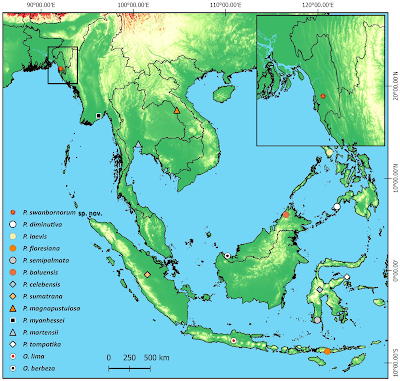
Distribution. Phrynoglossus swanbornorum sp. nov. is currently only confirmed to occur within the Chunati Wildlife Sanctuary (21.937533 N, 92.063010 E), Chattogram District at an elevation of ca. 33 m and Teknaf Wildlife Sanctuary (20.887020 N, 92.298954 E), Cox’s Bazar District at an elevation of ca. 26 m (Fig. 1).

Natural history: Phrynoglossus swanbornorum sp. nov. is only known to inhabit lowland, coastal, mixed-evergreen forests of southeast Bangladesh, which are bounded to the east by the mountainous Chattogram Hill Tracts. Within this habitat, Phrynoglossus swanbornorum sp. nov. has only been observed near lentic water bodies under dense forest canopy and was notably absent from surrounding agricultural fields and degraded forest. An image of P. swanbornorum sp. nov. in amplexus (see Distribution; Ahm, 2014) demonstrates that this species exhibits inguinal amplexus. Additionally, eggs from the single collected female were pigmented.


Figure 6: Type localities of all 14 species of Occidozyga and Phrynoglossus species.

Conclusions: 
We provide morphological, molecular, and bioacoustic evidence that support the validity of the new species, Phrynoglossus swanbornorum sp. nov. This species is currently only confirmed from a relatively small area in southeastern Bangladesh and is considered to have a high risk of extinction due to conspicuous and ongoing threats to the habitat it relies on. We also review and discuss inconsistencies in the literature regarding the genera Phrynoglossus and Occidozyga, particularly that of morphological characters and provide more accurate generic diagnoses for both.

Although multiple species of Phrynoglossus and Occidozyga are generally perceived to be widespread and common, this study adds to a growing body of literature demonstrating the existence of undescribed diversity within the genus, thereby masking the true extinction risk of these species (Mulcahy et al., 2018). We suggest further research be conducted to either rectify incongruent descriptions of diagnostic characters and/or better understand intraspecific variation within the genus as well as including additional nuclear genetic data. Doing so could result in further refinement of the provided generic diagnoses. We also suggest that further surveys be conducted in the northern part of Chattogram Hill Tracts, Bangladesh e.g., Pablakhali Wildlife Sanctuary and Kassalong Reserve Forest, and throughout Rakhine State, Myanmar to better understand the distribution of Phrynoglossus swanbornorum sp. nov.
 

Scott Trageser​, Hassan Al-Razi​, Marjan Maria, Fahimuzzaman Nobel, Md. Asaduzzaman and Shahriar Caesar Rahman. 2021. A New Species of Phrynoglossus Peters, 1867; Dicroglossidae) from southeastern Bangladesh, with Comments on the Genera Occidozyga and PhrynoglossusPeerJ. 9:e11998. DOI: 10.7717/peerj.11998

Monday, June 14, 2021

[Entomology • 2021] Gynacantha chaplini • A New Species of Gynacantha (Odonata: Aeshnidae) from Bangladesh


 Gynacantha chaplini  Khan, 2021


Abstract
 Gynacantha chaplini sp. nov. is described based on a male collected from the north-eastern region of Bangladesh. Distinguishing features of the adult male are illustrated and discussed. Gynacantha chaplini sp. nov. is distinguished from its congeners by a dark brown trapezium-shaped mark on the postfrons. An updated key is provided to identify the males of the Gynacantha species known from South Asia (Bangladesh, Bhutan, India, Nepal, Pakistan, Sri Lanka).

Key words: Anisoptera, taxonomy, conservation, diversity and distribution, South Asia


Md Kawsar Khan. 2021. Gynacantha chaplini sp. nov., A New Dragonfly from Bangladesh (Odonata: Aeshnidae).  Odonatologica. 50(1-2); 95-105. DOI: 10.5281/zenodo.4746248 

Tuesday, June 1, 2021

[Herpetology • 2021] Leptobrachium sylheticum • Integrative Taxonomic Analysis reveals A New Species of Leptobrachium Tschudi, 1838 (Anura, Megophryidae) from Bangladesh


Leptobrachium sylheticum
 Al-Razi, Maria & Poyarkov, 2021


ABSTRACT
We report on a new species of frogs of the genus Leptobrachium from Lawachara National Park, Moulvibazar District, Sylhet Division in northeastern Bangladesh, based on molecular, morphological and bioacoustic evidence. Leptobrachium sylheticum sp. nov. is to date reliably known only from Sylhet Division of Bangladesh and Tripura State of India. The new species belongs to the L. smithi complex within the subgenus Leptobrachium and based on phylogenetic analyses of 16S rRNA mtDNA gene is suggested as a sister lineage to the clade comprised L. smithi and L. rakhinense. The new species can be distinguished from all other congeners by the following combination of characters: adult SVL of 50.2–60.9 mm in males, 63.9–68.3 mm in females; digit tips rounded; relative finger lengths: II<I< IV<III; relative toe lengths: V < I = II<III<IV; toe webbing formula: I 1–1 II 1–2 III 1–3¼ IV 3½–1 V; inner metatarsal tubercle large; iris bicoloured, black ventrally, red dorsally, sclera bright-blue; dorsum grey with few small black spots laterally, dark head markings indistinct; belly and limbs ventrally dark-grey to black with sparse whitish marbling on chest and belly and characteristic orange-red dots on ventral surfaces of lower jaws and gular area; dark marking covering the entire tympanum; dark canthal stripe narrow; dark spots or blotches on body flanks absent or small, not forming a row; limbs dorsally with 2–3 dark markings not forming complete transverse bars; dark blotch at groin absent, posterior sides of thighs blackish with white spots; femoral gland in shape of small white blotch; axillary gland as a large roundish blotch; males with single vocal sac, lacking spinules on lips during breeding; and an advertisement call consisting of 3–8 notes and a dominant frequency of 1.4–1.9 kHz (at 31.0°C). Our study provides further evidence for still unrecognised amphibian diversity in Bangladesh.
 
KEYWORDS: Leptobrachium sylheticum sp. nov., Leptobrachium rakhinense, Leptobrachium smithi, taxonomy, mtDNA, acoustics, Indo-burma, phylogeny, biodiversity, Amphibia


Hassan Al-Razi, Marjan Maria and Nikolay A. Poyarkov. 2021. Integrative Taxonomic Analysis reveals A New Species of Leptobrachium Tschudi, 1838 (Anura, Megophryidae) from Bangladesh. Journal of Natural History. 55(1-2); 85-114. DOI: 10.1080/00222933.2021.1894365

Monday, February 15, 2021

[Ornithology • 2020] The Status and Distribution of the Masked Finfoot Heliopais personatus—Asia’s Next Avian Extinction?


 Masked Finfoot Heliopais personatus

in Chowdhury, Yong, Round, ... et Eames, 2020
 Forktail. 36
 image taken by Sayam U. Chowdhurybirdguides.com
 
Abstract  
The Masked Finfoot Heliopais personatus is among Asia’s most threatened waterbirds. The species formerly ranged widely across north-east India, Bangladesh and South-East Asia, but recent records are few. In this review, we aim to address the gaps in knowledge on the conservation status and ecology of the Masked Finfoot by (1) synthesizing recent information on its occurrence in all range states, (2) re-estimating the global population based on best guesses of national populations, and (3) identifying priority conservation actions. Based on a combination of our survey data (Bangladesh) and best-guess estimates from key sites, we estimate the current population at 108–304 individuals, far lower than the last estimate of 600–1,700 individuals in 2009. Our estimate of population size and rate of decline indicates that Masked Finfoot should be uplisted to Critically Endangered. Masked Finfoot may now breed only in Bangladesh and Cambodia, and there have been no records within the past five years in Malaysia and Thailand, where it once occurred regularly, despite a marked increase in observer effort. Habitat loss and disturbance is the single most important threat to the Masked Finfoot (and many riverine waterbird species), given that low-lying, forested wetlands across South-East Asia are increasingly encroached upon by human activities, or are cleared. There is an urgent need to re-survey areas where it was formerly known, especially in Myanmar. All remaining known breeding populations must be adequately protected or it may become Asia’s next avian extinction.

Global distribution and present population status of Masked Finfoot Heliopais personatus based on best-guess estimates at sites where it has been recently recorded (post-2000). Green circles represent sites with recent breeding records (post-2010). Blue circles represent sites that may hold breeding populations. Red dots represent isolated, likely non-breeding records (post-2005).


Individual differences in facial markings of four adult Masked Finfoots Heliopais personatus (a-c: male; d: female). Apart from the varying width and length of the white stripe on the side of the neck, the shape and size of the yellow horn at the base of the bill are also different in different individuals. The fleshy knob above the base of the bill may be present throughout the year (not only during breeding season) and occurs in both males and females, but is visibly shorter in the female.
 All images taken by Sayam U. Chowdhury
 

Sayam U. Chowdhury, Ding Li Yong, Philip David Round,  Robert Tizard, Simon P. Mahood and Jonathan Charles Eames. 2020. The Status and Distribution of the Masked Finfoot Heliopais personatus—Asia’s Next Avian Extinction? Forktail. 36; 16-24. 


Masked Finfoot sliding towards extinction
A new study published in Forktail, the journal of the Oriental Bird Club, has concluded that Masked Finfoot could become Asia's next avian extinction if its remaining populations are not afforded adequate protection.
Masked Finfoot is a secretive and poorly known waterbird, thinly distributed from north-east India and Bangladesh east to Vietnam, and south to Sumatra and Java, Indonesia. It was formerly found widely across its range, yet recent records are few and far between.
...


Gertrud Neumann-Denzau, E. Fahrni Mansur and R. Mansur. 2008. Nests, Eggs, Hatchlings and Behaviour of the Masked Finfoot Heliopais personatus from the Sundarbans in Bangladesh, with First Nesting Observations. FORKTAIL. 24; 92–99. orientalbirdclub.org/forktail24

Friday, October 30, 2020

[Ichthyology • 2020] Pomacentrus bangladeshius • A New Species of Damselfish (Perciformes, Pomacentridae) from Saint Martin’s Island, Bangladesh


 Pomacentrus bangladeshius 
Habib, Islam, Nahar & Neogi, 2020


Abstract
A new species of damselfish, Pomacentrus bangladeshius, is described from 3 specimens, 67–77 mm standard length (SL), collected from Saint Martin’s Island, Bangladesh. The new species is distinguished from congeners in having the following combination of characters: XIV, 13 dorsal-fin elements; II, 14 anal-fin elements; 19 pectoral-fin rays; 18–19 lateral-line scales; 17–19 gill rakers on first arch; body depth 1.68–1.88 (1.88) in SL; snout 4.17–4.60 (4.17) in head length; head 2.91–3.09 (3.08) in SL; a prominent notch present between preorbital and suborbital; olive to dark brown body color, dark brown premaxilla, and yellow iris with a narrow bronze eye ring. The new species inhabits shallow reef flats around rock and coral outcrops. Phylogenetic analysis also shows the clear divergence of P. bangladeshius from other genetically closely related congeneric species retrieved from GenBank and that it represents a separate lineage.

Keywords: Pisces, Bengal demoiselle, morphology, DNA barcoding


Kazi Ahsan Habib, Md Jayedul Islam, Najmun Nahar and Amit Kumer Neogi. 2020. Pomacentrus bangladeshius, A New Species of Damselfish (Perciformes, Pomacentridae) from Saint Martin’s Island, Bangladesh. Zootaxa. 4860(3); 413–424. DOI: 10.11646/zootaxa.4860.3.6  


Thursday, August 6, 2020

[Entomology • 2020] Titanodula gen. nov. • A New Genus of Giant Oriental Praying Mantises (Mantodea: Mantidae: Hierodulinae)


Titanodula attenboroughi 
 Vermeersch, 2020


Belgian Journal of Entomology. 100

Abstract
 Recent taxonomic expeditions that were made possible within the framework of the Global Taxonomic Initiative project “A step further in the entomodiversity of Vietnam” resulted in the collecting of large and robust Hierodula-like praying mantises with a unique morphology of the male genitalia for which the new genus Titanodula gen. nov. is created. All collected specimens were very similar in external morphology, but an in-depth analysis of the male genitalia revealed the existence of two distinct species in Vietnam. One species was matched with Hierodula fruhstorferi Werner 1916, previously only known by the holotype female, hereby transferring it to Titanodula gen. nov. The other species is new to science, endemic to the Annamite mountain range in the Vietnamese Central Highlands, and is described as Titanodula attenboroughi sp. nov. in tribute to Sir. David Attenborough. Additionally, two other Oriental species, Hierodula grandis Saussure, 1870 and Hierodula formosana GiglioTos, 1912 are discussed and transferred to Titanodula gen. nov.

 Keywords: Annamite mountains, Global Taxonomic Initiative, Hierodula, Vietnam 


Taxonomy
Order Mantodea Burmeister, 1838
Family Mantidae Burmeister, 1838
Subfamily Hierodulinae Brunner von Wattenwyl, 1893

Genus Titanodula gen. nov.

Type species: Titanodula attenboroughi by present designation.

DIFFERENTIAL DIAGNOSIS. Titanodula gen. nov. can be distinguished from all other genera within Mantidae by the combination of the following characters:
1) Large and robust praying mantis.
2) Lower frons with two vertical margins within, interrupted in the middle, forming two small but distinct tubercles at its anterior margin.
3) Ventral coxal lobe darkened or black ventrad.
4) Darkened or black spots at the base of 2nd, 10th and 15th profemoral AvS.
5) All protarsal segments black anteriorly.
6) Male genitalia as described below.

ETYMOLOGY. The genus name is derived from the ‘Titans’ in Greek mythology, who were a mythological race of giants, thus emphasizing the large size and strength of the species belonging to this genus. The second part of the genus name “-dula” is a reference to the genus Hierodula in which some species were previously described. 

DISTRIBUTION. Titanodula gen. nov. has a confirmed presence in Bangladesh, Southern China, Taiwan and Vietnam. It appears that the genus has a wide distribution across the Oriental region but remains limited to suitable forested habitats, making these giant praying mantises vulnerable to habitat loss and deforestation as a result of expanding human activities. 

SPECIES INCLUDED: Titanodula attenboroughi sp. nov., Titanodula formosana (Giglio-Tos, 1912) comb. nov., Titanodula fruhstorferi (Werner, 1916) comb. nov. and Titanodula grandis (Saussure, 1870) comb. nov. 


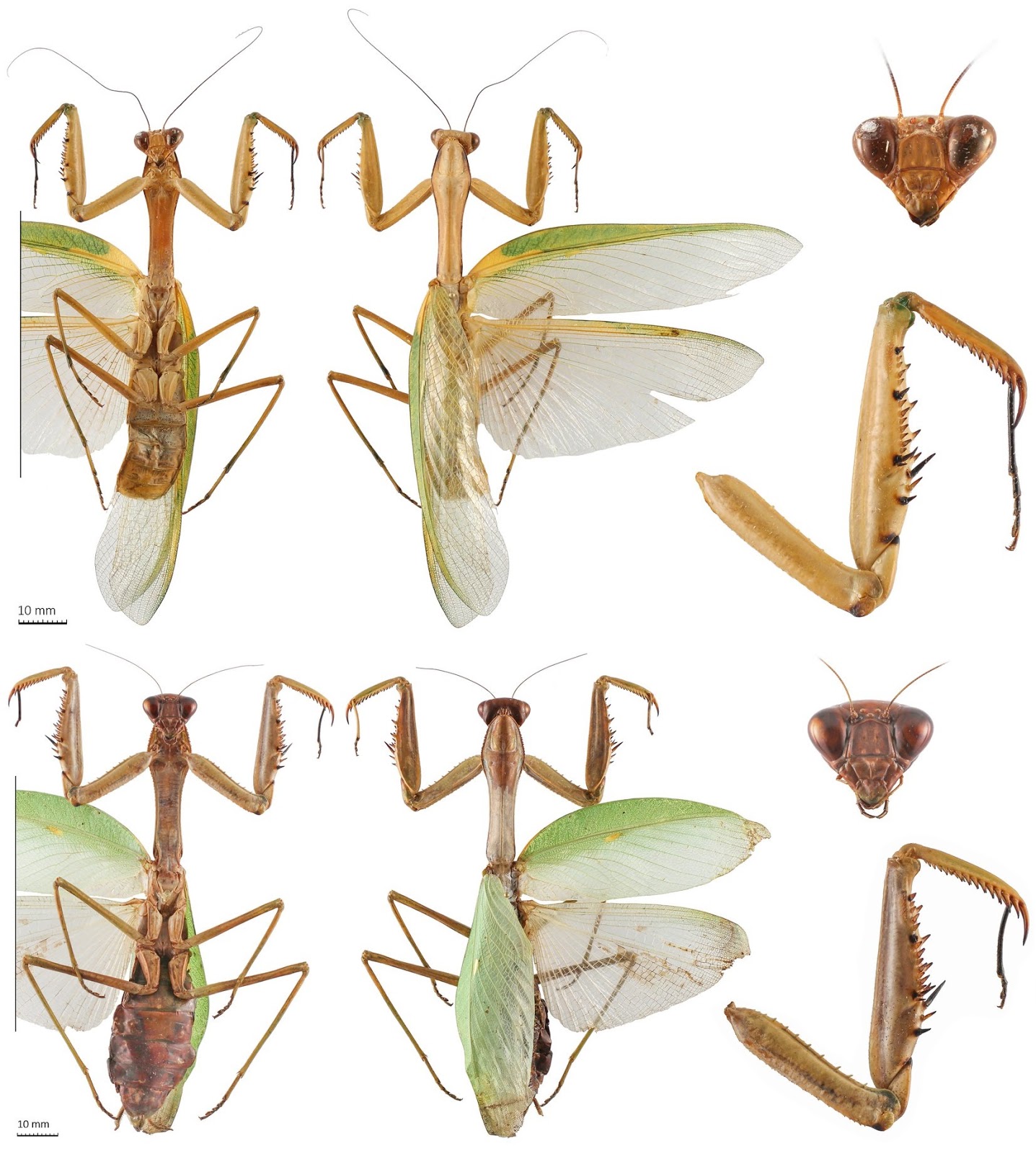
Fig. 3. Titanodula attenboroughi gen. nov. et sp. nov., live photographs of holotype ♂ (A, B, C) and paratype ♀ [PT1] (D, E) at Kon Chu Rang N.R., VII. 2018.

Fig. 1. Titanodula attenboroughi sp. nov., holotype ♂ (RBINS). A, habitus, dorsal view. B, habitus, ventral view. C, head, frontal view. D, left prothoracic leg, anterior view. C, D not to scale.

Titanodula attenboroughi sp. nov.

 DIAGNOSIS. Very large and robust praying mantis. Head triangular, antennae filiform. Long but robust pronotum, with smooth dorsal surface. Pronotum very finely denticulate along the margins of the prozone in female, without denticulations in the metazone, entirely smooth edges in males. Spinal formula: F = 4DS/15AvS/4PvS; T = 13−14AvS/10PvS. Ratios ♂: MzL/PzL: 3.2; ♀: MzL/PzL: 2.9. With black spots on the anterior side of the profemora located at the base of the 2nd, 10th and 15th anteroventral spine. Protarsus (all segments) entirely black on the anterior side. Both sexes macropterous. Phalloid apophysis (afa) with two sclerotised processes, anterior process (aafa) small and tubercle-shaped, broad and dome-like at the base with a smaller rounded projection on top of it, located posteriorly from the middle. Posterior process (pafa) spear-shaped, with weakly developed base, almost straight, long and heavily sclerotised, projecting straight or slightly diagonally posteriad.


ETYMOLOGY. The species epithet is a patronym dedicated to Sir David Attenborough, one of the world's most beloved naturalists, in acknowledgment for his life-long endeavours to disseminate knowledge on all the beings that are part of the natural world and to advocate for their protection and conservation. 

DISTRIBUTION. Titanodula attenboroughi sp. nov. appears to be an endemic of undisturbed forests in the Vietnamese Annamite mountains. However, forests in the known distribution area are highly threatened and continue to disappear at an alarming rate. More distribution data are needed to evaluate the conservation status according to the IUCN Red Lists assessment guidelines, in the meanwhile the species is considered DD (Data Deficient).


 Xavier H.C. Vermeersch. 2020. Titanodula gen. nov., A New Genus of Giant Oriental Praying Mantises (Mantodea: Mantidae: Hierodulinae). Belgian Journal of Entomology. 100: 1–18.