Showing posts with label Chelonia - Turtle; Tortoise. Show all posts

Tuesday, March 31, 2026

[Paleontology • 2026] Labyrinth Morphology of Eunotosaurus africanus in the Context of Semicircular Canal Shape Variation across Amniotes


 Eunotosaurus africanus with in-set labyrinth

in Evers, Panigot, Petermann, Rubidge, Bever et Lyson, 2026.
Life reconstruction by Andrey Atuchin.

Abstract
The Middle Permian reptile Eunotosaurus africanus is a key taxon for understanding reptile evolution because it has been proposed to be one of the earliest stem turtles, but it could alternatively represent an early sauropsid. Alternative evolutionary interpretations are based on morphological character observations, and comparative anatomy of previously undocumented body parts may yield novel character evidence. Based on a previously unreported specimen of Eunotosaurus africanus, we provide descriptions of its inner ear anatomy, which we compare to a diversity of amniotes including turtles, millerettids and novel segmentations of Youngina capensis and Champsosaurus lindoei. The inner ear of Eunotosaurus africanus has plesiomorphic neodiapsid inner ear features that contrast with turtle ear morphology, including a radius of curvature of the anterior semicircular canal (ASC) that is larger than that of the posterior semicircular canal (PSC), narrow intercanal angles, slender vertical semicircular canals, and a bend in the central section of the PSC. Eunotosaurus africanus shares with turtles a large common crus cross-section and a thickened lateral semicircular canal. We provide a landmark-based comparison of amniote labyrinth shapes, which shows principal differences in the semicircular canals of birds, mammals and turtles as end members of a gradient of semicircular canal geometries. Other extant amniote groups (crocodiles, lepidosaurs), fossil lineages (e.g. sauropterygians, captorhinids, millerettids, younginiforms, varanopids, Eunotosaurus africanus) and stem lineages of extant groups (e.g. pterosaurs, non-avian dinosaurs, phytosaurs, other extinct pseudosuchians, mosasaurs, ‘pelycosaurs’, dicynodonts) show semicircular canal geometries that are generally intermediate between extreme shapes of birds, mammals and turtles, so that the entire morphospace shows gradational morphologies. The observed variation provides evidence of convergent evolution of labyrinth features, but also suggests phylogenetic signal is widespread in labyrinth morphology and that bird, mammal, and turtle labyrinth shapes may have evolved from a plesiomorphic shape that was retained in many reptilian stem lineages.

Keywords: neuroanatomy, inner ears, emicircular canal geometry, amniote phylogeny, turtle origins

Photographs of Eunotosaurus africanus (BP/1/7852). A, dorsal view. B, ventral view. Arabic numerals indicate position of vertebra or rib. Note that the spacing between pre- and postzygapophyses of dorsal vertebra seven in A demonstrates the elongate vertebral centra.
Abbreviations: cor, coracoid; cra, cranium; cvs, cervical vertebral series; d, dorsal vertebra; hu, humerus; icl, interclavicle; man, mandible; poz, postzygapophysis; prz, prezygapophysis; sc, scapula; tr, thoracic rib.


  Life reconstruction of Eunotosaurus africanus with in-set labyrinth
reconstruction by Andrey Atuchin.

 
Serjoscha W. Evers, Eldon Panigot, Holger Petermann, Bruce S. Rubidge, Gabriel S. Bever and Tyler R. Lyson. 2026. Labyrinth Morphology of Eunotosaurus africanus in the Context of Semicircular Canal Shape Variation across Amniotes. Journal of Systematic Palaeontology. 24(1); 2634330. DOI: doi.org/10.1080/14772019.2026.2634330   [30 Mar 2026]

Thursday, December 18, 2025

[Paleontology • 2025] Byeoljubuchelys yeosuensis • A New, Early Cretaceous carettochelyid Turtle (Trionychia: Carettochelyidae) from South Korea provides insights into Softshell Evolution and Aquatic Ecology


Byeoljubuchelys yeosuensis
Kim, J. Jung, Joyce, Park, H.-Y. Jung, Jo & Huh, 2025


Abstract
Here, we present a new Cretaceous carettochelyid turtle, Byeoljubuchelys yeosuensis gen. et sp. nov., from the Lower Cretaceous Hasandong Formation of Yeosu, Korea. A nearly complete shell and select elements of the girdles and limbs provide crucial insight into the evolution and aquatic adaptation of this family. Phylogenetic analyses place Byeoljubuchelys yeosuensis at the most basal position within Carettochelyidae. The mid-sized plastron of Byeoljubuchelys yeosuensis appears to be plesiomorphic for the group. The expansion of the plastron during carettochelyid evolution, especially during the Paleogene, may be an evolutionary response to increasing body size or the threat of mammalian predators. Although the shell of Byeoljubuchelys yeosuensis lacks distinct scute sulci, traces are apparent that are reminiscent of juvenile scutes in the extant Carettochelys insculpta, suggesting that scute loss was facilitated in trionychian evolution through the thickening of the epidermis. Byeoljubuchelys yeosuensis possesses a plesiomorphic humerus with a proximally located lateral process and a sigmoidal shaft lacking torsion, implying rowing locomotion rather than the underwater flapping seen in more recent carettochelyids. The repeated acquisition of a softshell in two clades of trionychians during the mid-Cretaceous may be related to an environmental shift towards humid climates at that time, perhaps reflecting a remarkable adaptation to freshwater ecosystems.

Keywords: Byeoljubuchelys yeosuensis, Early Cretaceous, Hasandong formation, Korea, Carettochelyidae, Paleoecology, Micro-CT

Systematic paleontology
Testudines Batsch, 1788
Cryptodira Cope, 1868
Trionychia Hummel, 1929
Carettochelyidae Gill, 1889

Geographical and geological settings of the type locality of Byeoljubuchelys yeosuensis gen. et sp. nov. 
A, Geographical map of South Korea. B, Geological map of Gyeongsang Basin in South Korea. C, Geological map of Gwangyang Bay. D, Aerial photograph of Soneuk Island with adjacent islands. E, Photographs of the holotype in situ. The red asterisks indicate fossil locality


Byeoljubuchelys yeosuensis gen. et sp. nov.
Photographs (A, C) and micro-CT generated three-dimensional models (B, D) of the holotype [KDRC-YS-SR-001]
A, B, shell in dorsal view. C, D, shell in ventral view.
Abbreviations: co, costal; ent, entoplastron; epi, epiplastron; hyo, hyoplastron; hypo, hypoplastron; nc, nuchal; ne, neural; pe, peripheral; py, pygal; spy, suprapygal; xip, xiphiplastron
 
Byeoljubuchelys yeosuensis gen. et sp. nov.

Diagnosis—Byeoljubuchelys yeosuensis can be diagnosed as a member of Carettochelyidae by the presence of 10 pairs of peripherals, a single, triangular suprapygal, a thickened pygal with an anterior groove, plastral kinesis, a triangular entoplastron, and the absence of plastral scutes. It differs from other carettochelyids by the unique combination of the following characters: neurals and pygal lacking midline keel, neural series broad and continuous, a reversal of neural orientation at neural II, vermiculated peripheral ornamentation, absence of distinct carapacial scute sulci, a lack of paired nuchal processes, a relatively broad cruciform plastron, long cervical vertebrae, and a humerus with sigmoidal shaft and lateral and medial processes at the level of the humeral head.

Type Locality and Horizon—Soneuk Island, Yeosu, Republic of Korea, near the Aptian/Albian boundary, Early Cretaceous.

Etymology—The genus name ‘Byeoljubuchelys’ is derived from the combination of the Korean word ‘Byeoljubu’, a turtle character in Sugungga, one of the epic tales of Pansori (a traditional Korean musical storytelling art), and the Ancient Greek word ‘chelys’ meaning turtle. The species name ‘yeosuensis’ is derived from Yeosu City, where the fossil was found.
 
The peripherals and pygal of KDRC-YS-SR-001, holotype of Byeoljubuchelys yeosuensis gen. et sp. nov. 
Interpretive drawing of carapace in dorsal view and micro-CT generated three-dimensional models of peripherals in dorsal and posterior view. Dotted lines express the reconstructed outline of peripherals and pygal. pe, peripheral
 
 
Minguk Kim, Jongyun Jung, Walter G. Joyce, Jae-Il Park, Hye-Yeon Jung, Hyemin Jo and Min Huh. 2025. A New, Early Cretaceous carettochelyid Turtle from South Korea provides insights into Softshell Evolution and Aquatic Ecology. Swiss Journal of Palaeontology. 144, 75. DOI: doi.org/10.1186/s13358-025-00415-z [08 December 2025]

Thursday, November 20, 2025

[Paleontology • 2025] Shakiremys colombiana • Mosaic Morphology in Podocnemididae (Pleurodira) revealed by A New turtle from the Middle Miocene La Venta Biome, Colombia


 Shakiremys colombiana  
 Cadena, Leal-Amaya, A. Vanegas-Vanegas, R. D. Vanegas-Vanegas & Guevara-Serrano, 2025
  
Illustration by Juan Giraldo

Abstract
A new genus and species of podocnemidid turtle, Shakiremys colombiana, is described here from the Middle Miocene La Venta Biome, located in south-central Colombia. The new taxon is represented by two specimens: one consisting of a complete skull and articulated shell, and the other of an articulated shell only. Shakiremys colombiana is distinguished from other podocnemidids by the following combination of features: intermediate roofing of the temporal emargination; a jugal retracted from the orbital margin; a flatter, more rectangular carapace outline; peripherals 2 with a short, protruding anteromedial margin; vertebral scute 1 narrower than the others and not reaching peripherals 1; the gular scute reaching the pectorals and completely separating the humerals; and anterior plastral lobe margin almost straight. It also has an additional mosaic of characteristics found in Podocnemidinae, Erymnochelyinae and Peltocephalinae. A phylogenetic analysis recovered Sh. colombiana as the basalmost member of a large clade that includes both Erymnochelyinae and Peltocephalinae. Additionally, computed tomography was used to reconstruct and compare the neuroanatomical features of Sh. colombiana with other podocnemidids. The mosaic traits observed in Sh. colombiana are interpreted as advantageous for a broader dietary and ecological spectrum, potentially including an omnivorous diet, and the ability to thrive in various aquatic environments, ranging from blackwater to whitewater habitats. This ecological versatility may have offered a competitive advantage for Sh. colombiana within the diverse palaeoecosystem of La Venta, where multiple podocnemidid and chelid turtle species coexisted.

Keywords: turtle, pleurodire, Miocene, South America, La Victoria Formation


SYSTEMATIC PALAEONTOLOGY

TESTUDINES Batsch 1788 sensu Joyce et al. 2020 
PLEURODIRA Cope 1864 sensu Joyce et al. 2020 
PELOMEDUSOIDES Broin 1988 sensu Joyce et al. 2021 
PAN-PODOCNEMIDIDAE Joyce et al. 2004 sensu Joyce et al. 2021 
PODOCNEMIDIDAE Cope 1868 sensu Joyce et al. 2021 

Genus Shakiremys nov.
 
Derivation of name: In honour of Shakira, a Colombian singer who has inspired generations with her music and dance; music that has accompanied the first author's fieldwork for decades. Shakira also serves as an example of uniqueness, much like the fossil turtle described herein.


Shakiremys colombiana sp. nov.
 
Derivation of name: From Colombia, the country where the species was discovered.

Holotype: VPPLT-1730, complete skull (Figs 2, 3A−C, 4A−B) and articulated shell (carapace and plastron) (Figs 5, 6), belonging to a single individual (Fig. 1D).
 

Palaeoartist's reconstruction of the podocnemidid Shakiremys colombiana gen. et sp. nov. and the fluvial ecosystem.
Illustration by Juan Giraldo.

 
Edwin-Alberto Cadena, David E. Leal-Amaya, Andrés Vanegas-Vanegas, Rubén D. Vanegas-Vanegas, Lino J. E. Guevara-Serrano. 2025. Mosaic Morphology in Podocnemididae revealed by A New turtle from the Middle Miocene La Venta Biome, Colombia. Papers in Palaeontology. DOI: doi.org/10.1002/spp2.70051 [17 November 2025]


Saturday, November 1, 2025

[Paleontology • 2025] Manouria morlathe Ancient One: An Early Miocene large Tortoise (Cryptodira: Testudinidae) from the Swamps of Ahníkov, Czechia


Manouria morla   
Chroust, Szczygielski & Luján, 2025
  
Digital painting by Rudolf Hima

Abstract
Tortoises (Testudinidae) are a clade of turtles highly specialized to terrestrial environments, mainly living in semi-arid conditions. Herein, we present Manouria morla sp. nov., a new species of the genus Manouria, which is considered to be the most basal extant testudinid genus. The studied material comes from the Ahníkov I fossil site, formerly known as Merkur or Merkur-North, located in the Most Basin in NW Bohemia (Czechia), dated to the Early Miocene (Burdigalian, MN 3). Manouria morla sp. nov. is the oldest member of the Manouria lineage, which nowadays inhabits SE Asia only, and therefore its biogeography and plausible European origin are discussed. The specific type of multiplication of plastral scutes in the inguinal region is discussed as a new morphological character diagnostic for the genus. Based on zoological studies, specific environmental requirements of the genus Manouria allow us to use this taxon as a proxy for the paleoclimate reconstruction of the Ahníkov I fossil site which suggests a broadleaf evergreen tropical wet forest. The simplified use of fossil testudinids as a proxy for reconstructing semi-arid palaeoclimate is therefore disproven.

Manouria morla sp. nov. (Ahníkov I, Early Miocene),
anterior part of the plastron in A internal view (photograph), B external view (photograph), C internal view, D external view, E left lateral view, F anterior (epiplastral) view, G right lateral view. Posterior part of the plastron in H internal view (photograph), I external view (photograph), J internal view, K external view

Hypothetical reconstruction of the shell of Manouria morla sp. nov. (Ahníkov I, Early Miocene).
A dorsal view of the carapace, B ventral view of the plastron, C dorsal view of the plastron. Preserved parts indicated in grey color


Systematic palaeontology
Testudinata Klein, 1760
Cryptodira Cope, 1868
Testudinoidea Fitzinger, 1826

Pan-Testudinidae Joyce et al., 2004
Testudinidae Gray, 1825

Genus Manouria Gray, 1854

Manouria morla sp. nov. 

Diagnosis: The genus Manouria can be diagnosed by the following autapomorphies: prominent visceral rims associated with the body wall attachment, developed close to the sutures between the peripherals and costals (also on the nuchal and the pygal); thin carapacial elements (costals/neurals); axillary buttresses long and thin and just barely in contact with costal bones; the visceral surface of costal 5 shows the attachment for the inguinal buttress; the sinusoidal shape of the posterior carapacial edge; the presence of the pygal notch; the presence of 12 marginal pairs; coincidence between the costo-peripheral suture and the pleuro-marginal sulcus; significant serration of the posterior peripherals; posterior sulcus of the fifth vertebral coinciding with the suprapygal-pygal suture; overlap of the plastral scutes into the dorsal surface of the anterior and posterior plastral lobes; lateral portion of the humero-pectoral sulcus perpendicular to the axial plane and anteriorly deflected; pectorals medially short; contact between the inguinal and femoral scutes is present; the presence of the multiplication of inguinal scutes.

Etymology. The species is named after Morla, a fantasy character from the book The Neverending Story (orig. Die unendliche Geschichte) written by Michael Ende (1929–1995), firstly published in 1979, later adapted as a movie in 1984. Morla, the Ancient One, is a giant tortoise who lives in the Swamps of Sadness. The new species described herein is the oldest known species of the genus from the Early Miocene of Czechia; therefore, the Ancient One. Its remains come from the swamp deposits of Ahníkov, a parallel to the Swamps of Sadness.

Life restoration of Manouria morla sp. nov.  
Digital painting by Rudolf Hima
 
Conclusion: 
We describe Manouria morla sp. nov., the oldest member of the extant genus Manouria, from the Ahníkov I (formerly known as Merkur or Merkur-North) fossil site from Czechia (MN 3, Early Miocene). To aid the description, Manouria morla sp. nov. was scored and included in a phylogenetic analysis. According to our results, it seems that the genus Manouria originated in Europe just before the MMCO and later spread to Asia, where it persists until now. In the end, the use of the genus Manouria as an environmental indicator is coherent with the knowledge of the swamp ecosystem of the Most Basin.
 

Milan Chroust, Tomasz Szczygielski and Àngel H. Luján. 2025. Manouria morla sp. nov., the Ancient One: an Early Miocene large tortoise from the Swamps of Ahníkov, Czechia. Swiss Journal of Palaeontology. 144, 63. DOI: doi.org/10.1186/s13358-025-00400-6 [03 October 2025]
  x.com/HimaRudolf/status/1974115834210725948


Sunday, March 23, 2025

[Paleontology • 2021] Yakemys multiporcata • A large Macrobaenid Turtle (Cryptodira: Macrobaenidae) from the Basal Cretaceous of Thailand, with a Review of the Turtle Fauna from the Phu Kradung Formation and Its Stratigraphical Implications


Yakemys multiporcata 
 Tong, Chanthasit, Naksri, Ditbanjong, S. Suteethorn, Buffetaut, V. Suteethorn, Wongko, Deesri & Claude. 2021 
  
ยักษ์คีมิส มัลติพอร์คาตา  | เต่ายักษ์ หมวดหินภูกระดึง  ||  DOI: doi.org/10.3390/d13120630 

Abstract
Yakemys multiporcata n. g. n. sp. is described on the basis of shell elements from the upper part of the Phu Kradung Formation (basal Cretaceous), Khorat Plateau, NE Thailand and assigned to Macrobaenidae. The new taxon is unusually large for an early macrobaenid (with an estimated carapace length about 70 cm) and is characterized by a large, rounded, low shell, the presence of a midline keel and numerous additional strong ridges on the carapace, the anterolateral margin upturned to form a gutter, posterolateral peripherals mesiolaterally expanded, narrow vertebrals, the vertebral 4 triangular and narrowed posteriorly, a greatly reduced plastron with a short bridge, an oval and elongate entoplastron with reduced ventral exposure, and strip-shaped epiplastra. The discovery of a macrobaenid turtle provides further support for an Early Cretaceous age for the upper part of the Phu Kradung Formation.  

Keywords: Testudines; Macrobaenidae; Yakemys multiporcata; Phu Kradung Formation; Early Cretaceous; Khorat Plateau; Thailand

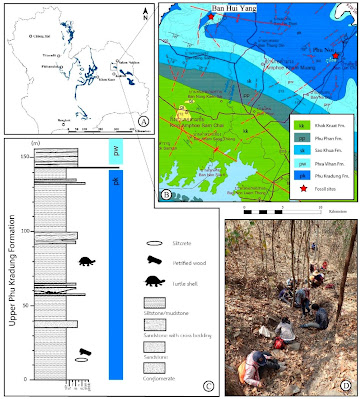
  (A), Map of northern Thailand showing location of Sam Chai area, and outcrops of the Phu Kradung Formation; (B): Geological map of Sam Chai area (modified from [Bumrungsong & Yamunsabideen, 2009]; (C): Stratigraphical column of Ban Hui Yang site; (D): Field work.


 Yakemys multiporcata n. g. n. sp. from the upper part of the Phu Kradung Formation (basal Cretaceous) of Khorat Plateau, NE Thailand. Holotype (SM KS39) from Ban Hui Yang locality, Sam Chai District, Kalasin Province.
(A, B) Carapace in dorsal view; (C, D) shell in ventral view; (E) detail of ornamentation of the carapace surface (on costal 2, indicated by a white rectangle on A), and (F) neural 6–8 with adjacent costal fragments in ventral view.
 Scale bar = 10 cm for (A–D,F) and 2 cm for (E). 
Abbreviations: co, costal plate; Ma, marginal scute; n, neural plate; pe, peripheral plate; py, pygal plate; spy, suprapygal plate; V, vertebral scute.

Testudines Linnaeus, 1758
Cryptodira Cope, 1868
Macrobaenidae Sukhanov, 1964

Yakemys multiporcata n. gen. n. sp.

Diagnosis: A genus of Macrobaenidae of large size, with the carapace length about 70 cm and a combination of characters that differs from all other Macrobaenidae as follows: narrow vertebral scutes; vertebral 4 triangular and narrowed posteriorly, strong midline keel extending to the suprapygal 2, large lateral longitudinal keels on the vertebral region, and additional ridges on the pleural region; plastron reduced, with a triangular short anterior lobe, epiplastron reduced to a strip-shaped plate, entoplastron oval in dorsal view but with a much reduced ventral exposure and an extremely reduced bridge that is shorter than the anterior lobe.

Etymology: Genus name from Yak, giant in Thai (ยักษ์); species name from Latin “multi”: multiple; porcata: from Latin “porca”, ridge.


Conclusions: 
Yakemys multiporcata n. g. n. sp. represents one of the earliest Macrobaenidae hitherto known, and this finding extends the paleogeographical distribution of the group to SE Asia. The discovery of a macrobaenid turtle in Thailand provides further support for the Early Cretaceous age of the upper part of the Phu Kradung Formation and the new evidence of faunal exchange between the SE Asia and more northern parts of mainland Asia at the very beginning of the Cretaceous. Yakemys multiporcata commonly occurs together with Basilochelys macrobios, although both turtles were likely aquatic animals as indicated by their low shell; the different morphology of the shell, especially the plastron, suggests that these turtles had different modes of life. Further discovery of more complete material, especially skull and limb bones, is expected for a better understanding of the phylogenetic relationships and the lifestyle of this strange turtle.


Haiyan Tong, Phornphen Chanthasit, Wilailuck Naksri, Pitaksit Ditbanjong, Suravech Suteethorn, Eric Buffetaut, Varavudh Suteethorn, Kamonlak Wongko, Uthumporn Deesri and Julien Claude. 2021. Yakemys multiporcata n. g. n. sp., a large Macrobaenid Turtle from the Basal Cretaceous of Thailand, with a Review of the Turtle Fauna from the Phu Kradung Formation and Its Stratigraphical Implications. Diversity. 13(12), 630. DOI: doi.org/10.3390/d13120630 
    facebook.com/fossilworld/posts/4864491833572637  ยักษ์คีมิส มัลติพอร์คาตา

Thursday, March 20, 2025

[Paleontology • 2025] Thaichelys ruchae • The Triassic Turtle of Thailand –Revision of ‘Proganochelysruchae (Testudinata: Proterochersidae)


THAICHELYS Szczygielski et al.
[A] Thaichelys ruchae (Broin, 1984) 
 
 [B-C] Proterochersis robusta. [F] Proganochelys quenstedtii 

in Szczygielski, Dróżdż, Chanthasit, Manitkoon et Ditbanjong, 2025. 
ไทยเชลิส โปรกาโนเชลิส รุจาอิ  Proganochelys’ ruchae  

Abstract
True turtles (Testudinata) appeared in the Norian (Late Triassic) and quickly attained a worldwide distribution and relatively high diversity. Their remains are currently known from that time from Asia, Europe, North America, and South America, and represent at least three separate clades. Whereas the generic and suprageneric attribution of comparatively well-preserved and studied European and South American taxa, such as Proganochelys quenstedtii, Proterochersis robusta and Proterochersis porebensis, Palaeochersis talampayensis, and Waluchelys cavitesta sparks no controversy, the more fragmentary and less common species have been variably considered representatives of separate genera or referred to already existing ones – most commonly, Proganochelys. This uncertainty is unfortunate, as it severely muddles the picture of the evolution, diversity, and geographical distribution of the earliest turtles. One such problematic species, coming from the Norian Huai Hin Lat Formation of Thailand, was described in 1980s as Proganochelys ruchae. However, this generic attribution was subsequently put into question and the recent increase of available Triassic turtle material allows to remove the species ruchae from Proganochelys to a new genus, Thaichelys gen. nov., and place it in the clade of Proterochersidae, together with Proterochersis spp., Keuperotesta limendorsa, and Chinlechelys i. As a result, the genus Proganochelys is considered here to be solely a central Pangean (modern-day European) taxon. Moreover, Thaichelys ruchae exhibits in some respects a transitional morphology between other Triassic taxa and Proterochersis spp., and may constitute a sister taxon to the grouping of Proterochersis spp. and Keuperotesta limendorsa from Europe. This, in turn, considering the lack of a Carnian record of pantestudinates outside of Asia, suggests that Thaichelys ruchae could represent an early radiation of the Proterochersidae which branched off before the Testudinata dispersed into the western Pangea.

Systematic paleontology
AMNIOTA Haeckel, 1866 sensu Laurin and Reisz, 2020 
TESTUDINATA Klein, 1760 sensu ITNC et al., 2020

PROTEROCHERSIDAE Nopcsa, 1923 (converted clade name)

Comparison of the bridge region morphology in Triassic pantestudinates (ventral view, scaled to roughly the same shell length).
A, Thaichelys ruchae SM2017-1-124.
B, Proterochersis robusta SMNS 18440. C, Proterochersis robusta SNBS 17561. D, Proterochersis porebensis ZPAL V. 39/49 (pratype).
E, Proganochelys quenstedtii SMNS 17204. F, Proganochelys quenstedtii SMSN 16980. G, Proganochelys quenstedtii MB.1910.45.2. H, Palaeochersis talampayensis PULR 068 (holotype). Scute sulci in A indicated with grey lines, dashed lines indicate poorly defined or ambiguous sulci.

THAICHELYS Szczygielski et al. gen. nov. 

Etymology: Referring to Thailand, as the origin place of the described specimens, and incorporating -chelys (gr. Χέλυς, turtle): „Thai turtle”.

Type and only species: Thaichelys ruchae (Broin, 1984)
 
Thaichelys ruchae (Broin, 1984) comb. nov.

Holotype: SM2015-1-001 (former TF 1440-6), incomplete left side of the anterior plastral lobe (Figs 6, 8A, 9).

Type locality: Ban Suan Sawan Banana Farm, Si Chomphu, Khon Kaen, Thailand.

Type horizon and age: Huai Hin Lat Formation, Late Triassic (Norian).

Revised diagnosis: Testudinate characterized by a unique combination of characters: (1) carapace not reduced in thickness (unlike in Chinlechelys tenertesta, Palaeochersis talampayensis, and Waluchelys cavitesta); (2) pleurals with shelf-like, anteroposteriorly elongated bosses (unlike in Proganochelys quenstedtii); (3) three supramarginals present (unlike in Palaeochersis talampayensis, Proganochelys quenstedtii, and Waluchelys cavitesta); (4) bridge-level marginals (a) not wedging between the supramarginals (unlike in Proganochelys quenstedtii), (b) with anterolaterally projected, V-shaped in lateral view intermarginal sulci (unlike in Proganochelys quenstedtii), (c) with the dorsal exposition smaller ...

Thaichelys ruchae, life restoration as a proterochersid turtle.
Digital drawing by Sita Manitkoon.

 
Tomasz Szczygielski, Dawid Dróżdż, Phornphen Chanthasit, Sita Manitkoon and Pitaksit Ditbanjong. 2025. The Triassic Turtle of Thailand –Revision of ‘Proganochelys’ ruchaePLoS ONE. 20(3): DOI: doi.org/10.1371/journal.pone.0316338 [March 19, 2025]


Friday, January 31, 2025

[Arachnida • 2025] Amblyomma kappa • A New Species of reptile tick (Acari: Ixodidae) from subtropical East Asia closely related to the Oriental turtle tick (Amblyomma geoemydae) from tropical Southeast Asia


Amblyomma kappa Kwak, 

in Kwak, Qiu, Heath, Takano, Takahashi, Kelava, Tamura, Taya & Nakao, 2025.

Abstract
The correct delineation of tick species is critical for efforts aimed at safeguarding One Health. Historically, the Asian turtle tick (Amblyomma geoemydae sensu lato) has been regarded as a geographically widespread species across much of Asia. However, based on morphological and phylogenomic data, the subtropical lineage (from Japan, Taiwan, and parts of China) of A. geoemydae is recognised as a new species: Amblyomma kappa sp. n., and all life stages are described. The tropical lineage of A. geoemydae sensu stricto is recharacterized and a differential diagnosis is provided to distinguish the two species. The ecology, host associations, and medical importance of A. kappa are also discussed.


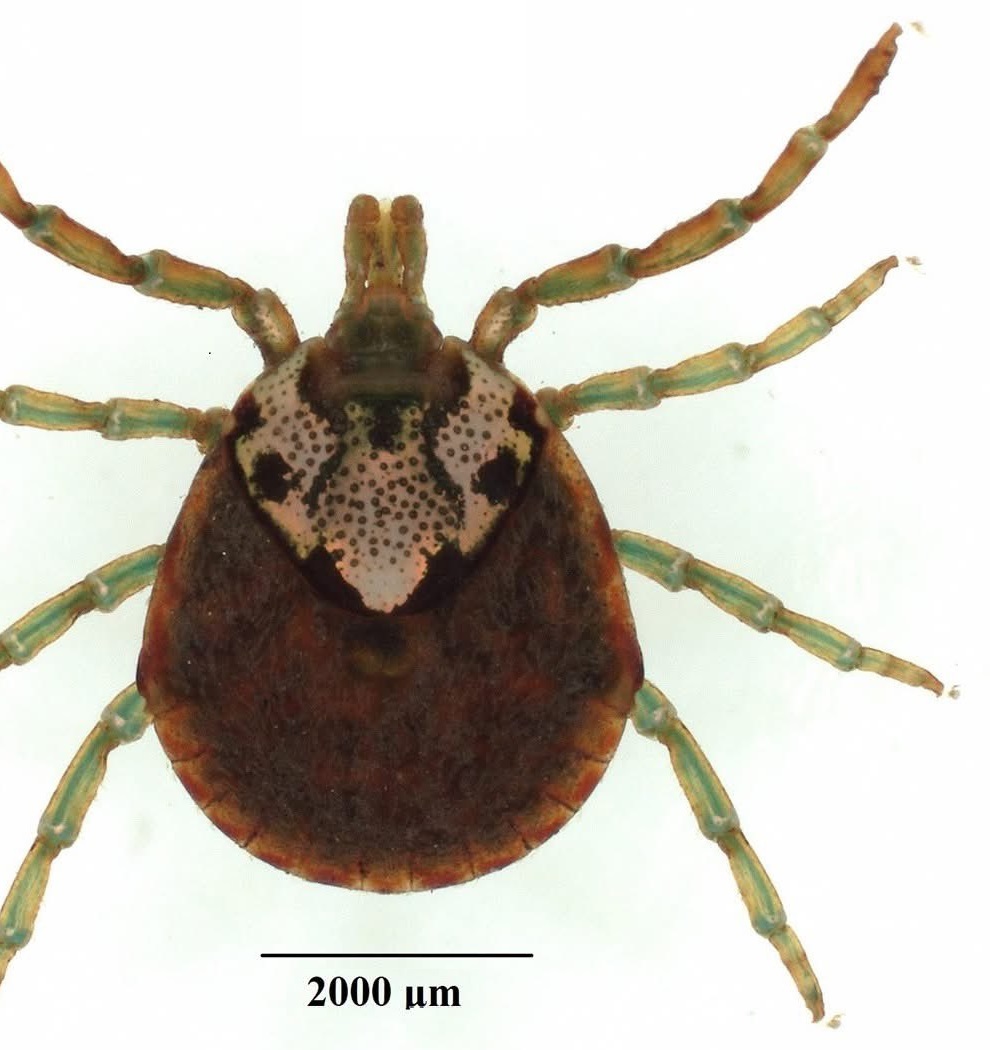
East Asian turtle tick (Amblyomma kappa n. sp.)

Family: Ixodidae Murray, 1877
Genus: Amblyomma Koch, 1844

Amblyomma kappa n. sp. Kwak, 2025
Amblyomma malayanum Keegan and Toshioka, 1957
Amblyomma geoemydae Yamaguti et al., 1971
Amblyomma geoemydae Fujita and Takada, 2007

Type host: Geoemyda japonica Fan 1931 (Ryukyu black-breasted leaf turtle)

Other hosts: Cuora flavomarginata Gray, 1863, Mauremys japonica Temminck and Schlegel 1832, Mauremys mutica Cantor, 1842, Lycodon semicarinatus Cope, 1860, ...

Differential diagnosis: Although A. kappa and A. geoemydae are closely related, they can be distinguished fairly easily based on a range of key morphological differences. Female: (i) when unengorged, A. kappa (∼4000 μm in length) is approximately half the size of A. geoemydae (∼7500 μm in length) (Fig. 12A); (ii) In A. kappa the scutum is almost as long as wide (width-length ration of ∼1:0.95), while in A. geoemydae the scutum is distinctly wider than long (width-length ration of ∼1:0.75) (Fig. 12B); (iii) a pair of ...

 
Mackenzie L. Kwak, Yongjin Qiu, Allen C.G. Heath, Ai Takano, Mamoru Takahashi, Samuel Kelava, Hisao Tamura, Yurie Taya and Ryo Nakao. 2025. Amblyomma kappa sp. n. (Acari: Ixodidae), A New Species of reptile tick from subtropical East Asia closely related to the Oriental turtle tick (Amblyomma geoemydae) from tropical Southeast Asia. Acta Tropica. 261, 107499. DOI: doi.org/10.1016/j.actatropica.2024.107499

Monday, June 24, 2024

[Paleontology • 2024] Xianyuechelys yingliangi • A New nanhsiungchelyid Turtle (Cryptodira: Nanhsiungchelyidae) from the Late Cretaceous of Ganzhou Basin, China


Xianyuechelys yingliangi 
Ke, Niu, Rummy, Tong, Hu & Han, 2024
 

Abstract
Nanhsiungchelyidae is a group of large Pan-Trionychia that lived in North America and Asia during the Cretaceous. Despite a long research history, their taxonomy and internal nodes are still controversial. Here, we erect a new taxon, Xianyuechelys yingliangi gen. et sp. nov., from the Upper Cretaceous Lianhe Formation of Ganzhou Basin, China. Xianyuechelys yingliangi is attributed to Nanhsiungchelyidae based on its carapace being covered by a sculpturing of large pits. However, the new species also possesses an unique combination of characteristics among nanhsiungchelyids such as a wide, crescentic nuchal, absence of a pair of anterolateral processes, and the fourth and fifth vertebral scutes that contact at a point. The holotype is a juvenile or sub-adult based on the incomplete ossification of carapace, but its morphological characteristics can mostly be regarded as taxonomically informative rather than ontogenetic in origin. Phylogenetic analysis suggests Xianyuechelys yingliangi forms a monophyletic group with Nanhsiungchelys spp. and Anomalochelys angulata, supported by two unambiguous synapomorphies: wide vertebral scutes and wide neurals. The phylogenetic analysis also suggests Basilemys, Jiangxichelys and ‘Zangerlia’ form a monophyletic group. Our new finding increases the known diversity of nanhsiungchelyids in southern China.

Keywords: Nanhsiungchelyidae, Late Cretaceous, phylogeny, Ganzhou Basin, China


Xianyuechelys yingliangi gen. et sp. nov.

 
Yuzheng Ke, Kecheng Niu, Paul Rummy, Haiyan Tong,Jinfeng Hu and Fenglu Han. 2024. Xianyuechelys yingliangi: A New nanhsiungchelyid Turtle from the Late Cretaceous of Ganzhou Basin, China. Journal of Systematic Palaeontology. 22(1); 2346838. DOI: 10.1080/14772019.2024.2346838

Tuesday, December 19, 2023

[Herpetology • 2023] A Taxonomic Hide and Seek: Phylogenetic and Phylogeographic Relationships in the Southeast Asian Box Turtle, Cuora amboinensis (Riche in Daudin, 1801)


in Blanck, Gaillard, Protiva, Wheatley, Shi, Liu, Ray & Anders, 2023.

Abstract
Cuora amboinensis is considered to be the most wide-ranging member of its genus and has one of the widest distributions of all geoemydid turtle species. The range of Cuora amboinensis spans major biogeographic barriers and encompasses diverse habitats. The genetics (nuDNA and mtDNA) and morphometry of 288 Cuora amboinensis sensu lato (s.l.) specimens from across its range were analyzed, and we identified five divergent species-level clades and two subspecies-level clades. One of the two identified potential subspecies lacked reliable locality data, requiring further field research before taxonomic steps can be undertaken. We designate a neotype for Cuora amboinensis sensu stricto and elevate both Cuora amboinensis couro and Cuora amboinensis lineata to species-level taxa. In addition, we describe two new species and one new subspecies from the «Cuora amboinensis» complex. The wide distribution of Cuora amboinensis s.l. is problematic because it is indigenous to many Pacific and Indian Ocean islands. We sought to clarify plausible dispersal hypotheses across islands using phylogeographic analyses.

Keywords: Testudines; Geoemydidae; Cuora; taxonomy; phylogeography; phylogenetics; conservation; species description; neotype; species complex; cryptic species


Cuora amboinensis​ aurantiae ssp. nov.

Cuora praschagi sp. nov.
 
 
Torsten Blanck, Daniel Gaillard, Tomáš Protiva, Madeleine Wheatley, Haitao Shi, Lin Liu, Parimal Chandra Ray and Ben Anders. 2023. A Taxonomic Hide and Seek: Phylogenetic and Phylogeographic Relationships in the Southeast Asian Box Turtle, Cuora amboinensis (Riche in Daudin, 1801). Russian Journal of Herpetology. 30(6-S); 1-52. DOI: 10.30906/1026-2296-2023-30-6-S-1-52
 facebook.com/100088301342746/posts/303415369278506

Tuesday, August 22, 2023

[Paleontology • 2023] Proadocus hadongensis • The First adocid Turtle (Cryptodira: Pan-Trionychia) in South Korea (Lower Cretaceous) and the early Evolution of the Adocidae


Proadocus hadongensis
 Kim, Lee, Ko, Park, Kim, Lee, Jung & Kong, 2023

 
Abstract
An adocid turtle was collected from the Lower Cretaceous Hasandong Formation, representing the first occurrence of the Adocidae in South Korea. The specimens consist of moderately preserved hard shells (carapace and plastron) with a limb bone (humerus). They turned out to be a new taxon named Proadocus hadongensis, gen. et sp. nov., characterized by combining synapomorphic characters of adocids and primitive characters ancestrally retained from basal pantrionychians. The pattern of marginal scales extension and pygal shape are shared with Sinaspideretes wimani and Basilochelys macrobios, the basal pantrionychian taxa of the Late Jurassic–Early Cretaceous in Southeast Asia. A cladistic analysis places it as the most basal taxon in Adocidae. Such phylogenetic position of Proadocus involves important implications about the origin and early evolution of the Adocidae. First, Proadocus supports the Southeast Asian origin of this family. Secondly, a new paleobiogeographic analysis, including Proadocus in Korea, requests a new interpretation of the adocid diversification and dispersion in East Asia during the Early Cretaceous.


Testudines Batsch, 1788 
Cryptodira Cope, 1868 

Pan-Trionychia Hummel, 1929 
Adocusia Danilov and Parham, 2006 

Adocidae Cope, 1870 

Proadocus hadongensis, gen. et sp. nov.


Do Hyeon Kim, Yuong-Nam Lee, Hyejin Ko, Jin-Young Park, Su-Hwan Kim, Sungjin Lee, Seung-Ho Jung and Dal-Yong Kong. 2023. The First adocid Turtle in South Korea (Lower Cretaceous) and the early Evolution of the Adocidae. Cretaceous Research. 151; 105665. DOI: 10.1016/j.cretres.2023.105665