Showing posts with label Thailand: Paleontology. Show all posts

Wednesday, May 14, 2025

[Paleontology • 2025] Isolated theropod teeth from the Upper Jurassic to Lower Cretaceous Khorat Group: Implications for Theropod Diversity in Thailand


Isolated theropod teeth from the Upper Jurassic to Lower Cretaceous Khorat Group 

in Chowchuvech, Manitkoon, Chanthasit, Chokchaloemwong, Kosulawatha et Ketwetsuriya, 2025.   
 
Abstract
Isolated theropod teeth are notably abundant of vertebrate remains within the Upper Jurassic to Lower Cretaceous Khorat Group of Thailand. However, despite the discovery of numerous dental materials, only a limited number of studies have focused on the morphology and taxonomy of these isolated teeth. This study investigated 112 isolated theropod teeth were retrieved from 19 localities on the Khorat Plateau in Northeastern Thailand. These teeth were divided into five morphotypes based on dental characteristics. They were identified based on cladistic and discriminant analyses that recovered four clades of theropod dinosaurs: Metriacanthosauridae, Tyrannosauroidea, Spinosauridae, and Allosauria. This dental evidence provide significant insights into the theropod diversity in Thailand during the Late Jurassic to Early Cretaceous. Specifically, the Late Jurassic to Early Cretaceous Phu Kradung Formation revealed an extended presence of metriacanthosaurids and basal tyrannosauroids, while the Sao Khua and Khok Kruat Formations indicated a shift towards allosaurian and spinosaurid dominance during the Early Cretaceous. The absence of metriacanthosaurids and basal tyrannosauroids in later formations suggests a faunal turnover, with allosaurians and spinosaurids becoming more prevalent, aligning with the changes in theropod faunal composition across Eurasia. Furthermore, this contribution suggested the faunal turnover pattern in the Eurasian theropods during the Jurassic-Cretaceous boundary interval, which might have been related to the change in herbivorous dinosaurs during this crucial timeframe of dinosaur evolution.


Wongwech Chowchuvech, Sita Manitkoon, Phornphen Chanthasit, Duangsuda Chokchaloemwong, Wachirawit Kosulawatha and Chatchalerm Ketwetsuriya. 2025.  Isolated theropod teeth from the Upper Jurassic to Lower Cretaceous Khorat Group: Implications for theropod diversity in Thailand. Cretaceous Research. 175, 106147. DOI: doi.org/10.1016/j.cretres.2025.106147

Friday, April 25, 2025

[Paleontology • 2025] Novel Report of An Osteogenic Tumor in a late Jurassic Mamenchisaurid from Thailand


A reconstruction of a mamenchisaurid with a pathology evident in its left forelimb

in Kaikaew, Suteethorn et Chinsamy, 2025. 
Artwork by Kmonvich Lawan.

Abstract
Here we report on an osseous abnormality and multiple fractures in an ulna of a subadult basal Eusauropod (Mamenchisauridae) from the Late Jurassic Phu Kradueng Formation in Thailand. The anatomical deformities were studied using a multi-method approach that included an assessment of its gross morphology, computed tomography (CT), and osteohistology to aid in its diagnosis. The intracortical lesion in the bone is irregularly shaped, has well-defined margins with scattered irregular bony trabeculae especially in its center, and it is surrounded by sclerotic bone and spiculated periosteal reactive tissue. The analysis of the radiology and the histopathological characteristics indicates that the lesion in the ulna is an osteogenic tumor, although we are unable to confidently commit to a more specific diagnosis. CT scan data indicated that the multiple fractures evident in the ulna occurred postmortem and are unrelated to the pathology. This is the first report of an osteogenic tumor in a basal Eusauropoda.

Keywords: bone tumor, Eusauropod, lesion, neoplasm, periosteal reactive

Mamenchisaurid ulna PN14-108.
 (a) Gross external morphology of the ulna in lateral view. (b) Gross external morphology of the ulna in medial view. The box shows close-up images of the external area that connects intracortically. (c) A 3D reconstruction in posterior view based on CT data and virtual thin sections showing the pathologic bone. PL1 indicates a sagittal view, whereas P1–P3 indicates cross-sectional views. Scale bar equals 100 mm.

A reconstruction of a mamenchisaurid with a pathology evident in its left forelimb.
Artwork by Kmonvich Lawan.


CONCLUSIONS: 
The paleopathology in the ulna of the 150-million-year-old mamenchisaurid from Thailand is identified as having an osteogenic tumor in the posterior metaphysis of the bone. Using a combination of anatomical observations, CT scan data, and osteohistology of the afflicted region of the ulna, we can rule out several pathologies (such as osteosarcoma, osteomyelitis, intraosseous abscess, stress fracture, and hemangioma), but the nature of the specific pathology in the mamenchisaurid remains elusive. Definitive diagnoses of a bone pathology in modern animals can sometimes be extremely challenging (e.g., Maxie, 2015), especially because different bone tumors often have similar characteristics (e.g., Thompson & Dittmer, 2017). Thus, here we prefer to err on the side of caution, fully aware that we do not even have soft tissue to assist in the diagnosis. The osteohistological data permitted the identification of the individual as a subadult, that is, an individual that had passed its most rapid phase of growth but was still growing. In addition, using both the CT scan data and the histological sections, we were able to identify the fractures in the bone as unrelated to the pathologic response and likely caused by taphonomic damage to the bone. Overall, our findings contribute to knowledge of dinosaur paleopathologies and shed insight into the biology of basal sauropods.

 
Siripat Kaikaew, Suravech Suteethorn and Anusuya Chinsamy. 2025. Novel Report of An Osteogenic Tumor in a late Jurassic Mamenchisaurid from Thailand. Journal of Anatomy. DOI: doi.org/10.1111/joa.14266 [24 April 2025]
 

An isolated posterior cervical vertebra of a sauropod discovered at Phu Dan Ma (Kalasin Province, northeastern Thailand) is the first informative postcranial specimen from the Phu Kradung Formation, a Upper Jurassic to Lower Cretaceous continental unit. The vertebra is referred to the family Mamenchisauridae, otherwise mainly known from China. In addition, spatulate teeth from the same formation and a mid−dorsal vertebra from the Upper Jurassic Khlong Min Formation of southern Thailand are reassigned to this family. The occurrence of mamenchisaurids in the earliest Cretaceous of Thailand supports a hypothesis of geographical isolation of Central, Eastern, and Southeast Asia during the Late Jurassic. It also suggests that the main changes in their dinosaur assemblages occurred during the Early Cretaceous, rather than at the Jurassic–Cretaceous boundary.
Key words: Dinosauria, Mamenchisauridae, Jurassic, Cretaceous, Thailand.
Suravech Suteethorn, Jean Le Loeuff, Eric Buffetaut, Varavudh Suteethorn and Kamonrak Wongko. 2012. First evidence of a mamenchisaurid dinosaur from the Upper Jurassic–Lower Cretaceous Phu Kradung Formation of Thailand. Acta Palaeontologica Polonica. 58 (3): 459–469. DOI: doi.org/10.4202/app.2009.0155

Saturday, March 29, 2025

[Paleontology • 2025] Garudapterus buffetauti • First gnathosaurine (Pterosauria: Ctenochasmatidae) from the Early Cretaceous of eastern Thailand


 Garudapterus buffetauti
 Manitkoon, Pêgas, Nonsrirach, Warapeang, Lauprasert, Deesri, Tumpeesuwan, Wongko & Zhou, 2025
การูแดปเทอรัส บุฟโตติ  ||  
 
Abstract
Pterosaur fossils in the Mesozoic formation of Southeast Asia are very scarce. A few articles reported isolated teeth and a handful of postcranial elements in northeastern Thailand. Here we report on a pterosaur upper jaw from the Early Cretaceous at Phra Prong locality of eastern Thailand, which is considered the lateral equivalent of the Sao Khua Formation of the Khorat Group. This represents the first pterosaur cranial material in Thailand. It comprises a partial rostrum, preserving eleven tooth positions, and four associated tooth crowns. The anterior tip of the rostrum is dorsoventrally flattened and laterally expanded (spoon-shaped), indicating affinities to the Gnathosaurinae (Ctenochasmatidae). Alveoli borders are conspicuously scalloped and collar-like, and the palatal surface exhibits a pair of sinusoidal grooves. These features bear a strong resemblance to the Late Jurassic gnathosaurines Gnathosaurus subulatus, Tacuadactylus luciae, and Lusognathus almadrava. Our phylogenetic analysis indicates that the Thai pterosaur is closely related to these gnathosaurines. Still, the Thai gnathosaurine is unique in exhibiting a kite-shaped rostrum expansion and is recognized as a new taxon herein named Garudapterus buffetauti gen. et sp. nov. This new specimen provides essential information regarding pterosaurs, including updated data for a better understanding of their diversity and distribution throughout Southeast Asia.


Systematic Palaeontology
Pterosauria Owen, 1842
Pterodactyloidea Plieninger, 1901
Ctenochasmatoidea Unwin, 1995

Ctenochasmatidae Nopcsa, 1928
Gnathosaurinae Nopcsa, 1928
 
Garudapterus gen. nov.

Garudapterus buffetauti gen. et sp. nov. 

Conclusions: 
The new specimen, which represents the first pterosaur skull material ever recovered from Southeast Asia, exhibits several anatomical features that allow for a confident assignment to the Gnathosaurinae (Pterodactyloidea, Ctenochasmatoidea), most importantly a spatulate rostrum containing a large number of lateralized alveoli. Being quite distinguishable from other members of this group, the new specimen is herein recognized as a new genus and species, named Garudapterus buffetauti gen. et sp. ...


Sita Manitkoon, Rodrigo V. Pêgas, Thanit Nonsrirach, Prapasiri Warapeang, Komsorn Lauprasert, Uthumporn Deesri, Sakboworn Tumpeesuwan, Kamonlak Wongko and Xuanyu Zhou. 2025. First gnathosaurine (Pterosauria, Pterodactyloidea) from the Early Cretaceous of eastern Thailand. Cretaceous Research. In Press, 106135. DOI: 10.1016/j.cretres.2025.106135
 facebook.com/DinoThaiThai/videos/642396331745015

Sunday, March 23, 2025

[Paleontology • 2021] Yakemys multiporcata • A large Macrobaenid Turtle (Cryptodira: Macrobaenidae) from the Basal Cretaceous of Thailand, with a Review of the Turtle Fauna from the Phu Kradung Formation and Its Stratigraphical Implications


Yakemys multiporcata 
 Tong, Chanthasit, Naksri, Ditbanjong, S. Suteethorn, Buffetaut, V. Suteethorn, Wongko, Deesri & Claude. 2021 
  
ยักษ์คีมิส มัลติพอร์คาตา  | เต่ายักษ์ หมวดหินภูกระดึง  ||  DOI: doi.org/10.3390/d13120630 

Abstract
Yakemys multiporcata n. g. n. sp. is described on the basis of shell elements from the upper part of the Phu Kradung Formation (basal Cretaceous), Khorat Plateau, NE Thailand and assigned to Macrobaenidae. The new taxon is unusually large for an early macrobaenid (with an estimated carapace length about 70 cm) and is characterized by a large, rounded, low shell, the presence of a midline keel and numerous additional strong ridges on the carapace, the anterolateral margin upturned to form a gutter, posterolateral peripherals mesiolaterally expanded, narrow vertebrals, the vertebral 4 triangular and narrowed posteriorly, a greatly reduced plastron with a short bridge, an oval and elongate entoplastron with reduced ventral exposure, and strip-shaped epiplastra. The discovery of a macrobaenid turtle provides further support for an Early Cretaceous age for the upper part of the Phu Kradung Formation.  

Keywords: Testudines; Macrobaenidae; Yakemys multiporcata; Phu Kradung Formation; Early Cretaceous; Khorat Plateau; Thailand

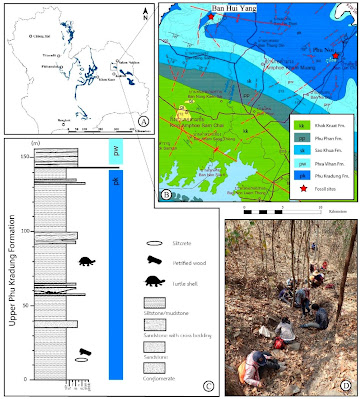
  (A), Map of northern Thailand showing location of Sam Chai area, and outcrops of the Phu Kradung Formation; (B): Geological map of Sam Chai area (modified from [Bumrungsong & Yamunsabideen, 2009]; (C): Stratigraphical column of Ban Hui Yang site; (D): Field work.


 Yakemys multiporcata n. g. n. sp. from the upper part of the Phu Kradung Formation (basal Cretaceous) of Khorat Plateau, NE Thailand. Holotype (SM KS39) from Ban Hui Yang locality, Sam Chai District, Kalasin Province.
(A, B) Carapace in dorsal view; (C, D) shell in ventral view; (E) detail of ornamentation of the carapace surface (on costal 2, indicated by a white rectangle on A), and (F) neural 6–8 with adjacent costal fragments in ventral view.
 Scale bar = 10 cm for (A–D,F) and 2 cm for (E). 
Abbreviations: co, costal plate; Ma, marginal scute; n, neural plate; pe, peripheral plate; py, pygal plate; spy, suprapygal plate; V, vertebral scute.

Testudines Linnaeus, 1758
Cryptodira Cope, 1868
Macrobaenidae Sukhanov, 1964

Yakemys multiporcata n. gen. n. sp.

Diagnosis: A genus of Macrobaenidae of large size, with the carapace length about 70 cm and a combination of characters that differs from all other Macrobaenidae as follows: narrow vertebral scutes; vertebral 4 triangular and narrowed posteriorly, strong midline keel extending to the suprapygal 2, large lateral longitudinal keels on the vertebral region, and additional ridges on the pleural region; plastron reduced, with a triangular short anterior lobe, epiplastron reduced to a strip-shaped plate, entoplastron oval in dorsal view but with a much reduced ventral exposure and an extremely reduced bridge that is shorter than the anterior lobe.

Etymology: Genus name from Yak, giant in Thai (ยักษ์); species name from Latin “multi”: multiple; porcata: from Latin “porca”, ridge.


Conclusions: 
Yakemys multiporcata n. g. n. sp. represents one of the earliest Macrobaenidae hitherto known, and this finding extends the paleogeographical distribution of the group to SE Asia. The discovery of a macrobaenid turtle in Thailand provides further support for the Early Cretaceous age of the upper part of the Phu Kradung Formation and the new evidence of faunal exchange between the SE Asia and more northern parts of mainland Asia at the very beginning of the Cretaceous. Yakemys multiporcata commonly occurs together with Basilochelys macrobios, although both turtles were likely aquatic animals as indicated by their low shell; the different morphology of the shell, especially the plastron, suggests that these turtles had different modes of life. Further discovery of more complete material, especially skull and limb bones, is expected for a better understanding of the phylogenetic relationships and the lifestyle of this strange turtle.


Haiyan Tong, Phornphen Chanthasit, Wilailuck Naksri, Pitaksit Ditbanjong, Suravech Suteethorn, Eric Buffetaut, Varavudh Suteethorn, Kamonlak Wongko, Uthumporn Deesri and Julien Claude. 2021. Yakemys multiporcata n. g. n. sp., a large Macrobaenid Turtle from the Basal Cretaceous of Thailand, with a Review of the Turtle Fauna from the Phu Kradung Formation and Its Stratigraphical Implications. Diversity. 13(12), 630. DOI: doi.org/10.3390/d13120630 
    facebook.com/fossilworld/posts/4864491833572637  ยักษ์คีมิส มัลติพอร์คาตา

Thursday, March 20, 2025

[Paleontology • 2025] Thaichelys ruchae • The Triassic Turtle of Thailand –Revision of ‘Proganochelysruchae (Testudinata: Proterochersidae)


THAICHELYS Szczygielski et al.
[A] Thaichelys ruchae (Broin, 1984) 
 
 [B-C] Proterochersis robusta. [F] Proganochelys quenstedtii 

in Szczygielski, Dróżdż, Chanthasit, Manitkoon et Ditbanjong, 2025. 
ไทยเชลิส โปรกาโนเชลิส รุจาอิ  Proganochelys’ ruchae  

Abstract
True turtles (Testudinata) appeared in the Norian (Late Triassic) and quickly attained a worldwide distribution and relatively high diversity. Their remains are currently known from that time from Asia, Europe, North America, and South America, and represent at least three separate clades. Whereas the generic and suprageneric attribution of comparatively well-preserved and studied European and South American taxa, such as Proganochelys quenstedtii, Proterochersis robusta and Proterochersis porebensis, Palaeochersis talampayensis, and Waluchelys cavitesta sparks no controversy, the more fragmentary and less common species have been variably considered representatives of separate genera or referred to already existing ones – most commonly, Proganochelys. This uncertainty is unfortunate, as it severely muddles the picture of the evolution, diversity, and geographical distribution of the earliest turtles. One such problematic species, coming from the Norian Huai Hin Lat Formation of Thailand, was described in 1980s as Proganochelys ruchae. However, this generic attribution was subsequently put into question and the recent increase of available Triassic turtle material allows to remove the species ruchae from Proganochelys to a new genus, Thaichelys gen. nov., and place it in the clade of Proterochersidae, together with Proterochersis spp., Keuperotesta limendorsa, and Chinlechelys i. As a result, the genus Proganochelys is considered here to be solely a central Pangean (modern-day European) taxon. Moreover, Thaichelys ruchae exhibits in some respects a transitional morphology between other Triassic taxa and Proterochersis spp., and may constitute a sister taxon to the grouping of Proterochersis spp. and Keuperotesta limendorsa from Europe. This, in turn, considering the lack of a Carnian record of pantestudinates outside of Asia, suggests that Thaichelys ruchae could represent an early radiation of the Proterochersidae which branched off before the Testudinata dispersed into the western Pangea.

Systematic paleontology
AMNIOTA Haeckel, 1866 sensu Laurin and Reisz, 2020 
TESTUDINATA Klein, 1760 sensu ITNC et al., 2020

PROTEROCHERSIDAE Nopcsa, 1923 (converted clade name)

Comparison of the bridge region morphology in Triassic pantestudinates (ventral view, scaled to roughly the same shell length).
A, Thaichelys ruchae SM2017-1-124.
B, Proterochersis robusta SMNS 18440. C, Proterochersis robusta SNBS 17561. D, Proterochersis porebensis ZPAL V. 39/49 (pratype).
E, Proganochelys quenstedtii SMNS 17204. F, Proganochelys quenstedtii SMSN 16980. G, Proganochelys quenstedtii MB.1910.45.2. H, Palaeochersis talampayensis PULR 068 (holotype). Scute sulci in A indicated with grey lines, dashed lines indicate poorly defined or ambiguous sulci.

THAICHELYS Szczygielski et al. gen. nov. 

Etymology: Referring to Thailand, as the origin place of the described specimens, and incorporating -chelys (gr. Χέλυς, turtle): „Thai turtle”.

Type and only species: Thaichelys ruchae (Broin, 1984)
 
Thaichelys ruchae (Broin, 1984) comb. nov.

Holotype: SM2015-1-001 (former TF 1440-6), incomplete left side of the anterior plastral lobe (Figs 6, 8A, 9).

Type locality: Ban Suan Sawan Banana Farm, Si Chomphu, Khon Kaen, Thailand.

Type horizon and age: Huai Hin Lat Formation, Late Triassic (Norian).

Revised diagnosis: Testudinate characterized by a unique combination of characters: (1) carapace not reduced in thickness (unlike in Chinlechelys tenertesta, Palaeochersis talampayensis, and Waluchelys cavitesta); (2) pleurals with shelf-like, anteroposteriorly elongated bosses (unlike in Proganochelys quenstedtii); (3) three supramarginals present (unlike in Palaeochersis talampayensis, Proganochelys quenstedtii, and Waluchelys cavitesta); (4) bridge-level marginals (a) not wedging between the supramarginals (unlike in Proganochelys quenstedtii), (b) with anterolaterally projected, V-shaped in lateral view intermarginal sulci (unlike in Proganochelys quenstedtii), (c) with the dorsal exposition smaller ...

Thaichelys ruchae, life restoration as a proterochersid turtle.
Digital drawing by Sita Manitkoon.

 
Tomasz Szczygielski, Dawid Dróżdż, Phornphen Chanthasit, Sita Manitkoon and Pitaksit Ditbanjong. 2025. The Triassic Turtle of Thailand –Revision of ‘Proganochelys’ ruchaePLoS ONE. 20(3): DOI: doi.org/10.1371/journal.pone.0316338 [March 19, 2025]


Monday, January 16, 2023

[Paleontology • 2023] An Unusual Metatarsal of Theropod Dinosaur from the lower Cretaceous of Thailand: the First detailed Study of Paleopathology in Megaraptora


Phuwiangvenator yaemniyomi  Samathi, Chanthasit & Sander, 2019

in Samathi, Weluwanarak, Duanyai, Kaikaew & Suteethorn, 2023.

ABSTRACT
A pathological metatarsal of the early-branching megaraptoran Phuwiangvenator yaemniyomi from the Lower Cretaceous of Thailand is here studied. It was CT-scanned and compared with pathology in other dinosaurs and living animals. The result shows that the palaeopathology in Phuwiangvenator was a traumatic fracture, specifically a greenstick fracture, based on the incomplete breakage of the bone, which occurred only on one side and twisted or distorted in the opposite direction to the force that caused the pathology. The cause of the fracture was possibly by accidentally hitting or kicking hard material, fighting, or falling to the ground. Phuwiangvenator was probably an adolescent when it was injured and survived the incident. This is the second report of a greenstick fracture in Theropoda after Akansaurus fridayii; the first detailed analysis of palaeopathology in Megaraptora; and the first record and detailed description of palaeopathology in non-avian theropods in Southeast Asia.

KEYWORDS: Theropoda, megaraptora, Thailand, palaeopathology, fracture, metatarsal


Adun Samathi, Jakkrapat Weluwanarak, Punyawee Duanyai, Siripat Kaikaew and Suravech Suteethorn. 2023. An Unusual Metatarsal of Theropod Dinosaur from the lower Cretaceous of Thailand: the First detailed Study of Paleopathology in Megaraptora. Historical Biology: An International Journal of Paleobiology. DOI: 10.1080/08912963.2023.2166833

Tuesday, May 10, 2022

[Paleontology • 2022] Peruvispira kanchanaburiensis • A Low-diversity Peruvispira-dominated Gastropod Assemblage from the Permian Ratburi Group of Central Thailand


 Peruvispira kanchanaburiensis
 Karapunar, Nützel & Ketwetsuriya, 2022


Abstract
Permian gastropods from Thailand have been extensively studied over the last few years. The earliest known fossil collection was recovered in 1967 but has never been figured or described. Here, we document this historically important gastropod assemblage excavated from the upper-Lower to Middle Permian Ratburi Group of Khao Mang Lat in the Ban Kao District of Kanchanaburi Province, Central Thailand. The material comprises approximately 200 specimens, almost all of which represent a new species, Peruvispira kanchanaburiensis sp. nov. (Goniasmatidae), together with a single individual of Orthonychia sp. (Orthonychiidae = Platyceratidae). This exceptionally low-diversity community is unusual in comparison to Permian gastropod faunas reported from elsewhere, and could reflect either a low temperature palaeoenvironmental setting or priority effects resulting from early establishment of planktotrophic larvae within the local habitat.
 
Keywords: Gastropoda, Platyceratidae, diversity, Kanchanaburi, Sibumasu Terrane


 Peruvispira kanchanaburiensis


Baran Karapunar, Alexander Nützel and Chatchalerm Ketwetsuriya. 2022. A Low-diversity Peruvispira-dominated Gastropod Assemblage from the Permian Ratburi Group of Central Thailand. Alcheringa: An Australasian Journal of Palaeontology. DOI: 10.1080/03115518.2022.2050814

Thursday, March 31, 2022

[Paleontology • 2022] Fossil Assemblage from the Khok Pha Suam Locality of northeastern, Thailand: An Overview of Vertebrate Diversity from the Early Cretaceous Khok Kruat Formation (Aptian-Albian)


 the Khok Pha Suam Locality of northeastern, Thailand
 Early Cretaceous (Aptian-Albian)  


in Manitkoon, Deesri, Lauprasert, ... et Chanthasit, 2022. 
Palaeoenvironmental interpretation drawing by Sakka Weerataweemat.

Abstract
The Khok Pha Suam locality in the province of Ubon Ratchathani, northeastern, Thailand, is known as “the last home of Thai dinosaurs”, because it belongs to the Lower Cretaceous Khok Kruat Formation (Aptian-Albian) which is currently the youngest Mesozoic vertebrate fossil producing formation in the Khorat Group. Here, we describe a diverse vertebrate assemblage, including hybodonts, ray-finned fishes, turtles, crocodyliforms, pterosaurs, and dinosaurs from the Khok Pha Suam locality. The updated data on the Khok Kruat fauna provides a better understanding of the variety and distribution of Early Cretaceous continental ecosystems, which are useful for palaeoenvironmental reconstruction. In addition to consolidating unincorporated data on fauna, this study also provides the palaeontological data necessary to illustrate the palaeoecosystem to the general public, as well as improving the academic value of the Pha Chan-Sam Phan Bok Geopark.

Key Words: Aptian-Albian, Khorat Group, Lower Cretaceous, Pha Chan-Sam Phan Bok Geopark, Vertebrates


Locality map and Lithostratigraphic section of Khok Pha Suam locality.
a. Map of Thailand, showing the location of the Khorat Plateau;
b. Distribution of the Khok Kruat Formation in northeastern Thailand (green color; modified from DMR, 2004), location of Khok Pha Suam locality (red star);
c. Stratigraphic column of Khok Pha Suam,
d, a photograph of the excavation site; e. Logo of The Pha Chan-Sam Phan Bok Geopark.


Mesozoic vertebrate fauna from the Indochina Terrane of NE Thailand, species-level identified taxa shown in white silhouettes, tentatively identified taxa in black silhouettes, further details in Suppl. material 1 (Modified from Lionel Cavin: All not to scale).

Palaeoenvironmental interpretation of the Early Cretaceous (Aptian-Albian) Khok Pha Suam Locality.
Drawing by Sakka Weerataweemat.


Sita Manitkoon, Uthumporn Deesri, Komsorn Lauprasert, Prapasiri Warapeang, Thanit Nonsrirach, Apirut Nilpanapan, Kamonlak Wongko and Phornphen Chanthasit. 2022. Fossil Assemblage from the Khok Pha Suam Locality of northeastern, Thailand: An Overview of Vertebrate Diversity from the Early Cretaceous Khok Kruat Formation (Aptian-Albian). Fossil Record. 25(1): 83-98. DOI: 10.3897/fr.25.83081
  
กลุ่มชีวินดึกดำบรรพ์ แหล่งซากดึกดำบรรพ์โคกผาส้วม จังหวัดอุบลราชธานี ประเทศไทย:
ความหลากหลายของสัตว์มีกระดูกสันหลัง หมวดหินโคกกรวด ยุคครีเทเชียส 
อุทยานธรณีผาชัน-สามพันโบก 

ความหลากหลายของสัตว์มีกระดูกสันหลังจากมหายุคมีโซโซอิกในแผ่นทวีปอินโดไชน่า


Saturday, February 5, 2022

[Paleontology • 2022] New Materials of Iguanodontians (Dinosauria: Ornithopoda) from the Lower Cretaceous Khok Kruat Formation, Ubon Ratchathani, Thailand


in Samathi & Suteethorn, 2022

Illustration: Kmonvish Lawan
 
Abstract
We describe iguanodontian post-cranial remains, including a cervical vertebra, two dorsal vertebrae, five caudal vertebrae, a metacarpal, right femur, tibia and fibula, and a small femur possibly from a juvenile of the same taxon. This is the first record of a juvenile iguanodontian co-occurring with an adult from Thailand. The material was recovered from the Lower Cretaceous Khok Kruat Formation of Khok Pha Suam, Ubon Ratchathani Province, north-eastern Thailand. It was reconstructed to belong to a non-hadrosauriform styracosternan. This study provides the first osteological description of iguanodontian post-cranial material in Thailand and its potential autapomorphic features. However, whether it belongs to a previously named taxon or represents a new one cannot be assessed yet and must await further discovery.

Keywords: Reptilia, Iguanodontia, Khok Pha Suam, Early Cretaceous, Thailand


 Adun Samathi and Suravech Suteethorn. 2022. New Materials of Iguanodontians (Dinosauria: Ornithopoda) from the Lower Cretaceous Khok Kruat Formation, Ubon Ratchathani, Thailand. Zootaxa. 5094(2); 301–320. DOI: 10.11646/zootaxa.5094.2.5
 

Wednesday, December 8, 2021

[Paleontology • 2022] New Material of Phuwiangvenator yaemniyomi (Dinosauria: Theropoda) from the Type Locality: Implications for the early Evolution of Megaraptora


 Phuwiangvenator yaemniyomi  Samathi, Chanthasit & Sander, 2019

in Samathi, Suteethorn, Pradit & Suteethorn, 2022.


Highlights
• The new material (topotype) of Phuwiangvenator is here described.
• The additional autapomorphy from the new material is here present.
Phuwiangvenator shows features shared with allosauroids and basal coelurosaurs.
• It appears to be intermediate between non-megaraptorid and megaraptorid theropods.
• This work provides information on the early evolution of the Megaraptora.

Abstract
Phuwiangvenator yaemniyomi is a mid-sized, early branching megaraptoran theropod from the Lower Cretaceous Sao Khua Formation of Phu Wiang Mountain, Khon Kaen Province, northeastern Thailand. The holotype includes dorsal and sacral vertebrae, lower legs, hand and foot elements. Here we describe new skeletal material pertaining to the same individual representing the holotype of Phuwiangvenator based on size, shape, and shared phylogenetic affinities. This material was recovered at the same quarry as the holotype and consists of an incomplete fibula, left and right metatarsals. A new autapomorphy observed from the new material is the presence of a long, deep fossa between the lateral and medial distal condyles of the metatarsal II that extends to the distal articular facet is visible in anterior view. The metatarsal III of Phuwiangvenator is relatively short, more similar to the proportion present in basal carcharodontosaur Concavenator than in the derived megaraptorans, but more gracile than other basal allosauroids. Its hindlimb proportions are similar to the basal carcharodontosaur Neovenator than other more derived megaraptorans and coelurosaurs. Phuwiangvenator shows a combination of features shared with allosauroids and basal coelurosaurs and appears to be “intermediate” between non-megaraptorid and megaraptorid theropods. The present work adds anatomical data on this theropod and provides information on the early evolution of the Megaraptora.

Keywords: Theropoda, Megaraptora, Phuwiangvenator, Early Cretaceous, Thailand


Adun Samathi, Suravech Suteethorn, Nakorn Pradit and Varavudh Suteethorn. 2022. New Material of Phuwiangvenator yaemniyomi (Dinosauria: Theropoda) from the Type Locality: Implications for the early Evolution of Megaraptora. Cretaceous Research. In Press, 105093. DOI: 10.1016/j.cretres.2021.105093  

งานวิจัยนี้ศึกษาชิ้นส่วนเพิ่มเติมของไดโนเสาร์กินเนื้อ ภูเวียงเวเนเตอร์ แย้มนิยมมี จากขอนแก่น คือชิ้นส่วนฝ่าตีนซ้ายและขวา พบว่า มันมีลักษณะทางกายวิภาคที่ก้ำกึ่งระหว่างพวกอัลโลซอรอยด์และเบซอลซีลูโรซอร์ ก็พอจะบอกได้ว่า ภูเวียงเวเนเตอร์ซึ่งอยู่ในกลุ่มเมกะแรปเตอร่า มีลักษณะที่โบราณเมื่อเทียบกับพวกเมกะแรปเตอร่ารุ่นหลังที่พบในอเมริกาใต้และออสเตรเลีย ...


Friday, October 16, 2020

[PaleoIchthyology • 2020] Ferganoceratodus annekempae | เฟอร์กาโนเซราโตดัส แอนน์เคมเป • A New Lungfish (Sarcopterygii: Dipnoi) from the Jurassic of Thailand


Ferganoceratodus annekempae
Cavin, Deesri & Chanthasit, 2020

เฟอร์กาโนเซราโตดัส แอนน์เคมเป   || DOI: 10.1080/02724634.2020.1791895  
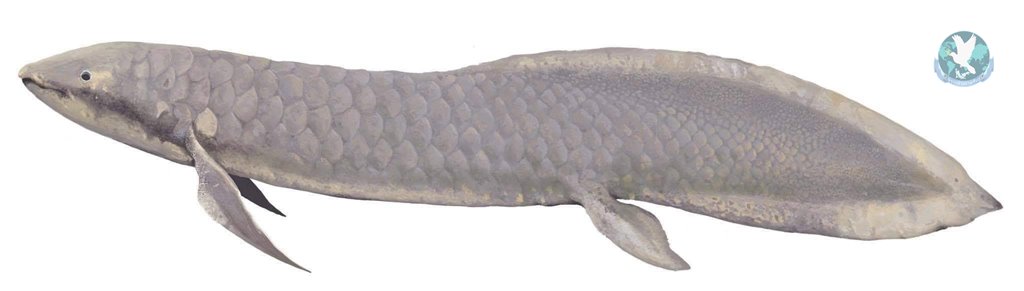
Reconstruction by Sakka Weerataweemat 

Ferganoceratodus annekempae sp. nov., holotype (all elements belong to a single individual), Upper Jurassic of Phu Noi, Tambon Din Chi, Kam Muang district, Kalasin province, northeastern Thailand.


SYSTEMATIC PALEONTOLOGY 
Subclass SARCOPTERYGII Romer, 1955 
Order DIPNOI Müller, 1845 
NEODIPNOI Agnolin, 2010 sensu Kemp, Cavin, and Guinot, 2017 
Suborder CERATODONTOIDEI Nikolski, 1954 sensu Kemp, Cavin, and Guinot, 2017 

Genus FERGANOCERATODUS Kaznyshkin and Nessov, 1985 (in Nessov and Kaznyshkin, 1985) 

Type Species— Ferganoceratodus jurassicus Kaznyshkin and Nessov, 1985. 

Referred Species— Ferganoceratodus szechuanensis (Young, 1942); Fmartini Cavin, Suteethorn, Buffetaut, and Tong, 2007. 

FERGANOCERATODUS ANNEKEMPAE, sp. nov.

Etymology— Species dedicated to Anne Kemp for her contribution to the study of lungfishes, past and present, and for her engagement in the protection of the Australian lungfish.

Locality and Horizon— Phu Noi, Tambon Din Chi, Kam Muang district, Kalasin province, northeastern Thailand. Lower part of the Upper Phu Kradung Formation, Upper Jurassic.


Lionel Cavin, Uthumporn Deesri and Phornphen Chanthasit. 2020. A New Lungfish from the Jurassic of Thailand. Journal of Vertebrate Paleontology. e1791895. DOI: 10.1080/02724634.2020.1791895  

นักวิจัย ค้นพบปลาปอดชนิดใหม่ของโลก จากแหล่งซากดึกดำบรรพ์ภูน้อย จ.กาฬสินธุ์ kalasinnews.com/news1/8-news/3220


Friday, June 5, 2020

[PaleoMammalogy • 2020] The late Middle Miocene Mae Moh Basin of northern Thailand: the Richest Neogene Assemblage of Carnivora from Southeast Asia and A Paleobiogeographic Analysis of Miocene Asian Carnivorans


A middle Miocene scene in Mae Moh, northern Thailand, illustrating five carnivorans:
in the right background Maemohcyon, and in the foreground, from right to left, Siamogale bounosaSiamictis carbonensis, Viverra sp. and Leptoplesictis peignei. 

Grohé, Bonis, Chaimanee, Chavasseau, Rugbumrung, ... et Jaeger. 2020. 
Pencil drawing by Mélanie Grohé. 
 DOI: 10.1206/3952.1 

Abstract 
The late middle Miocene fossil-bearing lignite zones of the Mae Moh Basin, northern Thailand, have yielded a rich vertebrate fauna, including two species of Carnivora described thus far: the bunodont otter Siamogale thailandica (known from over a 100 specimens) and the large amphicyonid Maemohcyon potisati. Here we describe additional carnivoran material from Mae Moh comprising new remains of Maemohcyon potisati as well as remains of seven new carnivorans belonging to at least four families: a new species of Siamogale (S. bounosa), a new species of another otter (Vishnuonyx maemohensis), one representative of the genus Pseudarctos (a small amphicyonid), a new genus of Asian palm civet, Siamictis, one representative of another civet (cf. Viverra sp.), a new species of mongoose (Leptoplesictis peignei) and a Feliformia indet. This carnivoran assemblage constitutes one of the richest for the middle Miocene of eastern Asia and by far the richest for the Neogene of Southeast Asia. While the presence of new species indicates a certain degree of endemism for the Mae Moh Basin, paleobiogeographic cluster analyses conducted on carnivoran faunas from the middle and late Miocene of Asia indicates that a southern Asian biogeographic province, analogous to the current Oriental Realm, has existed since at least the middle Miocene. These results strengthen the observation that the Himalayan Mountains and Tibetan Plateau constitute significant physical barriers as well as an important climatic barrier (through the strengthening of monsoon systems) preventing north-south mammal dispersals in Asia since at least the middle Miocene.

FIGURE 1. Mae Moh Basin, northern Thailand. A, Location of the basin and view of the southwest pit where the most fossiliferous lignite zones Q and K are found. Photo by O.C.; B, Lithostratigraphic sequence of the basin with Carnivora-bearing zones and paleomagnetical dates from Benammi et al. (2002) and Coster et al. (2010).

SYSTEMATIC PALAEONTOLOGY

Order Carnivora Bowdich, 1821
Suborder Caniformia Kretzoi, 1943

Superfamily Arctoidea Flower, 1869

Family Mustelidae Fischer, 1817
Subfamily Lutrinae Bonaparte, 1838

Siamogale Ginsburg et al., 1983
Type species: Siamogale thailandica Ginsburg et al., 1983.

Included species: Siamogale thailandica Ginsburg et al., 1983, S. melilutra Wang et al., 2018, S. bounosa, n. sp.

Siamogale bounosa, new species

Etymology: From Greek bounos (masculine), “hill”; for the bunodont teeth morphology of this species.


Vishnuonyx Pilgrim, 1932 
Type species: Vishnuonyx chinjiensis Pilgrim, 1932. 

Included species: Vishnuonyx chinjiensis Pilgrim, 1932, V. angololensis Werdelin, 2003, V. maemohensis, n. sp.


Vishnuonyx maemohensis, new species  

Etymology: The species name derives from the locality where it was originally found, Mae Moh.


Family Amphicyonidae Haeckel, 1866
Subfamily Amphicyoninae Haeckel, 1866

Maemohcyon Peigné et al., 2006

Maemohcyon potisati Peigné et al., 2006


Pseudarctos Schlosser, 1899
 cf. Pseudarctos sp.


FIGURE 9. A middle Miocene scene in Mae Moh, northern Thailand, illustrating five carnivorans: in the right background Maemohcyon, and in the foreground, from right to left, Siamogale bounosaSiamictis carbonensis, Viverra, and Leptoplesictis peignei.
Pencil drawing by Mélanie Grohé.

Suborder Feliformia Kretzoi, 1945

Family Viverridae Gray, 1821
Subfamily Paradoxurinae Gray, 1964

Siamictis carbonensis, new genus, new species

 Etymology: Generic name derived from Siam, referring to Thailand, and ictis, meaning “marten” in Greek. Species name derived from carbo, meaning “coal” in Latin, in reference to the open coal mine of Mae Moh.


Subfamily Viverrinae Gray, 1964 
cf. Viverra sp. 


Family Herpestidae Gray, 1964
 Leptoplesictis Major, 1903

 Type species: Herpestes filholi Gaillard, 1899.

 Other species included: L. aurelianensis (Schlosser, 1888), L. atavus Beaumont, 1973, L. rangwai Schmidt-Kittler, 1987, L. mbitensis Schmidt-Kittler, 1987, L. senutae Morales et al., 2008, L. namibiensis Morales et al., 2008, L. peignei, n. sp.

Leptoplesictis peignei, new species

Etymology: Species name in memory of Stéphane Peigné, who greatly contributed to carnivoran systematics and evolution.


CONCLUSIONS: 
Nine species of Carnivora are now recorded from the Mae Moh Basin. This fauna appears endemic at the species level. It includes two semiaquatic mustelid genera: the piscivorous otter Vishnuonyx and the bunodont otter Siamogale, represented by two species and the remains of which are the most abundant among Mae Moh Carnivora. It is worth mentioning that Vishnuonyx maemohensis fossils provide the first undoubted record of the lower dentition of the genus and is the most completely known species of this genus. In addition, four smaller feliforms are also present at Mae Moh: two viverrids (including one new genus of Asian palm civet, Siamictis), one herpestid (Leptoplesictis, which represents the oldest Asian member of the family) and a Feliformia indet. Amphicyonids are reported by a very small species (cf. Pseudarctos sp.) and by the largest carnivoran mammal of the Mae Moh community (Maemohcyon potisati).
 By conducting paleobiogeographical cluster analyses based on middle and late Miocene carnivorans, we highlight the existence of a southern Asian biogeographic province, analogous to the current Oriental Realm, since at the least the middle Miocene. This province results from the physical barrier created by the Himayan Mountains and Tibetan Plateau as well as the climatic changes they generated through the strengthening of the monsoon systems in Asia. Our study also demonstrates that carnivoran taxa can be used for the reconstruction of biogeographical provinces, and therefore should be integrated in future analyses.


Camille Grohé, Louis De Bonis, Yaowalak Chaimanee, Olivier Chavasseau, Mana Rugbumrung, Chotima Yamee, Kantapon Suraprasit, Corentin Gibert, Jérôme Surault, Cécile Blondel and Jean-Jacques Jaeger. 2020. The late Middle Miocene Mae Moh Basin of northern Thailand: the Richest Neogene Assemblage of Carnivora from Southeast Asia and A Paleobiogeographic Analysis of Miocene Asian Carnivorans. American Museum Novitates. 3952: 1–57. DOI: 10.1206/3952.1   digitallibrary.amnh.org/handle/2246/7223