Showing posts with label Hadrosauroidea. Show all posts

Monday, September 15, 2025

[Paleontology • 2025] Cariocecus bocagei • A New basal hadrosauroid from the Lower Cretaceous of Portugal


 Cariocecus bocagei
Bertozzo, Camilo, Araújo, Manucci, Kullberg & Cerio, 2025
 
Artwork by Victor F. Carvalho  

Abstract
In Portugal, iguanodontian dinosaurs are mostly known from the Late Jurassic of the Lourinhã Formation and are represented by dryosaurids and basal styracosternans. The Early Cretaceous record of iguanodontians in Portugal is scarce in comparison, with scattered and uninformative remains referred to Styracosterna indet. Here, we describe SHN.832, the first iguanodontian skull from Portugal, named Cariocecus bocagei gen. nov. sp. nov. The specimen was found in Praia do Areia do Mastro (Cabo Espichel, Sesimbra) in the Papo Seco Formation (lower Barremian), and comprises the right side of the skull, part of the skull vault and a nearly complete basicranium. Cariocecus bocagei is diagnosed based on autapomorphies such as the co-ossified maxillo-jugal complex and the trilobated shape of the supraoccipital. The phylogenetic analysis retrieves C. bocagei as a basal hadrosauroid in a clade with Comptonatus chasei and Brighstoneus simmondsi. Our biogeographical analysis emphasizes the effects of insular endemism during the Hauterivian–Aptian range in the European regions. We show that Iguanodontia originated in South America, and through a dispersal event towards North America during the Upper Jurassic, expanded their latitudinal range. Cariocecus and other early-diverging iguanodontians emerged during an eastward dispersal event in the Lower Cretaceous. We reconstructed the endocast, cranial nerves and inner ear of Cariocecus via segmentation of micro-computed tomography scanning, showing similarities with other Hadrosauriformes such as Iguanodon and Proa. We propose the most detailed inner ear soft-tissue reconstruction for a dinosaur so far, including the macula and sub-branches of the vestibulocochlear nerve, supported by the extant phylogenetic bracket. Based on the unossified suture of the cranial elements, we hypothesize that SHN.832 had not yet reached full skeletal maturity, and our restoration suggests a total skull length of about 45 cm. The supraorbital membrane was reconstructed based on the well-preserved supraorbital bone and comparison with modern taxa. 

Keywords: Ornithopoda, Barremian, Papo Seco Formation, supraorbital, biogeography
 

Cariocecus bocagei gen. nov. sp. nov. 


Filippo Bertozzo, Bruno Camilo, Ricardo Araújo, Fabio Manucci, José Carlos Kullberg, Donald G. Cerio. 2025. Cariocecus bocagei, A New basal hadrosauroid from the Lower Cretaceous of Portugal. Journal of Systematic Palaeontology. 23(1); 2536347. DOI: doi.org/10.1080/14772019.2025.2536347 [15 Sep 2025] 


Friday, April 19, 2019

[Paleontology • 2019] Gobihadros mongoliensis • A New Hadrosauroid (Dinosauria: Ornithopoda) from the Late Cretaceous Baynshire Formation of the Gobi Desert (Mongolia)


Gobihadros mongoliensis

Tsogtbaatar, Weishampel, Evans & Watabe, 2019

Abstract
A new genus and species of non-hadrosaurid hadrosauroid, Gobihadros mongoliensis, is described from a virtually complete and undeformed skull and postcranial skeleton, as well as extensive referred material, collected from the Baynshire Formation (Cenomanian-Santonian) of the central and eastern Gobi Desert, Mongolia. Gobihadros mongoliensis is the first non-hadrosaurid hadrosauroid from the Late Cretaceous of central Asia known from a complete, articulated skull and skeleton. The material reveals the skeletal anatomy of a proximate sister taxon to Hadrosauridae in remarkable detail. Gobihadros is similar to Bactrosaurus johnsoni and Gilmoreosaurus mongoliensis, but can be distinguished from them in several autapomorphic traits, including the maximum number (three) of functional dentary teeth per tooth position, a premaxillary oral margin with a ‘double-layer morphology’, and a sigmoidal dorsal outline of the ilium with a well-developed, fan-shaped posterior process. All of these characters in Gobihadros are inferred to be convergent in Hadrosauridae. Phylogenetic analysis positions Gobihadros mongoliensis as a Bactrosaurus-grade hadrosauromorph hadrosauroid. Its relationship with Maastrichtian hadrosaurids from Asia (e.g., Saurolophus angustirostris, Kerberosaurus manakini, Wulagasaurus dongi, Kundurosaurus nagornyi) are sufficiently distant to indicate that these latter taxa owe their distribution to migration from North America across Beringia, rather than having a common Asian origin with Go. mongoliensis.


Fig 2. Skull and mandible of Gobihadros mongoliensis.
 Skull and mandible (MPC-D100/763) in left lateral (A), dorsal (B), ventral (C), and posterior (D) views.
Abbreviations: an, angular; ar, articular; at, atlas; atr, atlantal rib; ax, axis; boc, basioccipital; bsp, basisphenoid; cop, coronoid process; c3, 3rd cervical vertebra; d, dentary; exo, exoccipital; f, frontal; gl, glenoid for the lateral quadrate condyle; hy, hyoid; j, jugal; l, lacrimal; mx, maxilla; n, nasal; p, parietal; pa, palpebral; pat, proatlas; pd, predentary; pf, prefrontal; pl, palatine; pm, premaxilla; po, postorbital; poc, paroccipital process; pt, pterygoid; q, quadrate; qj, quadratojugal; rap, retroarticular process; s, surangular; scl, sclerotic ring; soc, supraoccipital; sq, squamosal; v, vomer.


Fig 33. Skeletal reconstructions of Gobihadros mongoliensis.
 Skull (MPC-D100/763) of Gobihadros mongoliensis in left lateral (A), anterior (B), dorsal (C), and posterior (D) views.
Schematic reconstruction of the skeleton of Gobihadros mongoliensis (E) in lateral view.

Abbreviations: an, angular; boc, basioccipital; bsp, basisphenoid; d, dentary; exo, exoccipital; f, frontal; fm, foramen magnum; hy, hyoid; j, jugal; l, lacrimal; mx, maxilla; n, nasal; p, parietal; pa, palpebral; pd, predentary; pf, prefrontal; pm, premaxilla; po, postorbital; pt, pterygoid; q, quadrate; qj, quadratojugal; s, surangular; soc, supraoccipital; sq, squamosal.

Systematic Palaeontology
ORNITHISCHIA Seeley, 1887 
ORNITHOPODA Marsh, 1881 [42]

IGUANODONTIA sensu Sereno, 1998  
HADROSAUROIDEA sensu Sereno 1998  

Gobihadros nov. gen. 

Gobihadros mongoliensis nov. sp.

Etymology. Hadrosauroid from the Gobi Desert of Mongolia.

Holotype. MPC-D100/746, a complete, nearly articulated skeleton from sub-locality I of Bayshin Tsav.

Locality and horizon. Bayshin Tsav (South Gobi Aimag); Khoorai Tsav (South Gobi Aimag); Khongil Tsav (East Gobi Aimag); Baynshire Formation (Cenomanian-Santonian), Upper Cretaceous.

Diagnosis. Small hadrosauroid that differs from all other non-hadrosaurid hadrosauroids (including Bactrosaurus and Gilmoreosaurus) in the presence of a premaxilla with a ‘double-layer’ oral margin and up to three functional teeth in the dentary tooth row (both convergent in Hadrosauridae). Gobihadros differs from Bactrosaurus johnsoni, Probactrosaurus gobiensis, Eolambia caroljonesi, Claosaurus agilis, Tethyshadros insularis, in the sigmoidal dorsal outline of the ilium and the greater lateral expression of the supracetabular crest. Gobihadros differs from T. insularis, Plesiohadros djaktaensis, and Hadrosauridae in the possession of a spike-like manus digit 1.

Fig 34. Schematic depicting the limb proportions of Gobihadros mongoliensis relative to other iguanodontians. The forelimbs of several iguanodontians on the left scaled to a generalized hindlimb on the right, following [Norman, 1980], to show differences in limb proportions. The phalangeal formula of the manus occurs below each forelimb of the corresponding taxon. Modified from Figure 81 of [Norman, 1980].


Khishigjav Tsogtbaatar, David B. Weishampel, David C. Evans and Mahito Watabe. 2019. A New Hadrosauroid (Dinosauria: Ornithopoda) from the Late Cretaceous Baynshire Formation of the Gobi Desert (Mongolia). PLoS ONE. 14(4): e0208480.  DOI: 10.1371/journal.pone.0208480


Thursday, December 31, 2015

[Paleontology • 2015] Sirindhorna khoratensis | สิรินธรน่า โคราชเอนซิส • A New Basal Hadrosauroid Dinosaur from the Lower Cretaceous Khok Kruat Formation in Nakhon Ratchasima Province, Northeastern Thailand


สิรินธรน่า โคราชเอนซิส |  Sirindhorna khoratensis  Shibata, Jintasakul, Azuma & You, 2015

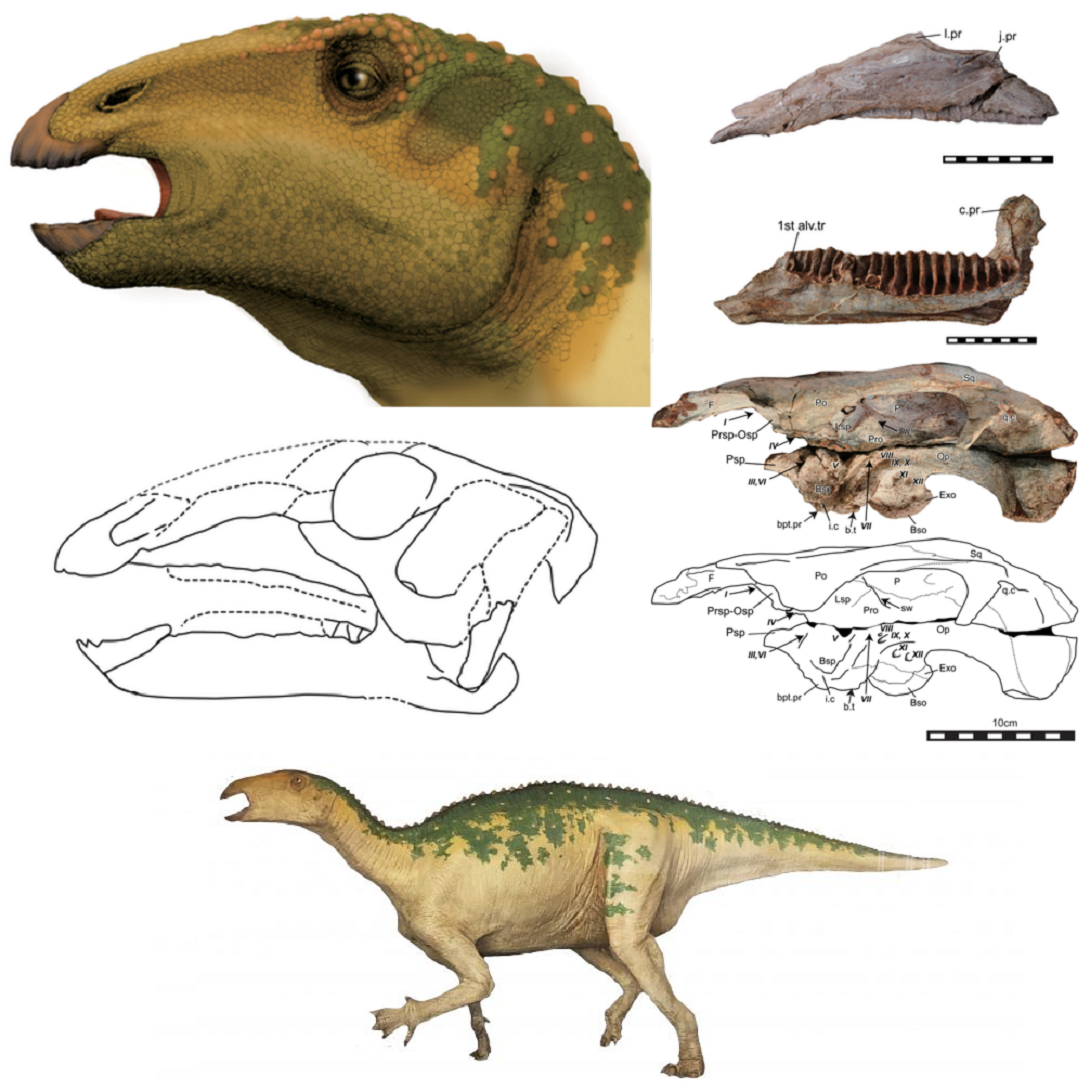
Fig 16. Skull of Sirindhorna khoratensis. (A) A composite skull reconstruction of Sirindhorna. Several elements are reversed. (B) Life restoration of the head of Sirindhorna by Yoko Ohnish.
Scale bar equals 10 cm. Dashed line indicates missing elements.

Abstract

A new basal hadrosauroid dinosaur from the Lower Cretaceous Khok Kruat Formation of Thailand, Sirindhorna khoratensis gen. et sp. nov is described. The new taxon is based on composite skull and mandible including premaxilla, maxilla, jugal, quadrate, braincases, predentary, dentaries, surangular, and maxillary and dentary teeth. It is diagnostic by such characters as, sagittal crest extending along entire dorsal surface of the parietal and reaching the frontoparietal suture (autapomorphy), transversely straight frontoparietal suture, caudodorsally faced supraoccipital, no participation of the supraoccipital in the foramen magnum, mesiodistally wide leaf-shaped dentary tooth with primary and secondary ridges on the lingual surface of the crown, perpendicularly-erected and large coronoid process of dentary, and nonvisible antorbital fossa of the maxilla in lateral view. Phylogenetic analysis revealed S. khoratensis as among the most basal hadrosauroids. Sirindhorna khoratensis is the best-preserved iguanodontian ornithopod in Southeast Asia and sheds new light to resolve the evolution of basal hadrosauriforms.


Introduction

Fossil records of non-hadrosaurid hadrosauriform dinosaurs in Asia have been accumulated in this century. Although these discoveries mainly came from China and Mongolia, new findings have been known from Uzbekistan, Kazakhstan, Japan and Thailand. However, well-preserved iguanodontian specimens were restricted in China and Mongolia; for instance, Jinzhousaurus yangi was known as the almost complete articulated skeleton found from Liaoning Province, Xuwulong yueluni was represented by an articulated skeleton without appendages from Gansu Province of China, and Probactrosaurus gobiensis from Inner Mongolia was described including several individuals of cranium and post cranial portions. In contrast, although two iguanodontians known from the Lower Cretaceous of Thailand, Siamodon (maxilla and referred braincase) and Ratchasimasaurus (dentary), none of them provides enough characters to discuss their phylogenies in detail. The new taxon in this study is known from extensive remains including a disarticulated skull and mandibles, and is much more complete than material of the aforementioned Thailand iguanodontians. This new material was collected from one locality of the Lower Cretaceous Khok Kruat Formation during the first term of Japan-Thailand Dinosaur Project (abbreviated as JTDP), including the preliminary excavation by NRRU in 2005. We describe this material and discuss its phylogenetic position based on a cladistic analysis.


Fig 1. Locality map and stratigraphic column for Sirindhorna.
(A) Map of Nakhon Ratchasima Province, Thailand, (B) localities of Sirindhorna (star mark), Ratchasimasuarus (R) and Siamodon (S), (C) stratigraphic column for the Khorat Group.

Fig 3. Photo (A) and line drawing (B) of the left lateral side of the skull (NRRU3001-166).


Systematic Paleontology

Dinosauria Owen, 1842
Ornithischia Seeley, 1887

Iguanodontia Dollo, 1888 sensu Sereno, 2005 
Ankylopollexia Sereno, 1986 sensu Sereno, 2005 
Styracosterna Sereno, 1986 sensu Sereno, 2005 

Hadrosauriformes Sereno, 1997 sensu Sereno, 1998
Hadrosauroidea Sereno, 1986 sensu Sereno, 2005

Sirindhorna gen. nov.
urn:lsid:zoobank.org:act:40C4FBA5-455F-45AE-AD5A-33B6A6FB8723

Sirindhorna khoratensis, sp. nov.
urn:lsid:zoobank.org:act:54C342F2-EB92-4047-8F78-714025579CB5

Etymology: Dedication to the Princess Maha Chakri Sirindhorn, Thailand, for her contribution to the support and encouragement of paleontology in Thailand. The specific name comes from the name of the locality, Khorat, which is the informal name of Nakhon Ratchasima Province, northeastern Thailand.

Diagnosis: Basal hadrosauroid distinguished by an autapomorphy: sagittal crest extending along entire dorsal surface of the parietal and reaching the frontoparietal suture, and the following unique combination of characters: relatively straight frontoparietal suture, caudodorsally faced supraoccipital, no participation of the supraoccipital in the foramen magnum, antorbital fossa of the maxilla not visible, slightly rostrally deepening dentary ramus, simple troughs for dentary alveoli with vertical walls and tooth crown-shaped base, vertical coronoid process expanded along rostral and caudal margins, and dentary teeth with primary and secondary ridges but no accessory ridges.

Holotype: An articulated braincase comprising the supraoccipital, exoccipitals, opisthotics, prootics, parietals, frontals, basioccipital, basisphenoid orbitosphenoids, parasphenoid and laterosphenoids, with postorbitals and squamosals (NRRU3001-166)

Referred materials: Disarticulated elements of skull and mandibles: a braincase articulating with a left postorbital (NRRU-A2035), dorsal half of a braincase (NRRU3001-65), caudal portion of a braincase (NRRU3001-179), a right premaxilla (NRRU-A3623), a left maxilla (NRRU-A2048), a right maxilla (NRRU-A2047), a right jugal (NRRU3001-7), a right quadrate (NRRU3001-175), a predentary (NRRU3001-169), a left dentary (NRRU3001-14), a right dentary (NRRU3001-167), a right surangular (NRRU3001-137), isolated maxillary teeth (NRRU-A1956, A3630, A3649, NRRU3001-157, 163), an isolated dentary tooth (NRRU3001-28).

Locality and horizon: In Ban (meaning “village”) Saphan Hin, Suranaree Subdistrict, Muaeng Nakhon Ratchasima District, Nakhon Ratchasima Province, Thailand. Lower Cretaceous (Aptian) Khok Kruat Formation.

Fig 15. Comparisons with other Thailand iguanodontians.
(A) Holotypic left maxilla of Siamodon, (B) holotypic right dentary of Ratchasimasaurus, (C) left maxilla of Sirindhorna (NRRU-A2048), (D) left dentary of Sirindhorna (NRRU3001-167).
Scale bars equal 10 cm.    DOI: 10.1371/journal.pone.0145904

Conclusions
The Early Cretaceous hadrosauroid dinosaur, Sirindhorna khoratensis, is described based upon cranial elements. This is the first report of well-preserved ornithopod skull in Southeast Asia (See reconstruction, in Fig 16). Sirindhorna shows general morphological features of hadrosauriforms, such as the low-triangle shaped maxilla, a broad leaf-shaped dentary tooth crown with one prominent primary and one secondary ridges, exclusion of the supraoccipital from the foramen magnum, and the closure of the antorbital fenestra. Uniquely, the craniocaudally-elongated parietals form a long saggital crest extending to the frontoparietal suture in Sirindhorna. Moreover, upper and lower jaws of Sirindhorna show evident differences from the other two Thailand hadrosauriforms, Siamodon nimingami and Ratchasimasaurus suranareae. Phylogenetic analysis recovers Sirindhorna as the most basal hadrosauroid.


Masateru Shibata, Pratueng Jintasakul, Yoichi Azuma and Hai-Lu You. 2015. A New Basal Hadrosauroid Dinosaur from the Lower Cretaceous Khok Kruat Formation in Nakhon Ratchasima Province, Northeastern Thailand. PLoS ONE. 10 (12): e0145904.  DOI: 10.1371/journal.pone.0145904


Sirindhorna khoratensis: Fossils of unknown dinosaur found in Thailand | The Japan Times http://www.japantimes.co.jp/news/2016/01/15/national/science-health/fossils-unknown-dinosaur-found-thailand


โดยความร่วมมือของคณะสำรวจไทยจากมหาวิทยาลัยราชภัฏนครราชสีมา [Nakhon Ratchasima Rajabhat University: NRRU] และพิพิธภัณฑ์ไดโนเสาร์จังหวัดฟุกุอิ [Fukui Prefectural Dinosaur Museum] ประเทศญี่ปุ่น ได้ศึกษาและขุดค้นภาคสนามที่ตำบลสุรนารี อำเภอเมืองนครราชสีมา จังหวัดนครราชสีมา ในชั้นตะกอนหินกรวดสีแดง ในหมวดชั้นหินโคกกรวด ซึ่งเป็นชั้นตะกอนหินที่ก่อตัวในช่วงต้นยุคครีเตเชียสเมื่อประมาณ 110 ล้านปีก่อน

การขุดค้นพบครั้งนี้ได้พบชิ้นส่วนฟอสซิลกระโหลกของไดโนเสาร์กินพืชกลุ่มออร์นิโธพอด ชิ้นกระดูกส่วนท้ายทอย ปลายจะงอยปากบน และกรามล่าง ซึ่งจากการศึกษาลักษณะเอกลักษณ์นั้น ฟอสซิลของไดโนเสาร์ตัวใหม่นี้มีลักษณะบางประการที่ดูคล้ายคลึงกับไดโนเสาร์ในกลุ่มอิกัวโนดอน แต่มีลักษณะของปลายจะงอยปากทรงสามเหลี่ยมแบนที่เป็นลักษณะของกลุ่มฮาโดรซอร์ที่พัฒนาขึ้น

. . . การค้นพบนี้คณะวิจัยได้ขอพระราชทานชื่อสายพันธุ์ไดโนเสาร์ชนิดใหม่นี้จากสมเด็จพระเทพรัตนราชสุดาฯ สยามบรมราชกุมารี เพื่อเฉลิมพระเกียรติ โดยไดโนเสาร์สายพันธุ์นี้มีชื่อวิทยาศาสตร์ว่า สิรินธรน่า โคราชเอนซิส (Sirindhorna khoratensis) ซึ่งชื่อสายพันธุ์นั้นได้ใช้คำว่า โคราช ชื่อเดิมของจังหวัดนครราชสีมา 

สิรินธรน่า เป็นไดโนเสาร์กินพืชในกลุ่มฮาโดรซอร์ที่มีลักษณะโบราณมาก ซึ่งอาศัยอยู่ในช่วงเวลาและหมวดหินที่ใกล้เคียงกันอย่างไดโนเสาร์สายพันธุ์ สยามโมดอน (Siamodon nimingami) และราชสีมาซอรัส (Ratchasimasaurus suranareae) แม้ว่าการศึกษาจะระบุว่าสองสายพันธุ์ที่กล่าวมาจะอยู่ในกลุ่มอิกัวโนดอนมากกว่า

ฮาโดรซอร์ หรือไดโนเสาร์ปากเป็ดเป็นกลุ่มไดโนเสาร์กินพืชที่พัฒนาขนาดให้ใหญ่ขึ้นมากในช่วงปลายยุคครีเตเชียส ซึ่งเป็นหนึ่งในกลุ่มไดโนเสาร์กินพืชที่อาศัยอยู่ในภูมิภาคซีกโลกเหนืออย่างเอเชีย-ยุโรป และอเมริกาเหนือ และสูญพันธุ์ในช่วงปลายยุคครีเตเชียส


ผศ.ดร.ประเทืองเปิดเผยว่า การขุดค้นพบฟอสซิลไดโนเสาร์อิกัวโนดอนสายพันธุ์ใหม่ของโลกในครั้งนี้ เกิดขึ้นจากความร่วมมือระหว่างนักวิจัยจากประเทศไทย และนักวิจัยจากประเทศญี่ปุ่น โดยศาสตราจารย์ ดร.โยอิชิ อะซูมา ผอ.สถาบันวิจัยไดโนเสาร์ มหาวิทยาลัยฟูกุอิ และพิพิธภัณฑ์ไดโนเสาร์ฟูกุอิ ประเทศญี่ปุ่น เป็นหัวหน้าคณะทีมวิจัยฟอสซิลไดโนเสาร์จากแหล่งบ้านสะพานหิน ต.สุรนารี อ.เมือง จ.นครราชสีมา โดยเริ่มวิจัยตั้งแต่ปี พ.ศ. 2550 ซึ่งที่ผ่านมาได้มีการขุดพบฟอสซิลไดโนเสาร์อิกัวโนดอนต์สายพันธุ์ใหม่ของโลกมาแล้ว 2 สกุล ได้แก่ ราชสีมาซอรัส และสยามโมดอน ส่วนฟอสซิลอิกัวโนดอนต์ที่ทำการวิจัยครั้งนี้ ประกอบไปด้วย ชิ้นส่วนกะโหลก ขากรรไกรบน ล่าง ฟัน และชิ้นส่วนอื่นๆ รวม 19 ชิ้น จากชั้นหินกรวดมนปนปูน ในหมวดหินโคกกรวด มีอายุประมาณ 115 ล้านปีก่อน ที่มีระบบนิเวศเป็นแบบกึ่งแห้งแล้ง ซึ่งฟอสซิลอิกัวโนดอนต์ตัวนี้ มีความแตกต่างจากอิกัวโนดอนต์ 2 สกุลที่พบในโคราชมาก่อน เช่น มีขากรรไกรล่าง ที่มีอัตราส่วนระหว่างความยาวและความสูงน้อยกว่าราชสีมาซอรัส หรือมีขากรรไกรบนทรงต่ำหรือลาดเอียงมากกว่าสยามโมดอน เป็นต้น

ได้รับพระมหากรุณาธิคุณในวโรกาส 60 พรรษา สมเด็จพระเทพรัตนราชสุดาฯ สยามบรมราชกุมารี พระราชทานพระราชานุญาตให้ใช้พระนามของพระองค์ เป็นชื่อสกุลว่า “สิรินธรน่า” ส่วนชื่อชนิด ใช้ชื่อโคราชซึ่งเป็นแหล่งค้นพบ คือ โคราชแดนซิส รวมเป็นชื่อทางการว่า “สิรินธรน่า โคราชเอนซิส” โดยมีขนาดความยาวตั้งแต่หัวจรดหาง ประมาณ 6 เมตร สูงประมาณ 2 เมตร หนักประมาณ 1 ตัน มีอายุอยู่ในช่วงประมาณ 115 ล้านปีก่อน ทั้งนี้สำหรับไดโนเสาร์อิกัวโนดอน อยู่ในประเภทไดโนเสาร์กินพืชที่มีกระดูกสะโพกแบบนก ต่างจากไดโนเสาร์กินพืชพวกซอโรพอตหรือพวกคอยาวหางยาว ที่มีกระดูกสะโพกแบบสัตว์เลื้อยคลาน ไดโนเสาร์กลุ่มอิกัวโนดอนนี้ พบมากกว่า 60 สกุล เพราะมีวิวัฒนาการต่อเนื่องกันมานานกว่า 100 ล้านปี และพบกระจายกว้างขวางทั่วโลก ลักษณะเด่นของอิกัวโนดอนต์ คือมีฟันคล้ายฟันอิกัวน่า แต่มีขนาดใหญ่กว่ากันมาก ไม่มีฟันในส่วนหน้าของขากรรไกรบน-ล่าง แต่มีจงอยปากที่เป็นกระดูกแข็งแทน ขาหลังแข็งแรง ใหญ่ และยาวกว่าขาหน้า จึงเป็นไดโนเสาร์ที่วิ่งได้เร็วด้วย 2 เท้า แต่เวลาเดินหรือแทะเล็มกินใบไม้ยอดไม้ระดับต่ำ จะเดินด้วย 4 เท้า อาจแบ่งได้เป็น 2 พวกย่อย คือ พวกที่มีหัวแม่มือเป็นเดือยแหลม ไว้ป้องกันตัวหรือแกะเมล็ดไม้ที่มีเปลือกแข็ง เช่น อิกัวโนดอน จึงหมายถึงกลุ่มไดโนเสาร์ที่ประกอบด้วยสกุลอิกัวโนดอน และสกุลอื่นๆ ที่คล้ายอิกัวโนดอน สำหรับสิรินธรน่า จะจัดอยู่ในกลุ่มย่อยที่ 1 คือ พวกที่มีหัวแม่มือเป็นเดือยแหลม รวมทั้งราชสีมาซอรัสและสยามโมดอน ก็จัดอยู่ในอิกัวโนดอนกลุ่มย่อยนี้ด้วย

ขึ้นทะเบียนซากไดโนเสาร์พันธุ์ใหม่โลก "สิรินธรนา โคราชเอนซิส" อายุ 100 ล้านปี
news.thaipbs.or.th/content/261064 #ThaiPBS via @ThaiPBS
พระราชทาน ‘สิรินธรน่า โคราชเอนซิส’ ฟอสซิลไดโนเสาร์สายพันธุ์ใหม่ที่ขุดพบ: http://www.matichon.co.th/news/7220

Wednesday, June 11, 2014

[Paleontology • 2014] Zhanghenglong yangchengensis • A New Basal hadrosauroid Dinosaur (Dinosauria: Ornithopoda) with Transitional Features from the late Cretaceous of Henan Province, China


Zhanghenglong yangchengensis
Xing, Wang, Han, Sullivan, Ma, He, Hone, Yan, Du & Xu. 2014

ABSTRACT 
Background
Southwestern Henan Province in central China contains many down-faulted basins, including the Xixia Basin where the Upper Cretaceous continental sediments are well exposed. The Majiacun Formation is a major dinosaur-bearing stratigraphic unit that occurs in this basin.

Methodology/Principal Findings
A new basal hadrosauroid dinosaur, Zhanghenglong yangchengensis gen. et sp. nov., is named based on newly collected specimens from the middle Santonian Majiacun Formation of Zhoujiagou Village, Xixia Basin. Two transitional features between basal hadrosauroids and hadrosaurids are attached to the diagnosis of the new taxon, namely five maxillary foramina consisting of four small scattered ones anteroposteriorly arranged in a row and a large one adjacent to the articular facet for the jugal, and dentary tooth crowns bearing both median and distally offset primary ridges. Zhanghenglong also displays a unique combination of plesiomorphic and derived features of hadrosauroids, and is clearly morphologically transitional between basal hadrosauroids and hadrosaurids. Furthermore, some measurement attributes in osteology are applied to the quantitative analysis of Zhanghenglong. For these attributes, the partition of the dataset on most hadrosauroid species resulting from model-based cluster analysis almost matches taxonomic separation between basal hadrosauroids and hadrosaurids. Data of Zhanghenglong on selected measurement attributes straddle the two combinations of intervals of partitioned datasets respectively related to basal hadrosauroids and hadrosaurids. This condition is similar to mosaic evolution of morphological characters present in the specimens of the taxon. The phylogenetic analysis of Hadrosauroidea recovers a clade composed of Zhanghenglong, Nanyangosaurus, and Hadrosauridae with an unresolved polytomy.

Conclusions/Significance
Zhanghenglong is probably a relatively derived non-hadrosaurid hadrosauroid, based on the inferences made from the morphological comparisons, quantitative evaluation of measurements, and cladistic analysis. In combination with information on the stratigraphy, phylogeny and biogeography, the material of Zhanghenglong provides direct evidence for the hypothesis that hadrosaurids might have originated in Asia.

FIGURE 2: Reconstruction and restoration of the skeleton of Zhanghenglong yangchengensis.
(A) Skull reconstruction of Z. yangchengensis in left lateral view. (B) Restoration of the head and the anterior part of the neck of Z. yangchengensis in left lateral view. (C) Skeleton reconstruction of Z. yangchengensis in left lateral view. Bones in white are preserved in the specimens of Z. yangchengensis (XMDFEC V0013 and V0014). Bones in grey are unknown.
Abbreviations: d, dentary; f, frontal; j, jugal; l, lacrimal; mx, maxilla; na, nasal; pd, predentary; pmx, premaxilla; po, postorbital; prf, prefrontal; q, quadrate; qj, quadratojugal; sa, surangular; sq, squamosal. 

Systematic Paleontology

Dinosauria Owen, 1842
Ornithischia Seeley, 1887 
Ornithopoda Marsh, 1881 

Iguanodontia Dollo, 1888 sensu Sereno, 1998
Ankylopollexia Sereno, 1986 sensu Sereno, 1998
Styracosterna Sereno, 1986 sensu Sereno, 1998
Hadrosauriformes Sereno, 1986 sensu Sereno, 1998
Hadrosauroidea Cope, 1870 sensu You et al., 2003 

Zhanghenglong yangchengensis  gen. et sp. nov.

Etymology: Zhangheng” is derived from the full name of Mr. Zhang Heng, a famous Chinese astronomer, mathematician, inventor, poet, and statesman who lived during the Eastern Han Dynasty (AD 25–220) of China. The figure was born in the outskirts of Nanyang in southwestern Henan Province, quite close to the Xixia Basin. The word “long” is the direct transliteration of the Mandarin Chinese word that means dragon. The specific name is derived from a large administrative region called Yangcheng that was established in the Spring and Autumn period (BC 770–403) of the Eastern Zhou Dynasty of China. This ancient administrative region included what is now southwestern Henan Province.


Hai Xing, Deyou Wang, Fenglu Han, Corwin Sullivan, Qingyu Ma, Yiming He, David W E Hone, Ronghao Yan, Fuming Du, Xing Xu. 2014. A New Basal hadrosauroid Dinosaur (Dinosauria: Ornithopoda) with Transitional Features from the late Cretaceous of Henan Province, China. PLoS ONE. 9(6):e98821. DOI: dx.doi.org/10.1371/journal.pone.0098821