Showing posts with label migration. Show all posts

Tuesday, June 18, 2024

[Entomology • 2024] The Most Remarkable Migrants — Systematic Analysis of the Western European Insect Flyway at a Pyrenean Mountain Pass


Systematic Analysis of the Western European Insect Flyway at a Pyrenean Mountain Pass

in Hawkes, Doyle, Massy, Weston, Davies, ... et Wotton, 2024. 

Abstract
In autumn 1950 David and Elizabeth Lack chanced upon a huge migration of insects and birds flying through the Pyrenean Pass of Bujaruelo, from France into Spain, later describing the spectacle as combining both grandeur and novelty. The intervening years have seen many changes to land use and climate, posing the question as to the current status of this migratory phenomenon. In addition, a lack of quantitative data has prevented insights into the ecological impact of this mass insect migration and the factors that may influence it. To address this, we revisited the site in autumn over a 4 year period and systematically monitored abundance and species composition of diurnal insect migrants. We estimate an annual mean of 17.1 million day-flying insect migrants from five orders (Diptera, Hymenoptera, Hemiptera, Lepidoptera and Odonata) moving south, with observations of southward ‘mass migration’ events associated with warmer temperatures, the presence of a headwind, sunlight, low windspeed and low rainfall. Diptera dominated the migratory assemblage, and annual numbers varied by more than fourfold. Numbers at this single site hint at the likely billions of insects crossing the entire Pyrenean mountain range each year, and we highlight the importance of this route for seasonal insect migrants.

Keywords: Pyrenees, insect migration flyway, monitoring, migration rates, movement ecology

 Classification of the migratory assemblage. Average ratios of insects showing migratory behaviour collected in the intercept trap and butterfly counts over 4 years sorted by (a) order and (b) family. 


Will L. Hawkes, Toby Doyle, Richard Massy, Scarlett T. Weston, Kelsey Davies, Elliott Cornelius, Connor Collier, Jason W. Chapman, Don R. Reynolds and Karl R. Wotton. 2024. The Most Remarkable Migrants—Systematic Analysis of the Western European Insect Flyway at a Pyrenean Mountain Pass. Proc. R. Soc. B. 291: 20232831. DOI: 10.1098/rspb.2023.2831
 

Wednesday, May 15, 2024

[Ornithology • 2024] Patagona chaski • Extreme Elevational Migration spurred Cryptic Speciation in Giant Hummingbirds (Apodiformes: Trochilidae)


Patagona chaski   
Patagona gigas  (Vieillot, 1824)

in Williamson, Gyllenhaal, Bauernfeind, Baumann, Gadek, Marra, Ricote, Valqui, Bozinovic, Singh & Witt, 2024. 
 
Significance: 
Biodiversity varies from place to place because the range of climates suitable for any one species tends to be limited. The giant hummingbird appears to defy this tendency, occurring across the broadest range of environments of any hummingbird. We asked whether its migration, physiology, or genetics explain its climate generalism, potentially illuminating mechanisms of niche breadth evolution. Microtracking devices revealed an epic migration from the Chilean coast to the Peruvian Andes, with an extreme, >4,100-m elevational shift and corresponding performance trade-offs. Genomes revealed that migrant and resident populations diverged in the Pliocene and have since evolved under phenotypic stasis. A migratory shift enabled climatic niche expansion, leading to speciation and niche subdivision, consistent with diversification by niche breadth oscillation.

Abstract
The ecoevolutionary drivers of species niche expansion or contraction are critical for biodiversity but challenging to infer. Niche expansion may be promoted by local adaptation or constrained by physiological performance trade-offs. For birds, evolutionary shifts in migratory behavior permit the broadening of the climatic niche by expansion into varied, seasonal environments. Broader niches can be short-lived if diversifying selection and geography promote speciation and niche subdivision across climatic gradients. To illuminate niche breadth dynamics, we can ask how “outlier” species defy constraints. Of the 363 hummingbird species, the giant hummingbird (Patagona gigas) has the broadest climatic niche by a large margin. To test the roles of migratory behavior, performance trade-offs, and genetic structure in maintaining its exceptional niche breadth, we studied its movements, respiratory traits, and population genomics. Satellite and light-level geolocator tracks revealed an >8,300-km loop migration over the Central Andean Plateau. This migration included a 3-wk, ~4,100-m ascent punctuated by upward bursts and pauses, resembling the acclimatization routines of human mountain climbers, and accompanied by surging blood-hemoglobin concentrations. Extreme migration was accompanied by deep genomic divergence from high-elevation resident populations, with decisive postzygotic barriers to gene flow. The two forms occur side-by-side but differ almost imperceptibly in size, plumage, and respiratory traits. The high-elevation resident taxon is the world’s largest hummingbird, a previously undiscovered species that we describe and name here. The giant hummingbirds demonstrate evolutionary limits on niche breadth: when the ancestral niche expanded due to evolution (or loss) of an extreme migratory behavior, speciation followed.


Jessie L. Williamson, Ethan F. Gyllenhaal, Selina M. Bauernfeind, Matthew J. Baumann, Chauncey R. Gadek, Peter P. Marra, Natalia Ricote, Thomas Valqui, Francisco Bozinovic, Nadia D. Singh, and Christopher C. Witt. 2024.  Extreme Elevational Migration spurred Cryptic Speciation in Giant Hummingbirds. PNAS. 121 (21); e2313599121. DOI: 10.1073/pnas.2313599121 

The proposed scientific name for the resident northern population is Patagona chaski. “Chaski” is the word for messenger in Quechua, a family of Indigenous languages that spread from Peru to other neighboring countries.


Sunday, May 8, 2022

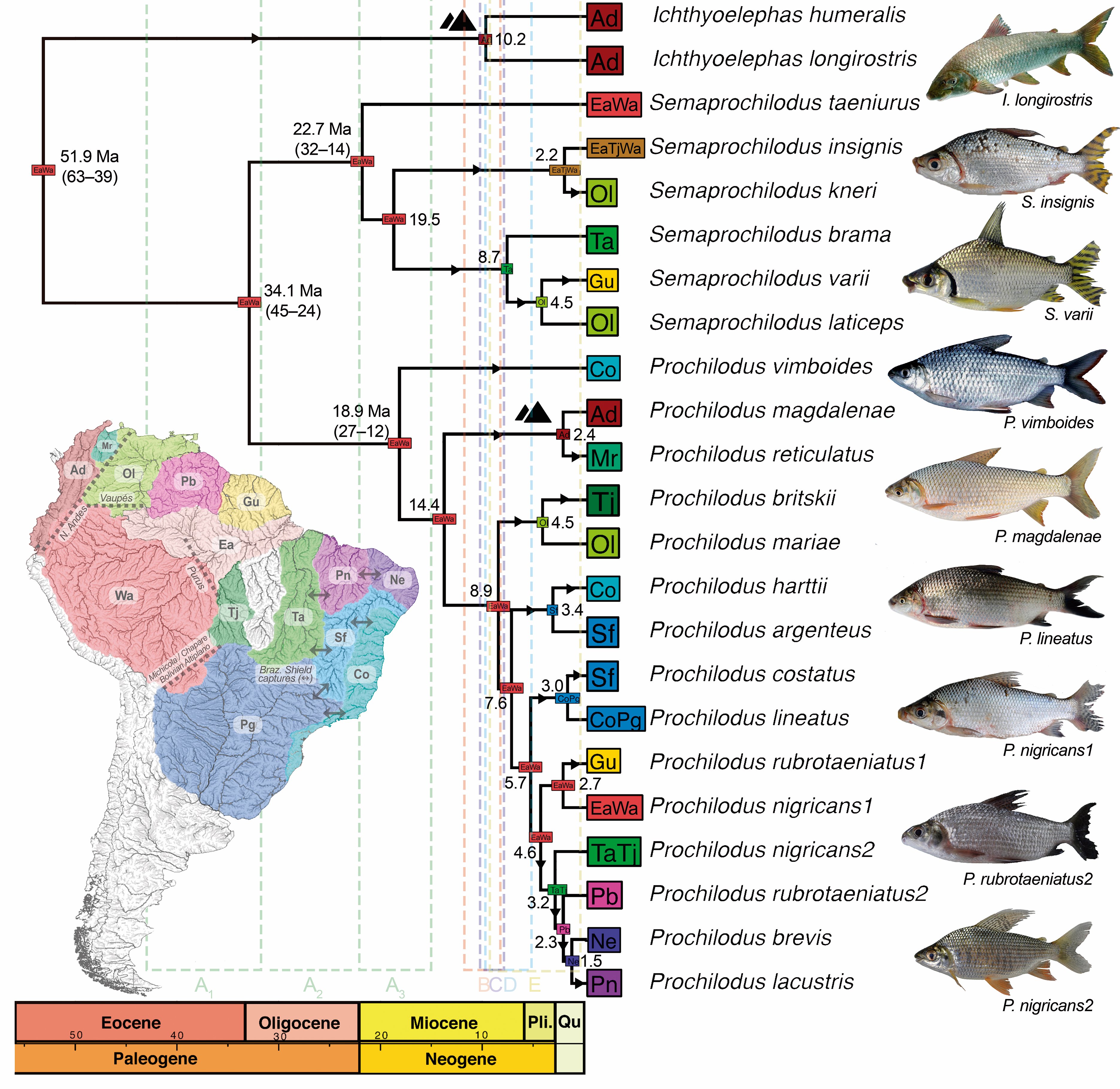
[Ichthyology • 2022] Biogeographic Reconstruction of the Migratory Neotropical Fish Family Prochilodontidae (Teleostei: Characiformes)


in Frable, Melo, Fontenelle, et al., 2022.

Abstract
Geographically, widespread Neotropical fish lineages offer opportunities to reconstruct historical biogeography patterns and infer processes leading to modern ichthyological diversity and distribution. The characiform family Prochilodontidae is well suited for such reconstruction because their migrations limit population substructure within river systems. Therefore, their biogeographic history should match closely the history of connectivity among Neotropical river basins. Here, we combine a time-calibrated phylogeny with biogeographic model testing to recover the history of this family's diversification. Results support the Miocene rise of the Andean Eastern Cordillera as a dispersal barrier, but also indicate a much earlier Eocene origin of the trans-Andean genus Ichthyoelephas. Despite the early origin of the family and its three constituent genera, most prochilodontid lineages originated during the Miocene in Greater Amazonia, likely due to drainage reorganizations caused by Andean uplift. Subsequent speciation appears linked to interbasin exchanges and expansions of Amazonian lineages into Brazilian coastal systems. The modern richness of Prochilodus in easterly drainages appears to be relatively young, with only Prochilodus vimboides likely reaching that region prior to the late Miocene. The rise of the Vaupes Arch coincides with two splits between Orinocoan and Amazonian lineages circa 9 million years ago (Ma). However, two instances of later dispersal between these drainages reveal the permeability of the Vaupes Arch, suggesting that it may promote periodic speciation. This study illustrates how model-based biogeographic studies of widespread groups can reconstruct historic paths of dispersal and help reveal how landscape evolution promoted modern diversity patterns.

Keywords: Amazon, BioGeoBEARS, Eastern Cordillera, historical biogeography, Ostariophysi


Time-calibrated phylogeny and ancestral range evolution of Prochilodontidae estimated by BEAST and BioGeoBEARS.

Photos by A. Nobile (Prochilodus lineatus), B. Melo (Semaprochilodus insignis, P. nigricans1, P. rubrotaeniatus2), J. García-Melo (Ichthyoelephas longirostris), M. Sabaj (S. varii, P. magdalenae, P. nigricans2) and R. Castro (P. vimboides).


Benjamin W. Frable, Bruno F. Melo, João P. Fontenelle, Claudio Oliveira and Brian L. Sidlauskas. 2022. Biogeographic Reconstruction of the Migratory Neotropical Fish Family Prochilodontidae (Teleostei: Characiformes). Zoologica Scripta. DOI: 10.1111/zsc.12531 


Sunday, November 29, 2020

[Crustacea • 2020] Why do Shrimps leave the Water? Mechanisms and Functions of Parading Behaviour in Freshwater Shrimps


Macrobrachium dienbienphuense Dang & Nguyen, 1972

Parading shrimps synchronously walking on land at night at the Lamduan Rapids, Ubon Ratchathani, Thailand. 

in Hongjamrassilp, Maiphrom et Blumstein, 2020. 
 Photos: Watcharapong Hongjamrassilp 

Abstract
An understanding of the mechanisms and functions of animal migratory behaviour may provide insights into its evolution. Furthermore, knowledge about migration may be important for conservation of rare species and may help to manage species in a rapidly changing world. Upstream migration is common in riverine animals, but little is known about proximate cues and functions of the upstream migration in aquatic macroinvertebrates. In Ubon Ratchathani, Thailand, locals have observed a synchronous mass migration of freshwater shrimps on land. This so‐called ‘parading behaviour' occurs annually during the rainy season and has become a large ecotourism event. Yet, we know little about the natural history, proximate causation and function of this extraordinary behaviour. Here we describe the natural history of parading behaviour and report the results from a series of experiments and observations to address its mechanisms and functions. Parading behaviour is not associated with breeding and spawning; rather, shrimps leave the water to escape strong currents. Conditions promoting shrimps to leave the water include low light, high water velocity and low air temperature. In addition, there is variation explained the specific location. River topology that creates hydrological variability and turbulence plays a role in triggering the shrimps to move out of water. Furthermore, turbidity and water chemistry were associated with shrimp activity. Finally, our results support that parading behaviour in freshwater shrimps is a mass movement upstream due to hydrological displacement. This study highlights the mechanisms that stimulate parading behaviour; a common activity in Macrobrachium and other decapod crustaceans.

Keywords: collective movement, freshwater prawn, Macrobrachium dienbienphuense, migration, Southeast Asia

Parading shrimps synchronously walking on land at night at the Lamduan Rapids, Ubon Ratchathani, Thailand. 
Photo: Watcharapong Hongjamrassilp.


W. Hongjamrassilp, W. Maiphrom and D. T. Blumstein. 2020. Why do Shrimps leave the Water? Mechanisms and Functions of Parading Behaviour in Freshwater Shrimps. Journal of Zoology. DOI: 10.1111/jzo.12841

These Shrimp Leave the Safety of Water and Walk on Land. But Why?
A biologist decided to investigate a shrimp parade that attracts thousands of tourists in a province of Thailand.


Wednesday, February 15, 2017

[Ichthyology • 2017] Goliath Catfish (Brachyplatystoma spp., Pimelodidae) Spawning in the far western Amazon confirmed by the Distribution of Mature Adults, Drifting Larvae and Migrating Juveniles


Figure 1: Migratory goliath catfishes (Brachyplatystoma, Pimelodidae).
 
(ABrachyplatystoma vaillantii (piramutaba in Portuguese, pirabutón in Spanish); (BB. rousseauxii (dourada in Portuguese, dorado in Spanish); (CB. platynemum (babão in Portuguese, mota flemosa in Spanish); (DB. juruense (zebra in Portuguese, zebra in Spanish);
(lower) Dorado migrations exploited by fishermen. The Santo Antônio Dam on the Madeira River now drowns the Teotônio Rapids (shown here) where
 B. rousseauxii (species in photo) and B. platynemum were previously exploited and easily detected when migrating.

Photos by M. Goulding.   DOI: 10.1038/srep41784 

Abstract
We mapped the inferred long-distance migrations of four species of Amazonian goliath catfishes (Brachyplatystoma rousseauxiiBplatynemumB. juruense and B. vaillantii) based on the presence of individuals with mature gonads and conducted statistical analysis of the expected long-distance downstream migrations of their larvae and juveniles. By linking the distribution of larval, juvenile and mature adult size classes across the Amazon, the results showed: (i) that the main spawning regions of these goliath catfish species are in the western Amazon; (ii) at least three species — B. rousseauxiiB. platynemum, and B. juruense — spawn partially or mainly as far upstream as the Andes; (iii) the main spawning area of B. rousseauxii is in or near the Andes; and (iv) the life history migration distances of B. rousseauxii are the longest strictly freshwater fish migrations in the world. These results provide an empirical baseline for tagging experiments, life histories extrapolated from otolith microchemistry interpretations and other methods to establish goliath catfish migratory routes, their seasonal timing and possible return (homing) to western headwater tributaries where they were born.


Dorado migrations exploited by fishermen. The Santo Antônio Dam on the Madeira River now drowns the Teotônio Rapids (shown here) where Brachyplatystoma rousseauxii (B) and B. platynemum (Cwere previously exploited and easily detected when migrating.

Photos by M. Goulding.   DOI: 10.1038/srep41784  

Figure 1: Migratory goliath catfishes (Brachyplatystoma, Pimelodidae).
(A) Brachyplatystoma vaillantii (piramutaba in Portuguese, pirabutón in Spanish); (B) B. rousseauxii (dourada in Portuguese, dorado in Spanish); (C) B. platynemum (babão in Portuguese, mota flemosa in Spanish); (D) B. juruense (zebra in Portuguese, zebra in Spanish); (E) Dorado migrations exploited by fishermen. The Santo Antônio Dam on the Madeira River now drowns the Teotônio Rapids (shown here) where B. rousseauxii (species in photo) and B. platynemum were previously exploited and easily detected when migrating. Photos by M. Goulding. 

Ronaldo B. Barthem, Michael Goulding, Rosseval G. Leite, Carlos Cañas, Bruce Forsberg, Eduardo Venticinque, Paulo Petry, Mauro L. de B. Ribeiro, Junior Chuctaya and Armando Mercado. 2017. Goliath Catfish Spawning in the far western Amazon confirmed by the Distribution of Mature Adults, Drifting Larvae and Migrating Juveniles.  
 Scientific Reports. 7, Article number: 41784. DOI: 10.1038/srep41784


Giant catfish clocks longest ever freshwater migration https://news.mongabay.com/2017/02/giant-catfish-clocks-longest-ever-freshwater-migration/ via @mongabay
Scientists confirm dorado catfish as all-time distance champion of freshwater migrations  scienmag.com/scientists-confirm-dorado-catfish-as-all-time-distance-champion-of-freshwater-migrations/ via @scienmag

Friday, August 19, 2016

[Ornithology / Behaviour • 2016] Evidence that Birds Sleep in Mid-Flight


Frigatebirds reaches a wingspan of over two meters. They are excellent gliders and can cover several hundred kilometers a day.
photo: B. Voirin    DOI: 10.1038/ncomms12468  

Abstract
Many birds fly non-stop for days or longer, but do they sleep in flight and if so, how? It is commonly assumed that flying birds maintain environmental awareness and aerodynamic control by sleeping with only one eye closed and one cerebral hemisphere at a time. However, sleep has never been demonstrated in flying birds. Here, using electroencephalogram recordings of great frigatebirds (Fregata minor) flying over the ocean for up to 10 days, we show that they can sleep with either one hemisphere at a time or both hemispheres simultaneously. Also unexpectedly, frigatebirds sleep for only 0.69 h d−1 (7.4% of the time spent sleeping on land), indicating that ecological demands for attention usually exceed the attention afforded by sleeping unihemispherically. In addition to establishing that birds can sleep in flight, our results challenge the view that they sustain prolonged flights by obtaining normal amounts of sleep on the wing.

Figure 1: Measuring the brain state and flight mode of flying frigatebirds.
 (a) Great frigatebird Fregata minor with a head-mounted data logger for recording the electroencephalogram (EEG) from both cerebral hemispheres and head acceleration in three dimensions. A back-mounted GPS logger recorded position and altitude. Photo: B.V. (b) Overhead view of a great frigatebird skull showing (1) the position of the cranial bulge (shaded grey) overlying the hyperpallium of each hemisphere, (2) the position of the epidural electrodes (red dots, EEG; green dot, ground) and (3) the data logger (black rectangle) just posterior to the naso-frontal hinge (arrow). Scale bar is 10 mm. (c) All GPS tracks for individual birds coded with different colours. The Galapagos Islands are outlined with black lines and the study site (Genovesa) is marked by a star. Ocean depth (m) is coded with grey scale. (d) High temporal resolution (1 Hz) 10 min flight trajectory recorded with GPS from a frigatebird (see Supplementary Movie 1 for 3D visualization) showing the circling (soaring) and straight (gliding) flight modes typical of Fregatidae13 (Methods). (e) Altitude, ground speed and airspeed (computed from the GPS data in (d)), tangential and centripetal (radial) low-pass filtered acceleration, and the absolute value of total acceleration (measured by an accelerometer) for the flight in (d). 


Niels C Rattenborg, Bryson Voirin, Sebastian M. Cruz, Ryan Tisdale, Giacomo Dell’Omo, Hans-Peter Lipp, Martin Wikelski and Alexei L. Vyssotski. 2016. Evidence that Birds Sleep in Mid-Flight. Nature Communications. 7: 12468. DOI: 10.1038/ncomms12468 

First evidence of sleep in flight
Birds engage in all types of sleep in flight, but in remarkably small amounts

Tuesday, August 19, 2014

[Herpetology • 2014] Sound Communication and Social Behavior in an Amazonian River Turtle Podocnemis expansa


 adult Giant South American river turtle Podocnemis expansa.
The turtle is the largest member of the side-necked turtle family and grows up to nearly 3 feet in length.
photo: C. Ferrara/Wildlife Conservation Society

Abstract
The social behavior of turtles during the nesting season can be attributed to a series of functions such as reducing predation, increasing hatchling survivorship, and information exchange between nesting females. However, the mechanism(s) used to remain in a group during the different phases of nesting behavior has yet to be explained. The objective of this study is to document the sounds produced by Giant South American River Turtle, Podocnemis expansa, during the nesting period, and identify how acoustic mechanisms might facilitate social behavior and group aggregation during this period. From September 2009 to October 2011, the sound repertoire of P. expansa was identified during the nesting period, which begins with the migration of the turtles from the flooded forests to the nesting beaches and terminates when the hatchlings emerge and the females migrate with the hatchlings to the flooded forests. Sounds were recorded when the turtles were active in different behavioral patterns (1) migrating; (2) aggregating in front of the nesting beaches before basking; (3) nesting at night; (4) waiting in the water without nesting or after they have nested; and (5) waiting for the arrival of the hatchlings. We observed six types of sound in the recordings of turtles made during the nesting period. These data indicate that this species is social, and that sound plays an important role in the synchronization of the activities of groups during the nesting season.

Keywords: Giant South American River Turtle, Migration, Nesting, Underwater vocalizations


Camila Rudge Ferrara, Richard C. Vogt, Renata S. Sousa-Lima, Bruno M.R. Tardio and Virginia Campos Diniz Bernardes. 2014. Sound Communication and Social Behavior in an Amazonian River Turtle (Podocnemis expansa). Herpetologica. 70(2):149- 156.
DOI: 10.1655/HERPETOLOGICA-D-13-00050R2

Scientists study 'talking' turtles in Brazilian Amazon
 Turtles are well known for their longevity and protective shells, but it turns out these reptiles use sound to stick together and care for young. Scientists working in the Brazilian Amazon have found that Giant South American river turtles actually use several different kinds of vocal communication to coordinate their social behaviors, including one used by female turtles to call to their newly hatched offspring in what is the first instance of recorded parental care in turtles.

Monday, March 17, 2014

[Herpetology / Behaviour • 2014] First Satellite Tracks of Neonate Sea Turtles redefine the 'Lost Years' Oceanic Niche


Loggerhead Caretta caretta

Abstract
Few at-sea behavioural data exist for oceanic-stage neonate sea turtles, a life-stage commonly referred to as the sea turtle ‘lost years’. Historically, the long-term tracking of small, fast-growing organisms in the open ocean was logistically or technologically impossible. Here, we provide the first long-term satellite tracks of neonate sea turtles. Loggerheads (Caretta caretta) were remotely tracked in the Atlantic Ocean using small solar-powered satellite transmitters. We show that oceanic-stage turtles (i) rarely travel in Continental Shelf waters, (ii) frequently depart the currents associated with the North Atlantic Subtropical Gyre, (iii) travel quickly when in Gyre currents, and (iv) select sea surface habitats that are likely to provide a thermal benefit or refuge to young sea turtles, supporting growth, foraging and survival. Our satellite tracks help define Atlantic loggerhead nursery grounds and early loggerhead habitat use, allowing us to re-examine sea turtle ‘lost years’ paradigms.

Keywords: sea turtle ‘lost years’, ocean migration, satellite telemetry, oceanic stage sea turtles, Caretta caretta, thermal niche


Tagged loggerhead sea turtle at swim.
Photo: Jim Abernethy

Katherine L. Mansfield, Jeanette Wyneken, Warren P. Porter and Jiangang Luo. 2014. First Satellite Tracks of Neonate Sea Turtles redefine the 'Lost Years' Oceanic Niche. Proceedings of the Royal Society B. 281, 20133039. http://dx.doi.org/10.1098/rspb.2013.3039

Mansfield KL, Wyneken J, Rittschoff D, Walsh M, Lim CW, Richards P. 2012. Satellite tag attachment methods for tracking neonate sea turtles. Mar. Ecol. Prog. Ser. 457, 181 – 192. doi: dx.doi.org10.3354/meps09485

A Turtle's Tale: researchers discover baby turtles' kindergarten