Showing posts with label Archaeology. Show all posts

Monday, March 20, 2023

[PaleoMammalogy • 2023] The Fallow Deer Dama celiae sp. nov. with Two-pointed Antlers from the Middle Pleistocene of Madrid, A Contemporary of Humans with Acheulean Technology


Dama celiae  
van der Made, Rodríguez-Alba, Martos, Gamarra, Rubio-Jara, Panera & Yravedra, 2023

Reconstruction of the Manzanares valley. 
Other species present are Anas platyrhynchos, Equus ferus, Elephas (Palaeoloxodon) antiquus, Mauremys leprosa, Bison sp., Bos primigenius, and Stephanorhinus hemitoechus
artwork y J. Gamarra twitter.com/Gamarraptor

Abstract
We describe fossils of a new species of fallow deer, Dama celiae. It is the end member of the lineage Dama farnetensis–D. vallonnetensis–D. roberti–D. celiae, which reduced the number of points of the antler from four to two, while the parallel lineage leading to the living fallow deer evolved more complex and palmate antlers. The fossils are from localities Pedro Jaro I and Orcasitas in the + 25–30-m terrace of the Manzanares river, which is correlated to MIS9 (337–300 ka) and which also yielded fossils of Megaloceros matritensis, a recently named species, end member of a lineage that survived longer than previously believed. A younger terrace of the Manzanares yielded remains of Haploidoceros, a rare deer known from two older localities in southern France and one younger locality in Spain. So many rare deer species in this valley indicates either endemism and a very special environment or that the record of fossil deer is much less known than generally assumed. Until recently, the European Middle Pleistocene record of deer had only one middle-sized species at a time. Now, it appears that there were up to three contemporaneous species of the size of a fallow deer. Acheulean lithic assemblages have been documented from the same sites as Dama celiae. This species was contemporaneous to Neanderthals with Acheulean culture. Cut marks suggest that it was consumed by them and probably was hunted.

Keywords: New species, Cervidae, Evolution, Manzanares valley, Cut marks


Antlers of Dama celiae sp. nov.
 (1) MAN 73/58/PJ/39 + 21 + 26—left antler holotype from Pedro Jaro I: (a) left lateral view, (b) anterior view, (c) dorsal view. (2) MAN 73/58/PJ/24 main beam of right antler of the same individual: dorsal view, placed symmetrically with respect to the left antler. (3) MAN C37/V6—left frontal and basal antler and right frontal with pedicle from Orcasitas: (a) medial view of left antler, (b) lateral view of left antler, and (c) frontal view of both. (4) MAN 73/58/ORC-3—left shed antler from Orcasitas: (a) anterior, (b) lateral, and (c) dorsal views. (5) MAN 73/58/ORC-1—right antler of Dama celiae fom Orcasitas: (a) lateral and (b) medial views. (6) MSI 1962/13/32 + 33—left frontal and antler base + brow tine from Orcasitas. Figure 4 (6). (7) MAN 73/58/ CA K7/7–8—left shed antler from Orcasitas: (a) lateral view, (b) section. Scale bar approximate

Family Cervidae.

Genus Dama Frisch, 1775.

Species Dama celiae sp. nov.

Type locality and horizon:  Arenero de Pedro Jaro I, Manzanares valley, Madrid, Spain. Late Middle Pleistocene, probably MIS9-10.

Derivatio nominis: The species is named in honor of Celia Casado Sarrión.

Diagnosis: Middle-sized Cervidae. Males with antlers with large upwards-directed brow tines and main beams directed backwards and curving laterally and again backwards, without important upward curvature and without signs of further bifurcation, important flattening or palmation. The bifurcation between brow tine and main beam is situated low above the burr.

Differential diagnosis: Dama celiae differs from Dama roberti and other species of Dama in having a long main beam without bifurcation or the flattening that preceedes such a bifurcation (or if it would have had such a bifurcation, it would be situated much further from the burr). Dama celiae differs from Haploidoceros in that the bifurcation between brow tine and main beam is situated much lower above the burr and that the main beam does not curve upward and then foreward. Dama celiae differs from R. eldii in that the main beam of the antler does not curve upward in its distal part and in not having minor tines.
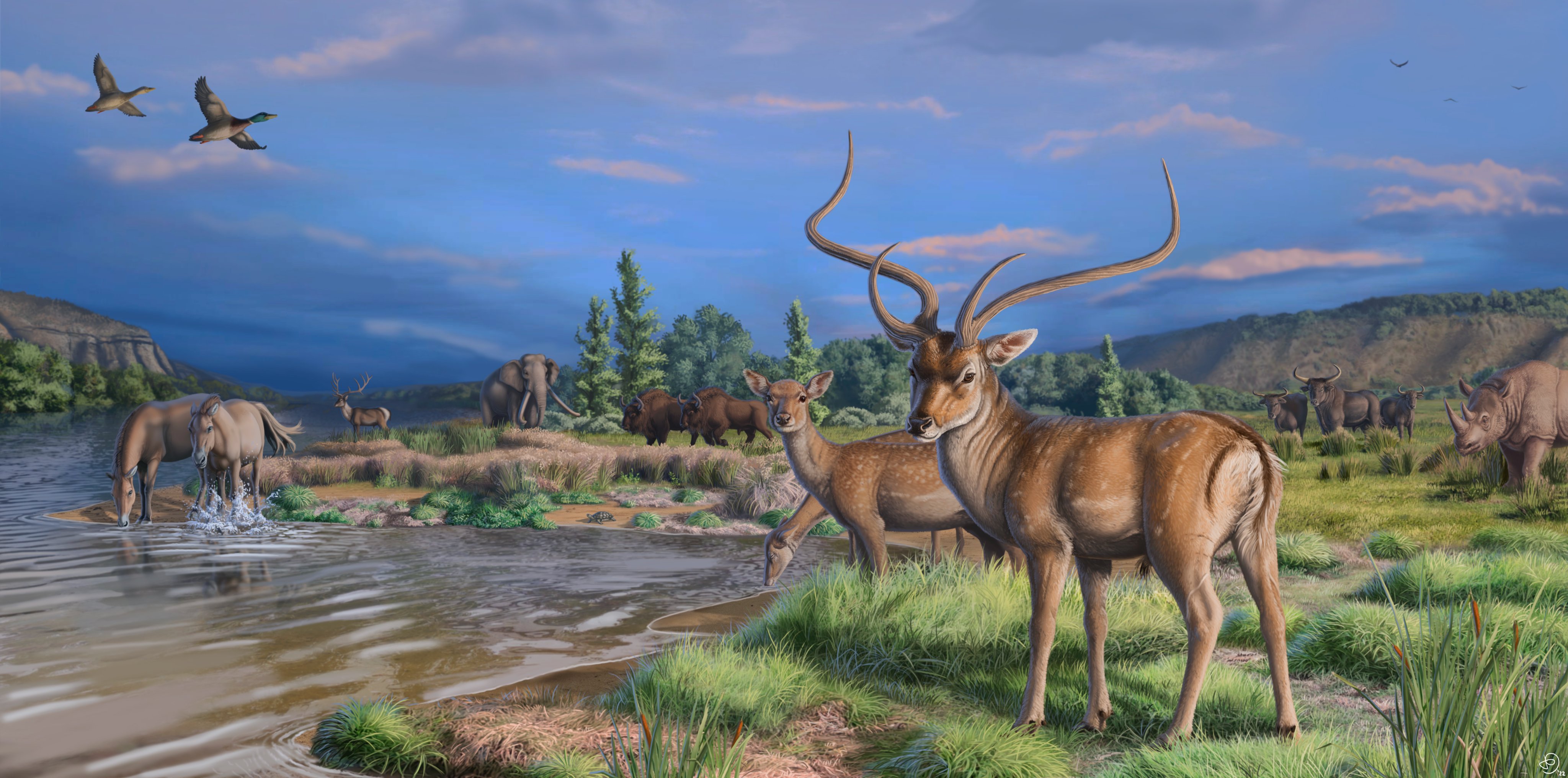
Reconstruction of Dama celiae in the Manzanares valley. Other species present are Anas platyrhynchos, Equus ferus, Elephas (Palaeoloxodon) antiquus, Mauremys leprosa, Bison sp., Bos primigenius, and Stephanorhinus hemitoechus.
(artwork y J. Gamarra)


Jan van der Made, Juan José Rodríguez-Alba, Juan Antonio Martos, Jesús Gamarra, Susana Rubio-Jara, Joaquín Panera and José Yravedra. 2023. The Fallow Deer Dama celiae sp. nov. with Two-pointed Antlers from the Middle Pleistocene of Madrid, A Contemporary of Humans with Acheulean Technology. Archaeological and Anthropological Sciences.15: 41. DOI: 10.1007/s12520-023-01734-3


Saturday, February 11, 2023

[Botany • 2023] Ruta museocanariensis • Can Material of A putatively Extinct New Species of Ruta (Rutaceae), preserved with Mummies, provide New Knowledge About Evolution in the Canary Islands Flora?

 
Ruta museocanariensis Marrero Rodr., Vidal Matutano, Delgado Darias & Jaén Molina,   

in Marrero-Rodríguez, Vidal-Matutano, Delgado-Darias, Jaén-Molina, Morales-Mateos, Alberto-Barroso & Velasco-Vázquez, 2023. 

Abstract 
Based on analyses carried out with plant material found in mummy shrouds preserved in the archaeological museum El Museo Canario, a putatively extinct new species of Ruta (Rutaceae) was identified and is described here as Ruta museocanariensis. The mummies were found in the funerary sites of Acusa and the Barranco de Guayadeque on Gran Canaria, Canary Islands, Spain. This article discusses taxonomic relationships with other species of the genus, aspects of colonization and evolutionary processes on islands. The archaeological plant material consists of vegetative and reproductive branches with leaves, remains of flowers and capsules. Several morphological traits, especially the type of fruits, establish a clear difference between Ruta species from Gran Canaria and the mainland (dehiscent) and species from the W Canary Islands (indehiscent). The discovery of R. museocanariensis, with dehiscent fruits, suggests that indehiscence is a post-colonization evolutionary process in the Canary Islands. It also supports a stepping-stone model of inter-island colonization with Gran Canaria as its starting point, in agreement with the age of the islands and to some extent with their distance from the mainland.

KEYWORDS: archaeobotany, Canary Islands, El Museo Canario, evolutionary process, extinct new species, mummy shrouds, Ruta, Rutaceae

Ruta museocanariensis 
 A: habit, terminal branch; B: pinna on one side of rachis, adaxial view; C: pedicel, calyx and ovary; D: terminal infructescence twig with open, star-shaped fruit, persistent calyces, bracteoles and immature fruit still closed; E: mature capsules showing dehiscence of valves, basal (left) and apical (right) views. – Image reconstructed from various twigs and fruits in different maturation stages extracted from infant mummy EMC no. 49991 (holotype and isotype) and branches and leaves extracted from adult mummy EMC no. 10 (paratypes).
– Drawn by Á. Marrero.

A: infant mummy EMC no. 49991, from which holotype and isotype specimens of Ruta museocanariensis were extracted;
B: adult mummy EMC no. 10, from the shroud (wrapped in layers of leather) of which the two paratype specimens were extracted;
C: branch bundle EMC no. 46558.
– Photographs by T. Delgado, El Museo Canario.

Ruta museocanariensis Marrero Rodr., Vidal Matutano, Delgado Darias & Jaén Molina, sp. nov. 

Etymology — The specific epithet refers to the scientific entity of El Museo Canario, the institution where the mummies, branch bundle and type specimens are deposited.


Águedo Marrero-Rodríguez, Paloma Vidal-Matutano, Teresa Delgado-Darias, Ruth Jaén-Molina, Jacob Morales-Mateos, Verónica Alberto-Barroso and Javier Velasco-Vázquez. 2023. Can Material of A putatively Extinct New Species of Ruta (Rutaceae), preserved with Mummies, provide New Knowledge About Evolution in the Canary Islands Flora? Willdenowia. 53 (1); 5-23. DOI: 10.3372/wi.53.53101 

Wednesday, March 9, 2022

[Paleontology • 2022] Hanyusuchus sinensis • An Intermediate Crocodylian (Crocodylia: Gavialidae) linking Two Extant Gharials from the Bronze Age of China and Its Human-induced Extinction


Hanyusuchus sinensis
Iijima, Qiao, Lin, Peng, Yoneda & Liu, 2022
 
life restoration by Hikaru Amemiya  twitter.com/WANIwaniamemi

Abstract
A solid phylogenetic framework is the basis of biological studies, yet higher level relationships are still unresolved in some major vertebrate lineages. One such group is Crocodylia, where the branching pattern of three major families (Alligatoridae, Crocodylidae and Gavialidae) has been disputed over decades due to the uncertain relationship of two slender-snouted lineages, gavialines and tomistomines. Here, we report a bizarre crocodylian from the Bronze Age of China, which shows a mosaic of gavialine and tomistomine features across the skeleton, rendering support to their sister taxon relationship as molecular works have consistently postulated. Gavialine characters of the new Chinese crocodylian include a novel configuration of the pterygoid bulla, a vocal structure known in mature male Indian gharials. Extinct gavialines have repeatedly evolved potentially male-only acoustic apparatus of various shapes, illuminating the deep history of sexual selection on acoustic signalling in a slender-snouted group of crocodylians. Lastly, a cutmark analysis combined with accelerator mass spectrometry (AMS) radiocarbon dating of bone remains demonstrated that two individuals from Shang and Zhou dynasties in Guangdong, China, suffered head injuries and decapitation. Archaeological evidence together with historical accounts suggests the human-induced extinction of this unique crocodylian only a few hundred years ago.

Keywords: crocodylia, phylogeny, Holocene, extinction, sexual selection, acoustics
 

Life restoration of Hanyusuchus sinensis, gen. et sp. nov. from the Bronze Age of southern China
(illustration: Hikaru Amemiya).

Anatomy of Hanyusuchus sinensis, gen. et sp. nov. from the Bronze Age of southern China.

 (a–d) Holotype skull (XM 12-1558) in dorsal (a,b) and ventral (c,d) views.

 (e) Posterior skull of a paratype (XM 12-1557) in ventral view. (f) Three-dimensional reconstruction of the boxed part in (e), highlighting the pterygoid bulla (purple volume). (g) Three-dimensional reconstruction of the pterygoid bullae and nasopharyngeal duct (purple volume) in Gavialis gangeticus (UF 118998).

(h–k) Holotype mandible (XM 12-1558) in dorsal (h,i) and left lateral (j,k) views.
(l–n) Left femur of the holotype (XM 12-1558) in lateral (l), proximal (m) and distal (n) views.
(o,p) Axis of a paratype (SM E1623) in left lateral (o) and ventral (p) views.
(q,r) Third cervical vertebra of the holotype (XM 12-1558) in left lateral (q) and ventral (r) views.

(s) Composite reconstruction of H. sinensis scaled to the holotype (XM 12-1558) compared with a human (1.8 m height).

 an, angular; ar, articular; bo, basioccipital; d, dentary; ect, ectopterygoid; emf, external mandibular fenestra; en, external naris; f, frontal; hp, hypapophysis; itf, infratemporal fenestra; j, jugal; l, lacrimal; m, maxilla; n, nasal; o, orbit; pa, parietal, pal, palatine; pf, prefrontal; pm, premaxilla; po, postorbital; pt, pterygoid, q, quadrate; qj, quadratojugal; sa, surangular; sof, soborbital fenestra; sq, squamosal; stf, supratemporal fenestra. Scale bars are 10 cm. (Online version in colour.)


Systematics
Crocodylia Gmelin, 1789 (sensu Benton and Clark, 1988).

Gavialidae Adams, 1854 (sensu Brochu, 2003).

Hanyusuchus sinensis gen. et sp. nov.

 Diagnosis: A large slender-snouted crocodylian with five premaxillary, 16 maxillary and 18 dentary teeth; seventh maxillary tooth largest in the anterior-mid maxilla; medial wall of the last three maxillary alveoli within the suborbital fenestrae swollen; dorsal half of the prefrontal pillar narrow anteroposteriorly, and the medial process of the pillar dorsoventrally tall and anteroposteriorly short; interfenestral bar wider than one half of the interorbital distance; postorbital and squamosal parts of the skull table slope laterally; a shallow fossa extending posteriorly from the supratemporal fenestra onto the dorsal squamosal surface (autapomorphy); a pair of deep depressions anterior to the internal choana associated with the expansion of the posterior chamber of the pterygoid bulla; exoccipital sending a robust process ventrally to the basioccipital tubera; a pair of knob-like hypapophyses on the ventral surface of axial and third cervical centra; anterior margin of dorsal midline osteoderms with anterior process; reduced medial condyle of the femur (figure 2a–r; see electronic supplementary material, part I and II and figures S2–S21 for full description and comparisons, and electronic supplementary material, tables S3–S5 for measurements).

Etymology: The generic name after Han Yu (a Chinese government official and poet during the Tang dynasty) + suchus (Latin for Greek soûkhos, the crocodile god Sobek), and the specific epithet after sinae (Latin for China) + ensis (Latin for ‘from’).

Distribution: Archaeological records and historical literature revealed the past occurrences of H. sinensis across Fujian, Guangdong, Guangxi, and Hainan provinces in southeastern China from the late fourth millennium BC to the mid second millennium AD (figure 1; electronic supplementary material, figure S1 and tables S1 and S2).


Masaya Iijima, Yu Qiao, Wenbin Lin, Youjie Peng, Minoru Yoneda and Jun Liu. 2022. An Intermediate Crocodylian linking Two Extant Gharials from the Bronze Age of China and Its Human-induced Extinction. Proc. R. Soc. B.. 28920220085. DOI: 10.1098/rspb.2022.0085


Thursday, December 9, 2021

[PaleoMammalogy / PaleoEcology • 2021] Collapse of the Mammoth-steppe in central Yukon as Revealed by Ancient Environmental DNA


in Murchie, Monteath, Mahony, ... et Poinar, 2021. 

Artwork by Julius Csotonyi  facebook.com/JuliusCsotonyi 


Abstract
The temporal and spatial coarseness of megafaunal fossil records complicates attempts to to disentangle the relative impacts of climate change, ecosystem restructuring, and human activities associated with the Late Quaternary extinctions. Advances in the extraction and identification of ancient DNA that was shed into the environment and preserved for millennia in sediment now provides a way to augment discontinuous palaeontological assemblages. Here, we present a 30,000-year sedimentary ancient DNA (sedaDNA) record derived from loessal permafrost silts in the Klondike region of Yukon, Canada. We observe a substantial turnover in ecosystem composition between 13,500 and 10,000 calendar years ago with the rise of woody shrubs and the disappearance of the mammoth-steppe (steppe-tundra) ecosystem. We also identify a lingering signal of Equus sp. (North American horse) and Mammuthus primigenius (woolly mammoth) at multiple sites persisting thousands of years after their supposed extinction from the fossil record.


Tyler J. Murchie, Alistair J. Monteath, Matthew E. Mahony, George S. Long, Scott Cocker, Tara Sadoway, Emil Karpinski, Grant Zazula, Ross D. E. MacPhee, Duane Froese and Hendrik N. Poinar. 2021. Collapse of the Mammoth-steppe in central Yukon as Revealed by Ancient Environmental DNA. Nature Communications. 12: 7120. DOI: 10.1038/s41467-021-27439-6

Friday, April 23, 2021

[PaleoMammalogy • 2021] Crateromys ballik, Carpomys dakal & Batomys cagayanensis • Three New Extinct Species from the Endemic Philippine Cloud Rat Radiation (Rodentia, Muridae, Phloeomyini)


Crateromys ballikCarpomys dakal Batomys cagayanensis  

Ochoa, Mijares, Piper, Reyes & Heaney, 2021
Drawing by Velizar Simeonovski.
 
Abstract
The 18 extant members of the Tribe Phloeomyini, the “cloud rats,” constitute an endemic Philippine radiation of arboreal herbivores that range in size from ca. 18 g to 2.7 kg, most occurring in cloud forest above 1,200 m elevation. Although calibrated phylogenies indicate that the Phloeomyini is estimated to have begun diversifying within the Philippines by ca. 10–11 million years ago, no extinct fossil species have been described, severely limiting our understanding of this distinctive radiation. Our studies of fossil and subfossil small mammal assemblages from the lowland Callao Caves complex in NE Luzon, Philippines, have produced specimens of Phloeomyini that date from ca. 67,000 BP to the Late Holocene (ca. 4,000 to 2,000 BP). We identify three extinct species that we name as new members assigned to the genera Batomys, Carpomys, and Crateromys, distinguished from congeners by body size, distinctive dental and other morphological features, and occupancy of a habitat (lowland forest over limestone) that differs from the high-elevation mossy forest over volcanic soils occupied by their congeners. Batomys cagayanensis n. sp. is known only from two specimens from ca. 67,000 BP; Carpomys dakal n. sp. and Crateromys ballik n. sp. were present from ca. 67,000 BP to the Late Holocene. These add to the species richness and morphological diversity of this endemic Philippine radiation of large folivores, and show specifically that the lowland fauna of small mammals on Luzon was more diverse in the recent past than it is currently, and that Luzon recently supported five species of giant rodents (ca. 1 kg or more). All three occurred contemporaneously with Homo luzonensis, and two, the new Carpomys and Crateromys, persisted until the Late Holocene when multiple exotic mammal species, both domestic and invasive, were introduced to Luzon, and new cultural practices (such as making pottery) became evident, suggesting that modern humans played a role in their extinction.

Keywords: biogeography, body size, extinction, fossils, Holocene, Luzon, oceanic islands, paleoecology, Pleistocene, zooarchaeology

Lower molar teeth of the new giant cloud rat,  Carpomys new species (left), compared with the two living species of Carpomys (middle) plus their close relative, Musseromys (right).
Photos by Lauren Nassef, 
Field Museum of Natural History

Collage of fossil cloud rat teeth.
Upper molars of Crateromys new species on the left.
Lower mandibles on the right: top, Carpomys new species. Middle, Batomys new species. Bottom, Crateromys new species.
 Photos by Lauren Nassef, 
Field Museum of Natural History

Artist’s conception of the three extinct cloud rats, based on their living relatives.
From the top, Crateromys, Carpomys, and Batomys.
Drawing by Velizar Simeonovski, 
Field Museum of Natural History

 Callao Cave interior.
Photo by Patricia Cabrera

Callao Cave excavation.
Photo by A. Mijares


Janine Ochoa, Armand S. B. Mijares, Philip J. Piper, Marian C. Reyes and Lawrence R. Heaney. 2021. Three New Extinct Species from the Endemic Philippine Cloud Rat Radiation (Rodentia, Muridae, Phloeomyini). Journal of Mammalogy. gyab023. DOI: 10.1093/jmammal/gyab023

Ang mga buot o “cloud rats” ay kabilang sa isang endemikong radiyasyon sa Pilipinas na tinatawag na tribong Phloeomyini. Ang salitang buot (buut/buwət) ay katawagang gamit sa ilang wika sa Cordillera at hilagang Luzon para sa mga cloud rat at mga kaanyong mammal na naninirahan o umaakyat sa mga punungkahoy. May labing-walong uri ng buot ang kasalukyang matatagpuan sa Pilipinas, at sila ay may timbang mula 18 gramo hanggang 2.7 kilo. Karamihan sa kanila ay naninirahan sa kagubatan na tinatawag na “cloud forest” na natatagpuan sa mga bundok na may elebasyon na higit sa 1,200 m. Base sa genetikong datos, tinatayang ang ninunong lipi ng mga buot ay nakarating sa Pilipinas 14 na milyong taon na ang nakalipas, ngunit dahil sa kakulangan ng mga fossil ay limitado ang ating kaalaman tungkol sa kanilang ebolusyon. Ang mga arkeolohikal na hukay sa iba’t ibang yungib ng Callao (probinsiya ng Cagayan, hilagang-silangang Luzon) ay nakapagtala ng mga fossil na buot na may edad na ~67,000 taon hanggang sa Late Holocene (~4,000–2,000 libong taon). Tatlong napuksang sarihay o species ang aming natuklasan, at base sa kanilang naiibang anyo at ekolohiya, sila ay ipinapangalan bilang bagong kasapi ng mga urihay na Batomys, Carpomys, at Crateromys. Ang Batomys cagayanensis n. sp. ay kilala lamang mula sa dalawang specimen na may edad na ~67,000 taong nakalipas. Ang Carpomys dakal n. sp. at Crateromys ballik n. sp. ay natagpuan sa mga suson ng lupa na may edad mula ~67,000 taon hanggang Late Holocene. Ipinapakita ng mga fossil na ito na mas maraming uri pa ng maliliit na mammal ang nabuhay noon kaysa sa ngayon, at ang Luzon ay minsang nagtaglay ng limang uri ng malalaking buot na may timbang na isang kilo o higit pa. Ang tatlong fossil na buot ay namuhay kasabay ng Homo luzonensis, isang bagong tuklas na uri ng tao noong Pleistocene. Ang Carpomys dakal at Crateromys ballik ay nabuhay hanggang Late Holocene at nalipol sa panahon kung saan iba’t ibang mga mammal na domestikado at ilang ang dinala ng tao sa Luzon; gayundin, lumitaw ang mga bagong tradisyon tulad ng pagpapalayok. Ipinapahiwatig nito na ang mga aktibidad ng modernong tao ay maaaring nagdulot ng kanilang pagkalipol.

biogeography, fossils, Holocene, Luzon, oceanic islands, pagkalipol (extinction), paleoecology, Pleistocene, sukat ng katawan (body size), zooarchaeology

Friday, June 22, 2018

[PaleoMammalogy • 2018] Junzi imperialis • New Genus of Extinct Holocene Gibbon associated with Humans in Imperial China


 Junzi imperialis
Turvey, Bruun, Ortiz, Hansford, Hu, Ding, Zhang & Chatterjee, 2018


Abstract
Although all extant apes are threatened with extinction, there is no evidence for human-caused extinctions of apes or other primates in postglacial continental ecosystems, despite intensive anthropogenic pressures associated with biodiversity loss for millennia in many regions. Here, we report a new, globally extinct genus and species of gibbon, Junzi imperialis, described from a partial cranium and mandible from a ~2200- to 2300-year-old tomb from Shaanxi, China. Junzi can be differentiated from extant hylobatid genera and the extinct Quaternary gibbon Bunopithecus by using univariate and multivariate analyses of craniodental morphometric data. Primates are poorly represented in the Chinese Quaternary fossil record, but historical accounts suggest that China may have contained an endemic ape radiation that has only recently disappeared.


Samuel T. Turvey, Kristoffer Bruun, Alejandra Ortiz, James Hansford, Songmei Hu, Yan Ding, Tianen Zhang and Helen J. Chatterjee. 2018. New Genus of Extinct Holocene Gibbon associated with Humans in Imperial China. Science. 360(6395); 1346-1349. DOI: 10.1126/science.aao4903

The noblewoman's ape
Human activities are causing extinctions across a wide array of taxa. Yet there has been no evidence of humans directly causing extinction among our relatives, the apes. Turvey et al. describe a species of gibbon found in a 2200- to 2300-year-old tomb ascribed to a Chinese noblewoman. This previously unknown species was likely widespread, may have persisted until the 18th century, and may be the first ape species to have perished as a direct result of human activities. This discovery may also indicate the existence of unrecognized primate diversity across Asia.

Vanished ape found in ancient Chinese tomb, giving clues to its disappearance  sciencemag.org/news/2018/06/vanished-ape-found-ancient-chinese-tomb-giving-clues-its-disappearance
Chinese grave reveals vanished gibbon genus  science.sciencemag.org/content/360/6395/1287
Ancient Royal Tomb Yields Strange New Ape Species  on.natgeo.com/2IadhQP via @NatGeo
Ancient Chinese tomb reveals previously unknown extinct species  fw.to/MiyAvFb

Thursday, January 4, 2018

[Mammalogy • 2017] Primate Archaeology Evolves


[upper] Locations and examples of stone tool use by wild non-human primates and early hominins.
[lower] Archaeologically excavated stone tools used in percussive activities.

Haslam, Hernandez-Aguilar, Proffitt, et al. 2017. 
   DOI:   10.1038/s41559-017-0286-4 

Abstract
Since its inception, archaeology has traditionally focused exclusively on humans and our direct ancestors. However, recent years have seen archaeological techniques applied to material evidence left behind by non-human animals. Here, we review advances made by the most prominent field investigating past non-human tool use: primate archaeology. This field combines survey of wild primate activity areas with ethological observations, excavations and analyses that allow the reconstruction of past primate behaviour. Because the order Primates includes humans, new insights into the behavioural evolution of apes and monkeys also can be used to better interrogate the record of early tool use in our own, hominin, lineage. This work has recently doubled the set of primate lineages with an excavated archaeological record, adding Old World macaques and New World capuchin monkeys to chimpanzees and humans, and it has shown that tool selection and transport, and discrete site formation, are universal among wild stone-tool-using primates. It has also revealed that wild capuchins regularly break stone tools in a way that can make them difficult to distinguish from simple early hominin tools. Ultimately, this research opens up opportunities for the development of a broader animal archaeology, marking the end of archaeology’s anthropocentric era.


Fig. 1 | Locations and examples of stone tool use by wild non-human primates and early hominins.
a, Bearded capuchin monkey (Sapajus libidinosus), Brazil. b, West African chimpanzee (Pan troglodytes verus), Guinea. c, Burmese long-tailed macaque (Macaca fascicularis aurea), Thailand. d, Stone tools from Lomekwi 3, Kenya, dated to 3.3 Myr ago. e, Stone tool from Gona, Ethiopia, dated to 2.6 Myr ago.

Fig. 2 | Archaeologically excavated stone tools used in percussive activities.
 a, Lomekwi 3 (Kenya); 3.3 Myr old, tool user unknown but possibly Kenyanthropus platyops.
b, Panda 100 (Ivory Coast); used by West African chimpanzees (P. t. verus).
c, Laem Son 5 (Thailand); used by Burmese long-tailed macaques (M. f. aurea).  


Michael Haslam, R. Adriana Hernandez-Aguilar, Tomos Proffitt, Adrian Arroyo, Tiago Falótico, Dorothy Fragaszy, Michael Gumert, John W. K. Harris, Michael A. Huffman, Ammie K. Kalan, Suchinda Malaivijitnond, Tetsuro Matsuzawa, William McGrew, Eduardo B. Ottoni, Alejandra Pascual-Garrido, Alex Piel, Jill Pruetz, Caroline Schuppli, Fiona Stewart, Amanda Tan, Elisabetta Visalberghi and Lydia V. Luncz. 2017. Primate Archaeology Evolves. Nature Ecology & Evolution. 1; 1431–1437.  DOI:   10.1038/s41559-017-0286-4 

Primate Archaeology Sheds Light On Human Origins  sciencedaily.com/releases/2009/07/090715131437.htm

Monday, October 30, 2017

[Mammalogy • 2017] Rediscovery of The Type Series of The Sacred Shrew, Sorex religiosus I. Geoffroy Saint-Hilaire, 1826 (Mammalia: Soricidae), with Additional Notes on Mummified Shrews of Ancient Egypt


  Crocidura religiosa   (I. Geoffroy-Saint Hilaire, 1826)
Illustration: P.J. Smit.


 Woodman, Koch & Hutterer, 2017.  

Abstract

In 1826, Isidore Geoffroy Saint-Hilaire described the Sacred Shrew, Sorex religiosus [= Crocidura religiosa] from a series of 22 embalmed individuals that comprised a portion of the Italian archeologist Joseph Passalacqua’s collection of Egyptian antiquities from an ancient necropolis near Thebes, central Egypt. Living members of the species were not discovered until the beginning of the 20th century and are currently restricted to the Nile Delta region, well north of the type locality. In 1968, the type series of S. religiosus was reported lost, and in 1978, a neotype was designated from among a small collection of modern specimens in the Natural History Museum, London. Our investigations have revealed, however, that the type series is still extant. Most of the specimens used by I. Geoffroy Saint-Hilaire to describe S. religiosus still form part of the Passalacqua Collection in the Ägyptisches Museum, Berlin, Germany. We summarize the taxonomic history of S. religiosus, review the history of the Passalacqua collection, and explain why the type series was thought to have been lost. We designate an appropriate lectotype from among the original syntypes of S. religiosus in the Ägyptisches Museum. Our examination of the shrew mummies in the Passalacqua collection also yielded a species previously unrecorded from either ancient or modern Egypt: Crocidura pasha Dollman, 1915. Its presence increases the number of soricid species embalmed in ancient Egypt to seven and provides additional evidence for a more diverse Egyptian shrew fauna in the archeological past. Finally, we provide details that will assist in better understanding the variety of mummification procedures used to preserve animals in ancient Egypt.

Keywords: Mammalia, ancient Egyptian history, animal mummy, Crocidura olivieriCrocidura pashaCrocidura religiosa, embalming practices, taxonomy

FIGURE 6. Crocidura religiosa, as seen by the Victorian artist P.J. Smit. Detail from plate 23 in Anderson & de Winton (1902).

FIGURE 5. X-ray (A) and micro-CT-scans (B-E) of the skull of the lectotype AM 690 of Sorex religiosus I. Geoffroy Saint-Hilaire, 1826 (GLS 15.3 mm): A, B, lateral views; C, sagittal cross section: D, dorsal view; E, ventral view. See the interactive 3D scan in Fig. S2. 


FIGURE 4. Lectotype ÄM 690 of Sorex religiosus I. Geoffroy Saint-Hilaire, 1826. A, External view of mummy; B, X-ray of entire specimen. Scale in mm. Photograph courtesy of S. Steiss, Berlin; X-ray image courtesy of C. Schmidt, Berlin.

Crocidura religiosa (I. Geoffroy-Saint Hilaire, 1826)

Diagnosis. Small and greyish-brown Crocidura with paler underparts and limbs. Fur short and silky. Tail thick at base and covered with long bristle-like hairs over most of its length. Head and body length 54 mm, tail 26-40 mm, hindfoot short (8–10 mm s.u., 9–11 mm c.u.). Skull short (GLS 14.4-16.1 mm, Table 1) and slender; braincase flat and dorsal profile straight. Upper toothrow (I1-M3) 5.9-6.8 mm, height of coronoid process (COR) 3.0-3.7 mm. Dentition not specialized. First upper incisor robust, but of medium size (Figs. 3, 5, S2). Upper unicuspid teeth with well-developed cinguli. Upper premolar (P4) with a short parastyle. M1 and M2 with well-separated protocone and hypocone. Upper third molar small. Cutting surface of lower incisor smooth.

Distribution. Today, C. religiosa is confined to the Upper Nile valley and delta (Fig. 1). Its current population status is unknown (Hutterer et al., 2008; Happold, 2013). The most recently reported collection dates from 1988 (Handwerk, 1990). A possible Pleistocene record from Bir Tarfawi indicates the species also may have occurred in southern Egypt at that time, but the identity of the fossil fragments needs to be confirmed (Kowalski et al., 1989; Butler, 1998).

 Vernacular name. We propose to use "Sacred Shrew" as the English common name for this small species. The name coined for it by I. Geoffroy Saint-Hilaire (1826: 294–295) is “musaraigne sacrée,” first translated into English by Partington (1837) and subsequently used by Smedley et al. (1845), Reichenbach (1852: "Heilige Spitzmaus"), Fitzinger (1868), Bodenheimer (1960), and Woodman (2015). “Egyptian Pigmy Shrew” has been used by Le Berre, 1990, Wolsan & Hutterer (1998), Wilson & Cole (2000), Hutterer (2005), Aulagnier et al. (2008), and Happold (2013), while Osborn & Helmy (1980), Osborn & Osbornová (1998), and Hoath (2003) used “Dwarf Shrew.”


Neal Woodman, Claudia Koch and Rainer Hutterer. 2017. Rediscovery of The Type Series of The Sacred Shrew, Sorex religiosus I. Geoffroy Saint-Hilaire, 1826, with Additional Notes on Mummified Shrews of Ancient Egypt (Mammalia: Soricidae).  Zootaxa. 4341(1); 1–24. DOI:  10.11646/zootaxa.4341.1.1


Saturday, July 2, 2016

[Archaeology • 2016] Earliest “Domestic” Cats in China Identified as Leopard Cat (Prionailurus bengalensis)


Abstract

The ancestor of all modern domestic cats is the wildcat, Felis silvestris lybica, with archaeological evidence indicating it was domesticated as early as 10,000 years ago in South-West Asia. A recent study, however, claims that cat domestication also occurred in China some 5,000 years ago and involved the same wildcat ancestor (F. silvestris). The application of geometric morphometric analyses to ancient small felid bones from China dating between 5,500 to 4,900 BP, instead reveal these and other remains to be that of the leopard cat (Prionailurus bengalensis). These data clearly indicate that the origins of a human-cat ‘domestic’ relationship in Neolithic China began independently from South-West Asia and involved a different wild felid species altogether. The leopard cat’s ‘domestic’ status, however, appears to have been short-lived—its apparent subsequent replacement shown by the fact that today all domestic cats in China are genetically related to F. silvestris.


Fig 2. Geometric morphometric analyses of the five archaeological Chinese cat mandibles.
 Left column: lateral view of the mandibles—the first and the fourth specimens being transposed right side left, the scale bare represents 1cm. Middle column: Boxplot comparison of centroid size of the archaeological specimen (A), with those of modern: domestic cat (Dom), leopard cat (Pb), European wildcat (Fss) and SW Asian wildcat (Fsl). Right column: species identification of the specimen based on discriminant analyses computed on mandible shape variables. Percentages within brackets correspond to the probability of being identified as Pb.

Fig 1. Modern distribution of wild felid species, archaeological site location and mandible shape relationship between modern wild felid species and domestic cat.
(A), Modern Old World distribution of the different wild cat subspecies (Felis silvestris) and the leopard cat (Prionailurus bengalensis), and location of the three Middle-Late Neolithic sites of the Shaanxi and Henan Provinces (China) analyzed in this paper: 1, Quanhucun, 2, Wuzhuangguoliang, 3, Xiawanggang;
 (B), Phenotypic relationship (unrooted neighbour joining tree) built on mandible shape distances between modern domestic cat (F. catus), leopard cat (P. bengalensis) and the two relevant sub-species of wild cat (F. s. silvestris; F. s. lybica) from our analyses.  DOI: 10.1371/journal.pone.0147295 

Jean-Denis Vigne, Allowen Evin, Thomas Cucchi, Lingling Dai, Chong Yu, Songmei Hu, Nicolas Soulages, Weilin Wang, Zhouyong Sun, Jiangtao Gao, Keith Dobney and Jing Yuan. 2016. Earliest “Domestic” Cats in China Identified as Leopard Cat (Prionailurus bengalensis). PLoS ONE. 11(1): e0147295.  DOI: 10.1371/journal.pone.0147295

Earliest Cat Domesticated in China Was the Leopard Cat, Scientists Say http://on.natgeo.com/29c0FdI via @NatGeo

Thursday, June 2, 2016

[Mammalogy / Archaeology • 2016] Archaeological Excavation of Wild Macaque Stone Tools


Figure 1. (a) Site LS5 at low tide, Piak Nam Yai, facing north along the island's east coast. The site is situated beneath the large boulder on the left. (b) Use-damage on tools collected after use by PNY macaques, showing (clockwise from top) pitting, crushing and fracture damage, with the use-wear highlighted by dashed white lines in each instance. Modified from Haslam et al. (2013, Fig. 4). (c) Burmese long-tailed macaque using a stone tool to open and eat oysters from an intertidal basalt boulder, Piak Nam Yai, Thailand. (d) LS5B during excavation, with a buried boulder visible at the base of the excavation (along with the rising water table), and the boulder that overhangs the site present at the left of the photograph. The scale on the buried boulder is 5 cm.

Abstract
More than 3 million years of excavated archaeological evidence (Harmand et al., 2015) underlies most major insights into the evolution of human behaviour. However, we have seen almost no use of archaeological excavation to similarly broaden our under- standing of behaviour in other animal lineages. The few published examples include recovery of a late Holocene assemblage of stones from the Ivory Coast, attributed to the agency of both humans (Homo sapiens) and chimpanzees (Pan troglodytes verus) (Mercader et al., 2002, 2007), and exploration of the occupation sites of non- tool-using species such as penguins (Emslie et al., 2014) and other birds (Burnham et al., 2009). The development of viable methods for identifying and interpreting past non-human tool use landscapes is essential if we are to gain a better understanding of technological evolution within other animals, including our close relatives, the primates. Recently, the growth of primate archaeology has built on the close phylogenetic relationship between humans and other primates to begin filling in this lacuna (Haslam et al., 2009; Carvalho, 2011; Stewart et al., 2011; Haslam, 2012, 2014; Visalberghi et al., 2013; Haslam et al., 2014; McGrew et al., 2014; Benito-Calvo et al., 2015; Luncz et al., 2015; Kühl et al., 2016).

Here, we present the first report on an archaeologically exca- vated Old World monkey tool use site, which was created by wild Burmese long-tailed macaques (Macaca fascicularis aurea) (Bunlungsup et al., 2016) during shellfish-processing activities in coastal Thailand. These macaques use stone and shell pounding tools to access a wide variety of coastal and inter-tidal resources, including shellfish, crabs and nuts (Fig. 1) (Malaivijitnond et al., 2007; Gumert et al., 2009, 2011; Gumert and Malaivijitnond, 2012; Tan et al., 2015), and previous work has demonstrated that use-wear on the stone tools permits reconstruction of past ma- caque activities (Haslam et al., 2013). Uncovering the history of this foraging behaviour opens up opportunities to study its evolution within the macaque lineage and, more broadly, to retrieve comparative data for researchers studying human and primate coastal exploitation (e.g., Marean, 2014; Russon et al., 2014).

............

Figure 2. 3D scans of selected macaque tools excavated from LS5, Piak Nam Yai, Thailand: (a) PNY065, (b) PNY064, (c) PNY076, (d) PNY079, (e) PNY080, (f) PNY062, (g) PNY082. (a) and (c–g) have crushing and/or fracture wear on their narrow ends; (b) and (e–f) have pitting wear on the tool face. Each tool is shown with both a photorealistic and surface-only scan, to illustrate use damage.

 Michael Haslam, Lydia Luncz, Alejandra Pascual-Garrido, Tiago Falótico, Suchinda Malaivijitnond and Michael D Gumert. 2016. Archaeological Excavation of Wild Macaque Stone Tools. Journal of Human Evolution.  DOI: 10.1016/j.jhevol.2016.05.002