|
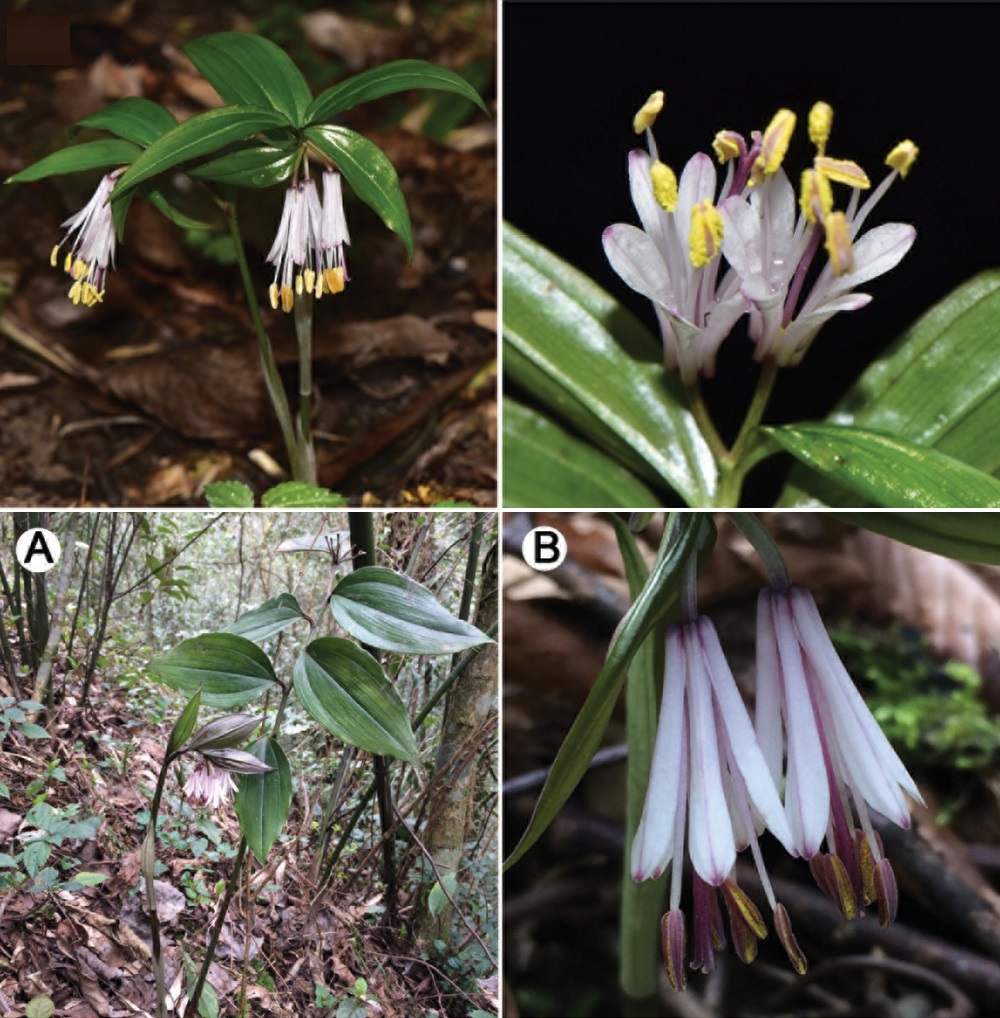
จักรเศวตร Disporum phuhinrongklaensis Sarapan & Chamch., มณีราคหมันแดง D. scabridum Sarapan & Hodk.,
ชมพูจักร D. dorsifixerum Sarapan & Suwanph., ว่านหัวสืบเชียงดาว D. chiangdaoense Sarapan & Suwanph., in Sarapan, Chamchumroon, Hodkinson et Suwanphakdee, 2024. |
Abstract
We present a taxonomic revision of the genus Disporum in Thailand based on Thai specimens including descriptions of the genus and species, a key to the species, illustrations and lectotypifications. The dorsifixed anther attachment is a new character for the genus. There is a total of six species in Thailand, including the four new species described here, namely D. chiangdaoense, D. dorsifixerum, D. phuhinrongklaensis and D. scabridum, and two well-known species D. calcaratum and D. cantoniense. Anatomical and pollen morphological characters can be used for species diagnoses and they strongly support the morphological recognition of the four new species. New lectotypifications of synonyms are provided for D. wallichii, Uvularia calcarata and U. hamiltoniana.
Keywords: Colchicaceae; Disporum; Flora of Thailand; Liliales; Uvularieae; leaf anatomy; new species; pollen morphology; taxonomy
Disporum calcaratum D.Don ว่านหัวสืบ
Distribution — India, China, Nepal, Bhutan, Myanmar, Thailand (Mae Hong Son, Chiang Mai, Chiang Rai, Nan, Lumpang, Loei, Kanchanaburi), Malaysia, Laos, Vietnam, Korea, and Japan.
Habitat & Ecology — In open areas, along roadsides in pine and oak forests at 1450–1800 m elevation. Flowering: May to July; fruiting: July to December
 |
Disporum cantoniense (Lour.) Merr.
a. Plant with distal branching and inflorescence; b. inflorescences; c. flowers; d. tepals with spur; e. stamens; f. pistil; g. fruits. — Photos by C. Suwanphakdee. |
Disporum cantoniense (Lour.) Merr. ว่านหัวสืบน้อย
Distribution — India, China, Tibet, Nepal, Sri Lanka, Myanmar, Laos, Vietnam Thailand (Mae Hong Son, Chiang Mai, Phayao, Nan, Lamphun, Loei), Malaysia, Indonesia.
Habitat & Ecology — In open areas or along roadsides of mixed deciduous or evergreen forests (pine forest) at 800– 1600 m elevation. Flowering: June to August; fruiting: July to December.
 |
Disporum chiangdaoense Sarapan & Suwanph.
a. Plant with inflorescences; b. inflorescence; c. flowers; d. tepals with spur; e. stamens; f. pistil; g. fruits. — Photos by P. Limpanasittichai. |
Disporum chiangdaoense Sarapan & Suwanph., sp. nov.
Disporum chiangdaoense differs from D. calcaratum in its perianth that is
white and green or cream at apex (vs pink and purple in D. calcaratum) and
the ridge of the spur is glabrous (vs papillose in D. calcaratum).
Etymology. The specific epithet refers to Chiangdao Wildlife Sanctuary,
Chiang Mai Province, where the type specimens were collected.
Distribution — Endemic to Thailand (Provinces: Mae Hong
Son (Mueang District); Chiang Mai (Chiangdao Wildlife Sanctuary)).
Habitat & Ecology — In open areas or along roadsides of
evergreen forest at 1200–2000 m elevation. Flowering: June
to July; fruiting: August to February.

 |
Disporum dorsifixerum Sarapan & Suwanph.
a. Plant with inflorescences; b. inflorescence; c. flowers; d. tepals with spur; e. stamens; f. pistil; g. fruits. — Photos by Y. Banchong. |
Disporum dorsifixerum Sarapan & Suwanph., sp. nov.
Disporum dorsifixerum has dorsifixed anthers; it differs from D. calcaratum
in its flowers which are rotate (vs campanulate in D. calcaratum); the ridge
of the spur that lacks papillae (vs papillose in D. calcaratum), and the tepals
that are apically green (vs pale pink in D. calcaratum).
Etymology. The specific epithet refers to the dorsifixed anther attachment
that is a unique distinguishing character for this species
Distribution — Endemic to Thailand (Lamphun: Doi Khun Tan
National Park; Tak: Thung Yai Naresuan Wildlife Sanctuary).
Habitat & Ecology — In open areas and along roadsides
of mixed deciduous and evergreen forests at 1300–1800 m
elevation. Flowering: July to August; fruiting: July to December.

 |
Disporum phuhinrongklaensis Sarapan & Chamch.
a. Whole plant; b. inflorescences; c. flowers; d. tepals with spur; e. stamens; f. pistil; g. fruits. — Photos by P. Limpanasittichai. |
Disporum phuhinrongklaensis Sarapan & Chamch., sp. nov.
Disporum phuhinrongklaensis differs from D. calcaratum in its flowers that are rotate and white and green at the apex (vs campanulate and pink or dark purplish red in D. calcaratum); the ridge of the spur is glabrous (vs papillose in D. calcaratum); the filaments and style are white (vs pink or purple in D. calcaratum).
Etymology. The specific epithet refers to Phu Hin Rong Kla National Park, Phitsanulok province, where the type specimens were collected.
Distribution — Endemic in Thailand (Chiang Mai: Si Lanna
National Park, Phitsanulok: Phu Hin Rong Kla National Park).
Habitat & Ecology — In open areas or along roadsides of
mixed deciduous and evergreen forests at 800–1200 m elevation. Flowering: May to June; fruiting: July to December
 |
Disporum scabridum Sarapan & Hodk.
a. Whole plants; b. inflorescences; c. flowers; d. tepals with spur; e. stamens; f. pistil; g. fruits. — Photos by C. Suwanphakdee. |
Disporum scabridum Sarapan & Hodk., sp. nov.
Disporum scabridum differs from D. calcaratum in its flowers that are tubulate
to campanulate with a deep purple red apex (vs campanulate with pink or
pale pink apex in D. calcaratum); the basal tepal and spur are densely scabrous (vs glabrous in D. calcaratum).
Etymology. The specific epithet refers to the densely scabrous spur that
is characteristic of the species.
Distribution — Endemic to Thailand (Pitsanulok: Phu Hin Rong Kla National Park).
Habitat & Ecology — In open areas and along roadsides of
mix deciduous or evergreen forests at 1000–1800 m elevation.
Flowering: June to July; fruiting: July to November.

Anuwat Sarapan, Voradol Chamchumroon, Trevor R. Hodkinson and Chalermpol Suwanphakdee. 2024. Taxonomic Revision of Disporum (Colchicaceae) from Thailand including Four New Species.
facebook.com/BotanyKU/posts/999284608667212
facebook.com/CSuwanph/posts/10222315914206053
พืชชนิดใหม่ของโลกในสกุลว่านหัวสืบ (𝐷𝑖𝑠𝑝𝑜𝑟𝑢𝑚) จำนวน 4 ชนิด ที่ค้นพบในครั้งนี้ ได้แก่
1. ว่านหัวสืบเชียงดาว 𝘋𝘪𝘴𝘱𝘰𝘳𝘶𝘮 𝘤𝘩𝘪𝘢𝘯𝘨𝘥𝘢𝘰𝘦𝘯𝘴𝘦 Sarapan & Suwanph. พบบริเวณป่าดิบเขา เขตรักษาพันธุ์สัตว์ป่าดอยเชียงดาว จังหวัดเชียงใหม่ เป็นไม้ล้มลุก สูงได้ถึง 94 ซม. ลำต้นอวบน้ำ สีม่วงแดงเข้มตลอดต้น มีขนสั้นหนาแน่น ใบเดี่ยว เรียงเวียน เกลี้ยง หลอดกลีบดอกด้านนอกสีขาวครีม ด้านในแฉกกลีบดอกและหลอดกลีบดอกสีขาวครีม คำระบุชนิด ‘𝑐ℎ𝑖𝑎𝑛𝑔𝑑𝑎𝑜𝑒𝑛𝑠𝑒’ เป็นภาษาละตินที่หมายถึง เขตรักษาพันธุ์สัตว์ป่าดอยเชียวดาวที่เป็นสถานที่เก็บตัวอย่าง
2. ชมพูจักร 𝘋𝘪𝘴𝘱𝘰𝘳𝘶𝘮 𝘥𝘰𝘳𝘴𝘪𝘧𝘪𝘹𝘦𝘳𝘶𝘮 Sarapan & Suwanph. พืชถิ่นเดียวพบบริเวณป่าดิบเขา จังหวัดลำพูน เป็นไม้ล้มลุก สูงได้ถึง 160 ซม. ลำต้นอวบน้ำ สีเขียวตลอดต้น ใบเดี่ยว เรียงเวียน เกลี้ยง หลอดกลีบดอกด้านนอกสีชมพู ด้านในแฉกกลีบดอกและหลอดกลีบดอกสีชมพู คำระบุชนิด ‘𝘥𝘰𝘳𝘴𝘪𝘧𝘪𝘹𝘦𝘳𝘶𝘮’ อธิบายลักษณะการติดของอับเรณู
3. จักรเศวตร 𝘋𝘪𝘴𝘱𝘰𝘳𝘶𝘮 𝘱𝘩𝘶𝘩𝘪𝘯𝘳𝘰𝘯𝘨𝘬𝘭𝘢𝘦𝘯𝘴𝘪𝘴 Sarapan & Chamch. พืชถิ่นเดียวพบบริเวณป่าดิบเขา จังหวัดพิษณุโลกและเชียงใหม่ เป็นไม้ล้มลุก สูงได้ถึง 105 ซม. ลำต้นอวบน้ำ เขียวตลอดต้น ใบเดี่ยว เรียงเวียน เกลี้ยง หลอดกลีบดอกด้านนอกสีขาว ด้านในแฉกกลีบดอกและหลอดกลีบดอกสีขาว คำระบุชนิด ‘𝘱𝘩𝘶𝘩𝘪𝘯𝘳𝘰𝘯𝘨𝘬𝘭𝘢𝘦𝘯𝘴𝘪𝘴’ หมายถึง อุทยานแห่งชาติภูหินร่องกล้าที่เก็บตัวอย่างต้นแบบ
4. มณีราคหมันแดง 𝘋𝘪𝘴𝘱𝘰𝘳𝘶𝘮 𝘴𝘤𝘢𝘣𝘳𝘪𝘥𝘶𝘮 Sarapan & Hodk. พืชถิ่นเดียวพบบริเวณป่าดิบเขา ระดับทะเลปานกลาง 800-1,000 เมตร จังหวัดพิษณุโลก เป็นไม้ล้มลุก สูงได้ถึง 100 ซม. ลำต้นอวบน้ำ เขียวตลอดต้น ใบเดี่ยว เรียงเวียน เกลี้ยง หลอดกลีบดอกด้านนอกสีแดงเลือดนก ด้านในแฉกกลีบดอกและหลอดกลีบดอกสีแดงคำระบุชนิด ‘𝘴𝘤𝘢𝘣𝘳𝘪𝘥𝘶𝘮 ’ อธิบายลักษณะกลีบรวมที่รยางค์มีความสาก