Showing posts with label Dinosaur: Africa. Show all posts

Thursday, April 23, 2026

[Paleontology • 2026] Phosphatotitan khouribgaensis • A Titanosaurian Sauropod with South American Affinities (Lognkosauria: Argentinosauridae) from the Late Maastrichtian of Morocco and Evidence for Dinosaur Endemism in Africa


Phosphatotitan khouribgaensis
Longrich, Pérez-Moreno, Díez Díaz, Pereda-Suberbiola, Bardet & Jalil, 2026

Artwork by Andrey Atuchin facebook.com/AndreyAtuchin

Abstract
The latest Cretaceous saw the final diversification of dinosaurs before the K/Pg extinction. Discussions of end-Cretaceous dinosaur diversity have focused on well-sampled faunas from Laurasia; far less is known about dinosaurian faunas of the Southern Hemisphere, especially Africa. The late Maastrichtian Phosphates of Morocco provide a rare window into African dinosaur diversity. Abelisaurids, lambeosaurines, and titanosaurian sauropods are known. However, no diagnostic titanosaur remains have been recovered, leaving the affinities of these sauropods unclear. We describe Phosphatotitan khouribgaensis gen. et sp. nov., a new titanosaur from the Maastrichtian of Sidi Chennane, Khouribga Province. Phosphatotitan is represented by dorsal, sacral, and caudal vertebrae, and the pelvis. The new species differs from titanosaurs described from the Cretaceous of Africa and Europe but resembles South American Lognkosauria, and especially Patagotitan, in having short dorsal and caudal centra, expanded dorsal and caudal neural spines, and a broad pubis. Its small size relative to other Lognkosauria (3.5–4 tonnes) suggests a lineage selected for small size. The close relationships of Morocco’s titanosaurs and abelisaurids to South American species may reflect a wide distribution of these clades prior to the opening of the South Atlantic and the separation of Africa and South America ~100 Ma, while a complex pattern of oceanic dispersal may explain the presence of distinct saltasauroid lineages worldwide. The latest Cretaceous Gondwanan dinosaur faunas were highly endemic due to a combination of continental fragmentation, extinction, and dispersal, creating high endemism in southern continents and within Africa, suggesting that Maastrichtian dinosaur diversity is underestimated.

Keywords: Dinosauria; Sauropoda; Titanosauria; Argentinosauria; Upper Cretaceous; biogeography; Gondwana


Phosphatotitan khouribgaensis gen. et sp. nov.


 Nicholas R. Longrich, Agustín Pérez-Moreno, Verónica Díez Díaz, Xabier Pereda-Suberbiola, Nathalie Bardet and Nour-Eddine Jalil. 2026. A Titanosaurian Sauropod with South American Affinities (Lognkosauria: Argentinosauridae) from the Late Maastrichtian of Morocco and Evidence for Dinosaur Endemism in Africa. Diversity. 18(5); 241. DOI: doi.org/10.3390/d18050241 [22 April 2026]

Thursday, August 28, 2025

[Paleontology • 2025] Spicomellus afer • Extreme Armour in the World’s Oldest Ankylosaur


Spicomellus afer
Maidment, Strachan, Ouarhache, Scheyer, Brown, Fernandez, Johanson, Raven & Barrett, 2021

in Maidment, Ouarhache, Ech-charay, Oussou, Boumir, El Khanchoufi, ..., Barrett et Butler, 2025. 

Abstract
The armoured ankylosaurian dinosaurs are best known from Late Cretaceous Northern Hemisphere ecosystems, but their early evolution in the Early–Middle Jurassic is shrouded in mystery due to a poor fossil record. Spicomellus afer was suggested to be the world’s oldest ankylosaur and the first from Africa, but was based on only a single partial rib from the Middle Jurassic of Morocco. Here we describe a new, much more complete specimen that confirms the ankylosaurian affinities of Spicomellus, and demonstrates that it has uniquely elaborate dermal armour unlike that of any other vertebrate, extant or extinct. The presence of ‘handle’ vertebrae in the tail of Spicomellus indicates that it possessed a tail weapon, overturning current understanding of tail club evolution in ankylosaurs, as these structures were previously thought to have evolved only in the Early Cretaceous. This ornate armour may have functioned for display as well as defence, and a later reduction to simpler armour with less extravagant osteoderms in Late Cretaceous taxa might indicate a shift towards a primarily defensive function, perhaps in response to increased predation pressures or a switch to combative courtship displays.


Spicomellus afer Maidment, Strachan, Ouarhache, Scheyer, Brown, Fernandez, Johanson, Raven & Barrett, 2021


Susannah C. R. Maidment, Driss Ouarhache, Kawtar Ech-charay, Ahmed Oussou, Khadija Boumir, Abdessalam El Khanchoufi, Alison Park, Luke E. Meade, D. Cary Woodruff, Simon Wills, Mike Smith, Paul M. Barrett and Richard J. Butler. 2025. Extreme Armour in the World’s Oldest Ankylosaur. Nature. DOI: doi.org/10.1038/s41586-025-09453-6 [27 August 2025]


Wednesday, January 15, 2025

[Paleontology • 2025] Tameryraptor markgrafi • Re-evaluation of the Bahariya Formation carcharodontosaurid (Theropoda: Carcharodontosauridae) and its implications for allosauroid phylogeny


Tameryraptor markgrafi
Kellermann, Cuesta & Rauhut, 2025
 
Life reconstruction by Joschua Knüppe.

Abstract
The first partial skeleton of a carcharodontosaurid theropod was described from the Egyptian Bahariya Oasis by Ernst Stromer in 1931. Stromer referred the specimen to the species Megalosaurus saharicus, originally described on the basis of isolated teeth from slightly older rocks in Algeria, under the new genus name Carcharodontosaurus saharicus. Unfortunately, almost all of the material from the Bahariya Oasis, including the specimen of Carcharodontosaurus was destroyed during World War II. In 1996, a relatively complete carcharodontosaurid cranium was described from similar aged rocks in Morocco and designated the neotype of the species Carcharodontosaurus saharicus in 2007. However, due to the destruction of the original material, comparisons of the neotype to the Egyptian fossils have so far only been done cursorily. A detailed reexamination of the available information on the Egyptian carcharodontosaurid, including a previously undescribed photograph of the exhibited specimen, reveals that it differs from the Moroccan neotype in numerous characters, such as the development of the emargination of the antorbital fossa on the nasals, the presence of a horn-like rugosity on the nasal, the lack of a dorsoventral expansion of the lacrimal contact on the frontals, and the relative enlargement of the cerebrum. The referability of the Egyptian specimen to the Algerian M. saharicus is found to be questionable, and the neotype designation of the Moroccan material for C. saharicus is accepted here under consideration of ICZN Atricle 75, as it both compares more favorably to M. saharicus and originates from a locality closer to the type locality. A new genus and species, Tameryraptor markgrafi gen. et sp. nov., is proposed for the Egyptian taxon. The theropods of the Bahariya Oasis and the Moroccan Kem Kem Group are thus not as closely related as previously thought, and the proposed faunal similarities between these two strata need further examination.

The holotype of Tameryraptor markgrafi (SNSB-BSPG 1922 X46).
Photograph of the mounted specimen at a point prior to April 1944.

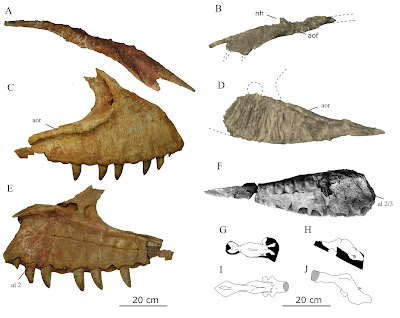
Comparison between Tameryraptor markgrafi [SNSB-BSPG 1922 X 46] and SGM-Din 1.
SNSB-BSPG 1922 X 46: (B) nasalia from left lateral, left maxilla from (D) lateral and (F) medial and endocast in (G) dorsal and (H) left lateral view;  
and SGM-Din1: (A) right nasal in lateral view, right maxilla in (C) lateral and (E) medial view and endocast in (I) dorsal and (J) left lateral view;
Sources: (A, C, E, J) [18], (I) modified from [54], (B, D) UAT 678/20/SNSB-BSPG 1922 X 46, (F) [1], (G, H) MB. R. 2056.

Systematic Paleontology
Theropoda Marsh, 1881
Allosauroidea Marsh, 1878

Carcharodontosauriformes new clade
comprising Carcharodontosaurus saharicus, Sinraptor dongi and all descendants of their most recent common ancestor

Carcharodontosauridae Stromer, 1931

Tameryraptor gen nov. 

Etymology: Tameryraptor meaning “thief from the beloved land” is a combination of one of the more informal ancient Egyptian names for Egypt, (ta-mery) meaning beloved land [Silver, 2021]; and the latin word for thief, raptor
 
  Tameryraptor markgrafi sp. nov.

Etymology: markgrafi in reference to Richard Markgraf, the Austrian fossil collector who discovered most of the dinosaur remains described by Stromer.

Holotype: SNSB-BSPG 1922 X 46, now destroyed. The specimen included parts of the left and right maxilla, both nasals, parts of the braincase and endocast of the braincase, three cervical vertebrae, an anterior to anterior mid-caudal vertebra and chevron, the proximal part of a dorsal rib, a left ischium, right and left pubis, both femora and a left fibula. In the absence of the actual specimen, the descriptions and figures of Stromer [1, 25] and the photograph UAT 678/20 stand as representatives for the holotype, in accordance with ICZN article 73.1.4.

Horizon and Locality: SNSB-BSPG 1922 X 46 was found two kilometers from Ain Gedid on the Western foot of the Gebel Harra (Fig 1) in basal layers of hardened, gypsum-free marl (Layer p of Stromer’s 1914 profile) of the Bahariya Formation, Cenomanian.

Diagnosis: Tameryraptor markgrafi gen. nov sp. nov. is a carcharodontosaurid theropod characterized by the following unique character combination (autapomorphies marked with a *): antorbital fossa visible on nasals in lateral view; small nasal horn on the medial rim of the nasals*; maxilla with well-developed antorbital ridge; maxillary teeth highly symmetrical anteroposteriorly; prefrontal facet on frontal not expanded; frontals vaulted dorsally*; femur with spike like accessory trochanter; proximal fibula more anteriorly than posteriorly expanded.

Skeletal reconstruction of SNSB-BSPG 1922 X 46. Preserved elements shown in white. Each square is 1 sq.m.

Life reconstruction of Tameryraptor markgrafi.
By Joschua Knüppe.


Maximilian Kellermann, Elena Cuesta and Oliver W. M. Rauhut. 2025. Re-evaluation of the Bahariya Formation carcharodontosaurid (Dinosauria: Theropoda) and its implications for allosauroid phylogeny. PLoS ONE. 20(1): e0311096. DOI: doi.org/10.1371/journal.pone.0311096

Monday, April 1, 2024

[Paleontology • 2024] Thyreosaurus atlasicus • A New stegosaurian dinosaur (Ornithischia: Thyreophora) with A remarkable dermal armour from the Middle Jurassic of North Africa


Thyreosaurus atlasicus
Zafaty, Oukassou, Riguetti, Company, Bendrioua, Tabuce, Charrière & Pereda-Suberbiola, 2024

 
Highlights: 
Thyreosaurus atlasicus, a new stegosaur from the Middle Jurassic of North Africa is presented.
• The new taxon is characterised by an asymetric bizarre dermal armour, unique among stegosaurs.
Thyreosaurus is closely related to Dacentrurus among Dacentrurinae.
• The discovery is important in understanding the evolutionary history of thyreophorans.

Abstract
In recent years the Middle Atlas of Morocco has become an area of interest for the study of dinosaurs in northern Africa. The Boulahfa locality, near Boulemane, has produced a diverse dinosaur assemblage from the Middle Jurassic of the El Mers Group. Fossil remains of sauropods and thyreophorans, such as ankylosaurs (Spicomellus) and stegosaurs (Adratiklit), have been reported thus far in this region. Here, we describe a new partial thyreophoran skeleton found in the gray marls of the El Mers III Formation (Bathonian-? Callovian), which mainly consists of disarticulated dorsal vertebrae and ribs, and associated dermal armour elements. Axial characters (e.g., elongated pedicels of the dorsal neural arches; upturned transverse processes and dorsal ribs with straight axes suggesting a narrow ribcage) indicate that the specimen belongs to a medium to large-sized stegosaur. The dorsal vertebrae show differences with those of Adratiklit, whose material has been found at the same stratigraphic levels. Thyreosaurus atlasicus gen. et sp. nov. is characterized by a remarkable dermal armour, which consists of thick (up to 4 cm) subovate to subrectangular-shaped osteoderms. The asymmetrical texture of their sides, one roughly ornamented with small pits and fiber bundles, the other with a well-marked cross-hatched pattern, is clearly different from that observed to date in other stegosaurs (and ankylosaurs). The bone histology of these osteoderms is reminiscent of that of stegosaur tail spines. It is interpreted that these osteoderms were arranged in a recumbent position over the body of the animal, instead of an erect position. The holotype corresponds to an adult individual who did not reach its maximum body size (estimated body length 6 m). The phylogenetic analysis suggests that Thyreosaurus is closely related to Dacentrurus within Dacentrurinae. The recent discoveries of Adratiklit and Thyreosaurus provide insight into the early evolution of stegosaurs in the Middle Jurassic of Africa.


Thyreosaurus atlasicus gen. et sp. nov.


Omar Zafaty, Mostafa Oukassou, Facundo Riguetti, Julio Company, Saad Bendrioua, Rodolphe Tabuce, André Charrière and Xabier Pereda-Suberbiola. 2024. A New stegosaurian dinosaur (Ornithischia: Thyreophora) with A remarkable dermal armour from the Middle Jurassic of North Africa. Gondwana Research. In Press. DOI: 10.1016/j.gr.2024.03.009

Thursday, August 24, 2023

[Paleontology • 2023] New Fossils of Abelisauridae (Dinosauria: Theropoda) from the upper Maastrichtian of Morocco, North Africa


in Longrich, Isasmendi, Pereda-Suberbiola & Jalil, 2023. 
Artwork: Andrey Atuchin

Abstract
The end of the Cretaceous saw the evolution of endemic dinosaur faunas on different landmasses, driven by continental fragmentation. Understanding the evolution of these biogeographic patterns is important for understanding the evolution of Mesozoic ecosystems. However, the faunas of the southern land masses remain understudied relative to the intensively sampled dinosaur faunas of western North America and Asia. In particular, the latest Cretaceous of Africa remains largely unknown, with only a handful of taxa reported so far, including titanosaurian sauropods, the lambeosaurine Ajnabia odysseus, and the large abelisaurid theropod Chenanisaurus barbaricus. We report two new abelisaurid fossils from the upper Maastrichtian phosphates of the Ouled Abdoun Basin, in northern Morocco. The first is the tibia of a medium-sized abelisaurid from Sidi Chennane, with an estimated length of ∼5 m. The tibia has a strongly hooked cnemial crest resembling that of the South American Quilmesaurus and Aucasaurus. The highly rugose bone texture suggest the animal was mature, rather than a juvenile of the larger Chenanisaurus. The second is a small right second metatarsal from Sidi Daoui,. The metatarsal measures 190 mm in length, suggesting a small animal, ∼2.6 m in length. The metatarsal shows strong mediolateral compression, a feature present in noasaurids and some early abelisaurids, but absent in most Late Cretaceous abelisaurids. It is distinct from other abelisauroids in the strong constriction and bowing of the shaft in lateral view, and the medial curvature of the bone in anterior view. Bone texture suggests it comes from a mature individual. The small size, gracile proportions and unusual shape of the metatarsal suggest it is not closely related to other latest Cretaceous abelisaurids. The new fossils suggest as many as three abelisaurid taxa coexisted in the upper Maastrichtian of Morocco, showing dinosaurs were highly diverse in North Africa prior to the end-Cretaceous mass extinction.


Nicholas R. Longrich, Erik Isasmendi, Xabier Pereda-Suberbiola and Nour-Eddine Jalil. 2023. New Fossils of Abelisauridae (Dinosauria: Theropoda) from the upper Maastrichtian of Morocco, North Africa. Cretaceous Research. 105677/ In Press. DOI: 10.1016/j.cretres.2023.105677


Friday, July 21, 2023

[Paleontology • 2023] Igai semkhu • A New titanosaurian (Dinosauria: Sauropoda) from the Upper Cretaceous (Campanian) Quseir Formation of the Kharga Oasis, Egypt


 Igai semkhu
Gorscak, Lamanna, Schwarz, Díez Díaz, Salem, Sallam & Wiechmann, 2023


ABSTRACT
Dinosaur fossils from the latest Cretaceous (Campanian–Maastrichtian) of Africa and the Arabian Peninsula are rare. Most discoveries to date have consisted of limited fossils that have precluded detailed phylogenetic and paleobiogeographic interpretations. Fortunately, recent discoveries such as the informative Egyptian titanosaurian sauropod dinosaur Mansourasaurus shahinae are beginning to address these long-standing issues. Here we describe an associated partial postcranial skeleton of a new titanosaurian taxon from the Upper Cretaceous (Campanian) Quseir Formation of the Kharga Oasis, Western Desert of Egypt. Consisting of five dorsal vertebrae and 12 appendicular elements, Igai semkhu gen. et sp. nov. constitutes one of the most informative dinosaurs yet recovered from the latest Cretaceous of Afro-Arabia. The relatively gracile limb bones and differences in the coracoid and metatarsal I preclude referral of the new specimen to Mansourasaurus. Both model-based Bayesian tip-dating and parsimony-based phylogenetic analyses support the affinities of Igai semkhu with other Late Cretaceous Afro-Eurasian titanosaurs (e.g., Mansourasaurus, Lirainosaurus astibiae, Opisthocoelicaudia skarzynskii), a conclusion supported by posterior dorsal vertebrae that lack a postzygodiapophyseal lamina, for example. Igai semkhu strengthens the hypothesis that northern Africa and Eurasia shared closely related terrestrial tetrapod faunas at the end of the Cretaceous and further differentiates this fauna from penecontemporaneous assemblages elsewhere in Africa, such as the Galula Formation in Tanzania, that exhibit more traditional Gondwanan assemblages. At present, the specific paleobiogeographic signal appears to vary between different dinosaur groups, suggesting that Afro-Arabian Cretaceous biotas may have experienced evolutionary and paleobiogeographic histories that were more complex than previously appreciated.


DINOSAURIA Owen, 1842

SAUROPODA Marsh, 1878
TITANOSAURIA Bonaparte and Coria, 1993
LITHOSTROTIA Upchurch et al., 2004

Location of discovery and quarry map of Igai semkhu (Vb-621–640).
A, map of Egypt showing the location of the town of Baris in the Kharga Oasis region, denoted by orange star (modified from Sallam et al., Citation2018:fig. 1a); B, satellite image from Google Earth Pro of the research area south of Baris with approximate quarry location indicated by orange star; C, quarry map showing disposition of skeletal elements in situ with currently missing and/or obliterated elements in gray, modified from Wiechmann (Citation1999b:17); and D, skeletal silhouette (reversed and modified from Sallam et al., Citation2018:fig. 1c) with elements described in the current study shown in orange.
Abbreviations: cor, coracoid; dv, dorsal vertebra; fib, fibula; mtc I, metacarpal I; mtc IV, metacarpal IV; mtc V, metacarpal V; mtt I, metatarsal I; mtt II, metatarsal II; pub, pubis; tib, tibia; ul, ulna.
 
 IGAI SEMKHU gen. et sp. nov.

Diagnosis— Characters supporting Igai semkhu as a titanosaurian sauropod dinosaur: dorsal vertebrae lacking hyposphene-hypantrum articulations; and ulna with prominent olecranon process. Autapomorphic characters of Igai semkhu: metacarpal V with proximomedial and distomedial tubercles; reduced cnemial crest of the tibia (does not exceed anterior margin of distal end of the tibia); and distal groove along dorsal margins of metatarsals I and II.

Etymology— Igai” is the name of the enigmatic “lord of the oasis” deity that was venerated by inhabitants of the Dakhla and Kharga oases (and surrounding regions) in Egypt from roughly the Old Kingdom to the Late Period. The species epithet “semkhu” is the perfect passive singular participle, “the forgotten,” of “semekh,” the ancient Egyptian verb “to forget.” Collectively, “the forgotten lord of the oasis” alludes to both the relatively recent emergence of latest Cretaceous non-marine vertebrate fossils from continental Africa (particularly Egypt) and the lengthy and complicated history of the holotypic specimen (see above).


Eric Gorscak, Matthew C. Lamanna, Daniela Schwarz, Verónica Díez Díaz, Belal S. Salem, Hesham M. Sallam and Marc Filip Wiechmann. 2023. A New titanosaurian (Dinosauria: Sauropoda) from the Upper Cretaceous (Campanian) Quseir Formation of the Kharga Oasis, Egypt. Journal of Vertebrate Paleontology.  e2199810. DOI: 10.1080/02724634.2023.2199810  

Thursday, June 9, 2022

[Paleontology • 2022] First Definitive Record of Abelisauridae (Theropoda: Ceratosauria) from the Cretaceous Bahariya Formation, Bahariya Oasis, Western Desert of Egypt


 Reconstruction of the palaeoecosystem of the Upper Cretaceous (Cenomanian) Bahariya Formation of the Bahariya Oasis, Western Desert of Egypt, showing diversity of large-bodied theropod dinosaurs.

in Salem, Lamanna, O'Connor, ... et Sallam, 2022. 
Artwork by Andrew McAfee, Carnegie Museum of Natural History.

Abstract
Numerous non-avian theropod dinosaur fossils have been reported from the Upper Cretaceous (Cenomanian) Bahariya Formation, Bahariya Oasis, Western Desert of Egypt, but unambiguous materials of Abelisauridae have yet to be documented. Here we report Mansoura University Vertebrate Paleontology Center (MUVP) specimen 477, an isolated, well-preserved tenth cervical vertebra of a medium-sized abelisaurid from the Bahariya Formation. The new vertebra shows affinities with those of other Upper Cretaceous abelisaurids from Madagascar and South America, such as Majungasaurus crenatissimus, Carnotaurus sastrei, Viavenator exxoni and a generically indeterminate Patagonian specimen (Museo Padre Molina specimen 99). Phylogenetic analysis recovers the Bahariya form within Abelisauridae, either in a polytomy of all included abelisaurids (strict consensus tree) or as an early branching member of the otherwise South American clade Brachyrostra (50% majority rule consensus tree). MUVP 477, therefore, represents the first confirmed abelisaurid fossil from the Bahariya Formation and the oldest definitive record of the clade from Egypt and northeastern Africa more generally. The new vertebra demonstrates the wide geographical distribution of Abelisauridae across North Africa during the middle Cretaceous and augments the already extraordinarily diverse large-bodied theropod assemblage of the Bahariya Formation, a record that also includes representatives of Spinosauridae, Carcharodontosauridae and Bahariasauridae.

Keywords: Abelisauridae, Egypt, Africa, Cretaceous, Bahariya Formation


Tenth cervical vertebra of Abelisauridae indet. (MUVP 477)
in cranial (a), caudal (b), left lateral (c), right dorsolateral (d), ventral (e) and dorsal (f) views.


 Reconstruction of the palaeoecosystem of the Upper Cretaceous (Cenomanian) Bahariya Formation of the Bahariya Oasis, Western Desert of Egypt, showing diversity of large-bodied theropod dinosaurs.
In the foreground, the unidentified abelisaurid described herein (right) confronts the spinosaurid Spinosaurus aegyptiacus (left centre, with dipnoan (lungfish) Retodus tuberculatus in jaws) and the carcharodontosaurid Carcharodontosaurus saharicus (right centre) while two individuals of the stomatosuchid crocodyliform Stomatosuchus inermis (left) look on. In the background, a herd of the titanosaurian sauropod Paralititan stromeri (left) warily regards these theropods and two individuals of the bahariasaurid Bahariasaurus ingens (far right) while a small flock of an undescribed pterosaur soars above. The vegetation is dominated by the mangrove-like tree fern Weichselia reticulata.
Artwork by Andrew McAfee, Carnegie Museum of Natural History.

Conclusion: 
The cervical vertebra (MUVP 477) described herein represents the first confirmed fossil of Abelisauridae from the Bahariya Formation, establishing it as the oldest definitive record of this theropod clade from Egypt and northeastern Africa more generally. The new vertebra demonstrates the wide geographical distribution of abelisaurids across North Africa during the middle Cretaceous and augments the already extraordinarily diverse large-bodied non-avian theropod record of the Bahariya Formation, a unit that also preserves representatives of Spinosauridae, Carcharodontosauridae and Bahariasauridae. This abelisaurid/spinosaurid/carcharodontosaurid/bahariasaurid faunal assemblage appears to have extended across most or all of northern Africa during the Cenomanian, suggesting that the Trans-Saharan Seaway did not represent a significant barrier to large-bodied theropod dispersal at this time. The Bahariya Formation holds unrealized potential to improve understanding of this northern African Cenomanian fauna due to the relative commonality of phylogenetically informative associated partial skeletons in this stratigraphic unit.

 
Belal S. Salem, Matthew C. Lamanna, Patrick M. O'Connor, Gamal M. El-Qot, Fatma Shaker, Wael A. Thabet, Sanaa El-Sayed and Hesham M. Sallam. 2022. First Definitive Record of Abelisauridae (Theropoda: Ceratosauria) from the Cretaceous Bahariya Formation, Bahariya Oasis, Western Desert of Egypt. R. Soc. open sci. 9220106. DOI: 10.1098/rsos.220106 

Hesham Sallam Leads Egyptian Team’s Discovery of Bizarre Meat-Eating Dinosaur in Egypt’s Bahariya Oasis 

Thursday, March 24, 2022

[Paleontology • 2022] Subaqueous Foraging among Carnivorous Dinosaurs


in Fabbri, Navalón, Benson, Pol, ... et Ibrahim, 2022. 
  
Artwork: Davide Bonadonna 

Abstract
Secondary aquatic adaptations evolved independently more than 30 times from terrestrial vertebrate ancestors. For decades, non-avian dinosaurs were believed to be an exception to this pattern. Only a few species have been hypothesized to be partly or predominantly aquatic. However, these hypotheses remain controversial, largely owing to the difficulty of identifying unambiguous anatomical adaptations for aquatic habits in extinct animals. Here we demonstrate that the relationship between bone density and aquatic ecologies across extant amniotes provides a reliable inference of aquatic habits in extinct species. We use this approach to evaluate the distribution of aquatic adaptations among non-avian dinosaurs. We find strong support for aquatic habits in spinosaurids, associated with a marked increase in bone density, which precedes the evolution of more conspicuous anatomical modifications, a pattern also observed in other aquatic reptiles and mammals. Spinosaurids are revealed to be aquatic specialists with surprising ecological disparity, including subaqueous foraging behaviour in Spinosaurus and Baryonyx, and non-diving habits in Suchomimus. Adaptation to aquatic environments appeared in spinosaurids during the Early Cretaceous, following their divergence from other tetanuran theropods during the Early Jurassic.


Matteo Fabbri, Guillermo Navalón, Roger B. J. Benson, Diego Pol, Jingmai O’Connor, Bhart-Anjan S. Bhullar, Gregory M. Erickson, Mark A. Norell, Andrew Orkney, Matthew C. Lamanna, Samir Zouhri, Justine Becker, Amanda Emke, Cristiano Dal Sasso, Gabriele Bindellini, Simone Maganuco, Marco Auditore and Nizar Ibrahim. 2022. Subaqueous Foraging among Carnivorous Dinosaurs. Nature.  DOI: 10.1038/s41586-022-04528-0