Showing posts with label Author: Ardi. Show all posts

Monday, May 11, 2026

[Botany • 2022] Vaccinium sulawesiense (Ericaceae: Vaccinieae)Vaccinium in Sulawesi: A New Species and A List of known Taxa


Vaccinium sulawesiense Mustaqim & P.W.Fritsch, 

in Mustaqim, Fritsch, Ahmad, Lakiu, Pitopang et Ardi, 2022.


Abstract
Vaccinium sulawesiense Mustaqim & P.W.Fritsch, a newly discovered endemic to Sulawesi, Indonesia, is described. This species is similar to V. simulans Sleumer but differs in having an acuminate leaf apex, larger floral organs, and an absence of trichomes in the upper half of the inner surface of corolla and disk. This species is known from the two specimens, one from a mid-montane rain forest in Mamasa Regency, Sulawesi Barat Province and the another from Poso Regency, Sulawesi Tengah Province. An updated list of the 17 known Vaccinium species in Sulawesi is also provided.

Keywords: endemic, Ericales, shrub, Sulawesi, taxonomy

Morphology of Vaccinium sulawesiense Mustaqim & P.W.Fritsch:
A. Living plant. B. Branchlets with leaves and inflorescences. C. Inflorescence. D. Flowers.
 Scale bar: B–D = 10 mm. 
Photographs: A–C by Wendy A. Mustaqim, All images from W.H. Ardi et al. 583.

  
Wendy A. Mustaqim, Peter W Fritsch, Roland P.P. Ahmad, Fedrik S. Lakiu, Ramadanil Pitopang and Wisnu H. Ardi. 2022. Vaccinium (Ericaceae) in Sulawesi: A New Species and A List of known Taxa. Telopea. 25; 301–307. DOI: 10.7751/telopea15774 


Monday, May 12, 2025

[Botany • 2021] Zingiber ultralimitale subsp. matarombeoense (Zingiberaceae) • A New Subspecies from South-East Sulawesi, Indonesia

 
 Zingiber ultralimitale subsp. matarombeoense Ardiyani & Ardi, 

in ArdiyaniArdi et Santoso, 2021.

Abstract
A new subspecies of Zingiber ultralimitale Ardiyani & A.D.Poulsen was found at Matarombeo, South-East Sulawesi. Zingiber ultralimitale subsp. matarombeoense Ardiyani & Ardi, was described, illustrated and barcoded using four barcoding loci (rbcL, trnH-psbA, Internal Transcribed Spacer-ITS, and matK). Provisional conservation status assessment indicates a Critical Endangered (CR) status. The taxonomic placement into section was determined based on morphology, molecular, and pollen SEM data.

Keywords: Indonesia, limestone, scanning electron microscope, South-East Sulawesi, Wallacea, Monocots


Zingiber ultralimitale subsp. matarombeoense Ardiyani & Ardi


MARLINA ARDIYANI, WISNU H. ARDI, WAHYUDI SANTOSO. 2021. Zingiber ultralimitale subsp. matarombeoense Ardiyani & Ardi (Zingiberaceae), A New Subspecies from Sulawesi.  Phytotaxa. 527(1); 32-40. DOI: doi.org/10.11646/phytotaxa.527.1.3 [2021-11-26]


Sunday, June 25, 2023

[Botany • 2023] Begonia stilpnophylla (Begoniaceae) • A New Species from Indonesia and Timor-Leste


 Begonia stilpnophylla D.C.Thomas & Ardi, 

in Thomas, Ardi, Santana, Pinto, Wei, Martins et Conaboy, 2023.

Abstract
A new rhizomatous, lithophytic species of Begonia (Begoniaceae – Begonia sect. Jackia) is described from material collected from limestone areas in the Indonesian and Timor-Leste parts of the island of Timor, Lesser Sunda Isles. Photographs, a provisional conservation status assessment of the new species, and an identification key to species of Begonia sect. Jackia in the Lesser Sunda Isles are provided.
 
Keywords: Endemism, Limestone karst

 Begonia stilpnophylla D.C.Thomas & Ardi, sp. nov.
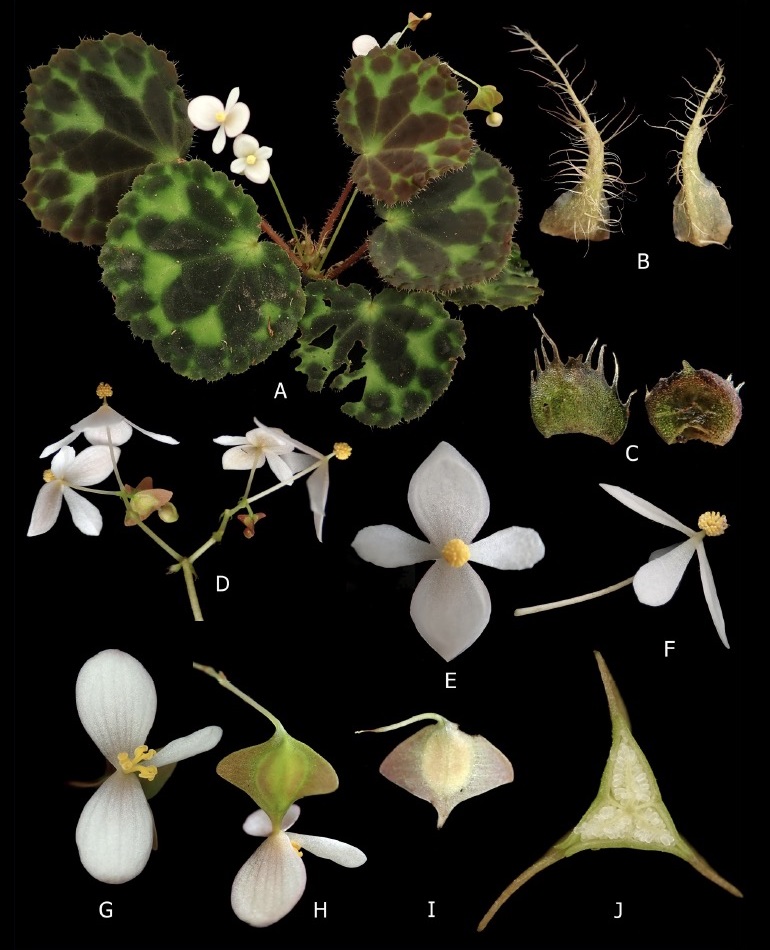
A, Habit; B, leaf, abaxial surface; C, leaf, adaxial surface; D, rhizome and stipules; E, leaf margin with reflexed teeth; F, dichasial-cymose inflorescence; G, female flower, side view; H, female flower, front view; I, male flower, front view; J, stamens; K, fruit; L, ovary, cross-section; M, seed. Scale bars: B, C and F, 10 cm; D, 2 cm; E, G and K, 1 cm; H, 5 mm; I, 12 mm; J, 1 mm; L, 3 mm; M, 300 μm. All photographs of D. C. Thomas 3494, taken by D. C. Thomas.

Begonia stilpnophylla D.C.Thomas & Ardi, sp. nov. 
[Section Jackia]

This species is morphologically similar to Begonia pseudomuricata Girm. from Bali but differs by its more strongly compressed rhizome internodes (2–5 mm vs c.10 mm long),glabrous petioles (vs sparsely to moderately densely hairy), smaller tepals of the male flowers (outer 10–11 × 8–9 mm, inner 12–14 × 6 mm vs outer 12–15 × 11–12 mm, inner15–19 × 7 mm) and female flowers (outer 7–8 × 7–8 mm, inner 5 × 2–4 mm vs outer10–11 × 9–10 mm, inner 9–10 × 3–4 mm).

Habitat and ecology. In crevices and on ledges on limestone cliffs, cave entrances and limestone boulders, in semi-shade, from 250 to 1300 m elevation.

Etymology. Greek, stilpnos (‘sparkling’, ‘glittering’) and -phyllos (‘-leafed’) – a reference to the way light reflects from the lower leaf surface.

 
 D.C. Thomas, W.H. Ardi, F. Santana, P. Pinto, F. Loke Wei, N.B. Martins and N. Conaboy. 2023. A New Species of Begonia (Begoniaceae) from Indonesia and Timor-Leste. Edinburgh Journal of Botany.DOI: 10.24823/EJB.2023.1973

Tuesday, April 25, 2023

[Botany • 2023] Begonia ranoposoensis (Begoniaceae, sect. Petermannia) • A New Species from Sulawesi, Indonesia


Begonia ranoposoensis Saleh, Bandjolu & Ardi, 

in Saleh, Bandjolu, Ardi et Thomas, 2023. 

Abstract
The new species Begonia ranoposoensis Saleh, Bandjolu & Ardi (Begoniaceae, Begonia section Petermannia) is described from material collected in Central and South Sulawesi. A detailed description, photoplate, distribution information and a provisional conservation status assessment are provided.

Keyword: Begonia comestibilis, Begonia vermeulenii, Poso Lake, sect. Petermannia, Wallacea

Begonia ranoposoensis Saleh, Bandjolu & Ardi, sp. nov.
A: Habit. B: Adaxial leaf lamina. C: Abaxial leaf lamina, petiole insertion. D: Leaves. E-F: Stipules. G-H: Male inflorescence. I: Male flowers, front view. J: Female flower, side view. K: Female flower, front view. L: Ovary, cross-section of middle, three-locular with axile, bilamellate placentae. M-N: Fruit, side view. O: Fruit, front views
 (Photographs by Bandjolu, K.P).


Begonia ranoposoensis Saleh, Bandjolu, & Ardi, sp. nov.  


Diagnosis: Begonia ranoposoensis vegetatively resembles Begonia vermeulenii Thomas because of the succulent, peltate leaves, but the male inflorescences are composed of up to 18 monochasial partial inflorescences, each with 4–12 flowers (vs composed of 1–3 cymosesubumbellate partial inflorescences composed of 2 compressed monochasia with up to 5 flowers), an androecium of 21–29 stamens (vs 35–44 stamens), the female flower pedicel is 1–4 mm long (vs 5–10 mm long), and the ovaries and fruit (dry capsules) have 3 welldeveloped wings (vs ovaries and fruit wingless; fruit fleshy and indehiscent).

Etymology: The specific epithet is derived from the local name of the locality where the species was found and collected - Rano Poso (Pamona Language): Poso Lake.


Muhammad F.R.M. Saleh, Kurniawan P. Bandjolu, Wisnu H. Ardi and Daniel C. Thomas. 2023. Begonia ranoposoensis (Begoniaceae), A New Species from Sulawesi, Indonesia. Taiwania. 68(2); 180-184. DOI: 10.6165/tai.2023.68.180

Thursday, June 16, 2022

[Botany • 2019] Begonia mufidahkallae (Begoniaceae, sect. Petermannia) • A New Species from the Moluccas, Indonesia


 Begonia mufidahkallae Ardaka & Ardi.

in Ardaka et Ardi, 2019.  
 Gardens' Bulletin Singapore. 71(2) 

ABSTRACT
 A new species of BegoniaBegonia mufidahkallae Ardaka & Ardi, is described from Sawai, Seram Utara District, Seram Island, Indonesia. The species is endemic to Seram Island and belongs to Begonia section Petermannia.

Keywords. Begonia section Platycentrum, Begonia section Sphenanthera, limestone, lithophytic


 Begonia mufidahkallae Ardaka & Ardi.
A. Habit. B. Stipule. C. Lamina abaxial surface. D. Male inflorescence. E. Female and male flower side view. F. Female and male flower front view. G. Female inflorescence. H. Infructescence. I. Ovary cross section (middle part).
(Photos: W.H. Ardi).

Begonia mufidahkallae Ardaka & Ardi, sp. nov. 
Petermannia)

 Begonia mufidahkallae is similar to Begonia flacca Irmsch. in the habit (semierect or appressed to substrate at the base and distally erect) but differs in having red multicellular hairs on the stem, petioles and lower surface of leaves (vs white), shorter petioles (2–6 cm vs 6−17 cm); denticulate to serrulate leaf margins (vs serrate to biserrate or shallowly lobed), paniculate-cymose male inflorescences (vs simple monochasia) and fruits on hanging, 10–20 mm long pedicels (vs fruit not pendulous, pedicels 3–8.5 mm long).

Distribution. Indonesia, Seram Island, Sawai, Seram Utara District.

Habitat. Growing lithophytically on limestone rock, half shade in the lowland limestone forest at 53 m elevation.

Etymology. The specific epithet is in honour of Mrs Mufidah Jusuf Kalla, the wife of the Vice President of the Republic of Indonesia, Jusuf Kalla.


 I.M. Ardaka and W.H. Ardi. 2019. A New Species of Begonia (Begoniaceae) from the Moluccas, Indonesia. Gardens' Bulletin Singapore. 71(2); 415–419. DOI: 10.26492/gbs71(2).2019-09 


Tuesday, May 17, 2022

[Botany • 2020] Begonia tjiasmantoi (Begoniaceae, sect. Petermannia) • A New Species from West Sulawesi, Indonesia


Begonia tjiasmantoi Ardi & D.C.Thomas

in Ardi & Thomas, 2020. 

A new species, Begonia tjiasmantoi Ardi & D.C.Thomas is described from Mamasa, West Sulawesi, Indonesia. The species is endemic to West Sulawesi and belongs to Begonia section Petermannia. A provisional conservation assessment indicates a Critically Endangered status.  

Keywords: new species, critically endangered, conservation assessment, a new species, endangered status

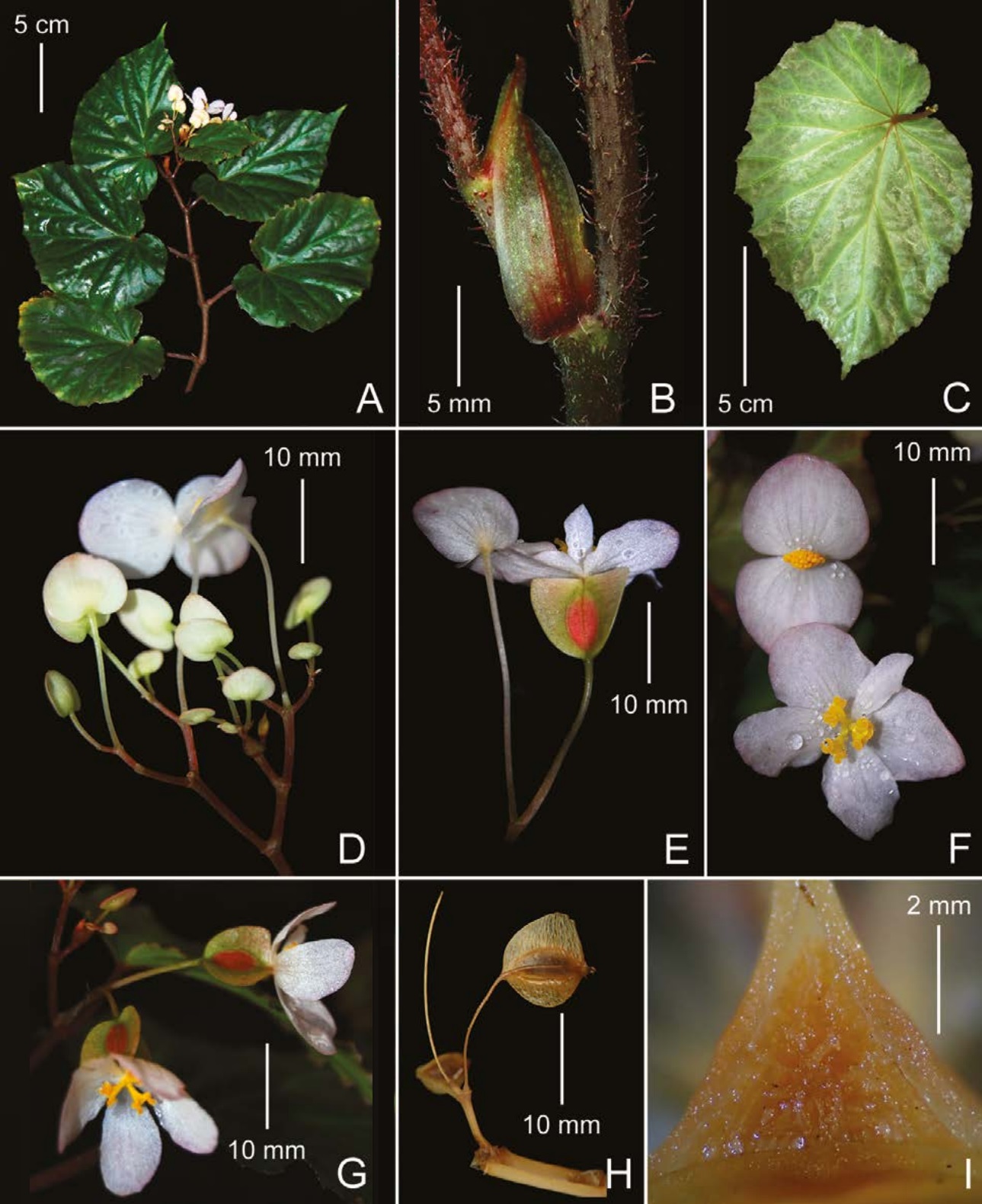
Begonia tjiasmantoi Ardi & D.C.Thomas.
A. Habit; scale bar: 5 cm. B. Stipule; scale bar: 5 mm. C.Male inflorescence; scale bar: 10 mm. D. Male inflorescence and female flower; scale bar: 10 cm. E. Male flower, front and side view; scale bar: 5 mm. F. Female flower, front view; scale bar: 5 mm. G. Infructescence; scale bar: 10 mm. H. Ovary cross-section, axile placentation and bilamellate placentae; scale bar: 2 mm.
A–H from WI 562. Photos: W.H. Ardi. 

Begonia tjiasmantoi Ardi & D.C.Thomas spec.nov. 
§ Petermannia

Begonia tjiasmantoi has a rhizomatous stem, male and female flowers with yellow tepals and male flowers with relatively few stamens (22‒24). This character combination differentiates it from other Sulawesi Begonia species. The rhizomatous growth habit of Begonia tjiasmantoi is similar to the growth habit of the orange-tepalled B. ignita C.W.Lin & C.I.Peng, but B. tjiasmantoi can be differentiated by its strongly asymmetric, ovate toelliptic leaves (8–11 × 3.5–5.5 cm); cymose-paniculate male inflorescence with subumbellate partial inflorescences with up to 6 flowers; yellow male flower tepals that are relatively small (6–8 ×7.5–8.5 mm) and have few stamens (22–24);female flowers with shorter pedicels (3–4 mm), 5(–6) yellow tepals, and a cylindrical seed-bearing part of the fruit. Begonia ignita has symmetric or subsymmetric cordiform leaves that are larger (7–12 × 6.5–11 cm); racemose-cymose male inflorescence with monochasial partial inflorescences with up to 3 flowers; orange male flower tepals that are larger in size (10–15 × 9–11mm), more stamens (35–45); female flowers with longer pedicels (6–13 mm), 4 (or rarely 2, 3 or 5)orange tepals, and an ellipsoid seed-bearing part of the fruit. 

Etymology. The species epithet refers to Wewin Tjiasmanto, the Chairmain of the Tjiasmanto Conservation Fund, who has generously supported the Sulawesi Begonia Project. 

 
Wisnu Handoyo Ardi and Daniel C. Thomas. 2020. Begonia tjiasmantoi, A New Species from West Sulawesi. Reinwardtia. 19(2); 61‒65. DOI: 10.14203/reinwardtia.v19i1.3848  


Sunday, January 16, 2022

[Botany • 2021] Begonia araneumoides, B. batuphila, B. panjangfolia, et al. (Begoniaceae: sect. Jackia) • Six New Species of Begonia from Sumatra, Indonesia


Begonia araneumoides Ardi & Girm.,
  Begonia batuphila Girm.,  
  Begonia hijauvenia Girm., Ardi & M.Hughes,
Begonia mursalaensis Girm., M.Hughes & Ardi.,
  Begonia panjangfolia Girm., Ardi & M.Hughes, 
  Begonia perunggufolia M.Hughes & Girm.,

in Girmansyah, Hughes, Sulistijoriniet al., 2022.

Abstract
Six new species of Begonia sect. Jackia from Sumatra are described and illustrated: B. araneumoides, B. batuphila, B. hijauvenia, B. mursalaensis, B. panjangfolia, and B. perunggufolia. All morphological characters and measurements were observed from living plants in the Bogor Botanical Gardens greenhouse or the wild. Using IUCN criteria, 4 species are considered to be Data Deficient, 1 Vulnerable, and 1 Least Concern.

Keyword: Begonia araneumoides, B. batuphila, B. hijauvenia, B. mursalaensis, B. panjangfolia, B. perunggufolia


Begonia araneumoides Ardi & Girm., sp. nov. 

Diagnosis: Begonia araneumoides most closely resembles B. droopiae (Ardi and Hughes, 2010) from Solok Ambah, West Sumatra in having strongly asymmetric leaves which are rugulose with a crenate and fringed margin, but it can be differentiated by its mix of basifixed and eccentrically peltate leaves (vs. purely basifixed); smaller male flower outer tepals 5‒7 × 6 mm (vs. 11–17 × 6–7 mm), and an ellipsoid capsule (excluding the wings) (vs. broadly ellipsoid to subglobose).

Distribution and habitat: Endemic to Sumatra, West Sumatra, Limapuluh Kota Regency, in lowland forest.

 Etymology: Latin (araneum: spiderweb; oides: resembling), referring to the pattern of tertiary veins which are arranged like a spiderweb. 


Begonia batuphila Girm., sp. nov.  

Diagnosis: Begonia batuphila resembles Begonia inversa Irmsch. (Irmscher 1953) in its diminutive habit but differs in having suborbicular-ovate leaves (vs. obovate-cuneate) which are widest at the middle (vs. the apical third of the lamina) and larger male flowers with orbicular tepals 1–1.4 × 0.8–1 cm, (vs. oval tepals 7 × 4 mm).  

Distribution and habitat: Sumatra, West Sumatra, on the coast near Padang, and in the hills surrounding Payakumbuh and Sijungjung, growing on damp, shaded cliff faces or large boulders below the tree canopy at 50– 800 m altitude. Frequently found on limestone. 

Etymology: Derived from the Indonesia word for rock (batu), referring to the lithophytic habit of this species. 


Begonia hijauvenia Girm., Ardi & M.Hughes, sp. nov. 

Diagnosis: Begonia hijauvenia is similar in habit and leaf shape to Begonia raoensis M.Hughes (Hughes et al. 2015a) but differs in having a purple-brownish lamina with pale green veins (vs. uniform green) with a broadly scalloped margin (not subentire), longer peduncles up to 40 cm (vs. c. 20 cm) which are white pilose (vs. red pilose with fleshy red hairs at the petiole apex) and 115 stamens (vs. c. 50). 
...

Distribution and habitat: Endemic to Sumatra, North Sumatra, in lowland forest. 

Etymology: Derived from the Indonesian word for green (hijau), referring to the green veins of the leaves.


Begonia mursalaensis Girm., M.Hughes & Ardi., sp. nov.  

Diagnosis: Begonia mursalaensis is most similar to B. raoensis M.Hughes (Hughes et al., 2015a) in habit, mature leaf colour, and red-pilose petioles with hairs denser at the apex, but differs in having leaf lamina ovate to broadly ovate (vs. suborbicular), larger male flower tepals 12–15 × 11–12 mm (vs. c. 8 × 7 mm) with more stamens (122 vs. 50), fruit which are on a ca. 10 mm stiff recurved pedicel (not pendent on a ca. 20 mm hair-like pedicel) and more elongate triangular fruit wings (vs. rounded triangular). Also similar to B. stictopoda in habit and leaf shape but differs in having petioles which are red-pilose (vs. white sparsely tomentose) and more elongate triangular fruit wings (vs. rounded fruit wings).
...

Distribution and habitat: Endemic to Sumatra, North Sumatra, Mursala Island, growing on the rocky banks of streams. 

Etymology: The epithet refers to the name of Mursala Island in North Sumatra, the type locality of the species. 


Begonia panjangfolia Girm., Ardi & M.Hughes, sp. nov.  

Diagnosis: The combination of dimorphic stipules and elongate elliptic-lanceolate leaves differentiates Begonia panjangfolia differentiate this species from all other species in Begonia sect. Jackia.

Distribution and habitat: Endemic to Sumatra, West Sumatra, Pasaman, Batang Landu. On the banks of the Batang Lindu river at c. 150 m altitude. 

Etymology: Derived from the Indonesia word panjang, meaning long, referring to the quite elongate leaf shape which is unique in Begonia sect. Jackia in Sumatra. 


Begonia perunggufolia M.Hughes & Girm., sp. nov. 
 
Diagnosis: Begonia perunggufolia is most similar to B. kemumuensis M.Hughes (Hughes, 2015) in habit, but differs in having an unlobed leaf margin (vs. with 2–6 pointed short lobes), upper leaf surface bright green along the primary veins and brownish green in between (vs. uniform green), male flower tepals broadly ovateorbicular (vs. ovate), and a globose androecium with c. 50 anthers (vs. globose-cylindrical with c. 100 anthers). 

Distribution and habitat: Endemic to Sumatra, North Sumatra, in lowland forest. 

Etymology: Derived from the Indonesian word for bronze (perunggu), referring to the bronze colour on the leaves. 


Deden Girmansyah, Mark Hughes, Sulistijorini, Rugayah, Wisnu H. Ardi and Tatik Chikmawati. 2022. Six New Species of Begonia (Sect. Jackia, Begoniaceae) from Sumatra, Indonesia. Taiwania. 67(1); 97-109.  taiwania.NTU.edu.tw/abstract.php?type=abstract&id=1814


Saturday, January 1, 2022

[Botany • 2021] Etlingera comosa (Zingiberaceae: Alpinioidea) • A New Species from Central Sulawesi, Indonesia


Etlingera comosa Ardiyani & Ardi, 

in Ardiyani, Ardi, Hutabarat & Poulsen, 2021.

Etlingera comosa Ardiyani & Ardi, a new and unusual species from Tentena, Central Sulawesi exhibiting terrestrial as well as epiphytic habit is described here. It is compared to the morphologically closest Etlingera sublimata A.D.Poulsen, but differs in having tufted sheath, bilobed and asymmetric ligule, loose peduncular bracts, densely pubescent fertile bracts and longer filament. Colour plates, notes on its conservation status and DNA barcode data for the new species are also provided.

Keywords: Acanthodes group, DNA barcode, epiphytic, Etlingera sublimata, Indonesia, Zingiberales


Etlingera comosa Ardiyani & Ardi spec. nov. 

Similar to Etlingera sublimata A.D.Poulsen by the spiny bracts and thecae dehiscent through their entire length but E. comosa differs from E. sublimata in having tufted sheath (vs. not tufted), bilobed, asymmetric ligule (vs. entire), peduncular bracts only loosely enclosing base of spike and partly exposed the axis (vs. peduncular bracts enclosing base of spike, peduncle axis not exposed), fertile bracts densely pubescent (vs. glabrous with ciliate margin), longer stamen (9 mm vs. 5 mm), longer filament (3.5–4.5 mm vs. 0.5 mm) and shorter anther (4 mm vs. 5–5.5 mm).  

Etymology. The epithet comosa refers to the tufted hairs of the sheath. 
 
 
  Marlina Ardiyani, Wisnu Handoyo Ardi, Prima Wahyu Kusuma Hutabarat and Axel Dalberg Poulsen. 2021. Etlingera comosa, A New Species (Zingiberaceae: Alpinioidea) from Central Sulawesi. Reinwardtia. 20(2); 63−68.  DOI: 10.14203/reinwardtia.v20i2.4243


Tuesday, August 24, 2021

[Botany • 2021] Begonia willemii (sect. Petermannia, Begoniaceae) • A New Species of Begonia from Sulawesi, Indonesia


Begonia willemii Ardi, Girm. & D.C.Thomas, 

in Ardi, Girmansyah, Zulfadli et Thomas, 2021. 

Abstract
A new species of Begonia sect. Petermannia (Begoniaceae), Begonia willemii Ardi, Girm. & D.C.Thomas, is described from Sulawesi, Indonesia. The species is a calciphile endemic to Sulawesi. It is morphologically similar to Begonia gemella but can be easily differentiated by its smaller leaves, a sparse, bristly indumentum on the adaxial lamina surface, simple monochasial male inflorescences, longer pedicels, fewer stamens and two-tepaled female flower. Its conservation status is provisionally assessed as Near Threatened (NT).

Keyword: Begonia gemella, Begonia manuselaensis, Begonia sidolensis endemic, karst, limestone, Petermannia


Begonia willemii Ardi, Girm. & D.C.Thomas
A. Habit of Toli-toli population; B. Habit of Batutikar waterfall population; C. Stipule; D. Male flower; E. Androecium; F. Male inflorescence; G. Mixed female-male inflorescence; H. Fruit of Toli-toli population; I. Fruit of Batutikar population; J. Ovary, cross section of middle part.
B–G, I, J from WI 415; A, H from ZF 42.
 (Photos B–G, I, J: W.H. Ardi; A, H: Zulfadly).


Begonia willemii Ardi, Girm. & D.C.Thomas, sp. nov. 
Sect. Petermannia 

 The creeping growth habit, the relatively small leaf laminas, and the monochasially branching male inflorescences are similar to Begonia gemella Warb. ex L.B.Sm. & Wassh. (1983) from Minahasa, Sulawesi, but B. willemii can be distinguished by a smaller leaf lamina (3–8 × 2.5–6 cm versus 5–9.5 × 4.5–8 cm for B. gemella) with a sparse indumentum of red bristle hairs between the veins on the adaxial surface (versus glabrous), male flowers in simple monochasial cymes (versus thyrses composed of up to 3 monochasial cymes), longer male flower pedicels (2–4 cm versus 1.5–1.8 cm long), fewer stamens (c. 19‒23 versus ca. 75–77), and female flowers consistently with two tepals (versus five tepals).

Distribution. Endemic to Sulawesi (Fig. 2), Gorontalo Province (Gorontalo Regency) and Central Sulawesi Province (Luwuk Banggai and Toli-toli Regencies). 

Habitat. Lowland limestone karst forest, disturbed forest, growing vertically on limestone rock, or terrestrially on the base of limestone cliffs, in half to full shade, at 10 to 50 m elevation. 

Etymology. This species is named in honour of Willem Jan Jacobus Oswald de Wilde (1936‒2021); a prominent tropical botanist, who has made outstanding contributions to the botanical knowledge of the Flora Malesia region.  


Wisnu H. Ardi, Deden Girmansyah, Zulfadli and Daniel C. Thomas. 2021. Begonia willemii, A New Species of Begonia from Sulawesi, Indonesia. Taiwania. 66(3); 374-377. DOI: 10.6165/tai.2021.66.374

Saturday, July 31, 2021

[Botany • 2021] Begonia robii (Begoniaceae) • A New Species of Begonia from Lima Puluh Kota, West Sumatra, Indonesia


Begonia robii Ardi & Girm.

in Ardi, Girmansyah & Hughes, 2021.

A new species of Begonia sect. Jackia (Begoniaceae), Begonia robii Ardi & Girm., is described from West Sumatra and is a limestone karst endemic in the Tanah Datar dan Lima Puluh Kota Regency. Its provisional IUCN threatened category is considered to be Endangered.

Keywords: Endemic, limestone, Jackia

  
Begonia robii Ardi & Girm.
A. Plant habit. B. Stipules. C. Bracts. D. Inflorescence. E. Male flower, front view. F. Male flower, side view. G. Female flower, front view. H. Female flower, side view. I. Fruit. J. Ovary, cross section of middle part.
From Wisnu Ardi WI 761. Photos by W.H. Ardi. 

Begonia robii Ardi & Girm. sp. nov. 
§ Jackia.
 
A limestone adapted species closely related to Begonia droopiae Ardi (Ardi & Hughes, 2010), in terms of its habit and variegated leaves, however it can be easily distinguished by its rounded leaf apex which have pale green blotches between the veins (not acuminate at the apex and green on the veins only), outer male flower tepals which are elliptic to obovate with an acute to rounded apex (vs. elliptic to suborbicular with a rounded apex), female flowers with two or three tepals, outer tepals 4‒12 × 7‒8.5 mm, elliptic (vs. female flower with three tepals, outer tepals 5.5‒6 × 4.5‒ 6 mm, orbicular to suborbicular), ovary ca. 8 × 5‒ 6 mm, ovoid to ellipsoid, wings equal to subequal with a truncate to cuneate base, and a cuneate apex (vs. globose to broadly ellipsoid ovary, 6‒7 × 10‒13 mm, wings equal with rounded base and apex).

Distribution. Sumatra, endemic to West Sumatra, Lima Puluh Kota and Tanah Datar Regencies (Harau valley, Lintau Buo and Halaban). Fig. 1. 

Etymology. The epithet is after the collector, Robi Satria.


  Wisnu Handoyo Ardi, Deden Girmansyah and Mark Hughes. 2021. Begonia robii, A New Species of Begonia from Lima Puluh Kota, West Sumatra. Reinwardtia. 20(1); 37-41. DOI: 10.14203/reinwardtia.v20i1.4141


ABSTRAK ARDI, W. H., GIRMANSYAH, D. & HUGHES, M. 2021. Begonia robii, jenis baru Begonia dari Lima Puluh Kota, Sumatra Barat. Reinwardtia 20(1): 37–41.
 — Jenis baru Begonia seksi Jackia (Begoniaceae) dipertelakan dari Sumatra Barat, dan merupakan jenis endemik bebatuan kapur di Kabupaten Tanah Datar dan Lima Pulu Kota. Evaluasi status konservasi berdasarkan IUCN untuk Begonia robii adalah terancam. 
Kata kunci: Endemik, batu kapur, Jackia.

Tuesday, February 16, 2021

[Botany • 2020] Etlingera tjiasmantoi (Zingiberaceae) • A New Species from Central Sulawesi, Indonesia


Etlingera tjiasmantoi Ardiyani & Ardi 

in Ardiyani, Ardi, Santoso & Poulsen, 2020.


Abstract

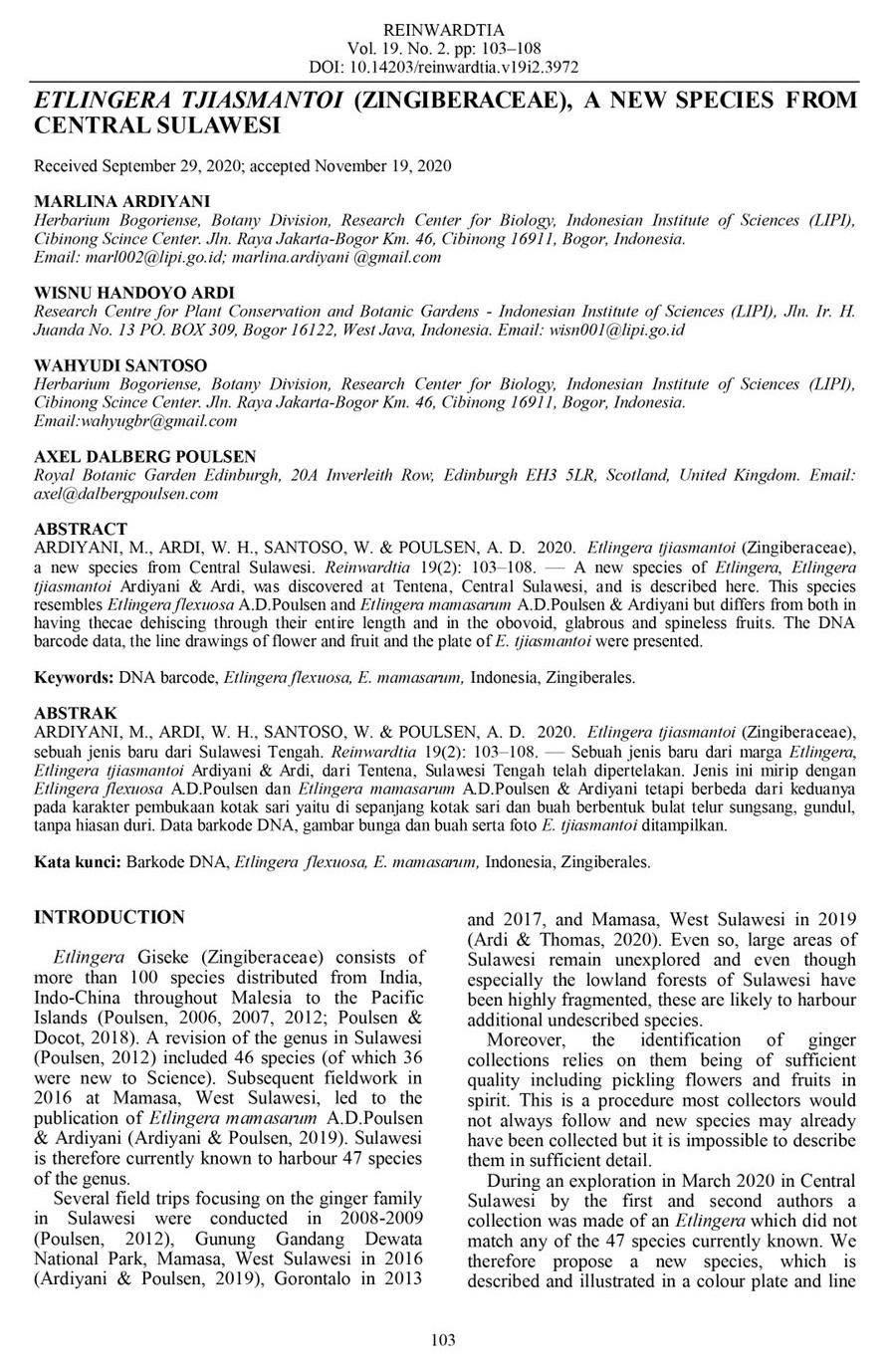
 A new species of Etlingera, Etlingera tjiasmantoi Ardiyani & Ardi, was discovered at Tentena, Central Sulawesi, and is described here. This species resembles Etlingera flexuosa A.D.Poulsen and Etlingera mamasarum A.D.Poulsen & Ardiyani but differs from both in having thecae dehiscing through their entire length and in the obovoid, glabrous and spineless fruits. The DNA barcode data, the line drawings of flower and fruit and the plate of E. tjiasmantoi were presented.
               
Keywords: DNA barcode, Etlingera flexuosa, E. mamasarum, Indonesia, Zingiberales.


Inflorescences of Etlingera species.
A. Etlingera flexuosa (Poulsen et al. 2655, the type).
B. E. mamasarum (Ardiyani et al. Sulbar 004, the type).
C. Etlingera tjiasmantoi (M. Ardiyani et al. 1007, the type).
Photos by A. D. Poulsen, M. Ardiyani & W. H. Ardi.


Fig. 1. Etlingera tjiasmantoi Ardiyani & Ardi spec. nov.
A. Leaves (upper surface). B. Leaves (lower surface). C. Leaf base, ligule and petiole. D. Base of leafy shoot and inflorescence arising from the rhizome. E. Inflorescence with three freshly opened flowers. F. Infructescence. G. a. Two flowers with a fertile bract each. b. Bract. c. Bracteole. d. Calyx. e. Flower with bracteole and calyx removed. f. Corolla lobes. g. Labellum. h. Flower with calyx, corolla lobes and labellum removed. i. Fruit.
From M. Ardiyani et al. 1007. Photos by M. Ardiyani & W.H. Ardi.


Etlingera tjiasmantoi Ardiyani & Ardi spec. nov. 

Etlingera tjiasmantoi is similar to E. flexuosa A.D.Poulsen and E. mamasarum A.D.Poulsen & Ardiyani in having entire ligules with ± emarginate apex, long petioles (around 4 cm), elongated elliptic to narrowly ovate laminas, pointed calyces, and ± pink flowers but E. tjiasmantoi differs from both in having thecae dehiscing through their entire length (vs. in upper part) and in the obovoid, glabrous and spineless fruits (vs. pyriform or round, pubescent and with small spines).

Habitat & Ecology. Grows in secondary forest by the road between Tentena and Bada, near a waterfall and a stream at about 1,700 m asl.

 Etymology. The epithet honours Mr. Wewin Tjiasmanto who funded the botanical trip to Central Sulawesi, and who is greatly concerned for wildlife, taxonomy, exploration and conservation.

 
 Marlina Ardiyani, Wisnu Handoyo Ardi, Wahyudi Santoso and Axel Dalberg Poulsen. 2020. Etlingera tjiasmantoi (Zingiberaceae), A New Species from Central Sulawesi. Reinwardtia. 19(2); 103‒108. DOI: 10.14203/reinwardtia.v19i2.3972

Congratulations to Dr. Marlina Ardiyani @MarlinaArdiyani and Wisnu Ardi @Begonia_Wisnu who in March this year, discovered a new species of Etlingera in Central Sulawesi. Today, E. tjiasmantoi is published in REINWARDTIA bringing the number of Etlingera species in Sulawesi to 48.