Showing posts with label Confuciusornithidae. Show all posts

Monday, January 2, 2023

[PaleoOrnithology • 2022] Confuciusornis shifan • A New confuciusornithid Bird (Confuciusornithidae) with A Secondary Epiphyseal Ossification reveals Phylogenetic Changes in confuciusornithid Flight Mode


Confuciusornis shifan 
Wang, Hu, Zhang, Wang, Zhao, Sullivan & Xu, 2022
 
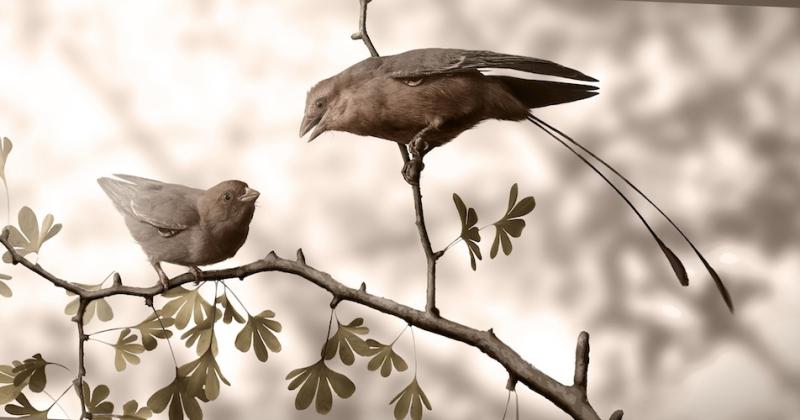
Artwork by Chuang Zhou

Abstract
The confuciusornithids are the earliest known beaked birds, and constitute the only species-rich clade of Early Cretaceous pygostylian birds that existed prior to the cladogenesis of Ornithothoraces. Here, we report a new confuciusornithid species from the Lower Cretaceous of western Liaoning, northeastern China. Compared to other confuciusornithids, this new species and the recently reported Yangavis confucii both show evidence of stronger flight capability, although the wings of the two taxa differ from one another in many respects. Our aerodynamic analyses under phylogeny indicate that varying modes of flight adaptation emerged across the diversity of confuciusornithids, and to a lesser degree over the course of their ontogeny, and specifically suggest that both a trend towards improved flight capability and a change in flight strategy occurred in confuciusornithid evolution. The new confuciusornithid differs most saliently from other Mesozoic birds in having an extra cushion-like bone in the first digit of the wing, a highly unusual feature that may have helped to meet the functional demands of flight at a stage when skeletal growth was still incomplete. The new find strikingly exemplifies the morphological, developmental and functional diversity of the first beaked birds.

Systematic paleontology
Avialae Gauthier, 1986
Pygostylia Chiappe, 2002

Confuciusornithidae Hou et al., 1995
Confuciusornis Hou et al., 1995

Confuciusornis shifan sp. nov.

Holotype: PMoL-AB00178, a nearly complete and mostly articulated skeleton, preserved on a single slab


Locality and horizon: Xiaotaizi Village, Lamadong Town, Jianchang County, Liaoning Province, China; second unit of Lower Cretaceous Jiufotang Formation (119 Ma).

Etymology: The specific name is derived from the Mandarin “shifan”, meaning a paragon of all teachers, in honor of Confucius. The name also commemorates the 70th anniversary of Shenyang Normal University (Shenyang Shifan Daxue).

Renfei Wang, Dongyu Hu, Meisheng Zhang, Shiying Wang, Qi Zhao, Corwin Sullivan and Xing Xu. 2022. A New confuciusornithid Bird with A Secondary Epiphyseal Ossification reveals Phylogenetic Changes in confuciusornithid Flight Mode. Communications Biology. 5: 1398. DOI: 10.1038/s42003-022-04316-6
 
A new specimen illuminates the story of flight evolution in an iconic group of early birds
Confuciusornithids only lived in the Early Cretaceous Jehol Biota are indeed a very unusual group of early birds. We are very lucky to encounter Confuciusornis shifan, a new member of this group. 


Wednesday, November 7, 2018

[PaleoOrnithology • 2012] Elaborate Plumage Patterning in A Cretaceous Bird


Confuciusornis sp.

in Li, Clarke, Gao, et al​., 2018. 
  DOI:  10.7717/peerj.5831 
Reconstruction by Velizar Simeonovski.

Abstract 
Integumentary patterns and colors can differentiate species, sexes, and life changes and can inform on habitat and ecology. However, they are rarely preserved in the fossil record. Here, we report on an extremely well-preserved specimen of the Cretaceous bird Confuciusornis with unprecedented complexity, including small spots on the wings, crest, and throat. Morphological and chemical evidence suggest that these patterns are produced by melanin, but unusual preservation prevents assignment of specific colors. Based on comparisons with extant birds, these patterns were likely used for camouflage, although other functions including sexual signaling cannot be ruled out. Our data show that even more elaborate plumage patterns than the spangles in Anchiornis and stripes in Sinosauropteryx were present at a relatively early stage of avian evolution, showing the significance of coloration and patterning to feather evolution.


Figure 1: Evidence of plumage diversity in the Confuciusornithidae from the new specimen (CUGB P1401). (A–D) The primary slab of CUGB P1401 showing details of the plumage including crest ornamentation on the (B) top and (C) back of the head as well as on the (D) secondary and (E) gular feathers. Dots indicate locations sampled for Raman and morphological analyses. Colored dots correspond to locations of SEM images and Raman spectra in Fig. 2. 

Figure 6: Reconstruction of the plumage in CUGB P140. Morphological data and probable eumelanin signatures are consistent darker preserved regions as associated with dark colors in the fossil (sampling regime explained in Fig. 1).
Reconstruction by Velizar Simeonovski.

Conclusions: 
The elaborate spotting on this specimen exceeds that found in exceptionally-preserved troodontids and compsognathids and rivals that in modern birds, suggesting that plumage patterns evolved greater complexity through avian evolution. This hypothesis remains to be tested as more exceptionally-preserved specimens are described.


Quanguo Li, Julia A. Clarke, Ke-Qin Gao, Jennifer A. Peteya and Matthew D. Shawkey​. 2018. Elaborate Plumage Patterning in A Cretaceous Bird.  PeerJ. 6:e5831.   DOI:  10.7717/peerj.5831

Wednesday, January 23, 2013

[PaleoOrnithology • 2012] Gender identification of the Mesozoic bird Confuciusornis sanctus | Sex of Early Birds Suggests Dinosaur Reproductive Style


Reconstruction of Confuciusornis sanctus
Art: Stephanie Abramowicz, NHM Dinosaur Institute

Hundreds of specimens of the beaked bird Confuciusornis sanctus have been recovered from Early Cretaceous lake deposits of northeastern China. These birds show remarkable variation in size and plumage, with some displaying two long, central ornamental rectrices (tail feathers) and others lacking them altogether. Although, traditionally specimens with ornamental rectrices were interpreted as males and those without them as females, this supposed sexual dimorphism has remained unconfirmed. Here we report on the discovery of medullary bone, a tissue unique to reproductively active female birds, in a specimen of C. sanctus (DNHM-D1874) lacking these feathers. Our discovery constitutes the first case of gender identification in a Mesozoic bird, and it provides undisputed evidence that individuals of C. sanctus without ornamental rectrices are females. By permitting gender identification in C. sanctus, our results provide insight into the onset of sexual maturity and attainment of adult body size of this and other early birds. 

Subject terms: Biological sciences, Evolution, Palaeontology, Zoology


Sex of Early Birds Suggests Dinosaur Reproductive Style
: New Way to Identify Gender of Ancient Avian Species

In a paper published in Nature Communications on January 22, 2013, a team of paleontologists including Dr. Luis Chiappe, Director of the Natural History Museum of Los Angeles County's (NHM) Dinosaur Institute, has discovered a way to determine the sex of a prehistoric bird species.

Confuciusornis sanctus, a 125-million-year-old Mesozoic bird, had remarkable differences in plumage -- some had long, almost body length ornamental tail feathers, others had none -- features that have been interpreted as the earliest example of avian courtship. However, the idea that male Confuciusornis birds had ornamental plumage, and females did not, has not been proven until now. Chiappe and the team studied hundreds of Confuciusornis fossils unearthed from rocks deposited at the bottom of ancient lakes in what is today northeastern China and found undisputed evidence of the gender difference: medullary bone.

Chiappe conducted the study with Anusuya Chinsamy of the Department of Biological Sciences, University of Cape Town, South Africa; Jesús Marugán-Lobón of Madrid's Universidad Autonóma, Cantoblanco; Gao Chunling and Zhang Fengjiao of the Dalian Natural History Museum in China.

"Our discovery provides the first case of sex identification in an ancient bird, an animal closely related to dinosaurs, such as the famous Velociraptor," said Chiappe. "When people visit dinosaur exhibits, they often want to know if the skeletons are male or female. We have nicknames like Thomas and Sue, but of all the thousands of skeletons of dinosaurs or early birds found around the world, only the sex of a few has been determined."

According to Chinsamy, the bone histologist on the team, "Just like modern hens, female Confuciusornis birds that lived 125 million years ago deposited this special bone inside their long bones, and then used it to make the calcium-rich eggshells." Finding such tissue -- present during a short period of time in reproductively active females -- in a specimen that lacked long feathers proved that those birds without ornamental plumage are females.

"This now permits us to assess gender differences in growth and development of this Mesozoic bird," she said.

But while this discovery offers evidence that both early and modern female avian species were essentially using the same physiological strategy to reproduce, it also spotlights an important difference in when they sexually matured.

"In human terms, knowing the sex of these specimens sheds light on when these early birds begin puberty," said Chiappe, "Now we know that early birds began reproducing way before they were full grown, a pattern that contrasts with what we know of living birds, which typically begin reproducing after they reach full body size." In that way, ancient birds produced offspring like dinosaurs, which also began to reproduce before they were fully grown.

The specimens, housed at the Dalian Natural History Museum in northeastern China, had been excavated from rocks formed at the bottom of ancient lakes in a forested environment surrounded by volcanoes. Ancient catastrophes, presumably related to volcanic eruptions, killed large numbers of birds and other animals, whose bodies were buried deep in the lake mud that helped minimize decay and preserving the organs, skeletons, and plumage. "This discovery is part of the big picture of understanding the early evolution of birds,'' Chiappe said, "and how living birds became what they are."


Anusuya Chinsamy, Luis M. Chiappe, Jesús Marugán-Lobón, Gao Chunling & Zhang Fengjiao. 2012. Gender identification of the Mesozoic bird Confuciusornis sanctus. Nature Communications. 4, 1381 doi:10.1038/ncomms2377