Showing posts with label Schistura. Show all posts

Monday, August 5, 2024

[Ichthyology • 2024] Schistura sonarengaensis • A New Species of Cave-dwelling Loach (Cypriniformes: Nemacheilidae) from Meghalaya, northeast India


Schistura sonarengaensis 
Mukhim, Sarma, Choudhury, Chandran, Das, Singh, Warbah, Sarkar & Sarma, 2024. 


Abstract
A new species of nemacheilid loach, Schistura sonarengaensis sp. nov., is described from three cave-dwelling populations (Barak–Surma–Meghna drainage) in the South Garo Hills district of Meghalaya, India. The new species possesses prominent eyes but is easily distinguished from all the congeners of the genus Schistura from Barak–Surma–Meghna and adjacent rivers drainages of northeast Indian (except S. syngkai) in having 13–26 vertically elongated to circular mid-lateral black blotches (brownish in life) overlayered on a grayish-black mid-lateral stripe on a dull white or pale-beige (golden brown in life) body. However, it can be easily distinguished from S. syngkai in having a complete (vs. incomplete) lateral line with more 72–89 (vs. 19–42) lateral-line pored scales, greater pre-dorsal length (48.5–53.1 vs. 41.9–44.1 %SL), a wider body at dorsal-fin origin (11.3–16.7 vs. 9.4–10.3 %SL), greater dorsal (18.1–21.1 vs. 15.1–17.0 %SL) and lateral (20.9–24.1 vs. 17.4–18.9 %SL) head length, a wider head (14.5–18.5 vs. 11.6–13.3 %SL), and moderately forked (vs. emarginated) caudal fin. Further, molecular analysis confirms the distinctiveness of S. sonarengaensis sp. nov. from its congeners found in northeast India by significant divergences with uncorrected genetic distance ranging from 3.7% to 17.3% in the mitochondrial cytochrome c oxidase subunit I (COI) gene dataset. The phylogenetic position of the new species with its sister species was evaluated using maximum likelihood and Bayesian analysis. The species delimitation approaches assemble species by automatic partitioning (ASAP) and Poisson tree processes (PTP) utilized for testing species assignments consistently identified our test group as a distinct species from its sister species. Although the new species lacks typical morphological adaptations usually associated with a subterranean life, such as complete absence (or vestigial presence) of eyes and pigmentation, it exhibits a reduction of pigmentation when compared to the epigean congeners.

Keywords: Barak–Surma–Meghna drainage, biodiversity hotspot, limestone cave, Meghalaya, new loach, subterranean life, taxonomy

Holotype of Schistura sonarengaensis sp. nov. (GUMF 1001, 72.8 mm SL), India: Meghalaya: Krem Sonarenga; dorsal (a), lateral (b), and ventral (c) views.

Live coloration of Schistura sonarengaensis sp. nov. GUMF uncatalogued, , about 63 mm SL; India: Meghlaya: Krem Chiabole.


Schistura sonarengaensis sp. nov.


Dran Khlur B. Mukhim, Kangkan Sarma, Hrishikesh Choudhury, Rejani Chandran, Rajdeep Das, Rajeev K. Singh, Deisakee P. Warbah, Uttam Kumar Sarkar and Dandadhar Sarma. 2024. Schistura sonarengaensis, A New Species of Cave-dwelling Loach (Teleostei: Nemacheilidae) from Meghalaya, northeast India. Journal of Fish Biology. DOI: doi.org/10.1111/jfb.15856

Monday, January 22, 2024

[Ichthyology • 2019] Schistura syngkai • A New Fish Species (Teleostei: Nemacheilidae) from Meghalaya, northeast India


Schistura syngkai
 Choudhury, Mukhim, Dey, Warbah & Sarma, 2019


Abstract
Schistura syngkai, a new stone loach, is described from the Twahdidoh Stream of Wahblei River (Surma-Meghna drainage) in Meghalaya, northeast India. It is unique among its Indian congeners in having a prominent dark-brown to blackish mid-lateral stripe about an eye diameter or more in width, overlain on 12–18 vertically-elongate black blotches on a golden-brown to amber body. Additionally, the species possesses an incomplete lateral line and a slightly emarginate caudal fin, and exhibits no apparent sexual dimorphism.

Keywords: Pisces, New loach, taxonomy, Surma-Meghna drainage, India


Schistura syngkai, new species

Etymology. From the Khasi (an ethnic community of Meghalaya) word ‘Syngkai’ meaning a loach-like fish. A noun in apposition.


Hrishikesh Choudhury, D. Khlur B. Mukhim, Abhinit Dey, Deisakee P. Warbah and Dandadhar Sarma. 2019. Schistura syngkai, A New Fish Species (Teleostei: Nemacheilidae) from Meghalaya, northeast India. Zootaxa. 4701(2); 185-191. DOI: 10.11646/zootaxa.4701.2.5 


Wednesday, October 4, 2023

[Ichthyology • 2022] Nemacheilus pezidion • A New Species of Loach (Cypriniformes: Nemacheilidae) from southern Laos

 
Nemacheilus pezidion
Kottelat, 2022
 Nemacheilus pezidion, A 92-104. 


Abstract
Nemacheilus pezidion, new species, is described from the Xe Kong watershed, Mekong drainage, in Attapeu province, southern Laos. It is distinguished from all other Nemacheilidae in Southeast Asia by its unique colour pattern consisting of a black midlateral stripe and a middorsal row of 11–15 narrow saddles. Besides, the male has a globulous suborbital flap with tubercles along its posterior edge, and the pectoral fin with thickened anterior rays, and branched rays 1–4 and unculiferous pads behind them covered by small tubercles. It was found in habitats with moderate flow, on mud to gravel bottom. Nemacheilus pezidion was earlier misidentified as N. longistriatus.

Keywords: Pisces, Cobitoidei, Nemacheilus, Laos, Mekong, stone loach, sexual dimorphism

 
Nemacheilus pezidion, Laos: Xe Nam Noi: Xe Pian;
 a, MHNG 2787.088, holotype, 57.8 mm SL, male;
b, CMK 15687, paratype, 53.8 mm SL, female;
c, CMK 21330, paratype, 54.2 mm SL; female.


Nemacheilus pezidion, new species

Etymology. From the ancient Greek πεζίδιον (pezidion), a ribbon, reference to the black stripe along the flank. A noun in apposition.


Maurice Kottelat. 2022. Nemacheilus pezidion, A New Species of Loach from southern Laos (Teleostei: Nemacheilidae).  Zootaxa. 5129(1); 92-104. DOI: 10.11646/zootaxa.5129.1.5
 
https://wwfasia.awsassets.panda.org/downloads/wwf_greater_mekong_new_species_2021_2022_optimized.pdf
facebook.com/WWFMekong/posts/540740841604973

Friday, September 8, 2023

[Ichthyology • 2023] Schistura palma • A New Species of Loach (Cypriniformes: Nemacheilidae) from the Nam Ngiep Drainage, central Laos


 Schistura palma
 Kottelat, 2023

 RAFFLES BULLETIN OF ZOOLOGY. 71

Abstract
 Schistura palma, new species, is described from the middle Nam Ngiep drainage, central Laos. It is distinguished from all other species of Schistura in Southeast Asia by the combination of having a dorsal keel on the entire length of the caudal peduncle in small individuals that develops into a conspicuous crest in large ones; cheeks conspicuously swollen in large individuals; lips smooth or with short, shallow wrinkles, their free edge entire; 8½ branched dorsal-fin rays; 7–10 [commonly 8–9] uniformly dark brown bars on body; plain brown cheeks. It occurs in fast-flowing stretches of the main river and lower course of main tributaries.

 Key words. Cobitoidei, Schistura, Mekong basin, stone loach

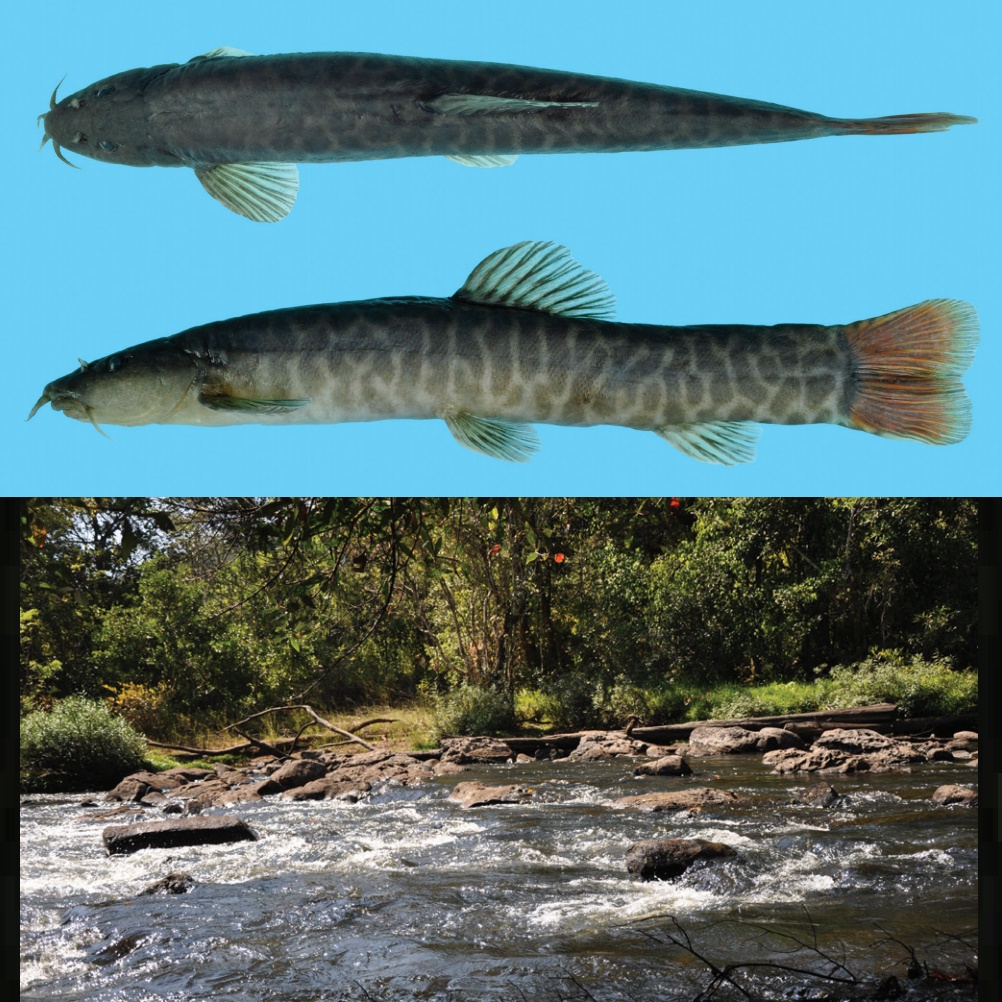
 Schistura palma, new species, MHNG 2790.080, holotype, 63.5 mm SL;
 Laos: Saysomboune Province: Nam Ngiep watershed.

Schistura palma, new species

Diagnosis. Schistura palma is characterised among other named species of Schistura sensu lato in Indochina by the presence of a dorsal keel along the entire length of the caudal peduncle in small individuals, that develops into a conspicuous crest in large ones. A low keel or crest exists in some other species of the genus, but in these it is restricted to the posterior part of the caudal peduncle. Among Southeast Asian species, such a crest extending along the entire length of the caudal peduncle is known in S. porthos (Figs. 6, 7) from the Mekong drainage in northern Laos and Xishuangbanna in China, and in S. alticrista (Fig. 8) from the Salween drainage in Thailand.
...

Etymology. From the Latin palma, the blade of an oar, an allusion to the shape of the caudal peduncle and caudal fin in large adults. A noun in apposition.

 
Maurice Kottelat. 2023. Schistura palma, A New Species of Loach from the Nam Ngiep Drainage, central Laos (Teleostei: Nemacheilidae). RAFFLES BULLETIN OF ZOOLOGY. 71; 520–530.

Friday, February 22, 2019

[Ichthyology • 2019] A Revised Molecular Phylogeny Reveals Polyphyly in Schistura (Cypriniformes: Nemacheilidae)


(A) Schistura desmotes, 38.9 mm SL, Ping River, Chiang Mai Province; (C) S. mahnerti, 71.9 mm SL, stream, Mae Khlong basin, Kanchanaburi Province;
 (E) S. aurantiaca, 39.9 mm SL, Pracham Mai River, Kanchanaburi Province.

in Sgouros, Page, Orlofske & Jadin, 2019. 

Abstract
There is a general consensus that the genus Schistura (Nemacheilidae), currently with 241 species, is not monophyletic. However, weak morphological synapomorphies and a lack of genetic data for most species of Schistura and their presumptive relatives have prevented meaningful diagnoses of species groups within this genus. To aid in deciphering evolutionary relationships, sequence data from two mitochondrial genes (cytochrome b and D-loop) were implemented in phylogenetic analyses for species of Schistura and other nemacheilids for which data from earlier studies and recently collected material were available. This analysis of 67 nemacheilid species, including 28 species of Schistura, provides the most comprehensive phylogeny of Nemacheilidae to date. In the phylogenetic tree for the combined data set, species of Schistura clustered in three clades. One clade contained 14 species of Schistura and Sectoria heterognathos and was sister to Homatula. A second clade of 11 species of Schistura was in a larger clade with Turcinoemacheilus kosswigi and Nemacheilus corica. The third clade contained three species, all from the Mae Khlong basin of Thailand. Taxonomic implications of these results are discussed; however, a more taxon-rich dataset and nuclear sequence data are needed before making taxonomic changes.

Keywords: Pisces, cytochrome b, D-loop, loaches, Nemacheilus

FIGURE 4. Species of Schistura included in the phylogenetic analysis; all are from Thailand.
 Clade 1: (A) Sdesmotes, UF 188065, 38.9 mm SL, Ping River, Chiang Mai Province; (B) S. robertsi, UF 185741, 50.8 mm SL, Tapee River, Nakhon Si Thammarat Province.
Clade 2: (C) S. mahnerti, UF 188061, 71.9 mm SL, stream, Mae Khlong basin, Kanchanaburi Province; (D) S. geisleri, UF 191830, 28.0 mm SL, Wae Creek, Yan River basin, Surat Thani Province.
Clade 3: (E) S. aurantiaca, UF 188063, 39.9 mm SL, Pracham Mai River, Kanchanaburi Province; (F) S. balteata, UF 191473, 52.0 mm SL, Pilok River, Kanchanaburi Province.
Photographs by Zachary Randall and Jarred Randall. 

Katherine Sgouros, Lawrence M. Page, Sarah A. Orlofske and Robert C. Jadin. 2019. A Revised Molecular Phylogeny Reveals Polyphyly in Schistura (Teleostei: Cypriniformes: Nemacheilidae). Zootaxa. 4559(2); 349–362. DOI: 10.11646/zootaxa.4559.2.8


Wednesday, September 12, 2018

[Ichthyology • 2018] Schistura alboguttata • A New Loach Species (Cypriniformes: Nemacheilidae) from the Pearl River basin in Guangxi, South China


Schistura alboguttata 
Cao & Zhang, 2018


Abstract
Schistura alboguttata, a new species of nemacheilid loach, is herein described from the Leli-He, a tributary flowing to the You-Jiang of the Pearl River basin (Zhu-Jiang in Chinese) at Tianlin County, Guangxi, South China. This new species can be readily distinguished from all other Chinese species of Schistura by its striking body coloration consisting of irregular white spots scattered over the dorsal and lateral regions of the body, with occasional irregular bars with narrow interspaces on the predorsal region.

Keywords: Pisces, nemacheilid, new species, Zhu-Jiang


FIGURE 5. Distribution of Schistura alboguttata. Symbol indicates type locality.

FIGURE 4. Live specimen of Schistura alboguttata, IHB2008050101, 71.4 mm SL, same collection data as holotype.

Schistura alboguttata, sp. nov.

Etymology. The specific epithet is derived from the Latin albus (white) and guttata (spotted), in reference to the irregular white spots scattered over the dorsal and lateral regions of the body.


Liang Cao and E. Zhang. 2018. Schistura alboguttata, A New Loach Species of the Family Nemacheilidae (Pisces: Cypriniformes) from the Pearl River basin in Guangxi, South China. Zootaxa. 4471(1); 125–136.  DOI: 10.11646/zootaxa.4471.1.5

Saturday, June 30, 2018

[Ichthyology • 2017] Schistura larketensis • A New Cavernicolous Fish (Teleostei: Nemacheilidae) from Meghalaya, Northeast India


Schistura larketensis
Choudhury, Mukhim, Basumatary, Warbah & Sarma, 2017


Abstract
Schistura larketensis, a new species of cavernicolous loach, is described from Khung, a limestone cave in Meghalaya, India. The species differs from Schistura papulifera, its only troglomorphic congener from northeast India, in having a smooth ventral surface of the head, the presence of a small cylindrical axillary pelvic lobe, and the presence of three pores in the supratemporal canal of the cephalic lateral-line system. Apart from these differences, the species can be immediately distinguished from all other species of Schistura from the Brahmaputra River and neighboring basins by the complete absence (or only vestigial presence) of eyes.

Keywords: Pisces, cavefish, new species, Krem Khung, Krem Synrang Pamiang


FIGURE 2. Live colouration of Schistura larketensis, GUMF uncat, about 52 mm SL; India: Meghalaya: Krem Khung.

Schistura larketensis, new species

Etymology. The species name is derived from the ‘Larket’ village, the locality of Krem Khung. This name is proposed so as to encourage the village to take up biodiversity conservation as it is already in the process of constituting a Biodiversity Management Committee under the Indian Biodiversity Act.

Habitat. The new species was collected from a small stagnant pool a few square meters in area and about 1 m in depth, located in a wet passage some 500 m from the main entrance of Krem Khung. The pool bed is mostly sandy with scattered pebbles (Fig. 5). The water was clear, pH 8.6, and a very low D.O. of 1.1 ppm when analyzed in the month of April 2015. No other macrofauna were recorded inside the cave except weakly-pigmented crabs and crayfish, crickets, cockroaches and millipedes.

Distribution. ...., East Jaintia Hills District, Meghalaya, India.

FIGURE 5. Photograph showing water pool in Krem Khung, the habitat of Schistura larketensis.


Hrishikesh Choudhury, D. Khlur B. Mukhim, Sudem Basumatary, Deisakee P Warbah and Dandadhar Sarma. 2017. Schistura larketensis, A New Cavernicolous Fish (Teleostei: Nemacheilidae) from Meghalaya, Northeast India. Zootaxa. 4353(1); 89-100. DOI:  10.11646/zootaxa.4353.1.5

A new species of blind cave-dwelling fish in Meghalaya  india.mongabay.com/2018/01/10/a-new-species-of-blind-cave-dwelling-fish-in-meghalaya/ via @Mongabay
গুবাহাটী বিশ্ববিদ্যালয়ৰ বিজ্ঞানীয়ে আৱিষ্কাৰ কৰিলে নতুন প্ৰজাতিৰ মাছ:  assam.nenow.in/গুবাহাটী-বিশ্ববিদ্যালয়ৰ/


Tuesday, March 13, 2018

[Ichthyology • 2018] Schistura kottelati • A New Species of Loach (Teleostei: Nemacheilidae) from the Phong Nha-Kẻ Bàng National Park in central Vietnam


 Schistura kottelati
 Tuan, Thao & Quang, 2018

 RAFFLES BULLETIN OF ZOOLOGY. 66 

Abstract

 Schistura kottelati, new species, is described from the Hung Dang Valley (Phong Nha-Kẻ Bàng National Park) in central Vietnam. It is distinguished from all other species of Schistura known from Vietnam and adjacent areas in Laos by a unique combination of characters, including features of lateral line and body pigmentation, counts of fin rays, and barbel and body measurements.

Key words. cypriniformes, taxonomy, morphology, Southeast Asia, karstic area


Schistura kottelati, new species

Diagnosis. Schistura kottelati differs from the other species of genus Schistura known from Vietnam and adjacent areas in Laos by the unique combination of the following characters: lateral line very short, with 5–14 pores; pelvic fin with 1 unbranched and 8 branched rays; a long maxillary barbel (reaching vertical through nape) and inner rostral barbel (reaching vertical through anterior margin of eye); body without obvious markings; caudal fin deeply forked (length of median ray 1.5–1.7 times in length of upper slobe); no external sexual dimorphism; caudal peduncle slender (its length 8.0–11.6% SL); a large eye (eye diameter 4.7–6.2% SL); and wide interorbital region (interorbital width 9.1–11.7% SL).

Etymology. The species is named for Maurice Kottelat, in appreciation for his research on Eurasian freshwater fishes, among others those of Vietnam. A noun in genitive.


 Ho Anh Tuan, Hoang Ngoc Thao and Ngo Xuan Quang. 2018. Schistura kottelati, A New Species of Loach from the Phong Nha-Kẻ Bàng National Park in central Vietnam (Teleostei: Nemacheilidae). RAFFLES BULLETIN OF ZOOLOGY. 66; 142–148.

Tuesday, August 22, 2017

[Ichthyology • 2017] Schistura thavonei • A New Species of Loach (Teleostei: Nemacheilidae) from northwestern Laos


 Schistura thavonei  Kottelat, 2017

RAFFLES BULLETIN OF ZOOLOGY. 65


  Abstract
 Schistura thavonei, new species, is described from the Nam Ma, Mekong drainage, in Louang Namtha Province, northwestern Laos. It is distinguished from all other Nemacheilidae by its unique colour pattern made of two broad dark brown stripes (one middorsal, one midlateral) and between them a pale yellowish-brown stripe (iridescent in life); a row of 12–24 short black bars are located increasingly lower on the flank from head to tail, posterior-most ones restricted to the lower half of the body or forming blotches along the ventral midline of the caudal peduncle. Besides, it has an elongate body with a hump immediately behind the head, 8+7 branched caudalfin rays; and 9–10 total pectoral-fin rays. It was found in riffles, over gravel to stone bottom. 

Key words. Cobitoidei, Schistura, Laos, Mekong basin, stone loach


Diagnosis. Schistura thavonei is distinguished from the other species of the genus by its unique colour pattern made of two broad dark brown stripes (one middorsal, one midlateral) and between them a pale yellowish-brown stripe (iridescent copper to orange in life) from the upper extremity of the gill opening to the upper half of the base of the caudal fin; overimposed to the midlateral stripe, a row of 12–24 short black bars, located increasingly lower on the flank from head to tail, posterior-most ones restricted to the lower half of the body or forming blotches along the ventral midline of the caudal peduncle. Additional characters useful for identification but not unique to the species are: body very elongate (depth 6.2–7.2 times in SL), with a marked hump behind the head; male without suborbital flap; 8+7 branched caudal-fin rays; 7½ branched dorsal fin rays; 9–10 pectoral-fin rays.


Notes on biology. A dissected female (CMK 25066, 46.6 mm SL) had unripe ovaries with white, irregular, not mature, ova about 1.0 mm diameter. The stomach of a 42.4 mm SL specimen was filled with insect larvae about 2–5 mm long. Schistura thavonei was observed in clear water [as expected for a benthic fish with bright coloration and contrasted pattern]. At all sites, S. thavonei has been collected in stretches of streams with riffles (in the sheltered parts with somewhat quieter current), over gravel to stone bottom (Fig. 7).

Distribution. Schistura thavonei is presently known only from the watershed of the Nam Ma in Louang Namtha Province, a tributary of the Mekong, in northeastern Laos (not to be confused with the Nam Ma in Houa Phan Province, which flows to Vietnam and enters the Gulf of Tonkin).

Etymology. The species is named for Mr. Thavone Phommavong, in appreciation for his help and companionship during several, and sometimes difficult, fish surveys in Laos. A noun in genitive.


Maurice Kottelat. 2017. Schistura thavonei, A New Species of Loach from northwestern Laos (Teleostei: Nemacheilidae). RAFFLES BULLETIN OF ZOOLOGY. 65: 395–403

Sunday, August 13, 2017

[Ichthyology • 2017] Schistura colossa & S. klydonion, Two New Species of Loaches (Teleostei: Nemacheilidae) from Bolaven Plateau, southern Laos


 Schistura colossa  Kottelat, 2017

 RAFFLES BULLETIN OF ZOOLOGY. 65; 341–356. 

Abstract
 Schistura colossa, new species, is described from the Xe Pian, Xe Set and Houay Champi on Bolaven Plateau in southern Laos. It is distinguished by its large size (up to at least 98 mm SL); the body has 16–21 bars, quite regularly shaped in juveniles and with increasing size becoming more irregular; in the largest individuals the bars on the caudal peduncle are broken up in irregular blotches. Schistura klydonion, new species, is described from the Xe Namnoy, also on Bolaven Plateau. It is distinguished by its relatively large size (up to at least 76 mm SL); the body has a midlateral row of 12–21 bars that do not reach the dorsal midline and that alternate with a middorsal row of saddles or small blotches, leaving a pale zigzag line between the two rows; the lips have a few sparsely-set pointed papillae. The topography of the plateau and the distribution of the endemic species suggest an earlier connection of the Houay Makchang Gnai and the Xe Katam with the Xe Pian instead of the Xe Namnoy. Both species are endemic to the Bolaven Plateau, have a limited distribution and are impacted by hydropower and agricultural activities.

 Key words. Cobitoidei, Schistura, Mekong basin, stone loach


Fig. 2. Schistura colossa, MHNG 2767.084, holotype, 98.0 mm SL; Laos: Xe Pian River on Bolaven Plateau.

Schistura colossa, new species

Distribution. Schistura colossa has been collected on Bolaven Plateau in the Xe Pian drainage, a tributary of the Xe Kong, in southern Laos (Fig. 9). A single specimen caught in the Champi and one caught in the Xe Set, both on Bolaven Plateau, cannot be distinguished from the samples from the Xe Pian.

 Etymology. The Latin adjective colossus (-a, -um) means giant. Allusion to the size of the species, a giant among Southeast Asian nemacheilids. 


Fig. 13. Schistura klydonion, MHNG 2767.085, 75.8 mm SL, holotype; Laos: Xe Namnoy on Bolaven Plateau (right side, reversed).

Schistura klydonion, new species

Distribution. Schistura klydonion has been observed only in the Xe Namnoy on the Bolaven Plateau, southern Laos. 

Etymology. From the classical Greek κλυδώνιον (klydonion) meaning small wave, ripple, undulation; allusion to the wavy stripe running along the flank between the row of saddles and the row of bars. A noun in apposition. 


Maurice Kottelat. 2017. Schistura colossa and S. klydonion, Two New Species of Loaches from Bolaven Plateau, southern Laos (Teleostei: Nemacheilidae).
 RAFFLES BULLETIN OF ZOOLOGY. 65; 341–356.

Sunday, March 16, 2014

[Ichthyology • 2013] Schistura crocotula • A New Loach (Teleostei: Nemacheilidae) from Prachuap Khiri Khan Province, southern Thailand


Schistura crocotula Plongsesthee, Kottelat & Beamish 2013

Schistura crocotula, a new species, is described from Khanan River, Prachuap Khiri Khan Province, southern Thailand. It is distinguished from other species of Schistura in Southeast Asia by a depressed head; 6-11 dark brown bars against an orange background; the first bar is the widest, two bars are under dorsal fin; interspaces are often indistinct on posterior part of body; a thick black bar at the base of the caudal fin.


Diagnosis: Schistura crocotula is distinguished from the other species of the genus by the combination of the following characters: lateral line incomplete; 7 1/2 branched dorsal-fin rays; 8 + 8 branched caudal-fin rays; pelvic-fin origin in front of dorsal-fin origin; anterior nostril pierced on front side of a pointed flap reaching eye; body with 6-11 regular dark brown bars on an orange (in life) or gray (when preserved) background; the first bar is wider than other bars; one or two bars are under dorsal fin, 1-1.5 times wider than interspaces; bars and interspaces often indistinct posterior to anus and orange-brown in life; black basal caudal bar conspicuous, wide, reaching dorsal and ventral midlines.
Size: 48.5 mm SL

Distribution: Schistura crocotula is known only from the Khanan River in Bangsapan and Pranburi river in Pranburi, Prachuap Khiri Khan Province, peninsular Thailand. It is possible that some of the S. robertsi samples reported by Kottelat (1990) include more than one species and that some specimens from the eastern slope of peninsular Thailand (NIFI 2071) might be S. crocotula. The juvenile specimen from Tapi drainage (CMK 5179, 22.5 mm SL) also reported as S. robertsi is plain brown and uninformative; the identity of this population requires sampling of adult specimens.

Etymology: The species name crocotula is derived from the Latin name of a saffron garment (a saffron-coloured dress) and refers to the background colour of the live fish.


Plongsesthee, R., Kottelat, M. & Beamish, F. W. H.; 2013: Schistura crocotula, A New Loach from Peninsular Thailand (Teleostei: Nemacheilidae). Ichthyological Exploration of Freshwaters, 24 (2): 171-178.

[Ichthyology • 2012] Schistura mobbsi • Fishes from Phuong Hoang cave, northern Vietnam, with description of a new species of loach (Teleostei: Nemacheilidae)


Schistura mobbsi Kottelat & Leisher 2012

Four fish species are known from inside Phuong Hoang cave in northern Vietnam. Pterocryptis crenula and Schistura cf. fasciolata are hypogean populations of epigean species. Cyprinus rubrofuscus individuals do not show morphological adaptations to the cave environment. Schistura mobbsi, new species, is characterized by the loss of the eyes, pigmentation and lateral line, reduced number of fin rays, large nostrils displaced forward on snout, and scales not overlapping and restricted to posterior part of flank, becoming very sparsely set anteriorly


Type locality: Vietnam, Thai Nguyen Prov., Phuong Hoang Cave, Bac Song (Lang Song Prov.), probably draining to Cau River, draining to Hai Phong, 21°46'31"N, 106°07'10"E.

Etymology: Named for the discoverer of the Phuong Hoang cave system, Jerry Mobbs.


Schistura mobbsi has no eyes, no pigmentation and a limited ability to sense motion. 

Discovery: New Cave Fish Species Sees “Light of Day”


Kottelat, M. & Leisher, C.. 2012. Fishes from Phuong Hoang cave, northern Vietnam, with description of a new species of loach (Teleostei: Nemacheilidae). Ichthyological Exploration of Freshwaters. 23 (3): 237-244.

[Ichthyology • 2012] Schistura pantherina Schistura (Teleostei: Nemacheilidae) in the Mae Khlong basin in southwestern Thailand with description of a new species


Schistura pantherina
 
Page, Plongsesthee, Beamish, Kangrang, Randall, Singer & Martin 2012

Abstract
Recent fieldwork has revealed the presence of six species of Schistura McClelland 1838 in the Mae Khlong basin in southwestern Thailand. These include S. sexcauda (Fowler 1937), S. balteata (Rendahl 1948), S. mahnerti Kottelat 1990, the recently described S. aurantiaca Plongsesthee et al. 2011 and S. tenebrosa Kangrang et al. 2012, and a newly discovered species described herein. Schistura sexcauda previously was the only Schistura species known in the Mae Khlong, and it was mis-identified as S. desmotes (Fowler 1934). Schistura pantherina, n. sp., is easily distinguished from all other species of Schistura by its distinctive color pattern. It appears to be endemic to the Mae Nam Kwai Noi system. 
Key words: Pisces, Cypriniformes, Schistura sexcauda, Schistura desmotes


Type locality: Thailand, Kanchanaburi Prov., Thong Pha Phum, Mae Khlong basin, Mae Nam Kwai Noi system, Kroeng Krawia,  
Etymology: The name pantherina from the Latin means 'like a panther,' is in reference to the spotted pattern on the dorsum and sides of some members of the felid genus Panthera.


Page, L.M.; Plongsesthee, R.; Beamish, F.W.H.; Kangrang, P.; Randall, Z.S.; Singer, R.A.; Martin, Z.P. 2012. Schistura (Teleostei: Nemacheilidae) in the Mae Khlong basin in southwestern Thailand with description of a new species. Zootaxa, 3586: 319-328.

[Ichthyology • 2012] Schistura tenebrosa • A New Species of Loach (Teleostei: Nemacheilidae) from the Kwai Noi River system, Mae Khlong basin, western Thailand


Schistura tenebrosa Kangrang, Page & Beamish 2012

Abstract
A new species of Schistura is described from the Kwai Noi, Mae Khlong basin, in the Thong Pha Phum District of Kanchanaburi Province in western Thailand. The species is distinguished from all other species of Schistura by a uniform dusky brown color pattern without marks on the dorsum or side of body and with many conspicuous supplementary neuromasts along the lateral line and on the head. It is further distinguished from other species of Schistura lacking marks on the body by its dark brown color, an incomplete lateral line extending only to beneath the dorsal fin, and the origin of the dorsal fin located above the origin of the pelvic fin. The species is small, reaching only 46.0 mm SL, 55.1 mm TL, and inhabits shallow gravel and rubble riffles in small streams. 

Key words: loach, Cypriniformes


Type locality: Thailand, Kanchanaburi Prov., Thong Pha Phum, Mae Khlong basin, Kwai Noi River system, Pakkok River, 14º36'22"N, 98º28'14"E.

Etymology: The name tenebrosa is a Latin adjective for dark or gloomy, and was given in reference to the dusky color of this species.


Kangrang, P.; Page, L.M.; Beamish, F.W.H. 2012: Schistura tenebrosa, A New Species of Loach from the Kwai Noi River system, Mae Khlong basin, Thailand (Teleostei: Nemacheilidae). Zootaxa. 3586: 69-77.

Thursday, June 30, 2011

[Ichthyology • 2011] ปลาค้อทองผาภูมิ | Schistura aurantiaca • A New Species (Teleostei: Nemacheilidae) from the Mae Khlong basin, western Thailand


Schistura aurantiaca  Plongsesthee, Page & Beamish 2011

Schistura aurantiaca, new species, is described from the Mae Khlong basin in western Thailand. It is distinguished from all other species of Schistura by a unique color pattern of 3-9 orange bars on the side of the body, with the 1st bar immediately behind the head and the 2nd bar near the dorsal-fin origin and widely separated so that most of the nape and the anterior side of the body are uniformly brown. The species reaches only 41 mm SL and inhabits shallow gravel and rubble riffles in small streams.

Etymology. The name, aurantiaca, Latin adjective for orange-colored, is in reference to the orange bars on this species.

Schistura aurantiaca
photo:  Nonn Panitvong | siamensis.org


Plongsesthee, R., Page, L.M. & Beamish, W. 2011. Schistura aurantiaca, A New Species from the Mae Khlong basin, Thailand (Teleostei: Nemacheilidae). Ichthyological Exploration of Freshwaters, 22 (2): 169-178. : http://www.pfeil-verlag.de/04biol/pdf/ief22_2_04.pdf