Showing posts with label Potamotrygonidae. Show all posts

Monday, August 21, 2017

[Ichthyology • 2017] Systematic Revision of the Potamotrygon scobina Garman, 1913 Species-complex (Myliobatiformes: Potamotrygonidae), with the Description of Three New Freshwater Stingray Species from Brazil and Comments on Their Distribution and Biogeography


Potamotrygon scobina Garman, 1913


Abstract

Potamotrygon scobina Garman, 1913, described from Cametá, rio Tocantins, lower Amazon basin, is taxonomically reviewed through an extensive morphological study of internal and external features. Specimens identified as P. scobina from different locations of the Amazon basin were also studied. The identity of P. scobina, its morphology, and distribution are redefined. In addition, three new species closely related to P. scobina are described from Brazil: Potamotrygon adamastor, sp. nov., from rio Uraricoera, rio Branco system, upper Amazon basin; Potamotrygon amazona, sp. nov., from rio Juruá, upper Amazon basin; and Potamotrygon garmani, sp. nov., from the mid to upper rio Tocantins. These three new species do not occur sympatrically with P. scobina, as far as known. Together with P. scobina and P. limai Fontenelle, Silva & Carvalho, 2014, the new species have three angular cartilages of different sizes, a condition not seen in any other potamotrygonin (which have either one or two angulars). Diagnostic characters in combination are primarily morphometric proportions, especially tail length and width, dermal denticles and tail thorns (their relative size, number, morphology, and distribution), tooth size and number of rows, and color pattern.

Keywords: Pisces, taxonomy, Neotropics, angular cartilages, Potamotrygon garmani sp. nov., Potamotrygon amazona sp. nov., Potamotrygon adamastor sp. nov.


FIGURE . The Potamotrygon scobina species complex (forms recognized herein as distinct species, shown here for comparion, following Fontenelle 2013).
 
A. Potamotrygon garmani sp. nov. B. Potamotrygon amazona sp. nov. C. Potamotrygon scobina. D. Potamotrygon adamastor sp. nov. E. Potamotrygon limai.

Potamotrygon scobina Garman, 1913 


João Pedro Fontenelle and Marcelo R. de Carvalho. 2017.  Systematic Revision of the Potamotrygon scobina Garman, 1913 Species-complex (Chondrichthyes: Myliobatiformes: Potamotrygonidae), with the Description of Three New Freshwater Stingray Species from Brazil and Comments on Their Distribution and Biogeography. Zootaxa.  4310(1); 1–63. DOI:  10.11646/zootaxa.4310.1.1

Tuesday, September 13, 2016

[Ichthyology • 2016] Potamotrygon albimaculata & P. jabuti • Description of Two Extraordinary New Species of Freshwater Stingrays of the Genus Potamotrygon endemic to the rio Tapajós Basin, Brazil (Chondrichthyes: Potamotrygonidae), with Notes on Other Tapajós Stingrays


 Potamotrygon albimaculata & P. jabuti  
 de Carvalho. 2016


Abstract
Stingrays from the rio Tapajós basin are reviewed based on material collected from its lower (i.e. from the mouth-lake to Itaituba), middle (from about the São Luiz rapids to the confluence of rios Juruena and Teles Pires), and upper (above the Juruena-Teles Pires confluence) segments. Two new species endemic to the mid and upper Tapajós, discovered long ago and common in the ornamental fish trade, are described. Potamotrygon albimaculata sp. nov. is part of the black stingray species group, and is diagnosed by its blackish brown dorsal disc color with numerous and generally evenly-spaced small whitish spots and faint ocelli, multiple rows of thorns broadly spread on dorsal and lateral tail, pelvic fins with broadly rounded apices, and two angular cartilages with the posterior far more slender but about as wide as the anterior angular. Potamotrygon jabuti sp. nov. is diagnosed by its marbled color pattern that undergoes remarkable change with growth as adults have elaborate designs of beige, golden to yellowish-orange spots or ocelli surrounded by a slender beige to golden mesh-like pattern, but neonates have simple, well-separated ocelli; this species also has a single to double row of tail thorns varying in their development, monognathic heterodonty with teeth of intermediate lateral rows of upper jaws larger and hexagonal, and two robust, more or less equally developed angular cartilages. Both species co-occur in the relatively fast-flowing mid and upper Tapajós basin, but mostly occupy different areas of the river, with P. albimaculata sp. nov. more abundant in its central troughs but foraging at its margins, whereas P. jabuti sp. nov. is also present in smaller streams over rocky, sandy and leafy substrates. The Tapajós basin includes at least seven stingray species, but additional species probably also occur. Potamotrygon motoro, P. orbignyi, P. humerosa, Potamotrygon sp., and Paratrygon aiereba are present in the lower Tapajós mouth-lake, which may also include Plesiotrygon and Heliotrygon species. In addition to the new species described herein, P. orbignyi and Paratrygon cf. aiereba occur in the mid and upper Tapajós, along with another form (Potamotrygon cf. scobina) known only from the region of the São Luiz rapids. Therefore, three additional new species may be present in the Tapajós basin, which has one of the most diverse stingray assemblages known together with the rios Negro and Tocantins-Araguaia.

Keywords: Pisces, Potamotrygon albimaculata sp. nov., Potamotrygon jabuti sp. nov., Neotropical region, morphology, systematics, taxonomy, Brazilian Shield, endemism


Marcelo R. de Carvalho. 2016. Description of Two Extraordinary New Species of Freshwater Stingrays of the Genus Potamotrygon endemic to the rio Tapajós Basin, Brazil (Chondrichthyes: Potamotrygonidae), with Notes on Other Tapajós Stingrays.
Zootaxa. 4167(1): 1–63. DOI:  10.11646/zootaxa.4167.1.1

Two New Freshwater Stingrays from the Tapajós Basin
http://www.reef2rainforest.com/?p=1615254

Wednesday, August 17, 2016

[Ichthyology • 2016] Potamotrygon rex • A New Species of Neotropical Freshwater Stingray (Chondrichthyes: Potamotrygonidae) from the middle and upper rio Tocantins, Brazil, closely allied to Potamotrygon henlei (Castelnau, 1855)


Potamotrygon rex 
de Carvalho, 2016  
DOI: 
10.11646/zootaxa.4150.5.2 

Abstract
A systematic revision of the rio Tocantins stingrays has confirmed the occurrence of a new species of Potamotrygon first discovered more than two decades ago but which lacked material for a thorough description. Field surveys since undertaken in the middle and upper rio Tocantins have assembled significant material that forms the basis of an ongoing revision of the diverse Tocantins potamotrygonid assemblage. Potamotrygon rex, sp. nov., is a very large, "black stingray" species from the mid and upper rio Tocantins that is closely related to P. henlei (Castelnau), which occurs in the lower Tocantins basin and in rio Araguaia; both species do not co-occur. Potamotrygon rex, sp. nov., has a unique blackish to dark brown dorsal color with numerous small, yellow to orange irregular spots usually forming distinct clusters on dorsal disc, with ocelli in center of clusters on posterior and outer disc, dorsal tail also with clusters but lateral tail with ocelli, and a dark brownish to gray color covering most of ventral surface except nasoral region, gill slits and anterior snout in some specimens, with small whitish spots on ventral disc, pelvic fins and tail. Potamotrygon rex, sp. nov., can be further distinguished by its broad pelvic-fin apices, lack of labial grooves, irregular double row of dorsal tail thorns, and in having two angular cartilages associated with each hyomandibula. Potamotrygon rex, sp. nov., P. henlei, P. leopoldi Castex & Castello, and another new Potamotrygon species from the rio Tapajós (in description) form a species-group (the "black stingrays") occurring in rivers draining the central Brazilian shield, characterized by their black to dark brown but highly ornate dorsal color, wide pelvic fins with broadly convex apices, among other features. Potamotrygon rex, sp. nov., is the 25th species of Potamotrygon, and highlights that very large new species of fishes still await discovery and description in the Neotropical region.

Keywords: Pisces, Potamotrygon, P. leopoldi, black stingrays, endemism, morphology, systematics, taxonomy, Brazilian Shield


Marcelo R. de Carvalho. 2016. Potamotrygon rex, A New Species of Neotropical Freshwater Stingray (Chondrichthyes: Potamotrygonidae) from the middle and upper rio Tocantins, Brazil, closely allied to Potamotrygon henlei (Castelnau, 1855).
Zootaxa. 4150(5); 537–565. DOI: 10.11646/zootaxa.4150.5.2


Friday, May 6, 2016

[Ichthyology • 2016] Potamotrygon wallacei • A New Species of Neotropical Freshwater Stingray (Chondrichthyes: Potamotrygonidae) from the Rio Negro, Amazonas, Brazil: the Smallest Species of Potamotrygon


Potamotrygon wallacei 
Carvalho, Rosa & Araújo, 2016 

DOI:  
10.11646/zootaxa.4107.4.5


Abstract

A new species of Potamotrygon is described from the Rio Negro drainage, Amazonas, Brazil. In spite of being cited or pictured several times in the scientific and aquarium fish literature since the 19th Century, it had been misidentified and still lacked a scientific name. Potamotrygon wallacei, n. sp., is diagnosed by the following characters: dorsal surface of disc light brown, with black irregularly-shaped vermiculate markings forming an amphora- or Ω-shaped figure on mid-disc, delimiting light brown reniform areas at disc center, and with subcircular light brown ocellate markings on disc margins; small body size (smallest known Potamotrygon species; largest examined specimen measured 310 mm DW); dorsal spines on tail usually rather low, without broad bases, in one to rarely three irregular rows, but extending posteriorly only to tail mid-length and not to caudal stings, with altogether relatively few spines; denticles on posterior mid-disc and tail base Y-shaped, with a central, anterior, bulbous cusp and usually two posterior pairs of smaller, rounded cusps; and single (anterior) angular cartilage. The new species is similar to P. orbignyi and other "reticulated" species in having a single (anterior) angular cartilage and in the color pattern of the tail, but is easily distinguished based on its size, dorsal tail spine arrangement, and specific details of color pattern.

Keywords: Potamotrygon wallacei n. sp., Myliobatiformes, morphology, systematics, taxonomy, Pisces


Potamotrygon wallacei, n. sp. live specimen resting in a tank in the Rio Itu, showing its great transparency 

Alfred Russel Wallace's illustration of the new species, Potamotrygon wallacei, n. sp. (modified from Wallace, 2002).
Original illustration about 12 cm long. 

Geographic distribution. Potamotrygon wallacei is endemic to the Rio Negro drainage in Amazonas, Brazil, occurring from Santa Isabel down to Rio Cuieiras in the vicinity of Manaus (Fig. 12).

Common name. The species is known as “raia cururu” in Brazil; “cururu” is a common name for the cane toad, Rhinella marina, to which the dorsum of P. wallacei bears some resemblance.

Etymology. The specific name honors Alfred Russel Wallace (1823–1913), the first naturalist to collect, observe and illustrate this species while on his travels in the Rio Negro in the early 1850's (Wallace, 2002).


FIGURE 14. Typical habitats where Potamotrygon wallacei n. sp. is common.
Upper left: Igarapé Daraquá, near the mouth of Rio Itu, left bank of the Rio Negro just above Barcelos (AM, Brazil). Upper right: typical flooded forest ("igapó") habitat (Rio Itu).
Lower left: live specimen resting in a tank in the Rio Itu, showing its great transparency. Lower right: Igarapé Cazurucu, affluent of Rio Itu. 

Marcelo R. de Carvalho, Ricardo S. Rosa and Maria Lúcia G. de Araújo. 2016. A New Species of Neotropical Freshwater Stingray (Chondrichthyes: Potamotrygonidae) from the Rio Negro, Amazonas, Brazil: the Smallest Species of Potamotrygon. Zootaxa. 4107(4);  DOI:  10.11646/zootaxa.4107.4.5

[Ichthyology • 2015] Systematics and Morphology of Potamotrygon orbignyi (Castelnau, 1855) and allied forms (Myliobatiformes: Potamotrygonidae)


FIGURE 34. Original illustrations of Potamotrygon orbignyi (left side) and Potamotrygon dumerilii (right side, indicated by an arrow), modified from Castelnau (1855, plates 48 and 49).

Abstract

The Neotropical freshwater stingray Potamotrygon orbignyi (Castelnau, 1855), and other similar "reticulated" species occurring in northern South American basins, were submitted to a thorough taxonomic analysis based on an extensive external and internal morphological study. The identity of P. orbignyi and the taxonomic status of the related nominal species Potamotrygon dumerilii (Castelnau, 1855), Potamotrygon reticulata (Günther, 1880), and Potamotrygon humerosa Garman, 1913, are defined. Taxonomic and morphological analyses revealed that P. reticulata and P. dumerilii fall within the range of variation found in P. orbignyi and were consequently treated as junior synonyms, corroborating previous works. The extensive variation in coloration observed in P. orbignyi could not be divided into consistent morphotypes; P. orbignyi is therefore a widespread species in the upper, mid and lower Amazonas basin, the Orinoco drainage, and in rivers of Suriname and the Guianas. Additionally, P. humerosa and Potamotrygon marinae Deynat, 2007 were found to present characters that support their validity, and are redescribed based on newly collected material. Potamotrygon humerosa occurs predominantly in the mid and lower Amazonas River and in lower reaches of many of its affluents, whereas P. marinae is known only from French Guiana and Suriname. Characters that proved valuable as diagnostic indicators, either in combination or as derived features, are primarily from coloration, dermal denticles and spines (morphology, development and distribution), meristic features (e.g. numbers of tooth rows, vertebrae and mesopterygial radials), morphometric proportions (e.g. snout length, tail width at base and length), and size at sexual maturity.

Keywords: Pisces, Taxonomy, Neotropical freshwater stingrays, anatomy, Potamotrygon humerosa, Potamotrygon marinae


Silva, João P. C. B. D. and Marcelo R. de Carvalho. 2015. Systematics and Morphology of Potamotrygon orbignyi (Castelnau, 1855) and allied forms (Chondrichthyes: Myliobatiformes: Potamotrygonidae). Zootaxa. 3982(1): 1–82. DOI: 10.11646/zootaxa.3982.1.1

Saturday, August 1, 2015

[Ichthyology • 2011] Heliotrygon gen. nov. • Morphology and Phylogenetic Relationships of A Remarkable New Genus and Two New Species of Neotropical Freshwater Stingrays (Chondrichthyes: Potamotrygonidae) from the Amazon Basin


Rosa’s Round Ray | Heliotrygon rosai
de Carvalho & Lovejoy, 2011

Abstract
The morphology and phylogenetic relationships of a new genus and two new species of Neotropical freshwater stingrays, family Potamotrygonidae, are investigated and described in detail. The new genus, Heliotrygon, n. gen., and its two new species, Heliotrygon gomesi, n. sp. (type-species) and Heliotrygon rosai, n. sp., are compared to all genera and species of potamotrygonids, based on revisions in progress. Some of the derived features of Heliotrygon include its unique disc proportions (disc highly circular, convex anteriorly at snout region, its width and length very similar), extreme subdivision of suborbital canal (forming a complex honeycomb-like pattern anterolaterally on disc), stout and triangular pelvic girdle, extremely reduced caudal sting, basibranchial copula with very slender and acute anterior extension, and precerebral and frontoparietal fontanellae of about equal width, tapering very little posteriorly. Both new species can be distinguished by their unique color patterns: Heliotrygon gomesi is uniform gray to light tan or brownish dorsally, without distinct patterns, whereas Heliotrygon rosai is characterized by numerous white to creamy-white vermiculate markings over a light brown, tan or gray background color. Additional proportional characters that may further distinguish both species are also discussed. Morphological descriptions are provided for dermal denticles, ventral lateral-line canals, skeleton, and cranial, hyoid and mandibular muscles of Heliotrygon, which clearly corroborate it as the sister group of Paratrygon. Both genera share numerous derived features of the ventral lateral-line canals, neurocranium, scapulocoracoid, pectoral basals, clasper morphology, and specific patterns of the adductor mandibulae and spiracularis medialis muscles. Potamotrygon and Plesiotrygon are demonstrated to share derived characters of their ventral lateral-line canals, in addition to the presence of angular cartilages. Our morphological phylogeny is further corroborated by a molecular phylogenetic analysis of cytochrome b based on four sequences (637 base pairs in length), representing two distinct haplotypes for Heliotrygon gomesi. Parsimony analysis produced a single most parsimonious tree revealing Heliotrygon and Paratrygon as sister taxa (bootstrap proportion of 70%), which together are the sister group to a clade including Plesiotrygon and species of Potamotrygon. These unusual stingrays highlight that potamotrygonid diversity, both in terms of species composition and undetected morphological and molecular patterns, is still poorly known.

Key words: Heliotrygon rosai, Heliotrygon gomesi, taxonomy, systematics, Myliobatiformes, South America


Family Potamotrygonidae Garman, 1913

Genus Heliotrygon, n. gen.

Type-species. Heliotrygon gomesi, n. sp., by original designation.

Included species. Currently the new genus is composed of two species, Heliotrygon gomesi, n. sp., and Heliotrygon rosai, n. sp., both described below.

Etymology. From the Greek helios, meaning “sun”, in reference to its distinctively arranged pectoral disc radials that appear to “radiate” outward; and trygon, Greek for stingray. Gender feminine.

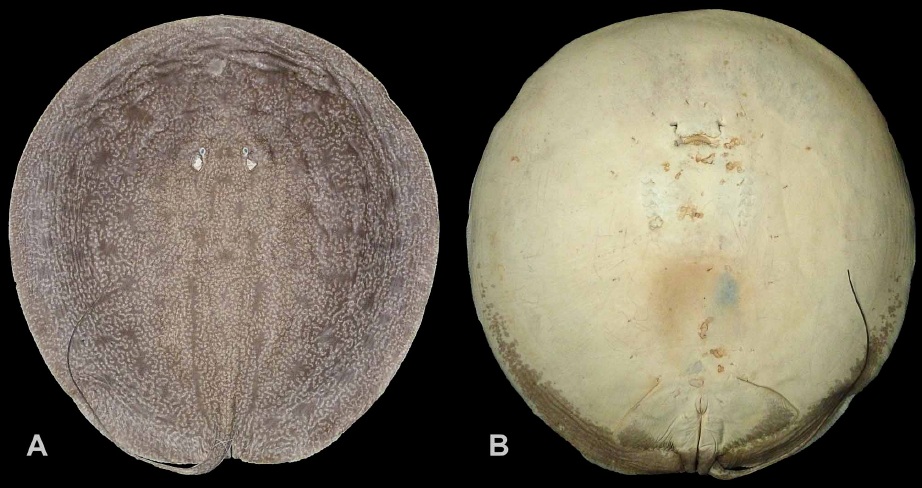
FIGURE 4. Paratype of Heliotrygon gomesi, n. sp., in dorsal (A) and ventral (B) views (ANSP 178017, preadult female, Rio Nanay, Rio Amazonas basin, 4.5 km west of Iquitos, Peru; 425 mm TL, 230 mm DL, and 224 mm DW).

Heliotrygon gomesi, n. sp.

Geographic distribution. Heliotrygon gomesi is distributed in the upper Rio Amazonas basin according to our material (Figure 10), but enters, we suspect, the lower reaches of most major tributaries and the lower Rio Amazonas basin as well. Its distribution is very similar to that of Plesiotrygon iwamae (Rosa et al., 1987; Carvalho et al., 2003).

Etymology. This new species honors Ulisses L. Gomes, a pioneer in the study of elasmobranch morphology and systematics in Brazil, and an esteemed colleague and collaborator of the first author.

Proposed common name. Gomes’s Round Ray (also referred to as "china" ray in the aquarium trade).

FIGURE 11. Holotype of Heliotrygon rosai, n. sp., in dorsal (A) and ventral (B) views (MZUSP 104996, adult male, Baía de Marajó, Pará state, Brazil; 984 mm TL, 604 mm DL, 577 mm DW).


Heliotrygon rosai, n. sp. 

Geographic distribution. Heliotrygon rosai is known from the upper, mid and lower Rio Amazonas basin, and probably also enters, we believe, the lower reaches of its major tributaries (Figure 17). As with H. gomesi, its distribution is similar to that of Plesiotrygon iwamae (Rosa et al., 1987; Carvalho et al., 2003).

Etymology. This new species is named after Ricardo S. Rosa, whose excellent revision of potamotrygonids (Rosa, 1985a) represents a landmark in our understanding of the taxonomy and diversity of this family. 

Proposed common name. Rosa’s Round Ray (also referred to as "coly" ray in the aquarium trade). 


Marcelo R. de Carvalho and Nathan R. Lovejoy. 2011. Morphology and Phylogenetic Relationships of A Remarkable New Genus and Two New Species of Neotropical Freshwater Stingrays from the Amazon Basin (Chondrichthyes: Potamotrygonidae). Zootaxa. 2776: 13–48. 
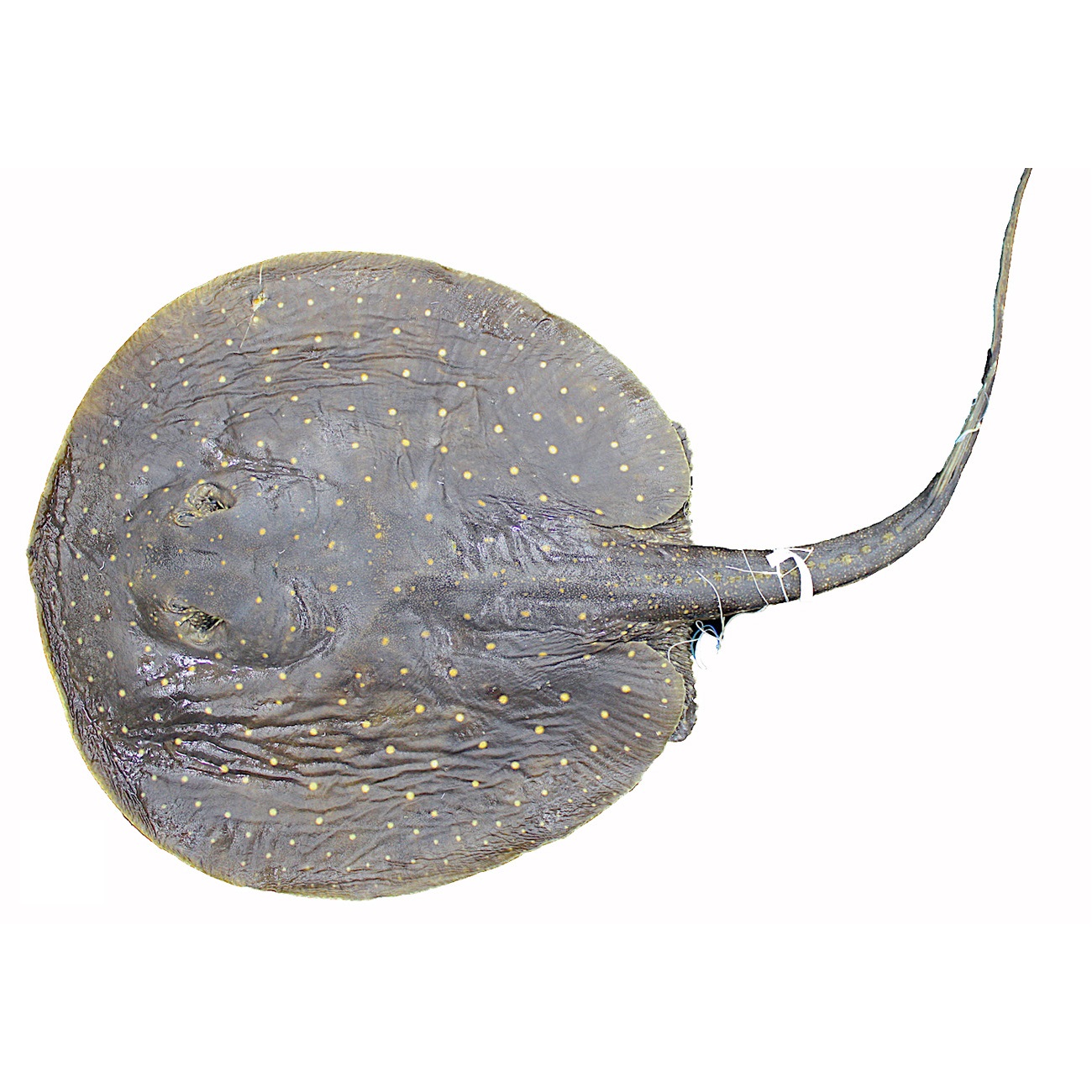
Pictures: Odd Stingless Stingrays Discovered in Amazon http://on.natgeo.com/1E1lYEw via @NatGeo

[Ichthyology • 2010] Plesiotrygon nana • An Unusual, Dwarf New Species of Neotropical Freshwater Stingray (Chondrichthyes: Potamotrygonidae) from the Upper and Mid Amazon Basin: The Second Species of Plesiotrygon


FIGURE 10: Small, free-living specimen of Plesiotrygon nana sp. nov. MZUSP 57642, juvenile or preadult female 912 mm TL, 124 mm DL, 118 mm DW. Characters that allow it to be identified as P. nana include its dorsal color pattern, dark purplish-brown caudal whip, proportionally smaller spiracles and nasoral region, and ventral lateral-line canals.
Photo: M. Toledo-Piza. | DOI: 10.1590/S0031-10492011000700001

ABSTRACT

A new species of the relatively poorly known Neotropical freshwater stingray genus Plesiotrygon Rosa, Castello & Thorson, 1987 is described from the main channel and smaller tributaries (Ríos Itaya and Pachitea) of the upper Amazon basin in Peru. The first specimen to be collected, however, was from much farther east in Rio Solimões in 1996, just down-river from Rio Purus (specimen unavailable for this study). Plesiotrygon nana sp. nov., is a very distinctive and unusually small species of freshwater stingray (Potamotrygonidae), described here mostly from three specimens representing different size classes and stages of sexual maturity. Plesiotrygon nana sp. nov., is distinguished from its only congener, P. iwamae Rosa, Castello & Thorson, 1987, by numerous unique features, including: dorsal coloration composed of very fine rosettes or a combination of spots and irregular ocelli; very circular disc and snout; very small and less rhomboidal spiracles; short snout and anterior disc region; narrow mouth and nostrils; denticles on dorsal tail small, scattered, not forming row of enlarged spines; adult and preadult specimens with significantly fewer tooth rows; fewer caudal vertebrae; higher total pectoral radials; very small size, probably not surpassing 250 mm disc length or width, males maturing sexually at around 180 mm disc length and 175 mm disc width; distal coloration of tail posterior to caudal stings usually dark purplish-brown; and features of the ventral lateral-line canals (hyomandibular canal very narrow, infraorbital and supraorbital canals not undulated, supraorbital and infraorbital loops small and narrow, supraorbital loop very short, not extending posteriorly to level of mouth, jugular and posterior infraorbital canals short, not extending caudally to first gill slits, subpleural loop very narrow posteriorly; absence of anterior and posterior subpleural tubules). To provide a foundation for the description of P. nana sp. nov., morphological variation in P. iwamae was examined based on all type specimens as well as newly collected and previously unreported material. Two specimens topotypic with the male paratype of P. nana sp. nov., referred to here as Plesiotrygon cf. iwamae, are also reported. Relationships of the new species to P. iwamae are discussed; further characters indicative of Plesiotrygon monophyly are proposed, but the genus may still not be valid. Plesiotrygon nana sp. nov., is commercialized with some regularity in the international aquarium trade from Iquitos (Peru), an alarming circumstance because nothing is known of its biology or conservation requirements.

Key-Words: Plesiotrygon iwamae; Taxonomy; Morphology; Myliobatiformes; Rio Solimões; Río Ucayali; South America.


Etymology: The specific epithet nana is in reference to its dwarf size (from the Latin nanus). Gender feminine.

Common name: Dwarf Antenna Ray (as in aquarium literature; also known as "black-tailed" antenna ray).

Geographic distribution: As far as is known, Plesiotrygon nana occurs in the upper Río Amazonas basin of Peru, both in smaller tributaries and in the main Río Amazonas channel, and in the lower course of Rio Solimões in Brazil, just down-river from the mouth of Rio Purus (MZUSP 57642). The small female paratype is from Río Itaya, a small tributary of Río Nanay (near Iquitos). The male paratype was collected in Río Amazonas slightly farther south, near Tamshiyacu, and the holotype was found in Río Pachitea, a triburay of Río Ucayali near Puerto Inca (Figure 16). This species may be expected to occur in Río Napo and other regions of the upper Río Amazonas inhabited by P. iwamae. Plesiotrygon nana is not restricted to the main Amazonas channel as previously thought (accounts from the aquarium fish trade conflict).


Marcelo R. de Carvalho and Maíra Ragno. 2010. An Unusual, Dwarf New Species of Neotropical Freshwater Stingray, Plesiotrygon nana sp. nov., from the Upper and Mid Amazon Basin: The Second Species of Plesiotrygon (Chondrichthyes: Potamotrygonidae). Papéis Avulsos de Zoologia (São Paulo). 51(7):101-138. DOI: 10.1590/S0031-10492011000700001