Showing posts with label Culicidae - Mosquito. Show all posts

Tuesday, December 5, 2023

[PaleoEntomology • 2023] Libanoculex intermedius • The Earliest Fossil Mosquito: A New Genus and Species (Diptera, Culicidae) from the lower Cretaceous Lebanese Amber


Libanoculex intermedius
Azar, Nel, Huang & Engel, 2023
 
 
Highlights: 
• Earliest-diverging lineage and oldest occurrence of mosquitoes
• Male mosquito with well-developed, denticulate, and hematophagous-type mouthparts
• New extinct subfamily of mosquitoes
Summary: 
Female mosquitoes are among the most notorious blood-feeding insects, sometimes causing severe allergic responses or vectoring a variety of microbial pathogens. Hematophagy in insects is likely a feeding shift from plant fluids, with the piercing-sucking mouthparts serving as suitable exaptation for piercing vertebrates’ skin. The origins of these habits are mired in an often-poor fossil record for many hematophagous lineages, particularly those of sufficient age, as to give insights into the paleoecological context in which blood feeding first appeared or even to arrive at gross estimates as to when such shifts have occurred. This is certainly the case for mosquitoes, a clade estimated molecularly to date back to the Jurassic. The known Mesozoic Culicidae are Late Cretaceous, assigned to the modern Anophelinae or to the extinct Burmaculicinae, sister to other Culicidae, all with mouthparts of a modern type. Here, we report the discovery, in Lower Cretaceous amber from Lebanon, of two conspecific male mosquitoes unexpectedly with piercing mouthparts, armed with denticulate sharp mandibles and laciniae. These male fossils were likely hematophagous. They represent a lineage that diverged earlier than Burmaculicinae, extending the definitive occurrence of the family into the Early Cretaceous and serving to narrow the ghost-lineage gap for mosquitoes.
 
Keywords: Culicidae, Lower Cretaceous, Lebanese amber, male hematophagy, new family, developed mouthparts

Systematic paleontology
Order Diptera Linnaeus, 1758
Family Culicidae Billberg, 1820

Libanoculicinae subfam. nov. 


Libanoculex gen. nov.
 
Etymology: The generic name is a combination of the Latin Libanus, meaning “Lebanon,” and the generic name Culex L. (Latin, meaning “gnat” or “mosquito”). Gender of the name is masculine.
 
Libanoculex intermedius sp. nov.

Etymology: The specific epithet is the Latin adjective intermedius, meaning “intermediate” or “between,” and refers to the early diverging position of the fossil relative to other Culicidae and its unique combination of culicid apomorphies and symplesiomorphies with Chaoboridae.
 
Outcrop and horizon: Mdeirij-Hammana outcrop, Caza (= District) Baabda, Central Lebanon, lower Barremian. 
 

Dany Azar, André Nel, Diying Huang and Michael S. Engel. 2023. The Earliest Fossil Mosquito. Current Biology. DOI: 10.1016/j.cub.2023.10.047
https://phys.org/news/2023-12-earliest-known-fossil-mosquito-males-bloodsuckers.html

Wednesday, October 25, 2023

[Entomology • 2023] Atherigona culicivora • A New Species of Bamboo Shoot-fly (Diptera: Muscidae) feeding on Mosquito Larvae


Atherigona culicivora, new species.
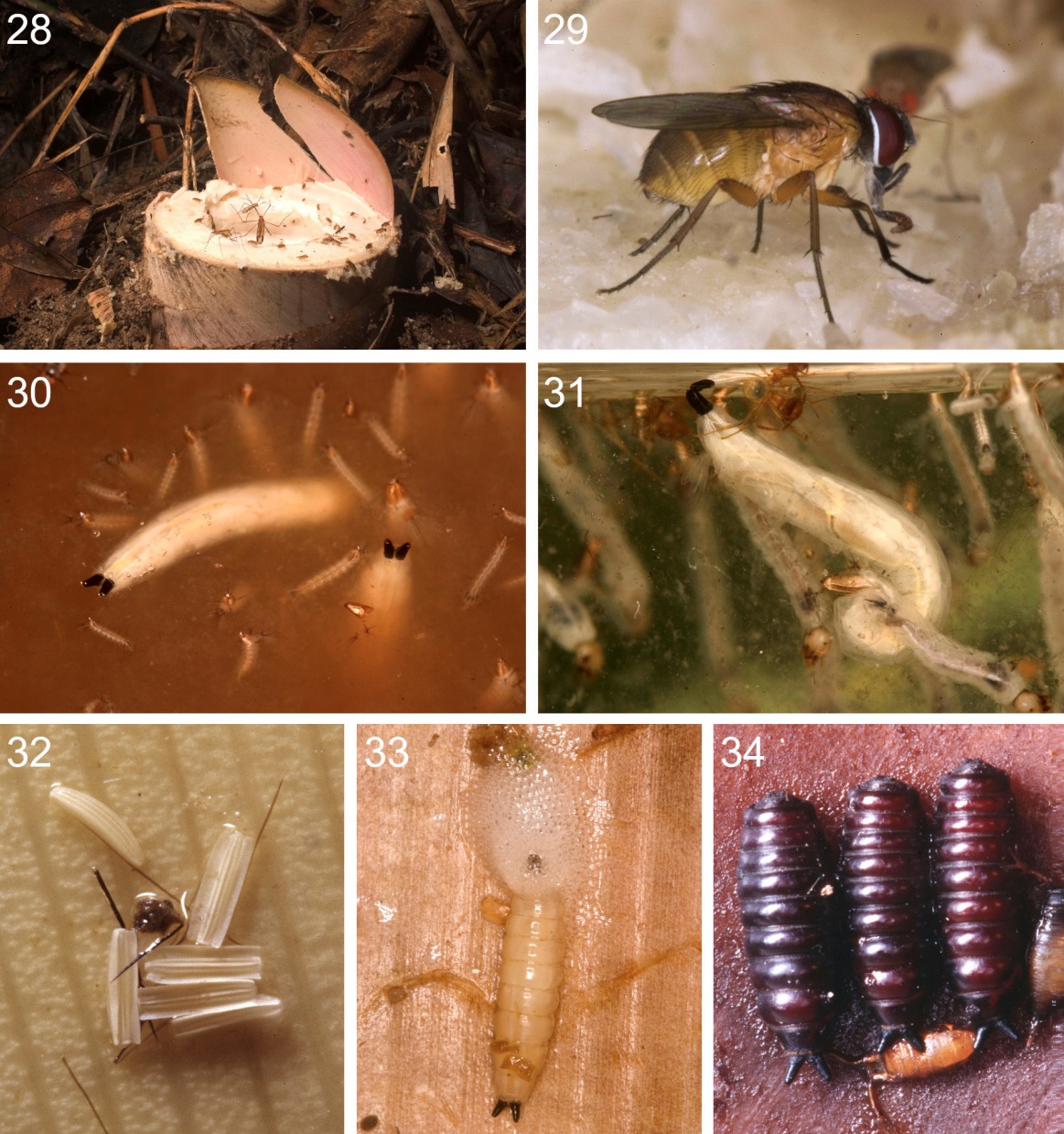
28, larval habitat: A stump of a young bamboo shoot of Gigantochloa scortechinii in Peninsular Malaysia with A. culicivora females and other flies breeding in the shoots, such as Tipulidae and Drosophilidae;
 29, a gravid A. culicivora female, feeding on the wall of a cut bamboo shoot, photographed in the field;
30, two larvae floating in the water, the black posterior spiracles are attached to the water surface, note mosquito larvae of different sizes; 31, larva feeding on a mosquito larva;
32, eggs deposited on the wet bamboo shoot sheath; 33, larva pupariating on the bamboo wall above the water surface, note the foam surrounding the anterior part of the body; 34, three puparia attached to the bamboo wall.

Kovac, Pont &  Deeming, 2023.
 RAFFLES BULLETIN OF ZOOLOGY. 71:

Abstract
 The male, female, egg, third instar larva, and puparium of Atherigona (Acritochaeta) culicivora, new species, are described from Peninsular Malaysia and northern Thailand. The saprophagous larvae of A. culicivora develop in water-filled stumps of freshly cut young bamboo shoots. They are subaquatic facultative predators of mosquito larvae, which is unique in the otherwise terrestrial genus Atherigona Rondani. Eggs are laid on the wet bamboo wall above the water surface. The larvae float upside down in the water, with their posterior spiracles attached to the water surface. When mosquito larvae approach, they quickly grab them and wrap themselves around the prey. Mature larvae crawl ashore and secrete a protective foam during pupariation. The development of A. culicivora from egg to adult takes only 13–14 days, which is an adaptation to the ephemeral nature of decaying bamboo shoots. Feeding on mosquito larvae may provide additional or complementary nutrients that could, for example, accelerate the rate of development of A. culicivora. The transition of A. culicivora from a terrestrial to an aquatic lifestyle was probably facilitated by the lack of aquatic predators in its habitat.

 Key words. life cycle, aquatic lifestyle, facultative predator, Culicidae, bamboo phytotelmata

Atherigona culicivora, new species:
 1, holotype male, lateral view, body length ca. 6 mm; 2, holotype male, dorsal view; 3, two males, lateral view, showing terminalia (Malaysia, Pahang state, Genting Highlands, 3.381°N 101.779°E, at 800 m, 1 to 7 December 2019; photos: E. Makovetskaya and N. Vikhrev).


Atherigona (Acritochaetaculicivora, new species

Diagnosis. A large species of the subgenus Acritochaeta Grimshaw (Figs. 1–3), with shining fronto-orbital plates, mid femur with 2 posterior preapical setae, and hind femur without a dorsal preapical seta. Males are easily recognised by secondary sexual characters: wing-tip with a dark cloud (Fig. 7) and fore tarsomere 5 flattened and modified in structure and bristling (Fig. 6).

Etymology. The name of the species is derived from the Latin ‘culex’ (midge) and ‘vorare’ (to devour), and refers to the feeding habits of the larvae. 

Atherigona culicivora, new species. Habitat and life stages:
28, larval habitat: A stump of a young bamboo shoot of Gigantochloa scortechinii in Peninsular Malaysia with A. culicivora females and other flies breeding in the shoots, such as Tipulidae and Drosophilidae; 29, a gravid A. culicivora female, feeding on the wall of a cut bamboo shoot, photographed in the field;
30, two larvae floating in the water, the black posterior spiracles are attached to the water surface, note mosquito larvae of different sizes; 31, larva feeding on a mosquito larva;
32, eggs deposited on the wet bamboo shoot sheath; 33, larva pupariating on the bamboo wall above the water surface, note the foam surrounding the anterior part of the body; 34, three puparia attached to the bamboo wall.


Damir Kovac, Adrian C. Pont and John C. Deeming. 2023. Atherigona culicivora, New Species (Insecta: Diptera: Muscidae), A Bamboo Shoot-fly feeding on Mosquito Larvae. RAFFLES BULLETIN OF ZOOLOGY. 71: 583–595.

Sunday, April 2, 2023

[Entomology • 2023] Trichoprosopon mixtli • A New sabethine Species (Diptera: Culicidae) from A Mexican Cloud Forest, with An Assessment of the Genus and Keys for the Identification of Known Species


Trichoprosopon mixtli 
Rivera-García, Mendez-Andrade & Ibañez-Bernal. 2023
 

Abstract
The genus Trichoprosopon Theobald, 1901 includes 13 described species in the Neotropical Region, three of which have been recorded in Mexico. In this work, a new species, Trichoprosopon mixtli sp. nov., is described based on characteristics of the fourth-instar larva, pupa, female and male genitalia, and adults. Larvae and pupae were collected from the flower bracts of Heliconia bourgaeana Petersen at the Instituto de Ecología, A.C. (INECOL), inside the “Santuario del Bosque de Niebla”, in Xalapa, Veracruz State, Mexico. This is the first time that the complete larval and pupal chaetotaxy of a species of Trichoprosopon is described. Keys for the identification of known species of Trichoprosopon are provided and the internal classification of the genus is discussed.

Keywords: Diptera, chaetotaxy, description, Heliconia, Mexico, Neotropical, Sabethini, Xalapa 


Karina D. Rivera-García, Alejandro Mendez-Andrade and Sergio Ibañez-Bernal. 2023. Trichoprosopon mixtli sp. nov., A New sabethine Species (Diptera: Culicidae) from A Mexican Cloud Forest, with An Assessment of the Genus and Keys for the Identification of Known Species. Zootaxa. 5254(1); 94-116. DOI: 10.11646/zootaxa.5254.1.5
Researchgate.net/profile/Karina-Rivera-Garcia