Wednesday, January 29, 2025

[Arachnida • 2024] Otacilia subshanxi • A New Otacilia Thorell, 1897 Species (Araneae: Phrurolithidae) from Hubei Province, China


Otacilia subshanxi 
Guo, Mu & Zhang, 2024  


Abstract
Background: Phrurolithidae is a family of spiders with 405 species belonging to 25 genera distributed worldwide. Notably, 213 species belonging to 17 genera have been recorded in China.

New information: A new species of the genus Otacilia Thorell, 1897 is described from Duheyuan Nature Reserve, Hubei Province, China. Diagnosis, morphological description, living photos and photos of the habitus and genitalia of the new species are provided.


Living photos of Otacilia subshanxi sp. nov.: A Male; B Female
(photographs by Qianle Lu).


Otacilia subshanxi sp. nov.

Diagnosis: This new species resembles O. shanxi Mu & Zhang, 2021 in having a similar femoral apophysis, atrium, curved connecting tubes, but it can be recognised by: 1) the wide embolus (vs. thin, cf. Fig. 3C and fig. 7F in Mu and Zhang 2021), 2) the thin retrolateral tibial apophysis (vs. wide, cf. Fig. 3B and fig. 7G in Mu and Zhang (2021)) and 3) the thin median septum (vs. wide, cf. Fig. 3E and fig. 7F in Mu and Zhang (2021)).

Etymology: This species is named for its similarity to O. shanxi Mu & Zhang, 2021.

 
Minghao Guo, Yannan Mu and Feng Zhang. 2024. A New Otacilia Thorell, 1897 Species from Hubei Province, China (Araneae, Phrurolithidae). Biodiversity Data Journal. 12: e137014. DOI: doi.org/10.3897/BDJ.12.e137014
 

[Botany • 2025] Piper saurodermus (Piperaceae) • A New Peltate-leaved Species restricted to the Tropical Rainforest of southern Mexico


Piper saurodermus  Ortiz-Rodr. & J.R.Carral, 

in Ortiz-Rodriguez, Carral-Domínguez, Amancio, Hurtado-Reveles et Martínez-Velarde, 2025. 

Summary
Piper saurodermus (Piperaceae), a new peltate-leaved species endemic to Mexico, is described and illustrated. In the context of the genus, the new species presents a unique combination of morphological features. These include its creeping habit, strongly bullate and densely pubescent leaves with an arcuate venation pattern, short stipitate inflorescences, glabrous flower bracts and the ornamented surface of its fruits. Based on the criteria established by IUCN, it is provisionally determined that the species is Critically Endangered [CR B2ab(ii,iii,v)].

Key Words: Conservation, floristic refuge, karst, neotropics 

Piper saurodermus.
A habit, a creeping understory plant; B peltate leaf with strongly bullate surface and arcuate venation pattern; C short stipitate inflorescence; D close-up of the inflorescence, note the glabrous bracts; E infructescence and ornamented fruit (inset).
 photos: A – B Leopoldo Hurtado Reveles; C – E Rodrigo Carral Domínguez.


Piper saurodermus Ortiz-Rodr. & J.R.Carral sp. nov. 


Andrés Ernesto Ortiz-Rodriguez, José Rodrigo Carral-Domínguez, Guadalupe Amancio, Leopoldo Hurtado-Reveles and María Fernanda Martínez-Velarde. 2025. Piper saurodermus (Piperaceae), A New Peltate-leaved Species restricted to the Tropical Rainforest of southern Mexico.  Kew Bulletin. DOI: doi.org/10.1007/s12225-024-10236-x

Tuesday, January 28, 2025

[Invertebrate • 2025] Coecobrya microphthalma • The Thermal Tolerance of Springtails in a Tropical Cave, with the Description of a New Coecobrya Species (Collembola: Entomobryidae) from Thailand


 Coecobrya microphthalma Manee & Jantarit,
 
in Manee, Deharveng, D’Haese, Nilsai, Shimano et Jantarit, 2025. 

Abstract
A new species of Collembola in the genus CoecobryaC. microphthalma sp. nov., is described from a cave environment in Saraburi province, central Thailand. The new species is the second described species of the boneti-group found in the country. It is most similar to C. chompon Nilsai, Lima & Jantarit, 2022, which is also described from a Thai cave. However, the new species is morphologically different from C. chompon in having orange dot pigmentation on its body and a combination of other morphological characteristics such as the number of sublobal hairs on the maxillary outer lobe and the number of medio-sublateral mac on Th. II, Abd. I, Abd. III and Abd. IV and the anterior face of the ventral tube. The morphological comparison of all known boneti species and a key to the world species of Coecobrya of the boneti-group are given. Coecobrya microphthalma sp. nov. was successfully cultured in the laboratory. The thermal tolerance of the new species was studied and tested with seven different temperature experiments (27 °C as a control, 30, 32, 33, 34, 35 and 36 °C). The results showed that C. microphthalma sp. nov. cannot survive at a temperature higher than 32 °C after exposure to the experimental heat for 7 and 14 consecutive days. At 27, 30 and 32 °C, C. microphthalma sp. nov. remained alive and produced eggs, but the duration of egg production and number of egg-laying days significantly declined when the temperature increased (p < 0.001). An interesting aspect of their reproduction concerns temperature. At 32 °C (5 °C above the control temperature), the F1 generation survived, was active and was able to molt to the adult stage. However, specimens were unable to produce the next generation of offspring. For postembryonic development, C. microphthalma sp. nov. required six molts to reach the adult stage. The development rate (from egg to adult) varied and differed significantly between the tested temperatures (p < 0.001). An increase in temperature from the control temperature significantly accelerated the developmental rate from egg to juvenile instars to adult with a statistical significance (p < 0.01). This study is the first attempt that provide information on the impact of increasing temperature on the population dynamics, reproductive capacity and life history of a subterranean tropical Collembola.

Keywords: breeding experiment; cave species; global warming; life history traits; thermal tolerance; taxonomy

 Coecobrya microphthalma sp. nov. 
(A) habitus under microscope; (B) habitus under SEM; (C) head and black eyepatch under slide; (D) head and eye (arrow) under SEM; (E) enlargement of eye under SEM.
Scale bar: (A,B)= 500 μm, (D) = 100 μm, (E) = 10 μm ((A,C): microscope images; (B,D,E): SEM images).

Taxonomy
Class Collembola Lubbock, 1870
Order Entomobryomorpha Börner, 1913

Family Entomobryidae Tömösváry, 1882
Subfamily Entomobryinae Schäffer, 1896

Genus Coecobrya Yosii, 1956

Coecobrya microphthalma sp. nov. Manee and Jantarit, 2025

Remarks. Coecobrya microphthalma sp. nov. belongs to the boneti-group characterized by the presence of eyes. The new species has 1+1 small eyes like six other species of the same group (C. boneti (Denis, 1948), C. sanmingensis Xu and Zhang, 2015, C. indonesiensis (Chen and Deharveng, 1997), C. tukmeas Zhang, Deharveng and Chen, 2009, C. oculata Zhang, Bedos and Deharveng, 2016 and C. chompon). Among Thai cave species, Coecobrya microphthalma sp. nov. is most similar to C. chompon in having relatively long antennae, labial chaetae as mrel1l2, presence of long smooth straight chaetae on antennae, 3 medio-medial mac on Th. II, 3 central mac on Abd. II, 1 central mac and ...

Etymology. Coecobrya microphthalma sp. nov. is derived from the Latin meaning “having small eyes”.


  Nongnapat Manee, Louis Deharveng, Cyrille A. D’Haese, Areeruk Nilsai, Satoshi Shimano and Sopark Jantarit. 2025. The Thermal Tolerance of Springtails in a Tropical Cave, with the Description of a New Coecobrya Species (Collembola: Entomobryidae) from Thailand. Insects. 16(1), 80. DOI: doi.org/10.3390/insects16010080  
(This article belongs to the Section Other Arthropods and General Topics)

Simple Summary: A new species of Collembola, Coecobrya microphthalma sp. nov., is described from a cave in Saraburi province, central Thailand. This species is the second boneti-group member found in the country. It closely resembles C. chompon Nilsai, Lima & Jantarit, 2022 but differs in having orange body dots and distinct morphological traits, such as the number of sublobal hairs and mac on various body segments. A comparison of all boneti-group species globally and a key to their identification are provided. Coecobrya microphthalma sp. nov. was cultured in the laboratory, and its thermal tolerance was tested at seven different temperatures (27 °C as control, 30, 32, 33, 34, 35, and 36 °C). The results showed that it cannot survive above 32 °C after 7 and 14 days of exposure. At 27, 30, and 32 °C, the species remained alive and produced eggs, though egg-laying duration and number of days decreased with higher temperatures. At 32 °C, the F1 generation survived and molted to adulthood, but no further offspring were produced. Development from egg to adult required six molts, with development rates increasing with higher temperatures. This study is the first attempt to examine how temperature affects the population dynamics, reproductive capacity, and life history of a subterranean tropical Collembola.

[Entomology • 2024] Metapocyrtus inangsabong, M. lumad & M. uphagpula • Three New Mimetic Weevils (Coleoptera: Curculionidae: Entiminae) from Mt. Candalaga, Davao de Oro, Mindanao Island, Philippines


Metapocyrtus inangsabong Cabras, Obrial & Agbas sp. nov.
Metapocyrtus lumad Cabras, Obrial & Agbas sp. nov., and 
Metapocyrtus (Trachycyrtusuphagpula Cabras, Obrial & Agbas sp. nov.

in ObrialAgbas, Medina et Cabras, 2024. 

Abstract
Three new species of MetapocyrtusMetapocyrtus inangsabong Cabras, Obrial & Agbas sp. nov.Metapocyrtus lumad Cabras, Obrial & Agbas sp. nov., and Metapocyrtus (Trachycyrtusuphagpula Cabras, Obrial & Agbas sp. nov. are described and illustrated. Short ecological notes on the species’ habitat, mimicry with other weevils and beetles, and the association between Nepenthes candalaga and Pachyrhynchini in the Philippines are also presented.

Coleoptera, Biodiversity, endemic, new species, mimicry, Pachyrhynchini, weevils, Nepenthes


Metapocyrtus inangsabong Cabras, Obrial & Agbas sp. nov.
Metapocyrtus lumad Cabras, Obrial & Agbas sp. nov.,
Metapocyrtus (Trachycyrtusuphagpula Cabras, Obrial & Agbas 


Graden G. OBRIAL, Daven JAYSON D. AGBAS, Milton Norman D. MEDINA and Analyn A. CABRAS. 2024. Three New Mimetic Weevils (Coleoptera, Curculionidae, Entiminae) from Mt. Candalaga, Davao de Oro, Mindanao Island, Philippines.  Zootaxa. 5543(4); 438-454. DOI: doi.org/10.11646/zootaxa.5541.4.2

[Arachnida • 2024] Tityus achilles • Biomechanics of Venom Delivery in South America’s First Toxungen-spraying Scorpion


Tityus (Tityusachilles Laborieux, 2024 

 
Abstract
Venom is a metabolically expensive secretion used sparingly in a variety of ecological contexts, most notably predation and defence. Accordingly, few animals employ their toxins from a distance, and venom-squirting behaviour is only known from select taxa. In scorpions, species belonging to two genera are known to spray venom when threatened, and previous work in Parabuthus transvaalicus shows that venom delivery depends on perceived levels of threat. Here, I describe Tityus (Tityusachilles sp. nov., a new species of buthid scorpion from Cundinamarca, Colombia. Remarkably, this species is capable of venom spraying, a first for both the genus and the South American continent. Using frame-by-frame video analysis and ballistic equations, I show that T. (Tityusachilles sp. nov. employs not one, but two types of airborne defences with dramatic differences in reach and venom expenditure. Further, the new species uses an unusually large reserve of prevenom-like secretion for spraying, as opposed to the costly venom used by other spraying scorpions. In light of these key specializations, I propose that toxungen spraying convergently evolved in response to different selection pressures, laying the groundwork for future investigation.

behaviour, Colombia, evolutionary biology, new species, taxonomy, toxin, toxungen, venom spitting


 Léo Laborieux. 2024. Biomechanics of Venom Delivery in South America’s First Toxungen-spraying Scorpion. Zoological Journal of the Linnean Society. 202(4) zlae161. DOI: doi.org/10.1093/zoolinnean/zlae161  

[Entomology • 2025] Psen fronistriatus & P. scabrosus • Two New Species of Psen Latreille, 1796 (Hymenoptera: Apoidea: Crabronidae) from China, with A Key to Psen Species of China


Psen fronistriatus 
Deng, Ma & Li, 2025 


Abstract
Two new species of the genus Psen Latreille, 1796, namely Psen fronistriatus sp. nov. and Psen scabrosus sp. nov. are described and illustrated from China. A key to the Chinese species of Psen is also provided.

Key words: Crabronidae, digger wasps, key, taxonomy


Psen fronistriatus sp. nov., holotype ♀
 A habitus, dorsal view B habitus, lateral view C head, frontal view D antennae E head, pronotum and scutum, dorsal view F scutellum, metanotum and propodeum, dorsal view G thorax, lateral view H propodeum, posterior view I left wing J pygidial plate, dorsal view.
Scale bars: 1 mm.

Psen fronistriatus sp. nov.

Etymology: The specific name is derived from two Latin words: froni - (= frons) and -striatus (= striate), referring to the upper frons weakly striate.

 Psen scabrosus sp. nov.

Etymology: The specific name from Latin word: scabrosus (= scabrous), referring to the head and thorax with large, scabrous punctures.


 Yao Deng, Li Ma, Qiang Li. 2025. Two New Species of Psen Latreille, 1796 (Hymenoptera, Apoidea, Crabronidae) from China, with A Key to Psen Species of China. ZooKeys. 1224: 87-108. DOI: doi.org/10.3897/zookeys.1224.133244  

[Herpetology • 2025] Trimeresurus erythrochloris • A New Species of Karst-associated Pitviper of the Trimeresurus kanburiensis Complex (Serpentes: Viperidae) from eastern Thailand


Trimeresurus erythrochloris 
 Pawangkhanant, Idiiatullina, Smits, Dugdale, Pierce, Suwannapoom & Poyarkov, 2025

Red-barred Green Pitviper | งูเขียวหางไหม้ลายหยัก  ||  DOI: doi.org/10.47605/tapro.v14i1.347

Abstract
We describe a new species of karst-dwelling pitviper from Sa Kaeo Province in eastern Thailand based on morphological and molecular (2,296 bp from cyt b, ND4, and 16S rRNA mitochondrial DNA genes) lines of evidence. Our phylogenetic analysis places the new species as a sister lineage of Trimeresurus venustus (p = 2.7% and 3.7% for cyt b and ND4 genes, respectively). It is also closely related to T. cardamomensis (p = 2.1% and 2.6% for cyt b and ND4 genes, respectively). To date, the new species is known from only two adult specimens, and its distribution seems to be restricted to a narrow limestone karst area in the province of Sa Kaeo in Thailand near the national border with Cambodia. Additional studies are required to understand its life history, distribution, and conservation status. The discovery of this new species brings the total number of known Trimeresurus to 51 species, 19 of which occur in Thailand, including five that are endemic to this country.

Key words: limestone, morphology, molecular phylogeny, systematics, Sa Kaeo Province


Trimeresurus erythrochloris sp. nov. adult female 

Trimeresurus erythrochloris sp. nov.  

Diagnosis. The new species differs from other members of the subgenus Trimeresurus by the following combination of characters: dorsal scales in 23-21-15 rows, moderately keeled except the outermost rows, which are smooth; ventral scales 164–172; subcaudals 54–67, all paired; iris golden yellow in both sexes; body dorsally grass green with irregular, serrated, reddish-brown transverse markings; suborbital stripe white and wide in male, absent in female; ventrolateral stripe distinct, present on the first few dorsal scale rows, white and red in male, white in female; throat, chin, and lower labials light turquoise; ventral surfaces pale blue in male, pale green in female; tail dorsally light brick-red mottled with dark spots, ventrally with irregular white markings; hemipenis with welldeveloped pointed almost spine-like papillae at its base.

Etymology. The species name “erythrochloris” is a Latinized adjective in the nominative singular, masculine gender, derived from the classical Greek adjective eruthros (ἐρυθρός), “erythros”, meaning “red”, and from the adjective chloros (χλωρός), “chloris”, meaning “green”. The species name is given in reference to the beautiful dorsal coloration of the new species, which consists of red bands on the green background
We suggest the following common names for the new species: 
“Ngu Khiew Hang Mai Lai Yhak” (งูเขียวหางไหม้ลายหยัก) (in Thai), 
“Red-barred Green Pitviper” (in English), and 
“Krasno-zelenaya bambukovaya kufiya” (Красно-зеленая бамбуковая куфия) (in Russian).

Habitat of Trimeresurus erythrochloris sp. nov. (in life) at the type locality in ..., Sa Kaeo, Thailand.
 Photo: T. Smits.


Parinya Pawangkhanant, Sabira S. Idiiatullina, Ton Smits, Ian Dugdale, Andrew Pierce, Chatmongkon Suwannapoom and Nikolay A. Poyarkov. 2025. A New Species of Karst-associated Pitviper of the Trimeresurus kanburiensis Complex (Squamata: Viperidae) from eastern Thailand. TAPROBANICA. 14(1); 1–15. DOI: doi.org/10.47605/tapro.v14i1.347

[Botany • 2021] Miconia waimiri-atroari (Melastomataceae: Miconieae) • A New Species from the Brazilian Amazon Forest


  Miconia waimiri-atroari  Meirelles & Caddah,

in Meirelles, Sartor, Chagas et Caddah, 2021.
 
Abstract
Miconia waimiri-atroari is presented here as a new species from the Brazilian Amazon Forest. This new species has discolorous leaf blades, inflorescences with scorpioid branches, and petals and antesepalous stamen connectives with glandular trichomes. It has been misidentified as Miconia argyrophylla, another species from the Amazon Forest that has this same set of characters. However, the new species has cylindrical young branches (vs. quadrangular in M. argyrophylla), stellate trichomes on leaf abaxial surface (vs. arachnoid), stamens with yellow filaments that turn red in old flowers (vs. stamens with white filaments that only turn pale in old flowers), and style with glandular trichomes (vs. glabrous). At the moment, the species is only known from a small area north of Manaus, state of Amazonas, Brazil. Morphological description, illustrations, general comments and comparison to other similar species are also provided.

Albicans clade, Eudicots, Miconia argyrophylla, Neotropics, Taxonomy

  Miconia waimiri-atroari.
A: Branch with inflorescence. B: Flower. C: Style. D: Antesepalous stamen in lateral view. E: Antepetalous stamen in lateral view. F: Antesepalous stamen in ventral view. G: Petal. H: Fruit in upper view. I: Fruit in lateral view.
Drawn by Carlos Alvarez based on the MG isotype.

  Miconia waimiri-atroari.
A: Branch with leaves and inflorescence. Flower in detail, with thin arrow pointing to petal with glandular-ciliate margin, and thick arrows pointing to glandular trichome on antesepalous stamen connective. B: Inflorescence branch with buds and young flowers. C: Inflorescence branch with young and old flowers. D: Young and old flowers.
 A-B: Photos by Francisco Farroñay, C-D: Photos by Layon Oreste Demarchi.

Miconia waimiri-atroari sp. nov. 

Etymology:—The new species is named after the indigenous people of Waimiri-Atroari, whose territory is located near the BR-174, between Manaus (Amazonas) and Boa Vista (Roraima), where the species occurs. During the construction of the BR-174, mainly in the 1960’ and 1970’s, these people have suffered a massive genocide by the military government of that time, and lost part of their land to farmers, squatters and the state (Sousa et al. 2020).Besides the BR-174, the Balbina Dam and mining companies have also explored the land of the Waimiri-Atroari, contributing to population decrease from 3000 in 1972 to 350 people in 1983 (Damasio 2019). The epithet is a name in apposition. 


Julia MEIRELLES, Mariana Furlan SARTOR, Rennan Lopes CHAGAS and Mayara Krasinski CADDAH. 2021. Miconia waimiri-atroari (Miconieae, Melastomataceae): A New Species from the Brazilian Amazon Forest.  Phytotaxa. 521(3); 203-211. DOI: doi.org/10.11646/phytotaxa.521.3.5

[Botany • 2020] Philodendron guadarramanum (Araceae) • A New Species from Tabasco, Mexico


Philodendron guadarramanum Díaz Jim., Croat & Aguilar-Rodr., 

in Díaz Jiménez, Aguilar-Rodríguez, Croat, Cedeño-Fonseca, Montano, Yovel et Macswiney G. 2020.  . Phytotaxa. 

 
Abstract
We describe and illustrate Philodendron guadarramanum, a new species of Araceae from Tabasco, Mexico. This species grows in montane cloud forest and evergreen tropical rainforest at elevations between 700 and 1100 m. It is similar to Philodendron purulhense, but differs from that species by having petioles broadly and sharply sulcate adaxially, with an acute medial rib, leaf blades with more basal veins and more primary lateral veins per side, and inflorescences more numerous per axil.

Araceae, endemic, Mexico, Philodendron, Tabasco, Monocots

Philodendron guadarramanum Díaz Jim., Croat & Aguilar-Rodr., sp. nov. 
A. Stem with old remains of cataphylls, closed inflorescences, a partial portion of the petiole, and the partial adaxial surface of a new blade; B. Stem covered with old cataphylls degrading and persisting as fiber masses; C. Inflorescence in post-anthesis with a longitudinal cut of the spathe showing the reddish purple inner surface of the spathe tube, and (from bottom-up) pistillate, sterile, and staminate portions of the spadix; D. Partial portion of the spadix showing pistillate portion (bottom) with the styles rounded at the apex, and the portion sterile (up) broader than pistillate portion; E. Partial view of leaves, showing the adaxial surface of a petiole (note the acute medial rib) and adaxial and partial abaxial surfaces of leaf blades.
Scale bars: A = 10 cm; B = 3 cm; C = 5 cm; D = 1.5 cm.

Philodendron guadarramanum Díaz Jim., Croat & Aguilar-Rodr., sp. nov.

Eponymy:—The species is named in honor of the Mexican botanist, M.C. María de los Ángeles Guadarrama Olivera, who for many years directed and supported the study of the flora of Tabasco. María de los Ángeles is an expert in Commelinaceae. She was a professor and director of the herbarium (UJAT) of the Universidad Juarez Autónoma de Tabasco and is now retired. 


Pedro Díaz Jiménez, Pedro A. Aguilar-Rodríguez, Thomas B. Croat, Marco Cedeño-Fonseca, Martin Alarcón Montano, Yossi Yovel and M. Cristina Macswiney G. 2020. Philodendron guadarramanum (Araceae), A New Species from Tabasco, Mexico. Phytotaxa. 468(3); 296-300. DOI: doi.org/10.11646/phytotaxa.468.3.5  

Monday, January 27, 2025

[Diplopoda • 2024] Skleroprotopus change, S. incisodentatus, S. megistus, S. tiankeng, etc. • Molecular Phylogenetic and Morphological Studies reveal increased Species Diversity in the Millipede Genus Skleroprotopus Attems, 1901 (Julida: Mongoliulidae) in China


 A Skleroprotopus change sp. nov.; B Skleroprotopus megistus sp. nov.; C Skleroprotopus longissimus sp. nov.;
 D Skleroprotopus genjudi sp. nov.; E Skleroprotopus tiankeng sp. nov.;
Skleroprotopus laiyuanensis sp. nov.; G Skleroprotopus incisodentatus sp. nov. 

 Chen, Zhao, Golovatch & Liu. 2024 

Abstract
A taxonomic study of the genus Skleroprotopus Attems, 1901 from nine provinces in China was conducted utilizing morphological comparisons and molecular phylogenetic analyses. The results reveal thirteen new species, i.e. Skleroprotopus yutiantianae sp. nov., S. tiankeng sp. nov., S. megistus sp. nov., S. penglai sp. nov., S. longissimus sp. nov., S. genjudi sp. nov., S. laiyuanensis sp. nov., S. longiflagellatus sp. nov., S. change sp. nov., S. ampullaceus sp. nov., S. incisodentatus sp. nov., S. multistriatus sp. nov., and S. conicus sp. nov. This significantly enriches the diversity of Skleroprotopus in China, bringing it to a total of 18 species. With the exception of S. yutiantianae sp. nov., all these species were collected in caves. In terms of their degree of adaptation to the cave environment, the latter six species are presumed troglophiles, while the others are likely troglobites. DNA-barcoding based on the COI mitochondrial gene is documented for the first time in this genus. The specific p-distances between Skleroprotopus species range from 6.6–17.0%, while intraspecific p-distances are only 0.2–1.4%. Additionally, the morphological features of male leg-pair 1, the penis and leg-pair 7 are also discussed.

Keywords: barcoding, cave, diversity, new species, phylogeny

Pictures of live animals:
 A Skleroprotopus change sp. nov.; B Skleroprotopus megistus sp. nov.; C Skleroprotopus longissimus sp. nov.; D Skleroprotopus genjudi sp. nov.; E Skleroprotopus tiankeng sp. nov.; F Skleroprotopus laiyuanensis sp. nov.; G Skleroprotopus incisodentatus sp. nov. 
photos by Prof. Mingyi Tian from SCAU

 Skleroprotopus tiankeng sp. nov.
 
Holotype male (SCAU), China, Shaanxi Province, Hanzhong City, Nanzheng District, Cave Xigoutiankeng Dong, ..., 850 m, ....

Diagnosis: Differs from congeners mostly based on the following combination of characters: (1) penis much longer than coxae 2 (Fig. 5I); (2) male leg 7 with a very small coxal process, lower than the telopodite (Fig. 5E); (3) anterior gonopod (Fig. 5G, H) with a large and foot-shaped like coxal process, carrying a broadened membranous lobe, outer margin with a triangular protrusion, and a relatively thick flagellum. — In addition, this new species differs from all other species analyzed in a >10.3% uncorrected p-distance of the COI barcoding gene.

Etymology: The species is named after its type locality that is the Hanzhong sinkhole group, a geological wonder composed of multiple heavenly pits. “Tiankeng” in Chinese “天坑”, a noun in apposition.


 Skleroprotopus megistus sp. nov.
 
Diagnosis: Differs from congeners mostly based on the following combination of characters: (1) telopoditomere 3 of male leg 1 particularly broad and bulging in the middle (Fig. 6E); (2) penis subequal in height to coxae 2 (Fig. 6F); (3) coxal process of male leg 7 very small, lower than the telopodite (Fig. 6D); (4) anterior gonopod with a long coxal process carrying a highly developed, axe-shaped, membranous lobe (Fig. 6I). — In addition, this new species differs from all other species analyzed in a >10.3% uncorrected p-distance of the COI barcoding gene.

Etymology: Latinised Greek “megistus” is meaning “large”. The specific epithet refers to the male leg-pair 1 being particularly large; adjective.


 Skleroprotopus change sp. nov.
 
Holotype male (SCAU), China, Hubei Province, Xianning City, Xian’an District, Chang’e Scenic Park, Cave Feixian Dong, ..., 160 m, ...

Diagnosis: Differs from congeners mostly based on the following combination of characters: (1) telopoditomere 4 of male leg 1 rounded, with a small mesal hump (Fig. 8E); (2) penis slightly longer than male coxae 2 (Fig. 8D); (3) male leg 7 with a very small coxal process and a 4-segmented telopodite (Fig. 8F); (4) anterior gonopod (Fig. 8G, H) with a very long coxal process carrying a somewhat broadened and dentated membranous lobe. — In addition, this new species differs from all other Skleroprotopus species analyzed in uncorrected p-distances ranging from between 6.6% (compared to S. longiflagellatus sp. nov.) and 15.6% (compared to S. longissimus sp. nov.).

Etymology: The specific epithet is primarily derived from its type locality, which is named after Chang’e. She is the fairy of the moon palace in the ancient Chinese mythology. “Change” in Chinese “嫦娥”, a noun in apposition.


 Skleroprotopus incisodentatus sp. nov.
 
Diagnosis: Differs from congeners mostly based on the following combination of characters: (1) telopoditomere 4 of male leg 1 with a small mesal hump (Fig. 13D); (2) penis slightly higher than coxae 2 (Fig. 13C); (3) male leg 7 with a very small coxal process, much lower than telopodite, which is made up of 4 segments and a claw (Fig. 13F); (4) anterior gonopod (Fig. 13E, I) with a very long coxal process carrying a narrow, lower, membranous lobe, distally with a vague indentation. — In addition, this new species differs from all other species analyzed in a >8.0% uncorrected p-distance of the COI barcoding gene.

Etymology: The specific epithet refers to the distally vague indentation of a membranous lobe of anterior gonopod; adjective.
.
.
.


 Rong Chen, Yi Zhao, Sergei Golovatch and Wei-Xin Liu. 2024. Molecular Phylogenetic and Morphological Studies reveal increased Species Diversity in the Millipede Genus Skleroprotopus Attems, 1901 in China (Julida: Mongoliulidae). Arthropod Systematics & Phylogeny. 82: 659-691. DOI: doi.org/10.3897/asp.82.e136751  

[Entomology • 2024] Isoplectron bicolor, I. virgatum, Praecantrix silvatica, P. saxicola, etc. • Revision of the New Zealand Cave Wētā Genus Isoplectron (Orthoptera: Rhaphidophoridae), with synonymy of Petrotettix and Setascutum, and the Description of A New Genus


Live Isoplectron Hutton, 1896 and Praecantrix gen. nov. in their natural habitats.
A. Isoplectron virgatum sp. nov., adult ♀. B. Isoplectron ferratum sp. nov.
C. Isoplectron parallelum sp. nov., adult ♀. D. Praecantrix saxicola sp. nov., adult ♀. 
E. Praecantrix silvatica silvatica gen., sp. et subsp. nov. adult ♀. FPraecantrix silvatica lutea gen., sp. et subsp. nov. adult ♀. 

in Hegg, Morgan-Richards et Trewick, 2024. 

Abstract  
The New Zealand cave wētā genus Isoplectron was first described by Hutton (1896) and included two species, Isoplectron armatum and I. calcaratum. Two more species, I. cochleatum and I. aciculatum, were described by Karny in 1935 and in 1937, respectively. The species I. cochleatum was later moved to the genus Pharmacus Pictet & de Saussure, 1893. Here we clarify the status and appearance of all known species of Isoplectron, and of other closely related cave wētā. Based on morphology and mtDNA sequences we determine that the genera Petrotettix Richards, 1972 and Setascutum Richards, 1972, belong in Isoplectron, and are thus synonymised with the latter. We also infer that Isoplectron aciculatum Karny, 1937 does not hold species rank, and that it should be considered a subspecies of Isoplectron armatum instead. The male of Isoplectron pallidum (Richards, 1972) comb. nov. and the female of Isoplectron armatum aciculatum Karny, 1937 are described here for the first time. Using molecular data, we also establish that two new species that are morphologically similar to Isoplectron are in fact more closely related to Pharmacus. These species are assigned to a new genus, Praecantrix gen. nov. We describe seven new species and two new subspecies of New Zealand rhaphidophorids belonging to the genera Isoplectron Hutton, 1896 and Praecantrix: Isoplectron bicolor sp. nov., I. maculatum sp. nov., I. virgatum sp. nov., I. ferratum sp. nov., I. parallelum sp. nov., Praecantrix silvatica silvatica gen., sp. et subsp. nov., P. silvatica lutea gen., sp. et subsp. nov. and P. saxicola gen. et sp. nov. Species demoted to subspecies rank: Isoplectron aciculatum Karny, 1937 becomes Isoplectron armatum aciculatum Karny, 1937. New combinations: Setascutum pallidum Richards, 1972 becomes Isoplectron pallidum (Richards, 1972) comb. nov.Petrotettix serratus Richards, 1972 becomes Isoplectron serratum (Richards, 1972) comb. nov. New synonyms: Isoplectron calcaratum Hutton, 1896 = Isoplectron armatum Hutton, 1896 syn. nov.; Setascutum ohauensis Richards, 1972 = Isoplectron armatum Hutton, 1896 syn. nov.; Petrotettix spinosus Richards, 1972 = Isoplectron serratum (Richards, 1972) syn. nov.; Petrotettix cupolaensis Richards, 1972 = Isoplectron serratum (Richards, 1972) syn. nov.; Petrotettix nigripes Richards, 1972 = Isoplectron serratum (Richards, 1972) syn. nov.

Keywords: cave cricket, Isoplectron, Praecantrix, Rhaphidophoridae, New Zealand, systematics

Live Isoplectron Hutton, 1896 in their natural habitats.
A. I. pallidum (Richards, 1972) comb. nov., adult ♀. Staircase Hut Track, Waianakarua. B. I. maculatum sp. nov., adult ♂. Middle Mt Peel, South Canterbury.
C–F. I. serratum (Richards, 1972) comb. nov. C.Adult ♀. The Gap, Torlesse Range. D. Adult ♂. Mt Richmond, Richmond Range. E.Mating pair. Mt Altimarloch, Black Birch Range. F. Female nymph. Mt Altimarloch, Black Birch Range.

Live Isoplectron Hutton, 1896 and Praecantrix gen. nov. in their natural habitats.
A. Isoplectron virgatum sp. nov., adult ♀ on Astelia Banks & Sol. ex R.Br.leaf. Bob’s Hut, Matakitaki River. B. Isoplectron ferratum sp. nov. in black beech Fuscospora solandri (Hook.f.) Heenan & Smissen tree canopy. Cave Brook, Gouland Downs, Kahurangi NP.
C. Isoplectron parallelum sp. nov., adult ♀ on flax Phormium tenax J.R.Forst. & G.Forst. flower. Wellington. D. Praecantrix saxicola sp. nov., adult ♀. Mt St Bathans, Central Otago.
E. Praecantrix silvatica silvatica gen., sp. et subsp. nov. adult ♀. Mt Arthur Tablelands, Kahurangi NP. FPraecantrix silvatica lutea gen., sp. et subsp. nov. adult ♀. Hinau Track, Kaikōura.


Danilo Hegg, Mary Morgan-Richards and Steven A. Trewick. 2024. Revision of the New Zealand Cave Wētā Genus Isoplectron Hutton (Orthoptera: Rhaphidophoridae), with synonymy of Petrotettix Richards and Setascutum Richards, and the Description of A New Genus. European Journal of Taxonomy, 971(1), 1–75. DOI: doi.org/10.5852/ejt.2024.971.2761 

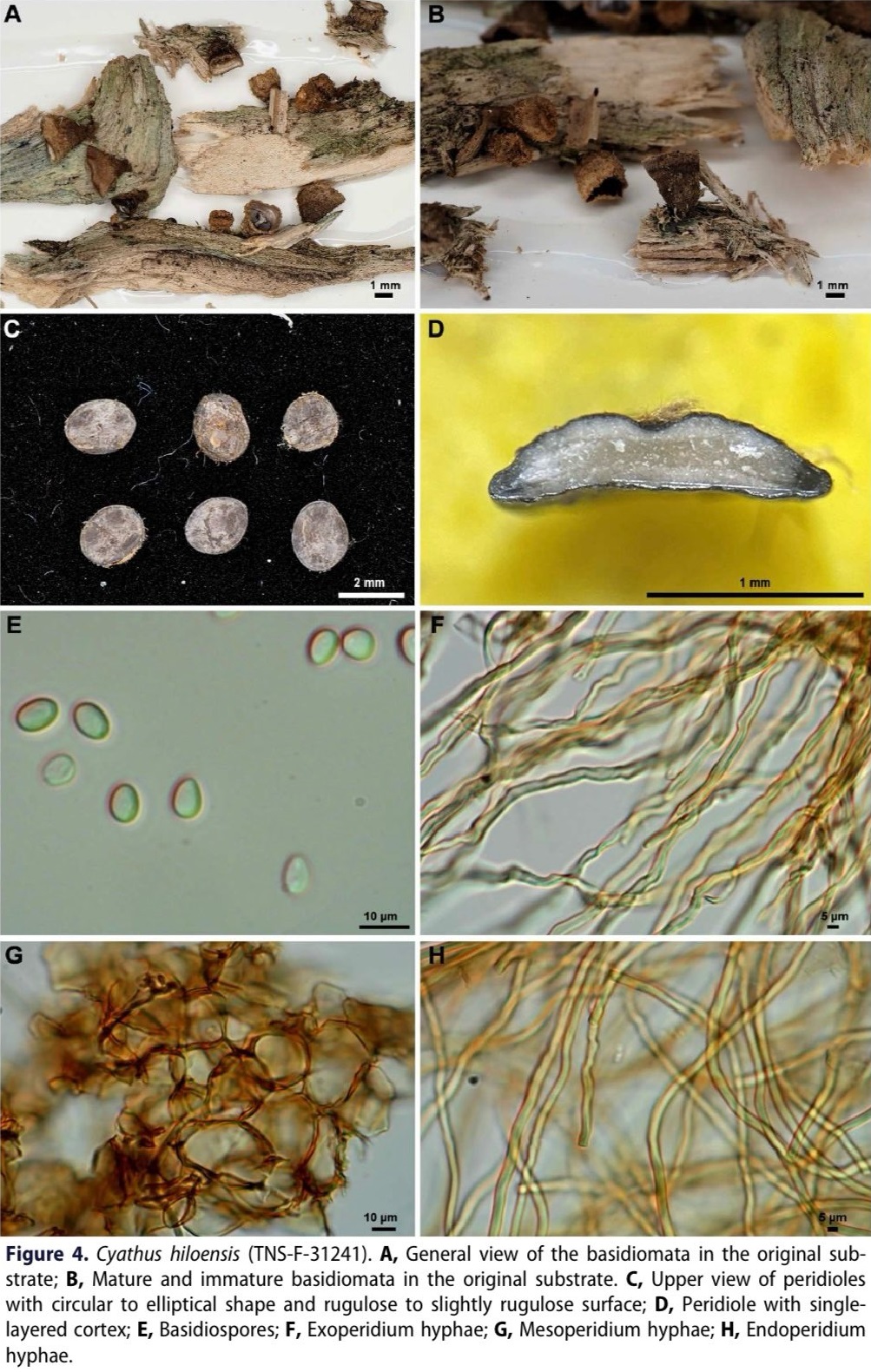
[Funga • 2025] Cyathus hiloensis (Basidiomycota: Nidulariaceae) • A new species in the Hawaiian Archipelago


Cyathus hiloensis  

in Góis, da Cruz, Baseia et Hosaka, 2025. 

ABSTRACT
This study focuses on expanding knowledge of Cyathus species in the Hawaiian archipelago through the description of a newly discovered species from Hilo, the largest town in Hawaii County. Based on morphological and molecular data, Cyathus hiloensis is proposed as new taxon within the pallidum group. A comprehensive description of its distinguishing features is provided, along with a detailed comparison to closely related taxa.

KEYWORDS: Biodiversity, Hawaiian archipelago, Pacific Ocean, taxonomy, systematic


Jefferson dos S. Góis, Rhudson H.S.F. da Cruz, Iuri G. Baseia and Kentaro Hosaka. 2025. A new species Cyathus hiloensis (Nidulariaceae, Basidiomycota) in the Hawaiian Archipelago. New Zealand Journal of Botany. DOI: doi.org/10.1080/0028825X.2025.2454602