Wednesday, November 29, 2023

[Botany • 2023] Impatiens karuppusamyi (Balsaminaceae) • A New Species from the Southern Western Ghats, India


Impatiens karuppusamyi P.S.S. Rich. & V. Ravich., 

in Richard et Ravichandran. 2023. 

Abstract
Impatiens karuppusamyi P.S.S. Rich. & V. Ravich (Balsaminaceae), a new species from the southern Western Ghats in Tamil Nadu, India, is described and illustrated. It is similar to I. bicornis, but differs from it in having small leaves; 6–8-flowered, short scape; small flower ca. 1 cm across; conical spur that is horizontally straight with an obtuse tip; base of the anterior lobe with two purplish, fleshy and erect auriculate projections to 1 mm long; stout biseriate purplish-blue hairs in front of the mouth; and orange-pinkish pollen grains.


Paulraj Selva Singh Richard and Vellingiri Ravichandran. 2023. Impatiens karuppusamyi (Balsaminaceae), A New Species from the Southern Western Ghats, India. Annales Botanici Fennici. 60(1):131-135. DOI: 10.5735/085.060.0121

[Botany • 2023] Dendrophorbium frezierifolium (Compositae) • On the Genus Dendrophorbium in Ecuador: A New Species and Identification Key


Dendrophorbium frezierifolium J. Calvo & Á.J. Pérez, 

in Calvo et Pérez, 2023.

 Abstract  
The new species, Dendrophorbium frezierifolium J. Calvo & Á.J. Pérez, is described from southern Ecuador, where it thrives at the edge of low montane forests near the limit with the paramo ecosystem. It differs from the most similar species D. dodsonii (H. Rob. & Cuatrec.) B. Nord. by its larger, chartaceous leaves with denser indumentum beneath, the stems with arachnoid indumentum, the shorter involucral bracts, and the lower number of disc florets. The species is preliminary assessed as “Endangered” [EN] using the IUCN Red List Categories and Criteria. Furthermore, images of living plants, a distribution map, and the first identification key to the species of Dendrophorbium (Cuatrec.) C. Jeffrey in Ecuador are provided.

KEYWORDS: Asteraceae, Dendrophorbium, Andes, Ecuador, Senecioneae, taxonomy


Dendrophorbium frezierifolium J. Calvo & Á.J. Pérez, sp. nov.

Among the species with c. 8 involucral bracts, this species differs in having leaves lanceolate with indumentum on both surfaces. It can be differentiated from D. dodsonii (H. Rob.& Cuatrec.) B. Nord., the most similar species, by its larger, chartaceous leaves with denser indumentum beneath, the stems with arachnoid indumentum, the shorter involucral bracts, and the lower number of disc florets. 


Joel Calvo and Álvaro J. Pérez. 2023. On the Genus Dendrophorbium (Compositae) in Ecuador: a new species and identification key. Candollea.  78(2); 91-97. DOI: 10.15553/c2023v782a1
La nueva especie, Dendrophorbium frezierifolium J. Calvo & Á.J. Pérez, se describe del sur del Ecuador, donde crece en los márgenes del bosque montano bajo cerca del límite con el ecosistema de páramo. Difiere de D. dodsonii (H. Rob. & Cuatrec.) B. Nord., la especie más similar, por sus hojas más grandes, cartáceas y con mayor indumento en el envés, los tallos con indumento aracnoideo, las brácteas involucrales más cortas y un menor número de flores del disco. De forma preliminar, se asigna la categoría IUCN “En peligro” [EN] a esta especie. Asimismo, se proporcionan imágenes, un mapa de distribución y la primera clave dicotómica para las especies del género Dendrophorbium (Cuatrec.) C. Jeffrey en Ecuador.

[Botany • 2023] Catasetum caquetense (Orchidaceae: Cymbidieae: Catasetinae) • A New Species from the Colombian Amazonia


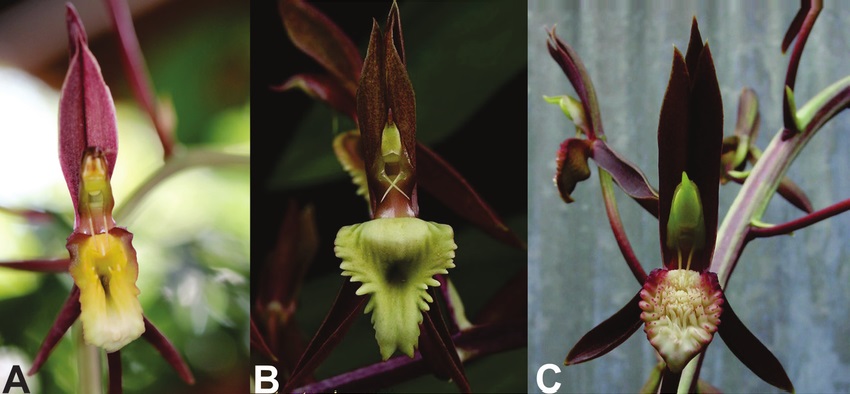
[A] Catasetum caquetense R.A.Calderón-Álvarez & M.Bonilla,

[B] C. juruenense Hoehne. [C] C. tuberculatum Dodson.
 Photographs by R.A. Calderón-Álvarez (A), Juan Fernández (B), and M. Bonilla (C).

in Álvarez et Morales, 2023.  

Abstract
 A new species, Catasetum caquetense from the Caquetá department of the Colombian Amazonia, is described and illustrated. Catasetum caquetense is morphologically distinct from similar species such as C. tuberculatum in its rectangular, entire, denticulate, prominent apiculate basal callus surrounded by inconspicuous crown-shaped protrusions with an extra callus towards the apex that partially narrows towards the midlip. Information about its distribution, ecology, habitat, and taxonomic comments on morphologically similar species is also provided. With this addition, the genus comprises eight species in the department of Caquetá. 

Keywords: Amazonia, Amazonía, Catasetum caquetense, Catasetum tuberculatum, orchid, orquídea, Caquetá

Comparison of morphologically similar species of Catasetum.
A. Catasetum caquetense R.A.Calderón-Álvarez & M.Bonilla, B. C. juruenense Hoehne. C. C. tuberculatum Dodson.
 Photographs by R.A. Calderón-Álvarez (A), Juan Fernández (B), and M. Bonilla (C).

Catasetum caquetense R.A.Calderón-Álvarez & M.Bonilla.
 A. General view of the plant habit without leaves, the inflorescence with male flowers. B. Male flower. C. Male flower side view. D. Perianth. E. Column with labellum longitudinally sectioned. F. Column without anther cap, frontal view. G. Anther cap in frontal, lateral, and dorsal views. H. Pollinarium, two views.
 Illustration by Marcela Morales-S. based on the holotype and isotype.

Catasetum caquetense R.A.Calderón-Álvarez & M.Bonilla, sp. nov. 

 Diagnosis: Catasetum caquetense is morphologically similar to C. tuberculatum Dodson; however, it differs by the rectangular lip (vs. elliptical), with smooth to somewhat denticulate edges (vs. entire), the abaxial surface not entirely tuberculated (vs. fully tuberculated lip on the abaxial surface), and a prominent apiculate basal callus (vs. slightly prominent), which is encircled by minor crown-shaped protrusions, with an extra callus towards the apex that partially narrows towards the saccate mid-lip, a characteristic absent in C. tuberculatum.

Etymology: The specific epithet “caquetense” refers to the Caquetá Department in Colombia, which is the geographical location where the species was discovered.


R. Alexis Calderón Álvarez and Miguel M. Bonilla Morales. 2023.  A New Species of Catasetum (Cymbidieae: Catasetinae) from the Colombian Amazonia. LANKESTERIANA. 23(3); 469–475. 

Resumen. Se describe e ilustra una nueva especie, Catasetum caquetense del departamento del Caquetá amazonia colombiana. Catasetum caquetense difiere de especies morfológicamente similares como C. tuberculatum por el callo basal rectangular, entero, denticulado, prominentemente apiculado, rodeado de protuberancias inconspicuas en forma de corona con un callo extra hacia el ápice que se estrecha parcialmente hacia el labelo. Además, se proporciona información sobre su distribución, ecología, hábitat y comentarios taxonómicos sobre especies morfológicamente similares. Con esta adición, el género comprende ocho especies en el departamento del Caquetá. 

[Botany • 2023] Pinalia campanulata (Orchidaceae) • A New Species of Pinalia with bell-shaped flowers from the Mossy Forest of southern Mindanao, Philippines


 Pinalia campanulata Saavedra & Pitogo, 

in Saavedra, Pitogo et Boos, 2023. 
 
Abstract
We present the first orchid species described from the Mount Busa Key Biodiversity Area (KBA 196) in southern Mindanao, Philippines. The new species was discovered growing on moss-covered tree trunks in the upper montane forest. It is primarily distinguished among the genus Pinalia by its very short inflorescence that bears few, closely spaced and relatively large campanulate flowers with trilobed, weakly keeled labellum and a dentate callus on disc. The discovery of this species brings the total number of Pinalia in the Philippines to 39. More importantly, it highlights the need for more field-based research on the flora of southern Mindanao to alleviate knowledge shortfalls that continue to limit our understanding of the region’s biodiversity.

Key words: Allah Valley Protected Landscape, Philippine biodiversity, Orchids, Malesia, Mount Busa


 Pinalia campanulata Saavedra & Pitogo.
A. Underside view of a flowering plant. B. Top view of labellum. C. Column (with the pollinia, left). D. Front view of flower. E. Lateral view of flower. F. Petals, sepals, and labellum (flattened).
 Illustrated by Larie Dianco.

Colored photos of  Pinalia campanulata Saavedra & Pitogo.
A. Flowering plant. B. Inflorescence. C. Lateral view of the flower showing its campanulate shape. D. Column (with the pollinia, left). E. Labellum (flattened). F. Labellum with column (natural form). G. petals and sepals.

Pinalia campanulata Saavedra & Pitogo sp. nov. 

Diagnosis:—The new species is related to Pinalia polyura (Lindl.) Kuntze in Ames (1905: 95) but with a much shorter inflorescence (1–4 vs. 10–14 cm) bearing fewer flowers (10–18 vs. up to 40), oblong-elliptic sepals and petals (vs. ovate- to triangular-lanceolate lateral sepals and cordate petals), trilobed labellum (vs. unlobed) that is weakly keeled (vs. bicarinate) and having a deltate callus on disc (vs. purple tubercle). The new species is also distinguished by its prominently campanulate flowers.

Etymology:—The specific epithet, campanulata, is reminiscent of the prominently bell-shaped flowers of this species that do not open widely. To our knowledge, the shape of P. campanulata flowers is quite unique among Pinalia species.


Aljohn Jay L. Saavedra, Kier Mitchel E. Pitogo, Ronny Boos. 2023. A New Species of Pinalia (Orchidaceae) with bell-shaped flowers from the Mossy Forest of southern Mindanao, Philippines.   Phytotaxa. 626(2); 93-100. DOI: 10.11646/phytotaxa.626.2.2

[Herpetology • 2019] Amolops ottorum • A New Species of Amolops (Anura: Ranidae) from Vietnam


 Amolops ottorum 
Pham, Sung, Pham, Le, Ziegler & Nguyen, 2019 

 Son La Sucker Frog | Ếch bám đá sơn la  ||  LKCNHM.nus.edu.sg/rbz/volume-67 

Abstract
 A new species of Amolops is described from northwestern Vietnam based on morphological differences and molecular divergence. Morphologically, Amolops ottorum, new species, is distinguishable from its congeners on the basis of a combination of the following diagnostic characters: size small (SVL 47.5–48.2 mm in females); head longer than wide; vomerine teeth absent; snout short (SE/SVL 0.14–0.15); tympanum dark brown, small (TD/ ED 0.36–0.37 in females); skin smooth; supratympanic fold absent; dorsolateral fold absent; webbing formula I 0―1/3 II 0―1 III 0―1 IV 2―0 V; in life, dorsum green with some dark brown spots; flanks with irregular dark markings; head and body with irregular dorsolateral cream stripe; dorsal surface of fore and hind limbs green with dark crossbars; throat, chest, anterior part of belly light-cream with brown dots; and posterior part of belly cream. In phylogenetic analyses, the new species is weakly supported as a sister taxon of Amolops tuberodepressus, and approximately 5.6% divergent from it based on a fragment of the cytochrome b gene. 

Key words. Amolops, molecular phylogeny, Muong La, new species, Son La Province, taxonomy

  Dorsolateral view (A) and ventral view (B) of the female holotype (IEBR 4243) of  Amolops ottorum, new species, in life.
Photo = A. V. Pham.

Dorsolateral view of the female paratype (TBU 06) of Amolops ottorum, new species, in life.
Photo = A. V. Pham.


Amolops ottorum, new species

Diagnosis. The new Amolops species from Son La Province is assigned to the A. mantzorum species group on the basis of the following characters: the absence of a dorsolateral fold and the absence of circummarginal groove on the disc of the first finger (Fei et al., 2009, 2017). The new species is also supported as a member of the A. mantzorum species group based on the molecular analyses (Fig. 2). Amolops ottorum, new species is distinguishable from its congeners by a combination of the following morphological characters: (1) size small (SVL 47.5–48.2 mm in females); (2) head longer than wide; (3) vomerine teeth absent; (4) snout short (SE/ SVL 0.14–0.15); (5) tympanum dark brown, small (TD/ED 0.36–0.37 in females); (6) skin smooth; (7) supratympanic fold absent; (8) dorsolateral fold absent; (9) webbing formula I 0–1/3 II 0–1 III 0–1 IV 2–0 V; (10) in life, dorsum green with some dark brown spots; (11) flanks with irregular dark markings; (12) head and body with irregular dorsolateral cream stripe; (13) dorsal surface of fore and hind limbs green with dark crossbars; (14) throat, chest and anterior part of belly light-cream with brown dots, posterior part of belly cream.

Distribution. Amolops ottorum, new species is currently known only from the type locality in Muong La District, Son La Province, Vietnam (Fig. 1). 

Etymology. The species name, ottorum, is the plural possessive form of Mrs Otti Ziegler and Mr Otto Ziegler, who facilitated herpetological research collaborations between Vietnam and Germany. For the common names we suggest Son La Sucker Frog (English) and Ếch bám đá sơn la (Vietnamese). 

Ecological notes. The holotype was collected at 1905 hours on leaves, ca. 1.5 m above the ground and the paratype was collected at 500 hours on a rock nearby a stream. The surrounding habitat was secondary forest of medium and large hardwoods mixed with shrubs (Fig. 6). Air temperature was 17–22°C and relative humidity was 80–85%. Other amphibian species found at the site were Leptobrachium sp., Leptobrachella sp., Quasipaa delacouri (Angel), Odorrana jingdongensis Fei, Ye & Li, and Kurixalus bisacculus (Taylor).


Anh Van Pham, Nenh Ba Sung, Cuong The Pham, Minh Duc Le, Thomas Ziegler and Truong Quang Nguyen. 2019. A New Species of Amolops (Anura: Ranidae) from Vietnam. RAFFLES BULLETIN OF ZOOLOGY. 67: 363–377. lkcnhm.nus.edu.sg/publications/raffles-bulletin-of-


[Botany • 2023] Cotoneaster densiflorus (Rosaceae) • A New Species from western Sichuan, China


Cotoneaster densiflorus M.W. Li, Q. Fan & W. B. Liao, 
 
in Li, Li, Lu, Mo, Ding, Chen, Lai, Zhang, Liao et Fan, 2023. 

Abstract
Cotoneaster densiflorus, a new species of Rosaceae from western Sichuan, China, is described and illustrated. Morphologically, we inferred that the new species belongs to Cotoneaster Ser. Salicifolii sensu Yü et al. (1974) in the Flora of China and Fryer and Hylmö (2009). This species is most similar to C. salicifolius, but differs in its leaf blade of ovate-lanceolate to obovate shape (vs. elliptic-oblong to ovate-lanceolate), smaller length-width ratio of 2.37 ± 0.31 (vs. 3.17 ± 0.32), slightly conduplicate (vs. not conduplicate), less lateral veins of 6–8 pairs (vs. 12–16 pairs), upper surface slightly rugose (vs. rugose), leaf margin plane (vs. revolute), lower surface densely grey tomentose (vs. grey tomentose, with bloom), greater corolla diameter of 7–9 mm (vs. 5–6 mm), styles 2 (vs. 2–3), pyrenes 2 (vs. 2–3), larger pollen grains P/E values of 2.05 ± 0.12 (vs. 1.19 ± 0.05) and leaf epidermis type W (vs. type I). Based on phylogenetic analysis of the whole chloroplast genome, C. densiflorus is sister to C. rhytidophyllus, but distantly related to C. salicifolius.

Key words: Anatomical, chloroplast genome, leaf epidermis, palynological, Ser. Salicifolii

Cotoneaster densiflorus sp. nov.
A habit B leaf, adaxial surface C leaf, abaxial surface D flowers E vertical section of flower F petals G stamens H styles I fruiting branch J pome K transverse section of pome L pyrenes.
Illustration by Zhengmeng Yang based on living field-collected materials (Q. Fan & M.W. Li 14925, M.W. Li 20230617007).

Cotoneaster densiflorus sp. nov.
A habitat B habit C branchlets D petal, stamen, style, and vertical section of flower E ovate-lanceolate to obovate shape of leaves F leaf, abaxial surface G 2 pyrenes per fruit H inflorescence I fruiting branch.

 Cotoneaster densiflorus M.W. Li, Q. Fan & W. B. Liao, sp. nov.
 

Diagnosis: Morphologically, Cotoneaster densiflorus is similar to C. salicifolius, but differs in its leaf blade of ovate-lanceolate to obovate shape (vs. elliptic-oblong to ovate-lanceolate), smaller length-width ratio of 2.37 ± 0.31 (vs. 3.17 ± 0.32), slightly conduplicate (vs. not conduplicate), fewer lateral veins of 6–8 pairs (vs. 12–16 pairs), upper surface slightly rugose (vs. rugose), leaf margin plane (vs. revolute), lower surface densely grey tomentose (vs. grey tomentose, with bloom), greater corolla diameter of 7–9 mm (vs. 5–6 mm), styles 2 (vs. 2–3) and pyrenes 2 (rarely 3). Although there is a closer phylogenetic relationship between the new species and C. rhytidophyllus, it is easy to distinguish them by the indumentum color of branchlets, leaves and inflorescences, rugose leaf upper surface, fruit shape and pyrenes number. See Table 2, Figs 1, 2 for a detailed comparison.

Etymology: The specific epithet refers to the compact compound corymbs with (5–)10– to 50–(61)-flowered per inflorescence.


Mingwan Li, Dan Li, Mengfei Lu, Shuangfeng Mo, Shen Ding, Yuanyuan Chen, Yong Lai, Dangquan Zhang, Wenbo Liao and Qiang Fan. 2023. A New Species of Cotoneaster (Rosaceae) from western Sichuan, China. PhytoKeys. 236: 39-52. DOI: 10.3897/phytokeys.236.111819


Tuesday, November 28, 2023

[Botany • 2020] Camellia rostrata (Theaceae) • A New Species of Yellow Camellias from Southwest China


Camellia rostrata S.X.Yang & S.F.Chai, 

in Liu, Chai, Wu, Ye, Jiang, Zhang, Yu, Ma et Yang, 2020.
 
Abstract
Camellia rostrata S.X.Yang & S.F.Chai is described and illustrated as a new species from Guangxi, China. It is morphologically closest to C. debaoensis R.C.Hu & Y.Q.Liufu, but can be easily distinguished by its abaxially glabrous leaf surface, 1.0−1.5(−2.0) cm long pedicel, powdery puberulent inner surface of bracteoles, sepals, and petals, sparsely pubescent inner filaments base, and triangle globose or ellipsoid capsule with pointed beak. The conservation status of this new species was assessed as Critically Endangered (CR).

Keywords: endemism, morphology, plant conservation, taxonomy, Theaceae, Eudicots


Camellia rostrata S.X.Yang & S.F.Chai.
A. Habitat. B. Adaxial leaves. C. Abaxial leaves. D. Front view of the flower. E.Side view of the flower. F. Bracteoles and sepals. G. Petals. H, I. Ovary and variations of the connate styles. J. Stamens. K. Adaxiallypuberulent sepal. L. Seeds. M. Sparsely puberulent seed surface. N. Habit. Scale =1 cm. Image N supplied by Wei Wei.


Zhen-Wen Liu, Sheng-Feng Chai, Fang-Yuan Wu, Pin-Ming Ye, Chang-Jie Jiang, Zhi-Rong Zhang, Xiang-Qin Yu, Jin-Lin Ma and Shi-Xiong Yang. 2020. Camellia rostrata, A New Species of Yellow Camellias from Southwest China. Phytotaxa. 459(1); 61–68. DOI: 10.11646/phytotaxa.459.1.6


[Botany • 2023] Fagraea christinae (Gentianaceae) • Taxonomic Appraisal of Fagraea ceilanica, and Description of A New Tree Species from the Bird's Head Peninsula, western New Guinea


Fagraea christinae Y.W. Low & V.A. Albert,  

in Low, Wanma, Ibrahim, Heatubun et Albert, 2023.

 Abstract  
A new rainforest understorey tree, Fagraea christinae Y.W. Low & V.A. Albert (Gentianaceae), is described here based on three collections from the Bird's Head Peninsula, western New Guinea. The new species was previously included in the species complex F. ceilanica Thunb. s.l. Fagraea christinae is superficially similar to F. annulata Hiern and F. berteroana A. Gray ex Benth. in having stamens inserted upon a fleshy ring on the inner surface of the corolla tube, but differs from those two taxa in having crenate bracteoles and calyx lobes. The new species is provided with line drawings, field photographs and a distribution map.

KEYWORDS: Gentianaceae, Fagraea, Malesia, Southwest Papua Province, Vogelkop Peninsula, endemic, taxonomy


Yee Wen Low, Jimmy F. Wanma, Bazilah Ibrahim, Charlie D. Heatubun and Victor A. Albert.  2023. Taxonomic Appraisal of Fagraea ceilanica (Gentianaceae), and Description of A New Tree Species from the Bird's Head Peninsula, western New Guinea. Candollea. 78(2); 167-175. DOI: 10.15553/c2023v782a8

[Ichthyology • 2022] Hyphessobrycon bayleyi • A New sexually dimorphic Hyphessobrycon (Characiformes: Characidae) from the western Amazon Basin


Hyphessobrycon bayleyi
Lima, Bastos, Rapp Py-Daniel & Ota, 2022

 
Abstract
A new species of Hyphessobrycon presenting dimorphic males is described from the western Amazon basin in Brazil, Colombia, Ecuador, and Peru. The new species has been mistakenly identified in the literature with the non-congener Hemigrammus marginatus, with which shares a similar color pattern by presenting dark patches of dark pigmentation on caudal-fin lobes. It can be distinguished from the latter species, as well as from Hemigrammus durbinae, and two similar congeners, Hyphessobrycon diancistrus and Hy. otrynus, all of which sharing the same caudal fin color pattern, by the combination of presenting a dark patch of pigmentation on the dorsal fin, a single large anal-fin hook at the last unbranched anal-fin ray in mature males, and a moderately high body depth (22.4–32.5 % SL, mean 28.4 %). The new species is more similar to Hyphessobrycon diancistrus, which is putatively its closely related taxon. A putative close relationship with Hyphessobrycon otrynus, and with a non-congener presenting a distinct color pattern but sharing a similar sexual dimorphism on anal-fin hook morphology, Hemigrammus boesemani, is suggested.

Color pattern, Hemigrammus boesemani, Hemigrammus durbinae, Hemigrammus marginatus, Hemigrammus diancistrus, Hemigrammus otrynus, Neotropical region, Pisces


Hyphessobrycon bayleyi: (A) ZUEC 15475, paratype, female, 37.2 mm SL: Brazil, Amazonas, igarapé do Adolfo (tributary of rio Javari); (B) INPA 56395, paratype, male, 30.2 mm SL: Brazil, Amazonas, rio Itaquaí basin; in life.


Flavio C.T. Lima, Douglas A. Bastos, Lucia H. Rapp Py-Daniel and Rafaela P. Ota. 2022. A New sexually dimorphic Hyphessobrycon from the western Amazon basin (Characiformes: Characidae). Zootaxa. 5116(2); 253-266. DOI: 10.11646/zootaxa.5116.2.4 

[Botany • 2023] Geostachys aristata (Zingiberaceae) • A Revision of Geostachys in Cambodia, Laos and Vietnam, including A New Species

 
Geostachys aristata Škorničk., Q.B.Nguyen & H.Đ.Trẫn, 
  
in Leong-Škorničková, Nguyễn, Trần, Lưu et Nuraliev, 2023.
facebook.com: Diep Dinh Quang
 
Abstract
A revision of the ginger genus Geostachys (Zingiberaceae: Alpinioideae: Alpinieae) in Cambodia, Laos and Vietnam is presented. Three species are formally recognised, all endemic to the area of study, including one new species from central Vietnam. Lectotypes are designated for G. annamensis and G. pierreana. The uncertainty about the type locality of G. pierreana is highlighted; the absence of this species in Thailand and Vietnam is demonstrated. The presence of Geostachys in Laos is discussed. The key to the species of the genus is provided. For each species, description, notes on etymology/eponymy, distribution, IUCN preliminary assessment, habitat and phenology, and taxonomy are given. The newly described species, Geostachys aristata, is compared to the morphologically closest congener, G. annamensis, from which it differs by green leaf sheaths and ligules, greenish bracts and bracteoles with prominently aristate apices, prominently mucronate calyx lobes and labellum with crimson spots extending to the margins.

Monocots, Alpinieae, Eastern Indochina, Geostachys annamensis, Geostachys pierreana, gingers,  Lectotypification


Geostachys aristata Škorničk., Q.B.Nguyen & H.Đ.Trẫn, sp. nov.

Etymology:— The specific epithet of G. aristata refers to the prominently aristate to mucronate apices of bracts, bracteoles and calyx lobes which readily distinguish the new species from the morphologically closest G. annamensis.


Jana Leong-Škorničková, Nguyễn Quốc Bình, Trần Hữu Đăng, Lưu Hồng Trường and Maxim S. Nuraliev. 2023. A Revision of Geostachys (Zingiberaceae: Alpinioideae) in Cambodia, Laos and Vietnam, including A New Species, G. aristata. Phytotaxa. 585(4); 245–260. DOI: 10.11646/phytotaxa.585.4.1

[Herpetology • 2023] Woodworthia korowai • On the Sand and among the Crowds: A New Species of Woodworthia Gecko (Reptilia: Diplodactylidae) from Auckland, Aotearoa/New Zealand


Woodworthia korowai 
 van Winkel, Wells, Harker & Hitchmough, 2023

Korowai gecko  ||  DOI: 10.11646/zootaxa.5374.2.7

Abstract  
Woodworthia is a diverse genus of diplodactylid geckos found in Aotearoa/ New Zealand, with 17 likely species. Despite this diversity, only two species have been formally described: Woodworthia maculata (Gray, 1845) and W. chrysosiretica (Robb, 1980). In this paper, we use an integrated taxonomic approach to describe a new species of Woodworthia gecko, Woodworthia korowai sp. nov., found along the western coastline of the Auckland Region, New Zealand. Although this species occurs in duneland habitat behind a popular beach near New Zealand’s most populated city, it was only recognised as a distinct taxon in 2016. We describe W. korowai sp. nov. based on a suite of morphological character states and substantial genetic divergence, based on the mitochondrial NADH dehydrogenase subunit 2 (ND2) gene, that distinguish it from W. maculata sensu stricto and all other known species of Woodworthia. Phylogenetic reconstruction and molecular dating place it sister to the W. maculata group, with an estimated time of divergence in the mid to late Pliocene. This gecko is one of the most geographically restricted of all Woodworthia geckos, occupying an area of less than 500 km2 within the Auckland Region. Its narrow range and coastal association make it susceptible to environmental and genetic stochasticity. Furthermore, the popularity and recreational usage of the dune system threaten its habitat. Therefore, we hope that this description will bring attention to the value of coastal environments and the unique and sensitive duneland of Te Korowai-o-Te-Tonga/ South Kaipara Peninsula and Te Oneone Rangatira/ Muriwai Beach in particular and encourage conservation efforts to protect this newly described species and its habitat.

Keywords: Reptilia, Taxonomy, Te Oneone Rangatira/ Muriwai Beach, duneland, Woodhill, Oaia Island, Conservation, Woodworthia korowai sp. nov. 


Dylan van Winkel, Sarah J. Wells, Nicholas Harker and Rodney A. Hitchmough. 2023. On the Sand and among the Crowds: A New Species of Woodworthia Gecko (Reptilia: Diplodactylidae) from Auckland, Aotearoa/New Zealand.  Zootaxa. 5374(2); 263-294. DOI: 10.11646/zootaxa.5374.2.7

Formerly known as the Muriwai gecko, this enigmatic species from the west coast of Auckland has just been formally described. They've been renamed the Korowai gecko (Woodworthia korowai) in reference to the south Kaipara peninsula where they live, and their colouration / striped pattern - which resembles the woven flax made into korowai (cloaks).
...


[Mollusca • 2022] Battle of the Bands: Systematics and Phylogeny of the white Goniobranchus nudibranchs with marginal bands (Nudibranchia: Chromodorididae)


[a–d] Goniobranchus fabulus
 Soong, Bonomo, Reimer & Gosliner, 2022 
Goniobranchus sinensis


Abstract
Species identities of Goniobranchus nudibranchs with white bodies and various marginal bands have long been problematic. In this study, specimens of these Goniobranchus nudibranchs from the Philippines, Peninsular Malaysia, Japan, Papua New Guinea, and Madagascar were analyzed and molecular data were obtained in order to re-examine the relationships between species within this “white Goniobranchus with marginal bands” group. The analyses clearly recovered six species groups corresponding to the described species Goniobranchus albonares, G. preciosus, G. rubrocornutus, G. sinensis, and G. verrieri as well as one new species, G. fabulus Soong & Gosliner, sp. nov. Notably, G. preciosus, G. sinensis, G. rubrocornutus, G. verrieri, and G. fabulus Soong & Gosliner, sp. nov. exhibit color variation and polymorphism, suggesting that some aspects of color patterns (e.g., presence or absence of dorsal spots) may not always be useful in the identification of species in the “white Goniobranchus with marginal bands” group, whereas other features such as gill and rhinophore colors and the arrangement and colors of the mantle marginal bands are more diagnostic for each species.

Keywords: Biodiversity, coral reefs, mtDNA, species delimitation, taxonomy

a, b Goniobranchus albonares a CASIZ 191440, Papua New Guinea b CASIZ 228939, Philippines
c–f Goniobranchus preciosus c CASIZ 208415, Morphotype A, Philippines d CASIZ 208574, Morphotype B, Philippines e CASIZ 176752, Morphotype C, Peninsular Malaysia f CASIZ 176761, Morphotype D, Peninsular Malaysia
g, h Goniobranchus rubrocornutus g CASIZ 203047, Morphotype A, Philippines h CASIZ 208563, Morphotype B, Philippines.
Photographs Terrence M. Gosliner. Scale bars: 1 cm.

a–d Goniobranchus sinensis a CASIZ 176759, morphotype A, Peninsular Malaysia b MISE-018-19, morphotype B, Okinawa, Japan c MISE-55-19, morphotype B, Okinawa, Japan d MISE-039-19, morphotype C, Kagoshima, Japan
e, f Goniobranchus verrieri e CASIZ 203059, morphotype A, Philippines f CASIZ 208442, morphotype B, Philippines.
 Photographs a, e, f Terrence M. Gosliner; b–d Giun Yee Soong. Scale bars: 1 cm.

Goniobranchus fabulus sp. nov.
 a CASIZ 177517, morphotype A, Philippines b CASIZ 177685, morphotype A, Philippines c CASIZ 201949, morphotype A, Philippines d CASIZ 191118, morphotype B, Papua New Guinea.
 Photographs Terrence M. Gosliner. Scale bars: 1 cm.


 Giun Yee Soong, Lynn J. Bonomo, James D. Reimer and Terrence M. Gosliner. 2022. Battle of the Bands: Systematics and Phylogeny of the white Goniobranchus nudibranchs with marginal bands (Nudibranchia, Chromodorididae). ZooKeys. 1083: 169-210. DOI: 10.3897/zookeys.1083.72939


[Crustacea • 2023] Palaemonella sandyi • A New Species of Palaemonella (Decapoda: Caridea: Palaemonidae) associated with scleractinian Corals of the Genus Euphyllia


Palaemonella sandyi 
Fransen, Van der Veer & Ďuriš, 2023

Photographs by C.H.J.M. Fransen.
  
Abstract
A new species of Palaemonella, P. sandyi sp. nov., is described on the basis of specimens collected in association with euphylliid scleractinian corals, Euphyllia glabrescens and E. cristata. Material was collected from the Maldives, Cebu in the Philippines, Semporna in Malaysia, and from Java, Bali, Sulawesi, Kalimantan, Ternate and Raja Ampat in Indonesia. The new species is similar to P. colemani and P. euphyllius, which are associated with euphylliid corals of the genus Fimbriaphyllia. The new species can be distinguished from P. colemani and P. euphyllius, as well as from the species P. philippinensis and P. smiti, which are both symbionts with plerogyrid scleractinians, on the basis of morphological characters in the rostrum and ambulatory pereiopods, colouration, and molecular data.

Keywords: Crustacea; Decapoda; Caridea; Palaemonidae; Palaemonella; new species; coral symbiont; 
Crustacea; Decapoda; Caridea; Palaemonidae; Palaemonella; nouvelle espèce; symbionte de coraux


Palaemonella sandyi sp. nov.
A, Ovigerous female, pocl. 4.3 mm, RMNH.CRUS.D.53060; B, male, pocl. 2.4 mm, RMNH.CRUS.D.53097.
 Photographs by C.H.J.M. Fransen.

 Palaemonella sandyi 

Palaemonella sandyi sp. nov., on Euphyllia glabrescens (Chamisso & Eysenhardt, 1821).
A, Stn. RAJ.29; B, stn. TER.06, RMNH.CRUS.D.53516;
 C, stn. SEM.28, RMNH.CRUS.D.53830; D, stn. MAL.03, RMNH.CRUS.D.58052;
E, stn. LEM.36, RMNH.CRUS.D.58050; F, LEM.01.
Photographs by C.H.J.M. Fransen.


Charles H. J. M. Fransen, Eva Van der Veer and Zdeněk Ďuriš. 2023. A New Species of Palaemonella (Decapoda, Caridea, Palaemonidae) associated with scleractinian Corals of the Genus Euphyllia Dana. Crustaceana. 345–381. DOI: 10.1163/15685403-bja10289