Tuesday, November 30, 2021

[Herpetology • 2021] Tropidodipsas tricolor & T. papavericola • Two New Species of Snail-eating Snakes of the Genus Tropidodipsas (Serpentes, Dipsadidae) from southern Mexico, with Notes on Related Species


[upper] Tropidodipsas tricolor & [lower] T. papavericola
Grünwald, Toribio-Jiménez, Montaño-Ruvalcaba, Franz-Chávez, Peñaloza-Montaño, Barrera-Nava, Jones, Rodriguez, Hughes, Strickland & Reyes-Velasco, 2021


Abstract
We describe two new species of Tropidodipsas related to the T. fasciata species group as defined by Kofron (1987), and provide morphological and molecular data to support the novelty of both species. A partial molecular phylogeny of the Mexican species of snail-eating snakes (Serpentes, Dipsadidae) is presented, and we discuss evolutionary relationships as supported by our molecular results. We analyze specific relationships of the new species described herein with their closest relatives. We present a distribution map for all species of Tropidodipsas and include photographs of living individuals of each species. Finally, we discuss other taxonomic changes based on our molecular phylogeny as well as conservation priorities of the new species.

Key Words: conservation, cloud forest, Geophis , Guerrero, Oaxaca, pine-oak woodland, Sierra Madre del Sur

Tropidodipsas tricolor sp. nov. 
Holotype (INIRENA 2800) in life

Tropidodipsas tricolor sp. nov. Variation.
Female from Municipio de Leonardo Bravo, Guerrero (A);
Male from Municipio de Leonardo Bravo, Guerrero (B).
Photos A–B by Peter Heimes. 

Tropidodipsas tricolor sp. nov.
  Proposed standard English name: Tricolor Snailsucker 
Proposed standard Spanish name: Caracolera tricolor
 
Diagnosis: Tropidodipsas tricolor sp. nov. is placed in the genus Tropidodipsas based on phylogenetic evidence (Fig. 6). It belongs to the Tropidodipsas fasciata group as defined by Kofron (1987) based on possessing a laterally compressed body, head distinctly wider than neck, protruding eyes of moderate to large diameter, vertebral and paravertebral scales not wider than other dorsal scales, 17 maxillary teeth, 18 dentary teeth, postmental scale absent. The species differs from all described species of Tropidodipsas based on the following combination of characters: (1) 15/15/15 rows of smooth dorsal scales with no enlarged vertebral row; (2) prefrontal broader than long, entering the orbit; (3) loreal square, equally long as high, not entering the orbit; (4) 183 ventral scales in males, 183 in females; (5) 78–79 divided subcaudals in males and 79 in females; (6) 19–22 reddish orange, light-edged bands on body, most with dark brown or black medial stippling, giving the snake a “tricolor” effect; 8 pale bands on tail; (7) ground color black or nearly so; (8) iris chocolate brown; (9) TL/SVL 0.31 in one male specimen, and 0.30 in one female specimen.

Distribution, habitat and ecology: This species appears to be restricted to moderate elevations in Sierra Madre del Sur from central Guerrero to western Oaxaca (Fig. 10). Habitats include cloud forest, mesic pine-oak woodland, tropical evergreen forest, tropical semi-deciduous forest and combinations of those assemblages (Brown et al. 2007). Known from 700–2200 m a.s.l., though most localities are from 1700–2200 m a.s.l. with the exception of the Sierra de Atoyac where it has been found at 700–1000 m a.s.l. in mesic tropical evergreen forest (Fig. 3A). Specimens were found at night on low or medium (1.5–3.0 m) vegetation, or dead on the road.

Etymology: The specific epithet tricolor refers to the tricolor pattern of the black dorsal coloration interspersed by light dorsal bands of cream and reddish orange.


Tropidodipsas papavericola sp. nov.
Holotype (INIRENA 2801) in life. 

Tropidodipsas papavericola sp. nov. Variation.
Male (INIRENA 2804) from Municipio de Técpan de Galeana, Guerrero (A);
Male (INIRENA 2802) from Municipio de Leonardo Bravo, Guerrero (B)

Tropidodipsas papavericola sp. nov.
 Proposed standard English name: Poppyfield Snailsucker 
Proposed standard Spanish name: Caracolera amapolera
  
Diagnosis: Tropidodipsas papavericola sp. nov. is placed in the genus Tropidodipsas based on phylogenetic evidence (Fig. 6). It belongs to the Tropidodipsas fasciata group as defined by Kofron (1987) based on possessing a laterally compressed body, head distinctly wider than neck, protruding eyes of moderate to large diameter, vertebral and paravertebral scales not wider than other dorsal scales, 17 maxillary teeth, 22 dentary teeth, postmental scale absent. The species differs from all described species of Tropidodipsas recognized herein based on the following combination of characters: (1) 15/15/15 rows of smooth dorsal scales with no enlarged vertebral row; (2) prefrontal broader than long, not entering orbit; (3) loreal almost square, slightly longer than broad, not entering orbit; (4) 179–189 ventral scales in males, unknown in females; (5) 69–76 divided subcaudals in males, unknown in females; (6) 25–34 pale bands on body and 10–16 pale bands on tail; (7) 26–36 dark bands on body and 10–16 on tail, irregular with faded pale centers in adult individuals; (8) TL/SVL 0.30–0.35 in males, unknown in females; (9) iris dark chocolate-gray in life.

Distribution, habitat and ecology: This species appears to be restricted to moderate elevations in the Sierra Madre del Sur in central Guerrero in two distinct areas (Fig. 10). Habitats include cloud forest, mesic pine-oak woodland, tropical evergreen forest, tropical semi-deciduous forest and combinations of these assemblages. Known from around 1600–2200 m a.s.l. in the Sierra de Técpan de Galeana, Sierra de Atoyac and above Acapulco, in the foothills in the area encompassed between Acahuizotla and El Treinta. Specimens were found at night during the rainy season on low to medium (1.5–3.0 m) vegetation or crossing the road.

Etymology: The specific epithet papaver + cola refers to the living among poppy plants (genus Papaver) which are illegally planted throughout the range of this species for the extraction of opium gum.


Christoph I. Grünwald, Sarahi Toribio-Jiménez, Carlos Montaño-Ruvalcaba, Hector Franz-Chávez, Miguel A. Peñaloza-Montaño, Eduardo Y. Barrera-Nava, Jason M. Jones, Christopher M. Rodriguez, India M. Hughes, Jason L. Strickland and Jacobo Reyes-Velasco. 2021. Two New Species of Snail-eating Snakes of the Genus Tropidodipsas (Serpentes, Dipsadidae) from southern Mexico, with Notes on Related Species. Herpetozoa. 34: 233-257. DOI: 10.3897/herpetozoa.34.e69176

[Invertebrate • 2021] Octopus djinda • A New Member of the Octopus vulgaris Group (Cephalopoda: Octopodidae) from southwest Australia


 Octopus djinda Amor, 
in Amor & Hart, 2021

photo: Mark Norman
 
Abstract
A new Octopus Cuvier, 1797 species, Octopus djinda Amor, 2021 (previously treated as O. cf. tetricus and O. aff. tetricus), is described from the shallow waters off southwest Australia. This species was classified as conspecific with O. tetricus Gould, 1852 from Australia’s east coast and New Zealand but is shown here to be morphologically and genetically distinct. This description is based on 25 individuals across three localities in southwest Australia, encompassing most of its distribution. Greater and non-overlapping sucker counts on the males hectocotylised arm delimit east and west coast forms. DNA barcoding using cytochrome c oxidase subunit I also successfully differentiates between these taxa; 13 polymorphisms along a 349 bp partial fragment (3.7% sequence divergence). A close relative of the O. vulgaris Cuvier, 1797 species-group, O. djinda, sp. nov. supports a highly productive fishery and is currently one of two octopod fisheries worldwide to have received sustainable certification from the Marine Stewardship Council. The taxonomic description presented here provides formal recognition of the taxonomic status of southwest Australia’s common octopus, O. djinda, sp. nov. and facilitates appropriate fisheries catch reporting and management.

Keywords: Mollusca, Allopatric speciation, Bassian Isthmus, cryptic species, Octopus tetricus


Michael D. Amor and Anthony M. Hart. 2021. Octopus djinda (Cephalopoda: Octopodidae): A New Member of the Octopus vulgaris group from southwest Australia. Zootaxa. 5061(1); 145-156. DOI: 10.11646/zootaxa.5061.1.7 Mark Norman

12 of the new species described so far in 2021

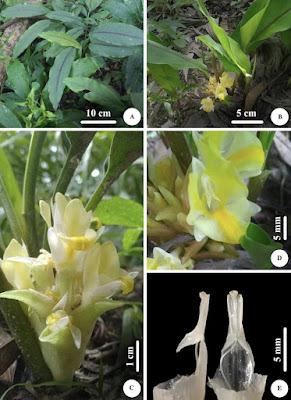
[Botany • 2021] Curcuma siamensis (Zingiberaceae) ขมิ้นสยาม • A New Species of Curcuma subgen. Ecomatae from Southeastern Thailand


 Curcuma siamensis  Saensouk & Boonma

in Saensouk, Boonma & Saensouk, 2021.

Abstract. 
Curcuma siamensis Saensouk & Boonma sp. nov. (Zingiberaceae: Zingibereae) belonging to the genus Curcuma subgenus Ecomatae, as herein described and illustrated discovered in Chachoengsao Province, Southeastern Thailand during our exploration of Zingiberaceae family in Thailand and in preparation for the revision of the genus Curcuma for the Flora of Thailand project. It is similar to Curcuma rangsimae Boonma & Saensouk in having terminal inflorescences between the leaf-sheaths, emerging at the basal of the pseudo-stem, lacking coma bract, yellow flowers, presence of epigynous glands, and anther spurs make this plant most similar to, which are also distributed in this nearby area too. But differ in having leaves narrowly elliptic, narrower and shorter in size 18–36 × 6–8.5 cm, upper midrib reddish; thyrse shorter and smaller (5–6.5 cm long, 4–5 cm in diam.); peduncle glabrous; bracts per inflorescence 10–15 in number, fused almost only at base; corolla lobes white, longer and narrower 17–18.3 × 6–7.8 mm; staminodes uniquely obovate-rhombic; labellum ovate-trullate; filament 4.4–4.5 mm long; anther longer c. 8 mm long, spurs pointing outward in front view, with anther crest apex retuse (vs. C. rangsimae having leaves narrowly elliptic to oblanceolate, 40–70 × 12–20 cm, upper midrib green; thyrse 12–20 cm long, 7.8–9.5 cm in diam.; peduncle pilose; 25–48 in number, connate 1/4 to 1/3 at base; corolla lobes light pale yellow, 15–17 × 9–12 mm; staminodes asymmetrical trullate–ovate; labellum ovate; filament 6–7 mm long; anther 6.3–6.9 mm long, spurs pointing downward in from view, with anther crest apex rounded). Based on the results of the morphological comparison and examination of all allied species in the same genus were found to be inconsistent with any species, especially in the subgenus Ecomatae. A comprehensive description, illustration, photographs, ecology, etymology, distribution and a revised key to 21species of Curcuma subgenus Ecomatae in Thailand are provided.

Keywords: Curcuma rangsimae, C. cotuana, Chachoengsao, Flora of Thailand, taxonomy, Zingiberales

Curcuma siamensis Saensouk & Boonma sp. nov.
 (A) habit, (B) side view of terminal inflorescence in the leaf-sheaths, (C) dorsalcorolla lobe, (D) lateral corolla lobes,(E) staminodes, (F) labellum, (G) bract, (H) bracteole, (I) calyx with ovary, (J) epigynous glands with ovary, (K) side and front view of anther.
Drawn by Thawatphong Boonma 

Curcuma siamensis Saensouk & Boonma sp. nov.
 (A) Natural habitat in oblique-top view, C. siamensis (red midrib) grows near C. harmandii Gagnep., (B) plants with inflorescence and flowers in oblique-top view, (C) inflorescence with flowers in side view, (D) flower-front view, (E) anther-side and front view.
Photographs A–D by N. Wannaphirun; E by Thawatphong Boonma  

Curcuma siamensis Saensouk & Boonma sp. nov.
Subgen. Ecomatae

The new species is similar to C. rangsimae Boonma & Saensouk. but differ in having leaves narrowly elliptic, narrower and shorter in size 18–36 × 6–8.5 cm, upper midrib reddish; thyrse shorter and smaller (5–6.5 cm long, 4–5 cm in diam.); peduncle glabrous; bracts per inflorescence 10–15 in number, fused almost only at base; corolla lobes white, longer and narrower 17–18.3 × 6–7.8 mm; staminodes uniquely obovate-rhombic; labellum ovate-trullate; filament 4.4–4.5 mm long; anther longer c. 8 mm long, spurs pointing outward in front view, with anther crest apex retuse (vs. C. rangsimae having leaves narrowly elliptic to oblanceolate, 40–70 × 12–20 cm, upper midrib green; thyrse 12–20 cm long, 7.8–9.5 cm in diam.; peduncle pilose; 25–48 in number, connate 1/4 to 1/3 at base; corolla lobes light pale yellow, 15–17 × 9–12 mm; staminodes asymmetrical trullate-ovate; labellum ovate; filament 6–7 mm long; anther 6.3–6.9 mm long, spurs pointing downward in from view, with anther crest apex rounded).

Etymology: The specific epithet “siamensis” is named from the former name of Thailand, refers to the geographical origin of this new species.
"ขมิ้นสยาม" "สุวรรณพนม" "มหาอุดมเหลืองนวล"

Distribution map of Curcuma siamensis Saensouk & Boonma sp. nov. and its allies.
 Abbreviations in the map are the floristic region after the "Flora of Thailand" project which N: Northern; NE: Northeastern; SW: Southwestern; C: Central; E: East; SE: Southeastern; and PEN:Peninsular.


Saensouk P, Boonma T, Saensouk S. 2021. Curcuma siamensis (Zingiberaceae, Zingibereae), A New Species of Curcuma subgen. Ecomatae from Southeastern Thailand. Biodiversitas. 22(12); 5239-5246. DOI: 10.13057/biodiv/d221201 smujo.id/biodiv/article/view/9607


[Ichthyology • 2021] Oxynoemacheilus nasreddini • A New Nemacheilid Loach (Teleostei: Nemacheilidae) from Central Anatolia


 Oxynoemacheilus nasreddini
Yoğurtçuoğlu, Kaya & Freyhof, 2021


Abstract
Oxynoemacheilus nasreddini, new species, from Lake Akşehir, Eber, Eğirdir, and Ilgın basins in Central Anatolia is distinguished from other species of Oxynoemacheilus in Central Anatolia by having irregularly shaped blotches on flank; 2–4 dark-brown bands on caudal fin; a slender body, and an emarginate caudal fin in which the shortest middle caudal-fin ray is 76–91% of the longest ray of the upper caudal-fin lobe. Molecular data suggest that the new species is closely related to O. mediterraneus from the Aksu and Köprüçay drainages. Although the two species are separated by only a minimum K2P distance of 1.2% in the mtDNA COI barcode region, they are well distinguished morphologically. The situation is complicated by loaches from Lake Eğirdir basin that are identified as O. nasreddini by their morphological character states but are only distinguished from O. mediterraneus by a minimum K2P distance of 0.2% in the mtDNA COI barcode region.

Keywords: Pisces, Freshwater fish, taxonomy, Middle East


Baran Yoğurtçuoğlu, Cüneyt Kaya and Jörg Freyhof. 2021. Oxynoemacheilus nasreddini, A New Nemacheilid Loach from Central Anatolia (Teleostei: Nemacheilidae). Zootaxa. 4974(1); 135–150. DOI: 10.11646/zootaxa.4974.1.5

Yeni keşfedilen balık türüne Nasrettin Hoca'nın adı verildi

Sunday, November 28, 2021

[Herpetology • 2021] Phylogeographic Advances in Midwife Toads (Alytes) support the Existence of A Novel Taxon Endemic to the Central Pyrenees


Alytes almogavarii inigoi
Dufresnes & Hernandez, 2021


Abstract
Although necessary to promote conservation, defining evolutionary units and naming biodiversity remain a difficult task, especially in problematic species groups that experienced a dynamic biogeographic history. In this article, we undertake such task for midwife toads of the Alytes obstetricans complex by integrating recent molecular studies altogether—multilocus phylogenies and population genetic barcoding. Despite a partly unresolved phylogeny underlain by deep cyto-nuclear discordances, nuclear and mitochondrial evidence support the validity of six genuine lineages assigned to two different species (A. obstetricans and A. almogavarii), which could be accurately mapped across most of their ranges. In particular, we demonstrate the existence for an overlooked yet genetically distinct lineage previously confounded with A. almogavarii, confined to the northern part of Huesca Province in the Spanish Central Pyrenees. We describe this micro-endemic as the subspecies Alytes almogavarii inigoi ssp. nov., with reports on the mating call and the larvae. Conservation genetics of eight populations of this new taxon revealed two independent conservation units, separated by topographic barriers. In the wait for upcoming genomic analyses to unravel many elusive aspects of the evolution, diversity and systematics of Alytes, the present paper offers an integrative phylogeographic overview to guide future investigations and generally illustrates how multiple lines of molecular evidence can be combined to clarify the confusing taxonomy of complex species groups.

Keywords: Alytes almogavarii inigoi, Alytes obstetricans, Amphibian, cyto-nuclear discordance, Iberian Peninsula, micro-endemism


 Alytes almogavarii inigoi ssp. nov. 


Christophe Dufresnes and Axel Hernandez. 2021. Phylogeographic Advances in Midwife Toads (Alytes) support the Existence of A Novel Taxon Endemic to the Central Pyrenees. Journal of Zoological Systematics and Evolutionary Research. DOI: 10.1111/jzs.12564

Saturday, November 27, 2021

[Herpetology • 2021] Cyrtodactylus rukhadeva | ตุ๊กกายรุกขเทวา • A New Cryptic Arboreal Species of the Cyrtodactylus brevipalmatus Group (Squamata: Gekkonidae) from the Uplands of western Thailand


Cyrtodactylus rukhadeva
Grismer, Suwannapoom, Pawangkhanant, Nazarov, Yushchenko, Naiduangchan, Le, Luu & Poyarkov, 2021

ตุ๊กกายรุกขเทวา || DOI: 10.3897/vz.71.e76069

Abstract
The first integrative taxonomic analysis of the Cyrtodactylus brevipalmatus group of Southeast Asia recovered two newly discovered populations from the Tenasserim Mountains in Suan Phueng District, Ratchaburi Province, Thailand as a new species described here as Cyrtodactylus rukhadeva sp. nov. Based on 1397 base pairs of the mitochondrial gene NADH dehydrogenase subunit 2 (ND2), C. rukhadeva sp. nov. is the well-supported sister species to a clade containing three undescribed species, C. ngati, and C. cf. interdigitalis with a large uncorrected pairwise sequence divergence from other species in the brevipalmatus group ranging from 15.4–22.1%. Cyrtodactylus elok and C. brevipalmatus are recovered as poorly supported sister species and the well-supported sister lineage to the remainder of the brevipalmatus group. Cyrtodactylus rukhadeva sp. nov. is putatively diagnosable on the basis of a number of meristic characters and easily separated from the remaining species of the brevipalmatus group by a number of discrete morphological characters as well as its statistically significant wide separation in multivariate morphospace. The discovery of C. rukhadeva sp. nov. continues to underscore the unrealized herpetological diversity in the upland forests of the Tenasserim Mountains and that additional field work will undoubtedly result in the discovery of additional new species.

Key words: Bent-toed geckos, integrative taxonomy, Southeast Asia, Tenasserim Mountains

In life coloration and pattern of Cyrtodactylus rukhadeva sp. nov. 
(A) the paratype (ZMMU R-16852) from Hoop Phai Trong, Suan Phueng District, Ratchaburi Province, Thailand and (B) the holotype (ZMMU R-16581) from Khao Laem Mountain, Suan Phueng District, Ratchaburi Province, Thailand. Photos by Platon V. Yushchenko.
C. a hatchling (not collected); photo by Mali Naiduangchan.


Cyrtodactylus rukhadeva sp. nov.
 Suggested common name: Tree Spirit Bent-toed Gecko
Cyrtodactylus brevipalmatus Ulber 1993:198 (partim).

Diagnosis: Cyrtodactylus rukhadeva sp. nov. can be separated from all other species of the brevipalmatus group by having 9–11 supralabials, 10 or 11 infralabials, 27–30 paravertebral tubercles, 19 or 20 rows of longitudinally arranged tubercles, 34–43 transverse rows of ventrals, 152–154 longitudinal rows of ventrals, nine expanded subdigital lamellae on the fourth toe, 11 unexpanded subdigital lamellae on the fourth toe, 18–20 total subdigital lamellae on the fourth toe, eight or nine expanded subdigital lamellae on the fourth finger, nine or 10 unexpanded subdigital lamellae on the fourth finger, 17–19 total subdigital lamellae on the fourth finger, 16–17 enlarged femorals, 20 femoral pores in the male; 17 precloacal pores in the male; 13–17 enlarged precloacals; 16 post-precloacals; enlarged femorals and enlarged precloacals not continuous; proximal femorals not less than one-half the size of the distal femorals; small tubercles on forelimbs and flanks; small dorsolateral caudal tubercles and ventrolateral caudal fringe; paired enlarged subcaudals; and maximum SVL 79.4 mm (Tables 1, 4).

Bayesian phylogeny of the Cyrtodactylus brevipalmatus group based on 1397 base pairs of ND2 with BBP and UFB nodal support values, respectively at the nodes.

Distribution: Cyrtodactylus rukhadeva sp. nov. is known only from the type locality from Khao Laem Mountain, Suan Phueng District, Ratchaburi Province, Thailand and Hoop Phai, Suan Phueng District, Ratchaburi Province, approximately 7.7 km to the west of the type locality (Fig. 1).

Etymology: The specific epithet “rukhadeva” is given as a noun in apposition and refers to the spirits or gods residing in trees in Thai mythology, known as Rukha Deva - รุกขเทพ (literally “Tree Nymphs”). According to Thai folklore, these sylvan spirits live on tree branches and on large older trees wearing traditional Thai attire, usually in reddish or brownish colours, and are believed to protect the forest. The new arboreal species of Cyrtodactylus resides in one of the remaining fragments of the north Tenasserim montane forests. We want to underscore the need for the immediate assessment of herpetofaunal diversity surveys and implementation of adequate conservation measures for these relic forests.

Distribution of the species of the Cyrtodactylus brevipalmatus group.
Stars = type localities and squares refer to literature records. White squares denote unexamined specimens of uncertain taxonomic status. Localities with specimen numbers denote individuals in the phylogeny (Fig. 2). No topotypic material (red) from the western Phetchabun massif was examined. NP = National Park and WS = Wildlife Sanctuary.

Illustration showing the general similarity body shape and color pattern among five species of the Cyrtodactylus brevipalmatus group.
A. Adult female C. elok (LSUDPC 2589) from Negeri Sembian, Peninsular Malaysia. Photo by L. Lee Grismer. B. Adult male C. sp. 11 (ZMMU R-16492) from Phu Hin Rong Kla National Park, Petchabun Province, Phitsanulok, Thailand. Photo by Nikolay A. Poyarkov.

C. Adult female C. interdigitalis from Tak Mal National Park, Phetchabun Province, Thailand. Photo from Creative Commons Attribution Share Alike. Photo by Evan S. H. Quah. D. Adult female C. cf. interdigitalis (NCSM 79472) from Ban Pha Liep, Houay Liep Stream, Xaignabouli Province, Laos. Photo by Bryan L. Stuart. E. Adult female C. ngati (VNUF R.2020.12) from Pa Thom Cave, Pa Xa Lao Village, Pa Thom Commune, Dien Bien District, Dien Bien Province, Vietnam. Photo by Dzung T. Le.

F. Adult female C. brevipalmatus [ตุ๊กกายโคนนิ้วติด] from the type locality at Khao Luang National Park, Nakon Si Thammarat Provice, Thailand. Photo from Creative Commons Attribution Share Alike. G. Adult male C. cf. ruhkhadeva sp. nov. form Kaeng Krachan National Park, Petchaburi Province, Thailand. Photo from Creative Commons Attribution Share Alike.


Habitat of Cyrtodactylus rukhadeva sp. nov. at the type locality: Khao Laem Mountain, Suan Phueng District, Ratchaburi Province, Thailand.
(A) Submontane forest on the slopes of Khao Laem Mountain.
 (B) A male of the new species hiding among the roots of a strangler fig (Ficus sp.).
Photos by Parinya Pawangkhanant.


 L. Lee Grismer, Chatmongkon Suwannapoom, Parinya Pawangkhanant, Roman A. Nazarov, Platon V. Yushchenko, Mali Naiduangchan, Minh Duc Le, Vinh Quang Luu and Nikolay A. Poyarkov. 2021. A New Cryptic Arboreal Species of the Cyrtodactylus brevipalmatus Group (Squamata: Gekkonidae) from the Uplands of western Thailand. Vertebrate Zoology. 71: 723-746. DOI: 10.3897/vz.71.e76069


Friday, November 26, 2021

[Paleontology • 2022] Morohasaurus kamitakiensis • A Fossil Monstersauria (Squamata: Anguimorpha) from the Lower Cretaceous Ohyamashimo Formation of the Sasayama Group in Tamba City, Hyogo Prefecture, Japan


Morohasaurus kamitakiensis 
Ikeda, Ota, Tanaka, Ikuno, Kubota, Tanaka & Saegusa, 2022


Highlights: 
• We report a nearly complete left dentary of lizard from the Lower Cretaceous Sasayama Group, Japan.
• The material was described as a new monstersaur taxon “Morohasaurus kamitakiensis”.
• The new taxon might possibly be the oldest representative of the Monstersauria in the world.
• The present finding endorses the high taxonomic and ecological diversity of the Early Cretaceous lizard assemblage in Japan.

Abstract
A nearly complete left dentary of a lizard was excavated from the Lower Cretaceous Ohyamashimo Formation of the Sasayama Group in Tamba City, Hyogo Prefecture, Japan. The specimen shows several characters, which suggest its allocation in Monstersauria of the superfamily Varanoidea (Squamata: Anguimorpha). However, the specimen exhibits obvious differences from the known members of the whole Varanoidea. Thus, the specimen is described as a new taxon of cf. Monstersauria, Morohasaurus kamitakiensis gen. et sp. nov.. This new species is characterized by a suit of unique features, such as the sinuous posteroventral rim of the dentary with a large U-shaped upper notch and small V-shaped lower notch, posteroventral corner of intramandibular septum with a weakly pointed eminence projecting posteriorly, and unicuspid, curved trenchant teeth with distinct blade-like carinae on their mesial and distal sides without grooves or serrations. Morohasaurus kamitakiensis might possibly be the oldest representative of the Monstersauria.

Keywords: Monstersauria, Japan, Lower Cretaceous, Ohyamashimo Formation, Oldest representative


Tadahiro Ikeda, Hidetoshi Ota, Tomonori Tanaka, Kenji Ikuno, Katsuhiro Kubota, Kohei Tanaka and Haruo Saegusa. 2022. A Fossil Monstersauria (Squamata: Anguimorpha) from the Lower Cretaceous Ohyamashimo Formation of the Sasayama Group in Tamba City, Hyogo Prefecture, Japan. Cretaceous Research. 130, 105063. DOI: 10.1016/j.cretres.2021.105063   hitohaku.jp

篠山層群より発掘されたトカゲ類化石の記載論文の出版および臨時展示の実施について

[Paleontology • 2021] Tarchia tumanovae • A New Ankylosaurid from the Upper Cretaceous Nemegt Formation of Mongolia and Implications for Paleoecology of Armoured Dinosaurs


 Tarchia tumanovae 
Park, Lee, Kobayashi, Jacobs, Barsbold, Lee, Kim, Song & Polcyn, 2021

Artwork by Choi Yusik  twitter.com/usikpaleoart 

Abstract
A new ankylosaurid dinosaur, Tarchia tumanovae sp. nov., has been recovered from the Upper Cretaceous Nemegt Formation of Mongolia. It includes a well-preserved skull, dorsal, sacral, caudal vertebrae, sixteen dorsal ribs, ilia, a partial ischium, free osteoderms, and a tail club. The squamosal horns of T. tumanovae are divided into two layers, the external dermal layer and the underlying squamosal horn proper. The irregular ventral margin of the base of the upper dermal layer may represent a resorption surface, suggesting that the squamosal horns of some ankylosaurids underwent extreme ontogenetic remodeling. Localized pathologies on the dorsosacral ribs and the tail provide evidence of agonistic behaviour. The tail club knob asymmetry of T. tumanovae resulted from restricted bone growth due to tail club strikes. Furthermore, T. tumanovae had an anteriorly protruded shovel-shaped beak, which is a morphological character of selective feeders. Ankylosaurid diets shifted from low-level bulk feeding to selective feeding during the Baruungoyot and the Nemegt “age” (middle Campanian-lower Maastrichtian). This ankylosaurid niche shifting might have been a response to habitat change and competition with other bulk-feeding herbivores.


Dinosauria Owen, 1842

Ankylosauridae Brown, 1908
Ankylosaurinae Nopcsa, 1918

Tarchia Maryañska, 1977
Type species. Tarchia kielanae Maryañska, 1977

Revised diagnosis. An ankylosaurid distinguished by having the following unique set of characters (autapomorphies with an asterisk): a narrow internarial bar of the premaxillae (shared with Tsagantegia) (ambiguous in Tarchia kielanae); large, rhomboidal loreal caputegulum with a laterally extended posterior keel (shared with Saichania) (ambiguous in T. kielanae); subrectangular frontal caputegulae (shared with Saichania); a “neck” present at the base of the quadratojugal horn (shared with Pinacosaurus mephistocephalus and Minotaurasaurus) (ambiguous in T. kielanae); sigmoidal and peaked anteromedial supraorbital caputegulum*; posterolateral supraorbital caputegulum with a rounded anterior surface, and a flat, anteriorly-inclined posterior surface*; anteromedially poorly defined postorbital fossa that medially reaches the lateral nuchal caputegulae*; occiput visible in dorsal view (shared with Minotaurasaurus and Zaraapelta); foramen magnum taller than wide*. Differs from Minotaurasaurus, Pinacosaurus grangeri, Saichania, and Zaraapelta in having no postocular caputegulae (ambiguous in T. kielanae) and a posteroventrally oriented occipital condyle. Differs from Minotaurasaurus, P. grangeri, and Zaraapelta in having confluent supraorbital horns. Differs from Minotaurasaurus and Saichania in having a relatively tall braincase. Differs from Minotaurasaurus and Zaraapelta in having a long nuchal crest. Differs from Minotaurasaurus in having relatively long paroccipital processes that laterally reach the squamosal horns. Differs from Saichania in having remodeled squamosal horns and anteroposteriorly short lateral nuchal caputegulae.


Tarchia tumanovae sp. nov.

Etymology. Named in honour of Tatiana Tumanova for her contributions toward the understanding of Mongolian ankylosaurs.

Holotype. MPC-D 100/1353, a well-preserved skull, dorsal, sacral, caudal vertebrae, sixteen dorsal ribs, ilia, a partial ischium, free osteoderms, and tail club.

Locality and horizon. Upper Cretaceous (upper Campanian-lower Maastrichtian) Nemegt Formation, Hermiin Tsav, southern Gobi Desert, Mongolia.


Diagnosis. An ankylosaurid distinguished by having the following unique set of characters: a single relatively bulbous internarial caputegulum that does not reach the rostral tip of beak*; a nasofrontal sagittal furrow with a weak Z-shaped offset (shared with Tarchia kielanae); lateral nuchal caputegulae taller laterally than medially (shared with Saichania); vomerine keel extends below the alveolar ridge (shared with Saichania). Differs from Minotaurasaurus, Pinacosaurus grangeri, T. kielanae, T. teresae, and Zaraapelta in having a moderate-sized basioccipital foramen. Differs from Minotaurasaurus, P. grangeri, Saichania, and Zaraapelta in having no postocular caputegulae and a posteroventrally oriented occipital condyle. Differs from Minotaurasaurus, P. grangeri, T. teresae, and Zaraapelta in having an anteriorly situated quadrate-quadratojugal region. Differs from Minotaurasaurus, P. grangeri, and Zaraapelta in having confluent supraorbital horns. Differs from P. grangeri, Saichania, and Zaraapelta in having a tall foramen magnum. Differs from Saichania, T. kielanae, and Zaraapelta in having unfused quadrate to the exoccipital area. Differs from Minotaurasaurus and Saichania in having a relatively tall braincase. Differs from Minotaurasaurus and Zaraapelta in having subrectangular frontal caputegulae and a long nuchal crest. Differs from Minotaurasaurus in having narrow narial caputegulae and long paroccipital processes that laterally reach the squamosal horns. Differs from Saichania in having remodeled squamosal horns, anteroposteriorly short lateral nuchal caputegulae, and occiput visible in dorsal view. Differs from T. teresae by having an interpterygoid vacuity visible in occipital view.


Jin-Young Park, Yuong-Nam Lee, Yoshitsugu Kobayashi, Louis L. Jacobs, Rinchen Barsbold, Hang-Jae Lee, Namsoo Kim, Kyo-Young Song and Michael J. Polcyn. 2021. A New Ankylosaurid from the Upper Cretaceous Nemegt Formation of Mongolia and Implications for Paleoecology of Armoured Dinosaurs. Scientific Reports. 11: 22928. DOI:  10.1038/s41598-021-02273-4