Showing posts with label Extinct. Show all posts

Friday, March 6, 2026

[Mammalogy • 2026] Found Alive After 6,000 years: Modern Records of An ‘Extinct’ Papuan Marsupial, Dactylonax kambuayai (Marsupialia: Petauridae), with A Revision of the Systematics and Zoogeography of the Genus Dactylonax


Dactylonax kambuayai (Aplin, 1999) 
Pygmy Long-fingered Possum

in Flannery, Aplin, Bocos, Koungoulos et Helgen, 2026. 
Records of the Australian Museum. 78
 painting by Peter Schouten. 

Abstract
The Pygmy Long-fingered Possum, Dactylonax kambuayai, is the smallest of the striped possums (the petaurid subfamily Dactylopsilinae). It is a ‘Lazarus species’, found living when previously known only from fossils. Recently collected museum specimens, and observations and photographs of living individuals, correspond taxonomically to the only previously reported specimens of D. kambuayai, which are fossil remains from a nearby Holocene location, all occurring in low- to mid-elevation rainforests on the Vogelkop Peninsula of New Guinea. Together with the recent discovery of another Lazarus possum, ‘Petauroidesayamaruensis, they represent the only marsupials known as modern animals only from low elevations (below 1000 m) on the Vogelkop Peninsula. Both of these species are diminutive species with enigmatic natural histories. In reviewing the systematics of this species, we demonstrate the distinctness of Dactylonax as a genus-level taxon, and clarify species boundaries in this genus. Dactylonax palpator, the type species of Dactylonax, was previously considered to be a widespread montane taxon, but is recognized here as two separate species: D. palpator is restricted to the Arfak Mountains of the Vogelkop, while D. ernstmayri is widely distributed on the New Guinean Central Cordillera and the Huon Peninsula at elevations above 800 m. Dactylonax palpator replaces, or co-occurs with, D. kambuayai at elevations between around 900 m and 1,400 m on the Vogelkop. We hypothesize that colonization of montane habitats on the Vogelkop by a D. kambuayai-like ancestor gave rise to the larger bodied D. palpator, and dispersal of this lineage to montane habitats in the Central Cordillera gave rise to the highly specialized D. ernstmayri. The fact that the montane taxon of the Vogelkop Dactylonax species couplet was able to migrate eastwards, while the lowland taxon was not, suggests that an unusual elevational zoogeographic filter was in play. We observe that D. kambuayai is thus far recorded from sites where the other small petaurid of New Guinea, Petaurus papuanus, is not recorded or is uncommon.

Keywords: Marsupialia; Petauridae; Dactylonaxkambuayaipalpatorernstmayri; Lazarus taxon; Vogelkop; New Guinea; systematic review


Photograph of a living female Dactylonax kambuayai, Klalik area, Vogelkop.
Photo: Carlos Bocos.

Dactylonax kambuayai (Aplin, 1999)

Hands of the four extant genera (and three subfamilies) of family Petauridae.
Palmar surfaces of the manus, showing key differences in phalangeal proportions, claws, palmar pads, furring, and patagial development in
(a) Dactylopsila, subfamily Dactylopsilinae (represented by Dactylopsila trivirgata); (b) Dactylonax, subfamily Dactylopsilinae (represented by Dactylonax palpator);
(c) Gymnobelideus, represented by G. leadbeateri (Gymnobelideus McCoy, 1867 is type genus of the new subfamily proposed here: Gymnobelideinae Helgen & Flannery, subfam. nov., Gymnobelideus leadbeateri McCoy, 1867 is type species of Gymnobelideus, the new subfamily and its type genus are both monotypic);
(d) Petaurus, subfamily Petaurinae (represented by P. norfolcensis). Modified from Flannery (1994:61–65). Drawings by Peter Schouten.

Dactylonax kambuayai (Aplin, 1999)—a painting by Peter Schouten.
 This artwork is based on the two modern specimens in the Australian Museum (M.56796 adult female and pouch young M.56797).


Tim F. Flannery; Kenneth P. Aplin; Carlos Bocos; Loukas G. Koungoulos; Kristofer M. Helgen. 2026. Found Alive After 6,000 years: Modern Records of An ‘Extinct’ Papuan Marsupial, Dactylonax kambuayai (Marsupialia: Petauridae), with A Revision of the Systematics and Zoogeography of the Genus DactylonaxRecords of the Australian Museum. 78; 17-34. DOI: doi.org/10.3853/j.2201-4349.78.2026.3003 [06 March 2026]


Wednesday, January 14, 2026

[PaleoBotany • 2026] Simojoflorum mijangosii gen. et sp. nov. preserved in the Mexican Amber unravels the polycarpellate condition in the tribe Mimoseae (Fabaceae: Caesalpinioideae)


Simojoflorum mijangosii 
Hernández-Damián, Rubalcava-Knoth, Gómez-Acevedo, Cruz-Durán & Cevallos-Ferriz, 

in Hernández-Damián, Knoth, Gómez-Acevedo, Cruz-Durán et Cevallos-Ferriz, 2026. 
Drawings by Aldo Domínguez de la Torre.
 
ABSTRACT
An inflorescence preserved in amber from the middle-early Miocene from southern Mexico is identified as a new extinct member of Fabaceae. We described and identified the fossil material, comparing it with extant and fossil members of the Fabaceae using light microscopy and computed microtomography. The fossil inflorescence has morphological characters that allow a near comparison with Caesalpinioideae (Fabaceae), including flowers aggregated in a capitate inflorescence. Even more, bisexual and staminate flowers, valvate aestivation, many stamens, a superior, unilocular ovary with marginal placentation are characters that allow their comparison with the tribe Mimoseae, especially the polycarpellate gynoecium is comparable to the Acacieae and Ingeae tribes in the traditional classification. However, other floral characteristics, such as anther glands, partially united filaments, a basal nectariferous disk, and a stalk ovary, are comparable to Mariosousa Seigler & Ebinger, 2006, Senegalia Raf., 1838, and Parasenegalia Seigler & Ebinger, 2017. The phylogenetic relationship between them is unresolved, and information on the floral structure is limited for further comparison. Thus, we support the identification of Simojoflorum mijangosii gen. et sp. nov. as a new extinct member of the tribe Mimoseae that suggests the diversification of the lineage during the Miocene.

KEYWORDS: Fossil inflorescence, Fabaceae, Mimoseae, Miocene, polycarpellate


Simojoflorum mijangosii gen. et sp. nov. from Simojovel de Allende, Chiapas, Mexico.
(A) Overall view showing the spherical capitate inflorescence, scale bar: 1.0 mm. (B), Lateral view of spherical inflorescence, scale: 1.0 mm. (C) Detail of staminate and bisexual flowers arranged in the spherical capitate inflorescence, inferior left arrow indicates staminate flower, superior left arrow indicates the differentiated perianth, and right arrow indicates a bisexual flower with a large style, scale: 1.0 mm. (D) Detail of sessile flowers with differentiate perianth, right arrow indicates sepal and left arrow to indicate petal, scale: 0.5 mm. (E) Detail of anthers, right arrow indicates dorsifixed anthers, and left arrow indicates glandular appendage, scale: 0.2 mm. (F) Detail of stigma and style, scale: 0.5 mm.

Family: Fabaceae Lindley, Citation1836

Subfamily Caesalpinioideae De Candolle, Citation1825

Tribe: Mimoseae sensu Queiroz et al. Citation2024

Genus: Simojoflorum Hernández-Damián, Rubalcava-Knoth, Gómez-Acevedo, Cruz-Durán et Cevallos-Ferriz gen. nov.

Etymology: The epithet Simojo refers to Simojovel de Allende, the locality from which the fossil was collected, and florum, of Latin meaning flowers.

Generic diagnosis: Inflorescence capitate and spherical with staminate and bisexual flowers. Staminate flowers sessile with pentamerous and differentiate perianth, actinomorphic; calyx and corolla with valvate aestivation, androecium with more than 30 stamens slightly fused at the base with stalked glands. Bisexual flowers with a basal nectariferous disk; central carpel stipitate, ovary superior, unilocular with ca. twenty ovules in two rows, and marginal placentation along a ventral suture. Some bisexual flowers present 4–5 peripheral carpels that surround the central carpel, these carpels are poorly differen and smaller than the central one.

 
Simojoflorum mijangosii Hernández-Damián, Rubalcava-Knoth, Gómez-Acevedo, Cruz-Durán et Cevallos-Ferriz sp. nov.

Etymology: The epithet mijangosii refers to Luis Alonso Zuñiga Mijangos who contributed to the study of Mexican amber through the Museo del ámbar, Lilia Mijangos.
 
Holotype: MALM-00111 (Museo del Ámbar, Lilia Mijangos)
 
Locality: Simojovel de Allende, Chiapas, Mexico

Stratigraphic horizon: La Quinta Formation, middle-early Miocene

Artistic reconstruction of inflorescence, flowers, and hypothetical whole plant of Simojoflorum mijangosii gen. et sp. nov. in the Mexican amber.
(A) Spherical capitate inflorescence of Simojoflorum mijangosii, scale=1.0 mm. (B) Details of staminate flower, scale = 0.25 mm. (C) Details of anther glands, scale=0.05 mm. (D) Details of monocarpellate bisexual flower, scale = 0.25 mm; (E) Details of polycarpellate bisexual flower, scale = 0.25 mm. (F) Hypothetical Simojoflorum mijangosii small tree, scale = 2.0 m.
Drawings by Aldo Domínguez de la Torre.


 Ana L. Hernández-Damián, Marco A. Rubalcava Knoth,Sandra L. Gómez- Acevedo, Ramiro Cruz-Durán and Sergio R. S. Cevallos-Ferriz. 2026. Simojoflorum mijangosii gen. et sp. nov. preserved in the Mexican Amber unravels the polycarpellate condition in the tribe Mimoseae (Caesalpinioideae, Fabaceae). Historical Biology: An International Journal of Paleobiology. DOI: doi.org/10.1080/08912963.2025.2604147 [13 Jan 2026]

Friday, November 21, 2025

[Herpetology • 2025] Dryadobates erythropus • A recently extinct New Species of Dryadobates (Anura: Aromobatidae) from South Brazil: Species Description and Implications for the historical distribution and Recent Extinction History of the Clade


Dryadobates erythropus Grant & Pinheiro, 2025
Dryadobates bokermanni Grant et al., 2025, from southern Bahia, Brazil 

photos: Taran Grant/IB-USP
 
Abstract
We describe a new species of Dryadobates on the basis of a single adult male collected in 1963 in Tarumã, Curitiba, Paraná, Brazil. Although the specimen is badly desiccated and extremely fragile, it can be readily assigned to Dendrobatoidea on the basis of its posterodorsally concealed tympanum, phalangeal swelling on finger IV, and tarsal keel. The new species shares with other species of Dryadobates the same morphology of finger discs II, IV, and V, absence of a metatarsal fold, presence of a complete pale oblique lateral stripe, absence of a pale dorsolateral stripe, presence of basal webbing between toes III–IV (absent between all other toes), presence of pale paracloacal marks, and small size. It is diagnosed from all nominal congeners by possessing a conspicuous pale oblique lateral stripe that is discrete and well defined along its entire length (i.e., not anteriorly indistinct). The type locality lies ca. 550 km south of the nearest congener in Angra dos Reis, Rio de Janeiro, suggesting the existence of additional Dryadobates populations between these localities. However, despite extensive surveys in suitable habitats at multiple localities in São Paulo and Paraná over the past 50 years, no other specimens of Dryadobates have been collected. Further, the region of the type locality—once characterized by forests, streams, and expansive fields and wetlands—has been transformed into a highly developed residential and commercial area lacking suitable habitat for Dryadobates, leading us to presume this species to be extinct. With the current species, Dryadobates now comprises seven described species, four of which disappeared within a 15–20-year window between the mid-1960s and mid-1980s. The drivers of these recent extinctions remain unclear, underscoring the urgent need to gather data on the natural history, distribution, and population status of extant Dryadobates species to inform effective conservation strategies.

Amphibia, Dendrobatoidea, Neotropics, Nurse frogs, Rocket frogs, Systematics, Taxonomy
 
Despite being quite dried out, the only known specimen of Dryadobates erythropus allowed it to be identified as a new species to science. 
photo: Taran Grant/IB-USP

Dryadobates erythropus sp. nov. 
 
Etymology. Like the specific epithets alagoanus, capixaba, and carioca, erythropus refers to inhabitants of the region of the type locality. Specifically, it is derived from the Greek erythros (red) and pous (foot), Latinized as pus, from the Portuguese term pé-vermelho (red-foot), a colloquial nickname for people in rural areas of Paraná, originating from the farmers who often worked barefoot on the characteristic red soil of the northern part of the state. 


Taran GRANT and Paulo Durães Pereira PINHEIRO. 2025. A recently extinct New Species of Dryadobates (Anura: Aromobatidae) from South Brazil: Species Description and Implications for the historical distribution and Recent Extinction History of the Clade. Zootaxa. 5693(4); 583-595. DOI: doi.org/10.11646/zootaxa.5693.4.9 [2025-09-19]

Monday, October 13, 2025

[Paleontology • 2025] Latonia dimenticataWhy extant, Why not Extinct? A New extinct Latonia Species (Anura: Discoglossidae) from the Early Pleistocene of the Apennine Peninsula provides clues on the survival of the genus in Eurasia


 Latonia dimenticata 
 Sorbelli, Azzarà, Cherin, Delfino, Roček & Villa, 2025
 
artwork: Leonardo Sorbelli
 
Abstract
Pietrafitta is one of the richest Early Pleistocene localities in the Italian Peninsula and it hosts one of the latest occurrences of the discoglossid frog Latonia in Europe. This occurrence is here described as a new species of Latonia, a large-bodied frog, potentially feeding on hard invertebrates in the Pietrafitta palaeoswamp. Our first attempt at the phylogenetic reconstruction of Latonia, based on a matrix consisting of 20 taxa and 39 characters, placed the new Italian species within a poorly understood clade that also includes Latonia caucasica from the Late Miocene of northern Caucasus. Almost all other extinct Latonia species make up a second clade, represented in the fossil record from the Oligocene and including the youngest occurrence of the genus in Europe, from the Middle Pleistocene of Hungary. The only extant species, Latonia nigriventer, was the earliest branching taxon in our topology, which could be due to its unique unsculptured morphology, a trait that may represent a secondary loss during the Quaternary. The exostosis on cranial bones, which is considered a diagnostic feature of the genus, might have developed in the earliest Latonia in response to pronounced warming and drought. Later, starting after the Middle Miocene, this exostosis underwent a reduction process, possibly triggered by cooling, that led to Plio–Pleistocene forms sharing a narrower frontoparietal with a less pustular sculpturing. Latonia dimenticata is a clear example of this frontoparietal morphology. Latonia nigriventer may have further evolved a completely unsculptured morphology to face rapid environmental changes in the last Quaternary glacial phases and ultimately facilitating its survival into the present day.  

Keywords: Quaternary, Italian Peninsula, Europe, Middle East, Latonia nigriventer, exostosis


Latonia dimenticata sp. nov. 


Leonardo Sorbelli, Beatrice Azzarà, Marco Cherin, Massimo Delfino, Zbyněk Roček and Andrea Villa. 2025. Why extant, Why not Extinct? A New extinct Latonia Species (Anura: Discoglossidae) from the Early Pleistocene of the Apennine Peninsula provides clues on the survival of the genus in Eurasia. Journal of Systematic Palaeontology. 23(1); 2554727. DOI: doi.org/10.1080/14772019.2025.2554727 [10 Oct 2025]
  facebook.com/acinonyxpardinensis/posts/2889113174614421

Friday, August 15, 2025

[PaleoOrnithology • 2025] Tadorna rekohu • Ancient DNA and Morphometrics reveal A New Species of extinct insular Shelduck (Anatidae: Tadorninae) from Rēkohu Chatham Islands, Aotearoa New Zealand


  Tadorna rekohu 
Rawlence, Lubbe, Adams, Shepherd, Cole, Knapp, Llamas, Wood, Mitchell & Tennyson, 2025

 Rēkohu shelduck  ||  DOI: doi.org/10.1093/zoolinnean/zlaf069
Artwork by Sasha Votyakova
 
Abstract
The Rēkohu Chatham Islands, 785 km east of mainland Aotearoa New Zealand, exhibit high levels of species endemism. Prior to human settlement, the islands supported a rich waterfowl fauna comprising at least eight anatid species. Here we describe a new extinct duck from Holocene fossil bone deposits on the Chatham Islands. Geometric morphometric analyses and phylogenetic analysis of complete mitogenomes confirm that the Rēkohu shelduck (Tadorna rekohu sp. nov.) was the sister-taxon to the pūtangitangi paradise shelduck Tadorna variegata (Gmelin, 1789) from mainland New Zealand. The ancestors of the Rēkohu shelduck colonized the Chatham Islands around 390 000 years ago during the Late Pleistocene. Comparatively short, robust wing bones and long leg bones indicate that the species was flight-reduced relative to their mainland congener. The presence of Rēkohu shelduck bones in early Moriori midden deposits suggests its extinction was due to over-hunting prior to the later European and Māori settlement of the islands in the 19th century.

dispersal, island evolution, New Zealand, palaeogenetics, Pleistocene, Tadorna


Artistic reconstruction of a female Rēkohu shelduck (Tadorna rekohu) showing the darker plumage common in birds isolated on islands.
Artwork by Sasha Votyakova, © Te Papa CC BY 4.0

Systematic palaeontology
Anseriformes Wagler, 1831
Anatidae Leach, 1819
Tadorninae Reichenbach, 1849
Tadornini Reichenbach, 1849

Tadorna Boie, 1822

Tadorna rekohu Rawlence, Lubbe, Adams, Shepherd, Cole, Knapp, Llamas, Wood, Mitchell, Tennyson sp. nov.
Common name: Rēkohu shelduck

Type locality: Maunganui, Chatham Island.

Etymology: After the Moriori name for the Chatham Islands, New Zealand, where T. rekohu formerly occurred. The name was gifted by the Hokotehi Moriori Trust, who represent the Indigenous people of Rēkohu Chatham Islands.

Diagnosis: A species of Tadorna with different proportions to T. variegata and differing from T. variegata in the following osteological features and allometries:

Cranium: The skull of T. rekohu is longer and has a smaller interorbital width.
Humerus, ulna, radius, and carpometacarpus: The humeri of T. rekohu are on average shorter, with more robust proximal and distal ends. The ulnae and carpometacarpi are on average shorter in T. rekohu, and the proximal radius width is on average larger in T. rekohu.

Humerus to femur ratio: The femur of T. rekohu is longer relative to the humerus total length. The ratio of mean humerus to femur length in T. rekohu ranges from 1.92 to 1.96 (associated skeletons) compared to 2.00–2.11 and 2.02–2.18 in female and male T. variegata, respectively.
Femur and tarsometatarsus: The femora and tarsometatarsi of T. rekohu are longer on average.


Nicolas J Rawlence, Pascale Lubbe, Amy L Adams, Lara D Shepherd, Theresa L Cole , Michael Knapp, Bastien Llamas, Jamie R Wood, Kieren J Mitchell and Alan J D Tennyson. 2025. Ancient DNA and Morphometrics reveal A New Species of extinct insular Shelduck from Rēkohu Chatham Islands. Zoological Journal of the Linnean Society. 204(3); zlaf069. DOI: doi.org/10.1093/zoolinnean/zlaf069 [25 July 2025]

Monday, January 20, 2025

[PaleoOrnithology • 2025] DNA and Spores from Coprolites reveal that Colourful Truffle-like Fungi endemic to New Zealand were consumed by extinct Moa Megalapteryx didinus (Dinornithiformes)


upland moa Megalapteryx didinus (Owen, 1883)
(c) Gallacea scleroderma*, 
(d) Gallacea sp. ‘Nelson Lakes’*, 
(e) Rossbeevera pachydermis*, 
(f) Russula macrocystidiata*,

in Boast, Wood, Cooper, Bolstridge, Perry et Wilmshurst, 2025. 
 
Abstract
Mycovores (animals that consume fungi) are important for fungal spore dispersal, including ectomycorrhizal (ECM) fungi symbiotic with forest-forming trees. As such, fungi and their symbionts may be impacted by mycovore extinction. New Zealand (NZ) has a diversity of unusual, colourful, endemic sequestrate (truffle-like) fungi, most of which are ECM. As NZ lacks native land mammals (except bats), and sequestrate fungi are typically drab and mammal-dispersed, NZ’s sequestrate fungi are hypothesized to be adapted for bird dispersal. However, there is little direct evidence for this hypothesis, as 41% of NZ’s native land bird species became extinct since initial human settlement in the thirteenth century. Here, we report ancient DNA and spores from the inside of two coprolites of NZ’s extinct, endemic upland moa (Megalapteryx didinus) that reveal consumption and likely dispersal of ECM fungi, including at least one colourful sequestrate species. Contemporary data from NZ show that birds rarely consume fungi and that the introduced mammals preferentially consume exotic fungi. NZ’s endemic sequestrate fungi could therefore be dispersal limited compared with fungi that co-evolved with mammalian dispersers. NZ’s fungal communities may thus be undergoing a gradual species turnover following avian mycovore extinction and the establishment of mammalian mycovores, potentially affecting forest resilience and facilitating invasion by exotic tree taxa.

Keywords: evolutionary anachronism, moa, New Zealand, extinction, ancient DNA, mycophagy

(a) Upland moa skeleton, (b) HC coprolite X17/11/33,
and (c–h) examples of fungi identified from aDNA (* denotes taxa with congruent spore evidence):
(c) Gallacea scleroderma*, (d) Gallacea sp. ‘Nelson Lakes’*, 
(e) Rossbeevera pachydermis*, (f) Russula macrocystidiata*,
(g) Cortinarius sp. ‘Blyth Track’, (h) Cortinarius violaceovolvatus.
Photo credits: (a) Wikimedia Commons, (b) Alexander P. Boast, (c–h) Noah Siegel.


Alexander P. Boast, Jamie R. Wood, Jerry Cooper, Nic Bolstridge, George L. W. Perry and Janet M. Wilmshurst. 2025. DNA and Spores from Coprolites reveal that Colourful Truffle-like Fungi endemic to New Zealand were consumed by extinct Moa (Dinornithiformes). Biol. Lett. 2120; 240440. DOI: doi.org/10.1098/rsbl.2024.0440  


Saturday, November 23, 2024

[Entomology • 2024] Wiped out by an Earthquake? The ‘Extinct’ Taiwanese Swallowtail Butterfly Papilio machaon sylvina (Lepidoptera: Papilionidae) was morphologically and genetically distinct


Life history of P. m. sylvina (A–E) and P. m. schantungensis (F–J) from Taiwan.

in Nazari, Yen, Hsu, Shapoval, Shapoval et Todisco, 2024. 

Abstract
For the first time, we obtained for the first time a COI DNA barcode from museum specimens of the Old World swallowtail butterfly endemic to Taiwan, Papilio machaon ssp. sylvina, that has disappeared since the devastating Jiji earthquake in 1999 that shook Central Taiwan. We demonstrate that this population was not only phenotypically distinct, but also had a unique mitochondrial haplotype among all other Holarctic populations of P. machaon. The life history of P. m. sylvina from rearing experiments carried out in the 1990s is illustrated and discussed.


Collection specimens of P. m. sylvina and P. m. schantungensis from Taiwan.
Upperside, underside: A,B) P.m. sylvina ♂, Taiwan: Nantou Co., Xinyi, Danda Forest Trail, VII. 3. 1992, Coll. W. I. Chou; C,D) P.m. sylvina ♀, “Taiwan”, specimen collected by the late Chin-King Yu, deposited at the Mu Sheng Insect Museum at Puli;
E,F) P.m. schantungensis ♂, Fujian: Lianjiang Co., Nangang, Bajiaoting, V.21.2012, coll. J.F. Tsai, reared on Foeniculum vulgare, VI.8.2012, HSU No. 12E23; G,H) P.m. schantungensis ♀, same data as male.
Scale bars = 1 cm. Photos by Y.-F. Hsu.

Life history of P. m. sylvina (A–E) and P. m. schantungensis (F–J) from Taiwan.
A,F) ova, B,G) second instar larvae, C,H) fourth instar larvae, D,I) pupae, E,J) freshly emerged adults.
Photos by J.L. Jean (A,B), S.-H. Yen (C–E), and Y.-F. Hsu (F–J).

 
Vazrick Nazari, Shen-Horn Yen, Yu-Feng Hsu, Galina Shapoval, Nazar Shapoval and Valentina Todisco. 2024. Wiped out by an Earthquake? The ‘Extinct’ Taiwanese Swallowtail Butterfly (Lepidoptera, Papilionidae) was morphologically and genetically distinct. PLoS ONE. 19(11): e0310318. DOI: doi.org/10.1371/journal.pone.0310318
 

Monday, September 30, 2024

[PaleoBotany • 2023] First Recognition of the Extinct Eudicot Genus Palibinia in North America: Leaves and Fruits of Palibinia comptonifolia (R.W.Br.) comb. nov. from the Eocene of Utah and Colorado, USA


Palibinia comptonifolia (R.W.Br.) comb. nov. 

in Manchester, Judd et Kodrul, 2023. 
 
Abstract
Newly investigated leafy twigs bearing axillary fruits from the Eocene Parachute Creek Member of the Green River Formation in eastern Utah, USA, have provided more information on the species previously attributed to the Proteaceae as Banksia comptonifolia R.W.Br. The leaves are simple, estipulate with short petioles, and elongate laminae with prominent angular nonglandular teeth. The laminae have a thick midvein and pinnate craspedodromous secondaries, and are distinctive in the presence of a thick, often coalified, marginal rim. Vegetative and reproductive buds occur in the axils of the leaves. These features indicate that the species belongs to Palibinia Korovin—an extinct Eudicot genus previously known only from the Paleogene of Asia and Europe. Small pedicellate ovoid fruits 1.5–2.2 mm wide are borne in fascicles of three and are seen to be capsules with four apical valves. Despite the specific epithet referring to similarity of the foliage to that of Comptonia (Myricaceae), the fasciculate inflorescence organization with axillary flowers is quite distinct from the catkins characteristic of that family. Assignment to Banksia or other Proteaceae with complex inflorescences and follicular fruits is also problematic. Additionally, MacGinitie′s transfer of the species to Vauquelinia of the Rosaceae is contradicted by the lack of stipule scars on the twig and by differences in leaf venation and floral morphology. We transfer the species to Palibinia comptonifolia (R.W.Br.) comb. nov., but its familial affinity within the Pentapetalae remains uncertain. This new occurrence augments records from the Paleogene of Turkmenistan, Kazakhstan, China, England, and Germany.

Palibinia comptonifolia (R.W.Br.) comb. nov. leafy twigs in a slab of shale from Bonanza, UT. DMNH EPI.43698.
A, Portions of three twigs showing alternate leaves. B, Enlargement of a twig with mature leaves giving rise to a flush of new growth. C, Another portion of a twig enlarged from (A), showing the axillary position of young fruits. D, Enlargement from (C), with pedicellate axillary globose fruits. E, Enlargement from another twig in (A), showing an axillary fruit.
F–H, Individual twigs digitally extricated from the image of (A). 
Scale bars = 2 cm in (A), (F–H), 1 cm in (B, C), 5 mm in (D, E).


Systematics
Group Pentapetalae D.E. Soltis, P.S. Soltis & W.S. Judd

Order indet.
Family indet.

Genus Palibinia Korovin

Palibinia comptonifolia (R.W.Br.) comb. nov.

Conceptual diagrams of Palibinia twigs.
A, B, Palibinia comptonifolia (R.W.Br.) comb. nov. twigs including axillary fruits and vegetative growth, diagram by Ashley Hamersma.
C–E, Original diagrams of Korovin (1932), slightly enhanced and reduced. C, Twig of Palibinia laxifolia Forma laxifolia showing axillary flowers or fruits. D, Forma densifolia. E, Forma lanceolata.

 
Steven R. Manchester, Walter S. Judd and Tatiana Kodrul. 2023. First Recognition of the Extinct Eudicot Genus Palibinia in North America: Leaves and Fruits of Palibinia comptonifolia (R.W.Br.) comb. nov. from the Eocene of Utah and Colorado, USA. Journal of Systematics and Evolution. DOI: doi.org/10.1111/jse.13011

Monday, September 2, 2024

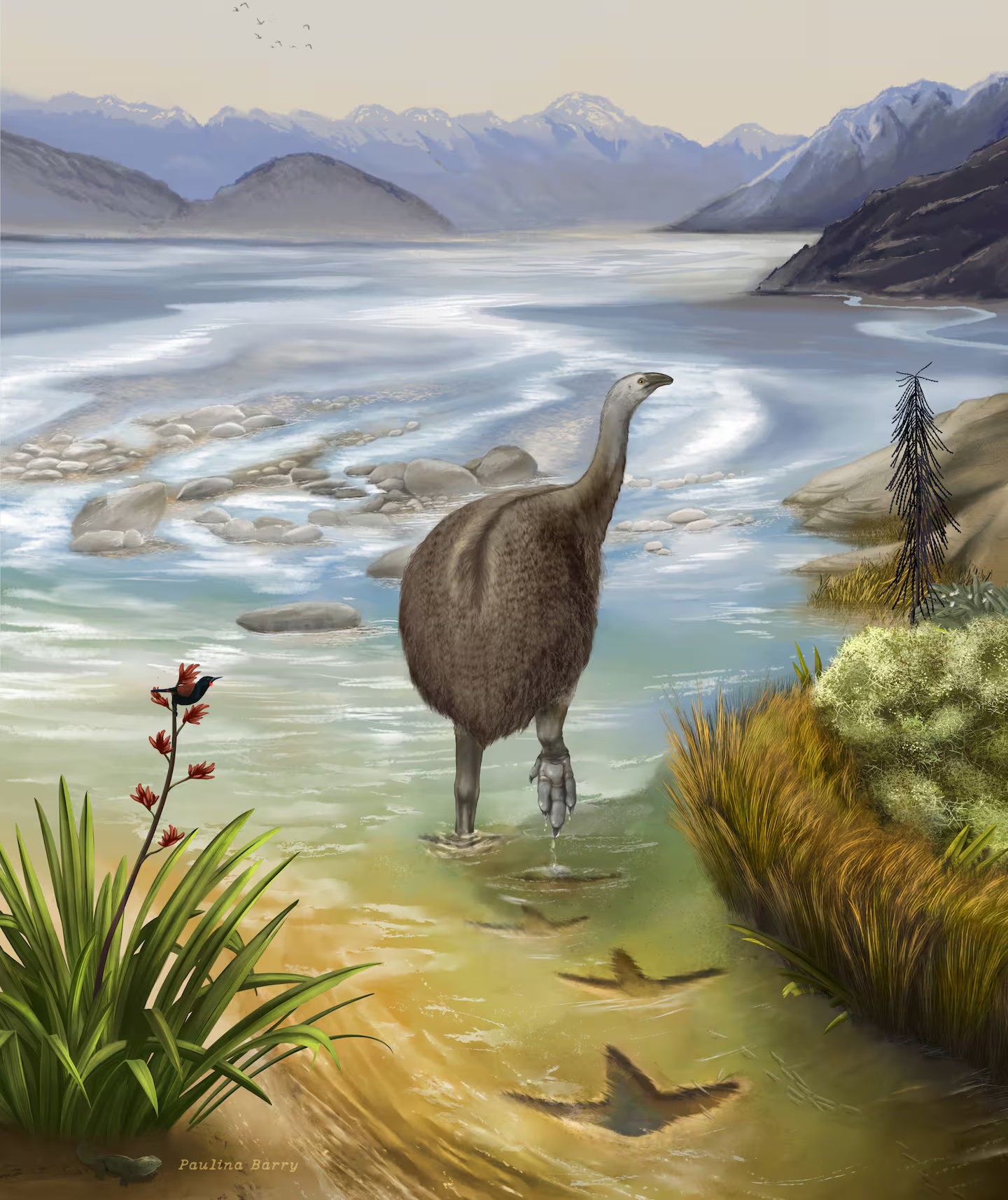
[PaleoOrnithology • 2024] The Moa Footprints from the Pliocene – early Pleistocene of Kyeburn, Otago, New Zealand


An artist’s impression of the moa which created the Kyeburn footprints.

in Fleury, Burns, Richards, Norton, Read, Wesley, Fordyce et Wilcken, 2024. 
 Artwork by Paulina Barry.
 
ABSTRACT
In March, 2019, a trackway of seven footprints was found at a riverbank outcrop of Maniototo Conglomerate Formation in the Kyeburn River, Central Otago, South Island, New Zealand. In this study, we describe this first known occurrence of moa (Dinornithiformes) footprints to be found and recovered in Te Waipounamu/South Island. Footprints of the trackway were ∼46 mm deep, 272–300 mm wide and 260–294 mm in length. An associated separate footprint was 448 mm wide and 285 mm long. Cosmogenic nuclide dating of adjacent overlying beds from the same formation establishes a mean minimum age of burial age for the tracks of 3.57 Ma (+1.62/−1.18 Ma) with a mode of 2.9 Ma, which we interpret to be Late Pliocene, with a conservative age range of Pliocene to Early Pleistocene. The trackway maker is identified as a moa from the Emeidae family, probably from the genus Pachyornis, with a mean mass of 84.61 kg that was travelling at a speed of 2.61 kmh−1. The single adjacent footprint was made by an individual from the family Dinornithidae, most likely from the genus Dinornis with an estimated mass of 158 kg. These moa footprints represent the second earliest fossil record of moa.

KEYWORDS: Trackway, moa footprint‌, Dinornithiformes, cosmogenic nuclide dating, Pliocene‌, Maniototo Conglomerate


Kane Fleury, Emma Burns, Marcus D. Richards, Kevin Norton, Stephen Read, Rachel Wesley, R. Ewan Fordyce and Klaus Wilcken. 2024. The Moa Footprints from the Pliocene – early Pleistocene of Kyeburn, Otago, New Zealand. Journal of the Royal Society of New Zealand. 54(5); 620-642. DOI: doi.org/10.1080/03036758.2023.2264789 
Special issue: Fossil vertebrates from Southern Zealandia: taonga of international significance. Guest Editors: Carolina Loch, Daniel Thomas, Jeffrey Robinson

www.linkedin.com/posts/pamela-naidoo-ameglio_feathery-moas-fossilised-footprints-ancient-activity-7132122722146385920-rgTz

Monday, July 1, 2024

[PaleoMammalogy • 2024] Temporal Dynamics of Woolly Mammoth Genome Erosion prior to Extinction


woolly mammoth Mammuthus primigenius wanders the frozen shore of Wrangel Island. 

in Dehasque, Morales, et al., 2024. 
    DOI: 10.1016/j.cell.2024.05.033    
 Artwork by Beth Zaiken

Highlights: 
• Analysis of long-term genomic changes using 21 high-coverage woolly mammoth genomes
• Severe bottleneck of the last surviving population when Wrangel Island was isolated
• The population partially recovered within a few generations and then remained stable
• Inbreeding depression and purging persisted for thousands of years after the recovery

Summary:
  A number of species have recently recovered from near-extinction. Although these species have avoided the immediate extinction threat, their long-term viability remains precarious due to the potential genetic consequences of population declines, which are poorly understood on a timescale beyond a few generations. Woolly mammoths (Mammuthus primigenius) became isolated on Wrangel Island around 10,000 years ago and persisted for over 200 generations before becoming extinct around 4,000 years ago. To study the evolutionary processes leading up to the mammoths’ extinction, we analyzed 21 Siberian woolly mammoth genomes. Our results show that the population recovered quickly from a severe bottleneck and remained demographically stable during the ensuing six millennia. We find that mildly deleterious mutations gradually accumulated, whereas highly deleterious mutations were purged, suggesting ongoing inbreeding depression that lasted for hundreds of generations. The time-lag between demographic and genetic recovery has wide-ranging implications for conservation management of recently bottlenecked populations.

Keywords: Mammuthus primigenius, woolly mammoth, extinction, ancient DNA, paleogenomics, mutation load, inbreeding, bottleneck, climate, Wrangel Island

The last woolly mammoth Mammuthus primigenius wanders the frozen shore of Wrangel Island. 
 Artwork by Beth Zaiken

 
M. Dehasque, H. E. Morales, et al. 2024. Temporal Dynamics of Woolly Mammoth Genome Erosion prior to Extinction. Cell.  DOI: 10.1016/j.cell.2024.05.033    

New genetic study reveals the woolly mammoths' journey towards extinction
 

Sunday, June 16, 2024

[Ornithology • 2024] Museum Specimens, Photographs, and Sightings of White-eyed River Martin Pseudochelidon sirintarae (Passeriformes: Hirundinidae)


White-eyed River Martin Pseudochelidon sirintarae  Thonglongya, 1968

in Bond & Berryman, 2024.

Abstract
White-eyed River Martin Pseudochelidon sirintarae was described in 1968 and there have been no confirmed sightings since the 1970s. It is known only from Bueng Boraphet in central Thailand. Here, we compile the most comprehensive summary of museum specimens, photographic records (including two previously unpublished images) and sightings for this poorly known species. Specimens are held mainly in the Thailand Natural History Museum near Bangkok, with others at the Natural History Museum (Tring), American Museum of Natural History (New York) and National Museum of Natural History, Smithsonian Institution (Washington, DC). At least three other mounts exist, all in Thailand, some of which may be composites from captive birds collected in the early 1970s. Photographs unearthed at Tring, and in unpublished reports, show birds that differ from the four previously known images and may represent individuals that are now museum specimens. With no confirmed sightings for more than 40 years, despite reasonable search effort (especially increasing citizen science data), it is very likely that White-eyed River Martin is now extinct.

Photographs of the White-eyed River Martin Pseudochelidon sirintarae caught in November 1968 published by Tobias (2000) and deposited in the Macaulay Library, Cornell University; the bird is presumably an adult given the presence of tail-streamers and is believed to be THNHM B-07481 (H. E. McClure, © BirdLife International)


Photographs of White-eyed River Martin Pseudochelidon sirintarae taken in the field in February 1968; it is now NHMUK 1968.68.1; the prints were sent by K. Thonglongya to NHMUK in April 1968 and Fig. 17 was also reproduced for an article in the newspaper Khaosod on 27 May 1992 about the species' discovery (Photographer unknown)

(left). Immature male White-eyed River Martin Pseudochelidon sirintarae, paratype USNM 533542, collected on 28 January 1968, alongside the removed left central rectrix from USNM 510428 (adult, unknown sex; see Fig. 7) (© C. Milensky)


Alexander L. Bond and Alex J. Berryman. 2024. Museum Specimens, Photographs, and Sightings of White-eyed River Martin Pseudochelidon sirintaraeBulletin of the British Ornithologists’ Club. 144(2):162-182. DOI: 10.25226/bboc.v144i2.2024.a9