Showing posts with label Synapsida. Show all posts

Monday, October 7, 2024

[Paleontology • 2023] Melanedaphodon hovaneci • A New Carboniferous edaphosaurid (Synapsida: Edaphosauridae) and the Origin of Herbivory in Mammal Forerunners

 Melanedaphodon hovaneci 
Mann, Henrici, Sues & Pierce, 2023

Life reconstruction by Henry Sutherland Sharpe

Abstract
Herbivory evolved independently in several tetrapod lineages during the Late Carboniferous and became more widespread throughout the Permian Period, eventually leading to the basic structure of modern terrestrial ecosystems. Here we report a new taxon of edaphosaurid synapsid based on two fossils recovered from the Moscovian-age cannel coal of Linton, Ohio, which we interpret as an omnivore–low-fibre herbivore. Melanedaphodon hovaneci gen. et sp. nov. provides the earliest record of an edaphosaurid to date and is one of the oldest known synapsids. Using high-resolution X-ray micro-computed tomography, we provide a comprehensive description of the new taxon that reveals similarities between Late Carboniferous and early Permian (Cisuralian) members of Edaphosauridae. The presence of large bulbous, cusped, marginal teeth alongside a moderately-developed palatal battery, distinguishes Melanedaphodon from all other known species of Edaphosauridae and suggests adaptations for processing tough plant material already appeared among the earliest synapsids. Furthermore, we propose that durophagy may have provided an early pathway to exploit plant resources in terrestrial ecosystems.

Holotype of  Melanedaphedon hovaneci gen. et sp. nov., CM 93778.
(A) Photograph showing the negative relief/natural mould. (B) Digital three-dimensional rendering of the CT data in positive relief. (C) Interpretative drawing of specimen based on micro-CT data and original fossil. Top left corner shows a reconstruction of the skull in lateral view with the preserved cranial elements highlighted.
Anatomical abbreviations: ang angular, art articular, d dentary, j jugal, mx maxilla, pt pterygoid, sur surangular, sp splenial.

Systematic palaeontology
Synapsida Osborn, 1903
Sphenacomorpha Ivakhnenko, 2003 sensu Spindler et al., 2015.
Edaphosauridae Cope, 1882.

Melanedaphodon hovaneci gen. et sp. nov.

Diagnosis: An edaphosaurid synapsid with the following autapomorphies: long maxilla with 20 tooth positions; marginal dentition consisting of tall teeth with bulbous crowns that have pointed apices; and cutting edges of tooth crowns without serrations. Further differential diagnosis includes: an elongate pterygoid shared with Ianthasaurus but not Edaphosaurus. Palatal shagreen with enlarged teeth on the anterior (palatal) ramus of pterygoid shared with Ianthasaurus but not Edaphosaurus. Differs from Ianthasaurus but shares with Edaphosaurus in having a tooth battery instead of enlarged single tooth row on the transverse flange of the pterygoid. Differs from Gordodon in the absence of a diastema on the anterior end of the maxilla.

Etymology: Generic name derived from the combination of the Greek ‘melanos’ meaning ‘black’ and ‘edaphon’ meaning ‘pavement’ and ‘odon’ meaning ‘tooth’, referring to the dense shagreen on the pterygoid and to the position of the taxon among Edaphosauridae. The specific epithet hovaneci honors George Hovanec who generously donated funds to facilitate the CT scanning of Linton fossils.

Life reconstruction of Melanedaphedon hovaneci gen. et sp. nov. (created by Henry Sutherland Sharpe).


Arjan Mann, Amy C. Henrici, Hans-Dieter Sues and Stephanie E. Pierce. 2023. A New Carboniferous edaphosaurid and the Origin of Herbivory in Mammal Forerunners. Scientific Reports. 13: 4459. DOI: 10.1038/s41598-023-30626-8

Friday, February 9, 2024

[Paleontology • 2024] Riojanodon nenoi • A New early-diverging probainognathian cynodont and A Revision of the Occurrence of cf. Aleodon from the Chañares Formation, northwestern Argentina: New clues on the Faunistic Composition of the latest Middle–?earliest Late Triassic Tarjadia Assemblage Zone


Riojanodon nenoi
 Martinelli, Ezcurra, Fiorelli, Escobar, Hechenleitner, von Baczko, Taborda & Desojo, 2024

 DOI: 10.1002/ar.25388  
 
Abstract
The Chañares Formation (Ischigualasto-Villa Unión Basin) is worldwide known by its exquisitely preserved fossil record of latest Middle-to-early Late Triassic tetrapods, including erpetosuchids, “rauisuchians,” proterochampsids, gracilisuchids, dinosauromorphs, pterosauromorphs, kannemeyeriiform dicynodonts, and traversodontid, chiniquodontid and probainognathid cynodonts, coming from the Tarjadia (bottom) and Massetognathus-Chanaresuchus (top) Assemblage Zones of its lower member. Regarding cynodonts, most of its profuse knowledge comes from the traditional layers discovered by Alfred Romer and his team in the 1960s that are now enclosed in the Massetognathus-Chanaresuchus Assemblage Zone (AZ). In this contribution we focus our study on the probainognathian cynodonts discovered in levels of the Tarjadia Assemblage Zone. We describe a new chiniquodontid cynodont with transversely broad postcanine teeth (Riojanodon nenoi gen. et sp. nov.) which is related to the genus Aleodon. In addition, the specimen CRILAR-Pv 567 previously referred to cf. Aleodon is here described, compared, and included in a phylogenetic analysis. It is considered as an indeterminate Aleodontinae nov., a clade here proposed to included chiniquodontids with transversely broad upper and lower postcanines, by having a cuspidated sectorial labial margin and a lingual platform that is twice broader than a lingual cingulum. Cromptodon mamiferoides, from the Cerro de Las Cabras Formation (Cuyo Basin), was also included in the phylogenetic analysis and recovered as an Aleodontinae. The new cynodont and the record of Aleodontinae indet. reinforce the faunal differentiation between the Tarjadia and Massetognathus-Chanaresuchus Assemblage Zones, in the lower member of the Chañares Formation, and inform on the diverse chiniquodontid clade with both sectorial and transversely broad postcanine teeth.

Keywords: Chiniquodontidae, Cynodontia, Probainognathia, South America, taxonomy


Riojanodon nenoi gen. et sp. nov.


Agustín G. Martinelli, Martín D. Ezcurra, Lucas E. Fiorelli, Juan Escobar, E. Martín Hechenleitner, M. Belén von Baczko, Jeremías R. A. Taborda and Julia B. Desojo. 2024. A New early-diverging probainognathian cynodont and A Revision of the Occurrence of cf. Aleodon from the Chañares Formation, northwestern Argentina: New clues on the Faunistic Composition of the latest Middle–?earliest Late Triassic Tarjadia Assemblage Zone. The Anatomical Record.  DOI: 10.1002/ar.25388

Wednesday, February 7, 2024

[Paleontology • 2024] Paratraversodon franciscaensis • Skull Anatomy and Paleoneurology of A New traversodontid (Therapsida: Cynodontia) from the Middle-Late Triassic of Brazil

 
 Paratraversodon franciscaensis
Kerber, Roese-Miron, Medina, da Roberto-da-Silva, Cabreira & Pretto, 2024

 
Abstract
Traversodontidae, a clade of gomphodont cynodonts, thrived during the Middle and Late Triassic, displaying a wide geographical distribution. During fieldwork in 2009, a new specimen was discovered in Ladinian/early Carnian stratigraphic layers in southern Brazil. Here, we describe this specimen and propose a new taxon closely related to Traversodon stahleckeri (Traversodontinae) but displaying a unique combination of traits (e.g., presence of a poorly developed suborbital process, mesiodistal length of the paracanine fossa similar to the length of the canine, short diastema between the fourth incisor and the upper canine, and coronoid process not entirely covering the distalmost lower postcanine). Furthermore, the endocranial anatomy of the new taxon was examined. The reconstruction of the cranial endocast revealed paleoneurological features consistent with non-Gomphodontosuchinae traversodontids. These features include the presence of a pineal body (but the absence of an open parietal foramen). These recent findings contribute significantly to our understanding of the evolutionary history and cranial anatomy of Middle-Late Triassic traversodontids, shedding light on the diversity and adaptations of non-mammaliaform cynodonts.

Keywords: Dinodontosaurus Assemblage Zone, Ladinian/Carnian, phylogeny, Traversodontidae


 Paratraversodon franciscaensis


Leonardo Kerber, Lívia Roese-Miron, Thais G. M. Medina, Lúcio da Roberto-da-Silva, Sérgio F. Cabreira and Flávio A. Pretto. 2024. Skull Anatomy and Paleoneurology of A New traversodontid from the Middle-Late Triassic of Brazil. The Anatomical Record. DOI: 10.1002/ar.25385


Wednesday, August 24, 2022

[Paleontology • 2022] Taphonomy of Drought afflicted Tetrapods in the Early Triassic Karoo Basin, South Africa


Mummified skin on spreadeagled Lystrosaurus 

in Smith, Botha & Viglietti, 2022. 

Highlights: 
• Outcrop containing hundreds of Early Triassic tetrapod fossils interpreted as evidence of drought.
• Clusters of articulated skeletons interpreted as drought-induced aggregations.
• Mummified skin on spreadeagled Lystrosaurus suggest rapid desiccation after death by starvation.
• Bone histology confirms that all the Lystrosaurus were juveniles or early sub-adult.
• Bonebeds of juvenile Lystrosaurus are interpreted as sheet-washed behavioural aggregations.

Abstract
The sedimentology and taphonomy of in-situ fossils from earliest Triassic strata (Induan) in the southern Karoo Basin of South Africa is presented as evidence for episodes of drought-induced mass death of the resident tetrapods. Abundant skeletons are preserved in a 2 m-thick tabular silty-sandstone capping a multi-storeyed low-sinuosity channel sandstone interpreted as a wide shallow channel that became progressively abandoned, with more ephemeral flow regime than in the underlying channels and subjected to intermittent flows of low-density sediment-laden floodwaters. Stratigraphic and planimetric distribution of 170 in-situ tetrapod fossils shows several clusters of up to eight closely-spaced articulated Lystrosaurus skeletons preserved in prone and spread-eagled body position. These are interpreted as drought-stricken carcasses that collapsed and died of starvation in and alongside dried-up water sources. Two of the specimens display an unusual micritic envelope with a distinctive pustular texture interpreted as permineralised mummified skin indicative of rapid desiccation after death. Bonebeds of disarticulated bones of multiple juvenile Lystrosaurus occur in shallow depressions within the rubified mudstones. Layering of different skeletal elements suggests some hydraulic sorting but the initial aggregation was likely a behavioural response to drought. Osteohistology of spread-eagled Lystrosaurus (L. declivis and L. murrayi species) skeletons show that they represent early juvenile stage which is in accordance with previous findings that throughout Pangaea Early Triassic Lystrosaurus died relatively young due to environmental stressors. Our results support the hyperthermal hypothesis that ~252 Mya increased continental aridity, already a consequence of the coalescence of Pangaea, was critically intensified by volcanogenic greenhouse gasses from the Siberian traps. We propose that in the aftermath of the End-Permian mass extinction event, a succession of climatic drying episodes orchestrated a series of fully-functioning terrestrial ecosystems that were markedly different to those of the pre-extinction, and likely had a profound and lasting influence on the evolution of tetrapods.

Keywords: Early Triassic, Katberg Formation, Lystrosaurus, Drought accumulations, Bonebeds, Mummified skin


Roger M.H. Smith, Jennifer Botha and Pia A. Viglietti. 2022. Taphonomy of Drought afflicted Tetrapods in the Early Triassic Karoo Basin, South Africa. Palaeogeography, Palaeoclimatology, Palaeoecology. In Press, 111207. DOI: 10.1016/j.palaeo.2022.111207 

Wednesday, July 6, 2022

[Paleontology • 2022] Eoscansor cobrensis • A Scansorial Varanopid Eupelycosaur (Synapsida: Eupelycosauria: Varanopidae) from the Pennsylvanian of New Mexico, USA


 Eoscansor cobrensis
 Lucas, Rinehart, Celeskey, Berman & Henrici, 2022


Abstract
An incomplete skeleton of a small tetrapod from the Upper Pennsylvanian of New Mexico represents a new genus and species of varanopid eupelycosaur named Eoscansor cobrensis. This skeleton is from the Cobrean (Virgilian) interval of the El Cobre Canyon Formation in the Cañon del Cobre of Rio Arriba County, New Mexico. Eoscansor is a small varanopid distinguished from other varanopids primarily by the unique structure of its manus and pes metapodials and phalanges. Diverse aspects of its anatomy indicate that Eoscansor was a climber, and possibly arboreal, the oldest such tetrapod now known. These features include: claw, phalangeal, and metapodial adaptations indicative of grasping, clinging, and climbing ability; equivalence of high claw curvature and limb length between the fore- and hind limbs; body mass per SVL within the range of extant climbing lizards; very low tibia length/femur length ratio; and a low center of gravity to facilitate an inclined surface-hugging posture.

 Eoscansor cobrensis
holotype: NMMNH P-75122.


Restoration of  Eoscansor cobrensis.
by Matt Celeskey

Eoscansor cobrensis


Spencer G. Lucas, Larry F. Rinehart, Matthew D. Celeskey, David S Berman and Amy C. Henrici. 2022. A Scansorial Varanopid Eupelycosaur from the Pennsylvanian of New Mexico. Annals of Carnegie Museum. 87(3); 167-205. DOI: 10.2992/007.087.0301 [3 June 2022] 


Thursday, November 4, 2021

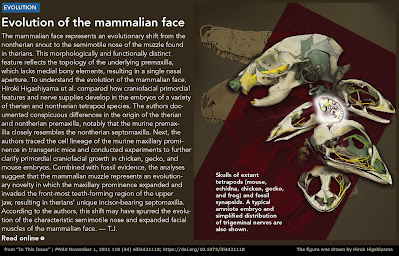
[Mammalogy • 2021] Mammalian Face as An Evolutionary Novelty


in Higashiyama, Koyabu, Hirasawa, ... et Kurihara, 2021. 


Significance: 
The anatomical framework of the jaw has traditionally been thought to be highly conserved among vertebrates. However, here we show that the therian-unique face (muzzle) evolved via a drastic alteration of the common pattern of the tetrapod jaw. Through comparative morphological and developmental analyses, we demonstrated that the therian mammal’s premaxilla (rostral-most upper jawbone) is derived from the maxillary prominence of the mandibular arch. The developmental primordium that produces the premaxilla in nonmammalian tetrapods rarely contributes to the upper jaw in therian mammals but rather forms a motile nose. We propose that these previously unrecognized rearrangements allowed key innovations such as the highly sensitive tactile perception and olfactory function in mammalian evolution.

Abstract
The anterior end of the mammalian face is characteristically composed of a semimotile nose, not the upper jaw as in other tetrapods. Thus, the therian nose is covered ventrolaterally by the “premaxilla,” and the osteocranium possesses only a single nasal aperture because of the absence of medial bony elements. This stands in contrast to those in other tetrapods in whom the premaxilla covers the rostral terminus of the snout, providing a key to understanding the evolution of the mammalian face. Here, we show that the premaxilla in therian mammals (placentals and marsupials) is not entirely homologous to those in other amniotes; the therian premaxilla is a composite of the septomaxilla and the palatine remnant of the premaxilla of nontherian amniotes (including monotremes). By comparing topographical relationships of craniofacial primordia and nerve supplies in various tetrapod embryos, we found that the therian premaxilla is predominantly of the maxillary prominence origin and associated with mandibular arch. The rostral-most part of the upper jaw in nonmammalian tetrapods corresponds to the motile nose in therian mammals. During development, experimental inhibition of primordial growth demonstrated that the entire mammalian upper jaw mostly originates from the maxillary prominence, unlike other amniotes. Consistently, cell lineage tracing in transgenic mice revealed a mammalian-specific rostral growth of the maxillary prominence. We conclude that the mammalian-specific face, the muzzle, is an evolutionary novelty obtained by overriding ancestral developmental constraints to establish a novel topographical framework in craniofacial mesenchyme.

Keywords: evolution, craniofacial, skull, mammals


Evolutionary transitions of upper jaw bones in the fossil synapsids.

 
 Hiroki Higashiyama, Daisuke Koyabu, Tatsuya Hirasawa, Ingmar Werneburg, Shigeru Kuratani, and Hiroki Kurihara. 2021. Mammalian Face as An Evolutionary Novelty. PNAS. 118 (44); e2111876118. DOI: 10.1073/pnas.2111876118

Friday, April 9, 2021

[PaleoMammalogy • 2021] Fossiomanus sinensis & Jueconodon cheni • Fossoriality and Evolutionary Development in Two Cretaceous Mammaliamorphs


Fossiomanus sinensis & Jueconodon cheni 
Mao, Zhang, Liu & Meng, 2021


Abstract
Mammaliamorpha comprises the last common ancestor of Tritylodontidae and Mammalia plus all its descendants. Tritylodontids are nonmammaliaform herbivorous cynodonts that originated in the Late Triassic epoch, diversified in the Jurassic period and survived into the Early Cretaceous epoch. Eutriconodontans have generally been considered to be an extinct mammalian group, although different views exist. Here we report a newly discovered tritylodontid and eutriconodontan from the Early Cretaceous Jehol Biota of China. Eutriconodontans are common in this biota, but it was not previously known to contain tritylodontids. The two distantly related species show convergent features that are adapted for fossorial life, and are the first ‘scratch-diggers’ known from this biota. Both species also show an increased number of presacral vertebrae, relative to the ancestral state in synapsids or mammals, that display meristic and homeotic changes. These fossils shed light on the evolutionary development of the axial skeleton in mammaliamorphs, which has been the focus of numerous studies in vertebrate evolution and developmental biology. The phenotypes recorded by these fossils indicate that developmental plasticity in somitogenesis and HOX gene expression in the axial skeleton—similar to that observed in extant mammals—was already in place in stem mammaliamorphs. The interaction of these developmental mechanisms with natural selection may have underpinned the diverse phenotypes of body plan that evolved independently in various clades of mammaliamorph.


Holotypes of Fossiomanus sinensis (JZMP-2107500093) 

 Systematic palaeontology
Synapsida Osborn, 1903
Cynodontia Owen, 1861
Mammaliamorpha Rowe, 1988
Tritylodontidae Cope, 1844

Fossiomanus sinensis gen. et sp. nov.

Holotype. A skeleton with broken skull and partial dentition (accessioned as Jinzhou Paleontological Museum (JZMP)-2107500093).

Locality and horizon. Jiufotang Formation at Lamadong, Jianchang (Liaoning province, China); Aptian stage (about 120 million years old) (Supplementary Information).

Etymology. Fossio, ‘digging’ and manus hand’; sinensis, ‘from China’ (Latin).


The dioramic landscape illustrates the Early Cretaceous Jehol Biota with emphasis on mammaliamorphs.
Illustration: Chuang Zhao

Mammaliaformes Rowe, 1988
Mammalia Linnaeus, 1758
Eutriconodonta Kermack, Mussett and Rigney, 1973

Jueconodon cheni gen. et sp. nov.

Holotype. A nearly complete skeleton with dentition (accessioned at the Beipiao Pterosaur Museum of China, catalogue number ZGY0052) (Figs. 1, 2, Extended Data Figs. 5–8).

Locality and horizon. Yixian Formation at Jianshangou, Beipiao (Liaoning province, China); Early Barremian to Early Aptian stage (Supplementary Information).

Etymology. Juedigging (Chinese pinyin); conodoncuspate tooth (Latin); the specific name is for Y. Chen, who collected the holotype.


Fangyuan Mao, Chi Zhang, Cunyu Liu and Jin Meng. 2021. Fossoriality and Evolutionary Development in Two Cretaceous Mammaliamorphs. Nature.  DOI: 10.1038/s41586-021-03433-2
 

Dig This: Two New Burrowing Mammal Ancestors Discovered
Scientists discover two new species of ancient, burrowing mammal ancestors

Wednesday, April 7, 2021

[Paleontology • 2021] Kocurypelta silvestris • An Upper Triassic Terrestrial Vertebrate Assemblage from the Forgotten Kocury Locality (Poland) with A New Aetosaur Taxon


Kocurypelta silvestris 
Czepiński, Dróżdż, Szczygielski, Tałanda, Pawlak, Lewczuk, Rytel & Sulej, 2021


ABSTRACT
Since 1990, several localities within the Keuper (upper Middle to Upper Triassic) strata in southern Poland have yielded remains of numerous terrestrial vertebrate species. Here we report a new Upper Triassic vertebrate assemblage from the rediscovered Kocury locality. An incomplete theropod dinosaur fibula named Velocipes guerichi described in 1932 was found there. The site was then forgotten and not explored until our excavations began in 2012, that yielded material of a lungfish, a proterochersid turtle, and a new typothoracin aetosaur Kocurypelta silvestris gen. et sp. nov. The new taxon is characterized by autapomorphies of the maxilla: an elongated edentulous posterior portion longer than 80% of the posterior maxillary process, a short medial shelf restricted to the posterior portion of the bone, an anteriorly unroofed maxillary accessory cavity, and lack of a distinct groove for choanal recess on the anteromedial surface of the bone. These new finds improve our knowledge on the vertebrate diversity of the Germanic Basin in the Late Triassic, evidencing the presence of yet unrecognized taxa. Additionally, the partial cranial aetosaur material emphasizes the issues with the aetosaurian taxonomy that is focused mostly on the osteoderm morphology.


  Kocurypelta silvestris gen. et sp. nov.
 

Łukasz Czepiński, Dawid Dróżdż, Tomasz Szczygielski, Mateusz Tałanda, Wojciech Pawlak, Antoni Lewczuk, Adam Rytel and Tomasz Sulej. 2021. An Upper Triassic Terrestrial Vertebrate Assemblage from the Forgotten Kocury Locality (Poland) with a New Aetosaur Taxon. Journal of Vertebrate Paleontology. e1898977. DOI: 10.1080/02724634.2021.1898977 


Friday, November 23, 2018

[Paleontology • 2019] Lisowicia bojani • An Elephant-sized Late Triassic Synapsid with Erect Limbs


Lisowicia bojani 
Sulej & Niedźwiedzki, 2018


Abstract
Here, we describe the dicynodont Lisowicia bojani, from the Late Triassic of Poland, a gigantic synapsid with seemingly upright subcursorial limbs that reached an estimated length of more than 4.5 meters, height of 2.6 meters, and body mass of 9 tons. Lisowicia is the youngest undisputed dicynodont and the largest nondinosaurian terrestrial tetrapod from the Triassic. The lack of lines of arrested growth and the highly remodeled cortex of its limb bones suggest permanently rapid growth and recalls that of dinosaurs and mammals. The discovery of Lisowicia overturns the established picture of the Triassic megaherbivore radiation as a phenomenon restricted to dinosaurs and shows that stem-group mammals were capable of reaching body sizes that were not attained again in mammalian evolution until the latest Eocene.


Illustration: Julius Csotonyi 


Lisowicia bojani gen. et sp. nov., hind limb elements (femur, fibula, tibia) preserved in situ, upper bone-bearing interval, Lipie Śląskie clay-pit at Lisowice.

Artistic reconstruction of Lisowicia bojani, front view.
Illustration: Karolina Suchan-Okulska

Systematic paleontology
 Synapsida Osborn, 1903 
Therapsida Broom, 1905 
Anomodontia Owen, 1860 
Dicynodontia Owen, 1860 
Placeriinae King, 1988 

Lisowicia gen. nov. 

Type species. Lisowicia bojani sp. nov.

Diagnosis. The dicynodont differs from all other dicynodonts as it possesses the following unique combination of character states, visible in the holotype (ZPAL V.33/96, left humerus): 1) the humerus has a narrower entepicondyle in comparison with other dicynodonts (autapomorphy); 2) the entepicondylar foramen of the humerus is absent (autapomorphy); 3) the supinator process is longer (it is 31% of the total humerus length) than in other dicynodonts. 

Lisowicia bojani sp. nov. 

Etymology. Lisowicia, from the name of the village Lisowice where the bones were found; bojani, in honor of Ludwig Heinrich Bojanus (1776–1827), comparative anatomist and paleontologist.

Age. Late Norian-earliest Rhaetian, Late Triassic.
....


Tomasz Sulej and Grzegorz Niedźwiedzki. 2018. An Elephant-sized Late Triassic Synapsid with Erect Limbs. Science. 363(6422); 78-80.  DOI:  10.1126/science.aal4853

Scientists find remains of huge ancient herbivore phys.org/news/2018-11-scientists-huge-ancient-herbivore.html via @physorg_com

Thursday, November 15, 2018

[Paleontology • 2018] Gordodon kraineri • The Oldest Specialized Tetrapod Herbivore: A New Eupelycosaur from the Permian of New Mexico, USA


Gordodon kraineri 
Lucas, Rinehart & Celeskey, 2018
  DOI: 10.26879/899 

ABSTRACT
Gordodon kraineri is a new genus and species of edaphosaurid eupelycosaur known from an associated skull, lower jaw and incomplete postcranium found in the early Permian Bursum Formation of Otero County, New Mexico, USA. It has a specialized dental apparatus consisting of large, chisel-like incisors in the front of the jaws separated by a long diastema from relatively short rows of peg-like maxillary and dentary cheek teeth. The dorsal vertebrae of Gordodon have long neural spines that bear numerous, randomly arranged, small, thorn-like tubercles. The tubercles on long neural spines place Gordodon in the Edaphosauridae, and the dental apparatus and distinctive tubercles on the neural spines distinguish it from the other edaphosaurid genera—Edaphosaurus, Glaucosaurus, Lupeosaurus and Ianthasaurus. Gordodon is the oldest known tetrapod herbivore with a dentary diastema, extending the temporal range of that anatomical feature back 95 million years from the Late Triassic. The dental apparatus of Gordodon indicates significantly different modes of ingestion and intraoral transport of vegetable matter than took place in Edaphosaurus and thus represents a marked increase in disparity among edaphosaurids. There were two very early pathways to tetrapod herbivory in edaphosaurid evolution, one toward generalized browsing on high-fiber plant items (Edaphosaurus) and the other (Gordodon) toward more specialized browsing, at least some of it likely on higher nutrient, low fiber plant items. Gordodon shows a surprisingly early specialization of the dental apparatus and indicates how incomplete our knowledge is of edaphosaurid evolution, disparity and diversity.


FIGURE 2. Holotype skull, lower jaw and incomplete postcranium of Gordodon kraineri, NMMNH P-70796, photograph (1) and bone map (2). Scale equals 10 cm.


FIGURE 3. The skull and lower jaw, as preserved, of the holotype of Gordodon kraineri, NMMNH P-70796, in right lateral view, photograph (1) and line drawing (2). 
Anatomical abbreviations are: an = angular; ar = articular; d = dentary; ep = epipterygoid; f = frontal; l = lacrimal; m = maxilla; mtp = mandibular tooth plate; n = nasal; p = parietal; pf = postfrontal; pm = premaxilla; pr = prearticular; prf = prefrontal; pt = pterygoid; q = quadrate; qj = quadratojugal; sa = surangular; sm = septomaxilla; spl = splenial; sq = squamosal; st = supratemporal; t = tabular; v = vomer. Scale equals 1 cm.

SYSTEMATIC PALEONTOLOGY

SYNAPSIDA Osborn, 1903
EUPELYCOSAURIA Kemp, 1982
EDAPHOSAURIDAE Cope, 1882

Gordodon gen. nov.

Etymology. Gordo, Spanish for “fat,” and Greek odon, “tooth,” in reference to the large (“fat”) teeth at the anterior end of the snout of the holotype. Gordo also is a reference to the city of Alamogordo, near the type locality.

Diagnosis. Gordodon is a medium-sized edaphosaur (presacral length ~1 m) distinguished from the other edaphosaurid genera by: an unique dental apparatus consisting of large chisel-like incisors in the premaxilla and dentary (dentary incisors inferred from empty alveolus) separated by a long diastema from a relatively short row of peg-like maxillary and dentary cheek teeth and tooth plates with small (<1 mm) teeth on the interior surface of the mandible; preorbital skull length subequal to postorbital skull length; a relatively short nasal-maxilla suture; cervical and anterior dorsal vertebrae with relatively gracile centra that are double-keeled ventrally; and cervical and dorsal vertebrae have long neural spines that bear up to 12 small, thorn-like lateral tubercles randomly distributed on each side.


Gordodon kraineri sp. nov.

 Etymology. To honor Karl Krainer for his many contributions to our knowledge of the late Paleozoic geology and paleontology of New Mexico.

Holotype. NMMNH P-70796, incomplete skeleton consisting of the skull, lower jaws, all or parts of 21 vertebrae (five cervical vertebrae, four complete dorsal vertebrae, the neural spines in varying states of completeness of 12 additional dorsal vertebrae), parts of five cervical and five dorsal rib pairs, parts of the right and left clavicles and scapulae and parts of two digits of the manus(?) (Figure 2).

Holotype locality. NMMNH locality 8967, Otero County, New Mexico, USA (Figure 1).

Stratigraphic horizon and age. Lower part of Bursum Formation, early Wolfcampian (early Permian).

....

 Life restoration of Gordodon kraineri.


Spencer G. Lucas, Larry F. Rinehart and Matthew D. Celeskey. 2018. The Oldest Specialized Tetrapod Herbivore: A New Eupelycosaur from the Permian of New Mexico, USA.   Palaeontologia Electronica. 21.3.39A; 1-42.  DOI: 10.26879/899  

Plain Language Abstract: Gordodon kraineri is a new kind of sail-backed reptile based on an incomplete skeleton found in ~300 million year old rocks in southeastern New Mexico. Gordodon belongs to a family of early herbivorous reptiles, the Edaphosauridae, and has a surprisingly specialized skull and dentition. These skeletal specializations indicate it was a selective browser on plants.

Sunday, June 10, 2018

[Paleontology • 2018] Gorynychus masyutinae • A New Therocephalian from the Permian Kotelnich Locality, Kirov Region, Russia


Gorynychus masyutinae
Kammerer​ & Masyutin, 2018


Abstract
A new therocephalian taxon (Gorynychus masyutinae gen. et sp. nov.) is described based on a nearly complete skull and partial postcranium from the Permian Kotelnich locality of Russia. Gorynychus displays an unusual mixture of primitive (“pristerosaurian”) and derived (eutherocephalian) characters. Primitive features of Gorynychus include extensive dentition on the palatal boss and transverse process of the pterygoid, paired vomers, and a prominent dentary angle; derived features include the absence of the postfrontal. Gorynychus can be distinguished from all other therocephalians by its autapomorphic dental morphology, with roughly denticulated incisors and postcanines. Phylogenetic analysis recovers Gorynychus as a non-lycosuchid, non-scylacosaurid therocephalian situated as sister-taxon to Eutherocephalia. The identification of Gorynychus as the largest predator from Kotelnich indicates that therocephalians acted as apex predators in middle–late Permian transition ecosystems in Russia, corroborating a pattern observed in South African faunas. However, other aspects of the Kotelnich fauna, and Permian Russian tetrapod faunas in general, differ markedly from those of South Africa and suggest that Karoo faunas are not necessarily representative of global patterns.


Figure 1: Holotype of Gorynychus masyutinae. The two blocks (KPM 346 and 347) making up the majority of the holotype shown in articulation. Holotype also includes two incisor teeth (KPM 348 and 349) disarticulated from the skull but found in association (see Figs. 2C and 10D). Scale bar equals 5 cm. Photograph by Christian F. Kammerer.


 Figure 4: Holotype of Gorynychus masyutinae in right lateral view. (A) Photograph and (B) interpretive drawing of skull (KPM 346). Abbreviations: ar, articular; C, upper canine; co, coronoid process of dentary; d, dentary; fr, frontal; i, lower incisor; j, jugal; la, lacrimal; mx, maxilla; na, nasal; pmx, premaxilla; prf, prefrontal; PC, upper postcanine; po, postorbital; q-qj, quadrate-quadratojugal complex; rla, reflected lamina of angular; sa, surangular; smx, septomaxilla; sq, squamosal; ss, squamosal sulcus. Gray coloration indicates matrix, patterning indicates eroded or broken bone surface. Scale bar equals 1 cm. Photograph and drawing by Christian F. Kammerer.

Systematic Paleontology
Synapsida Osborn, 1903
Therapsida Broom, 1905
Therocephalia Broom, 1903

Gorynychus gen. nov.

Type species: Gorynychus masyutinae sp. nov.

Etymology: Named for the legendary Russian dragon Zmey Gorynych (Змей Горыныч), in reference to the fearsome appearance of this taxon and its status as the largest known predator in the Kotelnich assemblage. Also a play on the English word “gory” (meaning bloody) and the Ancient Greek ὄνῠχος (Latinized “onychus,” meaning claw), in reference to this taxon’s inferred behavior being “red in tooth and claw.”


Gorynychus masyutinae sp. nov.

Holotype: KPM 346–349 (Figs. 1–9), a single individual (skull and cervical vertebrae in articulation, pectoral and rib elements disarticulated but directly associated with skull) broken into four pieces: KPM 346, a nearly complete skull (with damaged intertemporal region, occiput, and left temporal arcade) and lower jaws with the anterior 4 1/2 cervicals in articulation; KPM 347, postcranial elements including remaining half of fifth cervical (precise break, originally articulated with anterior portion) and worn sixth and seventh cervicals, ribs, partial clavicle, and left scapulocoracoid impression; KPM 348, isolated but associated incisor with intact crown; and KPM 349, isolated but associated incisor with damaged crown.


Etymology: Named in honor of Olga Masyutina for her skillful preparation of the holotype of this taxon, as well as numerous other important specimens from the Kotelnich locality.

Diagnosis: Therocephalian distinguished from all other members of the group by its autapomorphic dental morphology: all marginal teeth serrated, with serrations forming distinct denticles that are especially prominent on the incisors and postcanines. Postcanines “spade”-shaped and reduced in number (three in the maxilla) relative to most therocephalians. Further distinguished from the other known Russian basal therocephalian Porosteognathus efremovi by a shorter tooth row on the pterygoid transverse process situated on a more discrete, raised boss and an anterolaterally-curved and expanded pterygoid palatal boss with fewer (8–9) teeth (transversely broad with ∼14 teeth in Porosteognathus).

a therocephalian Gorynychus masyutinae, an apex predator during the mid-Permian, treeing a small herbivore, Suminia getmanovi.
Illustration: Matt Celeskey  

Conclusion: 
Based on a nearly-complete skull and partial skeleton and two additional, fragmentary specimens, a new therocephalian taxon, Gorynychus masyutinae, is described from the (probably) earliest late Permian Kotelnich locality of Russia. Gorynychus is the largest known predatory tetrapod in the Kotelnich assemblage, and demonstrates that therocephalians acted as top predators in Russian as well as South African assemblages during the transition between typical middle and late Permian terrestrial communities. Although falling outside of Eutherocephalia, Gorynychus is more closely related to eutherocephalians than to the large-bodied therocephalian predators of southern Africa (and possibly earlier Permian assemblages in Russia, if Porosteognathus from the middle Permian Isheevo fauna truly is a scylacosaurid). The Kotelnich therocephalian fauna shows greater diversity of eutherocephalians than probable coeval faunas in South Africa, and suggests that initial diversification in this clade probably was not occurring in the Karoo Basin.


Christian F. Kammerer​ and Vladimir Masyutin. 2018. A New Therocephalian (Gorynychus masyutinae gen. et sp. nov.) from the Permian Kotelnich Locality, Kirov Region, Russia. PeerJ. 6:e4933. DOI: 10.7717/peerj.4933