Showing posts with label African Botany. Show all posts

Thursday, July 9, 2026

[Botany • 2026] Buchnera hirsutorepens • A New Species of prostrate Orobanchaceae from Zambia and DR Congo, along with a revised description of Buchnera prorepens


Buchnera hirsutorepens  J.K.Gibson & I.Darbysh., 
 Buchnera prorepens Engl. & Gilg, 

in Gibson, Sichamba et Darbyshire, 2026.  

Summary
A new species of Buchnera L. is described, Buchnera hirsutorepens, from south-eastern Democratic Republic of the Congo, and central and eastern Zambia. Buchnera hirsutorepens is split from Buchnera prorepens Engl. & Gilg, which is also redescribed here, its range now encompassing Angola and Western Zambia. These two species are unique in the genus Buchnera in their prostrate habit and axillary flowers. They can be separated from each other by differences in indumentum of the inflorescence and leaves, bract shape, pedicel length and relative length of the corolla tube to the calyx. A distribution map of georeferenced specimen localities of the two species is provided, along with information on their habitat and ecology, and an evaluation of their conservation status based on IUCN guidelines and criteria.

Key Words: Africa, Red List assessment, Savanna, taxonomy, vicariance 

Buchnera hirsutorepens.
A habit (as on sheet); B stem indumentum; C leaf, adaxial surface, with indication of indumentum; D leaf indumentum; E flower, with bract and bracteole; F trichome, from corolla tube entrance; G petal margin; H calyx tube; J ovary, style and stigma; K corolla tube.
 A – D from D. B. Fanshawe F.1963 (holotype K), E – K from E. Robinson 2580 (K). 
drawn by Andrew Brown.

A Buchnera prorepens, Dec. 2023 in the Western Province, Zambia.
Buchnera hirsutorepens, Feb. 2022 in Shiwa-Ngandu District, Zambia.
photos: Nicholas Wightman.

Buchnera hirsutorepens J.K.Gibson & I.Darbysh. sp. nov. 

 
John K. Gibson, Mpande Sichamba and Iain Darbyshire. 2026. Buchnera hirsutorepens, A New Species of prostrate Orobanchaceae from Zambia and the Democratic Republic of the Congo, along with a revised description of Buchnera prorepens Kew Bulletin. DOI: doi.org/10.1007/s12225-025-10349-x [13 May 2026]

Monday, June 29, 2026

[Botany • 2026] Platylepis avaratraensis (Orchidaceae) • A New Species from northern Madagascar and its taxonomic position in Goodyerinae


Platylepis avaratraensis Hermans & Nusb., 

in Hermans, Ranirison, Havinga, Iharivolana et Nusbaumer, 2026. 

 Abstract  
Taxonomy and molecular research in the genera of the subtribe Goodyerinae (Orchidaceae) from Madagascar and adjacent islands of the western Indian Ocean are discussed. The characteristics of Goodyera R.Br. and Platylepis A.Rich. are compared, their history is presented, and the respective species currently accepted for the region are detailed. A new species, Platylepis avaratraensis Hermans & Nusb., is described from the Sava region in northern Madagascar. It is most similar to P. humicola (Schltr.) Schltr. but differs by the wider leaves, shorter floral bracts, flower colour, narrower sepals and a lip with distinct calli. The distribution and ecology of the new species are discussed and its conservation status is provisionally assessed as “Endangered” following the IUCN Red List Categories and Criteria.

KEYWORDS: conservation, Goodyera, Goodyerinae, Madagascar, new species, ORCHIDACEAE, Platylepis, taxonomy

Platylepis avaratraensis Hermans & Nusb.
A: plant in its habitat; B: inflorescence with buds, flowers and young fruits; C: flower, front view with an insect (potential pollinator of the species); D: leaves; E: flowers, ovary and bracts from side view; F: fruits
 [A–D: Nusbaumer et al. 5055; E: Iharivolana & Havinga 47; F: Donati et al. 61] 
[Photos: A–D: L. Nusbaumer; E: A. Havinga; F: Iharivolana]

Platylepis avaratraensis Hermans & Nusb., sp. nov. 

Diagnosis — Platylepis avaratraensis is distinct from all other Madagascar species of the genus, and especially from P. humicola, by its long erect stem, narrowly elliptic to sub-ovate leaves (l/w ratio: 2.5–3/1), long inflorescence with a laxly flowered rachis in the apical third, floral bracts about as long as the pedicellate ovary, the rachis stem, ovary and exterior of the sepals and petals densely hirsute to villose with fine white hairs, the pale flowers with an orange-pink base to the lip, the obscurely 3-lobed lip with strongly involute margins, but without a spur, scattered thorn-like calli along the base, the curving epichile, ending in a fleshy, strongly recurved bilobed appendage, and the distinctly bifid rostellum.

Etymology — The specific epithet refers to the North (Avaratra in Malagasy) indicating its distribution in the northern part of Madagascar.


Johan Hermans, Patrick Ranirison, Alessandra Havinga, Iharivolana, Louis Nusbaumer. 2026. Platylepis avaratraensis (Orchidaceae), A New Species from northern Madagascar and its taxonomic position in Goodyerinae. Candollea. 81(1); 1-6. DOI: doi.org/10.15553/c2026v811a1 (17 June 2026)   

Les recherches taxonomiques et moléculaires sur les genres de la sous-tribu Goodyerinae de Madagascar et des îles adjacentes de l'océan Indien occidental sont discutées. Les caractéristiques de Goodyera R.Br. et Platylepis A.Rich. sont comparées, et leur histoire est présentée. Les espèces actuellement acceptées par les auteurs pour la région sont détaillées. Une nouvelle espèce d'orchidée, Platylepis avaratraensis Hermans & Nusb., est décrite dans la région de Sava, au nord de Madagascar. Elle est illustrée et comparée à d'autres espèces du genre. Elle est la plus proche de P. humicola (Schltr.) Schltr., mais se distingue par ses feuilles plus larges, ses bractées florales plus courtes, la couleur de ses fleurs, des sépales plus étroits et un labelle avec des callosités distinctes. La distribution et l'écologie de la nouvelle espèce sont discutées et son statut de conservation préliminaire est évalué comme «En danger» suivant les Catégories et Critères de la Liste rouge de l'UICN.

Wednesday, June 24, 2026

[Botany • 2025] Dombeya scorpioides (sect. Xeropetalum; Malvaceae) • A New Species from southeastern Madagascar


 Dombeya scorpioides Jourdain Fievet & Applequist, 
 
in Jourdain Fievet, Le Prchon, Dubuisson et Applequist, 2025.
Illustration by Ludivine Lougou. 

Abstract
Dombeya scorpioides, a new endemic species of Dombeya (Malvaceae) from southeastern Madagascar, is described. Morphological analysis places this species within Dombeya section Xeropetalum as defined by Arènes. The species is distinguished by its unique biparous cyme, unusually elongated with mostly scorpioid terminal units. It is further differentiated from other species with similar narrow leaves by its hispid ovary with well-developed stellate hairs. Due to its restricted geographic distribution and past and future threats to its habitat, this species should be classified as Endangered according to IUCN Red List Criteria.

conservation status, endemism, scorpioid cyme, Eudicots

Morphological features of Dombeya scorpioides.
 A. Habit. B, C. Flower. D. Flower bud. e. Gynoecium. F. Part of theandroecium. g. Petal. H. Sepal, adaxial face. I. Sepal, abaxial face, with zoom on the hairs on the left.
Drawn from Rabevohitra et al.4121bis (P). Illustration by Ludivine Lougou, January 2025.

Dombeya scorpioides Jourdain Fievet & Applequist, sp. nov. 

Diagnosis:—Dombeya scorpioides Jourdain Fievet & Applequist differs from D. oblongipetala Arènes (1958: 438) in its longerinflorescences with often scorpioid branches, broader petals, a stellate-hispid ovary, and a longer style.


Lucile JOURDAIN FIEVET, Timothee LE PECHON, Jean-Yves DUBUISSON and Wendy APPLEQUIST. 2025. Dombeya scorpioides (Malvaceae: Dombeyoideae), A New Species from southeastern Madagascar.  Phytotaxa. 704(3); 232-238. DOI: doi.org/10.11646/phytotaxa.704.3.2 [2025-06-10]

Sunday, April 26, 2026

[Botany • 2026] Afzelia corallina (Fabaceae: Detarioideae) • A New micro-endemic Tree from Pemba Island, Zanzibar, Tanzania


Afzelia corallina  A.Bianchi, S.Orsenigo & Baldesi, 

in Bianchi, Baldesi, Calzoni, Delledonne, Focaia, Luke, Khamis, Tomasi et Orsenigo, 2026. 

Abstract
Afzelia corallina A.Bianchi, S.Orsenigo & Baldesi (Fabaceae: Detarioideae) is described from the coral rag forests of the Tondooni Peninsula in the Ngezi–Vumawimbi Forest Reserve on Pemba Island, Zanzibar, Tanzania. Morphologically distinct from all known members of the genus, this large, emergent tree shows the closest affinities to Afzelia quanzensis but differs in several vegetative and floral characters, including its falcate leaflets, highly branched terminal inflorescences, petal colour, the colour of stamens, and the number of extra staminodes. The species is currently known only from a restricted coastal limestone habitat, indicating a micro-endemic distribution. An updated diagnostic key to East African Afzelia species is provided. This discovery highlights the botanical uniqueness and conservation importance of Pemba’s remaining forest ecosystems.

Key words: Afzelieae, Detarioideae, new species, Ngezi, taxonomy, Vumawimbi

Afzelia corallina. a. Flower close-up showing two rudimentary subulate petals; b. Single flower; c. Inflorescence. Pictures by: Andrea Bianchi.


Afzelia corallina A.Bianchi, S.Orsenigo & Baldesi sp. nov.

Diagnosis. This species is similar to Afzelia quanzensis but can be distinguished by paniculate inflorescence (vs. racemose or one-forked inflorescence), number of flowers per inflorescence (up to 150 vs. 4–12), colour of the large petal (white and red, with a white median stripe vs. entirely green outside and red inside, occasionally mottled with white or greenish-white), the shape of small petals (subulate vs. clavate), the colour of stamen and staminodes that are crimson red in A. corallina and green, often with a red base, in A. quanzensis. Moreover, A. corallina shows a bigger style (40–50 mm vs 25 mm) and ovary (7 × 2.2–2.7 vs. 3.5 × 1.5 mm) compared to A. quanzensis. Finally, pods are thinly woody and 1–4 seeded (vs. thickly woody and 5–13 seeded in A. quanzensis), and seeds have much smaller aril (4–5 vs. 8–13 mm long) (Table 1).
 
Etymology. The epithet corallina (from the Latin ‘corallium’, coral) refers to this species’ habit of growing on coral rag, a rubbly limestone composed of ancient coral reef material. Furthermore, the colourful and dense inflorescence may resemble a coral head, as does the red marking on the large petal.


 Andrea Bianchi, Giacomo Baldesi, Daniela Calzoni, Massimo Delledonne, Riccardo Focaia, Quentin Luke, Khamis A. Khamis, Laura Tomasi and Simone Orsenigo. 2026. Afzelia corallina (Fabaceae), A New micro-endemic Tree from Pemba Island, Zanzibar, Tanzania. PhytoKeys. 273: 55-69. DOI: doi.org/10.3897/phytokeys.273.186903 [9 Apr 2026]


Saturday, February 28, 2026

[Botany • 2025] Tessmannia princeps (Fabaceae: Detarieae) • A New rainforest Tree from the Udzungwa Mountains, Tanzania


Tessmannia princeps A.Bianchi, Tomasi, Mwakisoma, Barbieri & Q.Luke, 

in BianchiTomasiMwakisomaBarbieri et Luke, 2025. 
 
Abstract
Tessmannia princeps, a new canopy emergent rainforest tree species from the Udzungwa Mountains, Tanzania, is described and illustrated. It is a montane, unarmed tree distinguished by its large stature, extensively buttressed bole, and high number of leaflets. Tessmannia princeps shows morphological affinities with another Tanzanian species, T. densiflora, nevertheless the two species can be distinguished by morphological characters as well as by ecology and geography. A diagnostic key to the East African species of Tessmannia is provided. Due to its restricted range and small number of recorded mature individuals, the conservation status of T. princeps is assessed as Vulnerable under the IUCN criteria.

Eastern Arc, Fabaceae, Detarieae, new species, taxonomy, Eudicots 


Tessmannia princeps A.Bianchi, Tomasi, Mwakisoma, Barbieri & Q.Luke, sp. nov. 

Diagnosis:—Superficially comparable to Tessmannia densiflora, but Tessmannia princeps is a taller tree, growing up to 40 m in height; leaves bear 18–24 pairs of leaflets on a rachis 68–94 mm long; leaflets are opposite to alternate, sub-rectangular or oblong in shape; flowers are white, with sepals and tepals up to 5 mm in length. Tessmannia densiflora is a smaller tree, reaching 20–25 m in height; leaves bear 8–13 pairs of leaflets on a rachis 30–60 mm long; leaflets are sub-opposite to alternate and may be oblong, lanceolate, ovate-oblong, or ovate-lanceolate in shape; flowers are red, with sepals and tepals measuring 10–20 mm in length.


ANDREA BIANCHI, LAURA TOMASI, ALOYCE MWAKISOMA, MATTEO BARBIERI and QUENTIN LUKE. 2025. Tessmannia princeps (Fabaceae), A New rainforest Tree from the Udzungwa Mountains, Tanzania.  Phytotaxa. 694(2); 109-118. DOI: doi.org/10.11646/phytotaxa.694.2.1 [2025-03-20]
https://news.mongabay.com/2025/03/3000-year-old-trees-in-tanzania-are-new-species/

Tuesday, February 3, 2026

[Botany • 2025] Keetia magassoubiana (Rubiaceae: Vanguerieae) • A threatened evergreen forest Climber and an updated key to Keetia in West Africa


Keetia magassoubiana Cheek, 
 
in Cheek, Yasuda, Jongkind et Bowden-Pickstock, 2025.

Summary
Keetia magassoubiana Cheek, an evergreen rainforest climber, is described and illustrated from the Republic of Guinea, Sierra Leone, Liberia and Ivory Coast. Previously indicated as being close to, but different from, K. tenuiflora (Hiern) Bridson, it differs in the glossy, black, glabrous, epidermis of the distal stem internodes; the first internode rarely with very sparse, red adpressed hairs (vs epidermis pale white-brown, with dense, pale yellow, spreading hairs); abaxial leaf surfaces with domed domatia with a central aperture (vs domatia absent or obscure); secondary stem leaf bases acute (vs obtuse to truncate); bracts forming a laciniate sheath on the distal peduncle (vs two opposite triangular bracts) and the pyrene surface honeycombed with pits (vs entire). The species was earlier included within Canthium multiflorum (Schum. & Thonn.) Hiern, now K. multiflora (Schum. & Thonn.) Bridson, in the Flora of West Tropical Africa, second edition. An updated key is presented to the 16 species of the genus from West Africa. Keetia magassoubiana is provisionally assessed using the IUCN standard as Endangered [EN B1ab(iii)] due to only five of the recorded 14 locations having extant forest habitat, and because of ongoing threats of habitat clearance, mainly for agriculture but also for mining.

Key Words: Conservation, extinction, liana


Keetia magassoubiana Cheek sp. nov.

Recognition. Keetia magassoubiana Cheek sp. nov. is close to but differs from K. tenuiflora in the glossy, black, glabrous epidermis of the distal stem internodes, rarely with very sparse red hairs (vs epidermis pale white-brown, densely pale yellow hairy in K. tenuiflora), abaxial leaf surface with domatia domed, with a central aperture (vs domatia absent or obscure), the secondary stem leaf bases acute (vs obtuse to truncate), the bracts forming a laciniate sheath on the distal peduncle (vs two opposite triangular bracts) and the pyrene surface honeycombed with pits (vs smooth).

Etymology. Named for Dr Sekou Magassouba, Director-General of the National Herbarium of Guinea (HNG) in the University of Gamal Abdel Nasser – Conakry, Republic of Guinea. Under his careful, tireless and diligent administration, HNG has increased greatly in its capacity to devise and manage projects, attract grants, to train students, including now at doctorate level for the first time and to develop publication of research and publicise the conservation of the threatened plant species and habitats of his country.


Martin Cheek, Shigeo Yasuda, Carel C. H. Jongkind and Joel Bowden-Pickstock. 2025. Keetia magassoubiana sp. nov. (Rubiaceae - Vanguerieae), a threatened evergreen forest climber and an updated key to Keetia in West Africa. Kew Bulletin. DOI: doi.org/10.1007/s12225-024-10234-z

Wednesday, January 28, 2026

[Botany • 2025] Petalidium engoense (Acanthaceae) • A New Species from Angola and Namibia, with notes on phenotypic plasticity in the genus


Petalidium engoense

in Swanepoel, Becker Van Wyk, 2025. 

Abstract 
Petalidium engoense, first collected in May 2025, is here described as a new species. It is a range-restricted species, only known from the western edge of the escarpment zone (Great Escarpment of southern Africa), in the hilly area bordering the Engo Valley (northwestern Namibia), and to the north of Espinheira (southwestern Angola), in the Kaokoveld Centre of Endemism. It grows amongst boulders on arid hillsides, and along an ephemeral riverbed. Diagnostic characters for P. engoense include the pale greyish green appearance of the plants, ashy-grey to white fissured bark on older stems, vegetative parts with a dense white indumentum of very small stellate (stellulate) and dendritic trichomes appearing tomentose, semi-succulent leaves, burgundy flowers borne in short few-flowered dichasia with inflorescence axis becoming spiny with age, and narrowly ovate, attenuate to acute, prominently reticulate bracteoles. The flowers of P. engoense are distinctive in having all lobes coloured burgundy, and the anterior lobe with two yellow ensiform nectar guides. A comparison of key morphological features distinguishing P. engoense from P. namibense, its closest relative in appearance, is provided. Based on IUCN Red List criteria, a provisional conservation assessment of Critically Endangered (CR) is recommended for the new species. The paper also summarises current knowledge of phenotypic plasticity within Petalidium in response to environmental variation. This contribution forms part of ongoing taxonomic studies on the genus.

endemism, Engo River, Engo Valley, flora, Hartmann Valley, Iona National Park, Kaokoveld Centre of Endemism, Kunene Region, Namib Desert, Namibe Province, Ruellieae, taxonomy, variation, Eudicots

Petalidium engoense. Habit, vegetative and reproductive features.   
A. Woody stem with fissured bark at the base of a mature plant. B. Flowering shoot with semi-succulent leaves, which are covered in matted, greyish white indumentum and typically ca. folded upward along the midrib for their full length. C. Portion of a plant showing an open flower along with several old inflorescences; the inflorescence axes usually persist and have become spiny with age.
Photographs by W. Swanepoel.

Petalidium engoense. Morphology of inflorescences and flowers.
A. Distal part of a shoot showing both an open flower and a faded, brownish one, along with several bracteoles. B. Old inflorescences with dried, shriveled bracteoles and persistent axes that have become spiny (indicated by arrows). C, E. Frontal view of a flower showing uniformly coloured corolla lobes; the anterior lobe with two yellow, ensiform nectar guides. Visiting ants were feeding on scale insect larvae. D, G. Flower and bracteoles in lateral view. F. Flower with bracteoles, viewed from above. Photographs by W. Swanepoel.

Petalidium engoense. Habitat and habit.
A. Several plants growing among rocks along a seasonal drainage line in the Engo Valley, Kunene Region, Namibia. B. A mature plant (ca. 800 mm tall) displaying a densely branched structure with greyish green foliage. Photographs by W. Swanepoel.


Wessel SWANEPOEL, Rolf W. BECKER and Abraham E. VAN WYK. 2025. Petalidium engoense (Acanthaceae), A New Species from Angola and Namibia, with notes on phenotypic plasticity in the genus.  Phytotaxa. 734(1); 9-19. DOI: doi.org/10.11646/phytotaxa.734.1.2 [2025-12-16]
 

Thursday, November 13, 2025

[Botany • 2025] Petalidium sebrabergense (Acanthaceae) • A New Species from Namibia


Petalidium sebrabergense  Swanepoel & A.E.van Wyk,

in Swanepoel et van Wyk, 2025. 
Photographs by W. Swanepoel.

Abstract
Petalidium sebrabergense, first collected in May 2024 and easily mistaken for P. cirrhiferum, is described here as a new species. It is a range-restricted species, only known from Namibia’s Zebra Mountains, within the Kaokoveld Centre of Endemism. It typically grows on plains, hillsides, and along ephemeral riverbeds and drainage lines, primarily in soils derived from anorthosite and gabbro of the Kunene Igneous Complex. Key distinguishing features for P. sebrabergense include the pale green appearance of the plants, vegetative parts with indumentum of dense, simple, multi-cellular stalked glandular trichomes, frequently interspersed with widely spaced eglandular simple and bifurcate trichomes, often with some leaves additionally bearing sparsely branched dendritic trichomes. The flowers are borne in racemose dichasia and are notable for having the corolla lobes lilac or mauve, with both sides concolorous. A comparison of key morphological features distinguishing P. sebrabergense from P. cirrhiferum, its closest look-alike, is provided. Brief comparisons are also made with P. huillense, P. subcrispum, and P. welwitschii, species with which it can be confused, particularly in herbarium specimens. Based on IUCN Red List criteria, a provisional conservation status of Critically Endangered (CR) is recommended for the new species.

anorthosite, endemism, Epupa, flora, Kaokoveld Centre of Endemism, Kunene Igneous Complex, Kunene Region, Kunene River, Ruellieae, Swartbooisdrif, taxonomy, ultramafic rocks, Zebra Mountains, Eudicots

Petalidium sebrabergense
Habit and leaf variation. 
A. Dwarf shrub ca. 400 mm high with relatively narrow leaves, growing among dark rocks of leucotroctolite. B. Dwarf shrub ca. 250 mm high with relatively broad leaves, growing in whitish anorthosite-derived soil.  
Habitat and habit. 
A. Dwarf shrubs in foreground with bright green foliage following recent rains; in open shrub and tree savanna of inter-mountain valley on whitish soil derived from anorthosite. B. Spreading dwarf shrubs in an ephemeral stream bed on whitish anorthosite-derived soil. 
Photographs by W. Swanepoel.

Petalidium sebrabergense. Morphology of flowers.
A. Shoot with relatively narrow leaves and flowers. B, C, D, E. Flowers in front view, each from a different plant to show variation. Corolla lobes are lilac or mauve (pale violet), both surfaces concolorous. F, G. Flower in side view; bracteoles abaxially with numerous simple multi-cellular stalked glandular trichomes up to 2 mm long (not or barely visible to the naked eye), but lacking dendritic trichomes.
Photographs by W. Swanepoel.

Petalidium sebrabergense Swanepoel & A.E.van Wyk, sp. nov. 

 Diagnosis:—A woody dwarf shrub up to 0.75 m tall, morphologically most similar to Petalidium cirrhiferum, differing by lacking dendritic trichomes on stems (vs. dendritic trichomes present); indumentum on leaves with trichomes sparsely to densely scattered (vs. appearing matted or floccose); leaf lamina lanceolate (sensu Lindley’s definition [Beentje 2016]), oblanceolate or elliptic (vs. lanceolate [sensu Lindley], ovate or narrowly ovate); bracteoles with indumentum abaxially lacking dendritic trichomes (vs. longstalked dendritic trichomes present); corolla lobes adaxially lilac or mauve (pale violet) (vs. heliotrope, magenta or purple-red [bright violet or red]).

Etymology:—The specific epithet refers to the Zebra Mountains (Fig. 1), known as Sebraberge in Afrikaans, located in northwestern Namibia, where Petalidium sebrabergense is exclusively found.


Wessel SWANEPOEL, Abraham E. VAN WYK. 2025. Petalidium sebrabergense (Acanthaceae), A New Species from Namibia. Phytotaxa. 728(1); 17-30. DOI: doi.org/10.11646/phytotaxa.728.1.2 [2025-11-11]

Thursday, October 23, 2025

[Botany • 2025] Carlephyton sajoreciae (Araceae: Arophyteae) • A New Species from Daraina, Northern Madagascar


Carlephyton sajoreciae  N.Wei, S.W.Wang, Q.F.Wang,

in Ratsiferanarivo, Andrianjatovo, Rakotonasolo, Letsara, Rakotoarinivo, Wan, S.-W. Wang, Wei et Q.-F. Wang, 2025. 

Abstract
Carlephyton sajoreciae is a new species of Araceae from northern Madagascar. It is distinguishable from the similar C. darainense mainly by the purple interior spathe, yellow spadix, 1-androus male flowers, loosely arranged stamens, and short, dark purple styles. A key for identification of the members of the Carlephyton has been provided. Interestingly, C. sajoreciae is the first species documented on humus-rich soils under forest, while other species grow on thin substrates among rocky outcrops. This finding highlights the botanical diversity in Madagascar, reinforcing the importance of conservation efforts in the region.

Key words: Arophyteae, Carlephyton, Daraina region, new species, taxonomy

Carlephyton sajoreciae.
A. Habitat; B. Plant in its natural habitat, arrow: inflorescence viewed from front; C. Whole individuals; D. Underside of leaf; E. Inflorescence that is not fully opened viewed from the front; F. Globular tuber with white roots. Scale bars: 1 cm (C–F).

Carlephyton sajoreciae
A, B. Inflorescence (not fully opened); C. Dissected spathe to show the purple interior; D. Close-up of the male and female spadix zone; E. Young fruits; F. Stamens of the male flowers, spadix ending in a short sterile apex; G, H. Crooked spiny exine globose pollen as seen by scanning electron microscope (SEM). Scale bars: 1 cm (A–D); 0.5 cm (E, F).


 Carlephyton sajoreciae N.Wei, S.W.Wang, Q.F.Wang, sp. nov.
 
Diagnosis. Carlephyton sajoreciae is similar to C. darainense from which differs in bearing a single leaf (vs. 2–5 leaves arranged in a basal rosette in C. darainense), distinctive purple inner spathe surface (vs. green), yellow spadix (vs. whitish in the female zone and whitish to purple in the male zone), and 1-androus male flower (vs. synandria of two stamens).

Etymology. The epithet “sajoreciae” is derived from the abbreviation of the authors’ affiliation, the Sino-Africa Joint Research Center (SAJOREC), Chinese Academy of Sciences, which was established in 2013 in Africa and Madagascar. The name is dedicated to the great contribution made by SAJOREC to biodiversity conservation in Africa and Madagascar over the past decade.


 Ranto Tiana Ratsiferanarivo, Haingotiana Johary Andrianjatovo, Franck Rakotonasolo, Rokiman Letsara, Mijoro Rakotoarinivo, Tao Wan, Sheng-Wei Wang, Neng Wei and Qing-Feng Wang. 2025. Carlephyton sajoreciae (Araceae, tribe Arophyteae), A New Species from Daraina, Northern Madagascar. PhytoKeys. 265: 61-69. DOI: doi.org/10.3897/phytokeys.265.165851

Friday, September 5, 2025

[Botany • 2025] Petalidium saxatile (Acanthaceae) • A New Species from Namibia


Petalidium saxatile  Swanepoel, K.G.Dexter, E.Tripp & A.E.van Wyk,

in Swanepoel, Dexter, Adamo, Manzitto-Tripp et van Wyk. 2025.

 Abstract
Petalidium saxatile, hitherto confused with P. canescens, and the widespread P. setosum, is here described as a new species. It is a range-restricted species, only known from the vicinity of Palmwag and southwards to the Bergsig area with an outlier population to the south of Khorixas in the Kaokoveld Centre of Endemism, northwestern Namibia. It grows mainly among basaltic rocks of the Etendeka Group on arid hillsides and along ephemeral riverbeds and drainage lines. Diagnostic characters for P. saxatile include the pale green appearance of the plants, vegetative parts with a dense white indumentum of relatively short dendritic trichomes appearing matted on young leaves, flowers borne in compact dichasia, and long simple eglandular trichomes on the bracts visible to the naked eye. The flowers of P. saxatile are distinctive in having the corolla lobes inside (adaxially) distinctly bicolorous: the upper and lateral lobes are pink or brown-pink, while the anterior lobe is yellow. Additionally, all lobes are discolorous in being much paler outside (abaxially). Furthermore, analyses of genetic data across many nuclear loci, generated using a ddRADseq approach, show the species to be genetically distinct from P. canescens. A comparison of key morphological features distinguishing P. saxatile from P. canescens and P. setosum, is provided. Based on IUCN Red List criteria, a provisional conservation assessment of Endangered (EN) is recommended for the new species. It is suggested that the Etendeka Tableland, to which P. saxatile is largely confined, may serve as a local subcentre of plant endemism within the larger Kaokoveld Centre of Endemism, at least for species in the genus Petalidium.

Bergsig, endemism, Etendeka Group, flora, genetics, Kaokoveld Centre of Endemism, Khorixas, Kunene Region, Oberholzeria, Palmwag, RADseq, Ruellieae, taxonomy, Eudicots

Petalidium saxatile, morphology of flowers.
A, B. Newly opened and faded flowers. Anterior corolla lobe inside (adaxially) bright yellow and without nectar guides. C. Flower viewed from above, showing puberulous abaxial surface of posterior corolla lobes. D. Flowers viewed obliquely from above, all corolla lobes discolorous with the outside (abaxial) surfaces puberulous and notably paler in colour. The long white trichomes next to the flower on the right do not belong to the plant, but is a wind-blown feathery awn (arrowed) of a member of the grass genus Stipagrostis.
Photographs by W. Swanepoel.

Petalidium saxatile, habitat and habit.
Note relatively narrow leaves ca. folded upwards along the midrib (B & C). A. Several plants (some arrowed) growing in typical habitat among stones comprising Etendeka Group basalt on an arid hillside. B. Plant with pale grey-green foliage due to a more persistent whitish indumentum, and inflorescences. C. Plant in flower and with greenish foliage resulting from a sparser indumentum.
Photographs by W. Swanepoel.

Petalidium saxatile Swanepoel, K.G.Dexter, E.Tripp & A.E.van Wyk, sp. nov.

 Diagnosis:—A woody dwarf shrub up to 0.5 m tall, morphologically most similar to Petalidium canescens and P. setosum, differing by having indumentum on vegetative parts consisting of simple (weak and robust), bifurcate, stellate-dendritic, dendritic and stalked glandular trichomes, lacking sessile glands (vs. indumentum strigose with in addition widely spaced long, robust, simple trichomes [P. canescens]; long, robust, simple and stalked glandular trichomes, sessile glands present [P. setosum]); leaf lamina conduplicate (vs. flat or subconduplicate [P. canescens]; flat or irregularly curved, twisted, widely undulate, recurved or incurved towards margins [P. setosum]), usually narrower, up to 22 mm wide (vs. up to 100 mm [P. canescens (broad-leaved form)]; up to 50 mm [P. setosum]), with 3 or 4 principal lateral veins each side (vs. 4–6 [P. canescens]; 3–7 [P. setosum]); corolla expanded portion longer, 7.7–9.1 mm long (vs. ca. 7.5 mm [P. canescens]; ca. 3.4 mm [P. setosum]), anterior lobe inside (adaxially) bright yellow, lateral and upper lobes pink or brown-pink, darker towards bases (vs. all lobes similarly coloured: violet-red but anterior lobe darker [P. canescens]; purple, burgundy or carmine, anterior lobe sometimes yellow towards apex [P. setosum]), nectar guides absent (vs. present).


Wessel SWANEPOEL, Kyle G. DEXTER, Martino ADAMO, Erin A. MANZITTO-TRIPP, Abraham E. VAN WYK. 2025. Petalidium saxatile (Acanthaceae), A New Species from Namibia.  Phytotaxa. 716(3); 161-174. DOI: doi.org/10.11646/phytotaxa.716.3.1 [2025-09-03]


Tuesday, May 6, 2025

[Botany • 2025] Begonia ebo sp. nov. (Begoniaceae, sect. Filicibegonia), endangered in Ebo, a highly threatened forest in Littoral Region, Cameroon


Begonia ebo H.Lockwood,

in Lockwood et Tchatchouang, 2025. 

Abstract  
Begonia ebo H.Lockwood sp. nov., a terrestrial herb endemic to Cameroon cloud forest, is described, mapped and illustrated. It is the first species of Begonia Section Filicibegonia known to have yellow flowers (vs pink or white), to have inflorescences that are epiphyllous, appearing to emerge from the upper leaf surface (vs ordinarily axillary) and, also, the first species of the section known to be endemic to Cameroon. It is also endemic to the Cross-Sanaga River Interval. In contrast, six of the nine species of Sect. Filicibegonia are endemic to the interval between the Sanaga River of Cameroon and the Congo River. So far Begonia ebo is only known from inside or adjacent to the Ebo forest, Littoral Region, Cameroon, apart from a single record from the Chaine de Nkohom in Central Region c. 60 km distant. In view of the massive ongoing threats of industrial logging to the Ebo Forest, the stronghold and main centre of this species on current evidence, the conservation status of Begonia ebo is provisionally assessed as Endangered, EN B1 ab(iii) +B2ab(iii).

Keywords: Cross-Sanaga River interval, epiphyllous, yellow-flowered

Begonia ebo.
Habit showing male and female flower. Lockwood 61 (K, YA).
Photo by H. Lockwood.

Begonia ebo.
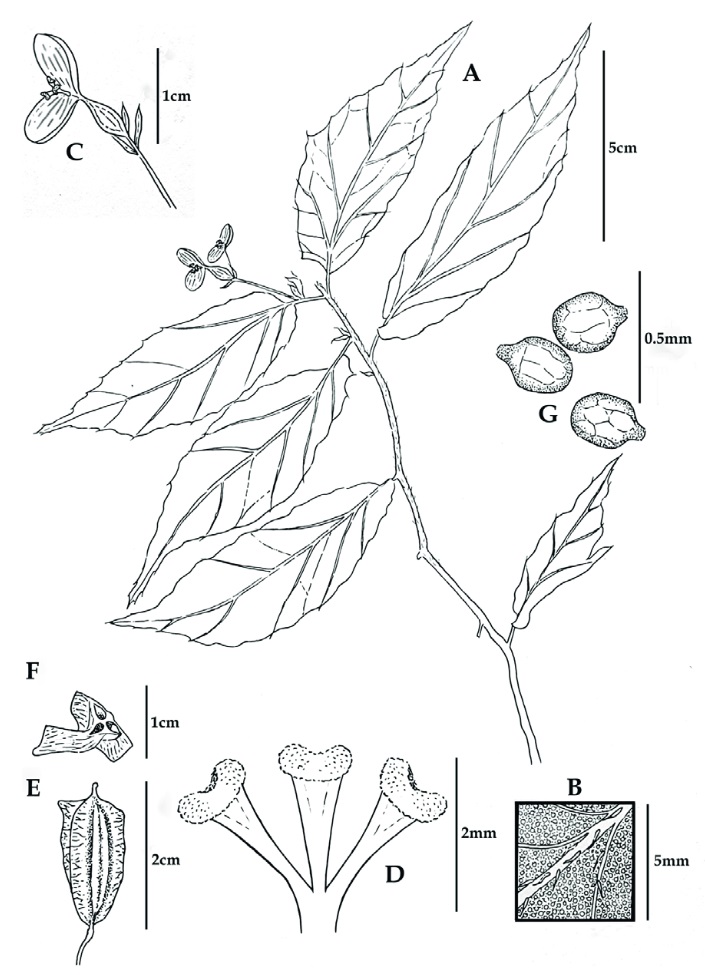
A habit, flowering stem; B. detail of abaxial blade surface showing midrib and hairs; C. female flower and inflorescence; D. style and stigmas; E fruit, side view showing unequal dorsal wing; F. fruit, transverse section showing locules; G. seeds, side view.
All from Lockwood 61 (K). Drawn by H. Lockwood.

Begonia ebo H.Lockwood sp. nov.

 Diagnosis: Begonia ebo differs from all known species of Begonia Sect. Filicibegonia due to its yellow (not white or pink) perianth lobes, and also in the peculiar posture of the inflorescence, which lie along the groove of the adaxial petiole leaf-blade midrib, the flowers appearing superficially to arise from the middle of the leaf-blade (vs inflorescence sessile, or held above or below the leaf blades).

Etymology: Named as a noun in apposition for the forest of Ebo, Littoral  Region,  whence  most  of  the  known  specimens  were found.


Helen Lockwood and Eric Ngansop Tchatchouang. 2025. Begonia ebo sp. nov. (Sect. Filicibegonia-Begoniaceae), endangered in Ebo, a highly threatened forest in Littoral Region, Cameroon. Webbia. Journal of Plant Taxonomy and Geography. 80(1); 77-87. DOI: doi.org/10.36253/jopt-17739 [2025-04-17]

Thursday, April 17, 2025

[Botany • 2025] Santolina razaneae (Asteraceae) • A New steppic Species from Morocco


Santolina razaneae Homrani-Bakali, Chamboul. & Léger, 
 
in Homrani-Bakali, Chambouleyron et Léger, 2025. 

Abstract
Based on morphological characters, Santolina razaneae, a new Asteraceae species growing in the steppic habitats of eastern Morocco (Moulouya valley and High Plateaus), is described and illustrated. This species is distinguished from other Santolina species present in Morocco by its unique morphological traits, including elliptic leaflets and pinnate leaves with obtuse lobes, triangular, lacerate, and glabrous paleae, and florets with triangular, pale pinkish lobes. A key to the spontaneous Santolina species occurring in Morocco is provided. 

Compositae, Distribution, Endemics, Morphological traits, Taxonomy, Varieties, Eudicots


Santolina razaneae Homrani-Bakali, Chamboul. & Léger sp. nov.


Abdelmonaim HOMRANI BAKALI, Mathieu CHAMBOULEYRON and Jean-François LÉGER. 2025. Santolina razaneae (Asteraceae), A New steppic Species from Morocco. Phytotaxa. 693(3); 235-244. DOI: doi.org/10.11646/phytotaxa.693.3.4 [2025-03-14]
 facebook.com/HomraniBakali
www.teline.fr/en/photos/asteraceae/santolina-razaneae
Researchgate.net/publication/389851037_Santolina_razaneae_a_new_steppic_species_from_Morocco

Sunday, February 23, 2025

[Botany • 2023] Lindernia barthlottii (Linderniaceae) • A New Species from Inselbergs in northern Madagascar


Lindernia barthlottii  Eb.Fisch., Andriant. & Sieder,

in Fischer, Andriantiana et Sieder, 2023.  
 
Abstract
The new species Lindernia barthlottii from an inselberg in Northern Madagascar is described and illustrated. It differs from all Madagascan Lindernia species in the small rosulate habit with condensed stems, the broad obtuse sepals, and the large and except for the palate entirely blue corolla. A short discussion on the other four species of Linderniaceae (Linderniella cerastioides, L. horombensis, L. pygmaea, Crepidorhopalon microcarpaeoides) endemic to inselbergs in Madagascar is provided.

Eudicots, endemic, Linderniella cerastioidesL. horombensisL. pygmaeaCrepidorhopalon microcarpaeoides, ephemeral flush vegetation, taxonomy


 Lindernia barthlottti Eb.Fisch., andriant. & Sieder sp. nov.
a,. detail of habitat.-b. habit.
Photographs: a.Sieder, 8 February 2020. Scale bars: a. 5 mm -b. 2 mm.


EBERHARD FISCHER, JACKY LUCIEN ANDRIANTIANA and ANTON SIEDER. 2023. Lindernia barthlottii (Linderniaceae), A New Species from inselbergs in Madagascar.  Phytotaxa. 626(3)191-198. DOI: doi.org/10.11646/phytotaxa.626.3.5