Showing posts with label Author: Bauer. Show all posts

Thursday, October 3, 2019

[Herpetology • 2019] Cnemaspis aaronbaueri • A Cryptic New Species of Cnemaspis Strauch, 1887 (Squamata: Gekkonidae) from the Western Ghats of Kerala State of India


Cnemaspis aaronbaueri 
Sayyed, Grismer, Campbell & Dileepkumar, 2019

Abstract
We describe cryptic new species of gecko of the genus Cnemaspis Strauch from the southern Western Ghats of Kerala. This medium-sized Cnemaspis species is differentiated from all other Indian congeners by a suite of the following distinct morphological characters: heterogeneous mid-dorsal scales, 6–7 supralabials; 113–120 paravertebral rows of tubercles; 71–85 mid-dorsal scales; absence of spine-like tubercles on flanks; subimbricate, smooth ventral scales; 135–140 mid-ventral scales; subdigital lamellae under fourth digit of manus 23–25; subdigital lamellae under fourth digit of pes 24–25; males with 7–8 precloacal pores; median row of subcaudals enlarged, smooth, a series of two large scales alternating, containing one divided scale; head and neck colouration brownish-yellow, consistent in adult males; adult females with orange coloured head and neck. Recent new descriptions of Cnemaspis species together with the present discovery show that the southern Western Ghats species have been overlooked by previous studies. Therefore we suggest further studies to evaluate the diversity of Cnemaspis in this region.

Keywords: Reptilia, Day-gecko, lizard, Cnemaspis ornata, southern Western Ghats


Cnemaspis aaronbaueri sp. nov.

Etymology. The specific epithet is a patronym, honouring Professor Dr. Aaron M. Bauer of Villanova University, USA for his contributions to herpetology.


Amit Sayyed, L. Lee Grismer, Patrick D. Campbell and Raveendran Dileepkumar. 2019. Description of A Cryptic New Species of Cnemaspis Strauch, 1887 (Squamata: Gekkonidae) from the Western Ghats of Kerala State of India. Zootaxa. 4656(3); 501–514. DOI:10.11646/zootaxa.4656.3.7


Sunday, March 31, 2019

[Herpetology • 2019] Trachylepis raymondlaurenti • A New Long-tailed Skink (Scincidae: Trachylepis) from Angola and the Democratic Republic of the Congo


Trachylepis raymondlaurenti 
Marques, Ceríaco, Bandeira, Pauwels & Bauer, 2019

Laurent’s Long Tailed Skink || DOI: 10.11646/zootaxa.4568.1.3
Photo by Luis M. P. Ceríaco.

Abstract
Angola and the Democratic Republic of the Congo are relatively unknown in terms of their herpetological diversity. Based on specimens collected in the Congolese region of the Katanga and the northeast of Angola during the first decades of the twentieth century, de Witte and Laurent independently suggested, based on morphological and coloration differences, that populations of T. megalura of these regions could belong a new “race”. We compared specimens of T. megalura (including the type specimens of T. megalura and T. massaiana) with Angolan and Katangan museum specimens as well as newly collected specimens from Angola. Coloration pattern and morphological characters, in combination with substantial divergence in the 16S mitochondrial gene, confirm the distinctiveness of the west Central African form, and it is here described as a new species. Data regarding its natural history, ecology and global distribution are presented.

 Keywords: Reptilia, Taxonomy, Trachylepis raymondlaurenti sp. nov., Cangandala National Park, Upemba National Park, Central Africa, type-specimens, nomenclature


FIGURE 3. Live specimen of Trachylepis megalura (EBG 1408) from Lwiro, South Kivu Province, DRC. Note the prominent white flank stripe.
Photo by Eli B. Greenbaum.

Holotype of Trachylepis raymondlaurenti sp. nov. (CAS 258401) from Cangandala National Park, Angola in life.
Photo by Luis M. P. Ceríaco.

Holotype of Trachylepis raymondlaurenti sp. nov. (CAS 258401) from Cangandala National Park, Angola.

Trachylepis raymondlaurenti 
Marques, Ceríaco, Bandeira, Pauwels & Bauer sp. nov. 

 Mabuya megalura (de Witte 1953: 107) 
Mabuya megalura subsp. (Laurent 1964: 74) 
Trachylepis megalura (Broadley & Cotterill 2004: 42 [partim]) 
Trachylepis cf. megalura (Ceríaco et al. 2016b: 71; 2018b: 423; Marques et al. 2018: 264)

Etymology. The species is named after Raymond F. Laurent (1917–2005), Belgian herpetologist who specialized in African amphibians and reptiles and contributed significantly to current knowledge of the Angolan and Congolese herpetofaunas. 
We propose the English name "Laurent’s Long Tailed Skink", the Portuguese name "Lagartixa de Cauda Longa de Laurent", and the French name "Scinque à longue queue de Laurent".


 Mariana P. Marques, Luis M. P. Ceríaco, Suzana Bandeira, Olivier S. G. Pauwels and Aaron M. Bauer. 2019. Description of A New Long-tailed Skink (Scincidae: Trachylepis) from Angola and the Democratic Republic of the Congo. Zootaxa. 4568(1); 51–68. DOI: 10.11646/zootaxa.4568.1.3

Friday, February 22, 2019

[Herpetology • 2019] Nucras aurantiaca • A New Nucras Gray, 1838 (Squamata: Lacertidae) from the Strandveld of the Western Cape, South Africa


Nucras aurantiaca
Bauer, Childers, Broeckhoven & Mouton, 2019

Abstract
striking new sandveld lizard of the Nucras tessellata group is described from the Lambert’s Bay Strandveld of the Western Cape Province, South Africa. It is sister to the clade N. livida + N. tessellata, and is phenetically most similar to N. tessellata, from which it differs in its more elongate body and possibly increased number of presacral vertebrae and patternless orange dorsal coloration. The form elegans, described as a species by Andrew Smith (1838), but treated as an infrasubspecific variant by Broadley (1972), also exhibits weak patterning, but is likely a regional color variant. Nucras aurantiaca sp. nov. is the ninth member of the genus found in southern Africa. Its discovery in the well-collected coastal Western Cape suggests that further herpetofaunal surveys are needed in this region, which is threatened by agricultural activity and tourism-related development.

Keywords: Reptilia, Sandveld lizard, Lambert’s Bay, description, molecular phylogeny

 Nucras aurantiaca sp. nov., Holotype specimen NMB R11626 from Lambert’s Bay in captivity.

Nucras aurantiaca sp. nov. 
Lambert’s Bay Sandveld Lizard

 Etymology: The specific epithet auriantiaca refers to the conspicuous, mostly unmarked orange dorsal coloration of the new species.


Aaron M. Bauer, Jackie L. Childers, Chris Broeckhoven and P. le Fras N. Mouton. 2019. A New Nucras Gray, 1838 (Squamata: Lacertidae) from the Strandveld of the Western Cape, South Africa. Zootaxa. 4560(1); 149–163.  DOI:  10.11646/zootaxa.4560.1.8

Friday, December 7, 2018

[Herpetology • 2018] Panaspis namibiana • A New Species of African Snake-eyed Skink (Scincidae: Panaspis) from central and northern Namibia


Panaspis namibiana 
 Ceríaco, Branch & Bauer, 2018


Abstract
A recent molecular revision of the snake-eyed skinks of the genus Panaspis Cope, 1868 uncovered extensive cryptic diversity within the P. wahlbergi (Smith, 1849) and P. maculicollis Jacobsen & Broadley, 2000 species complexes. We here describe an unnamed central and northern Namibian lineage of the P. maculicollis group as a new species. We base the description on previously published molecular evidence and newly collected morphological, meristic and coloration data. Members of the group share a conservative morphology and the newly described species is very similar to P. maculicollis, from which it differs mostly on the basis of its coloration. This description raises the number of Panaspis recognized to 17 species and reinforces the already strong evidence that northern Namibia is a hotspot of reptile diversity.

Keywords: Reptilia, endemism, Panaspis namibiana, arid environments, cryptic species, taxonomy


Luis M. P. Ceríaco, William R. Branch and Aaron M. Bauer. 2018. A New Species of African Snake-eyed Skink (Scincidae: Panaspis) from central and northern Namibia. Zootaxa. 4527(1); 140–150. DOI:  10.11646/zootaxa.4527.1.12

Monday, November 26, 2018

[Herpetology • 2018] Six New Cyrtodactylus (Squamata: Gekkonidae) from northeast India; Cyrtodactylus guwahatiensis, C. kazirangaensis, C. septentrionalis, C. jaintiaensis, C. montanus & C. nagalandensis


Cyrtodactylus kazirangaensis 
Agarwal, Mahony, Giri, Chitanya & Bauer, 2018


Abstract
We use mitochondrial sequence data to identify divergent lineages within the gekkonid genus Cyrtodactylus in northeast India and use morphological data to describe six new species from within the Indo-Burma clade of Cyrtodactylus. The new species share an irregular colour pattern but differ from described species from the region in morphology and mitochondrial sequence data (>11 % uncorrected pairwise sequence divergence). Three new species are from along the Brahmaputra River and three are from mountains south of the Brahmaputra, including the largest Cyrtodactylus from India and the fifth gecko to be described from a major Indian city, Guwahati.

Keywords: Reptilia, Cyrtodactylus khasiensis, endemic species, morphology, Myanmar, ND2, taxonomy

....

Results:
We recovered the same topology as Agarwal et al. 2014, with moderate support for the south of Brahmaputra clade (Fig. 2). A basal split within the south of Brahmaputra clade separates a mountain (clade M in Agarwal et al. 2014) and lowland clade (clade N), which contain a total of seven, unnamed divergent lineages. The lowland clade includes taxa from lowlands south of the Brahmaputra—the species C. ayeyarwadyensis Bauer, C. khasiensis, and C. tripuraensis Agarwal, Mahony, Giri, Chaitanya and Bauer; and the new species C. guwahatiensis sp. nov., C. kazirangaensis sp. nov., and C. septentrionalis sp. nov. The mountain clade has three species from Myanmar, C. brevidactylus Bauer, C. chrysopylos Bauer, and C. gansi Bauer; and the new species C. jaintiaensis sp. nov., C. montanus sp. nov., C. nagalandensis sp. nov. and the unnamed C. sp. Mizoram from mountains in northeast India. ND2 p-distance results are provided in Table 2 and are discussed below in comparisons sections. We describe six of these genetically divergent lineages from across the lowland and mountain clades as new species below.


FIGURE 3. Cyrtodactylus guwahatiensis sp. nov. in life (adult male holotype, BNHS 2146).

Cyrtodactylus guwahatiensis sp. nov.

Etymology. The specific epithet is a toponym for the type locality of the species, Guwahati, the largest city in Assam and northeast India.


FIGURE 6. Cyrtodactylus kazirangaensis sp. nov. in life (adult male paratype BNHS 2149).

Cyrtodactylus kazirangaensis sp. nov. 

Etymology. The specific epithet is a toponym for Kaziranga National Park, which is adjacent to the type locality. Kaziranga, a World Heritage Site, is best known for having most of the world’s surviving Indian one-horned rhinoceros, though it has high biodiversity across taxonomic groups.


Cyrtodactylus septentrionalis sp. nov.

Etymology. The specific epithet is a nominative, masculine, singular, Latin adjective meaning “northern”, as this species is the only known member of the lowland clade (Agarwal et al. 2014) that is found north of the Brahmaputra River, the other five known species of the clade are found south of the Brahmaputra River.


Cyrtodactylus jaintiaensis sp. nov. 

Etymology. The specific epithet is a toponym named after the type locality of the new species in the Jaintia Hills, West Jaintia Hills district, Meghalaya.


Cyrtodactylus montanus sp. nov. 

Etymology. The specific epithet is a nominative, masculine, singular, Latin adjective meaning “pertaining to a mountain” as this species is a member of the mountain clade, and is restricted to a mountainous region in northwestern Tripura.


Cyrtodactylus nagalandensis sp. nov. 

Etymology. This is the first endemic gecko from Nagaland, and the specific epithet is a toponym for the state. 

  
 Ishan Agarwal, Stephen Mahony, Varad B. Giri, R. Chitanya and Aaron M. Bauer. 2018. Six New Cyrtodactylus (Squamata: Gekkonidae) from northeast India. Zootaxa.  4524(5); 501–535.  DOI:  10.11646/zootaxa.4524.5.1

Tuesday, July 24, 2018

[Herpetology • 2018] Cyrtodactylus chamba • A New Bent-toed Gecko (Squamata: Gekkonidae: Cyrtodactylus) from the Western Himalayas, Himachal Pradesh, India


Cyrtodactylus chamba 
Agarwal, Khandekar & Bauer, 2018


Abstract
We describe a new species of the gekkonid genus Cyrtodactylus based on a series of six specimens from the Chamba Valley in the Western Himalayas, Himachal Pradesh state, India. Cyrtodactylus chamba sp. nov. is a member of the subgenus Siwaligekko and can be diagnosed from congeners in the Western Himalayas by a combination of its small size (snout to vent length up to 63 mm), a continuous series of five precloacal pores on males, 13–15 rows of dorsal tubercles, 33–43 scales across the belly, no regular series of enlarged subcaudals, and a dorsal colour pattern of 5–7 irregular, broad, dark bands with much narrower, light interspaces. The new species is 14% divergent in ND2 sequence from the most similar sampled congener, Cyrtodactylus (Siwaligekkohimalayanus from Jammu and Kashmir, and is 0.5–1.1% divergent in nuclear sequence data from sampled Siwaligekko species. Many more undiscovered Cyrtodactylus species probably exist across the Himalayas at elevations below ~2000 m; basic field surveys for reptiles and other poorly known groups and examination of existing material should be a priority if we are to appreciate the true diversity of this spectacular mountainous landscape.

Keywords: Reptilia, Alpha taxonomy, Cyrtodactylus lawderanus, Himalayas, lizard, ND2, Siwaligekko, systematics, taxonomy

FIGURE 8. Type series of Cyrtodactylus chamba sp. nov. in life,
 BNHS 2330 (top left), BNHS 2331 (top right),
BNHS 2333 (bottom left), BNHS 2334 (bottom right).

Cyrtodactylus chamba sp. nov. 
Cyrtodactylus sp. Chamba (Agarwal et al. 2014a)

Etymology. The specific epithet is the name of the type locality of the species and is used as a noun in apposition. Cyrtodactylus chamba sp. nov. is only known from around Chamba, in the Chamba Valley, Himachal Pradesh, India. 
Suggested common name. Chamba bent-toed gecko


 Ishan Agarwal, Akshay Khandekar and Aaron M. Bauer. 2018. A New Bent-toed Gecko (Squamata: Gekkonidae: Cyrtodactylus) from the Western Himalayas, Himachal Pradesh, India. Zootaxa. 4446(4); 442–454. DOI:  10.11646/zootaxa.4446.4.2

Agarwal, I., Bauer, A.M., Jackman, T.R. & Karanth, K.P. 2014. Insights into Himalayan Biogeography from Geckos: A Molecular Phylogeny of Cyrtodactylus (Squamata: Gekkonidae). Molecular Phylogenetics and Evolution. 80, 145–155. DOI:  10.1016/j.ympev.2014.07.018


Saturday, February 10, 2018

[Herpetology • 2018] Hemidactylus malcolmsmithi • On the Status of Cyrtodactylus malcolmsmithi (Constable, 1949)


Hemidactylus malcolmsmithi  (Constable, 1949)

in Agarwal, Giri & Bauer, 2018.

Abstract
Cyrtodactylus malcolmsmithi was described by Constable in 1949 in the genus Gymnodactylus on the basis of its apparently undivided subdigital lamellae. The species has not been collected since and only finds mention in some checklists and new Cyrtodactylus descriptions. We recently examined the holotype and paratype of this enigmatic taxon and discovered that the subdigital lamellae are divided. The species is accordingly transferred to the genus Hemidactylus, within which it is a member of the Hemidactylus brookii complex and a valid speciesHemidactylus malcolmsmithi comb. nov. We assign recently sampled populations to this taxon and provide a diagnosis against congeners from the Indian subcontinent and a summary of characters for the species.

Keywords: Gekkonidae, HemidactylusHemidactylus brookii complex, Hemidactylus malcolmsmithi, India, South Asia

Figure 4. Hemidactylus malcolmsmithi in life (CES/11/050).
 Figure 2. View of left manus of Hemidactylus malcolmsmithi (left panel, CES/11/052 in life; right panel, holotype MCZ-R-3252).

Hemidactylus malcolmsmithi in life (CES/11/050).

Systematics
 Hemidactylus malcolmsmithi comb. nov. 
 Gymnodactylus malcolmsmithi Constable, 1949 
Cyrtodactylus malcolmsmithi Underwood, 1954
....

Natural History and Distribution. Hemidactylus malcolmsmithi is nocturnal and may be seen on the ground as well as low rocks, road cuttings, and buildings at night. The species is known from across the lowlands of Himachal and Jammu (up to about 1,500 m), and from a few specimens from Odisha and Rajasthan (Lajmi et al., 2016), though it is unclear what the native range of this species is, and which, if any, of these localities represent human translocations, with further sampling needed to determine its distributional range.

....

The status of the enigmatic taxon H. malcolmsmithi is finally resolved, through a combination of relatively recent field sampling, a careful examination of .140-year-old museum specimens, and recent publications on the H. brookii complex (Mahony, 2011; Lajmi et al. 2016). Constable initially did think he had a Hemidactylus before him, but the poor condition of the specimens and the opinions of two experts led him to place the species in Gymnodactylus. Interestingly, Khan (2010) opined that this species might be a misidentified specimen of H. brookii, and I.A. thought he might have this species when collecting Hemidactylus from around the Beas River basin (which we now know are in fact H. malcolmsmithi). However, the appearance of the lamellae in the types, which are longitudinally folded over themselves, had led previous researchers to erroneous conclusions.
....


 Ishan Agarwal, Varad B. Giri and Aaron M. Bauer. 2018. On the Status of Cyrtodactylus malcolmsmithi (Constable, 1949). Breviora. 557; 1-11.   DOI: 10.3099/MCZ41.1 


Monday, November 27, 2017

[Herpetology • 2017] Hemidactylus sushilduttai • A New Species of Large-bodied, Tuberculate Hemidactylus Oken (Squamata: Gekkonidae) from the Eastern Ghats, India


Hemidactylus sushilduttai
Giri Bauer, Mohapatra, Srinivasulu & Agarwal, 2017


Abstract

A distinct new gecko of the genus Hemidactylus is described from Andhra Pradesh, India. This large-sized (snout to vent length up to at least 105 mm), scansorial Hemidactylus is characterized by dorsal scalation of small granules intermixed with large, pointed, trihedral tubercles that form 16–17 fairly regularly arranged longitudinal rows at midbody; 9–11 subdigital lamellae below the first and 11–13 below the fourth digit; 6–8 strongly pointed and keeled enlarged tubercles on the original tail; 20–23 femoral pores separated by 4 poreless scales in males; 11–13 supralabials and 9–11 infralabials. This is the third vertebrate endemic to the Mahendragiri Range, highlighting the significance of this topographically complex region.

 Keywords: Reptilia, Hemidactylus, Gekkonidae, Andhra Pradesh, Eastern Ghats, India


FIGURE 7. Hemidactylus sushilduttai sp. nov. in life, A) holotype NCBS-AU157, B) paratype ESV 109. Photos by Ishan Agarwal. 


This species was named after Prof. Sushil Dutta in honour of his immense contributions in Indian Herpetology.


Varad B. Giri,  Aaron M. Bauer, Pratyush P. Mohapatra, Chelmala Srinivasulu and Ishan Agarwal. 2017. A New Species of Large-bodied, Tuberculate Hemidactylus Oken (Squamata: Gekkonidae) from the Eastern Ghats, India. Zootaxa. 4347(2); 331–345. DOI:  10.11646/zootaxa.4347.2.8


Tuesday, September 26, 2017

[Herpetology • 2017] Naja peroescobari • A New Species of Naja Laurenti, 1768 (Squamata: Elapidae): The “Cobra-preta” of São Tomé Island, Gulf of Guinea


Naja (Boulengerina) peroescobari  
Ceríaco, Marques, Schmitz & Bauer, 2017

Photo: T. Pisoni. 
DOI: 10.11646/zootaxa.4324.1.7 

Abstract

The Cobra-Preta (black snake in Portuguese) of Sao Tomé Island in the Gulf of Guinea has historically been referred to as Naja (Boulengerina) melanoleuca (Squamata: Elapidae). Its presence on the island has been traditionally explained as an introduction from the mainland by Portuguese settlers, supposedly to control the rat population. This explanation has been widely accepted by local authorities and even international conservation agencies. The taxonomic identity of this snake has remained undisputed by all taxonomists who have published about it, with the exception of L. Capocaccia in 1961. Arguments supporting the human introduction hypothesis are weak and are contradicted by historical, morphological and molecular data. Further, the biogeographic history of the Gulf of Guinea oceanic islands and recent insights on the taxonomic identity and evolutionary history of other taxonomic groups occurring there suggest that the Cobra-Preta, in fact, represents a distinct lineage of the melanoleuca group, endemic to São Tomé. We here describe the Cobra Preta as a new species. The new species differs from N. (B.) melanoleuca, its sister species, by a distinct coloration ventral pattern and the type of contact of the sublingual scales. Data on the toxicology, distribution, ecology, folklore and conservation status of the new species are presented.

Keywords: Reptilia, NajaBoulengerina, taxonomy, São Tomé & Príncipe, conservation, Naja (Boulengerina) peroescobari sp. nov.


FIGURE 4. Holotype of Naja (Boulengerina) peroescobari sp. nov. (MUHNAC / MB 03 – 001065).

FIGURE 5. Live picture of Naja (Boulengerina) peroescobari  sp nov. from near Santa Josefina. Specimen not collected. Photo by Tiziano Pisoni. 


Luis M. P. Ceríaco, Mariana P. Marques, Andreas Schmitz and Aaron M. Bauer. 2017. The “Cobra-preta” of São Tomé Island, Gulf of Guinea, is A New Species of Naja Laurenti, 1768 (Squamata: Elapidae). Zootaxa. 4324(1); 121–141.  DOI: 10.11646/zootaxa.4324.1.7


Wednesday, May 17, 2017

[Herpetology • 2017] Trachylepis gonwouoi • A New Species of Trachylepis (Squamata: Scincidae) from Central Africa and A Key to the Trachylepis of West and Central Africa


Trachylepis gonwouoi 
Allen, Tapondjou, Welton & Bauer, 2017  
 DOI:  
10.11646/zootaxa.4268.2.5 

Abstract

A new species of skink, Trachylepis gonwouoi sp. nov. is described from Cameroon and the Republic of the Congo. It differs from all other species of Trachylepis in Central-West Africa by a combination of number of keels on dorsal scales (3–5); moderate SVL (maximum size of 80 mm); number of scale rows at midbody (28–34); number of supracilliaries (6–10); a well defined lateral white stripe, bordered by black, extending from under the eye to the insertion of the hind limb; and a ventral color in life of bright blue-green. Trachylepis gonwouoi sp. nov. was found in association with disturbed forest at elevations from 50 to 1050m. This species is syntopic with T. affinis and T. maculilabris. In order to aid in the identification of Trachylepis in West and Central Africa with the addition of T. gonwouoi sp. nov., we provide an updated key to the Trachylepis found from Mauritania through the Democratic Republic of the Congo. This key combines previous literature that treated Western and Central African taxa separately and represents the most comprehensive key for Trachylepis in West-Central Africa to date.

Keywords: Skink, Cameroon, Central-West Africa, systematics, key, Reptilia


Kaitlin E. Allen, Walter P. Tapondjou N., Luke J. Welton and Aaron M. Bauer. 2017. A New Species of Trachylepis (Squamata: Scincidae) from Central Africa and A Key to the Trachylepis of West and Central Africa.
 Zootaxa. 4268(2); 255–269. DOI:  10.11646/zootaxa.4268.2.5


Monday, February 20, 2017

[Herpetology • 2010] Cyrtodactylus dumnuii • A New Cave-dwelling Gecko (Squamata: Gekkonidae) from Chiang Mai Province, Thailand


ตุ๊กกายดำนุ้ย, Cyrtodactylus dumnuii 
 Bauer, Kunya, Sumontha, Niyomwan, Pauwels, Chanhome & Kunya, 2010

Abstract

A new cave-dwelling species of Cyrtodactylus is described from Chiang Mai Province in northern Thailand. Cyrtodactylus dumnuii sp. nov. may be distinguished from all other congeners by the possession of a series of enlarged femoral scales, disjunct precloacal and femoral pores in males (minute precloacal pores variably present in females), a relatively high number (18–22) of closely spaced, regularly arranged dorsal tubercle rows, well-defined non-denticulate ventrolateral folds, transversely enlarged subcaudal plates, and a color pattern of approximately six pairs of alternating light and dark transverse bands on the trunk. It is the nineteenth member of the genus recorded from Thailand and the eighth Thai Cyrtodactylus known to be a facultative troglophile.

Keywords: Thailand; Chiang Mai; Reptilia; Gekkonidae; Cyrtodactylus dumnuii; new species; taxonomy; cave-dwelling


Aaron M. Bauer, Kirati Kunya, Montri Sumontha, Piyawan Niyomwan, Olivier S. G. Pauwels, Lawan Chanhome and Tunyakorn Kunya. 2010.
 Cyrtodactylus dumnuii (Squamata: Gekkonidae), A New Cave-dwelling Gecko from Chiang Mai Province, Thailand.
 Zootaxa. 2570: 41–50.   mapress.com/j/zt/article/view/9399

ตุ๊กกายดำนุ้ย Cyrtodactylus dumnuii (Squamata : Gekkonidae)
ตุ๊กกายถ้ำสายพันธุ์ใหม่ที่พบในจังหวัดเชียงใหม่(2551)
ตุ๊กกายตัวแรกที่ได้ตั้งชื่อให้ ตั้งเป็นเกียรติ กับนายโสภณ ดำนุ้ย ขณะที่ดำรงตำแหน่งผู้อำนวยการองค์การสวนสัตว์ในพระบรมราชูปถัมภ์
ค้นพบตุ๊กกายสายพันธุ์ใหม่ในสกุล Cyrtodactylusที่จังหวัดเชียงใหม่ สามารถแยกตุ๊กกายดำนุ้ย (Cyrtodactylus dumnuii sp. nov.) จากตุ๊กแกในชั้นเดียวกันโดย การมีเกล็ดขา (femoral scales) ขนาดใหญ่ การมีรูเปิดหน้าทวารร่วม (precloacal pore) และรูเปิดขาพับใน (femoral pore) ที่ไม่ต่อกันในเพศผู้ (สามารถพบรูเปิดหน้าทวารร่วม (precloacal pore) ขนาดเล็กได้บ้างในเพศเมีย) แนวปุ่มนูนกลางหลัง (dorsal tubercle) เรียงชิดกันอย่างเป็นระเบียบจำนวนมาก (18-22) รอยพับข้างลำตัว (ventrolateral folds) ชัดเจน subcaudal platesขยายขนาดในแนวข้าง และลายแถบขวางบริเวณช่วงลำตัว (trunk) สลับสีอ่อนเข้มจำนวน 6คู่ ตุ๊กกายดำนุ้ยเป็นตุ๊กกายในสกุล Cyrtodactylus ชนิดที่ 19 ที่พบในประเทศไทย และเป็นตุ๊กกายไทยชนิดที่ 8ในกลุ่มตุ๊กกายที่อาศัยอยู่ในถ้ำ (facultative troglophile)
Key words:Thailand, Chiang Mai, Reptilia, Gekkonidae, Cyrtodactylus dumnuii, new species, taxonomy, cave-dwelling

สกุล Cyrtodactylus Gray เป็นสกุลที่มีจำนวนชนิดของตุ๊กกายมากที่สุดในวงศ์ตุ๊กแก โดยมีประมาณ 120 ชนิด ประมาณครึ่งหนึ่งของสกุลนี้ถูกค้นพบในทศวรรษที่ผ่านมา (Uetz 2010) แหล่งที่มีการค้นพบมากที่สุดอยู่ในแถบเอเชียตะวันออกเฉียงใต้ ตัวอย่างเช่น การศึกษาในประเทศเวียดนาม ได้มีการค้นพบตุ๊กกายทั้งหมด 19 ชนิด ซึ่งส่วนใหญ่เป็นสัตว์ท้องถิ่น และส่วนมากพบในเขตหินปูน หรือตามถ้ำหินปูน (e.g., Nazarov et al. 2008; Ngo 2008; Ngo & Bauer 2008; Ngo et al. 2008; Ziegler et al. 2010 และอ้างอิงอื่นๆที่มีการกล่าวถึง) ในประเทศไทย Baueret al.(2002) ค้นพบ Cyrtodactylus จำนวนทั้งสิ้น 13ชนิด อีก 5ชนิดได้มีการค้นพบในพื้นที่ต่างๆทั่วประเทศในเวลาต่อมา (Baueret al.2003; Pauwels et al. 2004; Baueret al. 2009; Sumontha et al. 2010) ซึ่งหลายชนิดมาจากถ้ำหินปูน (Sumontha et al. 2010) ในครั้งนี้จะทำการอธิบายลักษณะของตุ๊กกายชนิดใหม่ที่ค้นพบในถ้ำหินปูนในจังหวัดเชียงใหม่
กีรติ กันยาและมนตรี สุมณฑา


Wednesday, October 12, 2016

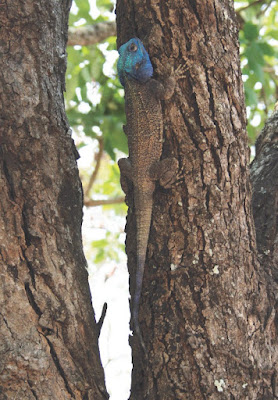
[Herpetology • 2012] Acanthocercus branchi • A New Species of the Acanthocercus atricollis complex (Squamata: Agamidae) from Zambia


Acanthocercus branchi  
      Wagner, Greenbaum & Bauer, 2012 

Abstract
In the course of working on a taxonomic revision of the Acanthocercus atricollis complex, we discovered a population from the Luangwa and Zambezi valleys in Zambia and adjacent Malawi that is morphologically and genetically distinct from all described taxa of this complex. This population is described as a new species on the basis of morphological characters, including indistinct transverse rows of enlarged scales on the body, a large black patch on the shoulders, and a different pholidosis. It is morphologically similar to A. a. gregorii and A. a. loveridgei, but seems to be more closely related to the former.

Key words. Squamata, Agamidae, Acanthocercus atricollis, new species, Africa, Zambia, Malawi, Zambezi Valley, Luangwa Valley.

Figure 2. (a) Holotype of Acanthocercus branchi sp. n. (ZFMK 88682) in life from near Chipata (see text for details), Zambia. (b) Typical habitat of Acanthocercus branchi sp. n. near Chipata, Zambia. 

Distribution: The new species is known from localities within the Luangwa (Chipata, Chikowa, Sayiri Court) and Zambezi (Lusaka) valleys in Zambia.

Habitat and ecology: This new species is a tree dweller as it is typical for the A. atricollis complex (Reaney & Whiting 2003), although not for all subspecies (Wagner unpubl. data). In Chipata, it was collected in dense Miombo woodland with large trees and a structured canopy. In Lusaka, it was captured on a solitary tree. At both localities, other individuals were also observed, but it was not possible to identify them as males or females. Specimens from Pioneer Camp were observed while climbing on tree trunks.


Etymology: This new species is named in honour of our friend and colleague William Roy Branch, in recognition of his important contributions to our knowledge of African amphibians and reptiles over several decades, and in commemoration of his nominal retirement as curator of herpetology at the Port Elizabeth Museum (Bayworld).


 Philipp Wagner, Eli Greenbaum and Aaron Bauer. 2012. A New Species of the Acanthocercus atricollis complex (Squamata: Agamidae) from Zambia.
SALAMANDRA48(1); 21–30. 

Saturday, September 24, 2016

[Herpetology • 2016] Cyrtodactylus varadgirii • A New Species of the Cyrtodactylus (Geckoella) collegalensis (Beddome, 1870) complex (Squamata: Gekkonidae) from Western India


Cyrtodactylus varadgirii 

Agarwal, Mirza, Pal, Maddock, Mishra & Bauer, 2016


Abstract
A new species of Cyrtodactylus (Geckoella) from the C. collegalensis complex is described based on a series of specimens from western and central India. Morphological and molecular data support the distinctiveness of the new form, which can be diagnosed from other Cyrtodactylus (including other Geckoella) species by its small body size (snout to vent length to 56 mm), the absence of precloacal and femoral pores, no enlarged preanal or femoral scales, and a dorsal scalation consisting wholly of small, granular scales. The new species is most closely related to C. collegalensis, C. speciosus and C. yakhuna, from which it differs by the presence of a patch of enlarged roughly hexagonal scales on the canthus rostralis and beneath the angle of jaw, its relatively long limbs and narrow body, and a dorsal colour pattern of 4–6 pairs of dark spots.

Keywords: Reptilia, Cyrtodactylus, Geckoella, Geckoella speciosus, India, cyt b, ND2


Agarwal, Ishan, Zeeshan A. Mirza, Saunak Pal, Simon T. Maddock, Anurag Mishra and Aaron M. Bauer. 2016. A New Species of the Cyrtodactylus (Geckoellacollegalensis (Beddome, 1870) complex (Squamata: Gekkonidae) from Western India.
Zootaxa. 4170(2): 339–354.  DOI: 10.11646/zootaxa.4170.2.7


Tuesday, May 31, 2016

[Herpetology • 2016] Resolving the Higher-Order Phylogenetic Relationships of the Circumtropical Mabuya group (Squamata: Scincidae): An Out-of-Asia Diversification


Highlights
• Concatenated and species tree approaches resolve intergeneric relationships of Mabuya group.
• Southeast Asian lineages are found to be non-monophyletic, supporting Southeast Asian origin of the group.
• Middle-Eastern Trachylepis form a distinct clade and are transferred to a resurrected genus.
Eutropis is rendered polyphyletic by placement of E. novemcarinata sister to Dasia, and a new genus name is provided.

Abstract
Despite an abundance of phylogenetic studies focused on intrageneric relationships of members of the Mabuya group, the intergeneric relationships between the genera within the circumtropical Mabuya group have remained difficult to resolve. The most-persistent unresolved regions of the phylogeny of the group include: (1.) the placement of the Middle-Eastern Trachylepis with respect to the Afro-Malagasy Trachylepis and its taxonomic status; (2.) the phylogenetic position of the Cape Verdean Chioninia within the larger Mabuya group; (3.) support for the placement of Dasia with respect to the entire group; and (4.) the phylogenetic placement of Eutropis novemcarinata with respect to other Eutropis and Dasia. In this study, we include representatives of all these taxa as well as African Eumecia and Neotropical Mabuya. We seek to address these phylogenetic and systematic issues by generating a well-resolved and supported phylogeny for the Mabuya group as a whole that can be used to develop a stable taxonomy and reconstruct the geographic patterns of diversification within the group. To meet these goals, we built a large multi-locus dataset of 11 markers (nine nuclear and two mitochondrial), and performed concatenated and species tree analyses to generate a well-supported phylogeny for the group. Statistical topology tests reject the monophyly of Middle-Eastern Trachylepis with Afro-Malagasy Trachylepis, and to reflect monophyly we place the Middle-Eastern species into a previously described genus, Heremites. Cape-Verdean Chioninia are resolved as the strongly supported sister-group to Afro-Malagasy Trachylepis. Monophyly of the Southeast-Asian genera, Eutropis and Dasia, is not supported, with a clade composed of Dasia + Eutropis novemcarinata more closely related to the rest of the Mabuya group than to the remaining Eutropis. The phylogenetic position of E. novemcarinata renders Eutropis polyphyletic, and we therefore describe and place E. novemcarinata into a new monotypic genus, Toenayar, to preserve monophyly among the genera. In light of these novel findings, we review and discuss the historical biogeography of the entire Mabuya group.

Keywords: species tree; Toenayar gen. nov; novemcarinata; Heremites; Mabuyidae; Mabuyinae

.......

Toenayar gen nov.

  Background: As the most significant line of evidence towards the naming of this genus is genetic, it is possible that other species within Southeast Asia that do not yet have genetic data may also be included within this new genus. Within Eutropis, the species that currently lack genetic data are E. chapaensis, E. darevskii, E. englei, E. floweri, E. gansi, E. innotata, E. quadratilobus, and E. tytleri. Eutropis innotata, in particular, possesses a transparent disc in the eyelid ( Smith 1935) and has been interpreted to be morphologically similar to E. novemcarinata ( Horton 1973), and is, therefore, a potential candidate species for the new genus. Within Dasia, D. griffini, D. nicobarensis, and D. semicincta do not have any genetic data, however D. griffini and D. semicincta were formerly synonymized with Dasia olivacea ( Greer 1970) suggesting that they are closely related, if not conspecific, with D. olivacea. Vietnascincus rugosus, with only the two type specimens known to date ( Darevsky and Orlov 1994), is expected to be part of the Mabuya group, and it is possible that future studies may find it to be a member of the new genus as well. Lamprolepis vyneri, which has been shown to be part of the Mabuya group ( Linkem et al. 2013), is nested within Dasia based on the available ND2 data (results not shown) and is likely to be transferred to Dasia upon further investigation. Thus, although there are some taxa that may ultimately be referable to the new genus, in the absence of any positive evidence of this, we regard it as monotypic.

 Composition: Toenayar gen. nov. includes only its type species Toenayar novemcarinata (Anderson) [จิ้งเหลนเกล็ดสัน].

 Etymology: The generic name comes from the mythology of Myanmar, in which the Toenayar (Pronunciation: “Toh-Ay-Nah-Yar), from the Burmese language, is a mythical dragon or serpent with four legs. The Burmese language has no grammatical gender, but we treat the scientific name, Toenayar, as feminine.

 Description: A medium-sized (SVL to 90 mm), robust skink with well-developed limbs, 32–34 scale rows around the midbody, 7–11 keels on the dorsal scales, adpressed hindlimbs reaching the wrist of the forelimb, 17–21 subdigital lamellae under toe IV, supranasals in contact or slight separation, prefrontals separated or in slight contact, parietals almost always separated by interparietal, frontal in contact with first and second supraocular, one pair of nuchals present, equal in width to two or three adjacent rows of cycloid scales; ear opening with two anterior lobules; 26 presacral vertebrae; palatal rami separated (i.e. open palate); males possess three enlarged, opaque-white heel scales, whereas females do not (Horton, 1973, Smith, 1935 and Taylor, 1963; this study). Color of dorsum light brown, with irregular black spotting; color of thick lateral stripes dark black-brown beginning at the nostril and diminishing posterior to the base of the tail; color of venter cream.

Diagnostic Comparison: Toenayar differs from Mabuya in the number of presacral vertebrae (26 vs. > 27, respectively) and from most species by having keeled (versus smooth) dorsal scales ( Greer et al., 2000 and Mausfeld et al., 2002); from Eumecia in having pentadactyl limbs (versus limb and digital reduction) and Eumecia and Eutropis by having an undivided transparent disk in the lower eyelid and 7–11 keels on the dorsal scales (versus lower eyelid scaly or having greater or less than three keels on dorsal scales); from Dasia by the separation of the palatine bones (open palate) and further by the possession of an undivided transparent disk in the lower eyelid; from Heremites and Trachylepis by the presence of enlarged, differentiated heel scales in males (and enlarged, undifferentiated heel scales in females), and additionally from the vast majority of Trachylepis by possessing 7–11 keels on the dorsal scales; and from Chioninia and Vietnascincus by having 32–34 midbody scale rows and no postnasal scale. Toenayar shares with it’s closest relative, Dasia, male possession of enlarged, differentiated heel scales, however in Toenayar there are three enlarged scales and in Dasia there are two ( Greer 1970).


  Conclusion
The relative degree of external morphological conservatism among members of the Mabuya group has led to a lag in the full understanding and appreciation of the immense diversification that has occurred in the complex. Species within the group have spread across the world making unprecedented dispersals across huge oceanic barriers on several occasions. They have adapted to a diverse array of environments, such as arboreal (e.g., Dasia), semi-aquatic (e.g., Trachylepis ivensii), rupicolous (e.g., Trachylepis sulcata and Trachylepis makolowodei), limb-reduced (Eumecia), and also human-commensalism (e.g., Eutropis multifasciata). Furthermore, species within the group have also evolved an extremely wide range of reproductive strategies from oviparity (assumed as the ancestral condition) to several independent derivations of viviparity, and even to some of the most extreme specializations of fetal membranes observed in all Squamates (Mabuya heathi, Eumecia, Trachylepis ivensii; Blackburn and Flemming, 2009). Finally, with the well-supported intergeneric phylogeny presented in this publication, it is now possible to investigate the incredible diversification that has occurred in the Mabuya group in an evolutionary framework.


Benjamin R. Karin, Margarita Metallinou, Jeffrey L. Weinell, Todd R. Jackman and Aaron M. Bauer. 2016.  Resolving the Higher-Order Phylogenetic Relationships of the Circumtropical Mabuya group (Squamata: Scincidae): An Out-of-Asia Diversification. Molecular Phylogenetics and Evolution