Showing posts with label Author: D.J.Middleton. Show all posts

Saturday, May 23, 2026

[Botany • 2026] Henckelia moniliformis (Gesneriaceae) • A New Species from North-Eastern Thailand


Henckelia moniliformis Sirim., 

in Sirimongkol, Tetsana et Middleton, 2026. 
เศวตนาด้วง หรือ ดาวสร้อยไข่มุก  ||  DOI: doi.org/10.20531/tfb.2026.54.1.06  

Abstract
The new species Henckelia moniliformis (Gesneriaceae) is described from North-Eastern Thailand. A key to the species of Henckelia in Thailand is provided, along with illustrations, notes on the ecology and the IUCN conservation status of the new species.

Keywords: Henckelia amplexifolia, Henckelia nakianensis, Lamiales, revision,taxonomy

Henckelia moniliformis Sirim.:
A.–C. habitat; D. lower leaves; E. flower, side view; F. flower, front view; G. fruit; H. eglandular hairs.
Photos by Naiyana Tetsana.

Henckelia moniliformis Sirim.:
 A. shows undeveloped leaf; B. shows pair of small leaves; C. flower dissection; D. shows moniliform hairs; E. & F. 100X moniliform hairs; G. fruits; H. seeds.
 A.–H. photos by Sukontip Sirimongkol.


Henckelia moniliformis Sirim. sp. nov.

This new species is allied to Henckelia amplexifolia and H. nakianensis in having a campanulate corolla tube which is less than 1 cm long, but differs in having one caducous bract (two persistent bracts in H. amplexifolia and H. nakianensis), two flowers per inflorescence (vs mostly more than two flowers per inflorescence), calyx persistent (vs calyx caducous), two lobes of upper lip hooded (vs two lobes of upper lip straight), anthers with dense moniliform hairs only on the lower half (vs anthers glabrous), staminodes apparently lacking (vs present) and orthocarpic fruit (vs  plagiocarpic  fruit).  It  also  differs  from  H. amplexifolia in having a caulescent habit (acaulescent in H. amplexifolia) and lacking stolons (present in H. amplexifolia) and differs from H. nakianensis in having more than one leaf (only one leaf in H. nakianensis) and the curved filaments (filaments straight in H. nakianensis)


Sukontip Sirimongkol, Naiyana Tetsana, David J. Middleton. 2026. A New Species of Henckelia (Gesneriaceae) from North-Eastern Thailand. Thai Forest Bulletin (Botany), 54(1); 58–63. DOI: doi.org/10.20531/tfb.2026.54.1.06 [2026-05-20] 

"เศวตนาด้วง" พืชชนิดใหม่ของโลก
พืชชนิดใหม่ของโลก ตีพิมพ์ในวารสาร Thai Forest Bulletin (Botany) vol. 54(1):58-63. 2026 โดย ดร. สุคนธ์ทิพย์ ศิริมงคล และ ดร. นัยนา เทศนา กลุ่มงานพฤกษศาสตร์ป่าไม้ สำนักวิจัยการอนุรักษ์ป่าไม้และพันธุ์พืช กรมอุทยานแห่งชาติ สัตว์ป่า และพันธุ์พืช ร่วมกับ Dr David J. Middleton นักพฤกษศาสตร์จากสวนพฤกษศาสตร์เอดินบะระ สกอตแลนด์ ผู้เชี่ยวชาญพืชวงศ์ชาฤาษี (Gesneriaceae) ของโครงการพรรณพฤกษชาติประเทศไทย (Flora of Thailand) ซึ่งพรรณไม้ชนิดนี้พบโดยทีมสำรวจพรรณไม้ภายใต้โครงการวิจัยความหลากหลายของพันธุ์พืชในระบบนิเวศเขาหินปูน บริเวณอำเภอนาด้วง จังหวัดเลย โดยตัวอย่างพรรณไม้ต้นแบบ (Holotype) N. Tetsana et al. หมายเลข 2974 ถูกเก็บรักษาไว้ที่หอพรรณไม้ กรมอุทยานแห่งชาติสัตว์ป่า และพันธุ์พืช (BKF)
เศวตนาด้วง หรือ ดาวสร้อยไข่มุก ชื่อพฤกษศาสตร์ Henckelia monilformis Sirim. จัดอยู่ในวงศ์ชาฤาษี (Gesneriaceae) เป็นพืชล้มลุกปีเดียว ขนาดเล็ก ใบเรียงตรงข้าม โดยใบคู่แรกเจริญเติบโตเต็มที่ใบเดียว ส่วนใบคู่ที่สองมีขนาดขนาดเล็ก ดอกออกเป็นช่อกระจุกจำนวน 2-8 ช่อ แต่ละช่อมี 2 ดอก ออกตามซอกใบ หรือดอกช่อล่างสุดออกติดโคนเส้นกลางใบ ดอกสีขาวรูประฆัง ยาว 4-5 มิลลิเมตร. กลีบดอก 5 กลีบ 2 กลีบด้านบนม้วนงอ 3 กลีบดอกด้านล่าง ปลายแผ่ออก เกสรเพศผู้ที่สมบูรณ์ 2 อัน ด้านล่างอับเรณูมีขนแบบเซลล์เรียงต่อกันคล้ายสร้อยไข่มุก
ปัจจุบันเศวตนาด้วง (เศวต=ขาว) เป็นพืชถิ่นเดียวของประเทศไทย พบขึ้นกระจายเฉพาะพื้นที่เขาหินปูนบริเวณของจังหวัดเลย บริเวณวัดถ้ำผาดำสันติธรรม อ.นาด้วง จ. เลย ซึ่งมีจำนวนประชากรค่อนข้างน้อย พบประมาณ 100-150 ต้น ในพื้นที่ประมาณ 2-3 ตารางเมตร บริเวณที่พบอยู่ในเขต ป่าสงวนแห่งชาติป่าโคกผาดำ 
สถานภาพการอนุรักษ์จัดเป็นพืชใกล้สูญพันธุ์ (Endangered - EN) ตามเกณฑ์ของ IUCN พบเฉพาะจากแหล่งที่เก็บตัวอย่างพรรณไม้ต้นแบบเท่านั้น ซึ่งไม่ได้เป็นพื้นที่อนุรักษ์คุ้มครอง ในฤดูแล้ง พืชอาจถูกรบกวนโดยนักท่องเที่ยว ยังไม่พบแหล่งกระจายพันธุ์ของพืชชนิดนี้เพิ่มเติม การสำรวจพืชชนิดนี้ในแหล่งหินปูนอื่น ๆ ในภูมิภาคนี้อย่างเข้มข้นคาดว่าจะนำไปสู่การค้นพบประชากรเพิ่มเติม ซึ่งมีความเป็นไปได้ว่าถิ่นที่อยู่อาศัยที่เหมาะสมของพืชชนิดนี้มีจำกัด
การอนุรักษ์ถิ่นที่อยู่เขาหินปูนหย่อมเล็ก ๆ โดยการประกาศเป็นพื้นที่อนุรักษ์ความหลากหลายทางชีวภาพนอกเขตพื้นที่คุ้มครอง หรือ Other Effective Area-based Conservation Measures: OECMs เป็นแนวทางหนึ่งที่ช่วยอนุรักษ์ถิ่นที่อยู่อาศัย รวมถึงการเก็บรักษาเมล็ดในธนาคารเมล็ด (Seed Bank) ก็เป็นตัวช่วยที่สำคัญ

Wednesday, September 24, 2025

[Botany • 2025] Kaisupeea larsenii (Gesneriaceae) • A New Species from southern Thailand


Kaisupeea larsenii Triboun, Pansomboon & Bannajit,

in Triboun, Pansomboon, Bannajit et Middleton, 2025.
มณีไกรลาส || http://qsbg.or.th 

Abstract 
Kaisupeea larsenii Triboun, Pansomboon & Bannajit, a new species from southern Thailand is newly described. A description and illustration are provided.

Keywords: Kaisupeea, new to science, Ranong, taxonomic treatment, Thailand


Kaisupeea larsenii Triboun, Pansomboon & Bannajit, sp. nov. 


Pramote Triboun, Tossawat Pansomboon, Worapon Bannajit and David J. Middleton. 2025. Kaisupeea larsenii (Gesneriaceae), A New Species from Thailand. Thai Journal of Botany. วารสารพฤกษศาสตร์ไทย. 17: 31–34. 


Monday, February 3, 2025

[Botany • 2021] Petrocosmea villosa (Gesneriaceae) • A New Species from Shan State, Myanmar


Petrocosmea villosa D.J.Middleton, 

in Middleton, Shin et Baba, 2021. 

ABSTRACT 
The new species Petrocosmea villosa D.J.Middleton from Shan State, Myanmar is described. It is most similar to Petrocosmea kerrii Craib, P. crinita (W.T.Wang) Z.J.Qiu and P. heterophylla B.L.Burtt in Petrocosmea sect. Deinanthera but differs particularly in inflorescence structure, inflorescence indumentum and in the long calyx lobes. 

Keywords. Petrocosmea crinita, Petrocosmea heterophylla, Petrocosmea kerrii, Petrocosmea sect. Deinanthera, Shan State

Petrocosmea villosa D.J.Middleton.
 A. Flower front view. B. Flower side view.
(Photo: S. Ruchisansakun)

Petrocosmea villosa D.J.Middleton, sp. nov. 

Similar to Petrocosmea kerrii and P. crinita (W.T.Wang) Z.J.Qiu in the shape and colour of the corolla but differs from both in having both sessile and petiolate leaves (petiolate only in P. kerrii and P. crinita), longer calyx lobes (11–12 mm long in P. villosa, 1.5–4 mm long in P. kerrii and P. crinita) and more flowers ...

Etymology. The specific epithet refers to the dense hair covering on the inflorescence.


David John Middleton, Thant Shin and Y. Baba. 2021. A New Species of Petrocosmea (Gesneriaceae) from Myanmar. Gardens’ Bulletin Singapore. 73(2); 457-460. DOI: doi.org/10.26492/gbs73(2).2021-14 

Saturday, November 30, 2024

[Botany • 2024] Chayamaritia sirindhorniana (Gesneriaceae) • A New Species from Northeastern Thailand


Chayamaritia sirindhorniana D.J.Middleton, Tetsana & Suddee, 

in Middleton, Tetsana, Puudjaa, Kerdkaew et Suddee, 2024.   
คำหยาดศรีสิรินธร  ||  DOI: doi.org/10.20531/tfb.2024.52.2.14 

Abstract
The new species Chayamaritia sirindhorniana (Gesneriaceae) is described from materials collected in Loei Province in Northeastern Thailand. As it is currently only known from the type locality, further exploration of the region is needed to assess its conservation status.

Keywords: Chayamaritia, Didymocarpoideae, Loei, new species


Chayamaritia sirindhorniana D.J.Middleton, Tetsana & Suddee

Chayamaritia sirindhorniana D.J.Middleton, Tetsana & Suddee, sp. nov.

Similar to Chayamaritia smitinandii (B.L.Burtt) D.J.Middleton in general appearance but differs in having the calyx completely covered by patent villous hairs except for the apex, lobes obtuse or rounded at apex (calyx densely appressed pubescent including at the apex, lobes acute or acuminate at apex in C. smitinandii), the corolla outside light purple, inside dark purplish red with 2 ventral yellow lines, distally light purple on lower lip (deep purple throughout, inside with 2 ventral yellow lines, distally deep to slightly paler purple on lower lip in C. smitinandii).

Etymology.— The specific epithet is given in honour of H.R.H. Princess Maha Chakri Sirindhorn for her dedication to, and encouragement of, the Flora of Thailand Project.


David J. Middleton, Naiyana Tetsana, Pachok Puudjaa, Orathai Kerdkaew, Somran Suddee. 2024. A New Species of Chayamaritia (Gesneriaceae) from Thailand. Thai Forest Bulletin (Botany). 52(2), 102–104. DOI: doi.org/10.20531/tfb.2024.52.2.14 


  ‘คำหยาดศรีสิรินธร’ พืชชนิดใหม่ของโลกนามพระราชทาน เทิดพระเกียรติกรมสมเด็จพระเทพรัตนราชสุดาฯ
 คำหยาดดอกม่วงเทิดพระเกียรติ ‘กรมสมเด็จพระเทพรัตนฯ’ ที่ทรงสนับสนุนโครงการพรรณพฤกษชาติประเทศไทย เผย ‘นักพฤษศาสตร์กรมอุทยานฯ’ ค้นพบร่วมกับทีมเจ้าหน้าที่ลาดตระเวนเขตรักษาพันธุ์ฯ ภูค้อ-ภูกระแต อ.หนองหิน จ.เลย ขึ้นบนเขาหินทราย ชี้เป็นพืชหายากควรค่าอนุรักษ์ เหตุประชากรขนาดเล็กพื้นที่จำเพาะ ...


Monday, October 14, 2024

[Botany • 2024] Microchirita radiata, M. simia, etc. • Four New Species of Microchirita (Gesneriaceae: Didymocarpoideae) from Thailand


หยาดอรทัย Microchirita orathaiae Suddee, D.J.Middleton, Tetsana & Puudjaa;
หยาดพระโพธิสัตว์ M. radiata D.J.Middleton, Daonurai, Poompayak & Suddee;
หยาดวานรพักตร์ M. simia D.J.Middleton, Thananth., Tetsana & Suddee

in Middleton, Tetsana, Puudja, Thananthaisong, Daonurai, Poompayak et Suddee, 2024. 

Abstract
Four new species of Microchirita (Gesneriaceae) from Thailand are described: Microchirita orothaiae, M. puglisiae, M. radiata and M. simia. With the addition of these species, 41 species are now recorded for Thailand.

Keywords: endemic, karst limestone, Microchirita purpurea, M. tubulosa, taxonomy

Microchirita orathaiae Suddee, D.J.Middleton, Tetsana & Puudjaa:
A. Habit; B. Inflorescence; C. Flower, front view; D. Flower, back view.
 Photos by Naiyana Tetsana. 

Microchirita orathaiae Suddee, D.J.Middleton,Tetsana & Puudjaa, sp. nov.

Similar to Microchirita purpurea D.J.Middleton & Triboun in general appearance but differs in the corolla tube pale yellow at the very base inside, dark bluish purple ventrally, somewhat dorsoventrally compressed making corolla mouth wider than high, lateral lobes strongly reflexed (dark purple throughoutor only slightly paler inside at base, not or only slightly dorsoventrally compressed with the corolla mouth mostly as wide as high, lateral lobes erect, not reflexed in M. purpurea) and anthers glabrous (anthers densely long pubescent near junction of upper anther locules and filaments in M. purpurea). 
Type: Thailand, Rayong, Khao Chamao District, ...

Etymology.— The specific epithet is given in honour of the botanical artist Mrs Orathai Kerdkaew, a long-time staff member at BKF.
Vernacular.— Yat o ra thai (หยาดอรทัย) (proposedhere).

Microchirita puglisiae D.J.Middleton, Daonurai, Poompayak & Suddee:
A. Habit; B. Inflorescences; C. Flower, side view; D. Flower, front view.
Photos by Kerkwit Poompayak.

Microchirita puglisiae D.J.Middleton, Daonurai, Poompayak & Suddee, sp. nov.

Differs from all other Microchirita species in the combination of densely tomentose leaves, few-flowered inflorescences, white corolla lobes and narrow corolla tube flaring gradually towards the mouth. 

Type: Thailand, Saraburi, Phra Phutthabat District, ...

Etymology.— The specific epithet is given in honour of Dr Carmen Puglisi (MO) for her contribu-tion to the taxonomy of Thai Gesneriaceae, including in the genus Microchirita.
Vernacular.— Yat tham kra bok (หยาดถ้ำกระบอก) (proposed here).

Microchirita radiata D.J.Middleton, Daonurai, Poompayak & Suddee:
A. Habit; B. Inflorescence; C. Flower, front view; D. Flower, side view.
Photos by Kerkwit Poompayak.
 
Microchirita radiata D.J.Middleton, Daonurai, Poompayak & Suddee, sp. nov.

Similar to Microchirita tubulosa (Craib) A.Weber & D.J.Middleton in general appearance and the large primarily white flowers but differs in the corolla tube orange inside, darker orange ventrally, with many radial brown lines dorsally and ventrally (white or very pale yellow inside, yellow ventrally, without brown lines or these only either side of yellow ventral stripe or rarely with additional very pale lines or dots ventrally in M. tubulosa) and the glabrous anthers (densely white pubescent in M. tubulosa). 

Type: Thailand, Saraburi, Kaeng Khoi District, ...

Etymology.— The specific epithet refers to the brown lines radiating from the narrow part of the tube into the widened upper tube.
Vernacular.— Yat phra pho thi sat (หยาดพระโพธิสัตว์) (proposed here).

Microchirita simia D.J.Middleton, Thananth., Tetsana & Suddee:
A. Habit; B. Flower, side view; C. Flower, front view with purple bar on lower lip; D. Flower, front view without purple bar on lower lip.
Photos by Naiyana Tetsana.

M. simia D.J.Middleton, Thananth., Tetsana & Suddee, sp. nov.

Similar to Microchirita purpurea D.J.Middleton & Triboun in the shape and size of the corolla but differs in the distinctive bright yellow and purple corollas (purple throughout in M. purpurea) and glabrous stamens (hairy at filament insertion in M. purpurea). 

Type: Thailand, Lop Buri, ...
 
Etymology.— The specific epithet is Latin for monkey, in reference to the monkey-like face when viewing the corolla from the front.
Vernacular.— Yat wa non pak (หยาดวานรพักตร์) (proposed here).


David Middleton, Naiyana Tetsana, Pachok Puudja, Theerawat Thananthaisong, Kunanon Daonurai, Kerkwit Poompayak and Somran Suddee. 2024. Four more New Species of Microchirita (Gesneriaceae: Didymocarpoideae) from Thailand. Thai Forest Bulletin (Botany). 52(2), 80–88. DOI: doi.org/10.20531/tfb.2024.52.2.11


Wednesday, December 20, 2023

[Botany • 2023] Kopsia obscura (Apocynaceae) • A New Species of unknown provenance


Kopsia obscura D.J.Middleton, 

in Middleton, 2023. 
Gardens’ Bulletin Singapore. 75(2);  

ABSTRACT
 The new species Kopsia obscura D.J.Middleton in the Apocynaceae is described.

Keywords. Cultivated, Kopsia fruticosa, Kopsia griffithii, Rauvolfioid

 
Kopsia obscura D.J.Middleton.
 A. Habit. B. Flower. (Photos: D.J. Middleton)

Kopsia obscura D.J.Middleton, sp. nov.
Similar to Kopsia fruticosa (Roxb.) A.DC. in the pink corolla but differs in the smaller stature (shrub to 50 cm tall in K. obscura, shrub or tree to 6 m tall in K. fruticosa), glabrous branchlets (pubescent in K. fruticosa) and mostly narrower corolla lobes (5– 5.7 mm wide in K. obscura, 5.5–16 mm wide in K. fruticosa). Also similar to Kopsia griffithii King & Gamble in general appearance, especially in the leaves, but differs in inflorescence structure (shorter and more congested in K. obscura), corolla colour (pink in K. obscura, white with yellow ‘eye’ in K. griffithii) and nectary indumentum (glabrous in K. obscura, pubescent in K. griffithii).  

Etymology. The specific epithet obscura reflects the lack of information available on the origins of this species.


D.J. Middleton. 2023. A New Species of Kopsia (Apocynaceae) of unknown provenance. Gardens’ Bulletin Singapore. 75(2);  315 - 317. 

Monday, September 25, 2023

[Botany • 2023] Spelaeanthus vietnamensis (Gesneriaceae: Didymocarpoideae) • A New Species from Vietnam


Spelaeanthus vietnamensis D.J.Middleton, 

in Middleton, 2023. 

Abstract
The species Spelaeanthus vietnamensis D.J.Middleton from Tam Đảo National Park in northern Vietnam is described as new to science, and photographs are provided. The genus now includes two species: one from Vietnam and one from Peninsular Malaysia.

Keywords: Didymocarpoideae, Loxocarpineae, Tam Đảo National Park, Trichosporeae

Spelaeanthus vietnamensis D.J.Middleton, sp. nov.
A, Habit; B, flowers (front view); C, flower (side view); D, young fruit. Scale bars: A, 5 cm; B–D, 1 cm.
All photographs of Nguyễn Quốc Bình, Jana Leong-Škorničková, Trần Hữu Đăng VMN-B1489,
 taken by J. Leong-Škorničkova.

Spelaeanthus vietnamensis D.J.Middleton, sp. nov.

Differs from Spelaeanthus chinii in the caulescent habit (vs acaulescent), the purple or blue corolla (vs white), and the larger flower (20–22 mm long vs c.6 mm long).


D.J. Middleton. 2023. A New Species of Spelaeanthus (Gesneriaceae: Didymocarpoideae) from Vietnam. Edinburgh Journal of Botany. DOI: 10.24823/ejb.2023.1993

Monday, September 4, 2023

[Botany • 2023] Wrightia vietnamensis (Apocynaceae) • A New Species from Vietnam


Wrightia vietnamensis  Hazell & D.J.Middleton, 

in Hazell, Baines, Nguyen, Francis et Middleton, 2023. 
 
Summary
A new species of Wrightia (Apocynaceae) from Vietnam, Wrightia vietnamensis Hazell & D.J.Middleton, is described and illustrated. Seed was collected on a Vietnamese led international collaborative expedition and grown on in the Temperate House at the Royal Botanic Gardens, Kew. When it matured and flowered, it was found to be an undescribed species. The species is currently only known from one karst limestone locality. This restricted distribution conforms to regional patterns of speciation and endemism in the genus whereby species restricted to karst limestone have very restricted distributions and those found on other soil types have wider distributions.

Key Words: Bat Dai Son, karst limestone, taxonomy.


Wrightia vietnamensis.
A habit; B twig and base of leaf; C twig showing opposite leaves and terminal inflorescence; D dissected flower; E corona; F synorganisation of gynoecium and androecium; G anthers from the front and back; H pistil.
 Drawn by Jessica Frances. 

Wrightia vietnamensis.
A habitat; B bark; C habit and flower; D fruit.
photos: A, D Richard Baines; B, C Emily Hazell.

Wrightia vietnamensis Hazell & D.J.Middleton, sp. nov. 

RECOGNITION. Similar to Wrightia kwangtungensis Tsiang in its antepetalous corona lobes toothed at the apex and having free carpels but differs in its glabrous inflorescence (pubescent in W. kwangtungensis), usually longer sepals ((2 –) 3.6 – 5.5 mm long in W. vietnamensis, c. 2 mm in W. kwangtungensis), shorter alternipetalous corona lobes (2 – 3 mm long in W. vietnamensis, c. 5.2 mm long in W. kwangtungensis).

DISTRIBUTION. Vietnam. Ha Giang Province: Bat Dai Son, 766 m.
 
HABITAT. Temperate and humid montane hillside, in wet, thin soil with high humus content over karst limestone. The surrounding vegetation is characterised by Rhododendron, Callicarpa and Trichosanthes spp.
 
ETYMOLOGY. The species is named after the country in which it was first collected.

 
Emily C. Hazell, Richard A. Baines, Van Dzu Nguyen, Jessica V. Francis and David J. Middleton. 2023. Wrightia vietnamensis (Apocynaceae), A New Species from Vietnam.  Kew Bulletin. DOI: 10.1007/s12225-023-10133-9

Sunday, July 23, 2023

[Botany • 2023] Microchirita candida, M. formosa, M. fuscifaucia, etc. • Eight New Species of Microchirita (Gesneriaceae: Didymocarpoideae) from Thailand


หยาดขาวลออ Microchirita candida C. Puglisi & D. J. Middleton,
หยาดศรีชล Microchirita chonburiensis D. J. Middleton & C. Puglisi,
หยาดเนินมะปราง Microchirita formosa D. J. Middleton,
หยาดเนรมิตร Microchirita fuscifaucia C. Puglisi & D. J. Middleton,

หยาดภู่มา Microchirita poomae D. J. Middleton,
หยาดศรีระยอง Microchirita rayongensis C. Puglisi & D. J. Middleton,
หยาดชัยบาดาล Microchirita striata D. J. Middleton & C. Puglisi,
หยาดศรีสุวัฒน์ Microchirita suwatii D. J. Middleton & C. Puglisi,

in Middleton, Tetsana, Suddee et Puglisi, 2023. 

Abstract
Eight new species of Microchirita (Gesneriaceae) from Thailand are described: Microchirita candida, M. chonburiensis, M. formosa, M. fuscifaucia, M. poomae, M. rayongensis, M. striata and M. suwatii. With the addition of these species, 37 species are now recorded for Thailand, considerably more than any other country.

Keywords: endemic, karst limestone, taxonomy


หยาดขาวลออ Microchirita candida C. Puglisi & D. J. Middleton

พบบริเวณเขาหินปูน อำเภอแกลง จังหวัดระยอง ไม้ล้มลุก สูงได้ถึง 80 ซม. ลำต้นอวบน้ำ ส่วนบนสีม่วงอมเขียว โคนสีม่วง ใบเดี่ยว เรียงตรงข้าม มีขนประปราย
ทั้ง 2 ด้าน ดอกสีขาววาว มีแต้มเหลืองที่โคนกลีบปากด้านใน คำระบุชนิด ‘candida’ ตั้งตามลักษณะดอกที่ขาวมีวาว


หยาดศรีชล Microchirita chonburiensis D. J. Middleton & C. Puglisi

พบบริเวณเขาหินปูน อำเภอบ่อทอง จังหวัดชลบุรี ไม้ล้มลุก สูงได้ถึง 30 ซม. ลำต้นอวบน้ำ ส่วนบนสีเขียว โคนสีม่วงอมเขียว ใบเดี่ยว เรียงตรงข้าม มีขนและต่อมประปรายทั้ง 2 ด้าน ดอกสีเหลืองสด คำระบุชนิด ‘chonburiensis’ ตั้งให้เป็นเกียรติแก่จังหวัดชลบุรี แหล่งที่พบ


หยาดเนินมะปราง Microchirita formosa D. J. Middleton

พบบริเวณเขาหินปูน อำเภอเนินมะปราง จังหวัดพิษณุโลก ไม้ล้มลุก สูงได้ถึง 65 ซม. ลำต้นอวบน้ำ สีเขียวอ่อน บริเวณข้อมีสีแดง มีขนสีขาวกระจายห่าง ๆ ใบเดี่ยว เรียงตรงข้าม มีขนสั้นนุ่มทั้ง 2 ด้าน ดอกสีขาว มีแต้มสีเหลืองทั้งบนและล่างในหลอดกลีบดอก คำระบุชนิด ‘formosa’ แปลว่าสวยงาม


หยาดเนรมิตร Microchirita fuscifaucia C. Puglisi & D. J. Middleton

พบบริเวณเขาหินปูน อำเภอเขาชะเมา จังหวัดระยอง ไม้ล้มลุก สูงได้ถึง 30 ซม. ลำต้นอวบน้ำ สีเขียวเป็นมันวาว ใบเดี่ยว เรียงตรงข้าม มีขนสั้นนุ่มประปรายถึงหนาแน่นทั้ง 2 ด้าน ดอกสีขาว คอหลอดกลีบดอกด้านในสีแดงอมม่วงถึงน้ำตาล คำระบุชนิด ‘fuscifaucia’ หมายถึงสีเข้มที่คอหลอดดอก


หยาดภู่มา Microchirita poomae D. J. Middleton

พบบริเวณเขาหินปูน อำเภอพระพุทธบาท จังหวัดสระบุรี ไม้ล้มลุก สูงได้ถึง 50 ซม. ลำต้นอวบน้ำ ส่วนใหญ่เกลี้ยง พบบ้างที่มีขนขนาดเล็กประปราย ใบเดี่ยว เรียงตรงข้าม เกลี้ยงหรือเกือบเกลี้ยง ดอกสีม่วงแดง มีแถบสีเหลืองตามยาวที่โคนกลีบปากด้านใน คำระบุชนิด ‘poomae’ ตั้งให้เป็นเกียรติแก่ ดร.ราชันย์ ภู่มา อดีตหัวหน้ากลุ่มงานพฤกษศาสตร์ป่าไม้ สำนักวิจัยการอนุรักษ์ป่าไม้และพันธุ์พืช กรมอุทยานแห่งชาติ สัตว์ป่า และพันธุ์พืช ผู้นำเก็บตัวอย่าง


หยาดศรีระยอง Microchirita rayongensis C. Puglisi & D. J. Middleton

พบบริเวณเขาหินปูน อำเภอเขาชะเมา จังหวัดระยอง ไม้ล้มลุก สูงได้ถึง 30 ซม. ลำต้นอวบน้ำ ส่วนบนสีเขียวอมม่วงแดงถึงเขียว ส่วนโคนสีม่วงแดง เกลี้ยง ใบเดี่ยว เรียงตรงข้าม มีขนสั้นนุ่มประปรายถึงหนาแน่นทั้ง 2 ด้าน ดอกสีขาว คอหลอดดอกและโคนกลีบปากด้านใน
สีเหลืองจาง คำระบุชนิด ‘rayongensis’ ตั้งให้เป็นเกียรติแก่จังหวัดระยอง แหล่งที่พบ


หยาดชัยบาดาล Microchirita striata D. J. Middleton & C. Puglisi

พบบริเวณเขาหินปูน อำเภอชัยบาดาล จังหวัดลพบุรี ไม้ล้มลุก สูงได้ถึง 25 ซม. ลำต้นอวบน้ำ มีขนสากทั่วไป ใบเดี่ยว เรียงตรงข้าม มีขนสั้นนุ่มทั้ง 2 ด้าน ดอกสีเหลือง โคนกลีบปากด้านในมีเส้นสีแดงตามยาว 5 เส้น คำระบุชนิด ‘striata’ หมายถึงแถบเส้นสีแดงที่โคนกลีบปาก


หยาดศรีสุวัฒน์ Microchirita suwatii D. J. Middleton & C. Puglisi

พบบริเวณเขาหินปูน อำเภอเมือง จังหวัดเลย ไม้ล้มลุก สูงได้ถึง 30 ซม. ลำต้นอวบน้ำ สีม่วงแดงอมเขียว มีขนประปราย ใบเดี่ยว เรียงตรงข้าม มีขนประปรายทั้ง 2 ด้าน ดอกสีม่วงแดงอมน้ำเงิน โคนกลีบปากด้านในมีแถบสีเหลือง คำระบุชนิด ‘suwatii’ ตั้งให้เป็นเกียรติแก่นายสุวัฒน์ สุวรรณชาติ อดีตเจ้าหน้าที่หอพรรณไม้ผู้ร่วมเก็บตัวอย่างและเป็นผู้ทุ่มเทในการปฏิบัติงานจนถึงวาระเกษียณอายุราชการ


David J. Middleton, Naiyana Tetsana, Somran Suddee and Carmen Puglisi. 2023. Eight New Species of Microchirita (Gesneriaceae: Didymocarpoideae) from Thailand. Thai Forest Bulletin (Botany). 51(2), 54–70. DOI: 10.20531/tfb.2023.51.2.08 


Tuesday, August 31, 2021

[Botany • 2021] Raphiocarpus axillaris (Gesneriaceae) • A New Species of Raphiocarpus from northern Vietnam


Raphiocarpus axillaris D.J.Middleton,

in Middleton, Nguyễn, Trần et Leong-Škorničková, 2021.

ABSTRACT
The new species Raphiocarpus axillaris D.J.Middleton from Tam Đảo National Park in northern Vietnam is described and illustrated.

Keywords: Conservation assessment, Didymocarpoideae, Tam Đảo National Park, Trichosporeae

Raphiocarpus axillaris D.J.Middleton, sp. nov.
A, Habit; B, flowers; C and D, inflorescences on bare stems; E and F, corolla from the front; G, very young fruit; H, undersurface of leaf.
All photographs of the type collection, taken by J. Leong-Škorničková.

Raphiocarpus axillaris D.J.Middleton, sp. nov.

Affinities within the genus uncertain but differs from all other species by the combination of densely pubescent stems and leaves, symmetrical leaf bases, short axillary inflorescences, narrowly elliptic and densely pubescent calyx lobes free to the base, whitish to pale-pink corolla, and glabrous ovary.

Etymology. The epithet axillaris refers to the short axillary inflorescences in this species.

Habitat and ecology. On rocks in montane evergreen broadleaved primary forest, from 1044 to 1101m.


David Middleton, Q. B. Nguyễn, H. Đ. Trần and J. Leong-Škorničková. 2021. A New Species of Raphiocarpus (Gesneriaceae) from Vietnam. EDINBURGH JOURNAL OF BOTANY. 78, 365: 1–4. DOI: 10.24823/EJB.2021.365


Tuesday, December 25, 2018

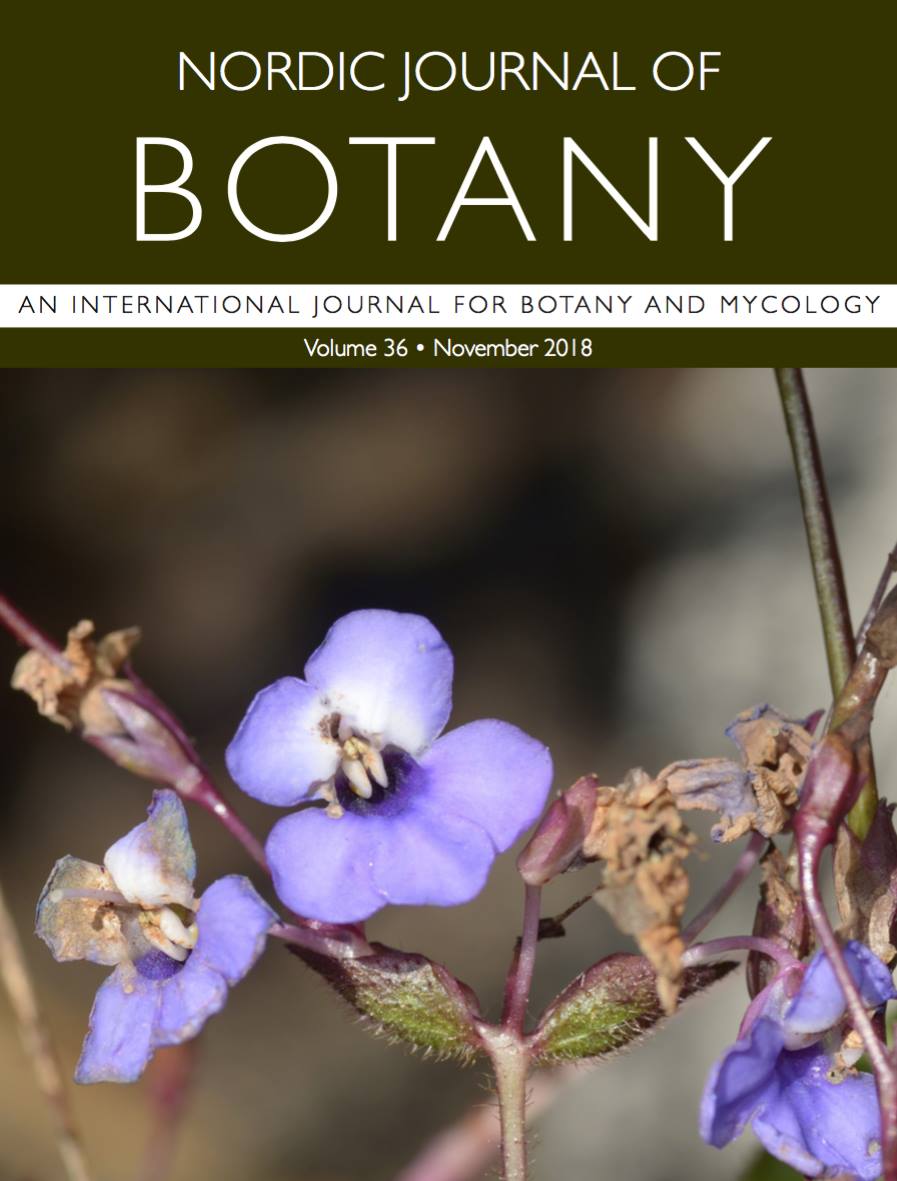
[Botany • 2018] Rachunia cymbiformis • A New Genus and Species of Gesneriaceae from Thailand


 Rachunia cymbiformis D.J.Middleton.

Rachunia D.J.Middleton & C.Puglisi gen. nov.
in Middleton, Khew, Poopath, et al., 2018.  

Abstract 
Rachunia, a new genus of Gesneriaceae from Thailand, is described with a single species, Rachunia cymbiformis. Its relationship to the rest of subtribe Didymocarpinae is investigated through a phylogenetic study based on Bayesian Inference and Parsimony analyses of nuclear ITS and plastid trnL‐trnF (intron‐spacer) sequences. Morphologically, Rachunia differs from the related genera Codonoboea in the large boat‐shaped bracts and orthocarpic vs plagiocarpic fruit; from Microchirita in the bracts, wiry vs fleshy stem, the campanulate vs tubular corolla and the clavate vs chiritoid stigma, and from Henckelia in the clavate vs chiritoid stigma, large boat‐shaped bracts in the inflorescence, free and imbricate sepals, short and campanulate corolla, clavate stigma, and relatively robust orthocarpic fruit.

Keywords: phylogeny, Henckelia, Didymocarpinae


Rachunia cymbiformis D.J.Middleton. close-up of bracts and flower.
Photo by Manop Poopath. 

Rachunia D.J.Middleton & C.Puglisi gen. nov. 

Type species: Rachunia cymbiformis D.J.Middleton. 

Etymology: The genus is named in honour of the Thai botanist Dr Rachun Pooma of the Forest Herbarium Bangkok (BKF) to recognise his great contribution to our understanding of plant diversity in Thailand and the wider region.


Rachunia cymbiformis D.J.Middleton sp. nov. 

Etymology: The specific epithet ‘cymbiformis’ refers to the boat-shaped bracts in the inflorescence.


D. J. Middleton, G. S. Khew, M. Poopath, M. Möller and C. Puglisi. 2018. Rachunia cymbiformis, A New Genus and Species of Gesneriaceae from Thailand. Nordic Journal of Botany. 36(11); e01992. DOI: 10.1111/njb.01992