Showing posts with label Serranidae. Show all posts

Sunday, November 11, 2018

[Ichthyology • 2018] Epinephelus craigi • A New Species of Grouper (Perciformes: Epinephelidae) from the South China Sea


Epinephelus craigi  
 Frable, Tucker & Walker, 2018

Illustration by Emilie Stump.  twitter.com/Frable

Abstract
A new species of grouper, Epinephelus craigi sp. nov., from the South China Sea is described from 17 specimens (104–250 mm SL). The new species is distinguished from Epinephelus stictus (Randall and Allen 1987) with which it has historically been conflated, based on coloration, meristics, morphology, and genetics. Epinephelus craigi sp. nov. has a unique color pattern of irregular squarish, dark brown blotches interrupting lighter brown bars along the lateral midline of the body, and small dots on the dorsal surface of the body. Additionally, E. craigi sp. nov. has a longer upper jaw, shorter snout length, narrower interorbital width, and shorter caudal peduncle than E. stictus. Both E. stictus and the new species are relatively deep-water species, with the new species occurring to at least 93 m. Epinephelus craigi sp. nov. is known from the South China Sea and E. stictus is known from Western Australia and southern Indonesia, suggesting allopatric and anti-equatorial distributions. DNA sequence divergence data of the mitochondrial COI gene further supports the distinction of E. craigi sp. nov. from E. stictus.

Keywords: Epinephelus stictus, Five-bar grouper, Species description, Cytochrome oxidase I 


Composite illustration of Epinephelus craigi, based on multiple specimens and market photographs, approximately 175 mm SL.
Illustration by Emilie Stump. 

Epinephelus craigi sp. nov.
(New English name: Brokenbar Grouper; 
Chinese name in Hong Kong: Cheung-pei-paan) 
....

Etymology. The new species is named in honor of Dr. Matthew T. Craig for his significant contributions to the conservation and scientific understanding of groupers and their relatives.


Benjamin W. Frable, Sarah J. Tucker and H. J. Walker, Jr. 2018. A New Species of Grouper, Epinephelus craigi (Perciformes: Epinephelidae), from the South China Sea. Ichthyological Research.  DOI: 10.1007/s10228-018-0669-9  

Tuesday, October 9, 2018

[Ichthyology • 2018] Tosanoides annepatrice • A New Basslet (Perciformes, Serranidae) from Deep Coral Reefs in Micronesia


Tosanoides annepatrice 
Pyle, Greene, Copus & Randall, 2018


Abstract
The new species Tosanoides annepatrice sp. n. is described from four specimens collected at depths of 115–148 m near Palau and Pohnpei in Micronesia. It differs from the other three species of this genus in life color and in certain morphological characters, such as body depth, snout length, anterior three dorsal-fin spine lengths, caudal-fin length, and other characters. There are also genetic differences from the other four species of Tosanoides (d ≈ 0.04–0.12 in mtDNA cytochrome oxidase I). This species is presently known only from Palau and Pohnpei within Micronesia, but it likely occurs elsewhere throughout the tropical western Pacific.

Keywords: closed-circuit rebreather, coral-reef twilight zone, mesophotic coral ecosystems, Micronesia


Figure 1. Holotype of Tosanoides annepatrice (BPBM 40848), 80.9 mm TL, collected at a depth of 115 m off Ngaruangl Atoll, Kayangel State, Republic of Palau. Photograph by RL Pyle.
 Figure 2. Paratype of Tosanoides annepatrice (USNM 444916), 104.0 mm TL, adult male, collected at a depth of 148 m off Ahnd (Ant) Atoll, Pohnpei, Federated States of Micronesia. Photograph by BD Greene.

Tosanoides annepatrice sp. n.

Diagnosis: A species of Tosanoides (sensu Katayama and Masuda 1980) distinguished by the following combination of characters: fourth or fifth dorsal spine the longest; dorsal-fin soft rays 16–17; anal-fin soft rays 8; pored lateral-line scales 33–34; head 2.3–2.9 in SL; body depth 2.6 in SL; color in life of males: head and body rose-pink, crossed by four bright yellow stripes, the third continuing as a bright red stripe with magenta edges along the middle of the body, becoming yellow centered on base of caudal fin; dorsal fin with a very broad middle yellow stripe with magenta margin; base of anal fin colored like body anteriorly, grading broadly to magenta posteriorly; pelvic fins yellow, except for magenta last two rays; eye magenta with an uneven ring of yellow around pupil; color of immature and presumed female yellow with irregular, near-vertical, wavy red lines following scale margins; anal fin magenta anteriorly, grading posteriorly to purple, with a greenish yellow streak; pelvic fins bright magenta.
....

Figure 3. Adult male Tosanoides annepatrice alive in an aquarium, collected in Pohnpei.
Figure 5. Adult female Tosanoides annepatrice alive in an aquarium, collected in Pohnpei.
Photographs by LA Rocha.

Distribution: Tosanoides annepatrice is known on the basis of four specimens, one (the holotype) collected at a depth of 115 m in Palau, and three paratypes collected at a depth of 148 m near Pohnpei. Additional individuals have been observed at depths of ~120–150 m at Pohnpei. The species likely occurs at similar depths throughout much of Micronesia, and perhaps more broadly within the tropical western Pacific; but more exploration of habitat at appropriate depths throughout this region is necessary to determine its complete geographic range.

Habitat and Ecology: Tosanoides annepatrice has been observed and collected along steep limestone coral-reef drop-offs at depths from 115–150 m. The paratypes were collected along a small rocky crevice near the entrance to a cave, but other individuals have been seen in similar habitats not in association with caves. Most individuals of this species have been observed in groups consisting of one apparent male and several apparent females and juveniles.

Etymology: We name this species annepatrice (a noun in apposition) in honor of Anne Patrice Greene, mother of Brian D. Greene who collected all known specimens of this new species, in recognition of the support and encouragement she has consistently provided to Brian’s exploration of the deep coral reefs of Micronesia.


Richard L. Pyle, Brian D. Greene, Joshua M. Copus and John E. Randall. 2018. Tosanoides annepatrice, A New Basslet from Deep Coral Reefs in Micronesia (Perciformes, Percoidei, Serranidae). ZooKeys. 786: 139-153.  DOI:  10.3897/zookeys.786.28421

Tuesday, September 25, 2018

[Ichthyology • 2018] Tosanoides aphrodite • A New Species (Perciformes, Serranidae, Anthiadinae) from Mesophotic Coral Ecosystems of St. Paul’s Rocks, Mid Atlantic Ridge


 Tosanoides aphrodite
 Pinheiro, Rocha & Rocha, 2018


Abstract
During a recent expedition to St. Paul’s Rocks, Atlantic Ocean, a distinctive and previously unknown species of Anthiadinae was collected at a depth of 120 m. A genetic analysis indicated the undescribed species is a member of the genus Tosanoides, which was only known to occur in the Pacific Ocean. This new taxon is distinguishable from all other Tosanoides species by the following combination of characters: soft dorsal fin rays 15–16; anal fin rays 9; ventral scale rows 9–10; last dorsal spine the longest (instead first through fourth). Here Tosanoides aphrodite sp. n. is described and illustrated, only known from St. Paul’s Rocks.

Keywords: Brazil, coral reefs, deep reefs, fish endemism, oceanic island, rebreather diving


Figure 3. Fresh specimens of Tosanoides aphrodite sp. n. collected in St. Paul’s Rocks, Brazil. A Male B Female. Photographs by LA Rocha. 

Tosanoides aphrodite sp. n.

Diagnosis: The new species differs from all other Anthiadinae by the following combination of characters: Dorsal-fin spines X; last dorsal spine the longest, 1.8–2.2 in head length; dorsal-fin rays 15–16; 7th dorsal ray the longest, 2.65–2.80 in head length; anal-fin rays 9; pored lateral-line scales 32–35; ventral scale rows 9–10; body slender and compressed, greatest depth 2.96–3.18 in SL, and the width 1.77–2.09 in depth. Our phylogenetic analysis shows the new species belongs to Tosanoides Kamohara 1953, from which it differs of the other known species by: a divergence of at least 12.35% at the cytochrome oxidase I gene, last dorsal spine the longest (instead first through fourth), fewer dorsal-fin rays (15–16 vs. 16–17), and more anal-fin rays (9 vs. 8 in the other Tosanoides).
....

Figure 4. Tosanoides aphrodite sp. n.  in its natural environment, photographed at a depth of 120 m in St. Paul’s Rocks, Brazil. Photograph by LA Rocha.

Etymology: The name “aphrodite” refers to the ancient Greek goddess of love and beauty. While we were collecting the Aphrodite anthias, a large Six-gill shark (Hexanchus griseus) came very close to both of us (HTP and LAR), but that didn’t divert our attention from the new exquisitely beautiful species, and we never even saw the shark (youtu.be/pSZrmoEwR0Q). The beauty of the Aphrodite anthias enchanted us during its discovery much like Aphrodite’s beauty enchanted ancient Greek gods.

Distribution and habitat: Tosanoides aphrodite is only known from Saint Paul’s Rocks, off Brazil. It was found on mesophotic coral ecosystems of the island, observed between 100 and 130 m depth while rebreather diving, and a single observation at 260 m depth, taken from a submersible dive. The species inhabits small crevices of complex rocky reefs (Figure 4). The ambient seawater temperature at the collecting depth (~ 120 m) varied between 13 and 15 °C during the two-week period we stayed in the area.


 Hudson T. Pinheiro, Claudia Rocha and Luiz A. Rocha. 2018. Tosanoides aphrodite, A New Species from Mesophotic Coral Ecosystems of St. Paul’s Rocks, Mid Atlantic Ridge (Perciformes, Serranidae, Anthiadinae). ZooKeys. 786: 105-115.  DOI: 10.3897/zookeys.786.27382

Thursday, June 7, 2018

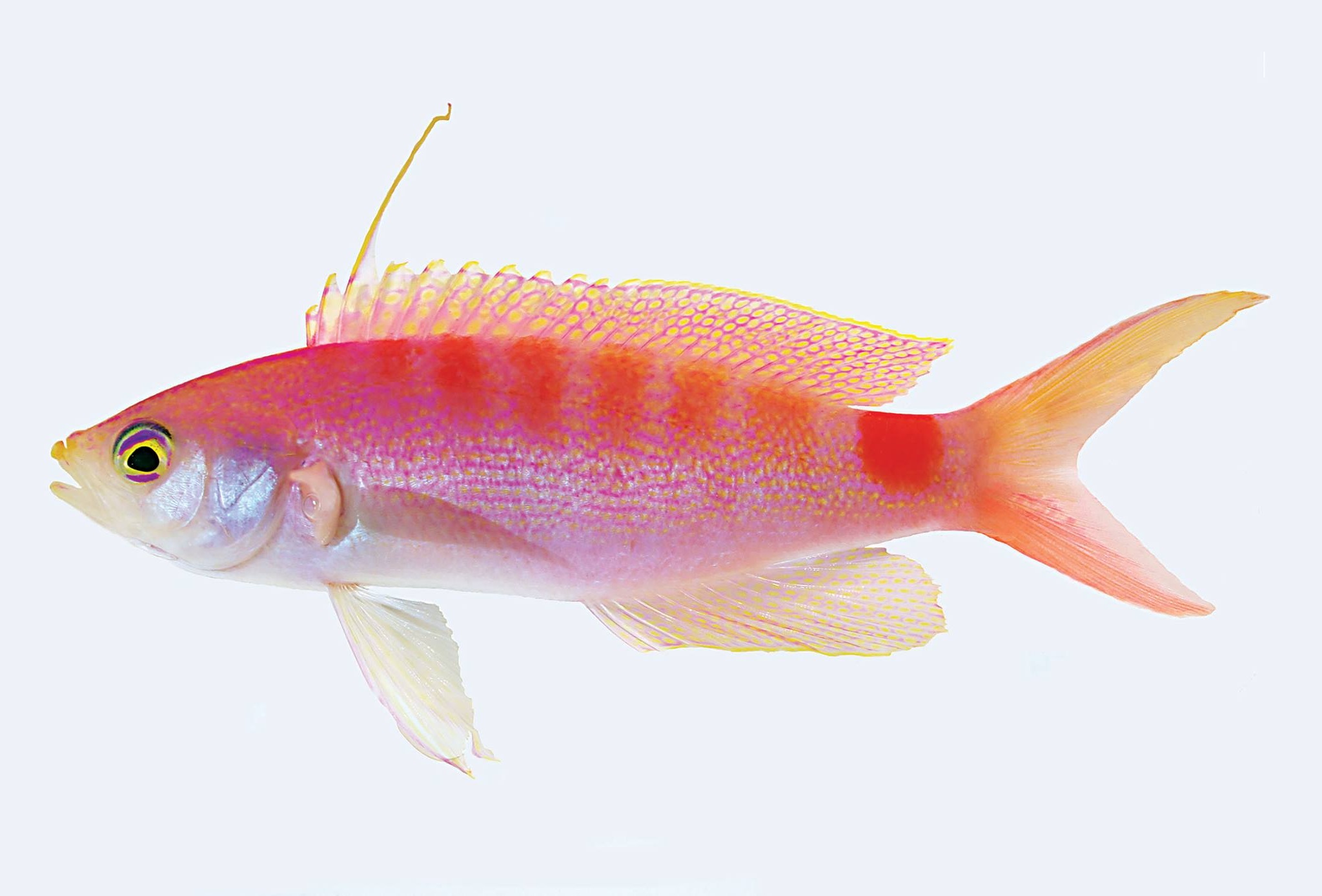
[Ichthyology • 2018] Plectranthias ahiahiata • A New Species of Perchlet (Serranidae, Anthiadinae) from A Mesophotic Ecosystem at Rapa Nui (Easter Island)


Plectranthias ahiahiata
Shepherd, Phelps, Pinheiro, Pérez-Matus & Rocha, 2018


Abstract
A new species of the perchlet genus Plectranthias is herein described from a single specimen found at Rapa Nui (Easter Island) in the South Pacific. Plectranthias ahiahiata sp. n. was collected at a depth of 83 m in a mesophotic coral ecosystem at Rapa Nui. The main difference between Plectranthias ahiahiata and other members of the genus is higher fin-ray counts (X, 18 dorsal; 18 pectoral) and its distinctive coloration. Compared to the three other known eastern South Pacific species, P. ahiahiata has more dorsal-fin rays, more pectoral-fin rays, fewer tubed lateral-line scales, fewer gill rakers, a longer head relative to SL, a very short first dorsal spine relative to SL, and a short third anal spine relative to SL. Plectranthias ahiahiata is distinguished from western Pacific species, by having more dorsal- and pectoral-fin rays. The closest relative based on genetic divergence (with 12.3% uncorrected divergence in the mitochondrial COI gene) is Plectranthias winniensis, a widely distributed species, suggesting important links between Rapa Nui and western Pacific islands. This new species adds to the high endemism of the Rapa Nui ichthyofauna, and is further evidence of the importance of mesophotic reefs as unique communities.

Keywords: endemism, ichthyology, reef fish, South Pacific, taxonomy


Figure 1. Plectranthias ahiahiata sp. n., holotype shortly after death, 39.95 mm SL
(photograph: Luiz A. Rocha).

Plectranthias ahiahiata sp. n.
  Sunset perchlet

Type locality: Hanga Piko, Rapa Nui (Easter Island), Chile.
  
Diagnosis: Plectranthias ahiahiata differs from all of its congeners by the following combination of characters: dorsal rays X, 18; pectoral rays 18; longest dorsal spine the fourth; LL continuous and complete with 31 tubed scales; circumpeduncular scales 16; head length 43.3% SL; first dorsal spine 4.5% SL; third anal spine 13.7% SL; gill rakers 6+11; and in coloration: overall orange-red in color, with predominantly yellow snout, dorsal, pelvic and anal fins, a brilliant red spot outlined in white on the caudal peduncle, and four white spots on each side, following the contour of the lateral line.


Etymology: Plectranthias ahiahiata is given a Rapa Nui name; the phrase ahiahi-ata means “the last moments of light before nightfall.” The species was given this name because the colors of the fish remind us of the beautiful Rapa Nui sunsets. To be treated as a noun in apposition.

Distribution and habitat: Plectranthias ahiahiata is currently only known to occur at Rapa Nui (Easter Island). This fish was collected with hand nets at a depth of 83 m in a rocky patch reef surrounded by a large sandy area, and transported to the surface alive in a perforated plastic jar.


 Bart Shepherd, Tyler Phelps, Hudson T. Pinheiro, Alejandro Pérez-Matus and Luiz A. Rocha. 2018. Plectranthias ahiahiata, A New Species of Perchlet from A Mesophotic Ecosystem at Rapa Nui (Easter Island) (Teleostei, Serranidae, Anthiadinae). ZooKeys. 762: 105-116. DOI:  10.3897/zookeys.762.24618

Tuesday, October 31, 2017

[Ichthyology • 2017] Pseudanthias tequila • A New Species of Anthiadine Serranid from the Ogasawara and Mariana Islands


Pseudanthias tequila 
Gill, Tea & Senou, 2017

Abstract

Pseudanthias tequila is described on the basis of two specimens from the Ogasawara Islands. It also is recorded from the Mariana Islands on the basis of colour photographs. The species belongs to a complex that includes P. randalli (Lubbock & Allen), P. pulcherrimus Heemstra & Randall, P. flavicauda Randall & Pyle, P. oumati Williams, Delrieu-Trottin & Planes, and a potentially new species from the Line Islands. Species within the complex are distinguished on the basis of male live colouration, morphometric details and gill-raker and scale counts. Colour photos of all five species are provided.

Keywords:  Pisces, taxonomy, ichthyology, Japan, Micronesia


Male Pseudanthias tequila: A) from Ototo-jima, Chichi-jima Islands, Ogasawara Islands, Japan (KPM-NR 179391A, photo by O. Morishita); B) from Tinian, Mariana Islands (photo by N. Tsuji)
FIGURE 6. Group of Pseudanthias tequila n. sp., Tinian, Mariana Islands, Micronesia. Photo by N. Tsuji.

Pseudanthias tequila new species 
New standard Japanese name: Bonin-hanadai
English common name: Cave anthias

Pseudanthias randalli (non Lubbock & Allen, 1978); Myers & Shephard, 1980: 316 (Blue Hole, Orote Peninsula, Guam).
Pseudanthias sp.; Myers, 1988: 140 (Guam).
Pseudanthias sp. 3; Michael, 1998: 576 (colour photo; Guam).
Pseudanthias sp. B; Myers 1999: 109, pl. 35 G (colour photo; Guam).
Pseudanthias flavicauda [non Randall & Pyle, 2001]; Myers & Donaldson, 2003: 616 (list, Marianas Islands).
Pseudanthias cf randalli; Kuiter, 2004: 61, unnumbered colour figs A and B (colour photos; Palau, Saipan and Guam).
Pseudanthias cf flavicauda; Kuiter & Debelius, 2006: 298 (colour photo; Micronesia).

Diagnosis. The following combination of characters distinguishes Pseudanthias tequila from congeners: dorsal rays X,16; anal rays III,7; pectoral rays 18; third dorsal spine prolonged in males; third segmented anal-fin ray longest; lateral-line scales 46–47; no auxiliary scales on body; interopercle and subopercle with distinct serrations in adults; males in life with upper body beneath anterior part of dorsal fin purple to pink with orange-red stripe, dorsal fin greenish yellow anteriorly, posteriorly red with blue basal area, anterior part of anal fin red, and pelvic fins bright yellow.

Habitat and distribution. Pseudanthias tequila is described on the basis of two specimens from Ototo-jima, Chichi-jima Islands, Ogasawara Islands, Japan. We also record it from Guam, Saipan and Tinian in the Mariana Islands on the basis of photographs (Figure 7). Kuiter’s (2004) photograph of an individual of “Pseudanthias cf randalli”, stated to be from Palau, is referable to P. tequila. However, R.F. Myers (pers. comm.) advised us that the photograph, by Hiroyuki Kimura, is actually from Saipan. Other photographs from Palau are referrable to the closely related P. randalli (Lubbock & Allen, 1978). The original description of Prandalli also included paratypes from Palau. Pseudanthias tequila appears to be mostly found in caves on reef slopes in 40–60 m, earning it the popular name of “cave anthias”. In Saipan and Tinian, however, it occurs in the open on reef slopes dominated by Halimeda and Caulerpa algae (Figures 4B & 6).


Etymology. The specific epithet refers to the alcoholic beverage tequila sunrise, alluding to the vibrant life colours of the males of the species. To be treated as a noun in apposition.


 Anthony C. Gill, Yi-Kai Tea and Hiroshi Senou. 2017. Pseudanthias tequila, A New Species of Anthiadine Serranid from the Ogasawara and Mariana Islands. Zootaxa. 4341(1); 67–76. DOI:  10.11646/zootaxa.4341.1.5

Wednesday, August 16, 2017

[Ichthyology • 2017] Sacura sanguinea • A New Species of the Anthiadin Genus Sacura (Perciformes: Serranidae) from the Andaman Sea


Sacura sanguinea
Motomura, Yoshida & Vilasri, 2017


Abstract

Sacura sanguinea n. sp. (Serranidae: Anthiadinae) is described on the basis of two male and one female specimens from the Andaman Sea. The new species is characterized by the following characters: dorsal-fin rays X, 15; pored lateral-line scales 34; gill rakers 8 + 23 = 31; body depth 42.6–44.7% of SL; head length 39.5–41.4% of SL; pectoral-fin length 32.4–33.1% of SL; poorly defined broad yellow band from anterior profile of head to middle of body, the band gradually becoming red around middle of body and ending at caudal-fin base; caudal fin with distinct red spots centrally; and large dark red blotch posteriorly on spinous portion of dorsal fin in females.

Keywords: Pisces, Perciformes, Serranidae


Hiroyuki Motomura, Tomohiro Yoshida and Veera Vilasri. 2017. New Species of the Anthiadin Genus Sacura (Perciformes: Serranidae) from the Andaman Sea.
 Zootaxa. 4306(2); 291–295. DOI:  10.11646/zootaxa.4306.2.10

Tuesday, December 27, 2016

[Ichthyology • 2016] Tosanoides obama • A New Basslet (Perciformes, Percoidei, Serranidae) from Deep Coral Reefs in the Northwestern Hawaiian Islands


Tosanoides obama 
Pyle, Greene & Kosaki, 2016  


Abstract

The new species Tosanoides obama is described from two specimens collected at a depth of 90–92 m off Kure Atoll and Pearl and Hermes Atoll, Northwestern Hawaiian Islands. It differs from the other two species of this genus in life color and in certain morphological characters, such as number of pored lateral-line scales, pectoral-fin rays, snout length, anterior three dorsal-fin spine lengths, dorsal-fin profile, and other characters. There are also substantial genetic differences from the other two species of Tosanoides (d ≈ 0.10 in mtDNA cytochrome oxidase I). The species is presently known only from the Northwestern Hawaiian Islands within the Papahānaumokuākea Marine National Monument.

Keywords:  Mesophotic Coral Ecosystem, Closed-Circuit Rebreather, Endemic, Papahānaumokuākea Marine National Monument, President Obama


Figure 1. Holotype of Tosanoides obama (BPBM 41315), collected at a depth of 90 m off Kure Atoll, Northwestern Hawaiian Islands. Photo by R. L. Pyle. 

Diagnosis:  A species of Tosanoides (sensu Katayama & Masuda, 1980) distinguished by the following combination of characters: fourth or fifth dorsal spine the longest, dorsal-fin soft rays 17; anal-fin soft rays 8; pored lateral-line scales 33 or 34; head 2.9–3.0 in SL; body depth 2.8–2.9 in SL; color in life pink or yellowish pink on head and body, slightly darker dorsally fading ventrally; snout and region immediately dorsal to eye bright yellow, with a thin bright yellow band extending dorsally on either side of nape; a thin bright yellow horizontal stripe extending horizontally from posterior middle edge of eye posteriorly across most of operculum, continuing as a series of irregular oblong spots on midline of body from just posterior to gill opening to a point approximately one-fourth to one-half of pectoral fin; a second thin bright yellow stripe extending posteriorly from lower jaw across maxilla just ventral to eye and continuing horizontally across operculum and base of pectoral fin; dorsal fin pink or yellowish pink with darker pink regions on membranes, and a bright magenta margin extending from tip of first dorsal fin posteriorly on anterior half of soft dorsal fin; males with a large circular ocellate spot covering posterior one-third of soft dorsal fin, bluish magenta on perimeter and dark red with faint yellow stripes centrally; anal and pelvic fins magenta or yellow; caudal fin translucent yellow, more pale and translucent medially and distally, with bright magenta margins extending along margins of both lobes.

Figure 4. Holotype of Tosanoides obama (upper left) alongside presumed female (lower right, not collected) immediately prior to collection of the holotype, at a depth of 90 m off Kure Atoll, Northwestern Hawaiian Islands. Both fish retreated into the same hole moments after this image was captured. Cropped frame from video by R. L. Pyle. 


Etymology:  We name this species obama (a noun in apposition) in honor of Barack H. Obama, 44th President of the United States, in recognition of his efforts to protect and preserve the natural environment, particularly through his decision to expand the Papahānaumokuākea Marine National Monument several weeks after the discovery of this new species.

Discussion
Tosanoides obama is another example of several new fish species that have been discovered on deep coral reefs over the past several decades, mostly involving the use of modern mixed-gas closed-circuit rebreather diving technology (Pyle 1996, 2000). In recent years there has been increased attention focused on mesophotic coral ecosystems (MCEs), coral-reef habitat at depths of approximately 30–150 m in tropical regions worldwide (Hinderstein et al. 2010, Baker et al. 2016). Many more new species of fishes and other reef-associated marine organisms are likely to be discovered as a result of continued exploratory work in this poorly documented environment.

The fish subfamily Anthiinae (Anthiadides Poey, 1861, type genus Anthias Bloch, 1792, stem Anthi-), is a homonym of the beetle subfamily Anthiinae (Anthies Bonelli, 1813, type genus Anthia Weber, 1801, stem Anthi-). According to Article 55.3 of the International Code of Zoological Nomenclature (ICZN 1999), homonymous family-group names in current use based on similar (but not identical) genus-group names must be referred to the Commission for a ruling to remove homonymy. A case is currently in preparation to formally resolve this homonymy through application to the ICZN. Until an Opinion is issued, we follow van der Laan et al. (2014, 2016) and Carvalho-Filho (2016) in using the spelling “Anthiadinae” to represent the subfamily for this new species, instead of the more commonly used (but homonymous) spelling “Anthiinae”.


Richard L. Pyle, Brian D. Greene and Randall K. Kosaki. 2016. Tosanoides obama, A New Basslet (Perciformes, Percoidei, Serranidae) from Deep Coral Reefs in the Northwestern Hawaiian Islands. ZooKeys 641: 165-181. DOI:  10.3897/zookeys.641.11500

Friday, December 9, 2016

[Ichthyology • 2016] Plectranthias takasei • A New Species of Anthiadine Fish (Teleostei: Serranidae) from southern Japan


Hinomaru Perchlet |  Plectranthias takasei  
Gill, Tea & Senou, 2016  
 DOI: 
10.11646/zootaxa.4205.4.3 

Abstract

Plectranthias takasei is described from two specimens collected in Izu Oceanic Park, Sagami Bay, Honshu, Japan. It is distinguished from congeners in having the following combination of characters: dorsal rays X,15; no fleshy flaps on dorsal-fin spines; pectoral rays 13, all unbranched; branched caudal-fin rays 8 + 7; lateral line scales 28 (including intermittent and terminal pitted scales); circumpeduncular scales 12; fourth dorsal-fin spine longest; and preopercle without antrorse spines or serrations ventrally, with 2–3 weak serrations or crenulations posteriorly.

Keywords: Pisces, ichthyology, taxonomy, morphology, Izu Oceanic Park, Sagami Bay, Honshu

FIGURE 3. Plectranthias takasei, underwater photo in 60 m, Izu Oceanic Park, Sagami Bay, Honshu, Japan.
photo by W. Takase DOI: 10.11646/zootaxa.4205.4.3 

Plectranthias takasei, new species
New standard Japanese name: Hinomaru-hanadai
English common name: Hinomaru Perchlet

Diagnosis. The following combination of characters distinguishes P. hinomaru from congeners: dorsal rays X,15; no fleshy flaps on dorsal-fin spines; pectoral rays 13, all unbranched; branched caudal-fin rays 8 + 7; lateral line scales 28 (including intermittent and terminal pitted scales); circumpeduncular scales 12; fourth dorsal-fin spine longest; and preopercle without antrorse spines or serrations ventrally, with 2–3 weak serrations or crenulations posteriorly.

Habitat and distribution. Plectranthias takasei is known only from Izu Ocean Park, where it has been collected and photographed on rocky reefs at depths of 48–60 metres.


Etymology. The species is named for Mr. Wataru Takase, who collected the holotype. The Japanese standard name and English common names refer to the prominent red spot on the side, which is reminiscent of the red disk (rising sun) in the Japanese flag (commonly called Hinomaru, ‘the sun disk’). 

Gill, Anthony C., Yi-Kai Tea & Hiroshi Senou. 2016. Plectranthias takasei, New Species of Anthiadine Fish from southern Japan (Teleostei: Serranidae). Zootaxa. 4205(4); 349–356. DOI: 10.11646/zootaxa.4205.4.3


Wednesday, September 7, 2016

[Ichthyology • 2016] Epinephelus kupangensis • A New Species of Grouper (Epinephelus; Epinephelidae) from the Indo-Pacific


Epinephelus kupangensis
Tucker, Kurniasih & Craig, 2016  

Fig. 1. Top: holotype MZB 23005 (320 mm TL), Sahul Banks, Timor Sea. Middle: paratype MZB 23006 (366 mm TL), Sahul Banks, Timor Sea. Bottom: paratype MZB 23008 (385 mm TL), purchased at a fish market in Kupang, Indonesia. Lower pane shows fish freshly caught; top two panes show fish in a more advanced state of decomposition. The pale patch on the ‘‘cheek’’ of the fish in mid-pane is an artifact of the dead fish in contact with a surface and not a true color characteristic of the species. The enlarged abdomen in the top pane is a result of an overinflated swim bladder, and the indentation on the head is likely a result of damage to the specimen after landing. This is the only specimen we have noted with a pronounced depression on the dorsal part of the head.

A new species of Indo-Pacific grouper is described from nine specimens, 165–391 mm in SL. Epinephelus kupangensis, new species, is similar in appearance to, and has been treated as, Epinephelus amblycephalus (Bleeker, 1857). The two species are both found in deep waters of the Indo-Pacific and have overlapping ranges in eastern Indonesia, and likely beyond. Epinephelus kupangensis, new species, can be distinguished from Epinephelus amblycephalus on the basis of coloration, counts, and measurements. The species is characterized by the following set of characters: dorsal rays XI, 16; anal rays III, 8; pelvic rays I, 5; pectoral rays 18; caudal rays 18; caudal fin rounded; gill rakers 8+16; lateral line scales 48; longitudinal scale series 99; body scales ctenoid; scales on head cycloid and particularly large in size on opercle; orbit diameter 5.1 in head; pelvic fin 4.0 in head; maxillary streak orange; color when freshly dead pale grayish brown with five dark brown bars; orange-brown spots present dorsally on head and at edges and within dark bars.


Distribution.— Several type specimens were provided by commercial fishermen landing at Kupang, Nusa Tenggara Timur, Indonesia and Benoa Harbor, Bali, Indonesia. Fishing grounds for these vessels (equipped with GPS tracking for fisheries observation programs) confirms the Savu Sea and Timor Sea as locations of catch for these specimens. Museum and photographic records are also known from Sulawesi and Maluku, Indonesia, Timor-Leste, Philippines, Taiwan, and Fiji. We suspect this species has a broad Indo-West Pacific distribution.

Etymology.— The Latin suffix -ensis (denoting place or locality) is appended to the locality of Kupang, Indonesia, the center of the Timor Sea fishery that provided the first author with the holotype and several paratypes.


Sarah J. Tucker, Eka M. Kurniasih and Matthew T. Craig. 2016. A New Species of Grouper (Epinephelus; Epinephelidae) from the Indo-Pacific. Copeia. 104(3); 658-662. DOI: 10.1643/CI-16-398

Saturday, July 23, 2016

[Ichthyology • 2012] Odontanthias hensleyi • A New Species of Odontanthias Bleeker (Perciformes: Serranidae: Anthiinae) from Mona Passage off Puerto Rico, the First Record of the Genus from the Atlantic Ocean


Odontanthias hensleyi 
Anderson & García-Moliner, 2012 

Abstract
Odontanthias hensleyi, a new species of anthiine serranid fish, is described from four specimens collected off the west coast of Puerto Rico in Mona Passage. This is the first Atlantic record for the genus Odontanthias, heretofore known from 13 Indo-Pacific species. The new species is distinguished from all other species of Odontanthias by the following combination of characters: 15 soft rays in the dorsal fin, 18 pectoral fin rays, vomerine tooth patch subquadrangular to diamond-shaped without posterior prolongation, pelvic fin and caudal fin lobes very well produced, and coloration (side of head with two bright yellow stripes; pelvic, anal and caudal fins bright yellow).


 Anderson, W.D.Jr. and García-Moliner, G. 2012. A New Species of Odontanthias Bleeker (Perciformes: Serranidae: Anthiinae) from Mona Passage off Puerto Rico, the First Record of the Genus from the Atlantic Ocean. aqua, International Journal of Ichthyology, 18 (1): 25-30.


[Ichthyology • 2011] Odontanthias randalli • A New Anthiine Fish (Serranidae: Anthiinae) from East Lombok, Indonesia


Odontanthias randalli
White, 2011 

Abstract 
Odontanthias randalli, a new species of anthiine serranid fish from southeastern Indonesia, is described, bringing the number of known species in the genus to 14. The new species is clearly distinguished from other members of the genus by the following combination of characters: dorsal-fin soft rays 16–17, lateral-line scales 37 to 39, 3rd dorsal spine longest, 3rd dorsal-fin soft ray the only filamentous dorsal-fin ray, caudal fin lunate with extremely long filamentous lobes, depth of body 2.2 to 2. 5 in SL, vomerine-tooth patch arrowhead shaped, and body pinkish with bright yellow spots on upper half and four pale pink blotches below dorsal-fin base. The new species is compared with other members of the genus.

  Key words: Odontanthias, Serranidae, new species, Indo-Pacific, Indonesia


FIGURE 1. Lateral view of Odontanthias randalli n. sp., holotype MZB 20010, 121 mm SL, east Lombok, Indonesia. 

Diagnosis. Dorsal rays X, 16–17; anal rays III, 7; pectoral rays 15–16; lateral-line scales 37–39; gill rakers 10–13 + 21–27 (total = 32–39); body depth 2.2–2.5 in SL; spine at angle of preopercle moderately long, extending about half distance to margin of subopercle; vomerine tooth patch arrowhead-shaped; no teeth on mesopterygoids; scales dorsally on snout nearly reaching upper lip; 3rd dorsal spine elongate, 1.36–2.32 in head length; 3rd ray of dorsal fin the longest, greatly produced as a long filament; 2nd anal spine subequal to third, 2.32–2.78 in head length; caudal fin lunate, the lobes very long and filamentous, fin length 1.37–2.01 in SL. Colour when fresh mostly pink; scales on upper half of body each with a bright yellow spot; head pinkish with a vivid yellow, horizontal V-shaped marking originating on snout tip and extending posteriorly as two stripes; lower stripe running posteroventrally below eye to edge of opercle; upper stripe running posterodorsally through about the middle of eye to edge of the opercle just above primary opercular spine; nape yellowish; four pale pinkish blotches present below dorsal fin base; dorsal fin mostly yellow with some pink areas; anal fin pinkish with yellow pigment between second and third spines extending on to posterior portion of posteriorly adjacent fin membranes; caudal fin mostly pink with yellow pigment basally and extending along centre of filamentous lobes; pectoral fins pinkish with yellow stripe on anterior third extending from base of fin to about one-third distance of longest rays; pelvic fin mostly pink with yellow pigment on membrane between first and second soft rays.

Distribution. Currently known only from East Lombok in the Nusa Tenggara region of Indonesia. All type specimens were collected from the fish market at Tanjung Luar from handline fishers operating in local waters. 

Etymology. Named after John E. Randall, who has made such a significant contribution to the knowledge of anthiine fishes, and Indo–Pacific fishes in general. The review of the Odontanthias genus he co-authored provided detailed description of the nominal species and their relationships with closely related genera. Proposed vernacular name: Lombok Swallowtail 


William T. White. 2011. Odontanthias randalli n. sp., A New Anthiine Fish (Serranidae: Anthiinae) from Indonesia. Zootaxa. 3015: 21–28.

[Ichthyology • 2016] Odontanthias cauoh • A New Species of Anthiadinae (Teleostei: Serranidae) from São Pedro and São Paulo Archipelago, Brazil, Equatorial Atlantic


Odontanthias cauoh 
Carvalho-Filho, Macena & Nunes, 2016 

   Red Jewelfish |  DOI: 
10.11646/zootaxa.4139.4.10

Abstract

A new species of Anthiadinae, Odontanthias cauoh, is described from São Pedro and São Paulo Archipelago (SPSPA), Brazil, Equatorial Atlantic. The new species differs from its only Atlantic congener by a combination of several characters: pectoral-fin rays 20; total gill rakers on first arch 39; vomerine tooth patch with a posterior prolongation; pelvic fin not reaching base of last anal-fin ray; dorsal, anal and pelvic fins scaleless; and coloration (dorsal, anal, and pelvic fins mostly dark red). The record of the new species contributes to increase the fish endemism in SPSPA.

Keywords: Pisces, Odontanthias cauoh, taxonomy, oceanic islands, endemism


FIGURE 2. Odontanthias cauoh sp. n., MZUSP 111260,holotype, 165.2 mm SL from São Pedro and São Paulo Archipelago, Brazil.  

Diagnosis. The new species differs from its only Atlantic congener by a combination of several characters: pectoral-fin rays 20; total gill rakers on first arch 39; vomerine tooth patch with a posterior prolongation; pelvic fin not reaching base of last anal-fin ray; dorsal, anal, and pelvic fins scaleless; and coloration (dorsal, anal, and pelvic fins mostly dark red). 

Distribution. Odontanthias cauoh sp. n. is currently known only from São Pedro and São Paulo Archipelago, Brazil, Western Central Atlantic (Fig. 1). No data about its depth range is available.

Etymology. The new species is named after the popular name given by the professional fishermen to the fish at St. Paul’s Rocks, “Carolina”, shortened to the nickname (Cauó) of the first author’s elder daughter, Ana Carolina S.R. Carvalho, pronounced as “kau-oh”. Proposed English name: Red Jewelfish due to the color of the known specimen. Proposed Portuguese (Brazilian) name: Carolina.

Biological aspects. The stomach of the holotype was examined and found to be empty, with no trace of biological material. The gonads were analyzed macroscopically, indicating an immature female specimen.


Alfredo Carvalho-Filho, Bruno César Luz Macena and Diogo Martins Nunes. 2016. A New Species of Anthiadinae (Teleostei: Serranidae) from São Pedro and São Paulo Archipelago, Brazil, Equatorial Atlantic. Zootaxa. 4139(4); 585–592. DOI: 10.11646/zootaxa.4139.4.10

Tuesday, July 5, 2016

[Ichthyology • 2012] Rypticus carpenteri • A New Species of Soapfish (Serranidae: Rypticus), with Redescription of R. subbifrenatus and Comments on the Use of DNA Barcoding in Systematic Studies


Slope Soapfish |  Rypticus carpenteri
Baldwin & Weigt, 2012  DOI: 10.1643/CG-11-035 

A new species of Rypticus is described from the Bahamas, Bermuda, Florida, and the Caribbean Sea. The species previously has been confused with the spotted soapfish, R. subbifrenatus Gill 1861, with which it shares a similar pattern of dark spotting on the body. The new species differs from R. subbifrenatus in having yellow pigment on the pectoral fin and distal portions of the soft dorsal, caudal, and anal fins in life (pale in preservative); a different configuration of dark spots on the head; usually dark spots on the belly and caudal fin; almost always four dorsal-fin spines; and modally 25 total dorsal-fin elements, 15 pectoral-fin rays, and 23 total caudal-fin rays. The lower jaw typically extends further anteriorly beyond the upper jaw in the new species than in R. subbifrenatus, and the caudal peduncle is usually narrower. The new Rypticus typically inhabits deeper waters than R. subbifrenatus, and is commonly found on vertical slopes and walls vs. shallow, flat areas. The new species likely would have continued to go unnoticed without examination of genetic data, as there was little reason to look further at R. subbifrenatus until DNA barcoding revealed two distinct genetic lineages within the species. The value of DNA barcoding data in systematic studies and the need for increased support of taxonomy are highlighted. A neotype for Rypticus subbifrenatus is designated.


Rypticus carpenteri, new species
Slope Soapfish

Diagnosis.— A species of Rypticus distinguished from all congeners by the following unique combination of characters: pectoral fin and distal portions of soft dorsal, caudal, and anal fins pale yellow to yellow in life, pale in preservative; head and trunk with numerous dark spots, size of spots variable but those on head posterior to horizontal through center of orbit almost always smaller than pupil; interorbital region usually with two dark spots at posterior end, spots set slightly apart from orbital rim; belly with dark spots; caudal fin and sometimes soft dorsal and anal fins usually with at least a few, sometimes tiny, dark spots; dorsal-fin spines three or four (almost always four); total dorsal-fin elements modally 25; pectoral-fin rays modally 15; total caudal-fin rays modally 23; lower jaw extending anteriorly beyond upper jaw, mean difference between distance from tip of lower jaw to orbit and tip of upper jaw to orbit 5% head length (HL); caudal peduncle relatively narrow, average depth 11% SL.


Fig. 4. Comparisons of color patterns between Rypticus carpenteri, new species, and Rypticus subbifrenatus.
Left column  Rypticus carpenteri, top to bottom: USNM 401043, DNA number CUR 8304; USNM 401040, DNA number BLZ 8230; USNM 401294, DNA number BLZ 5140 (photo by J. Mounts); USNM 401044, DNA number TOB 9103; USNM 387946, holotype (photo by J. T. Williams); USNM 401297, DNA number TOB 9197; USNM 401046, DNA number TOB 9178. 
Right column Rypticus subbifrenatus, top to bottom: USNM 401279, DNA number BAH 10090; USNM 401265, DNA number TOB 9256; USNM 401274, DNA number BLZ 5212 (photo by J. Mounts); USNM 401245, DNA number BLZ 7190 (photo by J. Mounts); USNM 401262, DNA number TOB 9106; USNM 401037, DNA number BLZ 8059; DNA number FLA 7397 (no voucher). 


Distribution.— Bahamas, Belize, Bermuda, Colombia, Curacao, Dominica, Florida, Grand Cayman, Haiti, Navassa, Saba, Tobago, Turks and Caicos, and U.S. Virgin Islands–St. Croix (Fig. 6).

Habitat.— Rypticus carpenteri inhabits clear tropical waters to depths of 40 m, but is found most commonly between 6 and 30 m (Fig. 7). Mean maximum depth of specimens examined herein is 17 m, and only six specimens were collected at depths ,5 m. Rypticus carpenteri lives among coral or rocks on steep slopes, vertical walls, or in other areas with large vertical relief, although a few specimens have been taken among coral heads in shallow flat areas.

Etymology.— Named in honor of Michael Carpenter, station manager for the Smithsonian’s research station at Carrie Bow Cay, Belize, for more than 30 years. Mike’s dedication to maintaining this remote station benefited a multitude of marine scientists (and marine science). We thank him for his good-natured support in the field, and the first author is grateful for his enduring friendship. The common name, Slope Soapfish, is in reference to the occurrence of the species on steep slopes and other areas of vertical relief.


Rypticus subbifrenatus Gill, 1861
Spotted Soapfish
Rhypticus subbifrenatus Gill 1861:53 (type locality St. Thomas, U.S. Virgin Islands).
Rhypticus nigromaculatus Steindachner 1867:42 (description; Barbados).
Rypticus subbifrenatus Gill 1861.—Humann and DeLoach, 2002:189 (unnumbered color photo).

Diagnosis.— A species of Rypticus distinguished from all congeners by the following unique combination of characters: pectoral fin and distal portions of soft dorsal, caudal, and anal fins tan to brown in life and in preservative; head and trunk with numerous dark spots; spots on head posterior to horizontal through center of orbit usually prominent, round or oblong, and one or more usually equal in size to or larger than diameter of pupil; posterior portion of interorbital region usually with two pairs of spots (sometimes joined as a stripe), spots directly on or abutting orbital rim; belly usually without spots; caudal fin usually without spots; dorsal-fin spines three or four (nearly bimodal); total dorsal-fin elements modally 26; pectoralfin rays modally 16; total caudal-fin rays modally 25; lower jaw extending anteriorly beyond upper jaw, mean difference between distance from tip of lower jaw to orbit and tip of upper jaw to orbit 4% HL; caudal peduncle relatively wide, average depth 13% SL.

Distribution.— Antigua, Bahamas, Belize, Brazil, Colombia,Cuba, Curacao, Dominica, Dominican Republic, Equatorial Guinea, Fernando Poo, Florida, Grand Cayman, Grenadines, Haiti, Honduras, Jamaica, Mexico, Navassa, Nigeria, Panama,Puerto Rico, Tobago, Turks and Caicos, U.S. Virgin Islands, and Venezuela (Fig. 6). See ‘‘Remarks’’ for comments on identification of specimens from Brazil, Nigeria, and Fernando Poo.

Habitat.— Rypticus subbifrenatus inhabits clear tropical waters to depths of 26 m, but it is found most commonly at 1–2 m (Fig. 7). Mean maximum depth of specimens examined herein is 5 m, and only six specimens were captured deeper than 15 m. Rypticus subbifrenatus lives in tide pools, among coral rubble, in patch reefs and shallow spur and groove reef areas, and occasionally it may be found on steep vertical walls.


Baldwin, C.C. and Weigt, L.A. 2012. A New Species of Soapfish (Teleostei: Serranidae: Rypticus), with Redescription of R. subbifrenatus and Comments on the Use of DNA Barcoding in Systematic Studies. Copeia. 2012(1): 23-36.  DOI: 10.1643/CG-11-035