Showing posts with label Belgium. Show all posts

Thursday, December 1, 2022

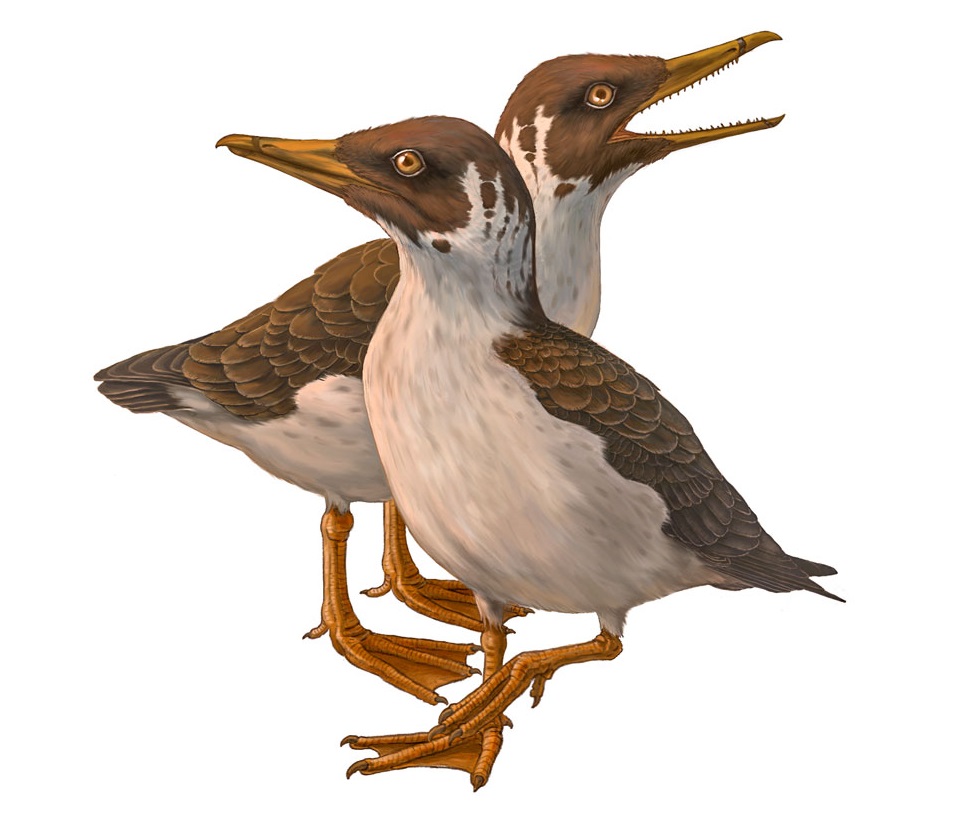
[PaleoOrnithology • 2022] Janavis finalidens • Cretaceous Ornithurine Supports A neognathous Crown Bird Ancestor (Ornithurae: Ichthyornithes)


Janavis finalidens
Benito, Kuo, Widrig, Jagt & Field, 2022

artwork by Phillip Krzeminski.

Abstract
The bony palate diagnoses the two deepest clades of extant birds: Neognathae and Palaeognathae. Neognaths exhibit unfused palate bones and generally kinetic skulls, whereas palaeognaths possess comparatively rigid skulls with the pterygoid and palatine fused into a single element, a condition long considered ancestral for crown birds (Neornithes). However, fossil evidence of palatal remains from taxa close to the origin of Neornithes is scarce, hindering strong inferences regarding the ancestral condition of the neornithine palate. Here we report a new taxon of toothed Late Cretaceous ornithurine bearing a pterygoid that is remarkably similar to those of the extant neognath clade Galloanserae (waterfowl + landfowl). Janavis finalidens, gen. et sp. nov., is generally similar to the well-known Mesozoic ornithurine Ichthyornis in its overall morphology, although Janavis is much larger and exhibits a substantially greater degree of postcranial pneumaticity. We recovered Janavis as the first-known well-represented member of Ichthyornithes other than Ichthyornis, clearly substantiating the persistence of the clade into the latest Cretaceous. Janavis confirms the presence of an anatomically neognathous palate in at least some Mesozoic non-crown ornithurines suggesting that pterygoids similar to those of extant Galloanserae may be plesiomorphic for crown birds. Our results, combined with recent evidence on the ichthyornithine palatine, overturn longstanding assumptions about the ancestral crown bird palate, and should prompt reevaluation of the purported galloanseran affinities of several bizarre early Cenozoic groups such as the ‘pseudotoothed birds’ (Pelagornithidae).


Avialae Gauthier, 1986 sensu Benito et al. 2022

Ornithurae Haeckel, 1866

Ichthyornithes Marsh, 1873 sensu Benito et al. 2022

Janavis finalidens, gen. et sp. nov.

Locality and age: CBR-Romontbos Quarry, Eben-Emael, Liège, Belgium. Valkenburg Member (67–66.9 million years ago), Maastricht Formation, late Maastrichtian, Late Cretaceous. Additional details regarding the locality and stratigraphic setting are provided in the Supplementary Information.

Diagnosis: Janavis is distinguished from other known Euornithes, and from Ichthyornis in particular, by the greater degree of pneumaticity of its thoracic vertebrae and ribs, especially the presence of large ventral pneumatic openings in the anterior thoracic vertebrae and fenestrated ventrolateral tubercles on the fifteenth presacral vertebra (Fig. 1b and Extended Data Figs. 1 and 3). It is also distinguished by the complete absence of an acromion process on the scapula (Extended Data Fig. 2d) and, most obviously, by its much larger size (maximum length of the Janavis humerus is 134.8 mm; maximum length of the longest known Ichthyornis humerus, YPM 1742, is 71.5 mm).

Etymology: Janavis from the Roman god Janus and the Latin avis for bird. In Roman mythology, Janus is the god of beginnings, endings and transitions, reflecting transitional aspects of the morphology of Janavis (combining plesiomorphic features such as teeth with a neognath-like palate) as well as its temporal provenance (deriving from the uppermost Cretaceous, making it one of the youngest non-neornithine avialan fossils in the world). The specific epithet finalidens, from the Latin finalis (adj.), meaning ending or final, and dens, for teeth, reflects the fact that the specimen is among the latest-known toothed avialans, which appear to have died out in the end-Cretaceous mass extinction shortly after Janavis lived.


Juan Benito, Pei-Chen Kuo, Klara E. Widrig, John W. M. Jagt and Daniel J. Field. 2022. Cretaceous Ornithurine Supports A neognathous Crown Bird Ancestor. Nature. 612; 100–105. DOI: 10.1038/s41586-022-05445-y

Thursday, January 28, 2021

[PaleoMammalogy • 2020] Antwerpibalaena liberatlas • A New Pliocene Right Whale (Cetacea, Balaenidae) from Belgium informs Balaenid Phylogeny and Function


Antwerpibalaena liberatlas
  Lavigerie, Bosselaers, Goolaerts, Park, Lambert & Marx, 2020


Abstract
Right whales (Balaenidae) are the most distinctive family of extant baleen whales, thanks to their highly arched rostrum, tall lips and robust body shape. They are also the oldest, originating as much as 20 million years ago (Ma). Nevertheless, their fossil record is patchy and frequently understudied, obscuring their evolution. Here, we describe a new stem balaenid, Antwerpibalaena liberatlas, from northern Belgium, adding to the rich but historically problematic baleen whale assemblage of the Pliocene North Sea. Within right whales, Antwerpibalaena forms a clade with two previously described extinct genera, Balaenella and Balaenula. The holotype preserves much of the postcranial skeleton, and informs the emergence of typical balaenid traits like fused neck vertebrae and paddle-shaped flippers. Its size is intermediate between that of extant right whales and most of their extinct forebears revealing a more complex pattern of balaenid size evolution than previously thought.
 
Keywords: Balaenidae, gigantism, cervical vertebrae, ear bones, forelimb, phylogeny


Systematic palaeontology 
Cetacea Brisson, 1762 
Neoceti Fordyce & de Muizon, 2001 
Mysticeti Gray, 1864 
Balaenidae Gray, 1821 

Antwerpibalaena gen. nov. 
 
Derivation of name. Antwerp, after the city (Antwerpen in Flemish) that lends its name to the harbour area where the fossil was found and which has long been at the centre of Belgian cetacean research; balaena, Latin for whale.

Antwerpibalaena liberatlas sp. nov.

Derivation of name. From liber, Latin for free; and atlas, after the name of the first cervical vertebra. The latter is unfused in the holotype of the new species. 


Holotype. IRSNB M2325, comprising a fragmentary basicranium, both tympanoperiotics, the right auditory ossicles, both mandibles, parts of the hyoid apparatus, the right forelimb, all seven cervical vertebrae, five thoracic vertebrae, the sternum and several ribs. 

Occurrence. The type and only specimen came from the Kieldrecht Lock (previously known as Deurganckdoksluis, Port of Antwerp area) on the left bank of the river Scheldt, north-west of the city of Antwerp, Belgium (Fig. 1). The specimen derives from the base of the Oorderen Sands Member (Lillo Formation), dated to 3.21–2.76 Ma (Piacenzian, late Pliocene) based on its dinoflagellate cyst assemblage (Louwye et al. 2004; De Schepper et al. 2009). 


 Consensus tree showing all compatible groups arising from the Bayesian total evidence (molecular þ morphological data) analysis. Numbers next to nodes represent posterior probabilities, values below 50 are not shown. Grey shading within Balaenidae indicates extant species. Drawing of whale by Carl Buell.


Conclusions: 
 Antwerpibalaena liberatlas is a new, medium-sized (9.5–11.9 m) extinct balaenid from the Pliocene of Belgium. Its well-preserved postcranial remains provide novel insights into the evolution of extant balaenid anatomy and function, such as the emergence of a fused neck and paddle-shaped flippers. Its total body length falls between that of extant right whales and most extinct species, and points to a more complex pattern of body size evolution than previously thought. The Pliocene North Sea was home to a disparate balaenid assemblage, ranging from small species like Balaenella brachyrhynus to comparative giants like Eubalaena ianitrix. Despite its chequered history, the Belgian Pliocene fossil record holds great potential to illuminate cetacean evolution at a time of major global change.


Guillaume Duboys de Lavigerie, Mark Bosselaers, Stijn Goolaerts, Travis Park, Olivier Lambert and Felix G. Marx. 2020. New Pliocene Right Whale from Belgium informs Balaenid Phylogeny and Function.  Journal of Systematic Palaeontology. 18(14); 1141-1166. DOI: 10.1080/14772019.2020.1746422


Wednesday, July 31, 2019

[PaleoIchthyology • 2019] Scheenstia bernissartensis (Actinopterygii: Ginglymodi) from the Early Cretaceous of Bernissart, Belgium, with An Appraisal of Ginglymodian Evolutionary History


Scheenstia bernissartensis (Traquair, 1911)

in Cavin, Deesri & Olive, 2019. 


Abstract
Lepidotes bernissartensis is a species of holostean ray-finned fish from the Barremian–Aptian of Bernissart, Belgium, described by Traquair in 1911. We provide here a revision of its anatomy, which led us to include this species in the genus Scheenstia, and to consider L. brevifulcratus and L. arcuatus, both from the same site, synonymous with S. bernissartensis. We performed two cladistic analyses in order to assess the phylogenetic position of S. bernissartensis and to do an updated appraisal of the evolutionary history of the ginglymodians. Scheenstia is included in the Lepidotidae, and placed in a pectinated position between the basal genus Lepidotes and the more derived members of the family (other species of Scheenstia, Isanichthys and Camerichthys). The nodes within the lepidotids are weakly supported. Although S. bernissartensis is not directly related to S. mantelli from the Wealden of Europe, the two species have similar palaeoenvironments and stratigraphical ranges. Taken as a whole, the ginglymodians experienced several episodes of diversification that are spatially and temporally restricted. The oldest episode involved basal ginglymodians and occurred in the Middle Triassic, in marine environments along the northern margin of the Tethys. A second episode affected the Semionotidae and occurred in freshwater environments of North America and Europe in the Late Triassic and Early Jurassic. The remaining Semionotiformes, Macrosemiidae and Callipurbeckidae, ranged from the Triassic to the Early Cretaceous and were mostly marine. Among the Lepisosteiformes, two clades, the Lepidotidae and the Lepisosteoidi, show episodes of diversification, first in marine and then in freshwater environments.

Keywords: Lepisosteiformes, Lepidotidae, osteology, cladistic analysis, evolutionary history

Scheenstia bernissartensis. A–D, IRSNB P 1205, lectotype,
photograph of the specimen (A) and interpretative drawing of the skull (B);
photograph (C) and interpretative drawing (D) of the palate in ventral view. E, F, IRSNB P 1207, photograph of the specimen (E) and interpretative drawing of the skull (F).

Systematic palaeontology

Holostei Muller, 1844 (sensu Grande 2010)
Ginglymodi Cope, 1872 (sensu Grande 2010)

Lepisosteiformes Hay, 1929 (sensu L opezArbarello 2012)
Lepidotidae Owen, 1860

Scheenstia López-Arbarello & Sferco, 2011

Scheenstia bernissartensis (Traquair, 1911)


Lionel Cavin, Uthumporn Deesri and Sébastien Olive. 2019. Scheenstia bernissartensis (Actinopterygii: Ginglymodi) from the Early Cretaceous of Bernissart, Belgium, with An Appraisal of Ginglymodian Evolutionary History. Journal of Systematic Palaeontology. DOI: 10.1080/14772019.2019.1634649   

Saturday, September 3, 2016

[PaleoIchthyology • 2016] Placoderm Assemblage from the Tetrapod-Bearing Locality of Strud (Belgium, Upper Famennian) Provides Evidence for a Fish Nursery


Fig 2. Reconstruction of the immature placoderms and diagrammatic model of the Strud nursery.
Immature placoderms (from top to bottom) Turrisaspis strudensis (left lateral view), Grossilepis rikiki (dorsal view), Phyllolepis undulata (dorsal view). Diagrammatic model of the Strud nursery displaying the habitat partitioning: on the left, shallow waters of the nursery with immature placoderms inside and Rhacophyton plant on the bank; on the right, deeper area with the placoderm adults. Scale bars equal 2 cm. Animal and environmental reconstructions by J. Jacquot Haméon (MNHN, Paris). 

Abstract

The placoderm fauna of the upper Famennian tetrapod-bearing locality of Strud, Belgium, includes the antiarch Grossilepis rikiki, the arthrodire groenlandaspidid Turrisaspis strudensis and the phyllolepidid Phyllolepis undulata. Based on morphological and morphometric evidence, the placoderm specimens from Strud are predominantly recognised as immature specimens and this locality as representing a placoderm nursery. The Strud depositional environment corresponds to a channel in an alluvial plain, and the presence of a nursery in such environment could have provided nutrients and protection to the placoderm offspring. This represents one of the earliest pieces of evidence for this sort of habitat partitioning in vertebrate history, with adults living more distantly from the nursery and using the nursery only to spawn or give live birth.

Fig 2. Reconstruction of the immature placoderms and diagrammatic model of the Strud nursery.
 Immature placoderms (from top to bottom) Turrisaspis strudensis (left lateral view), Grossilepis rikiki (dorsal view), Phyllolepis undulata (dorsal view). Diagrammatic model of the Strud nursery displaying the habitat partitioning: on the left, shallow waters of the nursery with immature placoderms inside and Rhacophyton plant on the bank; on the right, deeper area with the placoderm adults. Scale bars equal 2 cm. Animal and environmental reconstructions by J. Jacquot Haméon (MNHN, Paris).


Sébastien Olive, Gaël Clément, Edward B. Daeschler and Vincent Dupret. 2016. Placoderm Assemblage from the Tetrapod-Bearing Locality of Strud (Belgium, Upper Famennian) Provides Evidence for a Fish Nursery. PLoS ONE. 11(8): e0161540.


Tuesday, May 31, 2016

[PaleoMammalogy • 2016] Fragilicetus velponi • A New Mysticete Genus and Species and Its Implications for the Origin of Balaenopteridae (Cetacea, Mysticeti)


Fragilicetus velponi 
Bisconti & Bosselaers, 2016

Figure 14. Artistic interpretation of possible interaction between a large shark and Fragilicetus velponi gen. et. sp. nov. as suggested by the shark bite marks on the skull of the holotype specimen. 
The human in the upper right corner serves as a size reference. Illustration by Mark Bosselaers.
 
 DOI: 10.1111/zoj.12370

Abstract
A new extinct genus, Fragilicetus gen. nov., is described here based on a partial skull of a baleen-bearing whale from the Early Pliocene of the North Sea. Its type species is Fragilicetus velponi sp. nov. This new whale shows a mix of morphological characters that is intermediate between those of Eschrichtiidae and those of Balaenopteridae. A phylogenetic analysis supported this view and provided insights into some of the morphological transformations that occurred in the process leading to the origin of Balaenopteridae. Balaenopterid whales show specialized feeding behaviour that allows them to catch enormous amounts of prey. This behaviour is possible because of the presence of specialized anatomical features in the supraorbital process of the frontal, temporal fossa, glenoid fossa of the squamosal, and dentary. Fragilicetus velponi gen. et sp. nov. shares the shape of the supraorbital process of the frontal and significant details of the temporal fossa with Balaenopteridae but maintains an eschrichtiid- and cetotheriid-like squamosal bulge and posteriorly protruded exoccipital. The character combination exhibited by this cetacean provides important information about the assembly of the specialized morphological features responsible for the highly efficient prey capture mechanics of Balaenopteridae.  

Keywords: Belgium; feeding behavior; Fragilicetus; phylogeny; Pliocene


Figure 14. Artistic interpretation of possible interaction between a large shark and Fragilicetus velponi gen. et. sp. nov. as suggested by the shark bite marks on the skull of the holotype specimen shown in Figure 3.
The human in the upper right corner serves as a size reference. Illustration by Mark Bosselaers. 

Systematic Palaeontology

Class Mammalia Linnaeus, 1758
Order Cetacea Brisson, 1762
Suborder Mysticeti Cope, 1891
Chaeomysticeti Mitchell, 1989
Balaenomorpha Geisler & Sanders, 2003

Superfamily Thalassotherii Bisconti, Lambert & Bosselaers, 2013
Epifamily Balaenopteroidea Flower, 1864

Family Balaenopteridae Gray, 1864

Fragilicetus gen. nov.

Diagnosis: The diagnosis of Fragilicetus includes the presence of eschrichtiid-like and balaenopterid-like features in the same individual. Fragilicetus is distinguished from the other nonbalaenopterid mysticete families based on the presence, in the same individual, of a squamosal bulging into the temporal fossa; posterior projection of the posterolateral corner of the exoccipital; anterior placement of the posterior apex of the lambdoidal crest; squamosal cleft present and v-shaped (turning ventrally at its lateral end); abruptly depressed and flat supraorbital process of the frontal; anterior portion of temporal crest transversely elongated and forming a dorsal roof to the anterior portion of the temporal fossa; very short intertemporal region; infraorbital region of the frontal exposed dorsally between the ascending processes of the maxillae; anterior end of the parietal located more anteriorly than the posterior ends of the ascending process of the maxilla; descending suprameatal surface from the central portion of the periotic to the superior rim of the internal acoustic meatus; endocranial opening of the facial canal separated from the internal acoustic meatus by a thick crista transversa but not prolonged into a groove; triangular anterior process of the periotic; anterior process of the periotic and central portion of periotic on the same plane; groove for VII cranial nerve in posterior process reduced; anteroposteriorly short and flattened posterior process of the periotic.


Etymology: Fragilis, Latin, fragile, in reference to the extreme fragility of the holotype skull. Cetus, Latin, whale.

Type species: Fragilicetus velponi sp. nov. This is currently the only included species.


Figure 5. Holotype skull of Fragilicetus velponi gen. et. sp. nov. in lateral view. A, photographic representation; B, interpretative representation.
Abbreviations: eam, external acoustic meatus; exo, exoccipital; fr, frontal; max, maxilla; opt, optic channel; par, parietal; pgl, postglenoid process of squamosal; ppp, posterior process of the periotic; pt, pterygoid; soc, supraoccipital; sop, supraorbital process of the frontal; sq, squamosal; sqc, squamosal cleft; vom, vomer; zyg, zygomatic process of the squamosal. Scale bar = 300 mm.

Fragilicetus velponi sp. nov.

Holotype: Item no. NMR 999100007727, housed at the Natuurhistorisch Museum Rotterdam, The Netherlands (hereinafter, NMR).

Type locality: The specimen was found along the south-west border of the Deurganckdock, approximately 12 km north-west of Antwerp city centre and 4 km north of the village of Kallo (Fig. 1). The Deurganckdock is an artificial excavation located on the left side of the Scheldt River. The geographical coordinates of the discovery site are 51°17′05″N, 4°15′30″E.

Etymology: Velpon is the brand of the glue used in the preparation of the holotype skull.


Figure 6. Skull of Fragilicetus velponi gen. et. sp. nov. in anterior view. A, photo; B, line drawing.
Abbreviations: bocc, basioccipital; bs, basisphenoid; desc sop, descending part of supraorbital process of the frontal; fm, foramen magnum; fr, frontal; max, maxilla; par, parietal; pt, pterygoid; soc, supraoccipital; sop, supraorbital process of the frontal; sq, squamosal; sqc, squamosal cleft; vom, vomer. Scale bar = 300 mm.

Figure 3. Localizations and orientations of shark bite marks on the holotype skull of Fragilicetus velponi gen. et. sp. nov. as seen from the anterior view. The shark bite marks are in solid black. The skull is in anterior view; only the right side of the skull is shown because it is that part that bears the shark bite marks.
 Abbreviations: ali, alisphenoid; fr, frontal; pal, palatine; par, parietal; pgl, postglenoid process of squamosal; pt, pterygoid; soc, supraoccipital; sq, squamosal; sqc, squamosal cleft; sq-par, squamosal–parietal suture; sq-pt, squamosal-pterygoid suture; tc, temporal crest; vom, vomer; zyg, zygomatic process of the squamosal. Scale bar = 100 mm.

Figure 14. Artistic interpretation of possible interaction between a large shark and Fragilicetus velponi gen. et. sp. nov. as suggested by the shark bite marks on the skull of the holotype specimen shown in Figure 3.
The human in the upper right corner serves as a size reference. Illustration by Mark Bosselaers.

Conclusions
The new genus Fragilicetus is established based on the new fossil species F. velponi. Fragilicetus is the sister group of later Balaenopteridae; Eschrichtiidae is the sister group of the Balaenopteridae clade. Fragilicetus velponi shares several characters with Eschrichtiidae, e.g. the prominent bulge of the squamosal into the temporal fossa and the posterior protrusion of the posterolateral corner of the exoccipital; it shares with later Balaenopteridae the shape of the abruptly depressed supraorbital process of the frontal, details of the articulation of the rostrum with the frontal, and the shape of the supraoccipital. A phylogenetic analysis revealed that F. velponi is closer to Balaenopteridae than to Eschrichtiidae. The phylogenetic analysis also revealed high levels of homoplasy in the Balaenopteroidea clade but these did not prevent the construction of a highly resolved strict consensus tree. However, the high levels of homoplasy prevent unambiguous diagnoses of the internal nodes of Balaenopteridae. The morphological characters observed in F. velponi showed that the appearance of a wide and flat, abruptly depressed supraorbital process of the frontal and an anteriorly constricted supraoccipital preceded the loss of the squamosal bulge and the loss of strong attachment sites for neck muscles in the evolutionary process leading to the balaenopterid lineage. These characters have functional implications respectively related to the anterior placement of the attachment for the temporalis muscle and to the preservation of a mobile head in the earliest phases of balaenopterid evolution.

Finally, the fossil described in the present paper is a demonstration of direct interaction between sharks and mysticetes in the Pliocene; an illustration of this interaction is shown in Figure 14.


Michelangelo Bisconti and Mark Bosselaers. 2016. Fragilicetus velponi: A New Mysticete Genus and Species and Its Implications for the Origin of Balaenopteridae (Mammalia, Cetacea, Mysticeti). Zoological Journal of the Linnean Society. 177(2); 450–474.  DOI: 10.1111/zoj.12370

Wednesday, January 8, 2014

[PaleoMammalogy • 2014] Dormaalocyon latouri • Dental and Tarsal Anatomy of ‘Miacis’ latouri and a Phylogenetic Analysis of the Earliest carnivoraforms (Mammalia, Carnivoramorpha) from the Eocene of Dormaal, Belgium


Dormaalocyon latouri (Quinet, 1966)
Art by Charlène Letenneur (MNHN) and 
Pascale Golinvaux (RBINS)

ABSTRACT
One of the earliest basal carnivoraforms, Miacis latouri, previously known by only two teeth from the earliest Eocene of Dormaal, Belgium, is here described based on about 280 new specimens from Dormaal, allowing illustration of almost the entire deciduous and permanent dentition and thus giving information on the dentition of an early basal carnivoraform species and its variability. Based on the dental features, we refer the species to a new genus, Dormaalocyon. We identify possible sexual dimorphism in D. latouri that is less pronounced than in Uintacyon rudis. We also describe for the first time the tarsal bones (calcaneum and astragalus) of D. latouri; these indicate arboreal capabilities for this species. In order to ascertain the position of Dormaalocyon among basal carnivoraforms, we performed a phylogenetic analysis of the carnivoramorphans. Among basal carnivoraforms, three groups are recovered: the Uintacyon group, Oodectes group, and the Vulpavus group. Dormalocyon is one of the most primitive carnivoraforms and is closely related to North American Vulpavus and Miacis species. We propose that the two latter genera are North American with an ancestry that involves the European Dormaalocyon; this implies a dispersal of carnivoraforms from Europe to North America near the Paleocene-Eocene boundary. Finally, the topology of the phylogenetic tree supports a Paleocene radiation of the carnivoraforms, which is presently unknown.


CARNIVORAMORPHA Wyss and Flynn, 1993
CARNIVORAFORMES Flynn, Finarelli, and Spaulding, 2010

Dormaalocyon  gen. nov.
Type Species: Dormaalocyon latouri (Quinet, 1966), comb. nov.
Localities: Dormaal (Flemish Brabant), Belgium; earliest Eocene, MP7.

Etymology: From Dormaal, type locality of the species; from Greek Kyon, dog.
Dormaalocyon latouri (Quinet, 1966), comb. nov.
[Miacis latouri Quinet, 1966]


FIGURE 1 Dentaries of Dormaalocyon latouri (Quinet, 1966), comb. nov.


Floréal Solé, Richard Smith, Tiphaine Coillot, Eric de Bast & Thierry Smith. 2014. Dental and Tarsal Anatomy of ‘Miacis’ latouri and a Phylogenetic Analysis of the Earliest carnivoraforms (Mammalia, Carnivoramorpha). Journal of Vertebrate Paleontology. 34:1, 1-21. 

New Fossils Shed Light On the Origins of Lions, Tigers, and Bears
 — New fossils from Belgium have shed light on the origin of some of the most well-known, and well-loved, modern mammals. Cats and dogs, as well as other carnivorous mammals (like bears, seals, and weasels), taxonomically called 'carnivoraformes', trace their ancestry to primitive carnivorous mammals dating back to 55 million years ago (the beginning of the time period called the Eocene). A study, published in the most recent issue of the Journal of Vertebrate Paleontology, discusses the origins of this group and describes new specimens of one of the earliest of these primitive taxa.