Showing posts with label Dromaeosauridae. Show all posts

Friday, June 5, 2026

[Paleontology • 2026] Jian changmaensis • First non-Avian Theropod (Dromaeosauridae: Microraptorinae) from the Bird-bearing Lower Cretaceous Xiagou Formation of the Changma Basin, Gansu Province, Northwestern China


Jian changmaensis 
Zhou, Lamanna, Poust, Li, You & O’Connor, 2026
attacks the early bird Gansus yumenensis 
  
 illustration by Lewis LaRosa  x.com/LewisLaRosa, colorized by Jão Canola.

ABSTRACT
Lacustrine sediments of the Lower Cretaceous (lower Aptian) Xiagou Formation exposed near the village of Changma in the Changma Basin of northwestern Gansu Province, China have yielded more than 100 avian partial skeletons, many of which also preserve remnants of soft tissues such as feathers and skin. Collectively, these fossils characterize a rich avifauna dominated by the crownward ornithuromorph Gansus yumenensis Hou and Liu, 1984. Despite this wealth of Early Cretaceous bird material, no skeletal remains of other dinosaurs have been described from Changma to date. Here we report the first non-avian dinosaur body fossil from the Xiagou Formation of the Changma Basin. Consisting of an articulated left pectoral girdle and forelimb lacking the carpus and manus, the specimen pertains to a new dromaeosaurid theropod taxon, Jian changmaensis, gen. et sp. nov. Phylogenetic analysis recovers Jian within Microraptorinae, expanding the definitive fossil record of this clade to include northwestern China. The new Changma microraptorine constitutes an additional similarity between the theropod faunas of the Xiagou Formation of the Changma Basin and penecontemporaneous strata of the Jehol Group of northeastern China. In particular, the Changma theropod assemblage closely resembles that of the Sihedang locality of the Jehol Group in that both include representatives of Microraptorinae and are overwhelmingly dominated by single ornithuromorph taxa that phylogenetic analyses have repeatedly resolved as close relatives. This raises the possibility that the two sites were deposited under comparable paleoenvironmental settings that are otherwise poorly represented at known Jehol localities. 

Key Words: Early Cretaceous, Gansus yumenensis, Jian changmaensis, microraptorine, paleobiogeography, paleoenvironment, phylogeny, Sihedang 


SYSTEMATIC PALEONTOLOGY 

Dinosauria Owen, 1842 
Saurischia Seeley, 1888 
Theropoda Marsh, 1881 
Maniraptora Gauthier, 1986 
Dromaeosauridae Matthew and Brown, 1922 
Microraptorinae Xu, 2002 

Holotype of Jian changmaensis, gen. et sp. nov. (GSGM-D050), an articulated partial left pectoral girdle (scapulocoracoid) and forelimb (humerus, radius, and ulna). A, silhouette of generalized microraptorine dromaeosaurid theropod (courtesy Scott Hartman) showing skeletal elements preserved; B, photograph of specimen as preserved, exposed primarily in dorsomedial (scapulocoracoid), caudodorsal (humerus), and dorsal (radius and ulna) views; C, interpretive line drawing of B; D, detail photograph of scapulocoracoid and proximal end of humerus in caudodorsal view, showing supracoracoid fenestra and other structures; E, interpretive line drawing of D.
Abbreviations: ac, acromion; bc, bicipital crest; C, coracoid; cr, caudal ridge; dep, dorsal epicondyle; dpc, deltopectoral crest; dr, dorsal ridge; ed, epicondylar depression; fs?, fossa for M. supinator?; H, humerus; hh, humeral head; lp, lateral process; ‘mb’, ‘medial bar’; op, olecranon process; R, radius; S, scapula; scb, scapular blade; scf, supracoracoid fenestra; sta, sternal articulation; U, ulna.

Jian changmaensis, gen. et sp. nov.

Diagnosis.—Medium-sized (intermediate in skeletal dimensions between adult specimens of Microraptor zhaoianus and Sinornithosaurus millenii Xu et al., 1999; see Table 2) microraptorine dromaeosaurid theropod characterized by the following three autapomorphies: (1) a coracoid that is proportionally longer relative to the humerus than in any other microraptorine (~36% humerus length; the next closest individuals are the immature Microraptor IVPP V31612, with a value of ~35%, and IVPP V12811, the holotype of Sinornithosaurus, with a value of 33%) (Table 2); (2) humeral distal condyles developed on the cranial surface of this bone (Figs. 2B–C, 3E; a local autapomorphy within Microraptorinae, shared with nonmicroraptorine theropods such as the therizinosaur Erlikosaurus andrewsi Barsbold and Perle, 1980, and Aves); and (3) a well-developed foramen on the ventral aspect of ...

Etymology.—The genus name is for the Jiān (鹣), a one winged bird in Chinese mythology, in reference to the bird-like, possibly volant nature of this microraptorine taxon and the skeletal composition of its holotype (an isolated partial pectoral girdle and forelimb). The specific name is for Changma (昌马), the locality where the holotype was discovered.

 The new microraptor dinosaur Jian changmaensis (left) attacks the early bird Gansus yumenensis (right) in what is now the Changma Basin of northwestern China approximately 120 million years ago. 
 illustration by Lewis LaRosa  x.com/LewisLaRosa,
colorized by Jão Canola.


Ling-Qi Zhou, Matthew C. Lamanna, Ashley W. Poust, Da-Qing Li, Hai-Lu You and Jingmai K. O’Connor. 2026. First non-Avian Theropod (Dromaeosauridae, Microraptorinae) from the Bird-bearing Lower Cretaceous Xiagou Formation of the Changma Basin, Gansu Province, Northwestern China. ANNALS OF CARNEGIE MUSEUM. 92(2); 89–110. [4 June 2026]


Monday, July 14, 2025

[Paleontology • 2025] Shri rapax • A New bird-like Dinosaur from the Upper Cretaceous of Mongolia with extremely robust hands supports niche partitioning among velociraptorines


Shri rapax
Moutrille, Cau, Chinzorig, Escuillié, Tsogtbaatar, Ganzorig, Mallet & Godefroit, 2025

 
ABSTRACT
Dromaeosauridae is a clade of bird-like theropod dinosaurs including, among others, the genera Deinonychus and Velociraptor, and characterised by a specialised second toe bearing an enlarged and falciform ungual. Here, we describe an exquisitely-preserved velociraptorine dromaeosaurid from the Upper Cretaceous Djadokhta Formation of Mongolia, and refer it to the new species Shri rapax. This dromaeosaurid is diagnosed by a peculiar combination of vertebral and pelvic features and by an exceptionally robust hand with a very stout pollex bearing the ungual proportionally larger than in any other dromaeosaurid. Combined with cranial adaptations which could support a bite more powerful than in other velociraptorines, the enlarged unguals in both Shri species suggest ecological partitioning in prey preference among the sympatric Djadokhtan dromaeosaurids.

KEYWORDS: Cretaceous, Djadokhta Formation, Dromaeosauridae, Mongolia, Theropoda


Shri rapax


Léa Moutrille, Andrea Cau, Tsogtbaatar Chinzorig, François Escuillié, Khishigjav Tsogtbaatar, Bayasgaa Ganzorig, Christophe Mallet and Pascal Godefroit. 2025. A New bird-like Dinosaur from the Upper Cretaceous of Mongolia with extremely robust hands supports niche partitioning among velociraptorines. Historical Biology: An International Journal of Paleobiology. DOI: doi.org/10.1080/08912963.2025.2530148 [13 Jul 2025] 

Thursday, February 20, 2025

[Paleontology • 2025] Evolutionary and Paleobiogeographic Implications of New carcharodontosaurian, megaraptorid, and unenlagiine Theropod Remains from the upper Lower Cretaceous of Victoria, southeast Australia


Cretaceous Australia Landscape
 
in Kotevski, Duncan, Ziegler, Bevitt, Vickers-Rich, Rich, Evans & Poropat, 2025. 
artwork by Jonathan Metzger

ABSTRACT
The Early Cretaceous non-avian theropod body fossil record of Victoria, Australia dominantly comprises isolated dental and postcranial remains. Numerous specimens have been collected from both the upper Strzelecki Group (upper Barremian–lower Aptian) and Eumeralla Formation (upper Aptian–lower Albian), yet theropod diversity in each unit remains poorly resolved. In both deposits, specimens pertaining to Megaraptoridae—a clade seemingly endemic to South America and Australia in the Cretaceous—are most frequently encountered. However, evidence of other typically common Gondwanan theropod groups, including Abelisauridae and Carcharodontosauria, has remained unknown. Herein, we describe five new theropod specimens: three tibiae, and two articulated caudal vertebrae with haemal arches, from the upper Strzelecki Group; and a single tibia from the Eumeralla Formation. Two of these tibiae—one each from the upper Strzelecki Group and the Eumeralla Formation—provide the first evidence for Carcharodontosauria in Australia. Two megaraptorid specimens from the upper Strzelecki Group—a tibia, and two caudal vertebrae with haemal arches—demonstrate that this clade had achieved large body size at the time of its first appearance in the fossil record. A tibia from the upper Strzelecki Group is interpreted to represent the Gondwanan dromaeosaur clade Unenlagiinae. Collectively, the new theropod remains described herein strengthen the evidence for mid-Cretaceous faunal interchange between Australia and South America across Antarctica, and highlight the presence of carcharodontosaurians and unenlagiines at high latitudes in the late Early Cretaceous.

Carcharodontosauria indet. right tibia (NMV P221042)
from the Eumeralla Formation of Victoria, Australia.  

Cretaceous Australia Landscape.
artwork by Jonathan Metzger, Museums Victoria


Jake Kotevski, Ruairidh J. Duncan, Tim Ziegler, Joseph J. Bevitt, Patricia Vickers-Rich, Thomas H. Rich, Alistair R. Evans and Stephen F. Poropat. 2025. Evolutionary and Paleobiogeographic Implications of New carcharodontosaurian, megaraptorid, and unenlagiine Theropod Remains from the upper Lower Cretaceous of Victoria, southeast Australia. Journal of Vertebrate Paleontology. e2441903. DOI: doi.org/10.1080/02724634.2024.2441903  

Wednesday, October 23, 2024

[Paleontology • 2024] Theropod Trackways as indirect evidence of Pre-avian Aerial Behavior


The animal responsible for Dromaeosauriformipes rarus tracks is believed to be a small microraptorine related to the ancestors of birds.

in Dececchi, Kim, Lockley, Larsson, Holtz, Farlow et Pittman, 2024.
artwork: Julius Csotonyi.  

Abstract
Body fossils set limits on feasible reconstructions of functional capacity and behavior in theropod dinosaurs, but do not document in-life behaviors. In contrast, trace fossils such as footprints preserve in-life behaviors that can potentially test and enhance existing reconstructions. Here, we demonstrate how theropod trackways can be used as indirect evidence of pre-avian aerial behavior, expanding the approaches available to study vertebrate flight origins. This involved exploring the behavioral implications of a two-toed Cretaceous-aged theropod trackway produced by a small, bird-like microraptorine moving at high speed. Applying first principle running biomechanics, we were able to conclude that the trackway is atypical, indirectly evidencing pre-avian aerial behavior. This trackway documents the evidence of wing-assisted aerodynamic force production during locomotion, supporting a broader distribution of this behavior than currently known. These findings support previously proposed aerial behavior in early bird-like theropods, showing how trackways will help to deepen our understanding of theropod flight origins.


Illustrated reconstruction of Dromaeosauriformipes rarus running along the muddy shore of an ancient lake.
artwork: Alex Boersma

The animal responsible for Dromaeosauriformipes rarus tracks is believed to be a small microraptorine related to the ancestors of birds.
artwork: Julius Csotonyi.  


 T. Alexander Dececchi, Kyung Soo Kim, Martin G. Lockley, Hans C.E. Larsson, Thomas R. Holtz Jr., James O. Farlow and Michael Pittman. 2024. Theropod Trackways as indirect evidence of Pre-avian Aerial Behavior. PNAS. 121 (44) e2413810121. DOI: doi.org/10.1073/pnas.2413810121 

Researchers Solve Mystery of ‘Dinky’ Dinosaur’s Unusually Long Stride 
UMD paleontologist Thomas R. Holtz Jr. helped recreate the movements of a bird-sized raptor, shedding new light on the origin of flight.

Friday, June 14, 2024

[Paleontology • 2024] Diuqin lechiguanae • A New unenlagiine (Theropoda: Dromaeosauridae) from the Bajo de la Carpa Formation (Neuquén Group, Upper Cretaceous) of Neuquén Province, Patagonia, Argentina


Diuqin lechiguanae 
Porfiri, Baiano, dos Santos, Gianechini, Pittman & Lamanna. 2024
 

Abstract
Background: 
Unenlagiine paravians are among the most relevant Gondwanan theropod dinosaur clades for understanding the origin of birds, yet their fossil record remains incomplete, with most taxa being represented by fragmentary material and/or separated by lengthy temporal gaps, frustrating attempts to characterize unenlagiine evolution.

Results and conclusions: 
Here we describe Diuqin lechiguanae gen. et sp. nov., a new unenlagiine taxon from the Upper Cretaceous (Santonian) Bajo de la Carpa Formation of the Neuquén Basin of Neuquén Province in northern Patagonia, Argentina that fills a substantial stratigraphic gap in the fossil record of these theropods. Although known only from a very incomplete postcranial skeleton, the preserved bones of Diuqin differ from corresponding elements in other unenlagiines, justifying the erection of the new taxon. Moreover, in several morphological aspects, the humerus of Diuqin appears intermediate between those of geologically older unenlagiines from the Neuquén Basin (e.g., Unenlagia spp. from the Turonian–Coniacian Portezuelo Formation) and that of the stratigraphically younger, larger-bodied Austroraptor cabazai from the Campanian–Maastrichtian Allen Formation. Consequently, the morphology of the new taxon appears to indicate a transitional stage in unenlagiine evolution. Phylogenetic analysis recovers Diuqin as a paravian with multiple plausible systematic positions, but the strongest affinity is with Unenlagiinae. The humerus of the new form exhibits subcircular punctures near its distal end that are interpreted as feeding traces most likely left by a conical-toothed crocodyliform, mammal, or theropod, the latter potentially corresponding to a megaraptorid or another unenlagiine individual. Thus, in addition to filling important morphological and temporal gaps in unenlagiine evolutionary history, the new taxon also offers information relating to the paleoecology of these theropods.

Keywords: Unenlagiinae, Dromaeosauridae, Cretaceous, Bajo de la Carpa Formation, Patagonia, South America, Biostratigraphy, Phylogeny, Paleoecology, Megaraptoridae

Left humerus of Diuqin lechiguanae gen. et sp. nov. (MUCPv 1401/4) in lateral (A), medial (B), anterior (C), posterior (D), proximal (E), and distal (F) views.
Abbreviations: brf, brachial fossa; cr, crest; dldpr, distolateral deltopectoral ridge; dpc, deltopectoral crest; ect, ectepicondyle; ent, entepicondyle; ics, intercondylar sulcus; int, internal tuberosity; rac, radial condyle; sul, sulcus; tm, tooth marks; trab, trabecular tissue; tub, tuberosity; ulc, ulnar condyle. Asterisk indicates hypothesized autapomorphic feature (the distally arising distolateral deltopectoral ridge). Scale bar equals 5 centimeters


Systematic paleontology
Theropoda Marsh, 1881  
Tetanurae Gauthier, 1986 

Coelurosauria Huene, 1920 
Paraves Sereno, 1997 

Dromaeosauridae Matthew & Brown, 1922 
Unenlagiinae Bonaparte, 1999  

Diuqin lechiguanae gen. et sp. nov.
 
Holotype: MUCPv 1401, a fragmentary but associated postcranial skeleton consisting of the posteriormost sacral vertebral neural arch, an anterior caudal vertebral neural arch, the nearly complete left humerus, and four unidentified fragments (at least two of which may be small pieces of vertebrae). Accessioned in the Museo de Ciencias Naturales of the Universidad Nacional del Comahue in Neuquén, Neuquén Province, Argentina to ensure free access to qualified researchers in perpetuity.

Locality and horizon: The specimen was collected from the isthmus between the southeast coast of Lago Barreales and the northwest coast of Lago Mari Menuco, in Neuquén Province, northwestern Patagonia, Argentina (Fig. 1), from a stratum of the Bajo de la Carpa Formation of the Neuquén Group (Upper Cretaceous: Santonian).

Associated fauna: An isolated megaraptorid theropod tooth (MUCPv 1557; see below) and fragmentary bones of an indeterminate sauropod were also found near the site that yielded the D. lechiguanae holotype (MUCPv 1401). The megaraptorid tooth was found approximately 2–3 m from Diuqin, whereas the sauropod fragments were found some 10–12 m away.

Diagnosis: First unenlagiine theropod dinosaur to be discovered from the Bajo de la Carpa Formation (Neuquén Group, Upper Cretaceous), exhibiting the following autapomorphies and a unique combination of characters. Autapomorphies: (1) horizontal accessory lamina between spinopostzygapophyseal laminae on posteriormost sacral vertebra; (2) pair of elliptical, bilateral, dorsolaterally–ventromedially oriented foramina immediately anterolateral to base of neural spine in (at least) posteriormost sacral and anterior caudal vertebrae; (3) distolateral deltopectoral ridge of humerus arises on distal half of deltopectoral crest. Unique combination of characters: postzygapophyses of posteriormost sacral vertebra strongly posteriorly projected; humeral deltopectoral crest oriented anteriorly (also present in Austroraptor cabazai); absence of sulcus between deltopectoral crest and humeral shaft (also present in Austroraptor); sharp crest proximal to humeral ectepicondyle with proximally positioned tubercle (also present in Buitreraptor).

Etymology: Genus name: Diuqin (from Mapuzungun, the language of the Mapuce people indigenous to the region where the fossil was found), bird of prey. Species name: lechiguanae, after Lechiguana, the witch in the 1975 film Nazareno Cruz y el Lobo (directed by eminent Argentinian filmmaker Leonardo Favio) who foresaw that the film’s titular character would become a werewolf. Intended etymology: “Lechiguana’s bird of prey.”


Juan D. Porfiri, Mattia A. Baiano, Domenica D. dos Santos, Federico A. Gianechini, Michael Pittman and Matthew C. Lamanna. 2024. Diuqin lechiguanae gen. et sp. nov., A New unenlagiine (Theropoda: Paraves) from the Bajo de la Carpa Formation (Neuquén Group, Upper Cretaceous) of Neuquén Province, Patagonia, Argentina. BMC Ecology and Evolution. 24: 77. DOI: 10.1186/s12862-024-02247-w


Thursday, June 22, 2023

[Paleontology • 2023] Skull of A dromaeosaurid Dinosaur Shri devi from the Upper Cretaceous of the Gobi Desert suggests Convergence to the North American forms


Shri devi Turner, Montanari & Norell, 2021

Artwork by Jakub Zalewski
 
Numerous dromaeosaurid taxa recovered from the Upper Cretaceous strata of the Gobi Desert raise questions over niche partitioning among closely related species. Here, I describe a dromaeosaurid specimen from the Baruungoyot strata of the Khulsan locality, containing a partial skull in close association with the left hind limb. The material can be referred to the velociraptorine Shri devi, until now known only from a single specimen lacking a skull, collected from the same site. The referral is based on the apomorphic morphology of the pes, including the highly hypertrophic ungual of the second digit and details of the metatarsus. The skull of S. devi confirms its close affinities with Velociraptor mongoliensis, but shows distinctive features among Velociraptorinae, including a short antorbital fenestra, a Z-shaped maxillo-jugular suture, a distinct labial ridge above the supralabial foramina row of the maxilla, and the posterior position of the last maxillary tooth. The skull of S. devi is slender, but relatively short when compared to other velociraptorines, suggesting convergence to the North American eudromaeosaurians. The Baruungoyot strata with S. devi represent less arid conditions than the aeolian Djadokhta strata yielding V. mongoliensis, supporting earlier observations linking the elongation of the dromaeosaurid snout with the environment.

Key words: Dinosauria, Theropoda, Dromaeosauridae, convergence, Cretaceous, Mongolia, Gobi Desert.

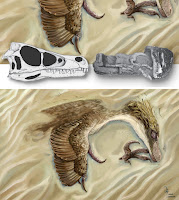
Dromaeosaurid dinosaur Shri devi Turner, Montanari, and Norell, 2021 (ZPAL MgD-I/97) from the Upper Cretaceous, Khulsan, Ömnögovi, Gobi Desert, Mongolia. Specimen prior to the preparation work (A1), and the 3D model of the skeleton, based on the CT and surface scanner data, with elements arranged as originally found (A2).

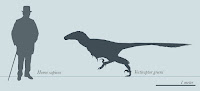
Reconstruction of the dromaeosaurid dinosaur Shri devi Turner, Montanari, and Norell, 2021, based on ZPAL MgD-I/97 and MPC-D 100/980.
A. Skull; missing elements reconstructed on the base of Velociraptor mongoliensis Osborn, 1924 (MPC-D 100/25 and MPC-D 100/54).
B. Whole body silhouette with known remains of the holotype and referred material. Silhouette based on V. mongoliensis drawn by J.A. Headden (Wikimedia Commons CC-BY-3.0).

Artistic post-mortem reconstruction of the Shri devi Turner, Montanari, and Norell, 2021,
individual represented by a specimen ZPAL MgD-I/97 before its final burial.
Artwork by Jakub Zalewski.


Łukasz Czepiński. 2023. Skull of A dromaeosaurid Dinosaur Shri devi from the Upper Cretaceous of the Gobi Desert suggests Convergence to the North American forms. Acta Palaeontologica Polonica. in press. DOI: 10.4202/app.01065.2023


Friday, December 2, 2022

[Paleontology • 2022] Natovenator polydontus • A Non-avian Dinosaur (Theropoda: Dromaeosauridae) with A Streamlined Body exhibits Potential Adaptations for Swimming

 
 Natovenator polydontus 
Lee, Lee, Currie, Sissons, Park, Kim, Barsbold & Tsogtbaatar, 2022

(Artwork by Yusik Choi).

Abstract
Streamlining a body is a major adaptation for aquatic animals to move efficiently in the water. Whereas diving birds are well known to have streamlined bodies, such body shapes have not been documented in non-avian dinosaurs. It is primarily because most known non-avian theropods are terrestrial, barring a few exceptions. However, clear evidence of streamlined bodies is absent even in the purported semiaquatic groups. Here we report a new theropod, Natovenator polydontus gen. et sp. nov., from the Upper Cretaceous of Mongolia. The new specimen includes a well-preserved skeleton with several articulated dorsal ribs that are posterolaterally oriented to streamline the body as in diving birds. Additionally, the widely arched proximal rib shafts reflect a dorsoventrally compressed ribcage like aquatic reptiles. Its body shape suggests that Natovenator was a potentially capable swimming predator, and the streamlined body evolved independently in separate lineages of theropod dinosaurs.

Skull of Natovenator polydontus (MPC-D 102/114, holotype).


Body plan of Natovenator polydontus (MPC-D 102/114, holotype) and dorsal rib morphology of various diving birds and terrestrial taxa.


Dinosauria Owen, 1842
Theropoda Marsh, 1881

Dromaeosauridae Matthew and Brown, 1922
Halszkaraptorinae Cau et al., 2017

Natovenator polydontus gen. et sp. nov.

Holotype: MPC-D 102/114 (Institute of Paleontology, Mongolian Academy of Sciences, Ulaanbaatar, Mongolia) is a mostly articulated skeleton with a nearly complete skull (See Supplementary Table 1 for measurements).

Locality and horizon: Baruungoyot Formation (Upper Cretaceous), Hermiin Tsav, Omnogovi Province, Mongolia. 

Diagnosis: A small halszkaraptorine dromaeosaurid with the following autapomorphies: wide groove delimited by a pair of ridges on the anterodorsal surface of the premaxilla, premaxilla with an elongated internarial process that overlies nasal and extends posterior to the external naris, 13 premaxillary teeth with large and incisiviform crowns, first three anteriormost maxillary teeth are greatly reduced and are clustered together with the following tooth without any separations by interdental septa, anteroposteriorly long external naris (about 30% of the preorbital skull length), paroccipital process with a anteroposteriorly broad dorsal surface, elongate maxillary process of the palatine that extends anteriorly beyond the middle of the antorbital fenestra, pterygoid with a deep fossa on the medial surface of the quadrate ramus, distinct posterolaterally oriented projection on the lateral surface of atlas, absence of pleurocoels in cervical vertebrae (not confirmed in the missing fifth cervical centrum), posterolaterally oriented and nearly horizontal proximal shafts in the dorsal ribs, hourglass-shaped metacarpal II with distinctly concave medial and lateral surfaces.

Etymology: Natovenator, from the Latin nato (swim) and venator (hunter), in reference to the hypothesized swimming behaviour and piscivorous diet of the new taxon; polydontus, from the Greek polys (many) and odous (tooth) in reference to the unusually many teeth.

Life reconstruction of Natovenator polydontus (Artwork by Yusik Choi).


Sungjin Lee, Yuong-Nam Lee, Philip J. Currie, Robin Sissons, Jin-Young Park, Su-Hwan Kim, Rinchen Barsbold and Khishigjav Tsogtbaatar. 2022. A Non-avian Dinosaur with A Streamlined Body exhibits Potential Adaptations for Swimming. Communications Biology.  5, 1185. DOI: 10.1038/s42003-022-04119-9

Sunday, November 20, 2022

[Paleontology • 2022] Daurlong wangi • Intestinal Preservation in A Birdlike Dinosaur (Theropoda: Dromaeosauridae) supports Conservatism in Digestive Canal Evolution Among Theropods


 Daurlong wangi 
Wang, Cau, Guo, Ma, Qing & Liu, 2022


Abstract
Dromaeosaurids were bird-like dinosaurs with a predatory ecology known to forage on fish, mammals and other dinosaurs. We describe Daurlong wangi gen. et sp. nov., a dromaeosaurid from the Lower Cretaceous Jehol Biota of Inner Mongolia, China. Exceptional preservation in this specimen includes a large bluish layer in the abdomen which represents one of the few occurrences of intestinal remnants among non-avian dinosaurs. Phylogenetically, Daurlong nests among a lineage of short-armed Jehol Biota species closer to eudromaeosaurs than microraptorines. The topographic correspondence between the exceptionally preserved intestine in the more stem-ward Scipionyx and the remnants in the more birdlike Daurlong provides a phylogenetic framework for inferring intestine tract extent in other theropods lacking fossilized visceral tissues. Gastrointestinal organization results conservative among faunivorous dinosaurs, with the evolution of a bird-like alimentary canal restricted to avialan theropods.

 Daurlong wangi holotype.
(a), whole specimen. (b), skull. (c), detail of orbit region. (d), feather remains associated to the thoracic vertebrae. (e), anuran skeleton.
Scale bars: 20 mm (b), 10 mm (c).

Diagnosis of Daurlong wangi. Specimen IMMNH-PV00731. Skull (a, b), left scapula (c), sternum and left hand (d, e), right forelimb (f). Reconstruction in (g) by M. Auditore (CC-BY 4.0).
Combination of features diagnostic for D. wangi: 1, slender subnarial ramus of premaxilla extended caudally well beyond the external naris; 2, large, trapezoid promaxillary recess placed at the rostroventral corner of antorbital fossa; 3, maxillary fossa large, shallow and caudodorsally located, so that the pila promaxillaris is wider than the pila interfenestralis; 4, stepped subcutaneous surface of the ventral ramus of maxilla; 5, absence of pitted ventral ramus of the antorbital fossa; 6, robust fang-like maxillary teeth with straight to slightly convex distal crown margins; 7, distal end of first sternal rib fan-shaped. 8, bowed scapula; 9. radius and ulna more robust than any manual element; 10. wide overlap of the semilunate carpal over metacarpal II. In D, gray area indicates sternum, black areas indicate left hand elements. Abbreviations: af, antorbital fossa; de, dentary; ju, jugal; la, lacrimal; ma, maxilla; na, nasal; pm, premaxilla; su, surangular. Scale bar in G = 10 cm.


Systematic palaeontology
Dinosauria
Theropoda
Dromaeosauridae

 Daurlong wangi gen. et sp. nov.

Holotype IMMNH-PV00731, an almost complete dromaeosaurid (Figs. 1, 2, Supplementary information).

Locality and Horizon: Pigeon Hill, Morin Dawa Daur Autonomous Banner, Inner Mongolia Autonomous Region (N 48°39′40.76″/E 123°52′ 41.15″); Longjiang Formation, Lower Cretaceous.

Etymology: The genus name is derived from the Daur Nation, and the Chinese ("lóng") for "dragon". The species name honors Mr. Wang Junyou, director of the IMMNH.

Diagnosis: Mid-sized dromaeosaurid with (autapomorphies marked by asterisk): slender subnarial ramus of premaxilla extended caudally well beyond the external naris; large, trapezoid promaxillary recess placed at the rostroventral corner of antorbital fossa*; maxillary fossa large, shallow and caudodorsally located, so that the pila promaxillaris is wider than the pila interfenestralis*; stepped transition from the subcutaneous surface of maxillary ventral ramus to the antorbital fossa; fan-shaped distal end of first sternal rib*. Differential diagnosis: Daurlong further differs from Tianyuraptor because it bears longer and more robust maxillary teeth and a more robust ulna. Daurlong further differs from Zhenyuanlong because it lacks a pitted ventral ramus of the antorbital fossa, lacks markedly concave distal margins in maxillary tooth crowns, bears a bowed scapula, a more robust radius, and a wider overlap of the semilunate carpal over metacarpal II (Fig. 3).


Xuri Wang, Andrea Cau, Bin Guo, Feimin Ma, Gele Qing and Yichuan Liu. 2022. Intestinal Preservation in A Birdlike Dinosaur supports Conservatism in Digestive Canal Evolution Among Theropods. Scientific Reports. 12, 19965  DOI: 10.1038/s41598-022-24602-x


Saturday, December 18, 2021

[Paleontology • 2021] Vectiraptor greeni • A New Dromaeosaurid Dinosaur from the Wessex Formation (Lower Cretaceous, Barremian) of the Isle of Wight, and Implications for European Palaeobiogeography


Vectiraptor greeni
 Longrich, Martill & Jacobs, 2021


A B S T R A C T
The Lower Cretaceous of England has produced a diverse assemblage of dinosaurs, including ornithischians, sauropods, and theropods. The origins of this assemblage are poorly understood. Here, we describe a new dromaeosaurid, Vectiraptor greeni gen. et sp. nov., from the Barremian Wessex Formation of the Isle of Wight. The animal is represented by associated dorsal vertebrae and a partial sacrum. Dorsal vertebrae are short, with pleurocoels, camellate pneumatization, stalked parapophyses and enlarged neural canals. Neural spines are tall, with large ligament scars. Sacral centra lack pleurocoels but have large neural canals and foramina suggesting pneumatization. These characters suggest affinities with Dromaeosauridae and specifically the derived, large-bodied Eudromaeosauria. Vectiraptor resembles Early Cretaceous eudromaeosaurs from North America, suggesting a faunal exchange between Europe and North America. The diverse Early Cretaceous dinosaur assemblage found in England and Europe resulted from dispersal from North America, Asia, and West Gondwana, likely involving both land bridges and oceanic dispersal. Europe served as a biotic crossroads in the Early Cretaceous, allowing faunal interchange between landmasses.

Keywords: Dinosauria, Theropoda, Dromaeosauridae, Biogeography, Barremian, United Kingdom


Vectiraptor greeni gen. et sp. nov.


Nicholas R. Longrich, David M. Martill and Megan L. Jacobs. 2021. A New Dromaeosaurid Dinosaur from the Wessex Formation (Lower Cretaceous, Barremian) of the Isle of Wight, and Implications for European Palaeobiogeography. Cretaceous Research. In Press, 105123. DOI: 10.1016/j.cretres.2021.105123