Showing posts with label Sky Island. Show all posts

Wednesday, April 22, 2026

[Herpetology • 2026] Nadzikambia nubila, N. evanescens, N. franklinae & N. goodallae • Sky Islands of Mozambique harbour Cryptic Species of Chameleons: Description of Four New Species of Sylvan Chameleons (Squamata: Chamaeleonidae: Nadzikambia Tilbury, Tolley & Branch, 2006)


 A adult male Nadzikambia mlanjensis (Broadley, 1965); B adult male N. baylissi Branch & Tolley, 2010;
C adult male Nadzikambia franklinae sp. nov.; D adult male N. goodallae sp. nov.;
E adult male N. evanescens sp. nov.; F adult female N. nubila sp. nov. 
Tolley & Conradie, 2026

  
Abstract
Several populations of forest-living chameleons in the genus Nadzikambia have been recorded from the montane sky island forests in northern Mozambique. These populations have not been evaluated for their species status, despite the potential for these allopatric populations having diverged at the species level due to vicariance of forest since the mid-Miocene. With only two described species of Nadzikambia, we hypothesised that candidate (new) species occur on each of four additional montane sky islands surveyed. We applied an integrative taxonomic approach to evaluate this, using morphological and genetic data collected from each population. Their distributions were mapped, the morphological dataset was quantitatively analysed using a multivariate analysis, and one nuclear and three mitochondrial genes were sequenced to generate a phylogeny and allele networks. Independent species delimitation analyses were applied to the genetic dataset (mPTP, SpeciesIdentifier, p distances) as supporting evidence for candidate species. By applying integrative taxonomy under the General Lineage Species Concept, we find support for four new species of Nadzikambia. The montane forests where they occur have declined in extent due to slash and burn agriculture and these forest endemics are presumed to be in a proportional decline as their habitat contracts. By examining historical and present-day satellite imagery, we show that all Nadzikambia species have lost significant proportions of their range. Given they do not occur outside these forests, these species are in imminent danger of extinction.

Keywords: Africa, Chamaeleonidae, conservation priority, Critically Endangered, habitat loss, morphological conservatism, reptiles, species declines, species delimitation, taxonomy
 
Life photos of Nadzikambia: A adult male N. mlanjensis (PEM R18445), B adult male N. baylissi (unvouchered specimen),
C adult holotype male N. franklinae sp. nov. (PEM R21165), D adult holotype male N. goodallae sp. nov. (PEM R24394),
E adult holotype male N. evanescens sp. nov. (PEM R24372), F adult paratype female N. nubila sp. nov. (NHMUK 2025.3278).


Nadzikambia franklinae sp. nov.
Namuli sylvan chameleon

Etymology. The new species is named after the British chemist Rosalind Franklin (1920–1958) whose work on X-Ray crystallography, particularly her legendary “photo 51”, revealed the structure of DNA (Franklin and Gosling 1953). Her ground-breaking work subsequently allowed for the field of phylogenetics to develop, decades later. Today, nearly all modern taxonomy is phylogenetically informed, including the description of N. franklinae sp. nov.

Nadzikambia goodallae sp. nov.
Ribáuè sylvan chameleon

Etymology. This species is named after Jane Goodall (1934–2025), an inspirational scientist who lived and worked in Africa throughout her lengthy career. Although her work was dedicated to the study of Pan troglodytes, the Chimpanzee, she spent much of her life living and working in tropical forest, in particular at Gombe National Park, Tanzania. Like her own study species, this chameleon is a forest endemic and the destruction of forest, and other habitats, both at Mount Ribáuè as well as within the home range of P. troglodytes in Central and West Africa is causing forest-living species to decline to the brink of extinction.

Nadzikambia evanescens sp. nov.
Inago sylvan chameleon

Etymology. This species is named Nadzikambia evanescens with the specific epithet from the Latin ‘evanescens’ meaning ‘vanishing’. The name is a present participle that can be used as an adjective or a noun in apposition, and the specific epithet is the same for all genders. The etymology is to highlight the rapidly vanishing forest on Mount Inago and the peril that this species is currently under. The forest has already been reduced to a few small patches, and the uncontrolled conversion of forest to agriculture is continuing. The consequence could be the demise of this endemic forest species, if action is not taken to stop the forest destruction.

Nadzikambia nubila sp. nov.
Chiperone sylvan chameleon

Etymology. This species is named after the “Ciperoni” – the term used locally for the weather that brings heavy clouds and orographic rainfall to the area. The cloud sustains the mid-elevation wet forest on this mountain. The epithet ‘nubila’ is derived from the Latin ‘nubilus’ meaning “cloudy,” and is modified to the feminine form to agree with the feminine gender of the genus Nadzikambia.


 Krystal Tolley and Werner Conradie. 2026. Sky Islands of Mozambique harbour Cryptic Species of Chameleons: Description of Four New Species of Sylvan Chameleons (Squamata: Chamaeleonidae: Nadzikambia Tilbury, Tolley & Branch, 2006). Vertebrate Zoology. 76: 207-246. DOI: doi.org/10.3897/vz.76.e178403 [21 Apr 2026]

Tuesday, January 20, 2026

[Herpetology • 2026] Hemiphyllodactylus puncak & H. jeraiensis • Phylogeny and Biogeography of the Hemiphyllodactylus harterti group (Squamata: Gekkonidae), with Description of Two New Species from the Sky-islands of Peninsular Malaysia


Hemiphyllodactylus puncak 
Hemiphyllodactylus jeraiensis 
 Hong, Anuar, Grismer & Quah, 2026

 
Abstract
Phylogenetic analyses of newly discovered populations of Hemiphyllodactylus from sky-islands across Peninsular Malaysia using the mitochondrial gene ND2, recovered two new upland species embedded within the harterti group. Hemiphyllodactylus puncak sp. nov. from Langkawi Island and Hjeraiensis sp. nov. from Gunung Jerai are sister species with an uncorrected pairwise sequence divergence of 3.6% between them. Together, they formed the sister lineage to H. cicak from Penang Hill, with an uncorrected pairwise sequence divergence of 3.9–4.8% and 4.5–5.7%, respectively. Given that these three populations occur on mountain tops isolated by lowland habitat and the Straits of Malacca, gene flow between them is highly unlikely, and there are unique combinations of characters that differentiate them from one another, as well as from all other species of the harterti group. The time-calibrated BEAST phylogeny shows that the harterti group diversified across the uplands of Peninsular Malaysia in the Oligocene and Pleistocene, which is consistent with climatic fluctuations during this period. During the Middle Oligocene, the ancestral population of the harterti group diverged into two distinct populations, one in the Banjaran Titiwangsa and another in the Banjaran Timur. These two populations then radiated independently across Peninsular Malaysia, giving rise to at least nine additional species within the harterti group.

Keywords: Endemic species, herpetofauna, Gunung Jerai, integrative taxonomy, Kedah, Langkawi Island, Southeast Asia

Hemiphyllodactylus puncak sp. nov. from Langkawi Island.
A Male holotype (LSUHC 15050) B Female paratype (LSUHC 15081) C Female paratype (LSUHC 15082).
Photographs by L. Lee Grismer.

 Hemiphyllodactylus puncak sp. nov. 
Suggested English common name: Langkawi Island slender gecko
Suggested Malay common name: cicak kerdil Pulau Langkawi 

Diagnosis. Hemiphyllodactylus puncak sp. nov. can be differentiated from all other species of Hemiphyllodactylus in having the unique combination of a maximum SVL of 35.6 mm; 5–7 chin scales; enlarged postmentals; four or five circumnasal scales; one or two scales between supranasals (= postrostrals); nine or 10 supralabials; 10 infralabials; 15 or 16 longitudinally arranged dorsal scales at midbody and seven or eight ventral scales contained within one eye diameter; lamellar formula on hand 4454 or 4554 or 4555; lamellar formula on foot 4554 or 4565 or 4675 or 5655; four subdigital lamellae on first finger and four or five on first toe; 44 continuous, pore-bearing femoroprecloacal scales in male; one cloacal spur on each side; subcaudals not plate-like; a dark postorbital stripe extending to at least base of neck; presence of dorsolateral light-coloured spots on trunk; absence of dark dorsolateral or ventrolateral stripe on trunk; generally unicolour wide vertebral area; postsacral marking lacking light-coloured anteriorly projecting arms; and unpigmented caecum and gonadal ducts. These characters are scored across all species of the harterti group listed in Table 5.

Etymology. The new species name ‘puncak’ is the Malay word for peak and named in reference to this species being found on the peak of Gunung Raya on Langkawi Island.


 Hemiphyllodactylus jeraiensis sp. nov.
 Suggested English common name: Gunung Jerai slender gecko
Suggested Malay common name: cicak kerdil Gunung Jerai 

DiagnosisHemiphyllodactylus jeraiensis sp. nov. can be differentiated from all other species of Hemiphyllodactylus in having the unique combination of a maximum SVL of 36.5 mm; seven chin scales; enlarged postmentals; five circumnasal scales; three scales between supranasals (= postrostrals); nine supralabials; nine infralabials; 12 longitudinally arranged dorsal scales at midbody and seven ventral scales contained within one eye diameter; lamellar formula on hand 2333; lamellar formula on foot 2333; two subdigital lamellae on first finger and two on first toe; 39 continuous, pore-bearing femoroprecloacal scales in male; two cloacal spurs on each side; subcaudals not plate-like; a dark postorbital stripe extending to base of neck; presence of dorsolateral light-coloured spots on trunk; absence of dark dorsolateral or ventrolateral stripe on trunk; generally unicolour wide vertebral area; postsacral marking lacking light-coloured anteriorly projecting arms; and unpigmented caecum and gonadal ducts. These characters are scored across all species of the harterti group listed in Table 5.

Etymology. The new species name ‘jeraiensis’ is in reference to the type locality of this species on Gunung Jerai, Kedah, Peninsular Malaysia.


Zijia Hong, M. S. Shahrul Anuar, L. Lee Grismer and Evan S. H. Quah. 2026. Phylogeny and Biogeography of the Hemiphyllodactylus harterti group (Squamata: Gekkonidae), with Description of Two New Species from the Sky-islands of Peninsular Malaysia. Vertebrate Zoology. 76: 1-32.  DOI: doi.org/10.3897/vz.76.e154822 [16 Jan 2026]


Monday, August 26, 2024

[Arachnida • 2024] Aphonopelma jacobii • Discovery of A New Tarantula Species from the Madrean Sky Islands and the first documented instance of syntopy between two montane endemics (Araneae: Theraphosidae: Aphonopelma): A Case of prior mistaken identity


 Aphonopelma jacobii Hamilton & Hendrixson, 

in Hamilton, Hendrixson & Bringas, 2024   

Abstract
The Chiricahua Mountains in southeastern Arizona are renowned for their exceptional biodiversity and high levels of endemism. Morphological, genomic, behavioral, and distributional data were used to report the discovery of a remarkable new tarantula species from this range. Aphonopelma jacobii sp. nov. inhabits high-elevation mixed conifer forests in these mountains, but also co-occurs and shares its breeding period with A. chiricahua—a related member of the Marxi species group—in mid-elevation Madrean evergreen oak and pine-oak woodlands. This marks the first documented case of syntopy between two montane endemics in the Madrean Archipelago and adds to our knowledge of this threatened region’s unmatched tarantula diversity in the United States. An emended diagnosis and redescription for A. chiricahua are also provided based on several newly acquired and accurately identified specimens. Phylogenetic analyses of mitochondrial and genomic-scale data reveal that A. jacobii sp. nov. is more closely related to A. marxi, a species primarily distributed on the Colorado Plateau, than to A. chiricahua or the other Madrean Sky Island taxa. These data provide the evolutionary framework for better understanding the region’s complex biogeographic history (e.g., biotic assembly of the Chiricahua Mountains) and conservation of these spiders.

Key words: Biodiversity hotspot, Chiricahua Mountains, conservation, cryptic species, molecular systematics, phylogenomics, spider taxonomy

Live habitus of Aphonopelma jacobii sp. nov.
 a male holotype (APH-5002) b female paratype (APH-5001).

 Aphonopelma jacobii Hamilton & Hendrixson, 2024, sp. nov.
 
Diagnosis: Aphonopelma jacobii sp. nov. is a member of the Marxi species group and can be distinguished by a combination of morphological, genomic, behavioral, and distributional features. This species is a mid- to late-fall breeder endemic to the Chiricahua Mountains in southeastern Arizona. Nuclear DNA identifies A. jacobii sp. nov. as a monophyletic lineage (Fig. 2) that is sister to A. marxi (distributed along the Colorado Plateau) and phylogenetically distinct from the other tarantula species endemic to the Chiricahua Mountains (i.e., A. chiricahua). Aphonopelma jacobii sp. nov. is probably the only tarantula species encountered in the high-elevation mixed conifer forests of the Chiricahua Mountains, but its distribution overlaps with A. chalcodes Chamberlin, 1940, A. chiricahua, A. gabeli Smith, 1995, and A. vorhiesi at lower elevations in the oak and pine-oak woodlands.
...

Etymology: The specific epithet is a patronym in honor of our friend, Michael A. Jacobi, who facilitated many of our field trips into the Chiricahua Mountains in 2018 and 2019. In addition, he generously carried out field work in the MSI on our behalf and discovered many important specimens, including the first female burrows of A. chiricahua and this remarkable new species. His tireless work in the field and passion for natural history have immensely helped improve our knowledge of tarantula biology and biodiversity in the Chiricahua Mountains and surrounding areas.

Habitat images of  Aphonopelma jacobii sp. nov. from the Chiricahua Mountains, Cochise County, Arizona a, b type locality along Forest Road 42D above Onion Saddle c, d Barfoot Park e along Forest Road 42A f open burrow at the type locality.
Photographs of images d and e provided by Michael A. Jacobi.


 Chris A. Hamilton, Brent E. Hendrixson and Karina Silvestre Bringas. 2024. Discovery of A New Tarantula Species from the Madrean Sky Islands and the first documented instance of syntopy between two montane endemics (Araneae, Theraphosidae, Aphonopelma): A Case of prior mistaken identity. ZooKeys. 1210: 61-98. DOI: doi.org/10.3897/zookeys.1210.125318
 

Monday, August 28, 2023

[Mammalogy • 2023] Uropsilus fansipanensis • A New Shrew Mole Species of the Genus Uropsilus (Eulipotyphla: Talpidae) from northwestern Vietnam


 Uropsilus fansipanensis
 Bui, Okabe, Le, Nguyen & Motokawa, 2023

Fansipan Shrew Mole | Chuột chũi vòi phan-xi-pan  ||  DOI: 10.11646/zootaxa.5339.1.3
 
Abstract
A new medium-sized shrew mole species of the genus Uropsilus from Mount Fansipan, Hoang Lien National Park, Lao Cai Province, northwestern Vietnam is described based on morphological and molecular differences. Uropsilus fansipanensis sp. nov. is distinguished from the other Uropsilus species by the combination of the following features: the dorsum is lightly reddish-brown and venter is dark gray; the dark gray tail is long and slender, with a scattered white base and short bristle hairs; orbital process is oriented upwards posteriorly; lacrimal foramen is well developed and much larger than infraorbital foramen; the lower first premolar is approximately the same size as the lower third premolar. Genetic distances in terms of mitochondrial cytochrome b from other Uropsilus species presented pairwise divergences from 8.63 to 20.70%. To date, the new species is known to exist only in the type locality of Mt. Fansipan, a wet and cold temperate climate area with an upper montane forest at an elevation of approximately 2900 m, forming the southernmost distribution of the genus Uropsilus.

Key words: Uropsilinae, taxonomy, Mt. Fansipan, Hoang Lien Son range


Lateral view of the body (A), lateral view (B), dorsal view (C), and ventral view (D) of the holotype (IEBR-M-8101) of Uropsilus fansipanensis sp. nov.

Uropsilus fansipanensis sp. nov.

Diagnosis. Medium-sized shrew mole. Body bicolor, dorsum lightly reddish-brown and venter dark gray, but the separation between the dorsum and venter is not obvious. The tip of the fur on the back reddish-brown, and the rest is gray. The tail uniformly dark gray, long, slender, and covered with small scales arranged in rings; gradually darken from base to tip. Short bristle hairs sparsely covering the tail from the base to the tip, and longer at the tip of the tail. The mastoid process developed sideways and pointed out. The interorbital region broad and parallel. The zygomatic arch stouter. The foramen magnum very large. The lacrimal foramen well developed and much larger than the infraorbital foramen. The orbital process oriented upwards anteroposteriorly. Dental formula I 2/1, C 1/1, P 4/4, M 3/3 = 38 including teeth of I1, I2, C1, P1, P2, P3, P4, M1, M2, M3 / i2, c1, p1, p2, p3, p4, m1, m2, m3 in the dentition. The buccal view of the upper fourth premolar (P4) triangular shape. The lower third premolar (p3) large in size. The lower first and third premolars (p1 and p3, respectively) approximately the same size. The lower canine (c1) larger than p1.

Etymology. The specific epithet “fansipanensis” refers to the type locality of the new species, Mt. Fansipan. We suggest “Fansipan Shrew Mole” and “Chuột chũi vòi phan-xi-pan” for the common names in English and Vietnamese, respectively.


Hai Tuan Bui, Shinya Okabe, Linh Tu Hoang Le, Ngan Thi Nguyen and Masaharu Motokawa. 2023. A New Shrew Mole Species of the Genus Uropsilus (Eulipotyphla: Talpidae) from northwestern Vietnam.  Zootaxa. 5339(1); 59-78. DOI: 10.11646/zootaxa.5339.1.3


Monday, August 7, 2023

[Herpetology • 2021] Selvasaura almendarizae • A New Species of Microtegu Lizard Genus Selvasaura (Gymnophthalmidae: Cercosaurinae) from Amazonian Ecuador


Selvasaura almendarizae
Torres-Carvajal, Parra, Sales Nunes & Koch, 2021 

 DOI:  10.1670/20-142

ABSTRACT
We describe a new species of Microtegu lizard (Selvasaura) from the Amazonian slopes of the Andes in Ecuador. Among other characters, the new species differs from the only other known species of Selvasaura, namely, Selvasaura brava from Peru, in having more femoral pores in males and a unilobed hemipenis. We present the first description of the skull of Selvasaura, along with a molecular phylogeny of Cercosaurinae and genetic distances as additional evidence supporting delimitation of the new species.

Specimens of Selvasaura almendarizae sp. nov. in life.
 (A, B) paratype QCAZ 9140, SVL = 39.73 mm; (C, D) uncollected specimens from Bigal River Biological Reserve, Napo Province (see map in Fig. 9).
Photographs by S. R. Ron (A, B), A. Anker (C), and T. Garcia (D).

Selvasaura almendarizae sp. nov.  
 Proposed standard English name: Almendáriz's Microtegus 
Proposed standard Spanish name: Microtegúes de Almendáriz

Diagnosis.—The new species belongs to Selvasaura as defined by Moravec et al. (2018). However, in the absence of morphological synapomorphies defining Selvasaura, the new species is assigned to Selvasaura based on phylogenetic evidence (Fig. 8; see also Moravec et al., 2018). Selvasaura almendarizae sp. nov. differs from S. brava (Table 1) in having more femoral pores in males (9– 12 vs. 7–9, respectively), fewer gular collar scales (7–9 vs. 9–11), fewer transverse rows of dorsals (25–32 vs. 33–36), fewer scales around midbody (29–32 vs. 32–34), and fewer lateral scale rows (5 vs. 6–7). The new taxon can be further distinguished from S. brava and other Cercosaurinae species in having a unilobed hemipenis, which among microteiids has been reported only in a few species within Gymnophthalminae (Calyptommatus sp., Nothobachia ablephara, and Scriptosaura catimbau) and Alopoglossidae (Alopoglossus brevifrontalis, Alopoglossus festae, Alopoglossus kugleri, Alopoglossus myersi, and Alopoglossus plicatus; Nunes, 2011; Herna´ndez Morales et al., 2020). 

Etymology.—The specific name is a noun in the genitive case and is a patronym for Ana Almendáriz former curator of Herpetology in the Museo de Historia Natural Gustavo Orce´s at Escuela Polite´cnica Nacional del Ecuador. Ana Almendáriz is an Ecuadorian herpetologist who has made important contributions to the study of amphibians and reptiles from Ecuador including more than a dozen species descriptions. For more than three decades, she also has trained many young herpetologists


Omar Torres-Carvajal; Vanessa Parra; Pedro M. Sales Nunes and Claudia Koch. 2021. A New Species of Microtegu Lizard (Gymnophthalmidae: Cercosaurinae) from Amazonian Ecuador. Journal of Herpetology. 55(4); 385–395. DOI:  10.1670/20-142
RESUMEN.—Describimos una especie nueva de lagartija microtegu (Selvasaura) de las estribaciones amazo´nicas de los Andes del Ecuador. Aparte de otras caracterı´sticas, la especie nueva difiere de la u´nica otra especie conocida de Selvasaura, Selvasaura brava del Peru´, por poseer ma´s poros femorales en los machos y un hemipene unilobado. Presentamos por primera vez la descripcio´n del cra´neo de Selvasaura, junto con una filogenia molecular de Cercosaurinae y distancias gene´ ticas como evidencia adicional para la delimitacio´n de la especie nueva.

Monday, May 8, 2023

[Herpetology • 2023] Selvasaura mamaduluae • A New Species of Microtegu (Gymnophthalmidae: Cercosaurinae) of the Cordillera del Cóndor, Ecuador


Selvasaura mamaduluae
Brito-Zapata, Guayasamin, Parra, Torres-Carvajal & Reyes-Puig, 2023


Abstract
We describe a new species of lizard of Selvasaura genus from Cordillera del Cóndor, in southeastern Ecuador. The new species is morphologically different from the other three species of Selvasaura mainly in its smaller body size (SVL: male 32.4 mm, female 33.5 mm) and coloration patterns; from the geographically closest species S. almendarizae, it differs mainly by having pentagonal frontoparietal scales, a higher number of transversal scales on the neck, and a longitudinal dorsal stripe more homogenous and weakly delimited by black. Phylogenetically, the new species is inferred within the genus Selvasaura as sister species of S. almendarizae, although this relationship has a low posterior probability. With this description, we recognize four species of Selvasaura, two of which are reported from Ecuador. The new species is known from two localities in the Cordillera del Cóndor that have serious threats such as large-scale mining and land-use change, among others.

Keywords: Montane forest, diversity, phylogeny, Saura, Selvasaura


Live photos of Selvasaura mamaduluae sp. nov. 
Holotype (ZSFQ 4409, male) in dorsolateral (A, B) and ventral (C) views;
paratype ZSFQ 1361 (female) in dorsolateral (D) and ventral (E) views.
The scale applies only to photographs on a white background.
Photos: David Brito-Zapata

Selvasaura mamaduluae sp. nov.


David Brito-Zapata, Juan M. Guayasamin, Vanessa Parra, Omar Torres-Carvajal and Carolina Reyes-Puig. 2023. A New Species of Microtegu (Gymnophthalmidae: Cercosaurinae) of the Cordillera del Cóndor, Ecuador. Revista Latinoamericana De Herpetología, 6(2), 17–37. DOI: 10.22201/fc.25942158e.2023.2.575

Thursday, April 27, 2023

[Herpetology • 2023] Selvasaura candesi • A New Species of Microteiid Lizard (Gymnophthalmidae: Cercosaurini) from A Remote Area in the Peruvian Andes


Selvasaura candesi
Chávez, García-Ayachi & Catenazzi, 2023


Abstract
We describe a new species of Selvasaura lizard from the western slopes of the eastern Andes of central Peru. Among other characters, the new species differs from congeners in having keeled dorsal scales and more transverse rows of scales on dorsum. We present a phylogeny as additional evidence supporting delimitation of the new species.

Key Words: New species, eastern Andes, central Peru, phylogeny

Selvasaura candesi sp. nov.
Dorsal (left) and ventral (right) views of
(A, B) the male holotype (CORBIDI 21865, SVL = 49.5 mm),
(C, D) male paratype (CORBIDI 21866, SVL = 49.1 mm), and
(E, F) juvenile paratype (CORBIDI 21867, SVL = 28.3 mm).


 Selvasaura candesi sp. nov.
 
Diagnosis: A medium sized lizard (adult males SVL 28.3–49.5 mm, n=2) characterized by the following combination of morphological features: 1) body slender, dorsoventrally depressed in males, females unknown; 2) head slightly short, pointed, about 1.6 times longer than wide; 3) ear opening distinct, moderately recessed; 4) nasals separated by an undivided frontonasal; 5) prefrontals, frontal, frontoparietals, parietals, interparietal, and postparietals present; 6) parietals polygonal, slightly longer than wide; 7) supraoculars four, anteriormost fused (2 individuals) or not (1 individual) with anteriormost superciliary; 8) superciliary series complete, consisting in four scales; 9) nasal plate divided posterior to nostril; 10) loreal present, in contact with second supralabial; 11) supralabials seven; 12) genials in four pairs, first and second pairs in contact; 13) collar present, containing 9–10 enlarged scales; 14) dorsals in 40–41 transverse rows, rectangular, nearly twice as long as wide, subimbricate, keeled; 15) ventrals in 24–25 transverse rows; square to rectangular, juxtaposed, smooth; 17) scales around midbody 38–43; 18) lateral scales at midbody reduced in size, in 8–9 rows; 19) limbs pentadactyl, all digits clawed;20) forelimb reaching anteriorly the third supralabial; 21) subdigital lamellae under Finger IV 14–16; 22) subdigital lamellae under Toe IV 19–21; 23) femoral pores per thigh 9–10 in males; 24) rectangular preanal scales large, four in number; 25) tail about 0.4 times longer than body; 26) caudals larger than wide, subimbricate, rugose dorsally, smooth ventrally; 27) lower palpebral disc transparent, undivided; 28) dorsal surface of head, body and limbs brown with black speckling, dorsal surface of tail pale brown to reddish brown; a thick yellowish brown vertebral stripe on dorsum, a row of 1–2 faded black rings on each flank; throat creamy white with minute black spots or blotches within each scale; belly yellow (creamy white in juveniles) with minute black spots within each scale; ventral surfaces of limbs yellow or yellowish orange; anal area saffron yellow or reddish yellow; tail red or reddish orange in males (pale red in juveniles) with fine black speckling; iris pale orange in males.

Etymology: The specific epithet “candesi” refers to the acronym CANDES (Consultores Asociados en Naturaleza y Desarrollo) in recognition of their efforts supporting the herpetological research in Peruvian territory.


 Germán Chávez, Luis A. García-Ayachi and Alessandro Catenazzi. 2023. A New Species of Microteiid Lizard (Gymnophthalmidae, Cercosaurini, Selvasaura) from A Remote Area in the Peruvian Andes. Evolutionary Systematics. 7(1): 123-132. DOI: 10.3897/evolsyst.7.99118


Monday, March 27, 2023

[Herpetology • 2022] Proctoporus otishi • A New Species of Andean Lizard, Proctoporus (Gymnophthalmidae: Cercosaurinae), from the highland of Parque Nacional Otishi in Peru


 Proctoporus otishi 
 Mamani & Rodriguez, 2022

 Photos by Lily O. Rodríguez.
 
Abstract
The gymnophthalmid Andean lizards of the genus Proctoporus (Gymnophthalmidae, Cercosaurinae) are semifossorial species that inhabit the montane forests, inter-Andean valley, and humid grasslands across the Cordillera de los Andes from Peru to Argentina. The distribution range of Proctoporus is discontinuous, with many places lacking herpetological surveys. Here, based on morphological data, we describe a new species of Proctoporus from a remote location on a mountaintop north of the Cordillera de Vilcabamba in southeastern Peru. The new species is readily distinguished from all other species of Proctoporus by the presence of three anterior infralabials, three rows of pregular scales and the absence of enlarged pregular scales. With this new species, the species diversity has increased to 19 since 18 species have previously been identified.

Key words: Reptilia, biodiversity, Andes, escalator to extinction, mountaintop, semifossorial lizard.


 the Paratype of Proctoporus otishi sp. nov. (MUSM 20753, SVL = 49.6 mm, TL = 68.7 mm, female) in life.
 Photos taken by Lily O. Rodríguez.

Proctoporus otishi sp. nov. 

Diagnosis: (1) Frontonasal subequal, longer or shorter than frontal; (2) nasoloreal suture absent; (3) two supraoculars; (4) four superciliaries; (5) two postoculars; (6) palpebral disc undivided and transparent; (7) four supralabials anterior to the posteroventral angle of the subocular; (8) three anterior infralabials; (9) six genials and four in contact; (10) three rows of pregulars; (11) dorsal body scales quadrangular, keeled, sub imbricate; (12) 32–35 scales around midbody; (13) 33–38 transverse dorsal rows; (14) 20–21 transverse ventral rows; (15) 22–25 longitudinal dorsal rows; (16) 10 longitudinal ventral rows; (17) two rows of continuous series of small lateral scales separating dorsals from ventrals per side; (18) 5–6 posterior cloacal plate scales; (19) two anterior preanal plate scales; (20) four femoral pores per hind limb in a male, absent in females; (21) preanal pores absent; (22) 11–13 subdigital lamellae on finger IV; 16–17 subdigital lamellae on toe IV; (23) limbs not overlapping when addressed against body; (24) pentadactyl, digits clawed; (25) in life, the dorsum is purple brown with tiny cream-colored spots, the flanks have enlarged cream-colored spots distributed irregularly from head to tail and the surface of the forelimbs and hindlimbs are similar to the flanks (Fig. 3); in preservative, the dorsum, head, and dorsal surface of the tail are dark brown, the flanks of the body, tail and dorsal surface of the limbs are dark brown with small and irregular cream-colored spots, and the venter, throat, and ventral surface of the limbs and tail are dark brown (Fig. 2). The measurements are shown in Table 1.
...

Etymology. The specific epithet otishi is a term that refers to the place where the new species was found—Parque Nacional Otishi, north of the Cordillera de Vilcabamba in Peru.

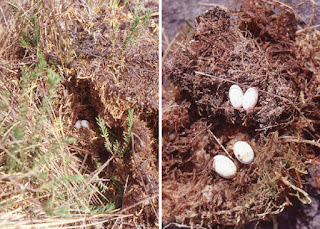
Eggs of Proctoporus otishi sp. nov. found under mosses.
Photos taken by Lily O. Rodríguez.


Luis Mamani and Lily O. Rodriguez. 2022. A New Species of Andean lizard, Proctoporus (Gymnophthalmidae: Cercosaurinae), from the highland of Parque Nacional Otishi in Peru. Zootaxa. 5213(1):75-85. DOI: 10.11646/zootaxa.5213.1.5

Friday, December 31, 2021

[Mammalogy • 2021] Shrews (Eulipotyphla: Soricidae) from A Biodiversity Hotspot, Mount Nimba (West Africa), with A Field Identification Key to Species


in Denys, Jacquet, Kadjo, ... et Monadjem, 2021. 

In this study, we collected 226 shrew specimens originating from 16 localities on the Guinean and Liberian sides of Mount Nimba. We surveyed all major vegetation zones from 400 to 1600 m above sea level (asl), including forest and savannah habitats. We recorded 11 species, whose identifications were confirmed by genetic analyses and classical morphometrics. Furthermore, we provide cytogenetic data for five of these species. The shrew community at Mount Nimba is composed of a mix of both savannah- and forest-dependent species, which is related to the peculiar position of Mount Nimba situated at the transition between lowland rainforest to the south and Guinean woodlands to the north. We recorded 11 species of shrews in syntopy in lowland rainforest, seven in edaphic savannah and mountain forest, and five in high-altitude savannah at 1600 m asl. Based on morphometric analyses, we show that these syntopic species separate along a size axis, allowing species to occupy different ecological niches, which we speculate allows them to access different food resources. We also highlight that Crocidura theresae Heim de Balsac, 1968 from Mount Nimba has a different karyotype from that described in Côte d’Ivoire. Finally, we develop a novel identification key for shrews from Mount Nimba using external characters and standard body measurements, allowing it to be used in the field on live specimens. In total 12 shrew species are now known from Mount Nimba, which highlights its exceptional position as a tropical African biodiversity hotspot.

KEYWORDS: Soricidae, CrociduraSuncus, community, cytogenetics, barcoding, morphometrics, morphology, Africa, Guinea, Liberia, biosphere reserve


Examples of habitats where pitfall traps were placed on the Guinean and Liberian Nimba:
A, gallery forest and swamp, camp 4 (Liberia); B, pitfall, altitude savannah with Loudetia kagerensis, Mare d’hivernage site (1642m) (Guinea);
C, pitfall, Selingbala (Guinea): mesophyllous secondary forest; D, pitfall, Gbie (Guinea): gallery forest with Parinari excelsa Sabine,1824, Carapa procera DC., 1824 and Pseudospondias microcarpa (A. Rich.) Engl., 1883, Maranthochloa purpurea (Ridl.) Milne-Redh.

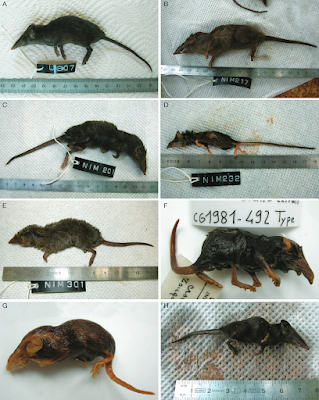
Nimba shrews skins with field numbers:
A, MNHN-ZM-2014-900 (LB07) C. buettikoferi Jentink, 1888 Camp 4;
B, MNHN-ZM-2012-1079 (NIM217) C. grandiceps Hutterer, 1983 Gouan;
C, MNHN-ZM-2012-1158 (NIM201) C. olivieri (Lesson, 1827) Gbié;
D, MNHN-ZM-2012-1111 (NIM232) C. muricauda (Miller, 1900) Gouan;
E, MNHN-ZM-2012-1180 (NIM 301) C. theresae Heim de Balsac, 1968 Gouan;
F, MNHN-ZM-MO-1981-492 C. nimbae Heim de Balsac, 1956 Holotype Zouguepo;
G, MNHN-ZM-MO-1981-483 C. eburnea Heim de Balsac, 1958 Mt Tonkui;
H, MNHN-ZM-2012-1123 (NIM 219) C. obscurior Heim de Balsac, 1958 Gouan. 

 
Christiane Denys, François Jacquet, Blaise Kadjo, Alain Didier Missoup, Vladimir Aniskine, Joelle Goüy de Bellocq, Barré Soropogui, Mory Douno, Morlaye Sylla, Violaine Nicolas, Aude Lalis and Ara Monadjem. 2021. Shrews (Mammalia, Eulipotyphla) from A Biodiversity Hotspot, Mount Nimba (West Africa), with A Field Identification Key to Species.   ZOOSYSTEMA. 43(30); 729-757. 


Thursday, December 16, 2021

[Mammalogy • 2021] Fourteen New, Endemic Species of Shrew (Genus Crocidura: Soricidae) from Sulawesi Reveal a Spectacular Island Radiation


in Esselstyn,  Achmadi, Handika, ... et Rowe, 2021.

Abstract
After nearly a decade of field inventories in which we preserved voucher specimens of the small terrestrial mammals of Sulawesi, we combined qualitative and quantitative analyses of morphological traits with molecular phylogenetics to better understand the diversity of shrews (Soricidae: Crocidura) on the island. We examined the morphology of 1368 specimens and obtained extensive molecular data from many of them, including mitochondrial DNA sequences from 851 specimens, up to five nuclear exons from 657 specimens, and thousands of ultraconserved elements from 90 specimens. By iteratively testing species limits using distinct character datasets and appropriate taxon sampling, we found clear, mostly consistent evidence for the existence of 21 species of shrews on Sulawesi, only seven of which were previously recognized. We divide these 21 species into five morphogroups, provide emended diagnoses of the seven previously named species, and describe 14 new species. The Long-Tailed Group contains Crocidura caudipilosa, C. elongata, C. microelongata, new species, and C. quasielongata, new species; the Rhoditis Group contains C. rhoditis, C. pseudorhoditis, new species, C. australis, new species, and C. pallida, new species; the Small-Bodied Group contains C. lea, C. levicula, C. baletei, new species, C. mediocris, new species, C. parva, new species, and C. tenebrosa, new species; the Thick-Tailed Group contains C. brevicauda, new species and C. caudicrassa, new species; and the Ordinary Group contains C. musseri, C. nigripes, C. normalis, new species, C. ordinaria, new species, and C. solita, new species. Documenting these endemic species reveals a local radiation (20 of the 21 species are members of an endemic clade) in which elevational gradients played a prominent role in either promoting speciation, or at a minimum, fostering the cooccurrence of phenotypically similar species. As now understood, the species-level diversity of Crocidura on Sulawesi is nearly three times the known diversity of any other insular shrew fauna. This study highlights the fact that if we wish to understand the true extent of biodiversity on Earth, large-scale, vouchered organismal inventories followed up with thorough examinations of genetic, morphological, and geographic traits are sorely needed in montane tropical regions, even for purportedly well-studied groups such as mammals.


We divide these 21 species into five morphogroups, provide emended diagnoses of the seven previously named species, and describe 14 new species

The Long-Tailed Group contains Crocidura caudipilosa, C. elongataC. microelongata, new species, and C. quasielongata, new species;
 the Rhoditis Group contains C. rhoditisC. pseudorhoditis, new speciesC. australis, new species, and C. pallida, new species; 
the Small-Bodied Group contains CleaC. levicula, C. baletei, new species, C. mediocris, new species, C. parva, new species, and Ctenebrosa, new species;
 the Thick-Tailed Group contains C. brevicauda, new species and C. caudicrassa, new species
the Ordinary Group contains C. musseri, C. nigripesC. normalis, new species, C. ordinaria, new species, and C. solita, new species.
 
Jacob A. Esselstyn, Anang S. Achmadi, Heru Handika, Mark T. Swanson, Thomas C. Giarla and Kevin C. Rowe. 2021. Fourteen New, Endemic Species of Shrew (Genus Crocidura) from Sulawesi Reveal a Spectacular Island Radiation. Bulletin of the American Museum of Natural History. 454(1); 1-108.  DOI: 10.1206/0003-0090.454.1.1


Friday, January 8, 2021

[Herpetology • 2021] Liolaemus galactostictos • A New Species of Liolaemus (Reptilia: Squamata) of the Liolaemus capillitas Clade (Liolaemini, Liolaemus elongatus-kriegi group) from Sierra de Velasco, La Rioja Province, Argentina


Liolaemus galactostictos 
Avila, Vrdoljak, Medina, Massini, Perez, Sites & Morando, 2021

 
Abstract
A new species of the Liolaemus capillitas clade is described. Liolaemus galactostictos sp. nov. differs from other members of its group by a combination of morphological and molecular traits, in particular its black dorsal coloration pattern not found in any other Liolaemus species. Liolaemus galactostictos sp. nov. is only known from its type locality. This new species is found in rocky fields surrounded by grasslands on the top of the Velasco Mountains, a ¨sky island environment¨, in northwestern Argentina. As well as other members of its clade this species seems to be strictly saxicolous, viviparous and feeds on insects.

Keywords: Reptilia, Argentina; Liolaemidae; Liolaemus galactostictos sp. nov.; Liolaemus petrophilus group; Northwestern Argentina

Liolaemus galactostictos sp. nov., paratype adult male.


Liolaemus galactostictos sp. nov.

Etymology. The specific epithet galactostictos is derived from the combination of the Greek words galacto (milk) and stiktos (spotted or dappled), in reference to the evident white mark along the vertebral region on the body.  


Luciano Javier Avila, Juan Esteban Vrdoljak, Cintia Débora Medina, Juan L. García Massini, Cristian Hernán Fulvio Perez, Jack W. Jr. Sites and Mariana Morando. 2021. A New Species of Liolaemus (Reptilia: Squamata) of the Liolaemus capillitas Clade (Squamata, Liolaemini, Liolaemus elongatus-kriegi group) from Sierra de Velasco, La Rioja Province, Argentina. Zootaxa. 4903(2); 194–216. DOI: 10.11646/zootaxa.4903.2.2