Showing posts with label Ankylosauria. Show all posts

Thursday, August 28, 2025

[Paleontology • 2025] Spicomellus afer • Extreme Armour in the World’s Oldest Ankylosaur


Spicomellus afer
Maidment, Strachan, Ouarhache, Scheyer, Brown, Fernandez, Johanson, Raven & Barrett, 2021

in Maidment, Ouarhache, Ech-charay, Oussou, Boumir, El Khanchoufi, ..., Barrett et Butler, 2025. 

Abstract
The armoured ankylosaurian dinosaurs are best known from Late Cretaceous Northern Hemisphere ecosystems, but their early evolution in the Early–Middle Jurassic is shrouded in mystery due to a poor fossil record. Spicomellus afer was suggested to be the world’s oldest ankylosaur and the first from Africa, but was based on only a single partial rib from the Middle Jurassic of Morocco. Here we describe a new, much more complete specimen that confirms the ankylosaurian affinities of Spicomellus, and demonstrates that it has uniquely elaborate dermal armour unlike that of any other vertebrate, extant or extinct. The presence of ‘handle’ vertebrae in the tail of Spicomellus indicates that it possessed a tail weapon, overturning current understanding of tail club evolution in ankylosaurs, as these structures were previously thought to have evolved only in the Early Cretaceous. This ornate armour may have functioned for display as well as defence, and a later reduction to simpler armour with less extravagant osteoderms in Late Cretaceous taxa might indicate a shift towards a primarily defensive function, perhaps in response to increased predation pressures or a switch to combative courtship displays.


Spicomellus afer Maidment, Strachan, Ouarhache, Scheyer, Brown, Fernandez, Johanson, Raven & Barrett, 2021


Susannah C. R. Maidment, Driss Ouarhache, Kawtar Ech-charay, Ahmed Oussou, Khadija Boumir, Abdessalam El Khanchoufi, Alison Park, Luke E. Meade, D. Cary Woodruff, Simon Wills, Mike Smith, Paul M. Barrett and Richard J. Butler. 2025. Extreme Armour in the World’s Oldest Ankylosaur. Nature. DOI: doi.org/10.1038/s41586-025-09453-6 [27 August 2025]


Monday, November 11, 2024

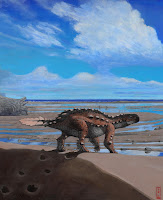
[Paleontology • 2024] Huaxiazhoulong shouwen • A New ankylosaurid Dinosaur (Ankylosauria: Ankylosauridae) from the Upper Cretaceous of Jiangxi Province, southern China


Huaxiazhoulong shouwen 
Zhu, Wu, You, Jia, Chen, Yao, Zheng & Xu, 2024 
 
artwork by YE Jianhao

ABSTRACT
Huaxiazhoulong shouwen gen. et sp. nov. is a new ankylosaurid recovered from the Upper Cretaceous Tangbian Formation of Jiangxi Province, southern China. Huaxiazhoulong shouwen can be diagnosed on the basis of three autapomorphies (the middle shaft and distal end of the ischium are expanded; the ratio of width of distal end to minimum shaft width is greater than 3 in humerus, the maximum length of femur to humerus length ratio is about 1.45) and a unique combination of characters (the centra of anterior caudal vertebrae in anterior view is heart-shaped; the dorsal surface of scapula is straight; the scapulocoracoid has a large medial brace; the humeral head and deltopectoral crest are separated by a distinct notch anteriorly). The phylogenetic analysis shows that Huaxiazhoulong shouwen is an early member of Ankylosauridae.

KEYWORDS: Ankylosauria, Upper Cretaceous, Tangbian Formation, Jiangxi Province, Huaxiazhoulong shouwen


Huaxiazhoulong shouwen gen. et sp. nov.


Ziheng Zhu, Jie Wu, Yue You, Yingli Jia, Chujiao Chen, Xi Yao, Wenjie Zheng and Xing Xu. 2024. A New ankylosaurid Dinosaur from the Upper Cretaceous of Jiangxi Province, southern China. Historical Biology: An International Journal of PaleobiologyDOI: doi.org/10.1080/08912963.2024.2417208  

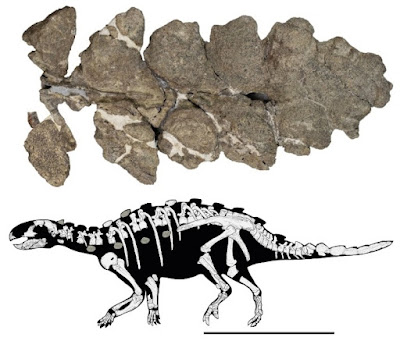
Sunday, February 25, 2024

[Paleontology • 2024] Datai yingliangis • A New Armored Dinosaur (Ankylosauria: Ankylosauridae) with double cheek horns from the early Late Cretaceous of southeastern China


Datai yingliangis
Xing, Niu, Mallon & Miyashita, 2024

Reconstruction by Kaitlin T. Lindblad twitter.com/Crocodontist

ABSTRACT
Ankylosaurines are the iconic armoured dinosaurs that characterize terrestrial vertebrate faunas in the Late Cretaceous of Asia and Laramidia (western North America). The earliest members of this clade are known from the early Late Cretaceous (Cenomanian–Santonian) times of Asia, but little consensus has emerged as to how they are related to the anatomically derived and chronologically younger forms. In southeastern China, the Cretaceous red sand beds crop out across basins from Zhejiang to Guandong provinces. However, the horizons corresponding to the early Late Cretaceous stages remain poorly sampled. Here, we report the first definitive vertebrate skeleton — let alone that of an armoured dinosaur — from the Coniacian/Turonian Ganzhou Formation, Datai yinliangis gen. et sp. nov. Despite the immature ontogenetic status of the type materials, D. yingliangis can be diagnosed with autapomorphic traits in the cranial caputegulae (such as double horns on the quadratojugal) and extensive gular osteoderms. Morphologically, it is intermediate between the chronologically older ankylosaurids from Asia (e.g., Crichtonpelta and Jinyunpelta) and derived post-Cenomanian ankylosaurines (e.g., Pinacosaurus). Phylogenetic analyses broadly corroborate this assessment. The new taxon either falls in the grade of Asian ankylosaurines proximal to the lineages of derived forms or forms a sister lineage to Pinacosaurus. Based on these insights, Datai makes a significant addition to the early Late Cretaceous vertebrate fauna from southeastern China and highlights the future potential in this region for improved understanding of the origin and early evolution of ankylosaurines.

Keywords: Ankylosauria, Ankylosaurinae, Zhoutian Formation, Guanzhou Group


The type specimens of Datai yingliangis gen. et ap. nov. (individual lying on top: YLSNHM 01003; individual on bottom: YLSNHM 01002, holotype) prepared and reconstructed in situ. The head, cervical, and thoracic regions of the specimens were discovered and extracted from a single block.


Dinosauria Owen, 1842
Ornithischia Seeley, 1887
Thyreophora Nopcsa, 1915
Ankylosauria Osborn, 1923
Ankylosauridae Brown, 1906

Datai gen. nov.

Etymology: 'Datai,' a composite of the last character (syllable) each from tongda (to understand/to be sensible) and antai (stable) in Chinese Pinyin.

Datai yingliangis sp. nov.

Diagnosis: An ankylosaurine with dual jugal/quadratojugal horns. This taxon is also distinguished from all other ankylosaurines with a unique combination of the following characters: protruded premaxilla such that prenarial portion is longer than infranarial portion (also present in Zhongyuansaurus luoyangensis), distinct 'postfrontal' caputegulum (also in Pinacosaurus mephistocephalus and Talarurus plicatospineus), well-developed supraorbitals forming no lacrimal incisure or postorbital peak (potentially controlled ontogenetically), parasagittaly projecting squamosal horn (also in Scolosaurus cutleri/Oohkotokia horneri), nuchal horn (also in Ankylosaurus magniventris, Euoplocephalus tutus, Nodocephaosaurus kirtlandensis, Zuul crurivastator), and polygonal, monotypic gular osteoderms covering the interman-dibular region and the entire throat (polymorphic gular osteoderms occur in Jinyunpelta sinensis).

Type locality and horizon: Zhoutian Formation, Ganzhou Group (Turonian–early Coniacian; Upper Cretaceous; 96–90 Ma).

Etymology: 'yingliangis', in recognition of the Yingliang Group. The Yingliang Stone Natural History Museum is operated as a public museum by the philanthropic program of the founder (Liang Liu) of the Yingliang Group, and the type specimens are curated in this museum in Shuitou, Fujiang, China.


Lida Xing, Kecheng Niu, Jordan Mallon and Tetsuto Miyashita. 2024. A New Armored Dinosaur with double cheek horns from the early Late Cretaceous of southeastern China. Vertebrate Anatomy Morphology Palaeontology. 11. DOI: 10.18435/vamp29396

Friday, June 16, 2023

[Paleontology • 2023] Vectipelta barretti • A New ankylosaurian Dinosaur (Ankylosauria: Nodosauridae) from the Lower Cretaceous Wessex Formation of the Isle of Wight, UK


Vectipelta barretti 
Pond, Strachan, Raven, Simpson, Morgan & Maidment, 2023


Abstract
The Wealden Group of southern England was deposited by rivers, on floodplains and in lagoons during the Early Cretaceous. Two historically significant ankylosaurs, Polacanthus and Hylaeosaurus, are currently known from its deposits; Hylaeosaurus from the ‘lower Wealden fauna’ and Polacanthus from the ‘upper Wealden fauna’. Here, we describe a new genus and species of ankylosaur from the Wessex Formation of the Isle of Wight, which is characterized by numerous postcranial autapomorphies. Vectipelta barretti gen. et sp. nov. is 6–8 million years older than Polacanthus, and at least 3 million years younger than Hylaeosaurus, suggesting a more complicated pattern of faunal turnover in the Wealden Group than previously realized. Vectipelta does not appear to be closely related to either of the other Wealden taxa, but instead is found in a clade with two Chinese ankylosaurs, suggesting a complex pattern of dispersal to and from Europe, North America and Asia during the Early Cretaceous. The historic practise of cataloguing all ankylosaur material from the Wessex Formation as ‘Polacanthus’ has potentially prevented a diversity of taxa from being discovered, and new and existing material in museum collections should be re-appraised using an autapomorphy-driven approach.
 
Keywords: Dinosauria, Ornithischia, Wealden Group, Barremian, osteology, taxonomy


Stuart Pond, Sarah-Jane Strachan, Thomas J. Raven, Martin I. Simpson, Kirsty Morgan and Susannah C. R. Maidment. 2023. Vectipelta barretti, A New ankylosaurian Dinosaur from the Lower Cretaceous Wessex Formation of the Isle of Wight, UK. Journal of Systematic Palaeontology. 21(1); 2210577. DOI: 10.1080/14772019.2023.2210577  
 nhm.ac.uk/discover/news/2023/june/new-species-of-dinosaur-named-after-museum-scientist-paul-barrett.html


Thursday, December 8, 2022

[Paleontology • 2022] Zuul crurivastator • Palaeopathological Evidence for Intraspecific Combat in Ankylosaurid Dinosaurs


Zuul crurivastator Arbour & Evans, 2017

in Arbour, Zanno & Evans, 2022. 

Abstract
Ankylosaurid dinosaurs were heavily armoured herbivores with tails modified into club-like weapons. These tail clubs have widely been considered defensive adaptations wielded against predatory theropod dinosaurs. Here we argue instead that ankylosaurid tail clubs were sexually selected structures used primarily for intraspecific combat. We found pathological osteoderms (armour plates) in the holotype specimen of Zuul crurivastator, which are localized to the flanks in the hip region rather than distributed randomly across the body, consistent with injuries inflicted by lateral tail-swinging and ritualized combat. We failed to find convincing evidence for predation as a key selective pressure in the evolution of the tail club. High variation in tail club size through time, and delayed ontogenetic growth of the tail club further support the sexual selection hypothesis. There is little doubt that the tail club could have been used in defence when needed, but our results suggest that sexual selection drove the evolution of this impressive weapon. This changes the prevailing view of ankylosaurs, suggesting they were behaviorally complex animals that likely engaged in ritualized combat for social dominance as in other ornithischian dinosaurs and mammals.

Keywords: Dinosauria, Ankylosauria, sexual selection, animal weaponry


Victoria M. Arbour, Lindsay E. Zanno and David C. Evans. 2022. Palaeopathological Evidence for Intraspecific Combat in Ankylosaurid Dinosaurs. Biol. Lett. 18: 20220404. DOI: 10.1098/rsbl.2022.0404
 

Friday, December 2, 2022

[Paleontology • 2022] Patagopelta cristata • A New Small-bodied Ankylosaurian Dinosaur (Ornithischia: Nodosauridae) from the Upper Cretaceous of North Patagonia (Río Negro Province, Argentina)


Patagopelta cristata 
 Riguetti, Pereda-Suberbiola, Ponce, Salgado, Apesteguía, Rozadilla Arbour, 2022
 
 facebook.com: Sebastián Apesteguía 
illustration by Gabriel Dìaz Yantèn
 
Abstract
The most representative ankylosaurian remains from Argentina have been found in sediments of the Allen Formation (Campanian–Maastrichtian) in Salitral Moreno, Río Negro Province. Several authors have discussed the identity and history of these remains. In this study, we review all published material along with some new remains in order to summarize all the knowledge about these ankylosaurs. Previously published material includes a tooth, dorsal and anterior caudal vertebrae, a femur and several osteoderms. The new remains include synsacral and caudal elements, a partial femur and osteoderms. The anatomy of the tooth, the synsacrum, the mid-caudal vertebra, the femur and the osteoderms, and the histology of the post-cervical osteoderms, support a nodosaurid identification, as proposed in previous descriptions of the Salitral Moreno material. Patagopelta cristata gen. et sp. nov. is a new nodosaurid ankylosaur characterized by the presence of unique cervical half-ring and femoral anatomies, including high-crested lateral osteoderms in the half rings and a strongly developed muscular crest in the anterior surface of the femur. The ∼2 m body length estimated for Patagopelta is very small for an ankylosaur, comparable with the dwarf nodosaurid Struthiosaurus. We recovered Patagopelta within Nodosaurinae, related to nodosaurids from the ‘mid’-Cretaceous of North America, contrasting the previous topologies that related this material with Panoplosaurini (Late Cretaceous North American nodosaurids). These results support a palaeobiogeographical context in which the nodosaurids from Salitral Moreno, Argentina, are part of the allochthonous fauna that migrated into South America during the late Campanian as part of the First American Biotic Interchange.
 
Keywords: Patagopelta, Nodosauridae Late Cretaceous, Salitral Moreno, Patagonia, Gondwana


 Patagopelta cristata gen. et sp. nov.

 
Facundo Riguetti, Xabier Pereda-Suberbiola, Denis Ponce, Leonardo Salgado, Sebastián Apesteguía, Sebastián Rozadilla... 2022. A New Small-bodied Ankylosaurian Dinosaur from the Upper Cretaceous of North Patagonia (Río Negro Province, Argentina). Journal of Systematic Palaeontology. 20(1): 2137441. DOI: 10.1080/14772019.2022.2137441 

Friday, December 3, 2021

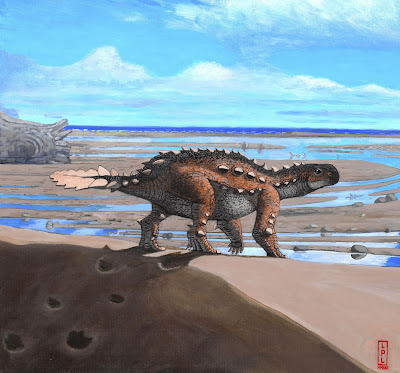
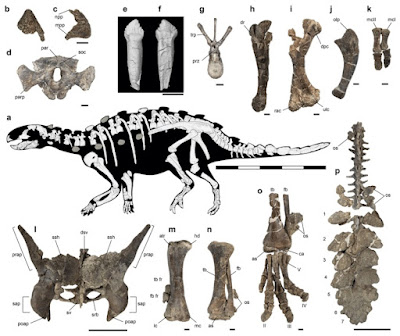
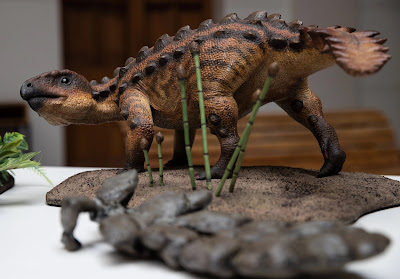
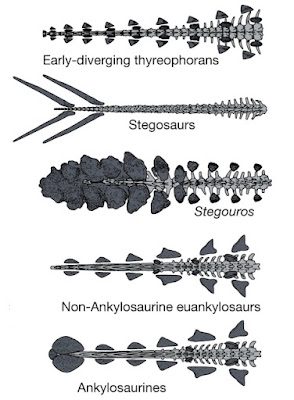
[Paleontology • 2021] Stegouros elengassen • Bizarre Tail Weaponry in A Transitional Ankylosaur (Thyreophora: Parankylosauria clade nov.) from Subantarctic Chile


Stegouros elengassen 
Soto-Acuña, Vargas, Kaluza, Leppe, Botelho, Palma-Liberona, Gutstein, Fernández, Ortiz, Milla, Aravena, Manríquez, Alarcón-Muñoz, Pino, Trevisan, Mansilla, Hinojosa, Muñoz-Walther & Rubilar-Rogers, 2021

Illustration: Luis Pérez López 

Abstract
Armoured dinosaurs are well known for forms that evolved specialized tail weapons: paired tail spikes in stegosaurs, and heavy tail clubs in advanced ankylosaurs. Armoured dinosaurs from southern Gondwana are rare and enigmatic, but likely include the earliest branches of Ankylosauria. Here, we describe a mostly complete, semiarticulated skeleton of a small (about 2m) armoured dinosaur from the late Cretaceous of Magallanes in southernmost Chile, a region biogeographically related to West Antarctica. Stegouros elengassen gen. et sp. nov. evolved a large tail weapon unlike any dinosaur: A flat, frond-like structure formed by 7 pairs of laterally projecting osteoderms encasing the distal half of the tail. Stegouros shows ankylosaurian cranial characters, but a largely primitive postcranial skeleton, with some stegosaur-like characters. Phylogenetic analyses placed Stegouros in Ankylosauria, and specifically related to Kunbarrasaurus from Australia and Antarctopelta from Antarctica, forming a clade of Gondwanan ankylosaurs that split earliest from all other ankylosaurs. Large osteoderms and specialized tail vertebrae in Antarctopelta suggest it had a tail weapon similar to Stegouros. We propose a new clade, the Parankylosauria, to include the first ancestor of Stegouros but not Ankylosaurus, and all descendants of that ancestor.

KEYWORDS: dinosaurs, tail weapons, anylosaurus, stegosaurus


Dinosauria Owen, 1842 
Ornithischia Seeley, 1887 
 
Thyreophora Nopcsa 1928 
Ankylosauria Osborn, 1923 

Parankylosauria clade nov. 

Stegouros elengassen gen. et sp. nov. 

Etimology— Stegouros, after the Greek stego (roof) and the Greek uros (tail) in reference to the covered tailelengassen, after an armoured beast in the mythology of the local Aónik’enk people.

Locality and horizon—Río de las Chinas Valley, Estancia Cerro Guido, Magallanes Region, Chilean Patagonia (51°S). Lower section of Dorotea Formation (upper Campanian – lower Maastrichtian), between 71.7 ± 1.2 Ma and 74.9 ± 2.1 Ma10,11 (Supplementary Information section 2, Supplementary Fig. 2).

Armoured dinosaurs are the only amniotes to have evolved three different specialized tail weapons in Stegosauria, Stegouros and Ankylosaurinae.


Sergio Soto-Acuña, Alexander Vargas, Jonatan Kaluza, Marcelo Leppe, Joao Botelho, José Palma-Liberona, Carolina Gutstein, Roy Fernández, Hector Ortiz, Verónica Milla, Bárbara Aravena, Leslie Manríquez, Jhonatan Alarcón-Muñoz, Juan Pino, Christine Trevisan, Héctor Mansilla, Luis Hinojosa, Vicente Muñoz-Walther and David Rubilar-Rogers. 2021. Bizarre Tail Weaponry in A Transitional Ankylosaur from Subantarctic Chile. Nature. DOI: 10.1038/s41586-021-04147-1


Friday, November 26, 2021

[Paleontology • 2021] Tarchia tumanovae • A New Ankylosaurid from the Upper Cretaceous Nemegt Formation of Mongolia and Implications for Paleoecology of Armoured Dinosaurs


 Tarchia tumanovae 
Park, Lee, Kobayashi, Jacobs, Barsbold, Lee, Kim, Song & Polcyn, 2021

Artwork by Choi Yusik  twitter.com/usikpaleoart 

Abstract
A new ankylosaurid dinosaur, Tarchia tumanovae sp. nov., has been recovered from the Upper Cretaceous Nemegt Formation of Mongolia. It includes a well-preserved skull, dorsal, sacral, caudal vertebrae, sixteen dorsal ribs, ilia, a partial ischium, free osteoderms, and a tail club. The squamosal horns of T. tumanovae are divided into two layers, the external dermal layer and the underlying squamosal horn proper. The irregular ventral margin of the base of the upper dermal layer may represent a resorption surface, suggesting that the squamosal horns of some ankylosaurids underwent extreme ontogenetic remodeling. Localized pathologies on the dorsosacral ribs and the tail provide evidence of agonistic behaviour. The tail club knob asymmetry of T. tumanovae resulted from restricted bone growth due to tail club strikes. Furthermore, T. tumanovae had an anteriorly protruded shovel-shaped beak, which is a morphological character of selective feeders. Ankylosaurid diets shifted from low-level bulk feeding to selective feeding during the Baruungoyot and the Nemegt “age” (middle Campanian-lower Maastrichtian). This ankylosaurid niche shifting might have been a response to habitat change and competition with other bulk-feeding herbivores.


Dinosauria Owen, 1842

Ankylosauridae Brown, 1908
Ankylosaurinae Nopcsa, 1918

Tarchia Maryañska, 1977
Type species. Tarchia kielanae Maryañska, 1977

Revised diagnosis. An ankylosaurid distinguished by having the following unique set of characters (autapomorphies with an asterisk): a narrow internarial bar of the premaxillae (shared with Tsagantegia) (ambiguous in Tarchia kielanae); large, rhomboidal loreal caputegulum with a laterally extended posterior keel (shared with Saichania) (ambiguous in T. kielanae); subrectangular frontal caputegulae (shared with Saichania); a “neck” present at the base of the quadratojugal horn (shared with Pinacosaurus mephistocephalus and Minotaurasaurus) (ambiguous in T. kielanae); sigmoidal and peaked anteromedial supraorbital caputegulum*; posterolateral supraorbital caputegulum with a rounded anterior surface, and a flat, anteriorly-inclined posterior surface*; anteromedially poorly defined postorbital fossa that medially reaches the lateral nuchal caputegulae*; occiput visible in dorsal view (shared with Minotaurasaurus and Zaraapelta); foramen magnum taller than wide*. Differs from Minotaurasaurus, Pinacosaurus grangeri, Saichania, and Zaraapelta in having no postocular caputegulae (ambiguous in T. kielanae) and a posteroventrally oriented occipital condyle. Differs from Minotaurasaurus, P. grangeri, and Zaraapelta in having confluent supraorbital horns. Differs from Minotaurasaurus and Saichania in having a relatively tall braincase. Differs from Minotaurasaurus and Zaraapelta in having a long nuchal crest. Differs from Minotaurasaurus in having relatively long paroccipital processes that laterally reach the squamosal horns. Differs from Saichania in having remodeled squamosal horns and anteroposteriorly short lateral nuchal caputegulae.


Tarchia tumanovae sp. nov.

Etymology. Named in honour of Tatiana Tumanova for her contributions toward the understanding of Mongolian ankylosaurs.

Holotype. MPC-D 100/1353, a well-preserved skull, dorsal, sacral, caudal vertebrae, sixteen dorsal ribs, ilia, a partial ischium, free osteoderms, and tail club.

Locality and horizon. Upper Cretaceous (upper Campanian-lower Maastrichtian) Nemegt Formation, Hermiin Tsav, southern Gobi Desert, Mongolia.


Diagnosis. An ankylosaurid distinguished by having the following unique set of characters: a single relatively bulbous internarial caputegulum that does not reach the rostral tip of beak*; a nasofrontal sagittal furrow with a weak Z-shaped offset (shared with Tarchia kielanae); lateral nuchal caputegulae taller laterally than medially (shared with Saichania); vomerine keel extends below the alveolar ridge (shared with Saichania). Differs from Minotaurasaurus, Pinacosaurus grangeri, T. kielanae, T. teresae, and Zaraapelta in having a moderate-sized basioccipital foramen. Differs from Minotaurasaurus, P. grangeri, Saichania, and Zaraapelta in having no postocular caputegulae and a posteroventrally oriented occipital condyle. Differs from Minotaurasaurus, P. grangeri, T. teresae, and Zaraapelta in having an anteriorly situated quadrate-quadratojugal region. Differs from Minotaurasaurus, P. grangeri, and Zaraapelta in having confluent supraorbital horns. Differs from P. grangeri, Saichania, and Zaraapelta in having a tall foramen magnum. Differs from Saichania, T. kielanae, and Zaraapelta in having unfused quadrate to the exoccipital area. Differs from Minotaurasaurus and Saichania in having a relatively tall braincase. Differs from Minotaurasaurus and Zaraapelta in having subrectangular frontal caputegulae and a long nuchal crest. Differs from Minotaurasaurus in having narrow narial caputegulae and long paroccipital processes that laterally reach the squamosal horns. Differs from Saichania in having remodeled squamosal horns, anteroposteriorly short lateral nuchal caputegulae, and occiput visible in dorsal view. Differs from T. teresae by having an interpterygoid vacuity visible in occipital view.


Jin-Young Park, Yuong-Nam Lee, Yoshitsugu Kobayashi, Louis L. Jacobs, Rinchen Barsbold, Hang-Jae Lee, Namsoo Kim, Kyo-Young Song and Michael J. Polcyn. 2021. A New Ankylosaurid from the Upper Cretaceous Nemegt Formation of Mongolia and Implications for Paleoecology of Armoured Dinosaurs. Scientific Reports. 11: 22928. DOI:  10.1038/s41598-021-02273-4
 

[Paleontology • 2021] Spicomellus afer • Bizarre Dermal Armour suggests the First African Ankylosaur


Spicomellus afer 
Maidment, Strachan, Ouarhache, Scheyer, Brown, Fernandez, Johanson, Raven & Barrett, 2021


Abstract
Ankylosauria is a diverse clade of armoured dinosaurs whose members were important constituents of many Cretaceous faunas. Phylogenetic analyses imply that the clade diverged from its sister taxon, Stegosauria, during the late Early Jurassic, but the fossil records of both clades are sparse until the Late Jurassic (~150 million years ago). Moreover, Ankylosauria is almost entirely restricted to former Laurasian continents, with only a single valid Gondwanan taxon. Spicomellus afer gen. et sp. nov. appears to represent the earliest-known ankylosaur and the first to be named from Africa, from the Middle Jurassic (Bathonian–Callovian) of Morocco, filling an important gap in dinosaur evolution. The specimen consists of a rib with spiked dermal armour fused to its dorsal surface, an unprecedented morphology among extinct and extant vertebrates. The specimen reveals an unrealized morphological diversity of armoured dinosaurs during their early evolution, and implies the presence of an important but undiscovered Gondwanan fossil record.


Dinosauria Owen, 18427
Ornithischia Seeley, 18878
Ankylosauria Osborn, 19239

Spicomellus afer gen. et sp. nov.

Etymology: Spicus meaning spike (Latin); mellus, a collar with spikes (Latin). A reference to the morphology of the specimen. Afer (Latin), an inhabitant of Africa. 

 
Susannah C. R. Maidment, Sarah J. Strachan, Driss Ouarhache, Torsten M. Scheyer, Emily E. Brown, Vincent Fernandez, Zerina Johanson, Thomas J. Raven and Paul M. Barrett. 2021. Bizarre Dermal Armour suggests the First African Ankylosaur. Nature Ecology & Evolution. DOI: 10.1038/s41559-021-01553-6