Showing posts with label Author: Matsui. Show all posts

Tuesday, October 1, 2019

[Herpetology • 2019] Megophrys kalimantanensis • A New Species of Megophrys Kuhl & Van Hasselt (Amphibia: Megophryidae) from Borneo allied to M. nasuta (Schlegel, 1858)


Megophrys kalimantanensis 
Munir, Hamidy, Matsui, Iskandar, Sidik & Shimada, 2019


Abstract
Within Sundaland, the species diversity of the genus Megophrys is richest in Borneo, with some species restricted to the northern highlands of the island. On the basis of molecular, morphological and acoustic evidence, we describe a new species of large-sized Megophrys, once confused with M. nasuta. The new species Megophrys kalimantanensis sp. nov. can be differentiated from all its congeners by large genetic distance more than 6.11% in the mitochondrial 16S rRNA gene, much shorter rostral and orbital appendages, and unique advertisement call. This new species has been recorded from medium to high altitudes of mountain forest in southern and northernmost Borneo.

Keywords: Amphibia, Megophrys kalimantanensis sp. nov., molecular phylogeny, new species, taxonomy, Southeast Asia


Megophrys kalimantanensis sp. nov.


Misbahul Munir, Amir Hamidy, Masafumi Matsui, Djoko T. Iskandar, Irvan Sidik and Tomohiko Shimada. 2019. A New Species of Megophrys Kuhl & Van Hasselt (Amphibia: Megophryidae) from Borneo allied to M. nasuta (Schlegel, 1858). Zootaxa. 4679(1); 1–24.  DOI: 10.11646/zootaxa.4679.1.1

Sunday, September 8, 2019

[Herpetology • 2019] Pelophryne ingeri • A New Species of Pelophryne (Anura, Bufonidae) from Malay Peninsula


 Pelophryne ingeri
 Matsui, 2019


 Abstract  
A small, semi-arboreal toad of the genus Pelophryne from Peninsular Malaysia has been treated as P. brevipes or P. signata. The peninsular toad and Bornean P. signata are very similar to each other morphologically, although slightly different in relative forelimb length, dorsal coloration, and tuberculation. However, in partial mtDNA sequence, the peninsular toad is substantially distinct from P. signata from Borneo and P. brevipes from the Philippines, although it is close to a congener from Sumatra. Thus, the peninsular toad is described as a new species based on specimens from Genting Highlands, state of Pahang, central Peninsular Malaysia. Of the two morphotypes recognized in the genus, the new species belongs to the one with the tips of the fingers expanded into truncate discs, in which the new species is the smallest in body size. The new species also occurs in Singapore and possibly in Sumatra.

KEYWORDS: body size, cryptic species, Malaysia, MtDNA phylogeny, Pelophryne ingeri sp. nov

Fig. 2. Dorsolateral view of male holotype of Pelophryne ingeri sp. nov. (KUHE 15647).

Systematics: 

Pelophryne ingeri sp. nov.

Pelophryne signata: Hendrickson, 1966, p. 73 (part).
Pelophryne brevipes: Grandison, 1972, p. 54 (part); Berry, 1975, p. 55 (part).

Diagnosis: The new species is placed in the genus Pelophryne by having the fingers and toes with a peculiar, fleshy web. A small Pelophryne, adult males 16–17 mm; tips of fingers expanded into truncate discs; disk of third finger slightly smaller than tympanum; tibiotarsal articulation of adpressed limb reaching to posterior corner of eye; dorsum clay brown, with a cruciform pattern outlined by darker bands; creamy band extending from below eye to groin, merging on flank with creamy abdomen with small dark spots; males with mandibular spines and nuptial pad.
...

Fig. 3. Dorsal (A) and ventral (B) views of male holotype of Pelophryne ingeri sp. nov. (KUHE 15647). Scale bar=10 mm.

Holotype: KUHE 15647, an adult male collected near a pond in Genting Highlands, State of Pahang, Malaysia (..., 850 m a.s.l.) by M. Matsui and K. Araya on 17 January 1993.

Paratype: KUHE 35585, an adult male, data same as the holotype.


Etymology: The specific name is dedicated to the late Dr. Robert F. Inger, Emeritus Curator of the Field Museum of Natural History, Chicago, for his great contributions to Southeast Asian herpetology, including taxonomy of Pelophryne.


Masafumi Matsui. 2019. A New Species of Pelophryne from Malay Peninsula (Anura, Bufonidae). Current Herpetology. 38(2); DOI: 10.5358/hsj.38.128 

Tuesday, July 16, 2019

[Herpetology • 2019] Relict Distribution of Microhyla (Amphibia: Microhylidae) in the Ryukyu Archipelago: High Diversity in East Asia maintained by Insularization


 Microhyla okinavensis 
in Tominaga, Matsui, Shimoji, Khonsue, et al., 2019. 

Abstract
The Ryukyu Archipelago, located at the southwestern part of Japan, is known as a group of continental islands and harbours many endemic taxa, supposedly reflecting its fairly long isolation from the Eurasian continent, Taiwan and the Japanese main islands. Microhyla okinavensis has been known as an endemic member of the terrestrial fauna of this archipelago. Molecular phylogenetic analyses using samples from nearly all island populations of the species and representative samples of other east Asian congeneric species revealed that M. okinavensis consists of four distinct subclades, of which the Amami, Okinawa and Miyako subclades, though exhibiting distinct genetic differentiations from each other, formed a monophyletic group (clade A). The remaining Yaeyama subclade was exclusively sister to M. mixtura from inland China, forming another monophyletic group (clade B), rendering M. okinavensis in the current definition paraphyletic. These results, as well as estimated dates of divergence from related taxa, indicate that M. okinavensis actually includes more than one distinct species. The results indicate that M. okinavensis and M. mixtura are relict species with disjunct distributions which had been most probably caused by invasion of M. fissipes in intervening areas.

Keywords: Continental Island, East Asia, Microhyla, phylogeography, relict lineage


Figure 2: Maximum likelihood phylogenetic tree of total 826 bp of the mitochondrial genes (12S and 16SrRNA) for 75 samples of Microhyla and additional five M. beilunensis.


Atsushi Tominaga, Masafumi Matsui, Naoko Shimoji, Wichase Khonsue, Chi‐Shiun Wu, Mamoru Toda, Koshiro Eto, Kanto Nishikawa and Hidetoshi Ota. 2019. Relict Distribution of Microhyla (Amphibia: Microhylidae) in the Ryukyu Archipelago: High Diversity in East Asia maintained by Insularization. Zoologica Scripta. 48(4); 440-453.  DOI: 10.1111/zsc.12361 


Monday, January 14, 2019

[Herpetology • 2018] Microhyla gadjahmadai • A New Species of Microhyla (Anura: Microhylidae) from Sumatra, Indonesia


Microhyla gadjahmadai 
 Atmaja, Hamidy, Arisuryanti, Matsui & Smith, 2018


Abstract 
A new species of frog in the genus Microhyla is described from Sumatra, Indonesia based on molecular and morphological characters. This new species was previously confused with M. achatina, a Javan endemic. This new species is diagnosable from its congeners by possessing a medium size (SVL in adult males 18.20–21.32 mm, in adult females 20.37–25.51 mm), a stout body, a nostril–eyelid length being about half of the snout length, having a single outer palmar tubercle, a tibiotarsal articulation reaching the center of the eye (when the hindlimbs are stretched and adpressed to the body), having finger and toe tips dilated, having the dorsum with medial longitudinal grooves, and excibiting a very thin and short dark stripe on the temporal region above a wider cream stripe, extending from the postorbital area to insertion of forelimb. Additionally, the new species is characterized by possessing relatively little foot webbing. Uncorrected 16S rRNA sequence divergences between the new taxon and sequences for other congeneric species available ranged from 4.8 to 15.0%. 

 Keywords: cryptic species, mitochondrial DNA, phylogeny, taxonomy

Figure 4 A. In life, dorsolateral and ventral view of male holotype of Microhyla gadjahmadai sp. nov. (MZB Amph 26081) from Rejang Lebong Regency, in the province of Bengkulu, Sumatra, Indonesia (Photographs by E. N. Smith).

Microhyla gadjahmadai sp. nov.
 Synonomy: Microhyla sp. 3: Matsui et al., 2011, p. 168 & 171

Diagnosis. The new species is assigned to Microhyla because of having a small size (SVL < 30 mm), narrow head and mouth, tympanum hidden by skin, maxillary and vomerine teeth absent, and a reduced first finger length (Tschudi,1838, Malkmus et al.,2002). Microhyla gadjahmadai sp. nov. is diagnosable from its congeners by having a medium size (for Microhyla, SVL adult males 18.2–21.3 mm, adult females 20.4–25.5 mm), stout body, a nostril–eyelid length of half the length of the snout, a single outer palmar tubercle, the tibiotarsal articulation reaching the center of eye, finger and toe tips dilated, median longitudinal grooves on dorsum, relatively reduced toe webbing (free of webbing: one and three quarter phalanges on outer surface of second toe, three phalanges on inner and outer surface of third toe, four phalanges on inner and outer surfaces of fourth toe, and two and three quarter phalanges on inner surface of fifth toe), and a thin-short dark temporal stripe over a wider cream stripe, extending from postorbital area to insertion of forelimb.

Etymology. The specific epithet honors the military leader and hero Gadjah Mada, who in the fourteenth century unified the whole of the Nusantara (i.e., Malay Archipelago) under the Javanese rule of the Hindu Majapahit Empire.

Natural history. Microhyla gadjahmadai sp. nov. is distributed in southern Sumatra, inhabiting from primary forest, secondary forest and open area such as farming area (Bengkulu). The tadpole and advertisement call of this species are still unknown.

Range. The new species is curently known from Bengkulu (Rejang Lebong, Bengkulu Utara, and Kepahiang Regency), Lampung (Tanggamus and Lampung Tengah Regency), and South Sumatra (Muara Enim Regency and Pagar Alam City) province with elevation range from 700–1647 m a.s.l.


Vestidhia Yunisya Atmaja, Amir Hamidy, Tuty Arisuryanti, Masafumi Matsui and Eric N. Smith. 2018. A New Species of Microhyla (Anura: Microhylidae) from Sumatra, Indonesia. Treubia. 45; 25-46.  DOI: 10.14203/treubia.v45i0.3625


Tuesday, September 18, 2018

[Herpetology • 2018] Leptobrachella bondangensis & L. fusca • Two New Species of the Genus Leptobrachella (Anura: Megophryidae) from Kalimantan, Indonesia


Leptobrachella bondangensis
 Eto, Matsui, Hamidy, Mumir & Iskandar, 2018


Abstract
Two new species of the dwarf litter frog genus Leptobrachella are described from North and Central Kalimantan, Indonesian part of the Borneo Island. Leptobrachella fusca n. sp. from Bulungan Regency, differs from all congeneric species in the following combination of characters: body small (SVL: 16.3 mm in a male); dorsum uniformly dark brown; sides of body without marking; a series of elongate ventrolateral glands present on flank; ventrum darkly pigmented except for throat and posterior portion; lineae masculinae invisible through ventral skin in preservative; and toe webs rudimentary. Leptobrachella bondangensis n. sp. from Gunung (=Mt.) Bondang of Murung Raya Regency, is distinct in possessing the following combination of characters: body large as this genus (SVL: 17.8 mm in a male); dorsum grayish brown; sides of body without dark blotches; a sparse series of rounded ventrolateral glands present on flunk; ventrum pale gray with dark mottles; lineae masculinae invisible through ventral skin in preservative; and toe webs rudimentary.

Keywords: Borneo, Kalimantan, Leptobrachella, New species, Taxonomy


Leptobrachella fusca  n. sp. 
Dorsal, lateral and ventral views of male holotypes (A–C, MZB Amph 9089).
Scale bar=10 mm.

Leptobrachella fusca n. sp.
Leptobrachella myobergi: Iskandar, 2004: 10 (part).

Etymology: The specific epithet “fusca”, a Latin word meaning dark or black, is derived from uniformly dark ventral coloration of the new species.


Leptobrachella bondangensis n. sp. 
 Dorsal, lateral and ventral views of male holotypes (D–F: MZB Amph 26212). 

Leptobrachella bondangensis n. sp.

Etymology: The specific name is derived from its type locality, Gunung Bondang.


Koshiro Eto, Masafumi Matsui, Amir Hamidy, Misbahul Mumir and Djoko Iskandar. 2018. Two New Species of the Genus Leptobrachella (Amphibia: Anura: Megophryidae) from Kalimantan, Indonesia.  Current Herpetology. 37(2); 95-105. DOI: 10.5358/hsj.37.95

Friday, March 16, 2018

[Herpetology • 2018] Phylogenetic Surveys on the Newt Genus Tylototriton sensu lato (Salamandridae, Caudata) reveal Cryptic Diversity and Novel Diversification Promoted by Historical Climatic Shifts


Figure 1: Sampling localities (A) and Maximum likelihood (ML) tree obtained based on mtDNA data of Tylototriton s.l. and relatives (B). Sample number 1–108 refer to Table S1. Five clades (I, II, III, IV and V) of the genus were denoted as different colors. Bootstrap supports (bs) resulted from ML analyses and posterior probability (pp) resulted from Bayesian inference (BI) method were labeled on major nodes. Node supports ML1 and BI1 were resulted from analyses on mtDNA data, while ML2 and BI2 were from analyses on four-gene concatenated data. Black: bs > 70% or pp > 0.95, grey: bs = 50–70% or pp = 0.85–0.95, white: bs < 50% and pp < 0.85.

in Wang, Nishikawa, Matsui, et al​., 2018.
  DOI: 10.7717/peerj.4384 

Abstract

Global climatic transitions and Tibetan Plateau uplifts are hypothesized to have profoundly impacted biodiversity in southeastern Asia. To further test the hypotheses related to the impacts of these incidents, we investigated the diversification patterns of the newt genus Tylototriton sensu lato, distributed across the mountain ranges of southeastern Asia. Gene-tree and species-tree analyses of two mitochondrial genes and two nuclear genes revealed five major clades in the genus, and suggested several cryptic species. Dating estimates suggested that the genus originated in the early-to-middle Miocene. Under different species delimitating scenarios, diversification analyses with birth-death likelihood tests indicated that the genus held a higher diversification rate in the late Miocene-to-Pliocene era than that in the Pleistocene. Ancestral area reconstructions indicated that the genus originated from the northern Indochina Peninsula. Accordingly, we hypothesized that the Miocene Climatic Transition triggered the diversification of the genus, and the reinforcement of East Asian monsoons associated with the stepwise uplifts of the Tibetan Plateau promoted the radiation of the genus in southeastern Asia during the Miocene-to-Pliocene period. Quaternary glacial cycles likely had limited effects on speciation events in the genus, but mainly had contributions on their intraspecific differentiations.


Figure 1: Sampling localities (A) and Maximum likelihood (ML) tree obtained based on mtDNA data of Tylototriton s.l. and relatives (B).
Sample number 1–108 refer to Table S1. Five clades (I, II, III, IV and V) of the genus were denoted as different colors. Bootstrap supports (bs) resulted from ML analyses and posterior probability (pp) resulted from Bayesian inference (BI) method were labeled on major nodes. Node supports ML1 and BI1 were resulted from analyses on mtDNA data, while ML2 and BI2 were from analyses on four-gene concatenated data. Black: bs > 70% or pp > 0.95, grey: bs = 50–70% or pp = 0.85–0.95, white: bs < 50% and pp < 0.85.


in Wang, Nishikawa, Matsui, et al​., 2018.


Conclusions: 
Our findings provided evidence for the profound influences of historical climate shifts especially associated with the uplift of the Tibetan Plateau on the diversification of animals occurring in the southeastern Asia. The results basically confirmed the reports on plant lineages, such as Rheum (Sun et al., 2012), Lepisorus (Wang et al., 2012a; Wang et al., 2012b), Juniperus (Mao et al., 2010) and Isodon (Yu et al., 2014), and on animal groups, such as Chiastocheta Pokorny, 1889 (Anthomyiidae, Diptera, Insecta; Espíndola, Buerki & Alvarez, 2012) and spiny frogs (Dicroglossidae, Anura, Amphibia; Che et al., 2010). Yet the present study further supplied some other indications. Primarily, although diversification of the newt group was promoted by the climatic shifts, several factors, for example, niche limits and their intrinsic low dispersal capacity, might have contributed to their Pleistocene rate-slowdown diversification. In addition, this study provided a putative “complete” species tree for Tylototriton s.l. to date. The inclusion of many putative cryptic species in the diversification analyses seems to be effective in finding diversification models of the group. But at present, wild populations of Tylototriton s.l. show a significant decline due to many reasons, such as climate changes, human capture and habitat deterioration. Further deep investigations of undetected cryptic lineages might supply the basic requirement for disclosing “true” diversification history of the taxa.


Bin Wang, Kanto Nishikawa, Masafumi Matsui, Truong Quang Nguyen, Feng Xie, Cheng Li, Janak Raj Khatiwada, Baowei Zhang, Dajie Gong, Yunming Mo, Gang Wei, Xiaohong Chen, Youhui Shen, Daode Yang, Rongchuan Xiong and Jianping Jiang​. 2018. Phylogenetic Surveys on the Newt Genus Tylototriton sensu lato (Salamandridae, Caudata) reveal Cryptic Diversity and Novel Diversification Promoted by Historical Climatic Shifts. PeerJ. 6:e4384.  DOI: 10.7717/peerj.4384

Monday, September 11, 2017

[Herpetology • 2017] Kalophrynus kiewi • A New Kalophrynus (Anura, Microhylidae) from Peninsular Malaysia


Kalophrynus kiewi
Matsui, Eto, Belabut & Nishikawa, 2017


Abstract
We report a new microhylid frog of the genus Kalophrynus from Peninsular Malaysia and describe it as a new species Kalophrynus kiewi based on results of molecular and morphological analyses. The new species is a large-sized Kalophrynus (snout-vent length 34–47 mm) and is morphologically very similar to K. pleurostigma, in which it has long been unrecognized, and K. meizon, but is distinguished from them molecularly and by its body size, dorsal skin texture, and relative length of hindlimb. The new species is also clearly differentiated from all the other members of the genus by molecular and morphological differences. Taxonomic and distributional problems of the genus Kalophrynus in Peninsular Malaysia are briefly discussed.

Keywords: Kalophrynus kiewi, Mitochondrial phylogeny, Southeast Asia, Systematics, Taxonomy


Kalophrynus kiewi sp. nov.

Etymology: The specific name kiewi is dedicated to Dr. Kiew Bong Heang, former academician at the Department of Zoology, University of Malaya, who is the pioneer in revising peninsular Kalophrynus.


Masafumi Matsui, Koshiro Eto, Daicus M. Belabut and Kanto Nishikawa. 2017. A New Kalophrynus (Amphibia, Anura, Microhylidae) from Peninsular Malaysia.
 Current Herpetology. 36(2) 75-86. DOI: 10.5358/hsj.36.75

Wednesday, August 30, 2017

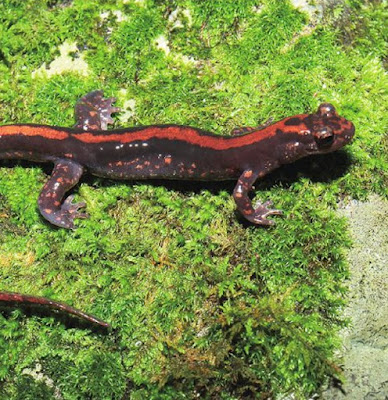
[Herpetology • 2017] Hynobius mikawaensis • A New Species of Lentic Breeding Salamander (Amphibia, Caudata) from central Japan


Hynobius mikawaensis
Matsui, Misawa, Nishikawa & Shimada, 2017


A new species of salamander, Hynobius mikawaensis, is described from the eastern part of Aichi Prefecture, central Japan. It is a lentic breeder of the so-called H. lichenatus species group, and is phylogenetically closest to H. nigrescens and H. takedai. Morphologically, it differs greatly from H. nigrescens, but is very similar to H. takedai, from which it could be differentiated by some morphological traits such as shorter forelimbs and hindlimbs, but longer axilla-groin length, all relative to snout-vent length. The new species from the southern Pacific side of central Japan is completely separated geographically from H. nigrescens and H. takedai, both from the northern, Japan Sea side, by the intervening high mountains. This north/south disjunctive distributional pattern is highly unique among Japanese fauna. The range of the species is so small that immediate measure of conservation is necessary.

 Keywords: Conservation, Distribution, Hynobius mikawaensis new species, Hynobius takedai, Lentic breeder


photo: Yasuchika Misawa 

Etymology: The specific name “mikawaensis” refers to the old name of the region (=Mikawa), including Shinshiro-shi, Toyota-shi, and Okazakishi, Aichi Prefecture, where the new species was found. [Japanese name: Mikawa-sansyou-uwo] 


Masafumi Matsui, Yasuchika Misawa, Kanto Nishikawa and Tomohiko Shimada. 2017.  A New Species of Lentic Breeding Salamander (Amphibia, Caudata) From Central Japan. Current Herpetology. 36(2); 116-126.  DOI: 10.5358/hsj.36.116


Saturday, May 13, 2017

[Herpetology • 2017] Cnemaspis leucura • A New Species of Rock Gecko Genus Cnemaspis (Squamata: Gekkonidae) from Western Sarawak, Malaysia


Cnemaspis leucura 
Kurita, Nishikawa, Matsui & Hikida, 2017 
Curse Rock Gecko | DOI: 10.11646/zootaxa.4258.6.2

Abstract

A new species of Asian rock gecko, genus Cnemaspis, is described from Padawan, western Sarawak, Malaysian Borneo. The new species forms a clade with C. paripari and C. nigridia of the C. nigridia group in a mitochondrial DNA phylogeny and is similar to them morphologically in some characters such as caudal scalation. It differs from the other Asian Cnemaspis species in its unique combination of snout–vent length (up to 62.7 mm), 4–9 precloacal pores in males, keeled subcaudals with an enlarged, smooth, median row, presence of ventrolateral caudal tubercles, and coloration (head and upper flanks dark-yellow; anterior portion of tail black; posterior portion of tail white with black, paravertebral blob). Phylogenetic relationships within the C. nigridia group and the distributional ranges of species within the group suggest allopatric speciation by geographic isolation.

Keywords: Borneo, Gunung Penrissen, sandstone, Cnemaspis nigridia group, Reptilia, Malaysia


 Cnemaspis leucura sp. nov., coloration in life of the holotype (SRC 00022)  

Etymology. The specific epithet leucura is from the Greek leukos and oura, meaning white-tailed, referring to white subcaudal color on the posterior part of tail in the male holotype. The generic name is feminine in gender.

Distribution. Cnemaspis leucura is known from the montane area of Gunung Penrissen, Kuching District, Sarawak, East Malaysia.


 Takaki Kurita, Kanto Nishikawa, Masafumi Matsui and Tsutomu Hikida. 2017. A New Species of Rock Gecko Genus Cnemaspis (Squamata: Gekkonidae) from Western Sarawak, Malaysia. Zootaxa. 4258(6); 525–538.  DOI: 10.11646/zootaxa.4258.6.2

Friday, April 28, 2017

[Herpetology • 2017] Distinction of Gracixalus carinensis from Vietnam and Myanmar, with Description of A New Species, Gracixalus sapaensis, from northwestern Vietnam


Gracixalus sapaensis  Matsui, Ohler, Eto & Tao, 2017

Figure 3. Dorsal (A) and dorsolateral (B) views of male holotype (MNHN 1999. 5961) of Gracixalus sapaensis sp. nov. in life.

Gracixalus carinensis was originally described from Myanmar, but samples of the species reported in molecular phylogenetic works were all from Vietnam, far apart from the type locality. Moreover, the voucher specimens used for sequencing seem to have never been critically studied. We newly sequenced specimens from Vietnam and also closely examined morphology of vouchers. As a result, we confirmed that samples treated under this name from Vietnam constitute a single species. Although no molecular data are available for topotypic samples from Myanmar, detailed morphological comparisons revealed that samples from Vietnam are constantly separated from the topotypic samples of G. carinensis by much poorly developed toe webbing. We thus consider the Vietnamese samples as an undescribed species and describe them as Gracixalus sapaensis sp. nov.


Gracixalus sapaensis sp. nov. 

Synonymy. Philautus carinensis: Ohler, Marquis, Swan & Grosjean, 2000, Herpetozoa, 13: 71-87;
Aquixalus (Aquixalus) carinensis: Delorme, Dubois, Grosjean & Ohler, 2005, Bulletin Mensuel de la Société Linnéenne de Lyon, 74: 166;
 Kurixalus carinensis: Nguyen, Ho & Nguyen, 2009, Herpetofauna of Vietnam: 527;
Gracixalus carinensis: Li, Che, Murphy, Zhao, Zhao, Rao & Zhang, 2009, Molecular Phylogenetics and Evolution, 53: 509.

Etymology. The specific epithet is derived from Sa Pa, a district in Lao Cai Province, northern Vietnam, where the new species occurs.

Range. Known only from northwestern Vietnam (fig. 5): Lai Chau, Lao Cai and Dak Lak (Nguyen et al., 2009, as Aquixalus). The known localities vary from 1250-2340 m in altitude. 

Natural history. Ohler et al. (2000) reported the new species to occur at all the vegetation types they classified (agriculture, scrub, submontane forest, and montane forest) from 1260-2020 m a.s.l. on Fan Si Pan mountains. Specimens were usually found sitting on leaves, rarely branches, up to 2 m from the ground, in the vicinity of mountain streams (median distance observed 3 m). They also reported the new species (as Philautus carinensis) to breed mainly in October-November unlike Ph. odontotarsus (now Kurixalus), and Ph. jinxiuensis and Ph. gracilipes (both now Gracixalus) that breed in July. 


Masafumi Matsui, Annemarie Ohler, Koshiro Eto and Nguyen Thien Tao. 2017. Distinction of Gracixalus carinensis from Vietnam and Myanmar, with Description of A New Species. ALYTES. 33(1-4); 25-37.

Sunday, August 7, 2016

[Herpetology • 2016] Leptobrachella itiokai • A New Highland Species of Dwarf Litter Frog Genus Leptobrachella (Anura: Megophryidae) from Sarawak


Leptobrachella itiokai 
Eto, Matsui & Nishikawa, 2016


Abstract
 A new highland species of the dwarf litter frog, Leptobrachella itiokai, is described from Gunung Mulu National Park, northern Sarawak, East Malaysia. It occurs syntopically with another highland species, L. brevicrus, but differs from it by a unique call that may be described as a chirp, with dominant frequency of ca. 10 kHz. The new species is morphologically distinguishable from congeners by the combination of the following traits: rounded ventrolateral glands usually not in series; side of body with small black spots; ventrum entirely dark-coloured with tiny light spots; male with thread-like lineae masculinae.

Key words: Leptobrachella, MtDNA; Phylogeny; Taxonomy; Borneo


Koshiro Eto, Masafumi Matsui and Kanto Nishikawa. 2016. A New Highland Species of Dwarf Litter Frog Genus Leptobrachella (Amphibia: Anura: Megophryidae) from Sarawak. RAFFLES BULLETIN OF ZOOLOGY. 64: 194–203. http://LKCNHM.nus.edu.sg/nus/images/data/raffles_bulletin_of_zoology/vol64/64rbz194-203.pdf


Saturday, July 30, 2016

[Herpetology • 2014] Leptolalax sabahmontanus • A New Leptolalax (Anura, Megophryidae) from the Mountains of Sabah, Borneo


Leptolalax sabahmontanus 
Matsui, Nishikawa & Yambun, 2014.

ABSTRACT
 A new species of Leptolalax is described from Kinabalu National Park in western Sabah, Malaysian Borneo. The new species had been assigned to L. dringi, L. gracilis, or L. fritinniens in the past. It differs from all congeners, including these species, by a unique combination of morphological characters, including small body size, rounded snout, narrower interorbital than upper eyelid, basal toe webbing, smooth skin with tiny tubercles on dorsum and dorsal side of head, small pectoral glands, absence of supraaxillary glands and ventrolateral glandular ridges, spotted venter, advertisement call consisting of long series of 1-149 notes, each composed of three or four pulses, and dominant frequency at 6.90-7.35 kHz, without prominent frequency modulation.

Keywords: Amphibia, Leptolalax sabahmontanus sp. n., advertisement call, Sabah, mtDNA phylogeny


 Masafumi Matsui, Kanto Nishikawa and Paul Yambun. 2014. A New Leptolalax from the Mountains of Sabah, Borneo (Amphibia, Anura, Megophryidae).
 Zootaxa. 3753(5):440-452. DOI: 10.11646/Zootaxa.3753.5.3

Wednesday, July 27, 2016

[Herpetology • 2014] Leptolalax marmoratus • A New Species of Leptolalax (Anura: Megophryidae) from Sarawak, western Borneo


A new megophryid species is described from southwestern Sarawak, Malaysian Borneo. In appearance, Leptolalax marmoratus sp. nov. is most similar to L. hamidi also from southwestern Sarawak, but differs from it by mtDNA sequence, larger body size, and higher dominant frequency of advertisement call. The assumption that more than one species of Leptolalax coexist at one locality in Borneo is supported. The finding of the new species raises the species number of Leptolalax known from Borneo to nine, and the island is thought to be one of the diversification centers of the genus.

Keywords: acoustics, Borneo, Leptolalax , new species, Southeast Asia, molecular phylogeny
   

Masafumi Matsui, Ramlah Zainudin and Kanto Nishikwa. 2014. A New Species of Leptolalax from Sarawak, western Borneo (Anura: Megophryidae).  ZOOLOGICAL SCIENCE31(11):773-779. DOI: 10.2108/zs140137

Wednesday, July 6, 2016

[Herpetology • 2016] Unusually High Genetic Diversity in the Bornean Limnonectes kuhlii-like Fanged Frogs (Anura: Dicroglossidae)


Highlights
• We estimated mitochondrial and nuclear DNA phylogeny for Bornean Limnonectes kuhlii-like fanged frogs.
• The degree of diversification in Borneo is much higher than was previously understood.
• Many genetic lineages occur syntopically, and are thought to be specifically distinct.
• High diversity, caused by complex island geohistory, seems to be maintained by ecological requirements in each lineage.


Abstract
A fanged frog Limnonectes kuhlii was once thought to be wide-ranging in Southeast Asia, but is now confined to its type locality Java through recent phylogenetic studies, which clarified heterospecific status of non-Javanese populations, and monophyly of Bornean populations. However, large genetic differences among Bornean populations suggest occurrence of cryptic species, which we test using dense geographic sampling. We estimated the phylogenetic relationships among samples of Bornean populations together with their putative relatives from the continental Southeast Asia, using 2517 bp sequences of the 12S rRNA, tRNAval, and 16S rRNA of mitochondrial DNA, and 2367 bp sequences of the NCX1, POMC, and RAG1 of nuclear genes. In the mtDNA trees, Bornean Limnonectes kuhlii-like frogs formed a monophyletic group split into 18 species lineages including L. hikidai, with the deepest phylogenetic split separating L. cintalubang from the remaining species. Almost all of these lineages co-occur geographically, and two to three lineages were found syntopically in each locality. Co-occurrence of more than one lineage may be maintained by differential morphology and microhabitat selection. These syntopic lineages should be regarded as distinct species. Our results clearly indicate that taxonomic revision is urgent to clarify many evolutionary problems of Bornean L. kuhlii-like frogs.

Keywords: Borneo; DNA phylogeny; Fanged frogs; Genetic diversity; Limnonectes kuhlii; Syntopic distribution


Masafumi Matsui, Norihiro Kuraishi, Koshiro Eto, Amir Hamidy, Kanto Nishikawa, Tomohiko Shimada, Paul Yambun, Charles Santhanaraju Vairappan and Mohamad Yazid Bin Hossman. 2016.  Unusually High Genetic Diversity in the Bornean Limnonectes kuhlii-like Fanged Frogs (Anura: Dicroglossidae). Molecular Phylogenetics and Evolution. DOI: 10.1016/j.ympev.2016.06.009 
ResearchGate.net/publication/304715420_Unusually_high_genetic_diversity_in_the_Bornean_Limnonectes_kuhlii-like_fanged_frogs_Anura_Dicroglossidae

Thursday, June 23, 2016

[Herpetology • 2016] Philautus nephophilus • A New Small Montane Species of Philautus (Anura: Rhacophoridae) from Gunung Kinabalu, Sabah, Malaysia (Borneo)


Philautus nephophilus 
 Dehling, Matsui & Imbun, 2016

Abstract
 Three populations of small montane bush frogs previously assigned to Philautus mjobergi were compared using morphological, bioacoustic, and genetic (mitochondrial 16S rRNA sequence) data. The comparison revealed that the population from Gunung Kinabalu in Sabah, Malaysia, represents a distinct species that is described herein. Although the new species differs from P. mjobergi in few morphological characters, most notably the acuminate snout, it is distinguished from this species and all other Bornean congeners by a unique advertisement call and large genetic differences. The population from Gunung Mulu assigned to P. mjobergi differs from the topotypic population from Gunung Murud in its advertisement call and 16S rRNA sequence and probably represents another, undescribed species.

Key words. DNA barcoding, advertisement call, Philautus mjobergi, Gunung Mulu, Sarawak, frog


Figure 4. A) Holotype (SP 27443; adult male) and B) adult male paratype (SP 27442) of Philautus nephophilus from Silau-Silau trail, Kinabalu National Park, Sabah, in situ prior to collection; C) Philautus mjobergi, adult male from Gunung Mulu (KUHE 54500) in life; D) Philautus mjobergi, paratype, adult male from Gunung Murud (BMNH 1925.9.1.2–6); E) Philautus mjobergi, adult male from near Bario (KUHE 53518) in life.


Etymology: The species epithet is composed of the Ancient Greek words νέφος [néphos], meaning cloud, and φιλεῖν [phileĩn], meaning to love; in allusion to the habitat of the new species in montane forest at Gunung Kinabalu that is often covered in clouds. The species is most active during or shortly after rain.


Distribution, habitat, and natural history: Philautus nephophilus is currently known with certainty only from the headquarters region of the Kinabalu National Park in Sabah where it is found at altitudes between 1,400 and 1,800 m. It probably also occurs at similar altitudes in the neighbouring Crocker Range. Around the headquarters of the Kinabalu NP, it is abundant and one of the most frequently encountered frog species. Calling males form aggregations in lower vegetation and are found on leaves or twigs at heights between 0.3 to 3 m above the ground. Individual males can be spaced from each other by distances of less than one to several meters. Males start calling at dusk and continue until dawn. Calling activity appears to increase after rain and during light rain showers. Calling groups are not found in the immediate vicinity of open water bodies, and the species is presumed to have a direct development without a free-swimming tadpole stage, as is observed in other species of the genus (Malkmus & Dehling 2008, Hertwig et al. 2012).


J. Maximilian Dehling, Masafumi Matsui and Paul Yambun Imbun. 2016. A New Small Montane Species of Philautus (Amphibia: Anura: Rhacophoridae) from Gunung Kinabalu, Sabah, Malaysia (Borneo). SALAMANDRA. 52(2); 77–90


Saturday, September 5, 2015

[Herpetology • 2015] Leptobrachella juliandringi • Description of A New Species of the Genus Leptobrachella (Anura, Megophryidae) from Borneo


Leptobrachella juliandringi
Eto, Matsui & Nishikawa, 2015
Fig. 7. Dorsolateral view of a male paratype of Leptobrachella juliandringi sp. nov. (SRC 00230) from the type locality.

Abstract
We describe a tiny megophryid frog Leptobrachella juliandringi sp. nov. from Northeastern to Central Sarawak, Malaysian Borneo. This species is distributed in hilly and montane regions, and has long been confused with L. mjobergi. Based on the assessment using morphological and bioacoustic approaches, we conclude that the new species is distinct from all the other congeneric species including topotypic L. mjobergi from western Sarawak in possessing a series of elongate glands ventrolaterally on the trunk, broken reticulated marking on the ventrum, strap-like lineae masculinae, and an advertisement call with a chirp. The new species is also differentiated phylogenetically from the other congeners, and tends to form a group with true L. mjobergi but with a large genetic divergence.

Keywords: New species, MtDNA, Phytogeny, Leptobrachella mjobergi, Borneo, Taxonomy


Fig. 7. Dorsolateral view of a male paratype of Leptobrachella juliandringi sp. nov. (SRC 00230) from the type locality.

Leptobrachella juliandringi sp. nov. 
English name: Dring’s Dwarf Litter Frog

Nesobia mjobergi: Inger, 1966: 49 (part). 
Leptobrachella mjobergi: Dring, 1983: 92 (part); Inger, 1983: 27 (part);
Inger, 1985: 6 (part); Oberhummer et al., 2014: 63. 

Etymology: The species is named in honor of Mr. Julian Dring in recognition of his great contribution to the taxonomic study of the Bornean amphibians.  

Range: Northeastern to Central Sarawak, eastern Malaysia. 

Natural history: In the type locality, males seemed to prefer calling from open places such as on leaves (ca. 0.2 to 0.8 m above the ground or the water surface: Fig. 7), close to small streams (ca. 1 to 3 m wide).  Males were seldom found calling on the ground or in hidden places.  These habitat selections are similar to those of topotypic L. mjobergi, males of which also preferred open places for calling, but were often found calling on the ground and the rocks (Matsui and Eto, unpublished data).  The eggs, the tadpoles, and the oviposition site are unknown, although some previous studies on the larvae of L. mjobergi (e.g., Inger, 1983, 1985) may contain information on the tad-poles of the new species. 


Koshiro Eto, Masafumi Matsui and Kanto Nishikawa. 2015. Description of A New Species of the Genus Leptobrachella (Amphibia, Anura, Megophryidae) from Borneo. Current Herpetology. 34(2):128-139. doi: 10.5358/hsj.34.128
ResearchGate.net/publication/281457105_Description_of_a_New_Species_of_the_Genus_Leptobrachella_(Amphibia_Anura_Megophryidae)_from_Borneo

Saturday, April 18, 2015

[Herpetology • 2015] Gracixalus seesom | ปาดแคระสีส้ม • A New Tree Frog of the Genus Gracixalus (Amphibia: Rhacophoridae) from western Thailand


Gracixalus seesom
 Matsui, Khonsue, Panha & Eto, 2015


 Abstract
We report a new tree frog of the genus Gracixalus from western Thailand and describe it as a new species Gracixalus seesom based on results of morphological and molecular analyses. The new species is a small-sized Gracixalus (male snout-vent length ca. 22 mm) and is morphologically similar to G. gracilipes, but is easily distinguished from it by its dorsal tan color in life, absence of white spot on lower lip, and black markings on its foot webbing. The new species also clearly differs from all the other members of the genus by the combination of small body size, triangular snout, and light yellowish brown dorsum without distinct tuberculations. Problems of phylogeny and taxonomy of the genus Gracixalus are briefly discussed.

Keywords: Gracixalus seesom, mitochondrial phylogeny, Southeast Asia, systematics, taxonomy


Masafumi Matsui, Wichase Khonsue, Somsak Panha and Koshiro Eto. 2015. A New Tree Frog of the Genus Gracixalus from Thailand (Amphibia: Rhacophoridae). Zoological Science. 32(2):204-210.