Showing posts with label Author: I. Agarwal. Show all posts

Wednesday, March 25, 2026

[Herpetology • 2026] Cyrtodactylus teraiensis • Middle Miocene Biogeographic Connectivity between the Eastern Ghats and Nepal revealed by A New Species of the Cyrtodactylus (Geckoella) nebulosus complex (Reptilia: Gekkonidae) from Nepal


 Cyrtodactylus (Geckoella) teraiensis
Gautam, Bhattarai, Neupane, Pokheral, Thackeray, Khandekar, Cyriac & Agarwal, 2026


Abstract
A new species of ground-dwelling gecko of the genus Cyrtodactylus (Geckoella) is described from the low elevation Terai-Duar region of southeastern Nepal using molecular and morphological data. Cyrtodactylus teraiensis sp. nov. is the first new species of the C. nebulosus species complex, the remaining members of which are distributed in the northern Eastern Ghats and Satpuras; a lectoype for C. nebulosus is also designated. The new species is the first Geckoella described from outside peninsular India and distributed north of the Indo-Gangetic Plains. Cyrtodactylus teraiensis sp. nov. forms the deeply divergent sister taxon to Indian members of the C. nebulosus complex with 15.7–18.1% uncorrected mitochondrial sequence divergence from them, and 21.0–28.5% from other Geckoella. The new species is also recognised in tree-based delimitation methods and can be morphologically distinguished from other Cyrtodactylus and Geckoella species by a small body size (snout to vent length, SVL up to at least 45.5 mm), length of original tail < SVL, 16–18 rows of dorsal tubercles, 30–32 ventral scales across belly at midbody; dorsal colour pattern of four or five paired spots between neck and hindlimb insertions alternating with two or three much smaller paired spots. The divergence between Cyrtodactylus teraiensis sp. nov. and Indian members of the C. nebulosus complex is estimated to have occurred in the Middle Miocene, and it may be that tropical forest expansion during the Mid-Miocene Climatic Optimum allowed dispersal across the Indo-Gangetic Plains.

Key words: Endemic species, Indian subcontinent, integrative taxonomy, mitochondrial DNA, taxonomy

Photo of: A. Holotype of Cyrtodactylus (Geckoella) teraiensis sp. nov. in life;
B. Habitat from where the new species was collected. Photographs by BG.

Cyrtodactylus (Geckoella) teraiensis sp. nov. 

Diagnosis. A small-sized Cyrtodactylus, snout to vent length up to 45.5 mm. Dorsal pholidosis heterogeneous; smooth granular scales intermixed with more or less regularly arranged rows of enlarged, feebly keeled, blunt to weakly conical tubercles; ventrolateral fold absent on lower flank; 16–18 rows of dorsal tubercles at midbody, 29–31 tubercles in paravertebral rows; ventral scales subequal from chest to vent, smooth, subcircular, and subimbricate with rounded end; 30–32 ventral scales across belly at midbody, 50–54 longitudinal scales between axilla to groin, ....


 Bivek Gautam, Santosh Bhattarai, Bishal Prasad Neupane, Chiranjibi Prasad Pokheral, Tejas Thackeray, Akshay Khandekar, Vivek Phillip Cyriac, Ishan Agarwal. 2026. Middle Miocene Biogeographic Connectivity between the Eastern Ghats and Nepal revealed by A New Species of the Cyrtodactylus (Geckoella) nebulosus complex (Reptilia, Squamata) from Nepal. ZooKeys. 1275: 15-42.  DOI: doi.org/10.3897/zookeys.1275.178507

Thursday, October 17, 2024

[Herpetology • 2024] Calotes sinyik • A New small-sized Calotes Cuvier (Squamata: Agamidae: Draconinae) from the Subansiri River Basin, Arunachal Pradesh, India


 Calotes sinyik 
Patel, Thackeray, Sheth, Khandekar & Agarwal, 2024


Abstract
We describe a new species of small-sized Calotes from mid-elevation (~1270 m asl.), swidden or shifting cultivation areas in the Subansiri river basin, Upper Subansiri District, Arunachal Pradesh, India. Mitochondrial sequence data (ND2) recovers Calotes sinyik sp. nov. as the closely related sister taxon to an unnamed species from Medog, Tibet; the two falling in a broader clade including C. paulus + C. zolaiking and species of the C. emma and C. mystaceus groups. The new species is 7.8% divergent in ND2 sequence data from the unnamed lineage from Medog and deeply divergent (≥ 21.6–28.1%) from other congeners. The new species can easily be distinguished from regional congeners by its small adult body size (maximum snout to vent length of 65 mm) and heterogenous dorsal scales, and from its closest relatives C. paulus and C. zolaiking by having 54 or 55 midbody scale rows and 42 or 43 vertebral scales. It is likely that many more allied species remain to be discovered from Northeast India, which remains poorly surveyed across taxonomic groups.

Reptilia, Biodiversity hotspot, dragon lizards, endemic, eastern Himalayas, Oriocalotes, taxonomy


 Calotes sinyik sp. nov.


Harshil Patel, Tejas Thackeray, Chintan Sheth, Akshay Khandekar and Ishan Agarwal. 2024. A New small-sized Calotes Cuvier (Squamata: Agamidae: Draconinae) from the Subansiri River Basin, Arunachal Pradesh, India.  Zootaxa. 5523(2); 151-170. DOI: doi.org/10.11646/zootaxa.5523.2.1   facebook.com/100064866994974/posts/1011385994366958


Sunday, November 12, 2023

[Herpetology • 2019] Hemidactylus kolliensis, H. chikhaldaraensis & H. sankariensis • An Expanded ND2 Phylogeny of the brookii and prashadi Groups with the Description of Three New Indian Hemidactylus Oken (Squamata: Gekkonidae)


 Hemidactylus kolliensis,
H. chikhaldaraensis &
 H. sankariensis
 Agarwal, Bauer, Giri & Khandekar, 2019

Abstract  

We present an expanded ND2 phylogeny of the brookii and prashadi groups of Indian Hemidactylus. While relationships within the clades are not well resolved, we recover many well supported subclades and a number of deeply divergent lineages within each clade. We use morphological data to describe three of these divergent lineages as new species; Hemidactylus kolliensis sp. nov., a member of the prashadi group from high elevation in the Kollimalai Massif in Tamil Nadu, Hemidactylus chikhaldaraensis sp. nov. and Hemidactylus sankariensis sp. nov., both members of the brookii group, are described from high elevation of the Satpuras in Maharashtra and low elevation of Tamil Nadu, respectively. The three new species exhibit >15% divergence for the ND2 gene from their phylogenetic sisters and differ in a number of morphological characters from all Indian congeners. The discovery of three more endemic Hemidactylus species from rocky habitats suggests that many more remain to be discovered across India.

Keywords: Reptilia, peninsular India, rupicolous, Satpuras, taxonomy


Ishan Agarwal, Aaron B. Bauer, Varad B. Giri and Akshay Khandekar. 2019. An Expanded ND2 Phylogeny of the brookii and prashadi Groups with the Description of Three New Indian Hemidactylus Oken (Squamata: Gekkonidae). Zootaxa. 4619(3); 431–458. DOI:  10.11646/zootaxa.4619.3.2


Tuesday, October 31, 2023

[Herpetology • 2020] Hemidactylus flavicaudus & H. xericolus • Two New Species of Yellow-tailed Hemidactylus Goldfuss, 1820 (Squamata: Gekkonidae) from Rocky Outcrops on the Telangana Plateau, India


Hemidactylus flavicaudus & H. xericolus 
Lajmi, Giri, Singh & Agarwal, 2020


Abstract

Two distinct species of the gekkonid genus Hemidactylus are described from the dry zone of peninsular India from the state of Telangana. The two sister species, Hemidactylus flavicaudus sp. nov. and H. xericolus sp. nov., are nested within the morphologically cryptic H. brookii group, but are clearly distinguishable from all known species in having a bright yellow tail and yellow markings on the head, besides unique combinations of meristic characters and small body size (< 45 mm snout to vent length). The two new species are also deeply divergent from each other and other members of the H. brookii group in mitochondrial NADH dehydrogenase 2 and cytochrome b sequences. Hemidactylus flavicaudus sp. nov. can be diagnosed from H. xericolus sp. nov. based on the number of dorsal tubercle rows at midbody (11–14 versus 6–8). These descriptions of evolutionarily and morphologically distinct species highlight the dearth of studies carried out in the dry zone of peninsular India and the urgent need to assess biodiversity in the face of rapid land-use changes in this landscape.

Keywords: Reptilia, Dry zone, granite, Hemidactylus brookii, peninsular India, rocky outcrops, rupicolous


Hemidactylus flavicaudus sp. nov. 
 H. xericolus sp. nov., 


Aparna Lajmi, Varad B. Giri, Taneraw Singh and Ishan Agarwal. 2020. Two New Species of Yellow-tailed Hemidactylus Goldfuss, 1820 (Squamata: Gekkonidae) from Rocky Outcrops on the Telangana Plateau, India. Zootaxa. 4895(4); 483–504. DOI: 10.11646/zootaxa.4895.4.2

Sunday, January 23, 2022

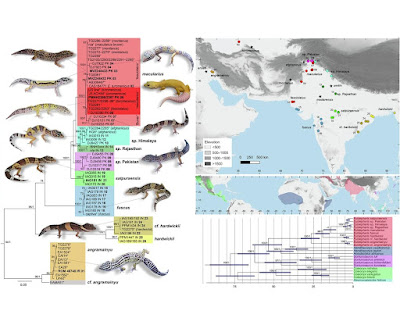
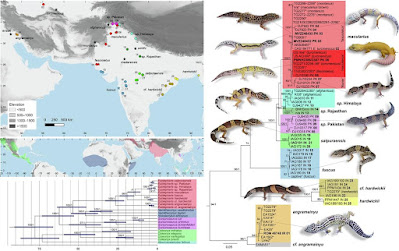
[Herpetology • 2022] The Evolutionary History of An Accidental Model Organism, the Leopard Gecko Eublepharis macularius (Squamata: Eublepharidae)


in Agarwal, Bauer, Gamble, Giri, Jablonski, et al., 2022. 
   

Highlights
• First multi-locus, range-wide sampling of leopard geckos, including most recognised species, synonyms.
• Updated time-tree for Eublepharidae shows most recent common ancestry at 77 Myr ago.
• 10 species of Eublepharis, Oligo-Miocene origins, with the most recent common ancestor entering India from Saharo-Arabia.
• Pleistocene separation of lineages occurs across different biogeographic regions within E. angramainyu and E. hardwickii, with E. macularius now recognized as five species .
• Model organism E. macularius represents a single population of this species with low mtDNA divergence, distributed in Pakistan.

Abstract
The leopard gecko, Eublepharis macularius, is a widely used model organism in laboratory and experimental studies. The high phenotypic diversity in the pet trade, the fact that the provenance of different breeding lines is unknown, and that distinct Eublepharis species are known to hybridize, implies that the continued use of E. macularius as a model requires clarity on the origin of the lineages in the pet trade. We combine multi-locus sequence data and the first range-wide sampling of the genus Eublepharis to reconstruct the evolutionary history of the Eublepharidae and Eublepharis, with an updated time-tree for the Eublepharidae. Our sampling includes five of the six recognized species and additional nominal taxa of uncertain status comprising 43 samples from 34 localities plus 48 pet-trade samples. The Eublepharidae began diversifying in the Cretaceous. Eublepharis split from its sister genera in Africa in the Palaeocene-Eocene, and began diversifying in the Oligocene-Miocene, with late Miocene-Pliocene cladogenesis giving rise to extant species. The current species diversity within this group is moderately underestimated. Our species delimitation suggests 10 species with four potentially unnamed divergent lineages in Iran, India and Pakistan. All 30 individuals of E. macularius that we sampled from the pet trade, which include diverse morphotypes, come from a few shallow E. macularius clades, confirming that lab and pet trade strains are part of a single taxon. One of the wild-caught haplotypes of E. macularius, from near Karachi, Pakistan, is identical to (10) pet-trade samples and all other captive populations are closely related to wild-caught animals from central/southern Pakistan (0.1–0.5 % minimum pairwise uncorrected ND2 sequence divergence).
 
Keywords: Aridification, Divergence dating, Eublepharis macularius, Historical biogeography, Pet trade


Ishan Agarwal, Aaron M. Bauer, Tony Gamble, Varad B. Giri, Daniel Jablonski, Akshay Khandekar, Pratyush P. Mohapatra, Rafaqat Masroor, Anurag Mishra and Uma Ramakrishnan. 2022. The Evolutionary History of An Accidental Model Organism, the Leopard Gecko Eublepharis macularius (Squamata: Eublepharidae). Molecular Phylogenetics and Evolution. 168; 107414. DOI: 10.1016/j.ympev.2022.107414

Wednesday, September 1, 2021

[Herpetology • 2021] Hemiphyllodactylus goaensis • A New Species of the Genus Hemiphyllodactylus Bleeker, 1860 (Squamata: Gekkonidae) from Goa, India


Hemiphyllodactylus goaensis
Khandekar, Parmar, Sawant & Agarwal, 2021


Abstract
We describe a distinct new species of the genus Hemiphyllodactylus based on three specimens collected from semi-urban areas in Goa state of India. The new species can be easily distinguished from all peninsular Indian congeners by its small body size (SVL up to 32.4 mm), having 16–18 dorsal scales and 13 or 14 ventral scales at mid-body contained within one longitudinal eye diameter, nine or ten precloacal pores separated by 1–5 poreless scales from a series of 10–12 femoral pores on each thigh in males, lamellar formula of manus 2222 and of pes 2323 & 2333, as well as subtle colour pattern differences. Mitochondrial sequence divergence confirms the distinctiveness of the new species, which is not closely allied to either the South Indian or Eastern Ghats clades of Indian Hemiphyllodactylus and appears to be a member of a third Indian Hemiphyllodactylus clade. Hemiphyllodactylus goaensis sp. nov. is the first member of the genus to be described from the northern Western Ghats region as well as Goa state, and also only the second Indian Hemiphyllodactylus known from < 100 m asl. Hemiphyllodactylus goaensis sp. nov. extends the known distribution of the genus in western India ~ 560 km north in aerial distance and highlights that the genus is more widely distributed than previously thought and most likely contains numerous undescribed species. We also provide final museum numbers for type specimens of H. arakuensis and the holotype of H. kolliensis.

Keywords: Reptilia, Biodiversity Hotspot, conservation, distribution, diversity, slender geckos, taxonomy 


Hemiphyllodactylus goaensis sp. nov. 


Akshay Khandekar, Dikansh S. Parmar, Nitin Sawant and Ishan Agarwal. 2021. A New Species of the Genus Hemiphyllodactylus Bleeker, 1860 (Squamata: Gekkonidae) from Goa, India. Zootaxa. 5027(2); 254-268. DOI: 10.11646/zootaxa.5027.2.6


Thursday, August 19, 2021

[Herpetology • 2021] Hemidactylus tamhiniensis • A Cryptic New Species of Rupicolous Hemidactylus Goldfuss, 1820 (Squamata: Gekkonidae) allied to H. aaronbaueri Giri, 2008 from the northern Western Ghats of Maharashtra, India


Hemidactylus tamhiniensis 
Khandekar, Thackeray & Agarwal, 2021


Abstract
We describe a cryptic new species of large-bodied rupicolous Hemidactylus allied to H. aaronbaueri from Tamhini Ghat, in Raigad and Pune districts of Maharashtra state, India. Hemidactylus tamhiniensis sp. nov. falls within the prashadi group of Indian Hemidactylus and can be diagnosed from all other members of the group by combination of several morphological characters such as its large-body size (maximum SVL 126 mm), the number of femoral pores and poreless scales between the left and right series of femoral pores in males, and the number of transverse ventral scales across the belly at mid-body. The new species differs from H. aaronbaueri based on dorsal pholidosis at mid-body, the number of undivided lamellae beneath the first finger, the number of internasal scales, and subtle colour pattern differences, besides 10.6% uncorrected ND2 sequence divergence.

Keywords: Reptilia, Basalt, biodiversity hotspot, morphology, rock geckos, species complex, taxonomy, Western Ghats


 Hemidactylus tamhiniensis sp. nov. 


Akshay Khandekar, Tejas Thackeray and Ishan Agarwal. 2021. A Cryptic New Species of Rupicolous Hemidactylus Goldfuss, 1820 (Squamata: Gekkonidae) allied to H. aaronbaueri Giri, 2008 from the northern Western Ghats of Maharashtra, India. Zootaxa. 5020(3); 434-456. DOI: 10.11646/zootaxa.5020.3.2


Wednesday, May 12, 2021

[Herpetology • 2021] Cnemaspis uttaraghati • A Novel Small-bodied Rupicolous Cnemaspis Strauch, 1887 (Squamata: Gekkonidae) from the northern Western Ghats, Maharashtra, India, with Comments on the Status of C. indraneildasii, Bauer 2000


Cnemaspis uttaraghati 
Khandekar, Thackeray & Agarwal, 2021


Abstract
We describe a distinct new rupicolous Cnemaspis based on four adult specimens collected from the Kedareshwar caves on Harishchandragad mountain, from the northern Western Ghats, approximately 1200 m asl. in Ahmednagar district of Maharashtra state, India. Cnemaspis uttaraghati sp. nov. can be diagnosed from all other peninsular Indian congeners by its small body size (maximum SVL < 39 mm), heterogeneous dorsal pholidosis, presence of spine-like tubercles on flanks; presence of only femoral pores in males; tail with enlarged, strongly keeled, conical tubercles forming whorls; median row of sub-caudal scales smooth, slightly enlarged, regularly arranged with condition of two slightly larger scales alternating with a large divided scale. The new species is likely to be allied to the C. girii clade and can be diagnosed from its members by its slightly larger body size, presence of spine-like tubercles on flanks, the number of enlarged tubercles in paravertebral rows between forelimb and hindlimb insertions, the number of dorsal tubercle rows at mid-body, the number of ventral scales across belly at mid-body, the number of longitudinal ventral scales from mental to cloaca, and the number of lamellae under digit IV of manus. We also provide a detailed morphological dataset for C. goaensis and C. indraneildasii based on topotypic material and specimens collected from additional localities to confirm C. indraneildasii is a junior synonym of C. goaensis, and provide an updated diagnosis for C. goaensis.

Keywords: Reptilia, Biodiversity Hotspot, dwarf geckos, endemic, Kalsubai-Harishchandragad Wildlife Sanctuary, morphology, South Asian Cnemaspis, taxonomy


Cnemaspis uttaraghati sp. nov.


Akshay Khandekar, Tejas Thackeray and Ishan Agarwal. 2021. A Novel Small-bodied Rupicolous Cnemaspis Strauch, 1887 (Squamata: Gekkonidae) from the northern Western Ghats, Maharashtra, India, with Comments on the Status of C. indraneildasii, Bauer 2000. Zootaxa. 4969(2); 331–350. DOI: 10.11646/zootaxa.4969.2.6


Tuesday, May 11, 2021

[Herpetology • 2021] Cnemaspis krishnagiriensis • A New Medium-sized Rupicolous Cnemaspis Strauch, 1887 (Squamata: Gekkonidae) of the C. bangara Clade from Granite Boulder Habitats in Krishnagiri, Tamil Nadu, India


Cnemaspis krishnagiriensis
 Agarwal, Thackeray & Khandekar, 2021


Abstract
We describe a new species of the Cnemaspis bangara clade from a rocky hillock near Kugai Periya Mariamman Temple, Krishnagiri fort, Krishnagiri District of Tamil Nadu, India. Cnemaspis krishnagiriensis sp. nov. can be diagnosed from all other peninsular Indian congeners by its medium body size (maximum SVL 40 mm), heterogeneous dorsal pholidosis, spine-like tubercles absent on flanks; presence of four femoral pores on each thigh separated on either side by nine or 10 poreless scales from three continuous precloacal pores in males; tail with enlarged, strongly keeled, conical tubercles forming four whorls on anterior portion, six tubercles in first whorl, four tubercles in second to fourth whorls, enlarged tubercles restricted to only paravertebral region on rest of the tail; median row of sub-caudals smooth and distinctly enlarged, and a unique colour pattern. The new species can be diagnosed from members of C. bangara clade by the number of dorsal tubercles rows at mid-body, the number of enlarged tubercles in paravertebral rows, the number of ventral scales across belly at mid-body, the number longitudinal ventral scales from mental to cloaca, the number of femoral and precloacal pores and poreless scales separating these series, and subtle colour pattern differences; besides 9.2–17.6 % uncorrected ND2 sequence divergence. Cnemaspis krishnagiriensis sp. nov. is the fourth member of the recently described bangara clade and is the first that is known to be distributed <900 m asl.. The discovery of yet another endemic species of Cnemaspis from lower elevations of the Mysore Plateau once again highlights the need of dedicated systematic sampling to uncover the true diversity of Cnemaspis. We also address a nomenclatural issue related to the recently described Cnemaspis stellapulvis Khandekar, Thackeray & Agarwal.

Keywords: Reptilia, Cnemaspis stellapulvis, dwarf geckos, endemic, microrefugia, ND2, nomenclature, South Asian Cnemaspis


 Cnemaspis krishnagiriensis sp. nov.


Ishan Agarwal, Tejas Thackeray and Akshay Khandekar. 2021. A New Medium-sized Rupicolous Cnemaspis Strauch, 1887 (Squamata: Gekkonidae) of the C. bangara Clade from Granite Boulder Habitats in Krishnagiri, Tamil Nadu, India. Zootaxa. 4969(2); 351–366. DOI: 10.11646/zootaxa.4969.2.7


Friday, April 2, 2021

[Herpetology • 2020] Cnemaspis stellapulvis • A New Cryptic Cnemaspis Strauch (Squamata: Gekkonidae) from An isolated Granite Hill on the Mysore Plateau, Karnataka, India


Cnemaspis stellapulvis
 Khandekar, Thackeray & Agarwal, 2020


Abstract
We describe a cryptic new species of the Cnemaspis mysoriensis complex from an isolated rocky hillock near Yadiyur, Mandya District of south Karnataka, India. Cnemaspis stellapulvis sp. nov. can be diagnosed from all other peninsular Indian congeners by its small body size (SVL <32 mm), presence of spine-like tubercles on the flanks, heterogeneous dorsal pholidosis, two or three femoral pores on each thigh separated on either side by eight poreless scales from a continuous series of two precloacal pores in males, tail with enlarged, strongly keeled, conical tubercles forming whorls, median row of sub-caudals smooth and slightly enlarged, and a distinct colour pattern. The new species can be diagnosed from members of C. mysoriensis clade by the number of femoral and precloacal pores and number of poreless scales separating these series, the number of dorsal tubercles rows at mid-body, the number of ventral scales across the belly at mid-body and subtle colour pattern differences; besides 13.4–21.4 % uncorrected ND2 sequence divergence. In this paper, we define the Cnemaspis mysoriensis clade and provide a diagnosis and comparison against peninsular Indian congeners. We also provide major diagnostic characters for members of the C. mysoriensis clade. The discovery of yet another endemic species of Cnemaspis from one of the many isolated granite rocky hills on Mysore Plateau highlights the possibilities of presence of many more cryptic undescribed species.

Keywords: Reptilia, dwarf geckos, endemic, granite boulders, microrefugia, ND2, South Asian Cnemaspis, systematics


Cnemaspis stellapulvis sp. nov.


Akshay Khandekar, Tejas Thackeray and Ishan Agarwal. 2020. A New Cryptic Cnemaspis Strauch (Squamata: Gekkonidae) from An isolated Granite Hill on the Mysore Plateau, Karnataka, India. Zootaxa. 4845(4); 509–528. DOI: 10.11646/zootaxa.4845.4.3


Wednesday, March 31, 2021

[Herpetology • 2021] Cnemaspis schalleri • A New Small-bodied, Polymorphic Cnemaspis Strauch, 1887 (Squamata: Gekkonidae) allied to C. monticola from the Central Western Ghats of Karnataka, India


Cnemaspis schalleri 
Khandekar, Thackeray & Agarwal, 2021


Abstract
We describe a new small-bodied, polymorphic Cnemaspis from near Hongadahalla village, Sakleshpur in the Central Western Ghats of Karnataka, India. Cnemaspis schalleri sp. nov. is allied to C. monticola and can be diagnosed from all other Indian Cnemaspis by its small body size; presence of spine-like tubercles on flank; heterogeneous dorsal pholidosis; presence of both precloacal and femoral pores in males; dorsal pholidosis of tail heterogeneous, composed of small, weakly keeled, flattened, sub-imbricate scales intermixed with enlarged, strongly keeled, distinctly pointed, conical tubercles forming whorls; slightly enlarged median row of sub-caudal scales, smooth at anterior half and strongly keeled posteriorly. The new species differs from C. monticola based on the number of dorsal tubercle rows at mid-body, the number of paravertebral tubercles, the number of precloacal pores and poreless scales between precloacal and femoral pores; besides 8.9–10.7 % uncorrected ND2 sequence divergence. We also provide the first description of topotypic males of C. monticola along with the first data on live colouration and natural history. Cnemaspis schalleri sp. nov. is the second new Cnemaspis described from around Sakleshpur within a span of less than a year with minimal field survey effort. It is almost certain than the dedicated systematic sampling across the Central Western Ghats will result in the discovery of many undescribed Cnemaspis lineages.

Keywords: Reptilia, Cnemaspis monticola, dwarf geckos, endemic, ND2, South Asian Cnemaspis, systematics, Western Ghats


Cnemaspis schalleri sp. nov.

 
Akshay Khandekar, Tejas Thackeray and Ishan Agarwal. 2021.  A New Small-bodied, Polymorphic Cnemaspis Strauch, 1887 (Squamata: Gekkonidae) allied to C. monticola Manamendra-Arachchi, Batuwita & Pethiyagoda, 2007 from the Central Western Ghats of Karnataka, India.  Zootaxa. 4950(3); 501–527. DOI: 10.11646/zootaxa.4950.3.5


Monday, December 21, 2020

[Herpetology • 2020] Hemiphyllodactylus nilgiriensis & H. peninsularis • Two New Hemiphyllodactylus Bleeker, 1860 (Squamata: Gekkonidae) from Tamil Nadu, India


Hemiphyllodactylus nilgiriensis  & H. peninsularis 
Agarwal, Bauer, Pal, Srikanthan & Khandekar, 2020


Abstract
Two new species of the gekkonid genus Hemiphyllodactylus are described from mountains of the Western Ghats in Tamil Nadu, southern India. Hemiphyllodactylus nilgiriensis sp. nov. and H. peninsularis sp. nov. are > 5 % divergent in the mitochondrial ND2 gene from each other and members of the H. aurantiacus complex and differ from each other and members of the H. aurantiacus complex in several meristic characters and colouration. The description of these two new species takes the number of Indian Hemiphyllodactylus to six and the number of endemic geckos from Tamil Nadu to 15.

Keywords: Reptilia, Biodiversity hotspot; cryptic species, Gekkonidae, massif, peninsular India, taxonomy, Western Ghats


Hemiphyllodactylus nilgiriensis sp. nov. in life, female paratype, CESL 467; 
H. peninsularis sp. nov. in life, male holotype, BNHS 2633.


Hemiphyllodactylus nilgiriensis sp. nov.
 Etymology. The specific epithet is a toponym for the Nilgiri mountain range or Nilgiris, to which the new species is restricted. 
Suggested Common Name. Nilgiris slender gecko


Hemiphyllodactylus peninsularis sp. nov.  

Etymology. The specific epithet comes from the Latin paene (almost) and insula (island), reflecting the isolated nature of the montane type locality of the new species at the southern extreme of the Indian peninsula. 

Suggested Common Name. Kalakkad-Mundanthurai Tiger Reserve slender gecko


Ishan Agarwal, Aaron M. Bauer, Saunak Pal, Achyuthan N. Srikanthan and Akshay Khandekar. 2020. Two More New Hemiphyllodactylus Bleeker, 1860 (Squamata: Gekkonidae) from Tamil Nadu, India. Zootaxa. 4729(2); 249–265. DOI: 10.11646/zootaxa.4729.2.6