Showing posts with label Nature Communications. Show all posts

Wednesday, September 24, 2025

[Paleontology • 2025] Joaquinraptor casali • Latest Cretaceous megaraptorid theropod Dinosaur sheds light on megaraptoran evolution and palaeobiology

 
Joaquinraptor casali 
Ibiricu, Lamanna, Alvarez, Cerda, Caglianone, Cardozo, Luna & Martínez, 2025 

Artwork by  Andrew McAfee

Abstract
Recent fossil discoveries have cast considerable light on the palaeobiology of Megaraptora, a group of large-clawed carnivorous theropod dinosaurs known from Cretaceous deposits in Asia, Australia, and especially South America. Nevertheless, many important aspects of megaraptoran morphology and evolution remain poorly understood, due in large part to the fragmentary nature of most fossils of these theropods and the scarcity of anatomically overlapping skeletal elements among the known taxa. Here we report a previously unknown megaraptoran genus and species represented by a partially articulated partial skeleton recovered from an uppermost Cretaceous stratum of the Lago Colhué Huapi Formation of south-central Chubut Province in central Patagonia, Argentina. Pertaining to the derived megaraptoran subclade Megaraptoridae, the taxon is among the most completely represented and latest-surviving megaraptorans. Its stratigraphic occurrence indicates that these dinosaurs likely persisted to the Cretaceous/Palaeogene boundary; moreover, the preservation of a crocodyliform humerus between the dentaries of the new theropod may provide information on megaraptoran dietary preferences and feeding strategies. Megaraptorids appear to have been the apex predators in central and southern Patagonian palaeoecosystems approaching the end of the Cretaceous, in contrast to more northerly areas of South America where these niches were occupied by other non-avian theropod groups.


 Osteology of Joaquinraptor casali gen. et sp. nov.
a Skeletal reconstruction of Joaquinraptor in left lateral view with preserved elements in blue (some reversed from right side) (modified and updated from Lamanna et al.7 [these authors’ Fig. 1e], which was in turn modified by A. McAfee from an original illustration by T.K. Robinson). Right maxilla in lateral (b) and medial (c) views. Skull roof, braincase, and atlantal intercentrum in dorsal (d) and ventral (e) views. f Probable right postorbital in lateral view. g Right quadrate in anterior view. Right and left dentaries in lateral and medial views (right dentary in lateral view and left dentary in medial view in h; opposite in i). j Two articulated middle or posterior caudal vertebrae in right lateral view. k Dorsal rib in anterior view. l Anterior haemal arch in anterior view. m Left scapulocoracoid in lateral view. Left humerus in anterolateral (n), lateral (o), and medial (p) views. Left radius in anterior (q) and lateral (r) views. Left ulna in lateral (s) and posterior (t) views. u Right manual ungual II (=manual phalanx II-3) in lateral view. Left femur in anterior (v) and posterior (w) views. x Distal right tibia in anterior view. y Right pedal ungual III (=pedal phalanx III-4) in medial view. Dashed lines indicate missing areas of scapulocoracoid and femur.

Systematic palaeontology
Saurischia Seeley, 1887 
Theropoda Marsh, 1881 
Tetanurae Gauthier, 1986 

Megaraptora Benson, Carrano, and Brusatte, 2010 
Megaraptoridae Novas, Agnolín, Ezcurra, Porfiri, and Canale, 2013 

Joaquinraptor casali gen. et sp. nov.

Etymology: Joaquín, in tribute to the son of the first author (L.M.I.) and the informal name given to the locality when the skeleton of the taxon was discovered (Valle Joaquín); Latin, raptor, thief. Specific epithet casali in recognition of Dr. Gabriel Andrés Casal for his many contributions to knowledge of the Cretaceous palaeontology and geology of central Patagonia (including the formal recognition and naming of the formation from which this megaraptorid was recovered).


Joaquinraptor casali with an ancient crocodile relative's front leg in its mouth.
Artwork by  Andrew McAfee

 
Lucio M. Ibiricu, Matthew C. Lamanna, Bruno N. Alvarez, Ignacio A. Cerda, Julieta L. Caglianone, Noelia V. Cardozo, Marcelo Luna and Rubén D. Martínez. 2025. Latest Cretaceous megaraptorid theropod Dinosaur sheds light on megaraptoran evolution and palaeobiology. Nature Communications. 16: 8298. DOI: doi.org/10.1038/s41467-025-63793-5 [23 September 2025]


Saturday, December 21, 2024

[Paleontology • 2024] Early–middle Permian Mediterranean gorgonopsian suggests an equatorial origin of therapsids

a gorgonopsian from the island of Mallorca, western Mediterranean

in Matamales-Andreu, Kammerer, Angielczyk, Simões, Mujal, Galobart et Fortuny, 2024.  
Reconstruction by Henry Sutherland Sharpe

Abstract
Therapsids were a dominant component of middle–late Permian terrestrial ecosystems worldwide, eventually giving rise to mammals during the early Mesozoic. However, little is currently known about the time and place of origin of Therapsida. Here we describe a definitive therapsid from the lower–?middle Permian palaeotropics, a partial skeleton of a gorgonopsian from the island of Mallorca, western Mediterranean. This specimen represents, to our knowledge, the oldest gorgonopsian record worldwide, and possibly the oldest known therapsid. Using emerging relaxed clock models, we provide a quantitative timeline for the origin and early diversification of therapsids, indicating a long ghost lineage leading to the evolutionary radiation of all major therapsid clades within less than 10 Myr, in the aftermath of Olson’s Extinction. Our findings place this unambiguous early therapsid in an ancient summer wet biome of equatorial Pangaea, thus suggesting that the group originated in tropical rather than temperate regions.

Systematic palaeontology
Synapsida Osborn, 190313
Therapsida Broom, 190514

Gorgonopsia Seeley, 189415
Gorgonopsia indet.

Most relevant elements of DA21/17-01-01 and silhouette showing their positions


 Life reconstruction of the gorgonopsian from Mallorca in a floodplain setting.
Reconstruction by Henry Sutherland Sharpe


 Rafel Matamales-Andreu, Christian F. Kammerer, Kenneth D. Angielczyk, Tiago R. Simões, Eudald Mujal, Àngel Galobart and Josep Fortuny. 2024. Early–middle Permian Mediterranean gorgonopsian suggests an equatorial origin of therapsids. Nature Communications. 15: 10346. DOI: doi.org/10.1038/s41467-024-54425-5  

Friday, November 1, 2024

[PaleoIchthyology • 2024] Ngamugawi wirngarri • A Late Devonian coelacanth reconfigures Actinistian Phylogeny, Disparity, and Evolutionary Ddynamics

 
Ngamugawi wirngarri 
Clement, Cloutier, Lee, King, Vanhaesebroucke, Bradshaw, Dutel, Trinajstic & Long, 2024 


Abstract
The living coelacanth Latimeria (Sarcopterygii: Actinistia) is an iconic, so-called ‘living fossil’ within one of the most apparently morphologically conservative vertebrate groups. We describe a new, 3-D preserved coelacanth from the Late Devonian Gogo Formation in Western Australia. We assemble a comprehensive analysis of the group to assess the phylogeny, evolutionary rates, and morphological disparity of all coelacanths. We reveal a major shift in morphological disparity between Devonian and post-Devonian coelacanths. The newly described fossil fish fills a critical transitional stage in coelacanth disparity and evolution. Since the mid-Cretaceous, discrete character changes (representing major morphological innovations) have essentially ceased, while meristic and continuous characters have continued to evolve within coelacanths. Considering a range of putative environmental drivers, tectonic activity best explains variation in the rates of coelacanth evolution.


Ngamugawi wirngarri 
A, B ‘Part a’ of WAM 09.6.148 (holotype) shown in left dorsolateral view and skull close up in left lateral view. C ‘Part b’ of WAM 09.6.148 (holotype) showing all exposed elements; D partial braincase of NMV P231504 (paratype) shown in right lateral view; E cleithrum of NMV P231504 (paratype) in mesial and lateral view; F, G skull reconstruction in dorsal and left lateral view.
Abbreviations: Ang angular, Cl cleithrum, Clv clavicle, Dt dentary, Exc extracleithrum, icj intracranial joint, ioc infraorbital canal, L.Gu lateral gular, Lj lachrymojugal, mc mandibular canal, L.Ex lateral extrascapular, Op operculum, Par Parietal, Po postorbital, Pop preoperculum, Pp postparietal, Pmx premaxilla, Psym parasymphysial, Q quadrate, Ro.p1 anterior pore of the rostral organ, Ro.p2 antero-lateral pore of the rostral organ, Ro.p3 postero-lateral pore of the rostral organ, So supraorbitals, soc supraorbital canal, Sop Suboperculum, Spl splenial, Sq squamosal.

Systematic palaeontology
Osteichthyes Huxley 1880
Sarcopterygii Romer 1955
Actinistia Cope 1871

Ngamugawi wirngarri gen. et sp. nov.

Diagnosis: Ngamugawi wirngarri gen. et sp. nov. is distinguished from all other coelacanths by the following apomorphies: jugal canal with prominent branches; large sensory pore openings between supraorbitals and parietals; teeth on parasymphysial tooth plate, but not on the dentary; prearticular and/or coronoid teeth rounded; cleithra and extracleithra with broad triangular anteroventral overlap for clavicle bearing a large ventral foramen; and scales with long ornamental ridges extending beyond the posterior margin of the base (Figs. 1, 2, Supplementary Fig. 1).

Locality and horizon: Canning Basin, in northern Western Australia, circa 100 km southeast of Fitzroy Crossing; Gogo Formation, early Frasnian, Late Devonian (~384–382 Ma). The holotype was found between Stromatoporoid Camp and Longs Well, the paratype was found in Paddys Valley. 

Etymology: Generic name meaning “ancient fish” in Gooniyandi/Guniyandi, language of the First Nations people from Country around Fitzroy Crossing in the Kimberley region of Western Australia. Specific name is given in honour of respected Gooniyandi elder and ancestor Wirngarri, who lived in the Emanuel Range. Generic and specific names were both provided to Prof. John Long in September 2023, who has a longstanding and ongoing relationship with the community, with permissions to use the language granted by elder Rosemary Nuggett, on behalf of the Gooniyandi people of the Mimbi community.


Phylogenetic relationships and divergence dates within coelacanths, based on tip-dated Bayesian inference.

A live recreation of the Ngamugawi wirngarri coelacanth in its natural habitat. P3D graphic credit: Katrina Kenny. 
 Illustration by Katrina Kenny (courtesy Flinders University)


 Alice M. Clement, Richard Cloutier, Michael S. Y. Lee, Benedict King, Olivia Vanhaesebroucke, Corey J. A. Bradshaw, Hugo Dutel, Kate Trinajstic and John A. Long. 2024. A Late Devonian coelacanth reconfigures Actinistian Phylogeny, Disparity, and Evolutionary Ddynamics. Nature Communications. 15: 7529. DOI: doi.org/10.1038/s41467-024-51238-4


Saturday, January 27, 2024

[PaleoEntomology • 2024] Eunotalia emeryi, Cretotettigarcta shcherbakovi & Pranwanna xiai • Mesozoic Evolution of Cicadas and their Origins of Vocalization and Root Feeding


Life reconstruction of cicadas in a Mesozoic Forest. 
Eunotalia emeryi gen. et sp. nov.
Cretotettigarcta shcherbakovi 
sp. nov.
Pranwanna xiai gen. et sp. nov.

 Jiang, Szwedo, Labandeira, Chen, Moulds, Mähler, Muscente, Zhuo, Nyunt, Zhang, Wei, Rust & Wang, 2024
 Reconstructed by Mr. Dinghua Yang

Abstract
Extant cicada (Hemiptera: Cicadoidea) includes widely distributed Cicadidae and relictual Tettigarctidae, with fossils ascribed to these two groups based on several distinct, minimally varying morphological differences that define their extant counterparts. However, directly assigning Mesozoic fossils to modern taxa may overlook the role of unique and transitional features provided by fossils in tracking their early evolutionary paths. Here, based on adult and nymphal fossils from mid-Cretaceous Kachin amber of Myanmar, we explore the phylogenetic relationships and morphological disparities of fossil and extant cicadoids. Our results suggest that Cicadidae and Tettigarctidae might have diverged at or by the Middle Jurassic, with morphological evolution possibly shaped by host plant changes. The discovery of tymbal structures and anatomical analysis of adult fossils indicate that mid-Cretaceous cicadas were silent as modern Tettigarctidae or could have produced faint tymbal-related sounds. The discovery of final-instar nymphal and exuviae cicadoid fossils with fossorial forelegs and piercing-sucking mouthparts indicates that they had most likely adopted a subterranean lifestyle by the mid-Cretaceous, occupying the ecological niche of underground feeding on root. Our study traces the morphological, behavioral, and ecological evolution of Cicadoidea from the Mesozoic, emphasizing their adaptive traits and interactions with their living environments.

Adults, final instar nymph, and exuviae of Cicadoidea fossils in Kachin amber of northern Myanmar.
 a Eunotalia emeryi gen. et sp. nov. (MGM2016–014). This image was published in the study by ref. 41 (Fig. 3a). b Cretotettigarcta problematica comb. nov. (new material: NIGP201895). c Cretotettigarcta shcherbakovi sp. nov. (NIGP201896). d Vetuprosbole parallelica (new material: NIGP201897).
e–i Pranwanna xiai gen. et sp. nov. (LYU–BC2001, male; LYU–BC2002, female). e Dorsal view of male. f Dorsal view of female. g Ventral view of male. h Ventral view of female. i Left view of final-instar nymph, Cicadoidea species 1 (NIGP2018985).
j–m Final- nymphal exuviae. j Nymphal sp. 2 (MGM2016–017), left view. k Nymphal sp. 3 (LYU–BC2004), right view. l Nymphal sp. 4 (NIGP201900), ventral view. m Nymphal sp. 5 (NIGP201901), left view.

Stem cicadoids
Eunotalia gen. nov.
  Eunotalia emeryi sp. nov.  

Etymology: The generic name is a compound form, from Classical Greek prefix: eu-, meaning ‘true’ or ‘good’, and notos, meaning ‘back’ or ‘dorsum’.

Stem cicadids
Cretotettigarcta

Cretotettigarcta problematica comb. nov.
Cretotettigarcta shcherbakovi sp. nov.

Pranwanna gen. nov 
 Pranwanna xiai sp. nov.

Etymology: The generic name, pranwanna, is from the Jingpho language spoken in Kachin State of Myanmar, meaning ‘primitive’.


Hui Jiang, Jacek Szwedo, Conrad C. Labandeira, Jun Chen, Maxwell S. Moulds, Bastian Mähler, A. Drew Muscente, De Zhuo, Thet Tin Nyunt, Haichun Zhang, Cong Wei, Jes Rust and Bo Wang. 2024. Mesozoic Evolution of Cicadas and their Origins of Vocalization and Root Feeding. Nature Communications. 15, 376.  DOI: 10.1038/s41467-023-44446-x

Thursday, November 2, 2023

[PaleoIchthyology • 2023] Yanliaomyzon ingensdentes & Y. occisor • The Rise of Predation in Jurassic Lampreys


Yanliaomyzon occisor Y. ingensdentes 
 Wu, Janvier & Zhang, 2023


Abstract
Lampreys, one of two living lineages of jawless vertebrates, are always intriguing for their feeding behavior via the toothed suctorial disc and life cycle comprising the ammocoete, metamorphic, and adult stages. However, they left a meager fossil record, and their evolutionary history remains elusive. Here we report two superbly preserved large lampreys from the Middle-Late Jurassic Yanliao Biota of North China and update the interpretations of the evolution of the feeding apparatus, the life cycle, and the historic biogeography of the group. These fossil lampreys’ extensively toothed feeding apparatus differs radically from that of their Paleozoic kin but surprisingly resembles the Southern Hemisphere pouched lamprey, which foreshadows an ancestral flesh-eating habit for modern lampreys. Based on the revised petromyzontiform timetree, we argued that modern lampreys’ three-staged life cycle might not be established until the Jurassic when they evolved enhanced feeding structures, increased body size and encountered more penetrable host groups. Our study also places modern lampreys’ origin in the Southern Hemisphere of the Late Cretaceous, followed by an early Cenozoic anti-tropical disjunction in distribution, hence challenging the conventional wisdom of their biogeographical pattern arising from a post-Cretaceous origin in the Northern Hemisphere or the Pangean fragmentation in the Early Mesozoic.

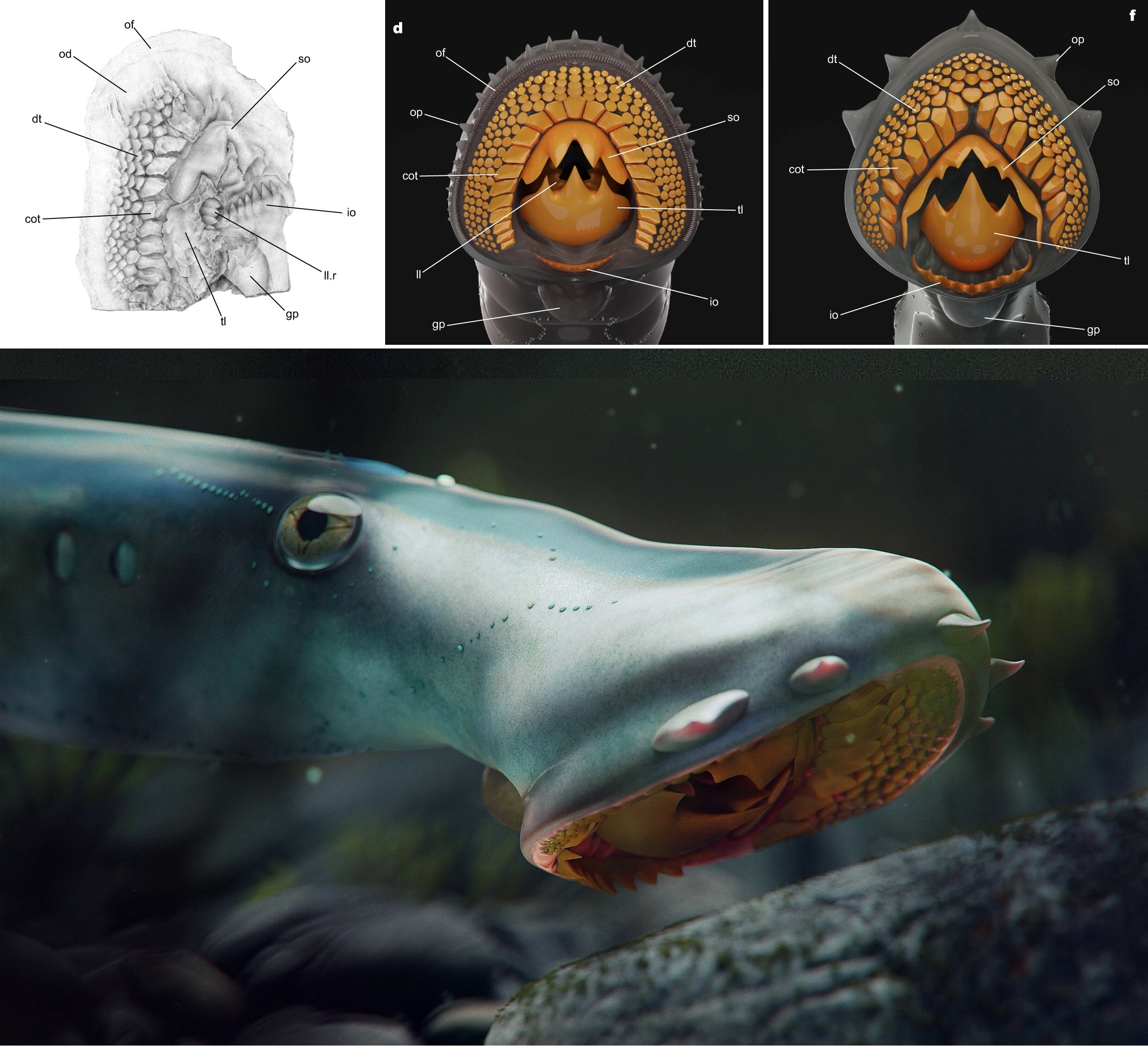
Jurassic lampreys from the Yanliao Biota, China, Yanliaomyzon occisor gen. et sp. nov. and Yanliaomyzon ingensdentes gen. et sp. nov.
a–e Yanliaomyzon occisor gen. et sp. nov., a Photograph of holotype (IVPP V 15830); b Line drawing of the oral disc and dentition of (a), based on Supplementary Fig. 2k and l; c, d Paratype (IVPP V 18956B), photograph (c) and line drawing (d); e Restoration.
 f–h Yanliaomyzon ingensdentes gen. et sp. nov., f Photograph of holotype (IVPP V 16715B), white arrow pointing to the skeletal relics in gut content; g Oral disc and dentition; h Restoration.
Abbreviations: adf, ‘anterior dorsal fin’ (dorsal fin); af, anal fin fold; ba, branchial apparatus; ca, cloaca (anus); cot, circumoral teeth; da, dorsal aorta; dcf, dorsal lobe of caudal fin; dt, oral disc teeth; cf, caudal fin; e, eyes; dt, disc teeth; go, external gill openings; gp, gular pouch; ic, intestine contents; io, infraoral lamina; ll, longitudinal lingual lamina; ll.l, left longitudinal lingual lamina; ll.r, right longitudinal lingual lamina; lv, liver; ns, olfactory organ (nasal sac); oc, otic capsule; od, oral disc; of, oral fimbriae; op, oral papilla(e); paf, precloacal skin fold; pdf, ‘posterior dorsal fin’ (anterior part of caudal fin); pt, piston cartilage; so, supraoral lamina; tl, transverse lingual lamina; vcf, ventral lobe of caudal fin; V1?, ophthalmic ramus of trigeminal nerve?

a–d Oral disc and dentition of Yanliaomyzon ingensdentes gen. et sp. nov., a Photograph (IVPP V 16716B) and b Line drawing; c Photograph (IVPP V 16716A), whitened with ammonium chloride, the white arrow pointing to the imprints of the wrinkles of the gular pouch; d Restoration.
e, f Oral disc and dentition of Yanliaomyzon occisor gen. et sp. nov., e Photograph (IVPP V18956A), whitened with ammonium chloride; f Restoration;
 g Oral disc and dentition of Geotria australis, redrawn from ref. 10.
Abbreviations: cot, circumoral teeth; dt, oral disc teeth; gp, gular pouch; ic, intestine contents; io, infraoral lamina; ll, longitudinal lingual lamina; ll.r, right longitudinal lingual lamina; od, oral disc; of, oral fimbriae; op, oral papilla(e); so, supraoral lamina; tl, transverse lingual lamina.


Systematic paleontology
Order: Petromyzontiformes Berg, 194018

Genus Yanliaomyzon gen. nov.
 
Diagnosis: Stem lampreys with oral discs well-toothed in anterior and lateral fields; anterior and lateral oral disc teeth closely arranged, dorsally truncated, spatulate in shape with the slightly concaved undersurface of the free edge protruding a shallow blade; posterior disc teeth lacking, anterior and lateral circumoral teeth elongate and trihedral in shape; supraoral lamina large and consisting of two stout central cusps flanked by wing-like lateral extensions; transverse lingual lamina very large with the apices of three cusps interlocking with the supraoral lamina in vivo.
 
Etymology: Yanliao’ derives from Yanliao Biota, a Jurassic terrestrial Lagerstätte from North China, where these fossils were discovered; ‘myzon’ (Greek), sucker.

Yanliaomyzon occisor

Diagnosis: The supraoral lamina spanning completely the lateral rims of the oral aperture, with the central cusps flanked immediately by two smaller projections; 16 circumoral teeth; the tail region occupying slightly less than 28% of the total body length.

Etymology: Latin ‘occisor’, meaning ‘killer’, refers to the powerful hunting skill of the species.

Horizon and locality: Tiaojishan Formation, Oxfordian, earliest Late Jurassic, ca. 158.58–160 million years ago (Ma); Daxishan, Linglongta Town, Jianchang County, Liaoning Province (Holotype), and Nanshimen Village, Gangou Town, Qinglong County, Hebei Province (Paratype), China.


Yanliaomyzon ingensdentes gen. et sp. nov.

Diagnosis: The supraoral lamina occupying roughly one-third of the rim of the oral aperture; the transverse lingual lamina almost equaling to the supraoral lamina in width; ca. 23 circumoral teeth; the tail region occupying slightly more than 40% of the total body length.

Etymology: Latin ‘ingens + dentes’, meaning large teeth, refers to the large cuspid laminae on the gouging piston.
 
Horizon and locality: Daohugou beds, Callovian, late Middle Jurassic, ca. 163 Ma in Wubaiding Village, Reshuitang County, Liaoning Province, China.


Feixiang Wu, Philippe Janvier and Chi Zhang. 2023. The Rise of Predation in Jurassic Lampreys. Nature Communications. 14: 6652. DOI: 10.1038/s41467-023-42251-0
https://phys.org/news/2023-11-species-large-ancient-lampreys-china.html


Sunday, July 9, 2023

[Paleontology • 2023] Megasiphon thylakos • A mid-Cambrian Tunicate and the Deep Origin of the Ascidiacean Body Plan


Megasiphon thylakos
Nanglu, Lerosey-Aubril, Weaver & Ortega-Hernández, 2023

 Artwork by Franz Anthony.

Abstract
Tunicates are an evolutionarily significant subphylum of marine chordates, with their phylogenetic position as the sister-group to Vertebrata making them key to unraveling our own deep time origin. Tunicates greatly vary with regards to morphology, ecology, and life cycle, but little is known about the early evolution of the group, e.g. whether their last common ancestor lived freely in the water column or attached to the seafloor. Additionally, tunicates have a poor fossil record, which includes only one taxon with preserved soft-tissues. Here we describe Megasiphon thylakos gen. et sp. nov., a 500-million-year-old tunicate from the Marjum Formation of Utah, which features a barrel-shaped body with two long siphons and prominent longitudinal muscles. The ascidiacean-like body of this new species suggests two alternative hypotheses for early tunicate evolution. The most likely scenario posits M. thylakos belongs to stem-group Tunicata, suggesting that a biphasic life cycle, with a planktonic larva and a sessile epibenthic adult, is ancestral for this entire subphylum. Alternatively, a position within the crown-group indicates that the divergence between appendicularians and all other tunicates occurred 50 million years earlier than currently estimated based on molecular clocks. Ultimately, M. thylakos demonstrates that fundamental components of the modern tunicate body plan were already established shortly after the Cambrian Explosion.

The tunicate Megasiphon thylakos from the mid-Cambrian (Drumian) Marjum Formation of Utah and comparisons with modern benthic tunicates.
 a Holotype (UMNH.IP.6079) and only known specimen of Megasiphon thylakos, showing overall morphology including paired siphons and barrel-shaped body drawing immediate comparisons with modern benthic tunicates (c–e). b Counterpart to a.
c Ciona intestinalis (Phlebobranchia). d Ascidiella sp. (Phlebobranchia) e Molgula manhattensis (Stolidobranchia).


a Simplified phylogeny of extant Tunicata [DeBiasse et al., 2020. ]. Depending on the phylogenetic position of Megasiphon thylakos, a solitary, sessile, epibenthic organism with a biphasic life cycle that underwent larval metamorphosis is ancestral for either total-group Tunicata, or for non-appendicularian tunicates.
b M. thylakos reconstructed as a stem-group tunicate would support a sessile mode of life in the adult forms as ancestral to Tunicata, as well as indirect development through a free-swimming larval form.
c Simplified time scale of tunicate evolution. M. thylakos recovered as a crown-group tunicate would indicate that the ascidiacean body plan evolved during the mid-Cambrian (Megasiphon silhouette at the node in the diagram), approximately 50 million years earlier than the Late Ordovician dichotomy (double helix at the node in the diagram) estimated through molecular clocks8.  

Systematic paleontology
Chordata (Linnaeus 1758)
Tunicata (Lamarck 1816)

Megasiphon thylakos gen. et sp. nov

Diagnosis: Barrel-shaped main body extends apically into two similarly sized, long siphons (Fig. 2a, b). Main body with millimetric circular transverse muscle bands. Siphons project at roughly a 25° angle relative to longitudinal axis of main body, and are associated with longitudinal muscle bands extending from the upper region of the main body.

Etymology: From Greek Mega (large) and siphon (siphon), referring to the prominent siphons. Species name from Greek thylakos (sacpouch), refers to the sac-like body.

 Artistic reconstruction of Megasiphon thylakos.
 Artwork by Franz Anthony.


Karma Nanglu, Rudy Lerosey-Aubril, James C. Weaver and Javier Ortega-Hernández. 2023. A mid-Cambrian Tunicate and the Deep Origin of the Ascidiacean Body Plan. Nature Communications. 14, 3832. DOI: 10.1038/s41467-023-39012-4 

Friday, November 18, 2022

[Paleontology • 2022] Mieridduryn bonniae • Ordovician Opabiniid-like Animals and the Role of the Proboscis in Euarthropod Head Evolution


Mieridduryn bonniae
Pates, Botting, Muir & Wolfe, 2022


Abstract
A crucial step in the evolution of Euarthropoda (chelicerates, myriapods, pancrustaceans) was the transition between fossil groups that possessed frontal appendages innervated by the first segment of the brain (protocerebrum), and living groups with a protocerebral labrum and paired appendages innervated by the second brain segment (deutocerebrum). Appendage homologies between the groups are controversial. Here we describe two specimens of opabiniid-like euarthropods, each bearing an anterior proboscis (a fused protocerebral appendage), from the Middle Ordovician Castle Bank Biota, Wales, UK. Phylogenetic analyses support a paraphyletic grade of stem-group euarthropods with fused protocerebral appendages and a posterior-facing mouth, as in the iconic Cambrian panarthropod Opabinia. These results suggest that the labrum may have reduced from an already-fused proboscis, rather than a pair of arthropodized appendages. If some shared features between the Castle Bank specimens and radiodonts are considered convergent rather than homologous, phylogenetic analyses retrieve them as opabiniids, substantially extending the geographic and temporal range of Opabiniidae.


Mieridduryn bonniae nov. gen. et sp. from the Castle Bank Biota (NMW.2021.3 G.7).

Systematic palaeontology

Superphylum PANARTHROPODA Nielsen, 199538

Genus Mieridduryn nov.

Etymology: From Welsh mieri (bramble) and duryn (proboscissnout), meaning “bramble-snout”. The dd is pronounced as a soft th, and results from mutation following a feminine noun. Gender f.

Diagnosis: Panarthropod with head region bearing dorsal sclerite, annulated proboscis with spiniform dorsal projections and radial mouthparts composed of small, sclerotized plates; gut trace leading to posterior-facing mouth; trunk bears large subrectangular dorsolateral flaps with rounded distal margins; dorsolateral flaps bear setal structures on surface facing body midline; annulated lobopods display triangular outline and possess short triangular spines on posterior margin.


Mieridduryn bonniae nov. gen. et sp.

Etymology: After Bonnie Douel, niece of the site owners and fossil devotee; the family has followed and supported the research extensively since the discovery of the fauna.

Holotype: NMW.2021.3 G.7 known from part and counterpart. Counterpart preserves anterior portion only.

Locality and horizon: Collected from the Darriwilian (Middle Ordovician, Didymograptus murchisoni Biozone) Gilwern Volcanic Formation at Castle Bank, near Llandrindod, Powys (UK)

Material, locality, and horizon: NMW.2021.3 G.8, known from part and counterpart. Collected from the Darriwilian (Middle Ordovician, Didymograptus murchisoni Biozone) Gilwern Volcanic Formation at Castle Bank, near Llandrindod, Powys (UK)


Stephen Pates, Joseph P. Botting, Lucy A. Muir and Joanna M. Wolfe. 2022. Ordovician Opabiniid-like Animals and the Role of the Proboscis in Euarthropod Head Evolution. Nature Communications. 13: 6969. DOI: 10.1038/s41467-022-34204-w
   

Tuesday, May 3, 2022

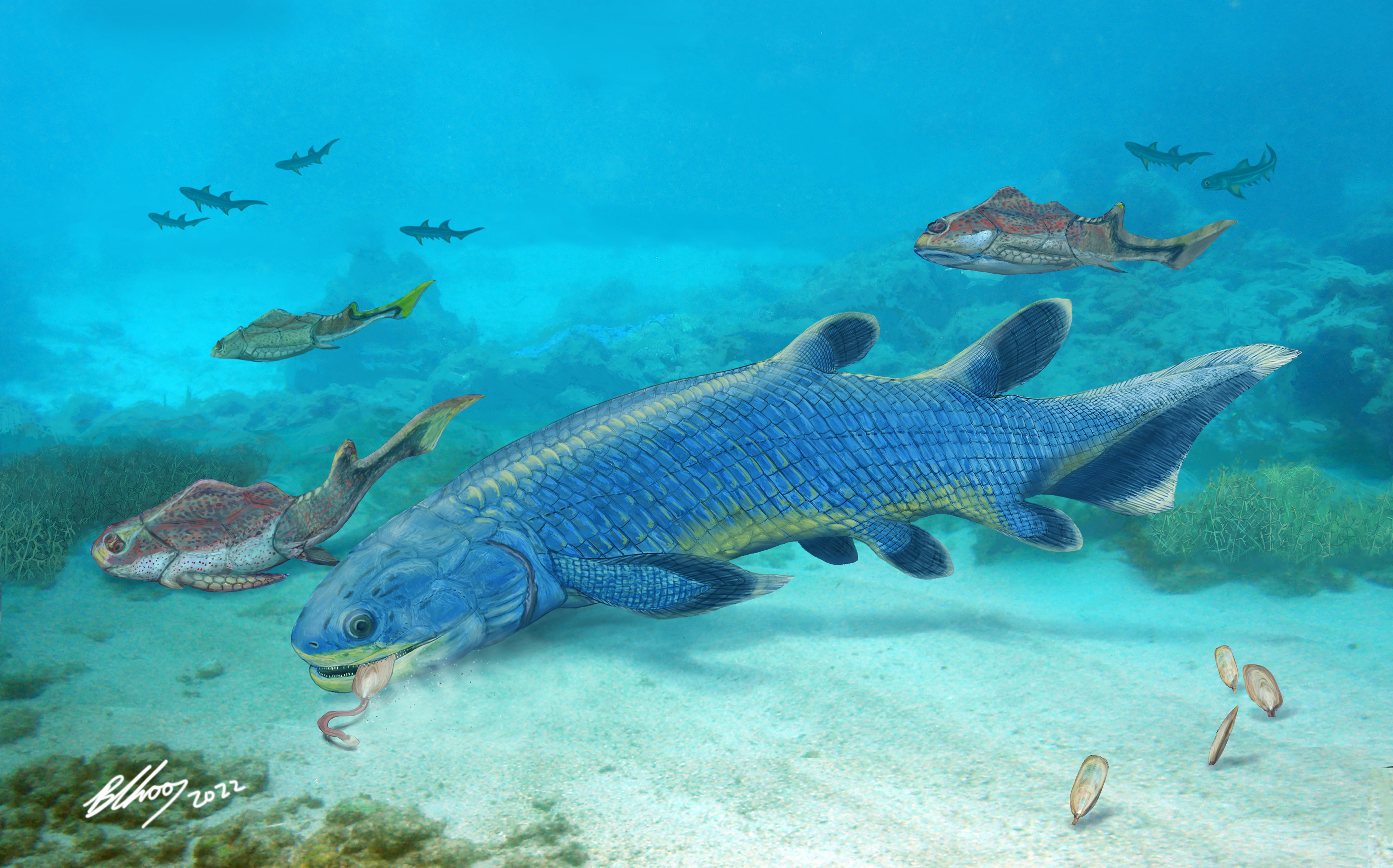
[PaleoIchthyology • 2022] The Rapid Evolution of Lungfish Durophagy


Youngolepis praecursor Chang & Yu, 1981
 
in Cui, Friedman, Qiao, et al., 2022. 
artwork by Brian Choo

Abstract
Innovations relating to the consumption of hard prey are implicated in ecological shifts in marine ecosystems as early as the mid-Paleozoic. Lungfishes represent the first and longest-ranging lineage of durophagous vertebrates, but how and when the various feeding specializations of this group arose remain unclear. Two exceptionally preserved fossils of the Early Devonian lobe-finned fish Youngolepis reveal the origin of the specialized lungfish feeding mechanism. Youngolepis has a radically restructured palate, reorienting jaw muscles for optimal force transition, coupled with radiating entopterygoid tooth rows like those of lungfish toothplates. This triturating surface occurs in conjunction with marginal dentition and blunt coronoid fangs, suggesting a role in crushing rather than piercing prey. Bayesian tip-dating analyses incorporating these morphological data indicate that the complete suite of lungfish feeding specializations may have arisen in as little as 7 million years, representing one of the most striking episodes of innovation during the initial evolutionary radiations of bony fishes.

  Youngolepis praecursor, specimen IVPP V28375 in dorsal view.

The palate and dorsal portion of the hyoid arch of Youngolepis praecursor.


Youngolepis praecursor Chang & Yu, 1981

Timing of divergences and rates of trait evolution in lungfishes and their close relatives.


Xindong Cui, Matt Friedman, Tuo Qiao, Yilun Yu and Min Zhu. 2022. The Rapid Evolution of Lungfish Durophagy. Nature Communications. 13: 2390. DOI: 10.1038/s41467-022-30091-3
 highlighting feeding innovations in Youngolepis, an Early Devonian stem lungfish from China (art: Brian Choo) @NatureComms @Friedman_Lab


Thursday, March 10, 2022

[Paleontology • 2022] Syllipsimopodi bideni • Fossil Coleoid Cephalopod (Cephalopoda: Coleoidea) from the Mississippian Bear Gulch Lagerstätte sheds light on early Vampyropod Evolution


Syllipsimopodi bideni 
Whalen & Landman, 2022

 Reconstruction by K. Whalen.

Abstract
We describe an exceptionally well-preserved vampyropod, Syllipsimopodi bideni gen. et sp. nov., from the Carboniferous (Mississippian) Bear Gulch Lagerstätte of Montana, USA. The specimen possesses a gladius and ten robust arms bearing biserial rows of suckers; it is the only known vampyropod to retain the ancestral ten-arm condition. Syllipsimopodi is the oldest definitive vampyropod and crown coleoid, pushing back the fossil record of this group by ~81.9 million years, corroborating molecular clock estimates. Using a Bayesian tip-dated phylogeny of fossil neocoleoid cephalopods, we demonstrate that Syllipsimopodi is the earliest-diverging known vampyropod. This strongly challenges the common hypothesis that vampyropods descended from a Triassic phragmoteuthid belemnoid. As early as the Mississippian, vampyropods were evidently characterized by the loss of the chambered phragmocone and primordial rostrum—traits retained in belemnoids and many extant decabrachians. A pair of arms may have been elongated, which when combined with the long gladius and terminal fins, indicates that the morphology of the earliest vampyropods superficially resembled extant squids.

Syllipsimopodi bideni gen. et sp. nov., holotype ROMIP 64897.
 a Schematic drawing of Syllipsimopodi bideni gen. et sp. nov.; teal = gladius, orange = head (including arms), brown = buccal apparatus, gray = ink sac, blue = conus, magenta = fin support, patterned yellow = scale-like patches (possible connective tissue remnant).
b Increased contrast false color image of Syllipsimopodi, holotype ROMIP 64897. Scale = 1 cm.
c Artistic reconstruction showing suckers (created by K. Whalen).


Syllipsimopodi bideni gen. et sp. nov., holotype ROMIP 64897, showing arm crown.
 a–d Scale = 1 cm. a Complete body fossil. b–d Showing arm crown; c arm traces in blue, purple indicates the arm is overlapping below two other arms, green indicates the arm is overlapping above itself; d red and yellow circles mark individual suckers.
e–g scale = 5 mm; closeup of arms showing suckers, select suckers indicated with white arrows.

Class: Cephalopoda Cuvier 1795 
Subclass: Coleoidea Bather 1888 
Clade: Vampyropoda von Boletzky 1992 

Syllipsimopodi bideni gen. et sp. nov.

Holotype. ROMIP 64897 (Royal Ontario Museum).

Material. The type and only specimen was donated to the Royal Ontario Museum by B. Hawes in 1988; accession number 88-72717. There is no counterpart.

Locality. Bear Gulch Limestone, Heath Formation, Big Snowy Group, Fergus County, Montana, USA. The Bear Gulch Limestone is a plattenkalk, or lithographic limestone, similar to the more famous Jurassic Solnhofen Limestone of Germany. ...

Horizon. Bear Gulch Limestone, Arnsbergian E2b (~328.3–324.5 Ma), Serpukhovian (Namurian), Mississippian, Carboniferous8,18,32.

Diagnosis. Coleoid with simple, nearly triangular gladius, bearing funnel-like conus and median field with median rib, but no hyperbolar zones, cone flags, or lateral reinforcements; lateral fields unlikely. Lacking chambered phragmocone, primordial rostrum, or rostrum. Ten arms bearing biserial rows of suckers but no hooks or cirri; two arms may be elongated (though this could be taphonomic). Ink sac present. Terminal median fin support and one fin pair present.

Etymology. The genus name is derived from the Greek συλλήψιμος (syllípsimos) for prehensile and πόδι (pódi) for foot. The name prehensile-foot is chosen because this is the oldest known cephalopod to develop suckers, allowing the arms, which are modifications of the molluscan foot, to better grasp prey and other objects. The species name is to celebrate the recently inaugurated (at the time of submission) 46th President of the United States, Joseph R. Biden.

Overview of neocoleoid interrelationships and divergence time estimates, showing the position of Syllipsimopodi bideni gen. et sp. nov.


Christopher D. Whalen and Neil H. Landman. 2022. Fossil Coleoid Cephalopod from the Mississippian Bear Gulch Lagerstätte sheds light on early Vampyropod Evolution. Nature Communications. 13: 1107. DOI: 10.1038/s41467-022-28333-5

Octopus Ancestors Had 10 Arms, New Study Shows