Showing posts with label Erebidae. Show all posts

Thursday, June 25, 2026

[Funga • 2025] Samsoniella scoliopterygis (Hypocreales: Cordycipitaceae) • A New Species of Samsoniella on the herald moth, Scoliopteryx libatrix (Noctuoidea: Erebidae), from caves in the British Isles


Samsoniella scoliopterygis  H.C. Evans & J.P.M. Araújo,

in Evans, Fogg, Buddie, Yeap et Araújo. 2025. 
 
Abstract
Samsoniella scoliopterygis (Cordycipitaceae: Hypocreales), pathogenic on the herald moth Scoliopteryx libatrix (Erebidae: Noctuoidea), is described as a new species, based on morphological, ecological and molecular evidence. Infected specimens of this troglophilic moth were recorded from caves, as well as from a copper mine, in southern England (Devon, Norfolk), Northern Ireland (Fermanagh) and the Republic of Ireland (Sligo). The moths were found consistently on the cave floor or rock ledges, rather than on the ceiling amongst the overwintering, healthy moth populations; producing multiple, white or non-pigmented clavae of the cordyceps-like sexual morph. Synnemata of the asexual morph occurred sporadically in situ but were produced consistently in vitro. The ecology and taxonomy are discussed in relation to previous records of entomopathogenic fungi on Scoliopteryx libatrix and other trogloxene moths.

 Keywords: Samsoniella scoliopterygis; ecology; entomopathogenic fungi; new taxon; phylogenetics; systematics 

Samsoniella scoliopterygis sp. nov., holotype IMI 507611.
A, B. Sexual morph on herald moth, (Scoliopteryx libatrix), dried specimen from floor of Boho Caves (Co. Fermanagh, Northern Ireland), showing the superficial perithecia on stromata emerging from the dorsal surface and orifices (mouth and anus). C, D. Transverse section of an ascostroma showing the superficial, flask-shaped perithecia with a wide, prominent neck region and wall. E. Perithecial tip showing the asci and ascospores oozing from the ostiole. F. Ascus showing prominent cap.
 Scale bars: A, B = 2 mm; C = 100 µm; D = 30 µm; E = 15 µm; F = 5 µm.

Samsoniella scoliopterygis, IMI 507613, on herald moths in situ in Boho Caves, July 2024.
 A. Infected moth on ledge in twilight zone (arrow), ca. 6 m from cave entrance in background. B. Close-up of stromata showing the white, superficial, crowded perithecia. C–E. Infected moths in various positions within the dark zone of the cave system, all with white stromata.
Scale bars: B = 1 mm; C, E = 8 mm; D = 5 mm.

Samsoniella scoliopterygis H.C. Evans & J.P.M. Araújo, sp. nov.

 
H.C. Evans, T. Fogg, A.G. Buddie, Y.T. Yeap and J.P.M. Araújo. 2025. A New Species of Samsoniella (Cordycipitaceae: Hypocreales) on the herald moth, Scoliopteryx libatrix (Erebidae: Noctuoidea), from caves in the British Isles. Fungal Systematics and Evolution. 15(1); 201-224. DOI: doi.org/10.3114/fuse.2025.15.09 (June 2025) 
x.com/joaofungo/status/1885628021882659155

Saturday, May 23, 2026

[Entomology • 2026] Teulisna breveprocessa & T. nicobara • Two New Species and A New Species Record of Genus Teulisna Walker (Lepidoptera: Erebidae: Arctiinae) from India


[1-2]. Teulisna breveprocessa sp. nov., Devikulam, Kerala, India;
[3] T. ruma (Swinhoe. 1889), Nilgiri, Tamil Nadu, India; [4] T. basigera (Walker [1865]), Tamil Nadu, India (NZCZSI); [5] T. inducta (Walker 1864), Naduvattam, Tamil Nadu, India;
[6-8]. T. nicobara sp. nov., Great Nicobar Islands, Govind Nagar, India.

S. Singh, N. Singh & Joshi, 2026 

Abstract
Two new species of the genus Teulisna Walker, 1862 (Lepidoptera: Erebidae: Lithosiina) are described from India: T. (Cossa) breveprocessa sp. nov. (from the Western Ghats of Kerala) and T. (Tegulata) nicobara sp. nov. (from the Great Nicobar Island). The former is diagnosed with its close congeners in the subgenus Cossa Walker: T. (C.) ruma (Swinhoe, [1890] 1889), T. (C.) munnara Volynkin, 2023, T. (C.) basigera (Walker, [1865]) and T. (C.) inducta (Walker, [1865]), whereas the latter is diagnosed with T. (Tegulata) chiloides chiloides (Walker 1862). T. (Poikilothosia) sayinyingpo Huang, Volynkin & Černý, 2025, from Arunachal Pradesh, which is a new record to India.

Keywords: Kerala, Lithosiina, Nicobar Islands, NorthEast Himalaya, Tegulata, Western Ghats

Habitus of Teulisna spp.
1. Teulisna breveprocessa sp. nov., m# HT, Devikulam, Kerala, India (NZCZSI); 2. T. breveprocessa sp. nov., m# PT, Devikulam, Kerala, India (NZCZSI);
3. T. ruma (Swinhoe. 1889) m# Avalanchi, Nilgiri, Tamil Nadu, India (NZCZSI); 4. T. basigera (Walker [1865]) m# Pykara, Tamil Nadu, India (NZCZSI);
5. T. inducta (Walker 1864), m#, Naduvattam, Tamil Nadu, India (NZCZSI);
6. T. nicobara sp. nov., m# HT Great Nicobar Islands, Govind Nagar, India (NZCZSI); 7. T. nicobara sp. nov., m# PT Great Nicobar Islands, Govind Nagar, India (NZCZSI); 8. T. nicobara sp. nov., f# PT, Great Nicobar Islands, Govind Nagar, India (NZCZSI);
9. T. sayinyingpo Huang, Volynkin & Černý, 2025 m#, Sela, Arunachal Pradesh, India (NZCZSI); 10. T. sayinyingpo Huang, Volynkin & Černý, 2025 f#, Sela, Arunachal Pradesh, India (NZCZSI).

Teulisna (Cossa) breveprocessa sp. nov. (from the Western Ghats of Kerala) 
T. (Tegulata) nicobara sp. nov. (from the Great Nicobar Island).


Santosh Singh, Navneet Singh and Rahul Joshi. 2026. Two New Species and A New Species Record of Genus Teulisna Walker (Lepidoptera: Erebidae: Arctiinae) from India. Journal of Asia-Pacific Biodiversity. In Press. DOI: doi.org/10.1016/j.japb.2026.03.007 [20 April 2026]

Tuesday, December 23, 2025

[Entomology • 2025] Araeopteron maculas, A. simaoensis, ... • Four New and one newly recorded Species of Araeopteron Hampson, 1893 (Lepidoptera: Erebidae: Boletobiinae), with the Checklist of the Genus from China


[1-2]. Araeopteron maculas sp. nov.; 
[3] A. simaoensis sp. nov.; [4] A. submedogensis sp. nov.;
[7-8] A. kononenkoi sp. nov.

Jin, Yao & Han, 2025

Abstract
Four new species of the genus Araeopteron Hampson, 1893 are described: A. maculas sp. nov., A. simaoensis sp. nov., A. submedogensis sp. nov., and A. kononenkoi sp. nov., and A. xanthopis (Hampson, 1907) is reported for the first time from China. The new species are diagnosed based on the adult habitus and genitalia, and compared with related species. Meanwhile, the genitalia of A. xanthopis are illustrated and described for the first time in this study.

Key words: Guizhou, new record, new species, Noctuoidea, taxonomy, Xizang, Yunnan

Adults of Araeopteron spp.
1. A. maculas sp. nov., male, holotype (NEFU); 2. A. maculas sp. nov., female, paratype (NEFU);
3. A. simaoensis sp. nov., male, holotype (NEFU); 4. A. submedogensis sp. nov., male, holotype (NEFU);
5. A. ussurica, male (after Fibiger and Kononenko 2008, ZMUC); 6. A. medogensis, male (after Han and Kononenko 2021, NEFU). Scale bars: 1 mm.  

Adults of Araeopteron spp.
7. A. kononenkoi sp. nov., male, holotype (NEFU); 8. A. kononenkoi sp. nov., female, paratype (NEFU);
9. A. legraini (after Bippus 2018, BMNH); 10. A. legraini (after Bippus 2018, BMNH);
11. A. xanthopis, male (NEFU); 12. A. xanthopis, female (NEFU). Scale bars: 1 mm.


 Yuanyuan Jin, Chunhua Yao, Huilin Han. 2025. Four New and one newly recorded Species of Araeopteron Hampson, 1893 (Erebidae, Boletobiinae, Araeopteronini), with the Checklist of the Genus from China. ZooKeys. 1256: 259-273.  DOI: doi.org/10.3897/zookeys.1256.159686  [22 Oct 2025]

Monday, December 15, 2025

[Entomology • 2025] Eilemithuna gen. n., Mithunoconosia gen. n., Mithuna armata, M. bolovena, M. securis, M. thaica, ... • Taxonomic Review of the Genus Mithuna Moore (Lepidoptera: Erebidae: Arctiinae: Lithosiini), with Descriptions of Two New Genera and Seventeen New Species


Mithuna thaica sp. n. (Thailand), M. securis sp. n. (Vietnam), 
... 

M. ochrocephala sp. n. (Thailand), M. wilemani sp. n. (Taiwan).

Volynkin & Černý, 2025
 Israel Journal of Entomology. 54; 

Abstract
The Oriental footman-moth genus Mithuna Moore, 1878 is reviewed. Two new genera and 17 new species are described: Eilemithuna gen. n. (type species: Ilema transducta de Joannis, 1930); Mithunoconosia gen. n. (type species: Mithuna clivusa Bucsek, 2012); Mithuna armata sp. n. (NE India), Mithuna atkinsoni sp. n. (NE India), Mithuna bolovena sp. n. (Laos), Mithuna bucseki sp. n. (Thailand, Laos and Vietnam), Mithuna flabellata sp. n. (Thailand), Mithuna fletcheri sp. n. (NE India), Mithuna lamdonga sp. n. (Vietnam), Mithuna meghalaya sp. n. (NE India), Mithuna ochrocephala sp. n. (Thailand), Mithuna phahompoka sp. n. (Thailand), Mithuna pianma sp. n. (China, Yunnan), Mithuna robusta sp. n. (Thailand), Mithuna securis sp. n. (Vietnam), Mithuna suthepia sp. n. (Thailand), Mithuna swanni sp. n. (Myanmar), Mithuna thaica sp. n. (Thailand), and Mithuna wilemani sp. n. (Taiwan). Seven new combinations are introduced: Pseudopelosia fuscivena (Hampson, 1896), comb. n., Mithuna bilineata (Bucsek, 2020), comb. n., Eilemithuna dimidilinea (Černý, 2009), comb. n., Eilemithuna transducta (de Joannis, 1930), comb. n., Mithunoconosia clivusa (Bucsek, 2012), comb. n., Mithunoconosia pulverea (Bucsek, 2012), comb. n. and Mithunoconosia strigifera (Hampson, 1900), comb. n. Lectotype is designated for Mithuna arizana Wileman, 1911. Adults and male and female genitalia of all species considered are illustrated.

Keywords: Biodiversity, footman moth, lectotype, Lithosiina, Oriental Region, new combination, South Asia, taxonomy, taxonomy, Lepidoptera


Eilemithuna gen. n. (type species: Ilema transducta de Joannis, 1930); 
Mithunoconosia gen. n. (type species: Mithuna clivusa Bucsek, 2012); 

Mithuna armata sp. n. (NE India), 
Mithuna atkinsoni sp. n. (NE India), 
Mithuna bolovena sp. n. (Laos), 
Mithuna bucseki sp. n. (Thailand, Laos and Vietnam), 
Mithuna flabellata sp. n. (Thailand), 

Mithuna fletcheri sp. n. (NE India), 
Mithuna lamdonga sp. n. (Vietnam), 
Mithuna meghalaya sp. n. (NE India), 
Mithuna ochrocephala sp. n. (Thailand), 
Mithuna phahompoka sp. n. (Thailand), 
Mithuna pianma sp. n. (China, Yunnan), 

Mithuna robusta sp. n. (Thailand), 
Mithuna securis sp. n. (Vietnam), 
Mithuna suthepia sp. n. (Thailand), 
Mithuna swanni sp. n. (Myanmar), 
Mithuna thaica sp. n. (Thailand), 
Mithuna wilemani sp. n. (Taiwan)


Anton V. Volynkin and Karel Černý. 2025. Taxonomic Review of the Genus Mithuna Moore (Lepidoptera: Erebidae: Arctiinae: Lithosiini), with Descriptions of Two New Genera and Seventeen New Species. Israel Journal of Entomology. 54; 113–165. 

Monday, April 28, 2025

[Entomology • 2023] Cyana karsticola, C. khami, ... • Taxonomic Review of the Cyana adelina (Staudinger) Species-group (Lepidoptera: Erebidae: Arctiinae) with Descriptions of Three New Species and One New Subspecies from Laos, Thailand and China


Cyana khami sp. n., C. bacillla, C. karsticola sp. n. 

Volynkin, Černý, Huang et Saldaitis, 2023. 
 
Abstract
The Cyana adelina (Staudinger, 1887) species-group is established and reviewed. Three new species and one new subspecies are described: Cyana yunnanensis regia ssp. n. (Northern Thailand and northern Laos), Cyana dubernardi sp. n. (China: Yunnan), Cyana khami sp. n. (central Laos), and Cyana karsticola sp. n. (northern Laos). Two new synonyms are established: Cyana yunnanensis yunnanensis (Hampson, 1903) (Chionaema) = Chionaema hoenei Daniel, 1952, syn. n., and Cyana griseilinea de Joannis, 1930 = Cyana succincta Černý, 2016, syn. n. Lectotypes are designated for Bizone adelina Staudinger, 1887 and Bizone pratti Elwes, 1890. Adults, male and female genitalia are illustrated.

Lepidoptera, Asia, lectotype, Lithosiini, new synonym, Nudariina, Vietnam

 Cyana spp.: adults.
Cyana khami sp. n., Cyana bacillla, Cyana karsticola sp. n. 
Depositories of the specimens: 26, 30 and 32 in MWM/ZSM (26 and 32 ex CKC); 27 and 33 in CKC; 28, 29 and 31 in GMF-B.


Anton V. VOLYNKIN, Karel ČERNÝ, Si-Yao HUANG and Aidas SALDAITIS. 2023. Taxonomic Review of the Cyana adelina (Staudinger) Species-group (Lepidoptera: Erebidae: Arctiinae) with Descriptions of Three New Species and One New Subspecies from Laos, Thailand and China. Zootaxa. 5323(4); 477-498. DOI: doi.org/10.11646/zootaxa.5323.4.2 [2023-08-03]

Monday, March 31, 2025

[Entomology • 2024] Carriola witti, C. polyakovi, ... • Review of the Genus Carriola Swinhoe, 1922 (Lepidoptera: Erebidae: Lymantriinae), with Descriptions of Four New Species


21 Carriola witti sp. nov.; a, b. HT (GU 25.852; ZSM); c. PT (GU 25.853; ZSM); 
24. C. polyakovi sp. nov.; a, b. HT (GU 28.779; ZSM); c. PT (GU 28.780; ZSM);
25. C. shorokhovi sp. nov.; a, b. HT (GU 26.961; ZSM); c. PT (GU 28.784; ZSM);
27. C. zolotuhini sp. nov.; a, b. HT (GU 28.069; ZSM).
  
 Shovkoon & Trofimova, 2024
 all specimens to scale.

Abstract
The genus Carriola Swinhoe, 1922, which is considered a recent synonym of Arctornis Germar, 1810, is revised on the basis of the wing pattern, the absence of abdominal tymbal organs and the genitalia of both sexes. Diagnostic and faunistic data are provided for the five known species previously classified as Carriola. In addition, four new species are described: C. witti sp. nov. from Borneo, C. polyakovi sp. nov., C. shorokhovi sp. nov., and C. zolotuhini sp. nov. from the Philippines. Comparative diagnoses, illustrations of external characters, including male and female genitalia, and information on distribution are provided for all species.

Adults of Carriola species. a. Male; b. Underside wings of male; c. Female.
19. C. ecnomoda (Swinhoe, 1907); a, b. East Java, Mt. Baluran (GU 26.698; ZSM); c. East Java, Mt. Baluran, (GU 26.699; ZSM); 20. C. thyridophora (Hampson, [1893]); a, b. NE India. Assam (GU 27.442; ZSM); c. SW Kampuchea, Kirirom Nat. Park (GU 28.073; ZSM);

21 C. witti sp. nov.; a, b. HT (GU 25.852; ZSM); c. PT (GU 25.853; ZSM); 22. C. seminsula (Strand, 1914); a, b. Sud Vietnam, Bao Loc (GU 27.431; ZSM); c. Nord Vietnam, Mai Chau (GU 27.445; ZSM); 23. C. saturnioides (Snellen, 1879); a, b. N. Sulawesi, (GU 21.966; ZSM); c. Sulawesi, Namo (GU 25.850; ZSM);

24. C. polyakovi sp. nov.; a, b. HT (GU 28.779; ZSM); c. PT (GU 28.780; ZSM); 25. C. shorokhovi sp. nov.; a, b. HT (GU 26.961; ZSM); c. PT (GU 28.784; ZSM); 26. C. fenestrata (Hampson, [1893]); a, b. Vietnam, prov. Thai Nguyen (GU 27.435; ZSM); c. Vietnam, prov. Thai Nguyen, (GU 27.436; ZSM); 27. C. zolotuhini sp. nov.; a, b. HT (GU 28.069; ZSM).
 Scale bar represents 10 mm, all specimens to scale.


Dmitry F. Shovkoon, Tatyana A. Trofimova. 2024. Review of the Genus Carriola Swinhoe, 1922 (Lepidoptera, Erebidae, Lymantriinae), with Descriptions of Four New Species. Nota Lepidopterologica. 47: 57-79. DOI: 10.3897/nl.47.114772

Monday, February 10, 2025

[Entomology • 2025] Lemyra rubripecta, L. densimacula, L. pinus, ... • Taxonomic Review of the Genus Lemyra Walker (Lepidoptera: Erebidae: Arctiinae) from India


[1–2] Lemyra neglecta, male, (Jang, Arunachal Pradesh, India); 
 [4–5] L. rubripecta sp. nov., holotype male, (Old Ziro, Arunachal Pradesh, India); [6] L. rubripecta sp. nov., female, dorsal side (Ziro, Arunachal Pradesh, India);
[7] L. biseriata, female, (Jatinga, Assam, India);
[10–11] L. densimacula sp. nov., male, (Kohima, Nagaland, India).  

H. Singh, Raha, Kirti & N. Singh, 2025
 
Abstract
In the present manuscript, we review the genus Lemyra Walker, 1856 from India by examining the specimens collected freshly from different parts of India from 2016 to 2019 and from the National Zoological Collection of the Zoological Survey of India (NZCZSI). The revised status of Lemyra in India is presented by describing seven new species: Lemyra (Thyrgorina) rubripecta sp. nov., L. (T.) densimacula sp. nov., L. (T.) fortiorspina sp. nov., L. (T.) apatani sp. nov., L. (T.) adunca sp. nov., L. (T.) obsoleta sp. nov. and L. (T.) pinus sp. nov., synonymizing equal number of species: L. (T.) punctilinea (Moore, 1879), syn. nov. under L. (T.) flavalis (Moore, 1865), L. (T.) magnaproteus N. Singh & Kirti, 2016, syn. nov. under L. (T.) proteus (De Joannis, 1928), Thanatarctia costalis Kaleka, 2012: 51, syn. nov., Thanatarctia collarlis Kaleka, 2012: 53, syn. nov., L. (T.) collarlis N. Singh, Kirti & Kaleka, 2016: 15, syn. nov. (objective synonym of T. collarlis Kaleka, 2012), L. (T.) pseudocollarlis N. Singh, Kirti & Kaleka, 2016: 16, syn. nov. under L. (T.) nigrescens (Rothschild, 1910) and L. (T.) angularis (Strand, 1919) under L. (T.) spilosomata (Walker, [1865]). The status of L. (T.) aurantiaca (Fang, 1985), a new record to India, is upgraded to species level. Additionally, two species i.e., L. (T.) kaikarisi Saldaitis et al., 2019 and L. (T.) persephone Saldaitis et al., 2020 are reported for the first time from India. An updated checklist of 117 species (including the nominotypical subspecies) and 10 subspecies of Lemyra is provided with 48 species (including the new records and new species described herein) from India. Of the 48 species from India, the systematics of 42 species is provided based on their voucher specimens. We could not study the rest of the six species with their voucher specimens. The detailed diagnoses with closely similar congeners, genitalia illustrations, distributions, individual variations and sexual dimorphism, if any, and bionomics is provided.

 Lepidoptera, Arctiini, checklist, new records, new species, new synonymies, species groups, status revisions, Thyrgorina

 Habitus of Lemyra spp.
1–2, L. neglecta, male, dorsal and ventral sides (Jang, Arunachal Pradesh, India); 3. ditto, dorsal side, male (Pfutsero, Nagaland, India);
4–5, L. rubripecta sp. nov., holotype male, dorsal and ventral sides (Old Ziro, Arunachal Pradesh, India); 6. L. rubripecta sp. nov., female, dorsal side (Ziro, Arunachal Pradesh, India);
7. L. biseriata, female, dorsal side, (Jatinga, Assam, India); 8–9. ditto, male, dorsal and ventral sides (Kohima, Nagaland, India);
10–11. L. densimacula sp. nov., male, dorsal and ventral sides (Kohima, Nagaland, India).  

 Habitus of Lemyra spp.
74–75. L. nigrescens, male, dorsal and ventral sides (Jatinga, Assam, India);
76. L. collarlis, syn. nov., male, dorsal side (Jatinga, Assam, India); 77. L. pseudocollarlis, syn. nov., male, dorsal side (Jatinga, Assam, India);
78. L. wokhaensis, male, dorsal side (Wokha, Nagaland, India); 79. L. pseudoneurica, male, dorsal side (Wokha, Nagaland, India); 80. L. cernyi, male, dorsal side (Vadaserikara, Kerala, India);
81–82. L. stigmata stigmata, male, dorsal and ventral sides (Tawang, Arunachal Pradesh, India);
83–84. L. aurantiaca, male, dorsal and ventral sides (Pange (TWLS), Arunachal Pradesh, India).
 

Harsimranjeet SINGH, Angshuman RAHA, Jagbir Singh KIRTI and Navneet SINGH. 2025. Taxonomic Review of the Genus Lemyra Walker (Erebidae: Arctiinae) from India.  Zootaxa. 5454(1); 1-69. DOI: doi.org/10.11646/zootaxa.5454.1.1 [2024-05-23] 

Friday, February 7, 2025

[Entomology • 2025] Tigridania magdalenae • A New Trasandean Species of the Genus Tigridania Kaye, 1918 (Lepidoptera: Erebidae: Arctiinae) from Colombia


Tigridania magdalenae 
Alzate-Cano, Wolff & Laguerre, 2025


During curatorial work at the Entomological Collection of the Universidad de Antioquia (Medellín, Colombia), we discovered a recently collected pair of Euchromiina in copula (Fig. 1B) in the department of Antioquia, Colombia (Fig. 1A). It was a large and robust species, with translucent wings and a striking yellow and red abdomen. This species resembled Autochloris thyestes Druce, 1883, described from Ecuador, but certain details and characteristics suggested a more complex situation. After reviewing recent literature, we found the revision of the genus Tigridania Kaye, 1918 by Grados & Ramírez (2021). The genus Tigridania is monotypic, containing only the type species Tigridania quadricincta Kaye, 1918, described from the Rio Ucayali in the upper Amazon. The species Isanthrene flavizonata Gaede, 1926 which is also a large and robust species with translucent wings, was synonymized with T. quadricincta, by Grados & Ramirez (2021). However in T. quadricincta the abdomen is creamy-yellow with broad black bands and a black tip, markedly different from our species. On the other hand, the male genitalia and secondary sexual characteristics are very similar to those of the type species. Therefore, we have decided to describe it below as a new species, under the name Tigridania magdalenae sp. nov.


Tigridania magdalenae sp. nov.


Julian David ALZATE-CANO, Matta WOLFF and Michel LAGUERRE. 2025. A New Trasandean Species of the Genus Tigridania Kaye, 1918 (Lepidoptera: Erebidae: Arctiinae: Arctiini: Euchromiina) from Colombia.  Zootaxa. 5583(3); 597-600. DOI: doi.org/10.11646/zootaxa.5583.3.12 [2025-02-04]


Thursday, April 28, 2022

[Entomology • 2022] Ivela yini • A New Species of the Genus Ivela Swinhoe (Lepidoptera: Erebidae: Lymantriinae) from Guangdong, China


 Ivela yini Xie & Wang, 

in Xie, Li, Chen & Wang, 2022.

Abstract
Ivela yini sp. nov., is described from Guangdong, China based on morphological characters and molecular data. Adults, including genitalia and wing venation, and pupa are illustrated and compared to those of similar species. A key to Chinese Ivela species is provided. Assignment of the new species to Ivela Swinhoe is based primarily on a molecular phylogenetic analysis and is corroborated by morphology. Life histories of I. yini and Dendrophleps semihyalina Hampson are discussed.

Keywords: adults, Dendrophleps, Leucomini, molecular data, phylogenetic analyses, pupae


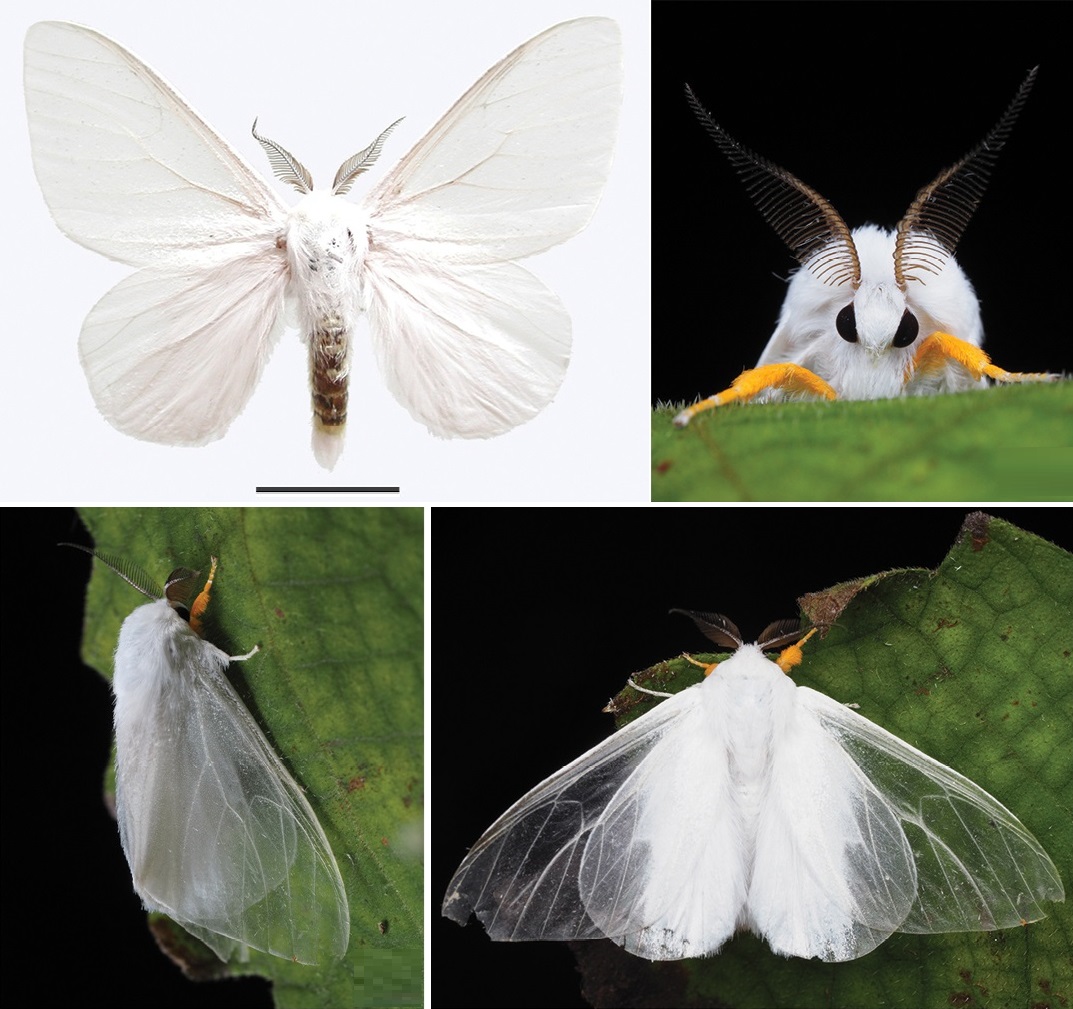
Adults 3‒6 Ivela yini sp. nov. (3 male, holotype 4 female, paratype 5 male, paratype 6 female, paratype)
7, 8 Dendrophleps semihyalina (7 male 8 female). Scale bars: 10 mm.

Field images of adults 9‒11 Ivela yini sp. nov. male (9 dorsal view 10 lateral view 11 ventral view of head)
12, 13 Dendrophleps semihyalina (12 male, dorsal view 13 female, dorsal view).

 Ivela yini Xie & Wang, sp. nov.
 
Diagnosis: This new species is diagnosed by a combination of characters. Superficially, the thorax and abdomen of the adult are white without black markings (Figs 3–6, 9, 10), the palpi are white (Fig. 11), and the forelegs are orange with white rings on the tarsal segments (Figs 9–11). In the male, the asymmetrical valvae are wide and truncated, with a deeply concave cucullus (Fig. 15). The uncus of I. yini (Fig. 15) is more than twice as long as the uncus of I. auripes (Fig. 17) and I. ochropoda (Inoue 1956: fig. 25). The female corpus bursae of I. yini has a pair of caudal projections (Fig. 16). The pupa has white hairs on the prothorax, on segments A2 and A3, and near the posterior end (Figs 21–24).

Etymology: The species is named after Ran Yin, who discovered the pupa of the new species. The name is in the genitive case.

Pupa of Ivela yini sp. nov.
21 dorsal view 22 lateral view 23 ventral view
24 pupa on Idesia polycarpa Maxim.


 Lin-Zhe Xie, Kun-Yuan Li, Liu-Sheng Chen and Hou-Shuai Wang. 2022. A New Species of the Genus Ivela Swinhoe (Lepidoptera, Erebidae, Lymantriinae) from Guangdong, China. ZooKeys. 1097: 103-116. DOI: 10.3897/zookeys.1097.79109


Wednesday, September 25, 2019

[Entomology • 2019] A Revision of the Genus Drasteria (Lepidoptera: Erebidae) of Central Asia and Kazakhstan with Special Attention to the Adjacent Areas


Drasteria christophi (Alphéraky, 1895)

in Matov & Korb, 2019. 

Abstract
A revision of the genus Drasteria within Central Asia and Kazakhstan with attention to the adjacent areas is presented. The status and position of all Drasteria taxa known from this area is clarified, the primary types are revised, primary types and their genitalia are illustrated. The following lectotypes are designated: Leucanitis aberrans Staudinger, 1888, Leucanitis tenera var. antiqua Staudinger, 1889, Leucanitis axuana Püngeler, 1907, Leucanitis cailino var. obscura Staudinger, 1901, Leucanitis cailino forma baigacumensis John, 1921, Euclidia сatocalis Staudinger, 1882, Ophiusa astrida Eversmann, 1857, Leucanitis herzi Alphéraky, 1895, Leucanitis chinensis Alphéraky, 1892, Ophiusa flexuosa Ménétriés, 1849, Leucanitis flexuosa var. caspica Staudinger, 1901, Leucanitis indecora John, 1910, Leucanitis kabylaria A. Bang-Haas, 1906, Leucanitis kusnezovi John, 1910, Syneda langi Erschoff, 1874, Leucanitis obscurata Staudinger, 1882, Leucanitis cailino var. picta Christoph, 1877, Leucanitis picta var. radapicta Staudinger, 1901, Leucanitis saisani var. clara Staudinger, 1894, Leucanitis scolopax Alphéraky, 1892, Leucanitis sculpta Püngeler, 1904, Leucanitis pamira John, 1921, Leucanitis sesquilina Staudinger, 1888, Leucanitis sinuosa Staudinger, 1894, Leucanitis tenera Staudinger, 1877. The type locality of Drasteria antiqua corrected to “Chinese Kashgaria”. The following synonymy is established: Drasteria flexuosa mongolica (Staudinger, 1896) = D. pulverosa pulverosa Wiltshire, 1969, syn. n.; = D. pulverosa intermedia Ronkay, 1985, syn. n.; D. picta (Christoph, 1877) = Drasteria austera (John, 1921), syn. n. The following new statuses are proposed: D. langi obscurata (Staudinger, 1882), stat. n., D. axuana indecora (John, 1910), stat. n. A new species, Drasteria pseudopicta Matov et Korb, sp. n., from the vicinities of Dosang (Astrakhan Province, Russia) is described. The brief DNA analysis (COI sequence) of the closely related taxa of the Central Asiatic Drasteria is presented. A key to species of the genus Drasteria of the studied area is compiled.

Keywords: Lepidoptera, owlet moths, distribution, Central Asia, Kazakhstan, systematics, nomenclature

Drasteria christophi (Alphéraky, 1895), Syr-Darya river coast near Aksuat, Kazakhstan.
Photo: E. Komarov. 

Alexey Yu. Matov and Stanislav K. Korb. 2019. A Revision of the Genus Drasteria of Central Asia and Kazakhstan with Special Attention to the Adjacent Areas (Lepidoptera: Erebidae). Zootaxa. 4673(1); 1-104. DOI: 10.11646/zootaxa.4673.1.1

Monday, June 17, 2019

[Entomology • 2019] A Review of the Barsine hypoprepioides (Walker, 1862) Species-group (Lepidoptera, Erebidae, Arctiinae), with Descriptions of Fifteen New Species and A New Subspecies


Barsine compar (Fang, 1991)

in Volynkin, Černý & Huang, 2019. 
 DOI: 10.11646/zootaxa.4618.1.1

Abstract
The Barsine hypoprepioides (Walker, 1862) species-group is reviewed. Forty seven species and one subspecies belong to the species-group. Among them, fifteen species and one subspecies are new for science and described in the present paper: B. amoenissima sp. n. (Myanmar), B. selene sp. n. (Thailand and Laos), B. cao sp. n. (Thailand, Laos and Vietnam), B. speideli sp. n. (SE China, Thailand, Laos, Cambodia and Vietnam), B. mesomene sp. n. (NE India, Myanmar, China, Thailand, Laos and Vietnam), B. pandeia sp. n. (Vietnam), B. karenkensis wushipheri ssp. n. (S Taiwan), B. euryphaessa sp. n. (Vietnam), B. ivanovamariae sp. n. (Vietnam and SE China), B. eos sp. n. (Thailand), B. mene sp. n. (Thailand), B. syntypicoida sp. n. (Malaysia and Indonesia), B. dubatolovi sp. n. (The Philippines), B. visaya sp. n. (The Philippines), B. nemea sp. n. (The Philippines) and B. kishidai sp. n. (The Philippines). Eight new combinations are established: B. parameia (Rothschild, 1913), comb. n. B. takamukui (Matsumura, 1927), comb. n., B. karenkensis (Matsumura, 1930), comb. n., B. rhipiptera (Wileman & West, 1928), comb. n., B. chi (Roepke, 1946), comb. nov., B. salakia (Schaus, 1922), comb. n., B. marginis (Fang, 1991), comb. nov. and B. dentata (Wileman, 1910), comb. nov. The lectotype is designated for Lithosia hypoprepioides Walker, 1862. Adults, male and female genitalia of all species are illustrated.

Keywords: Lepidoptera, Asia, lectotype, Lithosiini, new combination

Barsine compar (Fang, 1991) 
  
Anton V. Volynkin, Karel Černý and Si-Yao Huang. 2019. A Review of the Barsine hypoprepioides (Walker, 1862) Species-group, with Descriptions of Fifteen New Species and A New Subspecies (Lepidoptera, Erebidae, Arctiinae). Zootaxa. 4618(1); 1-82. DOI: 10.11646/zootaxa.4618.1.1

Tuesday, May 14, 2019

[Entomology • 2019] A Review of the Barsine phaeodonta (Hampson, 1911) Species-group (Lepidoptera: Erebidae: Arctiinae), with Descriptions of Four New Species from Indochina and India


Barsine sp.
Volynkin & Černý, 2019


Abstract
The Barsine phaeodonta species-group is reviewed. The new combination is established: Barsine phaeodonta (Hampson, 1911), comb. nov. Four new species are described: Barsine joshii, sp. nov. (South and North East India), Barsine meyi, sp. nov. (North West Myanmar), Barsine mophi, sp. nov. (North Laos) and Barsine arrigera, sp. nov. (Central Myanmar and North Thailand). Adults, male and female genitalia of all species are illustrated.


Anton V. Volynkin and Karel Černý. 2019. A Review of the Barsine phaeodonta (Hampson, 1911) Species-group, with Descriptions of Four New Species from Indochina and India (Lepidoptera: Erebidae: Arctiinae). Ecologica Montenegrina. 21; 70-79. biotaxa.org/em/article/view/51588