Showing posts with label River basin: Orinoco. Show all posts

Friday, February 8, 2019

[Ichthyology • 2019] Review of Ancistrus (Siluriformes: Loricariidae) from the northwestern Guiana Shield, Orinoco Andes, and Adjacent Basins with Description of Six New Species


Ancistrus patronus 
De Souza, Taphorn & Armbruster, 2019


Abstract
The Orinoco Andes and northwestern Guiana Shield (Essequibo, Orinoco, Branco, and upper Negro) were found to contain 11 species of Ancistrus, six of which are new. We additionally examine A. brevifilis from the Río Tuy of Venezuela and A. trinitatis from the island of Trinidad. The species in the region can be broken up into dorsoventrally flattened species (Ancistrus leoni new species, A. lithurgicus, and A. macropthalmus), white to yellow-dotted species (Ancistrus kellerae new species, A. nudiceps, and A. patronus new species), wide-jawed species (Ancistrus amaris new species and Ancistrus yutajae new species), and white-spotted species (A. brevifilis, A. leucostictus, A. trinitatis, A. saudades new species, and A. triradiatus). Distributions of Ancistrus support the Proto-Berbice hypothesis as A. saudades is found in the upper reaches of the Ventuari, Caura, and Caroni rivers, which were thought to have once flowed into the Proto-Berbice. In addition, although A. nudiceps does not appear to have split once the Takutu River was captured by the Branco, the progenitor of A. leucostictus and A. saudades did speciate with the populations on either side of the Rupununi Portal differing by 7% sequence divergence of the mitochondrial Cytochrome b gene. Besides the descriptions of the new species, we redescribe the others occurring in the area, and adjacent watersheds. We provide a key for their identification, and a preliminary hypothesis of relationships based on DNA sequences of the few species for which tissue samples are available.

Keywords: Pisces, Ancistrini, Colombia, Guyana, Venezuela, Taxonomy


Ancistrus patronus De Souza, Taphorn & Armbruster, 2019


Ancistrus patronus De Souza, Taphorn & Armbruster, 2019


Ancistrus patronusnamed for the genus's paternal care of offspring.

photos: Jonathan W. Armbruster.


Lesley S De Souza, Donald C. Taphorn and Jonathan W. Armbruster. 2019. Review of Ancistrus (Siluriformes: Loricariidae) from the northwestern Guiana Shield, Orinoco Andes, and Adjacent Basins with Description of Six New Species. Zootaxa. 4552(1); 1-67. DOI:  10.11646/zootaxa.4552.1.1

Six new species of hideously adorable tentacle-nosed catfish discovered in Amazon  phys.org/news/2019-02-species-hideously-adorable-tentacle-nosed-catfish.html via @physorg_com


Thursday, November 22, 2018

[Ichthyology • 2018] Spatuloricaria terracanticum • A New Species of Spatuloricaria Schultz, 1944 (Siluriformes: Loricariidae), from the Orinoco River Basin, Colombia


Spatuloricaria terracanticum 
Londoño-Burbano, Urbano-Bonilla, Rojas-Molina, Ramírez-Gil, & Prada-Pedreros, 2018


A new species of Spatuloricaria is described from the Orinoco River basin, Colombia. The new species can be distinguished from its congeners by the following characters: a broad, dark brown stripe on the first pre-dorsal plate, which occupies the entire plate, reaching the preopercle, and sometimes reaching the second pre-dorsal plate; the possession of a small group of plates posterior to the urogenital pore; the abdominal surface with scattered, very small plates leaving naked areas; the possession of five transverse dark brown bands on the dorsal region; and four to five premaxillary teeth. The new species is the first valid species of Spatuloricaria distributed in the Orinoco River basin. Ecological notes of the species and comments regarding the taxonomy and phylogenetic relationships of the genus are offered.


Fig. 2. Spatuloricaria terracanticum, coloration in life; MPUJ 13401, Colombia, Meta, Villavicencio, Guayuriba River, tributary to the upper Meta River, Orinoco basin.
Photograph by A. Ortega-Lara. 

Spatuloricaria terracanticum, new species

Spatuloricaria sp.—Urbano-Bonilla et al., 2018:74 [listed; included in identification key for Loricariidae genera and species of the Cusiana River, Orinoco River basin].

Etymology.—The specific epithet is from the latin terra [earth] and canticum [song]. It is dedicated to the Llanos work songs (cantos de vaquería). Its origin dates back to the 16th century and has been transferred from generation to generation in the Llanos region of Colombia and Venezuela. Sung a cappella, melodies reflect the feeling and the close relationship of the llanero with their myths, beliefs, nature, climate, and animals. Although these songs have been gradually lost within modern society due to economic, political, and social causes, UNESCO has declared them as intangible cultural heritage of humanity


Alejandro Londoño-Burbano, Alexander Urbano-Bonilla, Yecid Rojas-Molina, Hernando Ramírez-Gil, and Saúl Prada-Pedreros. 2018. A New Species of Spatuloricaria Schultz, 1944 (Siluriformes: Loricariidae), from the Orinoco River Basin, Colombia. Copeia. 106(4); 611-621. DOI: 10.1643/CI-18-087   


Una nueva especie de Spatuloricaria, proveniente del río Orinoco, Colombia, es descrita. La nueva especie se distingue de sus congéneres por los siguientes caracteres: una banda transversal ancha en la primera placa predorsal, la cual ocupa toda la placa y el preopérculo, alcanzado algunas veces la segunda placa predorsal; un grupo de pequeñas placas posterior al poro urogenital; abdomen cubierto por placas pequeñas y dispersas, las cuales dejan áreas desnudas; presencia de cinco bandas transversales marrón oscuro en la región dorsal; y cuatro a cinco dientes en el premaxilar. La nueva especie es la primera especie válida de Spatuloricaria distribuida en la cuenca del río Orinoco. Se presentan notas ecológicas de la especie, y comentarios con relación a la taxonomía y relaciones filogenéticas del género.

Saturday, August 12, 2017

[Ichthyology • 2017] Taxonomic Assessment of the Hard-Nosed Thornycats (Siluriformes: Doradidae: Trachydoras Eigenmann 1925) with Description of A New Species, Trachydoras gepharti


Trachydoras gepharti Sabaj & Hernández, 2017

   DOI: 10.1635/053.166.0102 

ABSTRACT
Trachydoras is a genus of Doradidae (thorny catfishes) with five nominal valid species distributed in lowland areas of the Amazon, Orinoco, Paraná-Paraguay and Essequibo river basins of South America. A sixth species is described here as Trachydoras gepharti and diagnosed by five characteristics unique among congeners: mental barbels thick, tapered and profusely ornamented with many elongate fleshy papillae loosely arranged in 2–3 rows (vs. mental barbels thinner, papillae lacking or fewer, arranged in 1–2 rows); distinct columns of small, soft papillae along medial and lateral margins of gill filaments on all gill arches (vs. gill filaments lacking conspicuous papillae in congeners); gas bladder acorn-shaped (vs. cordiform) with smooth anterolateral shoulder (vs. shoulder with accessory diverticulum) and terminal diverticula medially united into singular, finger-like projection formed mostly by elongation of only one of the two posterior chambers (vs. both chambers elongated, contributing more or less equally to terminal diverticula in congeners or terminal diverticula absent or reduced in some specimens of T. nattereri and T. paraguayensis). Trachydoras gepharti is known from the Amazon and Orinoco basins where it often occurs syntopically with T. microstomus, T. nattereri and a separate undescribed species of Trachydoras. Like other species of Trachydoras, T. gepharti is specialized for vacuuming chironomid larvae from sandy substrates in medium to large river channels. Redescriptions and diagnoses are provided for the five nominal valid species of Trachydoras along with a key to identification and comments on characteristics used to diagnose the genus and delimit species. Designations include a lectotype (NMW 46375, 91.7 mm SL) for Trachydoras brevis (Kner 1853) and neotype (ANSP 178443, 100 mm SL) for T. nattereri (Steindachner 1881). The true holotype of T. microstomus (Eigenmann 1912) is identified as FMNH 118302 [ex. FMNH 53207, ex. CM 1650] and the specimen previously cataloged as the holotype (FMNH 53206) is identified as T. brevis.

  
Trachydoras Eigenmann 1925 
Hard-nosed thornycats

Etymology.— Generic name derived from the Greek words trachys, meaning rough, and dora, meaning animal hide (Jaeger, 1950). In his generic description, Eigenmann (1925:337) noted “granular” surfaces on the snout, opercle, preopercle and coracoid process. See Sabaj and Birindelli (2008) for discussion on etymology of Doras. The common name proposed here is inspired by the ossified nature of the snout.

Fig. 7. Trachydoras gepharti, n. sp. A. ANSP 203169 (60.6 mm SL, holotype) from río Ventuari, Raudales Tencua, Amazonas, Venezuela. B. INPA 35233 (50.7 mm SL) from río Teles Pires, Mato Grosso, Brazil. C. ANSP 179866 (37 mm SL) from río Nanay, Loreto, Peru. Scale bars = 1 cm. 

Trachydoras gepharti n. sp.  
 Sabaj & Hernández, 2017

Etymology.— Species name honors George W. Gephart, Jr., President & CEO of the Academy of Natural Sciences of Drexel University from 2010 to 2017, for his bold, deft and heartfelt leadership of a Glorious Enterprise into its third century.


Trachydoras brevis (Kner 1853) 
Trachydodras microstomus (Eigenmann 1912)
Trachydoras nattereri (Steindachner 1881)
Trachydoras paraguayensis (Eigenmann & Ward 1907) 
Trachydoras steindachneri (Perugia 1897) 
Trachydoras sp. “mancha-caudal” 


Mark Henry Sabaj and Mariangeles Arce Hernández. 2017. Taxonomic Assessment of the Hard-Nosed Thornycats (Siluriformes: Doradidae: Trachydoras Eigenmann 1925) with Description of Trachydoras gepharti, n. sp.  Proceedings of the Academy of Natural Sciences of Philadelphia. 166(1);1-53.   DOI: 10.1635/053.166.0102


Tuesday, April 18, 2017

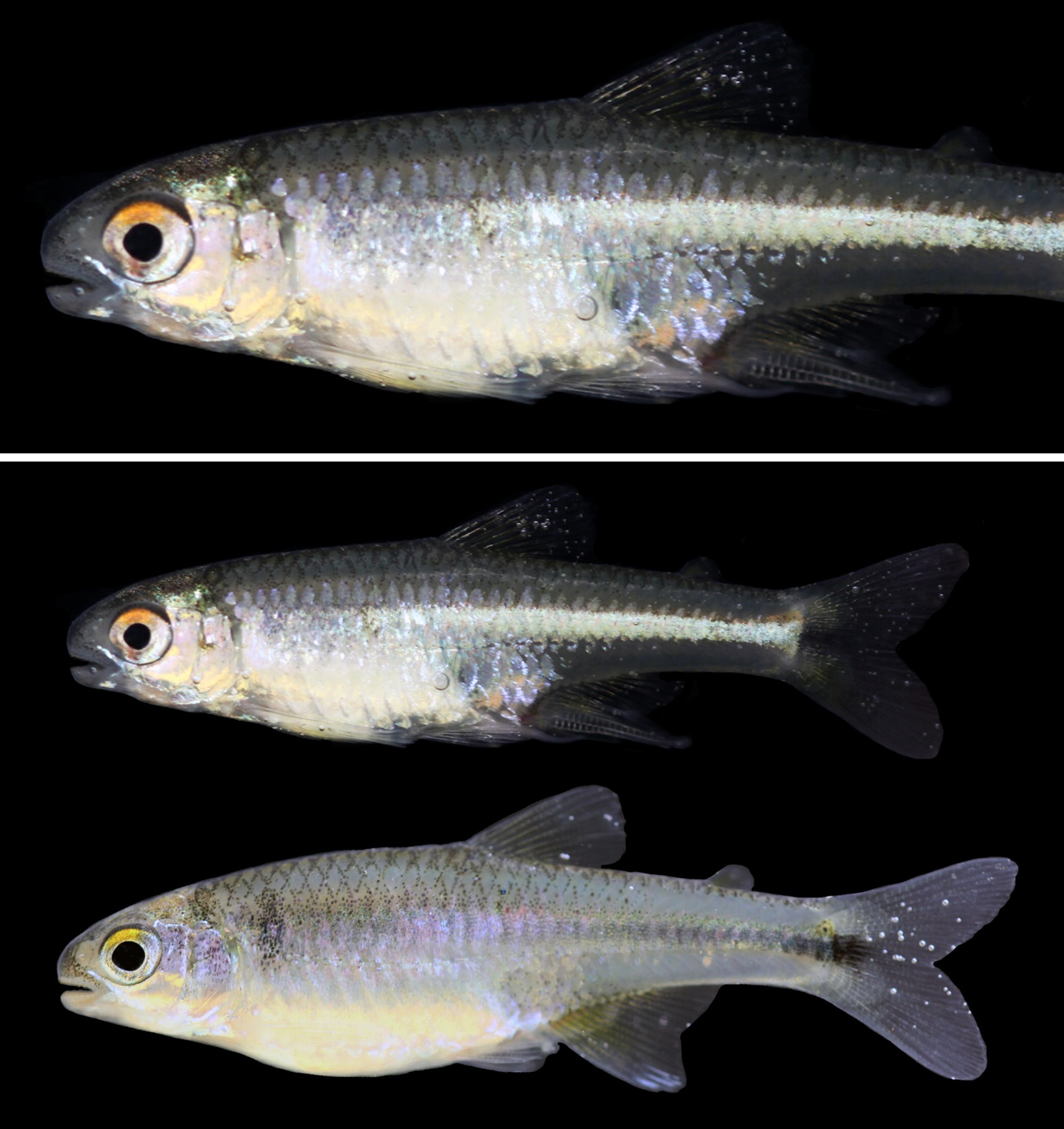
[Ichthyology • 2017] Hyphessobrycon klausanni • A New Species of Hyphessobrycon (Characiformes, Characidae) from the upper Guaviare River, Orinoco River Basin, Colombia


Hyphessobrycon klausanni 
García-Alzate, Urbano-Bonilla & Taphorn, 2017 

Abstract
Hyphessobrycon klausanni sp. n. is described from small drainages of the upper Guaviare River (Orinoco River Basin) in Colombia. It differs from all congeners by having a wide, conspicuous, dark lateral stripe extending from the anterior margin of the eye across the body and continued through the middle caudal-fin rays, and that covers (vertically) three or four horizontal scale rows. It also differs by having an orange-yellow stripe extending from the anterosuperior margin of the eye to the caudal peduncle above the lateral line in life. It differs from all other species of Hyphessobrycon that have a similar dark lateral stripe: H. cyanotaenia, H. loretoensis, H. melanostichos, H. nigricinctus, H. herbertaxelrodi, H. eschwartzae, H. montogoi, H. psittacus, H. metae, H. margitae, H. vanzolinii, and H. peruvianus in having only three or four pored scales in the lateral line, 21 to 24 lateral scales and six teeth in the inner premaxillary row. Hyphessobrycon klausanni differs from H. loretoensis in having seven to eight maxillary teeth (vs. three to four) and in having a longer caudal peduncle (12.4–17.0% SL vs. 4.6–8.0% SL). Additionally Hyphessobrycon klausanni can be distinguished from the other species of Hyphessobrycon with a dark lateral stripe from the Orinoco River Basin (H. metae and H. acaciae) in having two teeth in the outer premaxillary row (vs. three to four) and 10 branched pectoral–fin rays (vs. 11 to 12). It further differs from H. metae by the length of the snout (17.6–22.8% HL vs. 9.9–15.2% HL) and by the length of the caudal peduncle (12.4–17.0% SL vs. 7.3–11.8% SL).

Keywords: New taxon, Neotropical Ichthyology, Guaviare River, diversity


Figure 3. Live colours of Hyphessobrycon klausanni sp. n. Paratype, UARC–IC 540, 22.4 mm SL. 

Etymology: Research leading to the discovery and recognition of this species was partially funded by Mr. Klaus-Peter Lang from Oberhausen, Germany. To commemorate the 80th birthday of his mother, this species is dedicated to and named for his father “Klaus” and his mother “Anni”.

Ecological note: Hyphessobrycon klausanni lives in shallow (0.30–1.5 m) well-oxygenated (6.39–7.68 mg/l) streams with transparent waters flowing (0.063 m/s) over different types of substrates (rocks, sand, gravel and decomposing organic material). The temperature range was narrow, 25.5–26°C but pH varied from moderately acidic to basic (6.47–8.7). Hyphessobrycon klausanni was found near shore among aquatic vegetation, tree roots and fallen logs. Other species found at the sites included: Hemigrammus barrigonae, Ctenobrycon spilurus, Tyttocharax metae, Moenkhausia oligolepis, M. chrysargyrea, M. lepidura, Chrysobrycon guahibo, Ochmacanthus orinoco, Farlowella vittata, Ancistrus triradiatus, Centromochlus reticulatus and Anablepsoides sp. Stomach content analysis (n = 4) revealed a diet of aquatic and terrestrial invertebrates: Coleoptera (Dytiscidae), Ephemeroptera, Hymenoptera (Formicidae), larvae of Chironomidae and others not identified due to the degree of fragmentation.


Carlos A. García-Alzate, Alexander Urbano-Bonilla and Donald C. Taphorn. 2017. A New Species of Hyphessobrycon (Characiformes, Characidae) from the upper Guaviare River, Orinoco River Basin, Colombia. ZooKeys. 668; 123-138. DOI:  10.3897/zookeys.668.11489

Resumen: Hyphessobrycon klausanni sp. n. es descrita de pequeños drenajes del alto río Guaviare (cuenca del río Orinoco) en Colombia. Se diferencia de todos los congéneres por tener una amplia franja lateral oscura lateral que se extiende desde el margen anterior del ojo a través del cuerpo y se continúa hasta la base de la aleta caudal y que cubre (verticalmente) tres o cuatro escamas laterales, además difiere por tener una franja de color naranja-amarillo que se extiende desde el margen anterosuperior del ojo hasta el pedúnculo caudal por encima de la línea lateral en vida. Se diferencia de H. cyanotaenia, H. loretoensis, H. melanostichos, H. nigricinctus, H. herbertaxelrodi, H. eschwartzae, H. montogoi, H. psittacus, H. metae, H. margitae, H. vanzolinii, y H. peruvianus por tener solo 3 a 4 escamas con poros en la línea lateral, 21 a 24 escamas laterales y 6 dientes en la fila interna del premaxilar. Hyphessobrycon klausanni se diferencia de H. loretoensis por presentar 7 a 8 dientes maxilares (vs. 3 a 4) y la longitud del pedúnculo caudal (12.4–17.0% LE vs. 4.6–8.0% LE). Además se puede distinguir de las demás especies con banda lateral oscura presentes en la cuenca del rio Orinoco (H. metae y H. acaciae) por tener dos dientes en la fila externa del premaxilar (vs. 3 a 4) y 10 radios ramificados en la aleta pectoral (vs. 11 a 12), además se separa de H. metae por la longitud de hocico (17.6–22.8% LC vs. 9.9–15.2% LC) y por la longitud del pedúnculo caudal (12.4–17.0% LE vs. 7.3–11.8% LE).

Palabras clave: Nuevo taxón, Ictiología Neotropical, río Guaviare, diversidad

Sunday, April 2, 2017

[Ichthyology • 2017] Eigenmannia sayona • A New Species of the Eigenmannia trilineata Species Group (Gymnotiformes: Sternopygidae) from the río Orinoco Basin, Venezuela


  Eigenmannia sayona
Peixoto & Waltz, 2017
DOI: 10.1590/1982-0224-20150199 

Abstract

A new species of the Eigenmannia trilineata species group is described from the río Orinoco basin, Venezuela. The new species is distinguished from congeners by a unique set of characters including an ossified basibranchial 1; 198-217 anal-fin rays; suborbital depth, 21.3-26.1% HL; length of anterodorsal process of maxilla equal to the width of the posterior nostril; premaxilla with 17 teeth distributed in three rows; hyaline pectoral and anal fins; and number of scale series above lateral line, 9-10. It raises the number of species allocated to the Eigenmannia trilineata species group to 13 and the number of species within the genus to 18.

Keywords: Biodiversity; Electric-fishes; Taxonomy; Tuvira.


Fig. 1 Holotype of Eigenmannia sayona, new species, MZUSP 96497, 131.8 mm LEA, Venezuela, Bolivar, Cedeño, río Orinoco, río Parguaza, near the community of Puente Parhueña. a. Lateral view of head and body; b. Lateral view of head. 


Etymology. The specific epithet “sayona” is assigned to the new species in reference to “La Sayona”, a spirit of philanderous vengeance in Venezuelan lore. A noun in apposition.

Geographic distribution. Eigenmannia sayona is known from río Orinoco basin, from río Parguaza, río Apure, and Laguna de Castilleros, Venezuela.


Luiz A. W. Peixoto and Brandon T. Waltz. 2017. A New Species of the Eigenmannia trilineata (Gymnotiformes: Sternopygidae) Species Group from the río Orinoco Basin, Venezuela. Neotropical Ichthyology. 15(1); e150199. DOI: 10.1590/1982-0224-20150199.

Monday, January 23, 2017

[Ichthyology • 2017] A Revision of the Cis-Andean Species of the Genus Brycon Müller & Troschel (Characiformes: Characidae)


Brycon hilarii (Valenciennes, 1850)


 Abstract 

A revision of the cis-andean species of Brycon, with the exception of the Brycon pesu species-complex, is presented. Twenty-one Brycon species (including B. pesu) are recognized from cis-andean river systems: Brycon stolzmanni Steindachner, from the upper Río Marañon basin, Peru; Brycon coxeyi Fowler, from the Río Marañon basin, Ecuador and Peru; Brycon polylepis Moscó Morales, from the Lago de Maracaibo, Río Orinoco, upper rio Amazonas, and rio Tocantins basins, Venezuela, Colombia, Peru, and Brazil; Brycon coquenani Steindachner, from the upper Río Caroni, Río Orinoco basin, Venezuela; Brycon insignis Steindachner, from the rio Paraíba do Sul and small adjacent coastal river basins of eastern Brazil; Brycon vermelha Lima & Castro, endemic from the rio Mucuri basin, eastern Brazil; Brycon howesi new species, endemic from the rio Jequitinhonha basin, Brazil; Brycon dulcis new species, endemic from the rio Doce basin, eastern Brazil; Brycon ferox Steindachner, from several small coastal river systems, including the rio Mucuri basin in eastern Brazil; Brycon vonoi new species, from the rio Pardo basin and apparently also from a adjacent river system, the rio Una, in eastern Brazil; Brycon opalinus (Cuvier), from the headwaters of the rio Paraíba do Sul and rio Doce basins, eastern Brazil; Brycon nattereri Günther, from the headwaters of the upper rio Paraná, rio São Francisco, and upper rio Tocantins basins, Brazil; Brycon orthotaenia Günther, endemic from the rio São Francisco basin, Brazil; Brycon orbignyanus (Valenciennes), from the rio Paraná and rio Uruguai basins, Brazil, Paraguay, Argentina, and Uruguay; Brycon hilarii (Valenciennes), from the rio Paraguai, middle rio Paraná, and upper rio Amazonas basins, Brazil, Paraguay, Argentina, Peru, and Ecuador; Brycon whitei Myers & Weitzman, from the Río Orinoco basin in Colombia and Venezuela; Brycon amazonicus (Agassiz), from the Rio Amazonas and Río Orinoco basins, Brazil, Peru, Colombia, Bolivia, Venezuela, and Guyana; Brycon gouldingi Lima, endemic from the rio Tocantins basin, Brazil; Brycon melanopterus (Cope), from the western and central rio Amazonas basin, Brazil, Peru, Ecuador, and Colombia; and Brycon falcatus Müller & Troschel, widespread in the the rio Amazonas and Río Orinoco basins, and several guyanese river systems, in Brazil, Venezuela, Colombia, Peru, Bolivia, Guyana, Suriname, and French Guiana. All species are redescribed and illustrated, and a key to the species is provided. Comments on the diagnosis of the genus Brycon, the biogeography of the cis-andean species, and their current conservation status, are presented.

Keywords: Pisces, taxonomy, conservation, biogeography, mimicry, Amazon basin, Orinoco basin, eastern Brazil


Flávio C. T. Lima. 2017. A Revision of the Cis-Andean Species of the Genus Brycon Müller & Troschel (Characiformes: Characidae).
Zootaxa. 4222(1); 1-189. DOI:  10.11646/zootaxa.4222.1.1


21 Brycon species (including B. pesu) are recognized from Cis-Andean River Systems

• Brycon stolzmanni Steindachner, from the upper Río Marañon basin, Peru
• Brycon coxeyi Fowler, from the Río Marañon basin, Ecuador and Peru
• Brycon polylepis Moscó Morales, from the Lago de Maracaibo, Río Orinoco, upper rio Amazonas, and rio Tocantins basins, Venezuela, Colombia, Peru, and Brazil
• Brycon coquenani Steindachner, from the upper Río Caroni, Río Orinoco basin, Venezuela
• Brycon insignis Steindachner, from the rio Paraíba do Sul and small adjacent coastal river basins of eastern Brazil
• Brycon vermelha Lima & Castro, endemic from the rio Mucuri basin, eastern Brazil
• Brycon howesi new species, endemic from the rio Jequitinhonha basin, Brazil
• Brycon dulcis new species, endemic from the rio Doce basin, eastern Brazil
• Brycon ferox Steindachner, from several small coastal river systems, including the rio Mucuri basin in eastern Brazil
• Brycon vonoi new species, from the rio Pardo basin and apparently also from a adjacent river system, the rio Una, in eastern Brazil
• Brycon opalinus (Cuvier), from the headwaters of the rio Paraíba do Sul and rio Doce basins, eastern Brazil
• Brycon nattereri Günther, from the headwaters of the upper rio Paraná, rio São Francisco, and upper rio Tocantins basins, Brazil
• Brycon orthotaenia Günther, endemic from the rio São Francisco basin, Brazil
• Brycon orbignyanus (Valenciennes), from the rio Paraná and rio Uruguai basins, Brazil, Paraguay, Argentina, and Uruguay
• Brycon hilarii (Valenciennes), from the rio Paraguai, middle rio Paraná, and upper rio Amazonas basins, Brazil, Paraguay, Argentina, Peru, and Ecuador
• Brycon whitei Myers & Weitzman, from the Río Orinoco basin in Colombia and Venezuela
• Brycon amazonicus (Agassiz), from the Rio Amazonas and Río Orinoco basins, Brazil, Peru, Colombia, Bolivia, Venezuela, and Guyana
• Brycon gouldingi Lima, endemic from the rio Tocantins basin, Brazil
• Brycon melanopterus (Cope), from the western and central rio Amazonas basin, Brazil, Peru, Ecuador, and Colombia
• Brycon falcatus Müller & Troschel, widespread in the the rio Amazonas and Río Orinoco basins, and several guyanese river systems, in Brazil, Venezuela, Colombia, Peru, Bolivia, Guyana, Suriname, and French Guiana

Tuesday, January 3, 2017

[Ichthyology • 2016] Micromyzon orinoco • A New Species of the Blind and Miniature Genus Micromyzon Friel and Lundberg, 1996 (Siluriformes: Aspredinidae) from the Orinoco River: Describing Catfish Diversity Using High-Resolution Computed Tomography


Fig. 2. Micromyzon orinoco, paratype, ANSP 198335, 14.8. mm SL,
Río Orinoco, north-side of Isla Fajardo, opposite Palua, 182 nautical miles from sea bouy, Anzoátegui, Venezuela. Dorsal and ventral views.

ABSTRACT
A new species of the aspredinid catfish tribe Hoplomyzontini Micromyzon is described from two specimens collected with trawl nets in two localities, at 10 and 18 m depth, in the main channel of the lower Orinoco River in Venezuela almost 40 years ago. The new species is distinguished from its only congener, Micromyzon akamai, by the: straight anterior margin of the mesethmoid; open posterior cranial fontanel; ossified first pectoral-fin radial; single tubular infraorbital bone; infraorbital sensory canal entering neurocranium via the frontal; enclosed foramen for the abductor superficialis muscle in the coracoid; higher vertebral count (33 vs. 28–32); higher anal-fin ray count (10 or 11 vs. 7–9); and some morphometric features. The holotype of the new species was scanned using High-Resolution X-ray Computed Tomography to illustrate, describe, and compare its bony skeleton to other hoplomyzontins.

 Keywords: Anophthalmic, Miniaturization, Neotropical, River Channels, Taxonomy


Tiago P. Carvalho, John G. Lundberg, Jonathan N. Baskin, John P. Friel and Roberto E. Reis. 2016. A New Species of the Blind and Miniature Genus Micromyzon Friel and Lundberg, 1996 (Siluriformes: Aspredinidae) from the Orinoco River: Describing Catfish Diversity Using High-Resolution Computed Tomography. Proceedings of the Academy of Natural Sciences of Philadelphia. 165(1); 37-53. DOI:   10.1635/053.165.0104


RESUMEN: Una nueva especie de Hoplomyzontini Micromyzon se describe a partir de dos muestras colectadas con redes de arrastre en dos localidades, entre 10 y 18 metros de profundidad, en el canal principal de la parte baja del Río Orinoco, en Venezuela hace casi 40 años. La nueva especie se diagnostica de su único congénere, Micromyzon akamai, por la margen anterior recta del mesetemoide; parte posterior de la fontanela craneal abierta; el primer radial de la aleta pectoral osificado, un solo hueso infraorbital tubular; el canal sensorial infraorbital entra al neurocráneo a través del frontal; un foramen cerrado para el musculo abductor superficialis en el e coracoide; mayor número de vértebras (33 vs. 28–32) y del número de radios anales (10 o 11 vs. 7–9); además de algunas características morfométricas. El holotipo de la nueva especie fue escaneado en alta resolución utilizando Tomografía Computarizada de Radio-X de Alta Resolución, y se describe su osteología y se compara con otros Hoplomyzontini.

Sunday, September 25, 2016

[Ichthyology • 2015] Aequidens superomaculatum • A New Species (Teleostei: Cichlidae) from the upper Orinoco and Río Negro, Venezuela


Aequidens superomaculatum  
  Hernández-Acevedo, Machado-Allison & Lasso, 2015 


Abstract

A new species, Aequidens superomaculatum, is described from the Casiquiare Canal drainage and the upper reaches of the Orinoco and Negro rivers (Venezuela). This new species shares with others of the genus a vermiculated color pattern on the cheek, snout and preopercle and a high vertebral count, but it differs from congeners in having a continuous lateral stripe, and in having the lateral dark pigment blotch positioned high on both sides of the body.

Key words. Fishes, Taxonomy, Aequidens, Orinoco Basin, Amazon Basin.


Jaime H. Hernández-Acevedo, Antonio Machado-Allison y Carlos A. Lasso. 2015. Aequidens superomaculatum (Teleostei: Cichlidae) una nueva especie del alto Orinoco y Río Negro, Venezuela. Biota Colombiana. 16(2); 96-106.  http://www.RedALYC.org/articulo.oa?id=49144024004
 Jaime H. Hernández-Acevedo, Antonio Machado-Allison y Carlos A. Lasso. 2015. Aequidens superomaculatum (Teleostei: Cichlidae): A New Species from the upper Orinoco and Río Negro, Venezuela. Biota Colombiana. 16 (2): 96-106.


Resumen: Se describe una nueva especie, Aequidens superomaculatum, proveniente de la cuenca del Caño o Brazo Casiquiare y la parte alta de las cuencas de los ríos Orinoco y Negro (Venezuela). Esta nueva especie comparte con otras especies del género previamente descritas, la presencia de un patrón de coloración vermiculado en la mejilla, hocico y preopérculo y un conteo vertebral alto, pero se diferencia de estas especies por la presencia de una banda lateral continua y la posición superior de la mancha lateral en ambos lados del cuerpo.


Palabras clave. Peces. Taxonomía. Aequidens. Orinoquia. Amazonia.

Tuesday, May 24, 2016

[Ichthyology • 2016] Reconciling More Than 150 Years of Taxonomic Confusion: The True Identity of Moenkhausia lepidura, with A Key to the Species of the M. lepidura group (Characiformes: Characidae)


Abstract

Moenkhausia lepidura (Kner) is redescribed based on the examination of the type and other specimens from several localities of the Amazon and Orinoco basins. The species is readly diagnosed from congeners by a combination of a dark blotch on the upper caudal-fin lobe, lower lobe hyaline, and by the arrangement of predorsal scales, in which scales of anterior portion of predorsal area are arranged in pairs, followed by a single median row of scales extending to dorsal-fin origin. The analysis of the type material of Gymnotichthys hildae Fernández-Yépez and Knodus calliurus Ahl demonstrated the former is a junior synonym of Moenkhausia lepidura, whereas the latter should be removed from its synonymy. An identification key to the Moenkhausia lepidura-group is provided.

Keywords: taxonomy, systematics, Knodus calliurus, Neotropical fishes, Pisces, Amazon, Orinoco basins


 Manoela M F Marinho and Francisco Langeani. 2016. Reconciling More Than 150 Years of Taxonomic Confusion: The True Identity of Moenkhausia lepidura, with A Key to the Species of the M. lepidura group (Characiformes: Characidae).
Zootaxa. 4107(3); 338-352. DOI:  10.11646/zootaxa.4107.3.3


Wednesday, April 27, 2016

[Ichthyology • 2016] Chaetostoma joropo • Description of A New Species of the Genus Chaetostoma (Siluriformes: Loricariidae) from the Orinoco River Drainage with Comments on Chaetostoma milesi Fowler, 1941


Chaetostoma joropo Ballen, Urbano-Bonilla & Maldonado-Ocampo, 2016 

Abstract

Chaetostoma joropo n. sp. is described from the piedmont of the Orinoco River drainage in Colombia. The new species has been long confused with Chaetostoma milesi, a species with similar overall morphology and color pattern that is restricted to the Magdalena-Cauca River Basin. We diagnose the new species on the basis of morphology as well as a precise description of the color pattern. Chaetostoma joropo n. sp. is also easily distinguished from Cformosae the most similar species and other species inhabiting the Orinoco River drainage in Colombia. Data on ontogenetic variation and sexual dimorphism are provided, as well as natural history notes and remarks on the usage of the name Chaetostoma milesi for specimens from both the Orinoco and Magdalena-Cauca drainages. A discussion on the usage of the name Chaetostoma platyrhynchus is also provided given its current instability in the literature.

Keywords: Ancistrini, taxonomy, Hemiancistrus platyrhynchus, Andes, northern South America, Pisces


Gustavo A. Ballen, Alexander Urbano-Bonilla and Javier Maldonado-Ocampo. 2016. Description of A New Species of the Genus Chaetostoma from the Orinoco River Drainage with Comments on Chaetostoma milesi Fowler, 1941 (Siluriformes: Loricariidae). Zootaxa. 4105(2);  DOI:  10.11646/zootaxa.4105.2.6
ResearchGate.net/publication/301512112_Description_of_a_new_species_of_the_genus_Chaetostoma_from_the_Orinoco_drainage_with_comments_on_Chaetostoma_milesi_Fowler_Siluriformes_Loricariidae

Friday, June 1, 2012

[Ichthyology • 2005] Harttia merevari • a new species of catfish (Siluriformes: Loricariidae) from Venezuela

Harttia merevari 
Provenzano, Machado-Allison, Chernoff, Willink & Petry, 2005

ABSTRACT
Harttia merevari, a new species of loricariid catfish, is described from eight specimens captured in the upper Caura River, Orinoco River basin, Venezuela. The new species is recognized by the following combination of characters: abdomen naked; two or three preanal plates; a bony plate before each branchial opening; seven lateral plates between the pectoral and pelvic fins; maxillary barbel short and attached to the oral disk by a fleshy fold; head dorsal surface and anterior portion of the body light or dark yellow with numerous, round black spots; posterior region of the body light or dark yellow with five black transverse bands, dorsal central area of the two anterior bands diffused. The discovery of this new species extends the distribution of the genus northwest to include the Orinoco River basin on the northern slope of the Guyana shield.

Key Words: Taxonomy, Harttiini, Caura River, Orinoco River basin, Guyana shield, Biogeography.

Fig. 1. Harttia merevari, MBUCV-V-26578, holotype, 99.4 mm of SL.


Provenzano R., Francisco; Machado-Allison, Antonio; Chernoff, Barry; Willink, Phil; Petry, Paulo 2005. Harttia merevari, a new species of catfish (Siluriformes: Loricariidae) from Venezuela. Neotropical Ichthyology. 3 (4): 519–524. DOI:10.1590/S1679-62252005000400009.