Friday, February 25, 2022

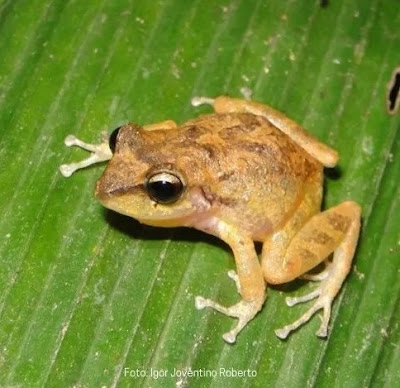
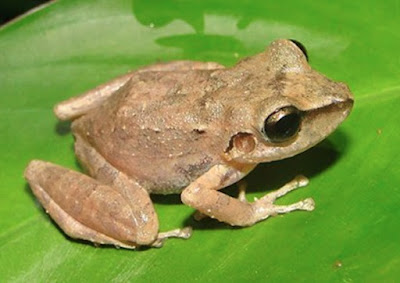
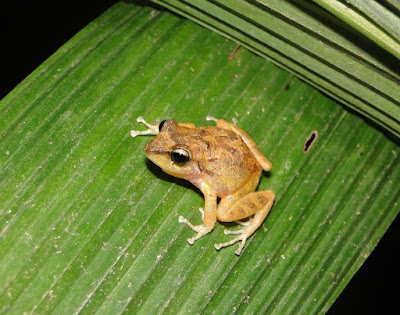
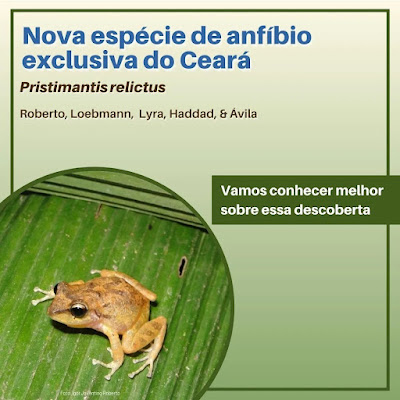
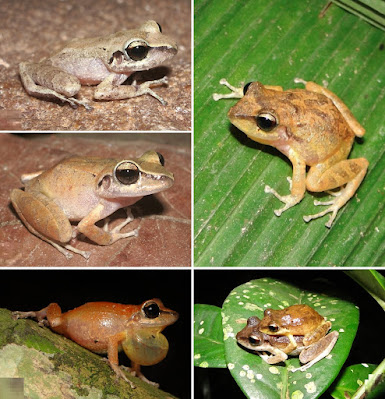
[Herpetology • 2022] Pristimantis relictus • A New Species of Pristimantis Jiménez de la Espada, 1870 (Anura: Strabomantidae) from the “Brejos de Altitude” in Northeast Brazil


Pristimantis relictus
Roberto, Loebmann, Lyra, Haddad & Ávila, 2022

 
Abstract
Pristimantis is the most diverse Neotropical genus of terrestrial vertebrates and is distributed from Central America to Argentina. The last few years have seen the description of several new species of the genus, suggesting that its diversity is still underestimated. After decades of uncertainties about the taxonomic status of populations of Pristimantis from the “Brejos de Altitude” of the state of Ceará, Northeast Brazil, we finally found morphological, acoustic and molecular evidence confirming their distinctiveness from other Atlantic Forest species. The new species is characterized by the following: shagreen dorsal skin with small-scattered tubercles, absence of dorsolateral fold, presence of tarsal fold, advertisement call composed of 1–8 pulsed notes, (2–5 pulses per note), and dominant frequency located in the second energy band, ranging from 3617–4220 Hz. Phylogenetic analysis placed the new species in the Pristimantis conspicillatus species group and the sister lineage of the Atlantic Forest clade comprising P. ramagii, P. paulodutrai and the P. vinhai species complex.

Keywords: Amphibia, Ceará state, Neotropics, systematics, taxonomy


adult female municipality of Guaramiranga


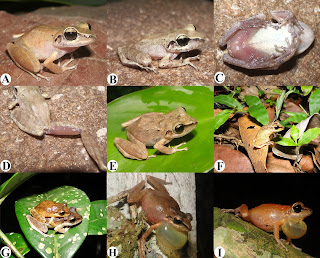
Adult specimens of Pristimantis relictus sp. nov. in life:
A—Adult male, B–D adult female, municipality of Ubajara; E–F adult female municipality of Guaramiranga, G—amplectant pair, municipality of Pacatuba; H–I—adult calling males, municipality of Guaramiranga, state of Ceará, Brazil.


Igor Joventino Roberto, Daniel Loebmann, Mariana L. Lyra, Céliof B. Haddad and Robson Waldemar Ávila. 2022. A New Species of Pristimantis Jiménez de la Espada, 1870 (Anura: Strabomantidae) from the “Brejos de Altitude” in Northeast Brazil.  Zootaxa. 5100(4); 521-540. DOI: 10.11646/zootaxa.5100.4.4

Wednesday, February 23, 2022

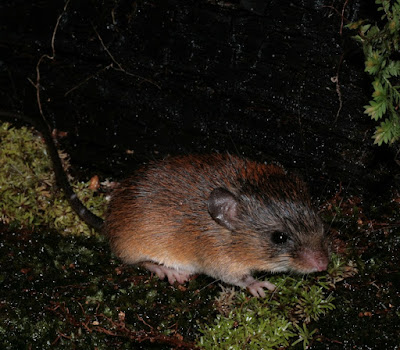
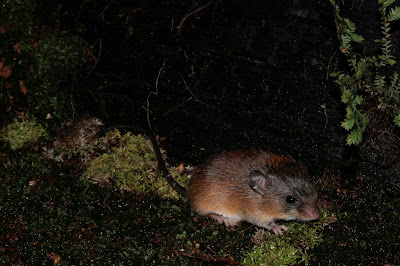
[Mammalogy • 2021] Three New Species of Spiny Mice, Genus Neacomys Thomas, 1900 (Rodentia: Cricetidae), from Brazilian Amazonia


Neacomys elieceri
Semedo, Da Silva, Carmignotto & Rossi, 2021


Abstract
Spiny mice of the genus Neacomys Thomas, 1900 are small oryzomyines that occur in forested habitats from Panama to central Bolivia. Previously known by only four species, systematic revisions provided great increase in genus species richness, which currently comprises 20 valid species. Herein we raise this number to 23, describing three new species of spiny mice. The new taxa are found in western and central Brazilian Amazonia in the states of Amazonas and Pará, and their geographic distribution are delimited by major rivers, being coincident with previously described Amazonian centers of endemism: (1) Neacomys aletheia, sp. nov., ranging from the right and left bank of the Rio Juruá, Amazonas state, Brazil to Loreto in Peru, from the Inambari center; (2) Neacomys jau, sp. nov., distributed between the Rio Negro and Rio Solimões, Amazonas state, Brazil, from the Imeri center; and (3) Neacomys elieceri, sp. nov., restricted to the Rondônia endemism center, between the Rio Tapajós and Rio Madeira, Pará state, Brazil. Previously reported more than 20 years ago as putative new species based on molecular and cytogenetic data, morphological analyses now reinforce the validity of these forms. Based on the analysis of 78 specimens, including name-bearing types from most of the distributional range of Neacomys, we formally describe and name these undescribed species. The new taxa can be distinguished from other closely related Neacomys by a set of qualitative traits, such as dorsal and ventral pelage coloration, tail color, morphology of the nasal bones, interorbital region, paraoccipital process, sphenopalatine foramen, incisive foramina, zygomatic plate, auditory bullae, foramen accessorius, anterocone and anteroloph of first upper molars, in association with cytochrome b gene sequences, and karyotype. These data increase the currently known Neacomys diversity, and also contribute to elevate Amazonian sigmodontinae species richness and endemism, in this yet poorly surveyed biome.
 
Key words: Amazonia, Cricetidae, Neacomys, Rodentia, sigmodontinae, spiny mice


Neacomys elieceri, sp. nov. 
 

Thiago Borges Fernandes Semedo, Maria Nazareth Ferreira Da Silva, Ana Paula Carmignotto and Rogério Vieira Rossi. 2021. Three New Species of Spiny Mice, Genus Neacomys Thomas, 1900 (Rodentia: Cricetidae), from Brazilian Amazonia. Systematics and Biodiversity. 19(8); DOI: 10.1080/14772000.2021.1980449 

[Botany • 2022] Camchaya bolavenensis (Asteraceae: Vernonieae) • A New Species from Bolaven Plateau, southern Laos


Camchaya bolavenensis Noyori, Komada, Soulad. & Tagane, 

in Noyori, Komada, Souladeth & Tagane, 2022. 
ມຸກຫນອງຫລວງ  ||  DOI: 10.11646/phytotaxa.536.1.1

 
Abstract
A new species Camchaya bolavenensis (Asteraceae: Vernonieae: Centrapalinae) from Dong Hua Sao National Protected Area located in Bolaven Plateau, southern Laos, is described and illustrated. It resembles C. gracilis and C. thailandica in morphology but distinguished by its basally decumbent stem, margin of lamina with distinct (1–)2–3 teeth, 2–4 mm long on each side, invisible secondary veins, and a capitulum with 10–30 of florets.

Keywords: Asterales, Compositae, Dong Hua Sao NPA, flora of Laos, Indochina, taxonomy

 
Camchaya bolavenensis Noyori, Komada, Soulad. & Tagane.
A. Flowering plant; B. Capitula; C. Long section of floret, lateral view; D. Phyllaries, inner (left), middle (middle) and outer (right); E. Achene.
Materials all from Tagane et al. L2011 (KYO).

Camchaya bolavenensis Noyori, Komada, Soulad. & Tagane.
 A. Habit; B. Lower leaf surface; C. Capitula, lateral view; D. Capitula, apical view; E. Capitula; F. Floret; G. Anthers; H. Styles and stigmas; I. Hexaporate pollen.
Materials A–E & G–H from Souladeth et al. L3349 (KAG), F from Tagane et al. L2011 (KYO) and I from Tagane et al. L2011 (KAG).

Camchaya bolavenensis Noyori, Komada, Soulad. & Tagane, sp. nov.

Diagnosis:—Camchaya bolavenensis is morphologically similar to C. thailandica Bunwong et al. (2012: 53) of Thailand and C. gracilis of Thailand and Laos in the point that all of them have terminal and axillary capitulescences and phyllaries without marginal spines. However, C. bolavenensis is distinguished from these two by its basally decumbent stem (vs. entirely erect), margin of lamina with distinct (1–)2–3 teeth which is 2–4 mm long (vs. entire or serrate with 5–10 teeth less than 1 mm long), invisible secondary veins (vs. prominent and clearly visible abaxially), and 10–30 florets per capitulescence (vs. 50–70 florets).

Distribution:—Laos (Champassak Province, Bolaven Plateau). 

 Habitat and ecology:—Camchaya bolavenensis grows on wet thin soil over large and exposed sandstone boulders, where it grows with sphagnum moss (Sphagnum sp.), Canscora andrographioides Griff. ex Clarke (1875: 431), Eriocaulon cormosum Souladeth et al. (2020: 2), Eriocaulon sp. and some species of Poaceae. Flowering specimens were collected in December.

Etymology:—The specific epithet bolavenensis refers to the type locality, Bolaven Plateau

 Vernacular name:—Mouk Nong Luang (ມຸກຫນອງຫລວງ), suggested here.


Wataru Noyori, Natsuki Komada, Phetlasy Souladeth and Shuichiro Tagane. 2022. Camchaya bolavenensis (Asteraceae: Vernonieae), A New Species from Bolaven Plateau, southern Laos. Phytotaxa. 536(1); 1-6. DOI: 10.11646/phytotaxa.536.1.1

Tuesday, February 22, 2022

[Paleontology • 2022] Dearc sgiathanach • A Skeleton from the Middle Jurassic of Scotland illuminates An Earlier Origin of Large Pterosaurs


Dearc sgiathanach
Jagielska, O’Sullivan, Funston, Butler, Challands, Clark, Fraser, Penny, Ross, Wilkinson & Brusatte, 2022

Illustration: Natalia Jagielska
 
Highlights: 
• A new pterosaur genus and species from the Middle Jurassic of Scotland is described
• It is represented by a well-preserved fossil skeleton, including the brain endocast
• It was not fully grown when it died and would have had a wingspan of >2.5 m
• Pterosaurs evolved to a considerably larger size earlier than previously recognized

Summary
Pterosaurs were the first vertebrates to evolve flight and include the largest flying animals in Earth history. While some of the last-surviving species were the size of airplanes, pterosaurs were long thought to be restricted to small body sizes (wingspans ca. <1.8–1.6 m) from their Triassic origins through the Jurassic, before increasing in size when derived long-skulled and short-tailed pterodactyloids lived alongside a diversity of birds in the Cretaceous. We report a new spectacularly preserved three-dimensional skeleton from the Middle Jurassic of Scotland, which we assign to a new genus and species: Dearc sgiathanach gen. et sp. nov. Its wingspan is estimated at >2.5 m, and bone histology shows it was a juvenile-subadult still actively growing when it died, making it the largest known Jurassic pterosaur represented by a well-preserved skeleton. A review of fragmentary specimens from the Middle Jurassic of England demonstrates that a diversity of pterosaurs was capable of reaching larger sizes at this time but have hitherto been concealed by a poor fossil record. Phylogenetic analysis places D. sgiathanach in a clade of basal long-tailed non-monofenestratan pterosaurs, in a subclade of larger-bodied species (Angustinaripterini) with elongate skulls convergent in some aspects with pterodactyloids.6 Far from a static prologue to the Cretaceous, the Middle Jurassic was a key interval in pterosaur evolution, in which some non-pterodactyloids diversified and experimented with larger sizes, concurrent with or perhaps earlier than the origin of birds.
 
Keywords: pterosaur, Jurassic, Scotland, Isle of Skye, wingspan, paleontology, evolution, fossil, histology, phylogeny


The new Middle Jurassic pterosaur Dearc sgiathanach
(A–C) Photographs of main slab (NMS G.2021.6.1–2), bones in dorsal view (A); wing phalanges 2–3 (NMS G.2021.6.3–4), in dorsal view (B); and main counterslab (NMS G.2021.6.3), bones in ventral view (C).
(D–F) Schematic drawings of (A)–(C).
(G–H) Reconstruction of skull in dorsal (G) and ventral (I) views and skeleton in lateral view (H).

ar, articular region; cd, caudal vertebrae; cor, coracoid; cv, cervical vertebrae; d, digit; den, dentary; dors, dorsal vertebrae; dpc, deltopectoral crest; ep, extensor process; fm, femur; gas, gastralia; hdc, humeral distal condyle; hmt, humeral tubercle; isc, ischium; ju, jugal; max, maxilla; mc, metacarpal; mt, metatarsal; po, postorbital; r, ribs; sac, sacral plate; sca, scapula; scv, sacral (?) vertebrae; sm, sesamoid; sq, squamosal; st, sternum; symp, symphysis; uc, ulnar crest; ul, ulna; wp, wing phalanx; r/l, right/left. Blue on reconstructions are missing regions; red line in (E) is location of histological sectioning. Scale bars, 30 mm.


Pterosauria Owen, 1842
Breviquartossa Unwin, 2003
Rhamphorhynchidae Seeley, 1870
Rhamphorhynchinae Seeley, 1870
Angustinaripterini He, 1983

 Included species: Angustinaripterus longicephalus, Sericipterus wucaiwanensis, and Dearc sgiathanach (below).

 Diagnosis: Group of rhamphorhynchine pterosaurs sharing a low and elongate skull (height-to-length ratio < 0.2); large antorbital fenestra (20%–35% skull length and >80% orbit dorsoventral height); lacrimal process of jugal nearly perpendicularly inclined (90°–110°) to jugal body; strongly inclined quadrate (130°–140° relative to maxilla long axis); cervical vertebrae with considerable change in length-to-width ratio across the neck (1.8 to 1.2, from anterior to posterior); humeral diaphysis slender with muscle scar tubercle.


Dearc n. gen.
 
Dearc sgiathanach sp. nov.

 Etymology: Scottish Gaelic, with the double meaning of “winged reptile” and “reptile from Skye,” paying homage to pterosaurs (winged reptiles) and the Gaelic name for Skye (An t-Eilean Sgitheanach, the “winged isle”). Phonetic pronunciation: jark ski-an-ach.

 Holotype: NMS (National Museums Scotland, Edinburgh) G.2021.6.1-4, a three-dimensionally preserved articulated skeleton, lacking anterior and dorsal portions of the cranium, left manus, portions of the wings, hindlimb elements, and the distal tail. The fossil was separated into four slabs during preparation: the main slab contains the majority of bones, exposed in dorsal view (NMS G.2021.6.1), and the main counter slab contains bones exposed ventrally (NMS G.2021.6.3). An additional block contains a wing phalanx (NMS G.2021.6.4). The skull and anterior cervical vertebrae (NMS G.2021.6.2) were separated from the main slab for X-ray computed microtomography (μCT) (Figure 2).

 Diagnosis: Dearc sgiathanach is a rhamphorhynchine pterosaur with the following autapomorphies: tri-tubular vomers with “trident-shaped” precapillary contact, pre-choana depression on the palatal surface of the maxilla, enlarged optic lobes expanded anteroposteriorly, and fourth metatarsal more robust (diameter 2.5×) than mt1-3.


Phylogenetic relationships of the Middle Jurassic pterosaur  Dearc sgiathanach and wingspan estimates for Jurassic pterosaurs
 Strict consensus of most parsimonious trees from phylogenetic analysis, with silhouettes scaled to wingspan (Dearc = ca. 2.0 m) (1), and skull reconstructions of key taxa: (A) Scaphognathus crassirostris (based on GPIB 1304), (B) Dorygnathus banthensis (based on SMNS 55886), (C) Rhamphorhynchus muensteri (based on NHMUK R 37002), (D) Angustinaripterus longicephalus (based on ZDM T8001), and (E) Dearc sgiathanach. Wingspan plot (2): estimated wingspan range for isolated pterosaur remains from the Taynton Limestone collection.
(A) NHMUK PV R 36634, (B) GSM 113726, (C) OUM J28352, (D) NHMUK PV R 38016, (E) NHMUK PV R1362, (F) LL12158, (G) NHMUK PV R 40126, (H) NMS G.2021.6.1-4 (Dearc), (I) OUM J23046, (J) OUM J28273, (K) NHM UK PV R 40126 B, (L) OUM J28319, (M) OUM J28307, (N) OUM J28271, (O) OUM J28354, (P) LL12160, (Q) OUM J23047, and (R) MJM L K1995.
 
 
Natalia Jagielska, Michael O’Sullivan, Gregory F. Funston, Ian B. Butler, Thomas J. Challands, Neil D.L. Clark, Nicholas C. Fraser, Amelia Penny, Dugald A. Ross, Mark Wilkinson and Stephen L. Brusatte. 2022. A Skeleton from the Middle Jurassic of Scotland illuminates An Earlier Origin of Large Pterosaurs.  Current Biology. DOI: 10.1016/j.cub.2022.01.073

[Diplopoda • 2022] Combining Mitochondrial DNA and Morphological Data to Delineate Four New Millipede Species and Provisional Assignment to the Genus Apeuthes Hoffman & Keeton (Spirobolida: Pachybolidae: Trigoniulinae)


Apeuthes pollex
Pimvichai, Panha & Backeljau, 2022


Abstract
Hitherto, the millipede genus Apeuthes (family Pachybolidae, subfamily Trigoniulinae) was only known from three species described in Vietnam based on morphological characters. The present study uses two partial mitochondrial gene fragments (cytochrome c oxidase I (COI) and 16S ribosomal RNA) and morphology to define four new Apeuthes species from Malaysia, Thailand and Vietnam: A. fimbriatus, sp. nov., A. longeligulatus, sp. nov., A. pollex, sp. nov. and ?A. spininavis, sp. nov. The intraspecific COI sequence divergence of two Apeuthes species is 3–7% (mean: 5%) and the interspecific divergence of five species is 11–16% (mean: 13.7%). All members of the genus share unique male characters, viz the posterior gonopod telopodite with several dentate, serrate or tuberculate lamellae in a boat-like cavity or a boat-like cavity covered with spines. The delimitation of the four new species is supported by the congruence between mitochondrial DNA and morphological data. However, while the monophyly of Trigoniulinae is well supported, the relationships within this subfamily, and particularly among Apeuthes species, including the monophyly of Apeuthes, lack strong support. Therefore assignment of the four new species, and particularly of ?A. spininavis sp. nov., to the genus Apeuthes is tentative and awaits a comprehensive revision of the group.

Keywords: DNA barcoding, Malaysia, mitochondrial DNA, monotypic genera, phylogeny, species delineation, Thailand, Trigoniulinae, Vietnam.


Class DIPLOPODA de Blainville in Gervais, 1844

Order SPIROBOLIDA Bollman, 1893
Suborder TRIGONIULIDEA Attems, 1909

Family PACHYBOLIDAE Cook, 1897
Subfamily TRIGONIULINAE Attems, 1909

Genus Apeuthes Hoffman & Keeton, 1960
Apeuthes Attems, 1938; invalidly proposed (as subgenus of Eucarlia Brölemann, 1913)

Type species: Eucarlia (Apeuthes) maculata Attems, 1938

Included species: Apeuthes eydouxii (Gervais, 1847) (formerly Iulus eydouxii Gervais, 1847 and Eucarlia (Apeuthes) charactopyga Attems, 1938), Apeuthes exustus (Attems, 1938) (formerly Eucarlia (Apeuthes) exusta Attems, 1938), Apeuthes maculatus (Attems, 1938) (formerly Eucarlia (Apeuthes) maculata Attems, 1938), Apeuthes fimbriatus, sp. nov., Apeuthes longeligulatus, sp. nov., Apeuthes pollex, sp. nov., ?Apeuthes spininavis, sp. nov.

Diagnosis: A genus of the pachybolid subfamily Trigoniulinae defined by having posterior gonopod telopodite with several dentate, serrate or tuberculate lamellae in a boat-like cavity (Attems 1938) or a boat-like cavity covered with spines (diagnostic extension provisionally added here to better accommodate ?A. spininavis, sp. nov., see Discussion).

Distribution: Malaysia, Thailand and Vietnam.


Apeuthes fimbriatus, sp. nov.

Diagnosis: Differing from all other species in the genus by having a triangular mesal sternal process of anterior gonopod, not reaching so far as the tip of coxae (Fig. 3a, d). Anterior gonopod telopodite far overreaching coxa, distally bifid, forming a butterfly-like structure (Fig. 3b, e). Posterior gonopods apically with rounded and spiny lamellae, one above the other (Fig. 3f–h).

Distribution: Da Nang Province, Vietnam (Fig. 9).

Etymology: The specific name is a Latin adjective, meaning ‘fringed’ and referring to the fringed lamella on the posterior gonopod.


Apeuthes longeligulatus, sp. nov.

Diagnosis Differing from all other species in the genus by having a narrow mesal sternal process of anterior gonopod, protruding slightly higher than coxae (Fig. 4a, d). Anterior gonopod telopodite distally bifid (Fig. 4b, e). Posterior gonopods apically with several flattened lamellae in a boat-like cavity (Fig. 4c, f–i).

Distribution: Sa Kaeo and Trad provinces, Thailand (Fig. 9).

Etymology: The specific name is a Latin adjective, meaning ‘with a long tongue’ and referring to the sternal process of the anterior gonopod.


 Live Apeuthes pollex, sp. nov. from Tham Sue Temple (WTS),
male (paratype, CUMZ D00143-2).

Apeuthes pollex, sp. nov.

Diagnosis: Differing from all other species in the genus by having coxa of anterior gonopod distinctly concave for accommodation of telopodite (Fig. 5b, e). Anterior gonopod telopodite protruding slightly over coxa, apically abruptly narrowed, ending in one slender process (Fig. 5b, e). Posterior gonopods apically with a rounded lobe, with serrated lamellae mesally and with a thumb-like process basally (Fig. 5c, f, g).

Distribution: Krabi and Phang-Nga provinces, Thailand (Fig. 9).

Etymology: The specific epithet is a noun in apposition, meaning ‘thumb’ and referring to the thumb-like basal process on the posterior gonopod.


?Apeuthes spininavis, sp. nov.

Diagnosis: Anterior gonopods with broad, triangular mesal sternal process (Fig. 6a, d). Similar in this respect to A. pollex, sp. nov. Differing from all other Apeuthes species by having posterior gonopods that are apically abruptly narrowed, forming a pointed lobe (Fig. 6c, f–h), and with a mesal margin forming a deep boat-like cavity covered with spines (Fig. 6h, i) and without a conical process at mesal margin of posterior gonopod telopodite.

Distribution: Johor and Perak provinces, Malaysia (Fig. 9).

Etymology: The specific epithet is a noun in apposition, ‘spiny boat’, referring to the shape and texture of the posterior gonopod telopodite.

Note: ?Apeuthes spininavis, sp. nov. shares several characters with other species in the genus Apeuthes. However, it differs from all of other species of Apeuthes by the absence of a conical process covered with spinules midway on the mesal margin of the posterior gonopod telopodite. Hence, for the time being, we only tentatively assign this species to Apeuthes and refer it to as ?Apeuthes spininavis, sp. nov.


Piyatida Pimvichai, Somsak Panha and Thierry Backeljau. 2022. Combining Mitochondrial DNA and Morphological Data to Delineate Four New Millipede Species and Provisional Assignment to the Genus Apeuthes Hoffman & Keeton (Diplopoda: Spirobolida: Pachybolidae: Trigoniulinae). Invertebrate Systematics. 36(2) 91-112. DOI: 10.1071/IS21038

***งานวิจัยใหม่: กิ้งกือกระบอกเล็ก 4 ชนิดใหม่ของโลก
สกุล 𝐴𝑝𝑒𝑢𝑡ℎ𝑒𝑠 จากเอเชียตะวันออกเฉียงใต้***

1. กิ้งกือกระบอกเล็กดานัง 𝐴𝑝𝑒𝑢𝑡ℎ𝑒𝑠 𝑓𝑖𝑚𝑏𝑟𝑖𝑎𝑡𝑢𝑠 Pimvichai, Backeljau & Panha, 2022 ค้นพบที่ จ. ดานัง ประเทศเวียดนาม
2. กิ้งกือกระบอกเล็กตะวันออก 𝐴𝑝𝑒𝑢𝑡ℎ𝑒𝑠 𝑙𝑜𝑛𝑔𝑒𝑙𝑖𝑔𝑢𝑙𝑎𝑡𝑢𝑠 Pimvichai, Backeljau & Panha, 2022 ค้นพบที่ จ. สระแก้วและตราด
3. กิ้งกือกระบอกเล็กภาคใต้ 𝐴𝑝𝑒𝑢𝑡ℎ𝑒𝑠 𝑝𝑜𝑙𝑙𝑒𝑥 Pimvichai, Backeljau & Panha, 2022 ค้นพบที่ จ.กระบี่และพังงา
4. กิ้งกือกระบอกเล็กมาเลเซีย ?𝐴𝑝𝑒𝑢𝑡ℎ𝑒𝑠 𝑠𝑝𝑖𝑛𝑖𝑛𝑎𝑣𝑖𝑠 Pimvichai, Backeljau & Panha, 2022 ค้นพบที่รัฐยะโฮร์และเประก์ ประเทศมาเลเซีย

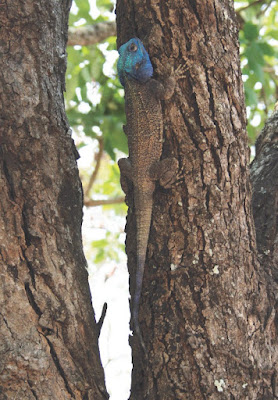
[Herpetology • 2022] Acanthocercus ceriacoi All in All It’s Just Another Branch in The Tree: A New Species of Acanthocercus Fitzinger, 1843 (Squamata: Agamidae), from Angola


Acanthocercus ceriacoi
Marques, Parrinha, Santos, Bandeira, Butler, Sousa, Bauer & Wagner, 2022

 
Abstract
Recent integrative taxonomic studies of the agamid genus Acanthocercus Fitzinger, 1843 have shown that Angola harbors three different taxa, all within the Acanthocercus atricollis (Smith, 1849) species complex—A. cyanocephalus (Falk, 1925) in the northeastern parts of the country, A. margaritae Wagner et al. 2021 in the southern regions, and an unnamed species in the central and northwestern parts of Angola. Using the previously published molecular data as evidence of phylogenetic support and newly collected morphological, meristic and coloration data, we here describe this unnamed lineage as a new species. The new species is morphologically very similar to A. cyanocephalus, but it can easily be differentiated from the latter by the coloration pattern of displaying males, with a blue coloration restricted to the head region, and by its inferior scale counts compared to other species of the A. atricollis complex group. As reported in other studies in this group, male breeding coloration is an effective trait for diagnosing these morphologically conserved species. This description raises the number of Acanthocercus species recognized to 15 and is another contribution revealing the rich but still incompletely described herpetological diversity of Angola.

Keywords: Reptilia, Africa, taxonomy, new species, morphology, coloration pattern, tree agama


Acanthocercus ceriacoi


Mariana P. Marques, Diogo Parrinha, Bruna S. Santos, Suzana Bandeira, Brett O. Butler, Ana Carolina A. Sousa, Aaron M. Bauer and Philipp Wagner. 2022. All in All It’s Just Another Branch in The Tree: A New Species of Acanthocercus Fitzinger, 1843 (Squamata: Agamidae), from Angola.  Zootaxa. 5099(2); 221-243. DOI: 10.11646/zootaxa.5099.2.4

[Herpetology • 2021] Hemiphyllodactylus zalonicus • The Phylogeny of Hemiphyllodactylus Bleeker, 1860 (Squamata: Gekkonidae) with A Description of A New Species from the Mangin Range, Sagaing Region, northern Myanmar


Hemiphyllodactylus zalonicus 
 Grismer, Chit, Pawangkhanant, Nazarov, Zaw & Poyarkov, 2021

Photos by Parinya Pawangkhanant 

ABSTRACT
Phylogenetic analyses of the 49 nominal species of the gekkonid genus Hemiphyllodactylus based on the mitochondrial gene NADH dehydrogenase subunit 2 and its flanking tRNAs resulted in a strongly supported tree composed of a number of regionally localised monophyletic lineages consistent with previous genus-wide analyses. One such lineage from Western Indochina is composed of three previously recognised clades plus an additional species from southern Thailand. An integrative taxonomic analysis of one of these clades (clade 3 from Western Yunnan, China) recovered a new species from the Mangin Mountain Range that represents the third independent origin of Hemiphyllodactylus in Myanmar (not counting the widespread parthenogenetic H. typus). Hemiphyllodactylus zalonicus sp. nov. from Mt. Zalon, Sagaing Region, is the first species of Hemiphyllodactyus known from the northern part of Ayeyarwady Basin and bears a 15.0–18.9% uncorrected sequence divergence from other clade members as well as having discretely non-overlapping meristic and mensural differences. This discovery brings the total number of Hemiphyllodactylus in Myanmar to at least 11 species.

KEYWORDS: Integrative taxonomy, Hemiphyllodactylus zalonicus sp. nov., Indochina, phylogeny, Ayeyarwady Basin, Burma


Hemiphyllodactylus zalonicus sp. nov. from Zalon Mountain, Zalon Taung National Forest, Ban Mauk District, Sagaing Region, northern Myanmar, in life.
Holotype (ZMMU R-16635, female):(a) General dorsolateral view. (b) Ventral view of tail. (c) Lateral view of head. Paratype (ZDUM-2019.12.29-038, female)
Photos by Parinya Pawangkhanant 

Hemiphyllodactylus zalonicus sp. nov. 


L. Lee Grismer, May Thu Chit, Parinya Pawangkhanant, Roman A. Nazarov, Than Zaw and Nikolay A. Poyarkov. 2021. The Phylogeny of Hemiphyllodactylus Bleeker, 1860 (Squamata: Gekkonidae) with A Description of A New Species from the Mangin Range, Sagaing Region, northern Myanmar. Journal of Natural History. 54(29-30); 1913-1931. DO: 10.1080/00222933.2020.1833095


Monday, February 21, 2022

[Botany • 2022] Vaccinium carmesinum (Ericaceae: Vaccinieae) • A New Species of Blueberry from Mt. Tago Range, Mindanao Island, Philippines


Vaccinium carmesinum M.N.Tamayo & P.W.Fritsch, 

in Tamayo, Coritico, Amoroso, ... et Fritsch, 2022. 
 
Abstract
Vaccinium carmesinum is described as a new species of Ericaceae from Mt. Tago Range, Mindanao Island, Philippines. It is similar to V. platyphyllum Merrill and V. luzoniense S.Vidal but is distinct from the former by longer and wider leaves, longer racemes, longer bracts, glabrous corollas, and glabrescent fruits, and from the latter by longer petioles, leaf glands distributed along the blade margin, glabrous rachis, and lanate filaments. Vaccinium carmesinum bears the widest leaves among Philippine Vaccinium. Its discovery increases the number of Vaccinium species recognized in the Philippines to 37.

Key words: Mindanao, Pantaron Mountain Range, Vaccinieae, volcanic-igneous

Vaccinium carmesinum M.N.Tamayo & P.W.Fritsch. 
A. Leafy branchlet. B. Inflorescences showing flower buds and foliaceous bracts. C. Corolla. D. Dissected flower showing stamens, style, ovary, hypanthium, and calyx. E. Dorsal view of stamen. F. Ventral view of stamen. G. Fruit cross section.
Illustration by M. N. Tamayo.

Vaccinium carmesinum M.N.Tamayo & P.W.Fritsch.
A, B. Flowering branchlet. C. Leafy branchlet. D. Inflorescences showing flower buds and foliaceous bracts. E. Longitudinal section of flower showing corolla, style and stamens. F. Immature fruits.
Photographs: A, D by D. S. Penneys; B, E, F by MAKP; C by D. N. Tandang.


Vaccinium carmesinum M.N.Tamayo & P.W.Fritsch, sp. nov. 

Diagnosis:—Vaccinium carmesinum resembles V. platyphyllum Merrill (1917: 294) and V. luzoniense S.Vidal (1886: 168), but differs from the former by longer and wider leaves, longer racemes, longer bracts, glabrous corollas, and glabrescent fruits, and from the latter by longer petioles, leaf glands distributed along the length of the blade margin, a glabrous inflorescence rachis, and lanate filaments.

Distribution and Habitat:—Vaccinium carmesinum is endemic to two mountains (Mt. Kiamo and Mt. Limbawon) in Mt. Tago Range, Mindanao, growing in tropical lower montane rainforest to upper montane rainforest. Populations of V. carmesinum were mostly found near summits where they thrive on volcanic-igneous or clay substrate with abundant humus. They also occur in areas of open shaded mossy forests, or on ridges covered in heathland scrub. Paratypes of the new species were collected on ca. 10–30% west-facing slopes.


 Etymology:—The epithet carmesinum is derived from the Greek word for crimson (blood red), as depicted by its crimson red petioles, floral bracts, peduncle, rachis, pedicels, hypanthium, and calyces. Moreover, a crimson red stain is extracted in notable quantity when the plants are soaked in a denatured alcohol solution.
 

Maverick N. Tamayo, Fulgent P. Coritico, Victor B. Amoroso, Darin S. Penneys, Danilo N. Tandang and Peter W. Fritsch. 2022. Vaccinium carmesinum (Ericaceae), A New Species of Blueberry from Mt. Tago Range, Mindanao Island, Philippines. Phytotaxa533(3); 173-180. DOI: 10.11646/phytotaxa.533.3.3


[Paleontology • 2022] Mambawakale ruhuhu • A New Pseudosuchian Archosaur (Pseudosuchia) from the Middle Triassic Manda Beds of Tanzania


Mambawakale ruhuhu 
Butler, Fernandez, Nesbitt, Leite & Gower, 2022
 
 Life reconstruction by Gabriel Ugueto twitter.com/SerpenIllus


Abstract
The Manda Beds of southwest Tanzania have yielded key insights into the early evolutionary radiation of archosaurian reptiles. Many key archosaur specimens were collected from the Manda Beds in the 1930s and 1960s, but until recently, few of these had been formally published. Here, we describe an archosaur specimen collected in 1963 which has previously been referred to informally as Pallisteria angustimentum. We recognize this specimen as the type of a new taxon, Mambawakale ruhuhu gen. et sp. nov. The holotype and only known specimen of M. ruhuhu comprises a partial skull of large size (greater than 75 cm inferred length), lower jaws and fragments of the postcranium, including three anterior cervical vertebrae and a nearly complete left manus. Mambawakale ruhuhu is characterized by several cranial autapomorphies that allow it to be distinguished with confidence from all other Manda Beds archosaurs, with the possible exception of Stagonosuchus nyassicus for which comparisons are highly constrained due to very limited overlapping material. Phylogenetic analysis suggests that M. ruhuhu is an early diverging pseudosuchian, but more precise resolution is hampered by missing data. Mambawakale ruhuhu is one of the largest known pseudosuchians recovered to date from the Middle Triassic.

Keywords: phylogeny, Pseudosuchia, Triassic, Archosauria, Tanzania
 

Figure 1. Photographs showing the collection of NHMUK R36620, holotype of Mambawakale ruhuhu, in 1963. Alan Charig is sat in the bottom right of the frame in the top left image, and is accompanied by Alfred ‘Fuzz’ Crompton. The top left and bottom right images also show Tanzanians (names unfortunately not recorded in archival material) who were employed by the 1963 expedition team and were critical to its success, discovering many of the fossil sites, constructing roads and carrying excavated fossils out of the field.
Photographs courtesy of Barry Cox and Steve Tolan. Original slides of these photographs are archived at NHMUK.

 Photographs of the skull of NHMUK R36620, holotype of Mambawakale ruhuhu, in right lateral (a) and left lateral (b) views.


Systematic Palaeontology

Archosauria 1869–1870
Pseudosuchia 1887–1890

Mambawakale ruhuhu gen. et sp. nov.

Holotype. NHMUK R36620, partial skull including premaxillae, maxillae, vomers, palatines, pterygoids, ectopterygoids and fragments of the jugals and basipterygoid, with associated hemimandibles, hyoids and isolated maxillary or dentary teeth. These cranial remains are associated (see below) with an incomplete postcranium, including an atlantal intercentrum, partial axis and partial third cervical vertebra, a mostly complete left manus, and additional poorly preserved fragments.

Etymology. Mambawakale, from the Kiswahili words mamba, meaning crocodile, and wakale, meaning ancient. The species name refers to the Ruhuhu Basin from which the type specimen and other taxa from the Manda Beds were collected.

Locality and stratigraphy. Field locality U15/1 of Attridge et al. [1964], Lifua Member of the Manda Beds (Middle Triassic: ?Anisian), Ruhuhu Basin, southwest Tanzania. ...


 Life reconstruction of Mambawakale ruhuhu.
 Only the skull, mandible and a few postcranial elements are known for Mambawakale ruhuhu, so the rest of the body, tail and limbs are reconstructed based on the anatomy of hypothesized close relatives of similar size.
Illustration by Gabriel Ugueto, who retains the copyright.


Richard J. Butler, Vincent Fernandez, Sterling J. Nesbitt, João Vasco Leite and David J. Gower. 2022. A New Pseudosuchian Archosaur, Mambawakale ruhuhu gen. et sp. nov., from the Middle Triassic Manda Beds of Tanzania. Royal Society Open Science. 9: 211622. DOI: 10.1098/rsos.211622