Monday, September 28, 2020

[Herpetology • 2020] A Revision of the Dwarf Geckos, Genus Lygodactylus (Squamata: Gekkonidae), from Angola, with The Description of Three New Species: Lygodactylus baptistai, L. nyaneka & L. tchokwe


Lygodactylus nyaneka 
Marques, Ceríaco, Buehler, Bandeira, Janota & Bauer, 2020


Abstract
At present the genus Lygodactylus is represented by three species in Angola confirmed by voucher specimens—L. angolensis, L. bradfieldi, and L. capensis—and two others believed to be present, but without specimens with precise localities, L. chobiensis and L. lawrencei. We present a detailed taxonomic revision of the group in Angola and describe three new species, Lygodactylus baptistai sp. nov. L. nyaneka sp. nov. and Lygodactylus tchokwe sp. nov. Phylogenetic analysis using the mitochondrial marker ND2, as well as morphological data support the recognition of the new species. In addition, data suggest that specimens historically assigned to L. capensis in Angola represent misidentifications of L. nyaneka sp. nov. and L. tchokwe sp. nov. We revisit the identity of Lygodactylus laurae, a junior synonym of L. angolensis. We also present the first confirmed record of L. lawrencei in the country, using both morphological and molecular data. The description of the new species and the revision of the taxonomic identity of the Angolan populations of the genus, raises the number of species occurring in the country to five. A key to the Angolan species is presented.

Keywords: Reptilia, Lygodactylus baptistai sp. nov., L. nyaneka sp. nov. Lygodactylus tchokwe sp. nov., molecular phylogeny, endemism, taxonomy, Angola


Lygodactylus lawrencei 


Lygodactylus baptistai


Mariana P. Marques, Luis M. P. Ceríaco, Matthew D. Buehler, Suzana A. Bandeira, Joyce M. Janota and Aaron M. Bauer. 2020. A Revision of the Dwarf Geckos, Genus Lygodactylus (Squamata: Gekkonidae), from Angola, with The Description of Three New Species. Zootaxa. 4853(3); 301–352. DOI: 10.11646/zootaxa.4853.3.1

Três Novas Espécies Descobertas em Angola


Sunday, September 27, 2020

[Entomology • 2020] Platylestes kirani • A New Species of Platylestes Selys (Odonata: Zygoptera: Lestidae) from the coastal area of Kannur District, Kerala, India


 Platylestes kirani 
Emiliyamma, Palot & Charesh, 2020


ABSTRACT
The genus Platylestes Selys, 1862 is known from India, by only one species, P. platystylus from eastern India, West Bengal, and recently from Kerala.  Here, we describe a new species Platylestes kirani from the coastal tracts of the northern part of Kerala, southern India.  The new species differs from all other known species of the genus by its unique coloration, distinct marking on synthorax, and the shape of anal appendages.

Keywords: Platylestes kirani sp. nov., P. platystylus, southern India, wetland

Image 1–11.  Platylestes kirani sp. nov.
1—Adult male| 2—Adult female| 3—Head and thorax of male| 4—Head and thorax of female| 5—Male and appendage - lateral view| 6—Male anal appendage - dorsal view| 7—Secondary genitalia of male| 8—Female anal appendage - lateral view| 9—Female anal appendage - ventral view| 10—Female anal appendage - dorsal view| 11—Wings. 
 photos: K.G. Emiliyamma & C. Charesh.

Comparison of adult specimens of  Platylestes kirani sp. nov. and P. platystylus:
 a—Platylestes platystylus - male | b—Platylestes platystylus - female 
 c—  Platylestes kirani sp. nov. - male | d—  Platylestes kirani sp. nov. - female.


Platylestes kirani sp. nov.

Diagnosis: This species can be easily distinguished from all other species of Platylestes, by its unique coloration, distinct black marking on its synthorax and shape of anal appendages. This species is characterized from P. platystylus and P. heterostylus by its broad black band on synthorax and apple green coloration.
The new species, Platylestes kirani sp. nov. is differentiated from its close relative, P. platystylus by the following set of characters (Images 12 & 13): 
1. Dorsum of synthorax with a broad black marking, its inner side straight, while its outer side crenulated expanded structure at three points (in P. platystylus, dorsum of synthorax without stripe, and with many black spots)
2. Synthorax apple green (P. platystylus: pale khaki brown)
3. Apex of superior anal appendages blunt and rounded, meeting each other (P. platystylus: apex is conical, not meeting each other, pointing downwards)
4. The colour of pterostigma is much darker than P. platystylus.

Etymology: The species is named after the late C.G. Kiran, in recognition  of  his  outstanding  contribution  to  the odonatology of Kerala.  He co-authored the first Odonata book  in  Malayalam  (local language)  and  popularized  odontology among the nature enthusiasts of the region.  He passed away in 2017, at an early age of 40 years.  The species name kirani is used as a noun in the genitive case.


K.G. Emiliyamma, Muhamed Jafer Palot and C. Charesh. 2020. A New Species of Platylestes Selys (Odonata: Zygoptera: Lestidae) from the coastal area of Kannur District, Kerala, India.  Journal of Threatened Taxa. 12(13); 16854-16860. DOI: 10.11609/jott.5209.12.13.16854-16860


Friday, September 25, 2020

[Herpetology • 2020] Herpetoreas pealii Lost and Found: Rediscovery and Systematics of the Northeast Indian Snake Hebius pealii (Sclater, 1891) (Colubridae: Natricinae)


Herpetoreas pealii  (Sclater, 1891)

in Das, Gower & Deepak, 2020.
 facebook.com: Dhritiman Mukherjee

 We report the rediscovery of the keelback snake Hebius pealii after 129 years from Arunachal Pradesh in Northeast India. We designate a lectotype for the species, and provide the first description of a female, of colour in life, and aspects of its natural history. Multilocus phylogenetic analyses of two mitochondrial (1071 bp cytb, 508 bp 16s) and two nuclear (560 bp bdnf, 579 bp cmos) genes provides strong evidence for Hebius pealii being nested within the genus Herpetoreas instead of Hebius. We transfer this species to the genus Herpetoreas.

Key words: Eastern Himalaya, HerpetoreasHerpetoreas platyceps, Natricinae, phylogeny, snakes.


First photographs in life of Herpetoreas pealii (WII-ADR547).
animal in its natural habitat (photo by Dhritiman Mukherjee) 

First photographs in life of Herpetoreas pealii (WII-ADR547).
 full body profile (photo by Abhijit Das).

Herpetoreas pealii comb. nov.

  Tropidonotus pealii – Sclater (1891a: 241); Sclater (1891b:41); Boulenger (1893: 214) 
Natrix pealii – Wall (1923: 600) 
Natrix peali [sic] – Smith (1943: 291) 
Amphiesma peali [sic] – Malnate (1960: 50 & 52); Sharma (2007: 206 & 210) 
Amphiesma pealii – Das et al. (1998:151); Das (2003: 473); Whitaker & Captain (2004: 25); Ahmed et al. (2009: 19); Das (2010: 42 &73); Purkayastha (2013: 59); Wallach et al. (2014: 32) 
Hebius pealii – Das & Das (2017: 168); Das et al. (2019: 125); Purkayastha & David (2019: 86)

Common name. Assam keelback (Uetz, 2020), 
Peal’s Keelback (Whitaker & Captain, 2004; Das & Das, 2017), 
Bark Brown Keelback (Sharma, 2007)

Diagnosis. A member of Herpetoreas that differs from other species of the genus in having fewer ventrals (136 and 142) than H. sieboldii (180), H. platyceps (174–217), H. xenura (158–165), and H. burbrinki (172). Herpetoreas pealii also has fewer subcaudals (69 and 77) than H. platyceps (86–107), H. xenura (82–105), and H. burbrinki (96). Herpetoreas pealii further differs from H. platyceps and H. sieboldii: in having nine (versus eight) supralabials and from H. sieboldii and H. platyceps in having laterally darkly blotched (verses immaculate) ventrals. Herpetoreas pealii differs from H. xenura in having paired (versus unpaired) subcaudals.


Abhijit Das, David J. Gower and V. Deepak. 2020. Lost and Found: Rediscovery and Systematics of the Northeast Indian Snake Hebius pealii (Sclater, 1891). Vertebrate Zoology. 70(3): 305-318. DOI: 10.26049/VZ70-3-2020-04


[Fungi • 2020] Hysterangium bonobo • A Newly Described Truffle Species (Basidiomycota: Agaricomycetes) that is eaten by Bonobos in the Democratic Republic of Congo


Hysterangium bonobo M.E. Sm. & T.F. Elliott

in Elliott, Georgiev, Lokasola & Smith, 2020.
 
ABSTRACT
Many animals have been shown to eat fungi and most truffle-like fungi depend on animals for spore dispersal via mycophagy. Although these interactions are widespread, they are understudied in many habitats. In this study, we show that bonobos (Pan paniscus) forage and feed on an undescribed truffle species in the rainforests of the Democratic Republic of Congo. Based on morphological and molecular assessment of collections, we show that the species eaten by bonobos is a previously undescribed taxon described here as Hysterangium bonobo. This species is known in the local Bantu language (Bongando) as simbokilo and is used for baiting traps to catch several species of small mammals. Our findings highlight the need for further research into mycophagy and systematics of sequestrate fungi in Africa.

KEYWORDSAfrican fungi, Hysterangiales, Phallomycetidae, primate mycophagy, truffle taxonomy, 1 new taxon


the holotype collection of Hysterangium bonobo collected in a bonobo foraging site after bonobos had recently been feeding. 
 Broken fruiting body revealing brown gleba and columella at the center.


Hysterangium bonobo M.E. Sm. & T.F. Elliott, sp. nov.

Etymology: bonobo, in reference to the common name of the primate Pan paniscus, which digs and eats this fungus.


Todd F. Elliott, Alexander V. Georgiev, Albert Lotana Lokasola and Matthew E. Smith. 2020. Hysterangium bonobo: A Newly Described Truffle Species that is eaten by Bonobos in the Democratic Republic of Congo.  Mycologia.  DOI: 10.1080/00275514.2020.1790234  


[Diplopoda • 2020] Coxobolellus gen. nov. • Integrative Taxonomy of the New Millipede Genus (Spirobolida : Pseudospirobolellidae), with Descriptions of Ten New Species


Coxobolellus albicepsC. tenebris
C. fuscus & C. tigris  

Pimvichai, Enghoff, Panha & Backeljau, 2020

Abstract
Pseudospirobolellidae is a poorly known family of spirobolidan millipedes with only two genera and five described species. Yet, the descriptive taxonomy and molecular systematics of this group have been largely neglected. Therefore, the present work presents an integrative taxonomic study of new pseudospirobolellid taxa in Thailand. To this end, two mitochondrial gene fragments (COI and 16S rRNA) combined with morphological characters were used to define the genus Coxobolellus, gen. nov. with 10 new species, viz. C. albiceps, sp. nov., C. compactogonus, sp. nov., C. fuscus, sp. nov., C. nodosus, sp. nov., C. serratus, sp. nov., C. simplex, sp. nov., C. tenebris, sp. nov., C. tigris, sp. nov., C. transversalis, sp. nov. and C. valvatus, sp. nov. The interspecific COI sequence divergences among the new species ranged from 6 to 15%. The intergeneric COI sequence divergence between species of Coxobolellus, gen. nov., Benoitolus birgitae and Pseudospirobolellus sp. ranged from 20 to 23%. Three major morphological differences separate Coxobolellus, gen. nov. from Benoitolus and Pseudospirobolellus, namely (1) the protruding process on the 3rd (and 4th) coxae on male legs, (2) the posterior gonopod telopodite divided into two parts, and (3) a conspicuous opening pore at the mesal margin at the end of the coxal part of the posterior gonopod. Thus, the new genus is well supported by both mtDNA and morphological evidence, while the delimitation of the 10 new species is supported by the congruence between mtDNA and morphological data. Yet, with respect to the relationships of Benoitolus birgitae, morphological data suggest a similarity with Coxobolellus, gen. nov. and Pseudospirobolellus, whereas mtDNA data place this species in the Pachybolidae. Further phylogenetic analyses are needed to explore this apparent incongruence and test the monophyly of Pseudospirobolellidae.

Keywords: mitochondrial DNA, new genus, phylogeny, species delineation


Class DIPLOPODA de Blainville in Gervais, 1844 

Order SPIROBOLIDA Bollman, 1893 
Suborder SPIROBOLIDEA Bollman, 1893 

Family Pseudospirobolellidae Brölemann, 1913


Genus Coxobolellus, gen. nov. 
Type species: Coxobolellus tenebris, sp. nov.

Distribution: Hitherto known only from Thailand 

Ecology: Specimens of Coxobolellus gen. nov. are mostly found under leaf litter. Sometimes specimens are found inside rotten wood or climbing on trees. 

Etymology: The name emphasises the importance of coxal characters in the diagnosis of the new genus.


Coxobolellus albiceps, sp. nov., male (paratype, CUMZ-D00124- 1)
from Tham ..., Noen Maprang District, Phitsanulok Province.  

Coxobolellus albiceps, sp. nov.

Etymology: The specific epithet is a Latin noun in apposition, meaning ‘white/pale head’ and referring to the contrastingly pale head in living specimens (Fig. 13A–C).


Coxobolellus compactogonus, sp. nov. 

Etymology: The specific epithet is a noun in apposition referring to the particularly compact posterior gonopod. 
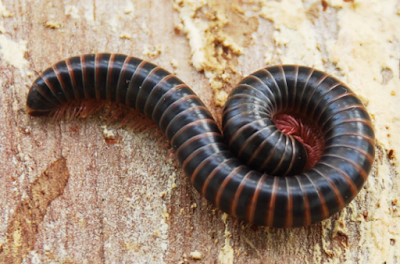

Coxobolellus fuscus, sp. nov., male (paratype, CUMZ-D00137-1)
from Wat ..., Thong Pha Phum District, Kanchanaburi Province.  

Coxobolellus fuscus, sp. nov. 

Etymology The specific name is a Latin adjective, meaning ‘brown’ and referring to the general body colour of living specimens (Fig. 13D). 


Coxobolellus nodosus, sp. nov.

Etymology The specific epithet is a Latin adjective referring to the pigmented node at the tip of the anterior gonopod telopodite of this species.


Coxobolellus serratus, sp. nov. 

Etymology The specific epithet is a Latin adjective referring to the prominent serration of the telopodital part of the posterior gonopod. 


Coxobolellus simplex, sp. nov.

Etymology The specific epithet is a Latin adjective referring to the particularly simple posterior gonopod. 


Coxobolellus tenebris, sp. nov., male (paratype, CUMZ-D00138-1)
from Wat ..., Nong Prue District, Kanchanaburi Province.

Coxobolellus tenebris, sp. nov.

Etymology The specific epithet is a Latin adjective, meaning ‘dark’ and referring to the general body colour of living specimens. 


Coxobolellus tigris, sp. nov., male (paratype, CUMZ-D00130-1)
from Wat Tham ..., Pathio District, Chumphon Province.

Coxobolellus tigris, sp. nov.

Etymology The specific epithet is a Latin noun in apposition, meaning ‘tiger’ and referring to the colour pattern on living specimens (Fig. 13F). 


Coxobolellus transversalis, sp. nov.

Etymology The specific epithet is a Latin adjective referring to the transverse truncation of the anterior gonopod coxa. 

Coxobolellus valvatus, sp. nov.

Etymology The specific epithet is a Latin adjective referring to the prominently toothed vulva valve.

  
Piyatida Pimvichai, Henrik Enghoff, Somsak Panha and Thierry Backeljau. 2020. Integrative Taxonomy of the New Millipede Genus Coxobolellus, gen. nov. (Diplopoda : Spirobolida : Pseudospirobolellidae), with Descriptions of Ten New Species. Invertebrate Systematics. 34(6); 591-617. DOI: 10.1071/IS20031 


นักวิจัยคณะวิทย์ฯ มมส ค้นพบกิ้งกือกระบอกสกุลใหม่ของโลก (new genus) จำนวนกว่า 10 สปีชีส์


Thursday, September 24, 2020

[Herpetology • 2020] Atelopus moropukaqumir • A New Species of Atelopus (Anura: Bufonidae) from southern Peru


Atelopus moropukaqumir 
 Herrera-Alva, Díaz, Castillo, Rodolfo & Catenazzi, 2020


Abstract
We describe a new harlequin frog (genus Atelopus) from the cloud forest near Anchihuay (Anco District, Ayacucho Department) from 2000 to 2150 m elevation in southern Peru, representing the first record for the genus in the Department of Ayacucho. The new species has a maximum snout-vent length of 21.5 mm in females and 21.6 mm in males, and resembles A. erythropus in general appearance, small size, and dorsal coloration. The new species can be distinguished from A. erythropus by its unique pattern of ventral coloration, dorsal skin texture, and snout shape. We detected the presence of the pathogenic fungus Batrachochytrium dendrobatidis in individuals of the new species. This pathogen is threatening the survival of harlequin frogs throughout the Neotropics. In addition to chytridiomycosis, habitat loss further threatens the single locality where the new species is known to occur.

Keywords: Amphibia, Andes, Ayacucho, Batrachochytrium dendrobatidis, chytridiomycosis, harlequin frog


Atelopus moropukaqumir


Valia Herrera-Alva, Vladimir Díaz, Ernesto Castillo, César Rodolfo and Alessandro Catenazzi. 2020.  A New Species of Atelopus (Anura: Bufonidae) from southern Peru. Zootaxa. 4853(3); 404–420. DOI: 10.11646/zootaxa.4853.3.4


[Crustacea • 2020] Potamonautes licoensis • Phylogenetics of the Freshwater Crab (Potamonautes MacLeay, 1838) Fauna from ‘Sky Islands’ in Mozambique with the Description of A New Species (Brachyura: Potamonautidae)


 Potamonautes licoensis  
Daniels, Bittencourt-Silva, Muianga & Bayliss, 2020.


Abstract
Patterns and processes of cladogenesis among taxa living on the Mozambique ‘sky islands’ remain poorly studied. During the present study, we report on a new freshwater crab species from Mount Lico, an inselberg and ‘sky island’ in the Zambezia Province of Mozambique. Phylogenetic analyses using three mitochondrial DNA sequence loci (12S rRNA, 16S rRNA and COI) were used to determine the evolutionary placement of the freshwater crab specimens from Mount Lico. The freshwater crab specimens from Mount Lico were retrieved sister to Potamonautes choloensis. The new species, Potamonautes licoensis sp. nov., is described and compared with other southern African freshwater crab species. Divergence time estimations for the Mozambican freshwater crab species suggest a Miocene / Plio–Pleistocene diversification. Some endemic ‘sky island’ species form an early branching and are sister to other predominantly East African species, while other ‘sky island’ species are more recently derived and nested within a predominantly southern African clade. The present study presents the description of the fourth endemic freshwater crab species from Mozambique and suggests that the species diversity in the country is likely highly underrepresented, reiterating the call for renewed systematic surveys. An argument for the conservation of these mountainous ‘sky islands’ is presented.

Keywords: alpha taxonomy; species diversity; novel lineages; sky island; conservation


Infraorder Brachyura Latreille, 1802
Superfamily Potamoidea Ortmann, 1896

Family Potamonautidae Bott, 1970
Subfamily Potamonautinae Bott, 1970

Genus Potamonautes MacLeay, 1838

Fig. 2.  Potamonautes licoensis sp. nov., holotype, ♂ (CL = 17.55 mm) (SAM C-A091399). A. Entire animal, dorsal aspect. B. Entire animal, ventral aspect. C. Cephalothorax, frontal aspect. Scale bar = 10 mm.
Fig. 5. A. Primary rainforest habitat where  Potamonautes licoensis sp. nov. occurs. B. Live colour of P. licoensis sp. nov upon collection. Photographs by J. Bayliss. 
 
Potamonautes licoensis sp. nov. 

Diagnosis Carapace: highly flat (CH/CL = 0.44) (Table 1); postfrontal crest well-defined, complete, lateral ends meeting anterolateral margins; epigastric crests faint, median sulcus between crests short, not forked posteriorly; exorbital, epibranchial teeth reduced to granules; anterolateral carapace margin with small tooth epibranchial (Figs 2A–C, 5A). Third maxilliped: ischium with distinct vertical sulcus (Fig. 3C); s3/s4 complete, V-shaped, deep, midpoint almost meeting anterior margin of sterno-pleonal cavity; margins of s4 low, not raised (Fig. 2B). Cheliped: dactylus (moveable finger) slim, highly arched, enclosing oval interspace, with three larger teeth interspersed by smaller teeth along length; propodus (fixed finger) with four larger teeth interspersed by smaller teeth along length (Fig. 2A–C); carpus inner margin distal tooth large, pointed, proximal tooth reduced to granules (Fig. 3A); medial inferior margin of merus lined with series of small granules terminating distally at small, low distal meral tooth, lateral inferior margin smooth. G1 terminal article: ⅓rd length of subterminal segment; first third straight in line with longitudinal axis of subterminal segment, middle part directed outward at 45°, widened by raised rounded ventral lobe, tip curving sharply upward (Fig. 3A–B).

Etymology: Named for Mount Lico, from where the species was first collected.

Type locality: Mount Lico, Zambezia Province, Mozambique. 

Habitat: Primary rain forest streams on top of Mount Lico, Zambezia Province, Mozambique. Frequently found under small stones in first order streams (Fig. 5A). 

Distribution: Known from Mount Lico, Zambezia Province, Mozambique. More recently, the species has also been collected from Mount Nallume (Daniels pers. obs.).


Savel R. Daniels, Gabriela B. Bittencourt-Silva, Vanessa Muianga and Julian Bayliss. 2020. Phylogenetics of the Freshwater Crab (Potamonautes MacLeay, 1838) Fauna from ‘Sky Islands’ in Mozambique with the Description of A New Species (Brachyura: Potamoidea: Potamonautidae). European Journal of Taxonomy. 716; 1–23. DOI: 10.5852/ejt.2020.716


Wednesday, September 23, 2020

[Botany • 2020] Dichocarpum hagiangense • A New Species and An updated Checklist of Ranunculaceae in Vietnam


Dichocarpum hagiangense L.K Phan & V.T. Pham

in Nguyen, Trinh, ... et Pham​​, 2020.

Abstract 
Dichocarpum hagiangense from Ha Giang province, northern Vietnam is described and illustrated. Diagnostic features of the new species are a short rhizomatous stem, (2–)3-foliolate or simple leaves, and pink-purple flowers. The described species is distinct from closely allied D. trifoliolatum in having longer sepals, shape and obcordate apex of petal limbs, shorter flower stem, number and tooth shape of basal leaves; it differs from D. basilare and D. carinatum in having stem leaf, retuse apex and longer of central leaflet, number and (2–)3-foliated (or simple) of leaf. With the support of molecular data, the new species was clearly distinguished from other species in the Dichocarpum group by eight autapomorphic characters in nrITS sequence. A key to all species of Dichocarpum is provided. We suggest the IUCN conservation status of D. hagiangense to be “Critically Endangered”. A newest checklist of the family Ranunculaceae in Vietnam is updated.


Figure 1: Distribution map of Dichocarpum species in Vietnam.
 (A) Southeast Asia, Vietnam and collection point in black; (B) Northern Vietnam, Ha Giang and Lao Cai provinces in grey; (C) Detail of Ha Giang and Lao Cai provinces, the collection and recorded points in black.

Figure 3: Dichocarpum hagiangense L.K. Phan & V.T. Pham.
(A) Flattened flowering specimen. (B) Scaly rhizomes. (C) 3-foliolate leaves adaxial (lower) and abaxial (upper) views. (D) 2-foliolate leaf adaxial view. (E) Single leaves abaxial view. (F, G) Stem leaves. (B) Bract. (I) Inflorescences. (J) Flower frontal view. (K) Flower side view. (L) Flower behind view. (M) Sepals frontal view. (N) Petals. (O) Stamens. (P) Follicles. (Q) Seeds.
Scale bars: A = 5 cm; B, C, D, E = 2 cm; F, G, H, M, Q = 0, 5 cm; I, J, K, L, P = 1 cm; N, O = 0, 2 cm.

Figure 4: Dichocarpum hagiangense L.K. Phan & V.T. Pham in its natural habitat.
(A) Rocky cliff at the limestone forest. (B) Plant with inflorescence. (C) Flower.

Dichocarpum hagiangense L.K Phan & V.T. Pham, sp. nov.

Diagnosis. According molecular characters new species belong to sect. Dichocarpum, subsect. Dichocarpum. Dichocarpum hagiangense is morphologically most similar to D. trifoliolatum, but differs in having longer sepals, shape and obcordate apex of petal limbs, shorter flower stem, number and tooth shape of basal leaves. However, D. hagiangense differs from D. basilare and D. carinatum in having stem leaf, retuse apex and longer of central leaflet, number and (2–)3-foliated (or simple) of leaf.

Habitat and ecology. The new species grows in disturbed primary evergreen forest on a limestone mountain at elevations of 1297 m, as a lithophytic herb on large wet mossy boulders and cliffs on steep slopes (Fig. 4).

Distribution and Conservation status. Dichocarpum hagiangense was only recorded from one small population in Ha Giang province of Vietnam (Fig. 1). The existing population is facing the risk of extinction in the wild, since the area where this species is found does not belong to any protected forest. The habitat is highly disturbed by the local people for cardamom and Lysimachia foenum-graecum cultivations, collecting timber, firewood and non-timber forest products. The species is very rare and only known from one population of less than 50 mature individuals, in a habitat that is seriously threatened. According to IUCN Standards and Petitions Subcommittee (2019) criteria B1ab(ii) + B2ab(ii), with EOO (Extent of Occurrence) = 0 km2 and AOO (Area of Occupancy) = 4.000 km2, this species should be classified as “critically endangered” (CR).

Etymology. The species epithet ‘hagiangense’ refers to Ha Giang province, the only site where the species is currently known.


Minh Ty Nguyen, Ngoc Bon Trinh, Thanh Thi Viet Tran, Tran Duc Thanh, Long Ke Phan and Van The Pham​​. 2020. Dichocarpum hagiangense—A New Species and An updated Checklist of Ranunculaceae in Vietnam.  PeerJ. 8:e9874. DOI: 10.7717/peerj.9874

Tuesday, September 22, 2020

[Herpetology • 2020] Lycodon deccanensis • A New Species of Lycodon (Serpentes: Colubridae) from the Deccan Plateau of India, with notes on the range of Lycodon travancoricus (Beddome, 1870) and A Revised Key to peninsular Indian forms


Lycodon deccanensis 
Ganesh, Deuti, Punith, Achyuthan, Mallik, Adhikari & Vogel, 2020

  facebook.com: Ashok Kumar Mallik 

Abstract
A new species of wolf snake, Lycodon deccanensis sp. nov., is described from southern India, from the hill ranges situated in the Deccan Plateau adjacent to the Southern Eastern Ghats and the Mysore uplands. The new species somewhat resembles, and has previously been confused with, another predominantly wetzone taxon Lycodon travancoricus. The new species can be diagnosed by the following combination of characters: dorsal scale rows 16–17:17:15; usually 9 supralabials; ventrals 181–201; subcaudals 68–74, divided; an undivided anal scale; loreal in contact with internasal; nasal not in contact with prefrontal, separated by loreal-internasal contact; supraocular usually contacting prefrontal; preocular usually not contacting frontal; and a dorsum that is brownish in adults and blackish in juveniles, with white cross bars. Some previous records of Lycodon travancoricus (sic) from outside the Western Ghats represented the new species, while others were re-identifed as L. aulicus and L. anamallensis, effectively restricting the range of L. tarvancoricus to the Western Ghats and Southern Eastern Ghats.

 Keywords: Coloration, Deccan plateau, Lycodon deccanensis sp. nov., Reptilia, scalation, South Arcot, Tumkur 


Fig. 1. Lycodon deccanensis sp. nov. in life:
(a) entire, dorsolateral view; (b–d) head profles of a live uncollected specimen from Devarayana Durga; (e–f) live uncollected adult and juvenile from Melagiri, showing ontogenic color shift.
Photos by K.G. Punith, M.V. Shreeram, and S.R.Ganesh.

Lycodon deccanensis sp. nov. 
Lycodon travancoricus (nec Beddome, 1870) – Sclater 1891 part. 
Lycodon sp. – Ganesh et al. (2018, 2020b).

Etymology: Toponym, named after its region of occurrence – the Deccan plateau, a raised table land of late Cretaceous origin, situated between the Eastern Ghats and the Western Ghats of the Indian peninsula. 

Diagnosis: A species of Lycodon inhabiting the Deccan plateau of India, characterized by: small size (total length < 470 mm); scales smooth, in 16–17:17:15 rows, without apical pits; usually 9 supralabials (10, in one case); ventrals 181–201 (n = 9) angulate laterally; anal plate undivided; subcaudals 68–78 (84; n = 8), paired; loreal in contact with internasal, separate from eye; nasal not in contact with prefrontal; anterior pair of genials subequal to posterior pair; supraocular usually contacting prefrontal; preocular usually not contacting frontal (preocular separating frontal, prefrontal, and supraocular in one case); dorsum brown in adults and black in juveniles, with white cross bars. 

Due to the slender body and smaller head, the new species superfcially resembles the genus Dryocalamus, its higher midbody scale rows (17) and lower ventral counts (181–201; avg. 190; n = 9) [vs. rows 13–15; ventrals 200+ in Dryocalamus, see Smith 1943] clearly indicate this species belongs to the genus Lycodon, even if Dryocalamus is regarded as a valid genus.


Fig. 3. Map showing the type locality and distribution records of Lycodon deccanensis sp. nov.  Type locality (Devarayana Durga) marked with a red dot.


Distribution and natural history. Based on the specimens observed in situ during feldwork, this species appears to inhabit mid- to higher elevations (> 600 m asl), and hilly forest tracts in the Deccan plateau, such as the taller isolated peaks in the Eastern Ghats and the Mysore uplands. The two examined specimens in museum collections (ZSI and SACON), come from near South Arcot (ca. 11.77°N, 78.75°E; 850 m asl) and Anaikatti (11.092°N, 76.778°E; 670 m asl), respectively. Though the exact place names given on the jar labels of these specimens furnish coarselevel geographic data, the places are always associated with the presence of hills nearby (see Ganesh et al. 2018), attesting to its affnity for the hills.
...


 S.R. Ganesh, Kaushik Deuti, K.G. Punith, N.S. Achyuthan, Ashok Kumar Mallik, Omkar Adhikari and Gernot Vogel. 2020. A New Species of Lycodon (Serpentes: Colubridae) from the Deccan Plateau of India, with notes on the range of Lycodon travancoricus (Beddome, 1870) and A Revised Key to peninsular Indian forms. Amphibian & Reptile Conservation. 14(3) [Taxonomy Section]: 74–83 (e256).