Saturday, March 28, 2020

[Botany • 2019] A Taxonomic Revision of Globba subsect. Nudae (Zingiberaceae) including Three New Species: Globba aranyaniae, G. lithophila & G. macrochila


A. Globba aranyaniae Sangvir. & M.F.Newman sp. nov., B. G. expansa Wall. ex Horan., 
C. G. flagellaris K.Larsen., D. G. insectifera Ridl., 
E. G. lithophila Sangvir. & M.F.Newman sp. nov. and F. G. macrochila Sangvir. & M.F.Newman sp. nov.


in Sangvirotjanapat, Denduangboriphant & Newman, 2019.
 Photographs: S. Sangvirotjanapat  facebook.com/SunisaSang5

Abstract
Globba subsect. Nudae K.Larsen is revised. Seven species are recognised and three names are lectotypified. A key to the species and descriptions are provided. Three new species are described and illustrated: Globba aranyaniae Sangvir. & M.F.Newman sp. nov.G. lithophila Sangvir. & M.F.Newman sp. nov., and G. macrochila Sangvir. & M.F.Newman sp. nov. Four names based on types from Bangladesh, India and Myanmar remain doubtful. The morphological expression of andromonoecy in this group is described in detail. Provisional IUCN conservation assessments of all species are supplied.

Keywords: Andromonoecy; Globba; Nudae; taxonomic revision; Zingiberaceae

Fig. 2. Globba subsect. Nudae K.Larsen.
A. Globba aranyaniae Sangvir. & M.F.Newman sp. nov. (S. Sangvirotjanapat 785 leg.). B. G. expansa Wall. ex Horan. (M.F. Newman 2561 leg.). C. G. flagellaris K.Larsen (M.F. Newman and JLS 2048 leg.).
D. G. insectifera Ridl. (S. Sangvirotjanapat s.n. leg.). E. G. lithophila Sangvir. & M.F.Newman sp. nov. (M.F. Newman 2576 leg.). F. G. macrochila Sangvir. & M.F.Newman sp. nov. (S. Sangvirotjanapat 795 leg.).

Photographs: S. Sangvirotjanapat.  facebook.com/SunisaSang5

Class Magnoliopsida Brongn.

Order Zingiberales Griseb.
Family Zingiberaceae Martinov

Genus Globba L.
Section Nudae K.Larsen
Subsection Nudae K.Larsen

General morphology: The main distinguishing characteristics of G. subsect. Nudae are the lax conical inflorescence and flowers with four anther appendages. These differentiate this subsection clearly from G. sect. Globba and G. sect. Sempervirens, which also have four anther appendages, but have dense inflorescences with colourful, persistent bracts.

Habitat The substrate and ecological surroundings are found to relate to plant size. Plants in G. subsect. Nudae are mostly middle-sized, about 50–100 cm tall. Occasionally G. expansa Wall. ex Horan., found in mixed evergreen montane forest, can grow to 1.5 m tall while G. lithophila Sangvir. & M.F.Newman sp. nov., which grows on limestone, is a miniature plant, only 10 cm tall. The most variable species is G. insectifera Ridl., which is large or small depending on the conditions of the dry or the rainy season which determine the production of inflorescence shoots or leafy shoots.

Rhizome Small, globose, about 3–5 cm in diameter. In one growing season, 5–8 rhizomes can be produced in a moniliform arrangement. The root tubers are spindle-shaped or elongate and function in food storage during the dormant period.

Flower For reliable identification to species, the flower must be seen. Flower colour seems to be a variable character while, on the other hand, the yellow and orange tone of flowers in this subsection is clearly different and useful for classification in many cases. A red or brown spot on the labellum is quite common in other groups of Globba but, in G. subsect. Nudae, G. aranyaniae sp. nov. is unique in having a spot (Fig. 2A).


Globba aranyaniae Sangvir. & M.F.Newman sp. nov. 

Diagnosis: The main distinguishing character within G. subsect. Nudae is the red or brown spot on the labellum. Laotian and northern Thai populations resemble G. flagellaris and G. macrochila sp. nov. by their condensed cincinni, and orange-toned flowers with rather broad lateral staminodes (> 5 mm). Central and eastern Thai populations resemble G. expansa by their lax cincinni, orange-toned flowers, and ellipsoid fruits.

Etymology The epithet ‘aranyaniae’ derives from ‘Aranyani’ who is a princess in the myth relating to the name of the type locality, Pha Nang Khoy (‘Cave of the Lady who Waits’).

Distribution and habitat: Laos and Thailand, at 100–700 m a.s.l., on limestone in mixed evergreen forest or near streams.


Globba expansa Wall. ex Horan.
Prodromus Monographiae Scitaminearum Additis Nonnullis de Phytographia, de Monocotyleis et Orchideis: 19 (Horaninow 1862).

Synonyms: G. yeatsiana Craib, Bulletin of Miscellaneous Information, Royal Botanic Gardens, Kew 1912: 400 (Craib 1912). – Type: THAILAND • Northern, Chiang Mai, Doi Suthep-Pui National Park; 960 m a.s.l.; 12 Jun. 1910; A.F.G. Kerr 1214 leg.; K (lectotype, designated here), E E00097516 (isolectotype).
G. platystachya sensu Gagnepain, Flore Générale de l'Indo-Chine 6 (1): 33 (Gagnepain 1908), non Baker, The Flora of British India 6 (17): 206 (Baker 1890).

Distribution and habitat: Myanmar, Laos, Thailand, 174–1350 m a.s.l., growing in mixed evergreen forest along the trail under semi shade. Usually found as dense clump.


Globba flagellaris K.Larsen
Nordic Journal of Botany. 17: 119 (Larsen 1997).

Distribution and habitat: Chiang Mai, Mae Hong Son, and Nan provinces, Thailand, 450–1100 m a.s.l. It grows in dense populations in rather moist areas, often near streams.


Globba insectifera Ridl.
Journal of the Straits Branch of the Royal Asiatic Society 49: 42 (Ridley 1908). 

Synonyms: G. kerrii Craib, Bulletin of Miscellaneous Information, Royal Botanic Gardens, Kew 1912: 398 (Craib 1912). – Type: THAILAND • Chiang Mai, Doi Suthep-Pui National Park; 1200 m a.s.l.; 24 Jul. 1910; A.F.G. Kerr 1278 leg; E (lectotype, designated here), BM (isolectotype), E E00097477 (isolectotype), K (isolectotype, 2 sheets). 
G. nuda K.Larsen, Notes from the Royal Botanic Garden Edinburgh 31: 235 (Larsen 1972). – Type: THAILAND • Chiang Mai, Doi Suthep-Pui National Park; 850 m a.s.l.; 13 Apr. 1958; K. Larsen, B. Hansen and T.J. Sørensen 2678 leg.; AAU (holotype), C (isotype), BKF (isotype).

Distribution and habitat: Myanmar and Thailand, 240–1500 m a.s.l. Common in dipterocarp or grass forest in open areas. The plants grow over large areas but not covering the ground densely


Globba lancangensis Y.Y.Qian
 Acta Botanica Austro Sinica 9: 51 (Qian 1994).

Distribution and habitat: China (Yunnan), 1080–1350 m a.s.l.


Globba lithophila Sangvir. & M.F.Newman sp. nov. 

Diagnosis Similar to G. flagellaris and G. macrochila sp. nov. in its condensed cincinni and bright orange flowers, but differing from them by its clearly visible lateral corolla lobes, oblong and patent lateral staminodes, smaller size and ecological requirements, being found only in pockets of soil in cracks in limestone. 

Etymology: From the Greeklithos (stone) andphila(loving), reflecting its limestone habitat.

Distribution and habitat: Thailand, 450–800 m a.s.l., only found in small pockets of soil in or very near limestone.

Conservation status: Least Concern. Globba lithophila sp. nov. has a small AOO of 28 km2 and EOO of 2600 km2 , suggesting a status of Endangered but it grows in Lum Nam Pai Wildlife Sanctuary as well as ex situ in Queen Sirikit Botanic Garden so it is of Least Concern. It is a lithophyte which makes it sensitive to environmental factors so good management of protected areas is important to keep it in its natural habitat.

Notes: Globba lithophila sp. nov. has been compared closely to G. flagellaris, with which it is sympatric in north Thailand. Both species were cultivated in the same place at the Zingiberaceae nursery of Queen Sirikit Botanic Garden under controlled conditions. After two years of growth, the vegetative parts of the plants were larger than those of wild plants, while the floral parts and ratios of sizes remained the same. We conclude that these are two separate species and that G. lithophila sp. nov. is not merely a part of the variation of G. flagellaris.


Globba macrochila Sangvir. & M.F.Newman sp. nov. 

Diagnosis: Similar to G. flagellaris in its bright orange flowers, but differing by its much longer labellum, 19– 20 mm long (vs short labellum, 10–12 mm long) and growing in dry areas (vs moist areas). 

Etymology: Greek, ‘macros’ (large) and ‘-chila’ (-lipped), referring to its long labellum.

Distribution and habitat: Myanmar and Thailand, 100–350 m a.s.l., in rather dry forest.

Conservation status: Least Concern. Although this species has a small AOO of 32 km2 , the populations in Kanchanaburi province, where this species is commonest, are found in several protected areas. It is also grown in Queen Sirikit Botanic Garden.

 Notes Usually found in somewhat dry areas, such as bamboo forest. The labellum is remarkable, being longer than the lateral staminodes. It always covers the lateral corolla lobes. Plants were cultivated under more humid test conditions in Bangkok to find out the stability of the morphological characters. After growing for one season, the environmental factors affected only vegetative structures, i.e., leafy stem size, inflorescence size but did not influence the ratios of the floral parts.


Doubtful species of Globba subsect. Nudae

Globba pauciflora King ex Baker
Flora of British India 6: 205 (Baker 1890).

Globba rahmanii Yusuf
Journal of Economic and Taxonomic Botany 28: 88 (Yusuf 2004).

Globba subscaposa Collett & Hemsl.
Journal of the Linnean Society. Botany 28: 135 (Collett & Hemsley 1890).


 Sunisa Sangvirotjanapat, Jessada Denduangboriphant and Mark F. Newman. 2019. A Taxonomic Revision of Globba subsect. Nudae (Zingiberaceae).  European Journal of Taxonomy. 503; 1–37. DOI: 10.5852/ejt.2019.503

[Botany • 2020] Thismia ornata & T. coronata (Thismiaceae) • Two New Species from Sarawak, Borneo


Thismia ornata Dančák, Hroneš & Sochor

in Dančák, Hroneš & Sochor, 2020.

 Abstract 
Thismia ornata and T. coronata (Thismiaceae), two new species from Sarawak (Malaysian Borneo) are described and illustrated. Thismia ornata belongs to T. sect. Thismia subsect. Odoardoa and occurs at several localities in western Sarawak around the city of Kuching. This species has been misidentified as T. aseroe until now, although the two species differ considerably. The species is assigned a preliminary conservation status of VU according to IUCN criteria. Thismia coronata belongs to T. sect. Sarcosiphon and has been found at only one site near the village of Long Tuyo in Lawas district of northern Sarawak. It is related to T. goodii and T. kelabitiana. The species is assigned a preliminary conservation status of CR.

KEYWORDS: Borneo, Malesia, mycoheterotrophy, new species, Sarawak, Thismia, Thismia aseroe, Thismiaceae, Tropical rain forest

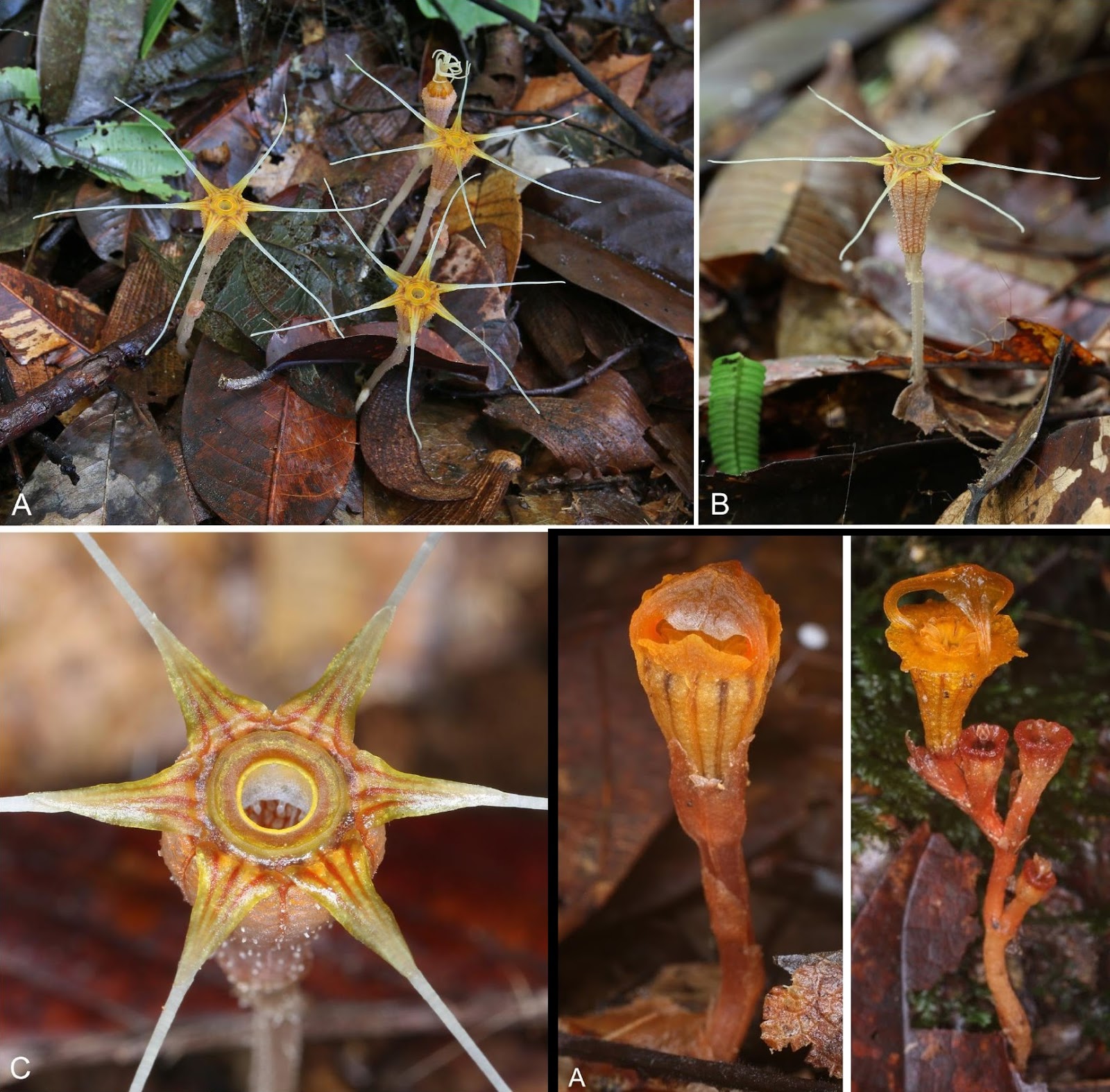
Fig. 1. Thismia ornata – A: habit of flowering plant; B: flower bud; C: detail of flower, apical view; D: stigma; E: inner view of stamens,; F: seed; G: outer view of stamens and inside of floral tube.
– From Sochor & al. BOR 51/19 (A, C–E, G), BOR54/19 (B), BOR 56/19 (F). 

– Drawn by Kateřina Janošíková. 

Fig. 3. Distribution of Thismia ornata (yellow circles) and T. coronata (red circle).

Fig. 2. Thismia ornata – A, B: overall appearance; C: detail of flower, apical view; D: ovary, stigma and inner surface of floral tube (background grid spacing = 1 mm); E: seeds; F: inner view of stamens; G: lateral view of connective after cutting off neighbouring connective; H: outer view of stamen.
– From Sochor & al. BOR53/19 (A), BOR51/19 (B–D, F–H) and BOR56/19 (E).


Thismia ornata Dančák, Hroneš & Sochor, sp. nov. 

Diagnosis — Thismia ornata differs from the most similar known species, T. filiformis Chantanaorr., by flower size (to c. 10 cm in diam. vs to c. 3 cm including tepal appendages), inner surface of floral tube (with very fine bright orange reticulum inside vs lacking any reticulum), length of tepal appendages (to 35 mm vs to 8 mm), appendages on apical margin of connective (five of three different shapes vs three of two different shapes) and shape of lateral appendage (with small horn-shaped projection arising from each side of the lateral appendage vs lacking any horn-shaped projections).


 Distribution — Thismia ornata occurs in western Sarawak in a number of locations surrounding Kuching, including Kubah National Park, Santubong National Park, Dered Krian National Park and Fairy Cave Nature Reserve (Fig. 3).

Habitat — Thismia ornata inhabits a wide range of tropical lowland rain forest habitats with an altitudinal range from 40 m to c. 300 m a.s.l. It is known from rather dry limestone outcrops, lowland mixed dipterocarp forests, riverine forests including forests with some anthropogenic disturbance.

Conservation status — Thismia ornata is endemic to Borneo. Most, if not all, known populations occur within national parks and other protected areas. While the extent of occurrence (EOO) is c. 270 km2, its minimal area of occupancy (AOO) could be estimated to be 30 km2. It is known from several populations, which represent three locations (sensu IUCN 2012). Thismia ornata is therefore assigned a preliminary conservation status of VU (D1+2) according to the IUCN Red List categories and criteria (IUCN 2012).

Etymology — The specific epithet is the feminine form of the Latin adjective ornatus (ornate or decorated), which-reflects the colourful flowers and very fine bright orange reticulum inside the floral tube that resembles lace.


Fig. 5. Thismia coronata – A: lateral view of flower; B: apical view of flower; C: habit of flowering plant; D: stigma; E: outer view of stamens; F: inner view of stamens.
– From Sochor & al. BOR11/19 (A–H). – Drawn by Kateřina Janošíková. 

Fig. 6. Thismia coronata – A: flower prior to anthesis; B, C, D: overall appearance; E: apical view of flower; F: stigma; G: roots; H: outer bottom view of stamen.
– Finest grid spacing in D and G = 1 mm. 

– From Sochor & al. BOR11/19 (A–H).


Thismia coronata Hroneš, Dančák & Sochor, sp. nov. 

Diagnosis — Thismia coronata differs from T. kelabitiana by the shape of outer tepals (entire with a single tooth in the middle vs deeply divided into several acute lobes), mitre apex (without tetrahedral depressions on upper surface vs with tetrahedral depressions on upper surface), smaller size of flower (1.8–2.3 cm vs 2.6–2.8 cm long) and flower colour (dark yellow to orange across whole flower vs white floral tube and bright yellow upper parts).


Distribution — Thismia coronata is known only from the type locality and its close surroundings in the Paya Maga mountain range in northern Sarawak (Fig. 3). At least 40 individuals were recorded at the locality.

Habitat — Thismia coronata occurs in lower montane primary tropical rainforest at an altitude around 1300 m a.s.l. It was found in relatively humid forest with dense understorey (Fig 7C). A variety of other mycoheterotrophic species were abundant at the type locality and surroundings, including Burmannia lutescens Becc. agg. (Burmanniaceae), Cystorchis aphylla Ridl. (Orchidaceae), Epirixanthes kinabaluensis T. Wendt, E. pallida T. Wendt (both Polygalaceae), Exacum tenue (Blume) Klack. (Gentianaceae), Lecanorchis multiflora J. J. Sm. (Orchidaceae), Sciaphila arfakiana Becc., Sciaphila sp. (both Triuridaceae) and Thismia viridistriata Sochor, Hroneš & Dančák. Herbaceous vegetation was otherwise sparse.

Conservation status — Thismia coronata is endemic to Borneo and the only known population occurs outside national parks and other protected areas. The number of mature individuals observed is fewer than 50. The extent of occurrence cannot be estimated because the species is known only from the type locality and its area of occupancy (AOO) is estimated to be only 4 km2. Thismia coronata is therefore assigned a preliminary status of CR (B2ab(iii); D) according to the IUCN Red List categories and criteria (IUCN 2012).

Etymology — The specific epithet is the feminine form of the Latin adjective coronatus (crowned), which reflects the shape and colour of the tepals resembling a royal crown.


Martin Dančák, Michal Hroneš and Michal Sochor. 2020. Thismia ornata and T. coronata (Thismiaceae), Two New Species from Sarawak, Borneo. Willdenowia. 50(1); 65–76. DOI: 10.3372/wi.50.50106


[Ichthyology • 2020] Plectranthias cruentus • A New Species of Anthiadine Perchlet (Teleostei: Serranidae) from the Lord Howe Rise, Tasman Sea


Plectranthias cruentus Gill & Roberts. 2020

Plectranthias pelicieri Randall & Shimizu, 1994


Abstract
Plectranthias cruentus new species is described from the holotype and two paratypes collected off Ball’s Pyramid and a paratype from Lord Howe Island. It resembles P. pelicieri Randall & Shimizu 1994 in live coloration and most morphological details, including absence of predorsal scales anterior to the supratemporal commissure, but differs in having the fifth or sixth (versus third) dorsal-fin spine longest, at least some pectoral-fin rays branched (versus all unbranched), and inconspicuous (versus distinct) serrations on the interopercle. It also differs in live coloration details.

Keywords: Pisces, ichthyology, taxonomy, osteology, distributions

Plectranthias cruentus new species, AMS I.42725-007, 57.3 mm SL, freshly dead holotype, off Ball’s Pyramid, Lord Howe Island, Australia.
Photo by Robin McPhee/Kerryn Parkinson, NORFANZ voyage 2003

Plectranthias cruentus new species 
Common name: Bloody Perchlet

Etymology. The specific epithet is from the Latin, meaning stained or spotted with blood, and alludes to the bright red markings in life. 


 Plectranthias pelicieri, aquarium individual from New Caledonia.
Photo by Y.K. Tea.


 Anthony C. Gill and Clive D. Roberts. 2020. Plectranthias cruentus, A New Species of Anthiadine Perchlet (Teleostei: Serranidae) from the Lord Howe Rise, Tasman Sea. Zootaxa. 4750(4); 560–566. DOI: 10.11646/zootaxa.4750.4.6 

The jigsaw: putting together the Bloody Perchlet puzzle

Friday, March 27, 2020

[Paleontology • 2020] Dineobellator notohesperus • New Dromaeosaurid Dinosaur (Theropoda, Dromaeosauridae) from New Mexico and Biodiversity of Dromaeosaurids at the End of the Cretaceous


Dineobellator notohesperus
Jasinski, Sullivan & Dodson, 2020 

Illustration: Sergey Krasovskiy 

Abstract
Dromaeosaurids (Theropoda: Dromaeosauridae), a group of dynamic, swift predators, have a sparse fossil record, particularly at the time of their extinction near the Cretaceous-Paleogene boundary. Here we report on a new dromaeosaurid, Dineobellator notohesperus, gen. and sp. nov., consisting of a partial skeleton from the Upper Cretaceous (Maastrichtian) of New Mexico, the first diagnostic dromaeosaurid to be recovered from the latest Cretaceous of the southern United States (southern Laramidia). The holotype includes elements of the skull, axial, and appendicular skeleton. The specimen reveals a host of morphologies that shed light on new behavioral attributes for these feathered dinosaurs. Unique features on its forelimbs suggest greater strength capabilities in flexion than the normal dromaeosaurid condition, in conjunction with a relatively tighter grip strength in the manual claws. Aspects of the caudal vertebrae suggest greater movement near the tail base, aiding in agility and predation. Phylogenetic analysis places Dineobellator within Velociraptorinae. Its phylogenetic position, along with that of other Maastrichtian taxa (Acheroraptor and Dakotaraptor), suggests dromaeosaurids were still diversifying at the end of the Cretaceous. Furthermore, its recovery as a second North American Maastrichtian velociraptorine suggests vicariance of North American velociraptorines after a dispersal event during the Campanian-Maastrichtian from Asia. Features of Dineobellator also imply that dromaeosaurids were active predators that occupied discrete ecological niches while living in the shadow of Tyrannosaurus rex, until the end of the dinosaurs’ reign.

Figure 1: Selected elements and features of the holotype of Dineobellator notohesperus (SMP VP-2430), gen. et sp. nov., including: right humerus, posterior (A) view; right ulna, medial (B) view; close up of ulna showing feathers where ulnar papillae are located along the ulnar ridge, feathers used are from Megascops kennicottii (C); middle caudal vertebra (D,E), distal (D) and (E) lateroventral (E) views, with red highlighting circular indent on centrum surface; tooth, lateral (F) view; magnification of distal basal denticles (G); anterior caudal vertebra 1, right lateral (H) view; right manual ungual II (I–L), lateral (I) view, silhouette of transverse plane of right manual ungual II near distal end (J), medial (K) view, and with area shown in dashed box in K highlighting abnormal oblong concavity in red (L); right pedal ungual III, partially reconstructed, lateral (M) view.

Abbreviations: cc, central concavity; dc, deltopectoral crest; eg, digital extensor groove; ft, flexor tubercle; ld, latissimus dorsi scar; lg, lateral groove; mc, medial crest; mg, medial groove; na, neural arch; ns, neural spine; op, olecranon process; tp, transverse process. Scale bars, 1 cm for (A–E) and (H–M), 1 mm for (F,G). (L) not to scale.

Figure 2: Skeletal reconstruction of Dineobellator notohesperus gen. et sp. nov., SMP VP-2430, with known elements colored in white. Figured bones are as follows: fused distal caudal vertebra (A); middle caudal vertebra (B); caudal vertebra 1 (C); right femur (D); rib (E); right basipterygoid (F); left lacrimal (reversed) (G); right jugal (H); right humerus (I); right ulna (J); right metacarpal III (K); right manual ungual II (L); right metatarsal II (M); right metatarsal III. (N) Individual scale bars, 2 cm. Skeletal drawing based off work of Scott Hartman.


Systematic paleontology
Dinosauria Owen, 1842; 
Theropoda Marsh, 1881; 
Coelurosauria Huene, 1914; 
Dromaeosauridae Matthew and Brown, 1922; 

Dineobellator notohesperus gen. et sp. nov.

Etymology: The generic name is derived from Diné, the Navajo word in reference to the people of the Navajo Nation, and the Latin suffix bellator, meaning warrior. The specific epithet noto is from the Greek, meaning southern, or south; and the Greek hesper meaning western, in reference to the American Southwest. Additionally, Hesperus refers to a Greek god, namely the personification of the evening star and, by extension, “western.” Pronounced “dih NAY oh - BELL a tor” “Noh toh – hes per us.”

Holotype: SMP VP-2430 is a disarticulated, associated individual consisting of a rostromedial portion of right premaxilla, left maxilla fragment, ?maxillary tooth, dorsolateral process of left lacrimal, left ?nasal fragment, incomplete right jugal, incomplete right basipterygoid, incomplete occipital condyle, isolated prezygopophyses, isolated vertebral processes, caudal vertebra 1, middle caudal vertebra, four fused distal caudal vertebrae, several vertebral fragments, nearly complete rib and rib fragments, nearly complete right humerus, nearly complete right ulna, incomplete right metacarpal III, nearly complete right manual ungual II, incomplete right femur, incomplete right metatarsals I, II and III, incomplete left ?astragalus, nearly complete right pedal ungual III, and various other cranial and post-cranial bone fragments (Figs. 1–2). Portions of the specimen were first found and collected by Robert M. Sullivan, Steven E. Jasinski, and James Nikas in 2008, and more material was subsequently collected from the same individual by Sullivan and Jasinski in 2009 and Jasinski in 2015 and 2016.

 Type locality and horizon: The type locality, SMP 410b, Bisti/De-na-zin Wilderness, New Mexico. Precise locality information is on file at the State Museum of Pennsylvania, Section of Paleontology and Geology, and is available to qualified researchers. The holotype (SMP VP-2430) was collected within a few meters above the base of the Naashoibito Member (Ojo Alamo Formation) in relatively poorly consolidated sandstone. 40Ar/39Ar dates acquired from detrital sanidines give a maximum depositional age for the Naashoibito Member at 66.5 ± 0.2 Ma (upper Maastrichtian)16,17,18,19,20. Biostratigraphy, however, seems to suggest an early late Maastrichtian age, approximately 70.0–68.0 Ma21.

Diagnosis: A mid-sized dromaeosaurid theropod that differs from other eudromaeosaurs by the following characters: offset of lateral grooves on manual ungual; distinct and conspicuous dorsomedial groove proximally dorsal to the articular surface on the manual ungual; sharp angle of distal deltopectoral crest of the humerus; opisthocoelous proximal caudal vertebrae; short and robust neural spines on proximal caudal vertebrae; gracile and subrectangular transverse processes on proximal caudal vertebrae; proximal caudal vertebrae with curved ventral surface and oval to subrectangular cranial and caudal centrum surfaces; distinct round concavities on cranial and caudal centrum surfaces in mid-caudal vertebrae; enlarged flexor tubercles on manual ungual II and pedal ungual III; and secondary lateral grooves ventral on pedal unguals.


Figure 3: Time-calibrated phylogeny of dromaeosaurid relationships illustrating the major relationships within the family including their paleobiogeography. Strict consensus phylogenetic tree resulting in 32 most parsimonious trees, each with a tree length of 416 steps, a Consistency Index of 0.466, and a Retention Index of 0.640. Archaeopteryx is the outgroup. Temporal positions and biogeographic locations of dromaeosaurid taxa are provided. Silhouettes are taken from phylopic.org and are freely available for reuse under a Public Domain or Creative Commons license (www.phylopic.org), see SI for more information about individual silhouettes. Credits for silhouettes and references for temporal positions and biogeographic locations provided in SI.


Dineobellator notohesperus from the Ojo Alamo Formation from the end of the Cretaceous period in New Mexico. 
 the ceratopsid Ojoceratops 

A small tyrannosaurid is following the sauropod Alamosaurus

 hadrosaurids and the rare caenagnathid oviraptorosaur Ojoraptorsaurus

Illustration: Sergey Krasovskiy 


Steven E. Jasinski, Robert M. Sullivan and Peter Dodson. 2020. New Dromaeosaurid Dinosaur (Theropoda, Dromaeosauridae) from New Mexico and Biodiversity of Dromaeosaurids at the End of the Cretaceous. Scientific Reports. 10: 5105. DOI: 10.1038/s41598-020-61480-7  

Scientists working in New Mexico found a fossilized 6-inch dinosaur claw that has led them to recognize a fierce new species, Dineobellator notohesperus 


[Herpetology • 2020] A Taxonomic Revision of the South-eastern Dragon Lizards of the Smaug warreni (Boulenger) Species Complex (Squamata: Cordylidae) in southern Africa, with the Description of A New Species, Smaug swazicus


Smaug swazicus Bates​​ & Stanley, 2020

Swazi Dragon Lizard  || DOI: 10.7717/peerj.8526  

Abstract
A recent multilocus molecular phylogeny of the large dragon lizards of the genus Smaug Stanley et al. (2011) recovered a south-eastern clade of two relatively lightly-armoured, geographically-proximate species (Smaug warreni (Boulenger, 1908) and S. barbertonensis (Van Dam, 1921)). Unexpectedly, S. barbertonensis was found to be paraphyletic, with individuals sampled from northern Eswatini (formerly Swaziland) being more closely related to S. warreni than to S. barbertonensis from the type locality of Barberton in Mpumalanga Province, South Africa. Examination of voucher specimens used for the molecular analysis, as well as most other available museum material of the three lineages, indicated that the ‘Eswatini’ lineage—including populations in a small area on the northern Eswatini–Mpumalanga border, and northern KwaZulu–Natal Province in South Africa—was readily distinguishable from S. barbertonensis sensu stricto (and S. warreni) by its unique dorsal, lateral and ventral colour patterns. In order to further assess the taxonomic status of the three populations, a detailed morphological analysis was conducted. Multivariate analyses of scale counts and body dimensions indicated that the ‘Eswatini’ lineage and S. warreni were most similar. In particular, S. barbertonensis differed from the other two lineages by its generally lower numbers of transverse rows of dorsal scales, and a relatively wider head. High resolution Computed Tomography also revealed differences in cranial osteology between specimens from the three lineages. The ‘Eswatini’ lineage is described here as a new species, Smaug swazicus sp. nov., representing the ninth known species of dragon lizard. The new species appears to be near-endemic to Eswatini, with about 90% of its range located there. Our study indicates that S. barbertonensis sensu stricto is therefore a South African endemic restricted to an altitudinal band of about 300 m in the Barberton–Nelspruit–Khandizwe area of eastern Mpumalanga Province, while S. warreni is endemic to the narrow Lebombo Mountain range of South Africa, Eswatini and Mozambique. We present a detailed distribution map for the three species, and a revised diagnostic key to the genus Smaug.


 Smaug swazicus sp. nov. (B) Dorsal colouration of live paratype (NMB R9194). (C) Ventral colouration.
(Photos: E.L. Stanley).

Figure 8: (A) Shady rocky outcrops at Nkomati Viewpoint, Malolotja National Park, Eswatini, typical habitat of Smaug swazicus sp. nov. (B) Dorsal colouration of live paratype of S. swazicus (NMB R9194). (C) Ventral colouration of S. swazicus. (Photo credits: E.L. Stanley).

Systematics
Family Cordylidae Gray, 1838

Smaug swazicus Bates & Stanley sp. nov.
Swazi Dragon Lizard

Diagnosis. (includes ‘additional material’) Distinguished from all other cordylids (Cordylidae) by its unique combination of dorsal, lateral and ventral colour patterns (see descriptions and figures). Referable to the genus Smaug on the basis of its large size and robust body, enlarged and spinose dorsal and caudal scales, enlarged occipital scales, and frontonasal in contact with the rostral, separating the nasal scales.

A medium to large species of Smaug distinguishable by the following combination of characters: (1) back dark brown usually with 5–6 pale bands (usually interrupted) between fore- and hindlimbs, each band consisting of pale, sometimes dark-edged, markings; (2) pale band on nape behind occipitals; (3) flanks with large pale spots or blotches; (4) belly pale with a dark median longitudinal band bordered on either side by broad, dark, bands; (5) throat pale with extensive bold brown mottling (sometimes forming transverse bands; often much of throat is dark); (6) six enlarged, moderately to non-spinose, occipital scales, middle pair the smallest, outer occipitals usually shorter than the adjacent inner ones; (7) dorsolateral and lateral scales moderately spinose; (8) tail moderately spikey; (9) dorsal scale rows transversely 31–41; (10) dorsal scale rows longitudinally 20–26; (11) ventral scale rows transversely 23–29; (12) ventral scale rows longitudinally 14 (rarely 12); (13) femoral pores per thigh 10–13; subdigital lamellae on 4th toe 16–19.
....

Figure 5: Smaug swazicus sp. nov. (A) Dorsal, (B) ventral and (C) lateral views of the head of the holotype (NMB R9201). (Drawing credit: E.L. Stanley).


Figure 2: Differences in colour pattern in the Smaug warreni species complex.
From left to right: Dorsal views of (A) Smaug barbertonensis (NMB R9196, topotype), (B) S. cf. barbertonensis (TM 78918, allotype of new species) and (C) S. warreni (TM 63567);
ventral views of (D) S. barbertonensis (TM 55789), (E) S. cf. barbertonensis (TM 78918) and (F) S. warreni (TM 78969)
(Photos: M.F. Bates).


Etymology. Named for the Kingdom of Eswatini, the country where most of the species’ range is located. Both ‘eSwatini’ and ‘Swaziland’ derive from the word iSwazi, after the name of an early chief, Mswati II (c. 1820–1868).

Distribution. Highveld and Middleveld of Eswatini in Hhohho, Manzini and Shiselweni Regions, and adjacent areas in the South African provinces of (eastern) Mpumalanga (in Nkomazi municipality) and (northern) KwaZulu–Natal (in uPhongolo and Abaqulusi municipalies) (Fig. 9) at elevations of 462 to 1,139 m a.s.l.


Natural history. Diurnal and rupicolous, living in deep, horizontal (or gently sloping) crevices in granitic rock along hillsides, usually in the partial shade of trees (Fig. 8A; see also Jacobsen, 1989). According to R.C. Boycott (in litt., 2019), rocky terrain in closed canopy bushveld is the preferred habitat in Eswatini. A specimen in Ithala Game Reserve in KwaZulu–Natal was photographed on a tree trunk (ReptileMAP, VM no. 152451). When grasped by the hind limb, an individual from the type series performed an unusual anti-predator behaviour by repeatedly flexing and extending the inhibited limb caudally, so as to pull the captors’ digits directly onto the very sharp whorl of spines at the base of the tail (E.L. Stanley, 2008, personal observation). 


Michael F. Bates​​ and Edward L. Stanley​. 2020. A Taxonomic Revision of the South-eastern Dragon Lizards of the Smaug warreni (Boulenger) Species Complex in southern Africa, with the Description of A New Species (Squamata: Cordylidae).   PeerJ. 8:e8526. DOI: 10.7717/peerj.8526