Thursday, June 27, 2019

[Botany • 2019] Curcuma saraburiensis (Zingiberaceae) • A New Species from Thailand


Curcuma saraburiensis Boonma & Saensouk

in Boonma & Saensouk, 2019. 
สระบุรีรำลึก ||  tai2.ntu.edu.tw/Taiwania

Abstract
Curcuma saraburiensis sp. nov. (Zingiberaceae), a new species from Saraburi Province, Central Thailand, is described, illustrated and photographed. The dominant characteristics of this species are; the fertile bracts are light green with light pale green or white longitudinal line and 2 white circles patch. Coma bracts; outer glabrous, light green with green longitudinal line alternating with light green or white lines, inner glabrous, white with green edges. Lateral staminodes narrowly oblong, white with 3‒4 red lines (2 red lines in the middle, half of the length of the staminodes and 1‒2 lines found at the edge of the staminodes). Labellum obovate, deep incision up to 9 mm, white with 2 purple patches on ether sides and 4 red lines, 2 lines at each side.

Keyword: Curcuma saraburiensis, New species, Saraburi, Thailand, Zingiberaceae

Fig. 1. Curcuma saraburiensis Boonma & Saensouk;
 A. rhizome; B. habitat and inflorescences; C. closed form of young inflorescence; D. mature inflorescence; E. top view of mature inflorescence; F. flower-side view; G. flower-front view; H. seeds with white arils.

Fig. 2. Curcuma saraburiensis Boonma & Saensouk;
A. dorsal corolla lobe; B. lateral corolla lobes; C. staminodes; D. stamen; E. labellum; F. flower-front view; G. inflorescence; H. bract; I. habit; J. flower-side view (Scale bars: A–E and J = 1 cm; G = 3 cm; H = 2 cm; I =10 cm); Drawn by Thawatphong Boonma.


Curcuma saraburiensis Boonma & Saensouk, sp. nov.

Etymology: The specific epithet of the new species is collected from ‘Saraburi Province’, the first discover place.

 Distribution: Endemic to Thailand, currently found in the type locality (Phra Phutthabat District, Saraburi Province) 

Ecology: Deciduous forest 50‒300 m above sea level. 

Vernacular names: "Saraburi-Rum-Luek - สระบุรีรำลึก” 

DISSCUSION
When comparing all Curcuma L. species reported in previous study by Sirirugsa et al. (2007) and many botanists, the morphology of Curcuma saraburiensis sp. nov. was similar to C. parviflora, C. larsenii and C. rhabdota in some characters but differs in its fertile bracts are light green with light pale green or white longitudinal line and 2 white circles patch. Coma bracts; outer glabrous, light green with green longitudinal line alternating with light green or white lines, inner glabrous, white with green edges. Lateral staminodes narrowly oblong, white with 3-4 red lines. Labellum obovate, deep incision up to 9 mm, white with 2 purple patches on ether sides and 4 red lines, 2 lines at each side. (Table 1 and Figs. 1‒2). 


Thawatphong Boonma and Surapon Saensouk. 2019. Curcuma saraburiensis (Zingiberaceae), A New Species from Thailand. Taiwania. 64(3); 245-248. DOI: 10.6165/tai.2019.64.245

[Ichthyology • 2019] Channa brunnea • A New Species of Snakehead (Teleostei: Channidae) from West Bengal, India


Channa brunnea  
Praveenraj, Uma, Moulitharan & Kannan, 2019


Abstract
Channa brunnea, a new species of snakehead fish lacking pelvic fins, from West Bengal, India, is distinguished from its pelvic fin-less congeners by possessing an uniform dark brown body, ochre to bright-orange blotches on the caudal fin, fewer dorsal and anal-fin rays (35–37 vs. 47–51 and 24 vs. 28–32, respectively), fewer vertebrae (43 vs. 45–57), and fewer lateral-line scales (43–46 vs. 51–63). Though Channa brunnea superficially resembles C. bleheri, it can be distinguished from the latter by possessing dark-brown oblique markings on the upper half of the body; transverse scale rows (4½–5½ vs. 3½); pre-anal scales (22–26 vs. 17–20); 2 rows of teeth in the fifth ceratobranchial, the outer row with 16 large conical teeth (vs. 3 rows of teeth, the outer row with 13 large conical teeth); dentary with 20 large, stout, conical teeth in the inner row (vs. 32 medium-sized conical teeth); and a Kimura’s two parameter (K2P) distance of 9.8–10.6%.

Keywords: Pisces, Channa bleheri, Channa andrao, cox1 gene, Eastern Himalaya, freshwater fish


Jayasimhan Praveenraj, Arumugam Uma, Nallathambi Moulitharan and Rajesh Kannan. 2019. Channa brunnea, A New Species of Snakehead (Teleostei: Channidae) from West Bengal, India. Zootaxa. 4624(1); 59–70. DOI: 10.11646/zootaxa.4624.1.4

[PaleoOrnithology • 2019] Pachystruthio dmanisensis • A Giant early Pleistocene Bird from eastern Europe: Unexpected Component of Terrestrial Faunas at the Time of early Homo arrival


Pachystruthio dmanisensis

in Zelenkov, Lavrov, Startsev, et al, 2019
  DOI: 10.1080/02724634.2019.1605521
Illustration: Andrey Atuchin

ABSTRACT
Giant birds, comparable in size to elephant birds and moa, have never been reported from Europe. Here, we describe a femur from the lower Pleistocene of the north Black Sea area (Crimea) that is referred to Pachystruthio dmanisensis, comb. nov., a giant bird with an estimated body mass of about 450 kg. This value makes this extinct bird one of the largest known avians (comparable to Aepyornis maximus) and the only bird of such giant size in Europe and the Northern Hemisphere in general. In contrast to very large insular birds, Pachystruthio dmanisensis was a good runner, which may be explained by its coexistence with large carnivoran mammals. Pachystruthio dmanisensis and associated assemblage of fossil mammals are shared with the Dmanisi locality in Georgia (∼1.8–1.7 Ma); thus, this giant bird was likely a typical component of eastern European faunas at the time of early hominin arrival. We suggest that Pachystruthio dmanisensis, together with early Homo and a variety of mammals, reached the northern Black Sea region via the southern Caucasus and Anatolia, because the older (Pliocene) finds of this fauna are known from Georgia and Turkey.


Illustration: Andrey Atuchin 

SYSTEMATIC PALEONTOLOGY
Order ?STRUTHIONIFORMES

Family INCERTAE SEDIS

Genus PACHYSTRUTHIO Kretzoi, 1954 

?PACHYSTRUTHIO DMANISENSIS (Burchak-Abramovich and Vekua, 1990), comb. nov.

FIGURE 2. Fossil femora of an extinct giant bird from the Crimean Peninsula (eastern Europe), with that of an average Recent ostrich for comparison.
A, C, E, F, Pachystruthio dmanisensis, comb. nov., specimen PIN 5644/56, from Taurida Cave, Crimean Peninsula (early Pleistocene);
B, D, Struthio camelus, osteological collection of PIN 1741-1. A, B, cranial view; C, D, caudal view; E, lateral view; F, proximal view.
 Abbreviations: cf, caput femoris; cl, condylus lateralis; cm, condylus medialis; ct, crista trochanteris; faa, facies articularis antitrochanterica; fop, fossa poplitea; fp, foramen pneumaticum; li, linea intermuscularis; sic, sulcus intercondylaris; sp, sulcus patellaris; tfi, trochlea fibularis.

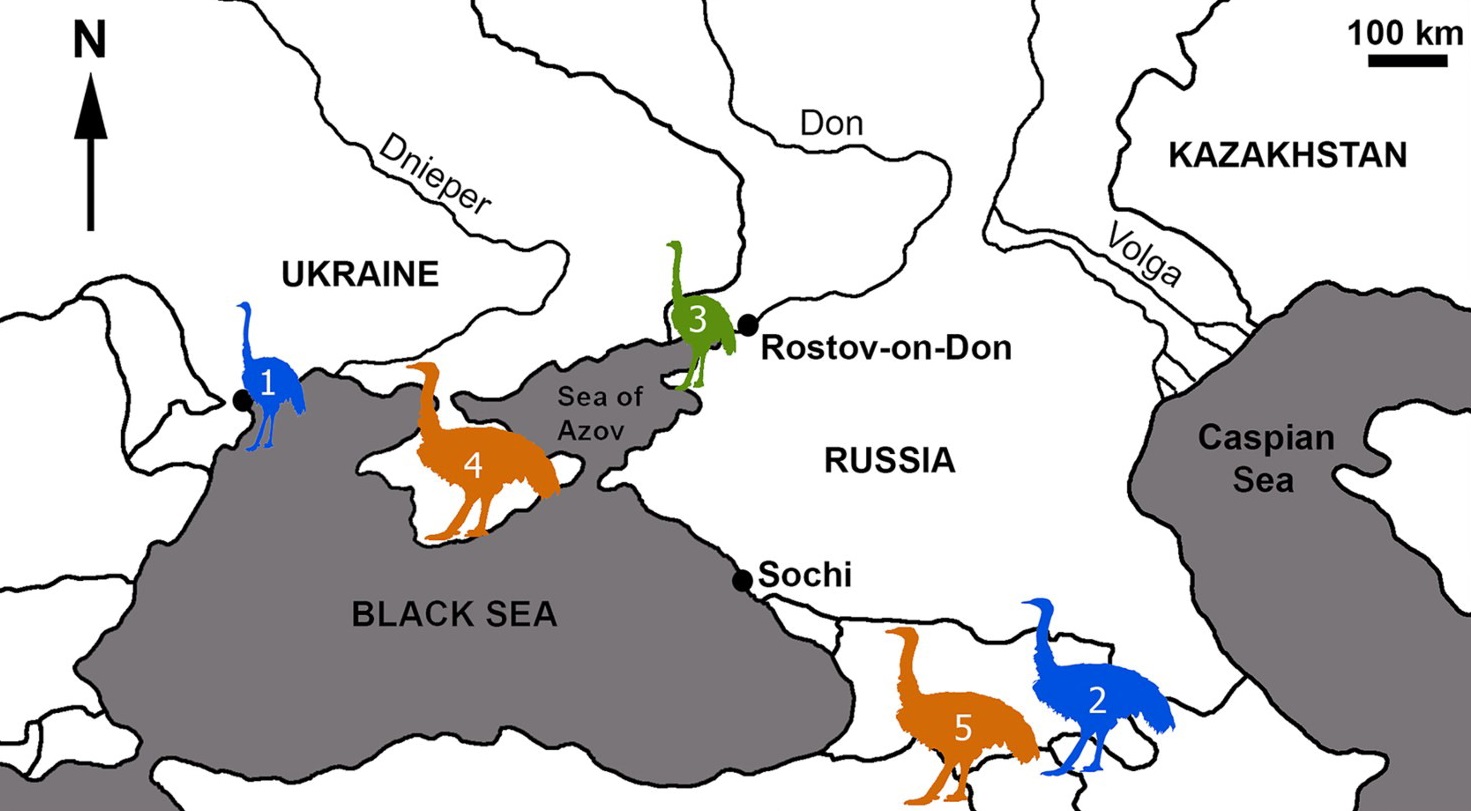
FIGURE 3. Map showing distribution of bony remains of the giant species of Pachystruthio (large ostrich silhouettes) and smaller Struthio ostriches (small ostrich silhouettes) in the Black Sea region in the Pliocene (5.3–2.6 Ma; blue), Gelasian (2.6–1.8 Ma; green), and Calabrian (1.8–0.8 Ma; brown). Pachystruthio from Hungary (Kretzoi, 1954) is not shown. Localities: 1, Odessa catacombs (early Pliocene); 2, Kvabebi (late Pliocene); 3, Liventsovka (Gelasian); 4, Taurida Cave (Calabrian); 5, Dmanisi (Calabrian).


 Nikita V. Zelenkov, Alexander V. Lavrov, Dmitry B. Startsev, Innessa A. Vislobokova and Alexey V. Lopatin. 2019. A Giant early Pleistocene Bird from eastern Europe: Unexpected Component of Terrestrial Faunas at the Time of early Homo arrival. Journal of Vertebrate Paleontology.  e1605521 DOI: 10.1080/02724634.2019.1605521
Half-tonne birds may have roamed Europe at same time as humans  theguardian.com/science/2019/jun/27/half-tonne-birds-roamed-europe-humans 


Tuesday, June 25, 2019

[Herpetology • 2019] First Record of the Krait Bungarus slowinskii (Squamata: Elapidae) from Thailand


Bungarus slowinskii Kuch, Kizirian, Nguyen, Lawson, Donelly & Mebs, 2005
from Doi Phu Kha National Park, Nan Province, northern Thailand.

 in Smits & Hauser, 2019. 
งูสามเหลี่ยมน่าน || tci-thaijo.org/index.php/TNH

Abstract
The Red River krait Bungarus slowinskii has hitherto been known only from six localities in northern and central Vietnam and central Laos. In this paper, the first country record of this species is reported for Thailand. One adult specimen was observed and photographed in the evergreen forest in the mountainous Doi Phu Kha National Park, Nan Province, eastern North Thailand. Its morphological characteristics closely matched those in the previous records of B. slowinskii. The new record extends the range of the species about 200 km to the west.

Keywords: Bungarus slowinskii, elapids, habitat, northern Thailand, zoogeography


FIGURE 1. QSMI 1601, Bungarus slowinskii from Nan Province, Thailand.

  FIGURE 2. Lateral view of the head and neck of QSMI 1601, Bungarus slowinskii from Nan Province, Thailand.

FIGURE 3. Details of white cross-bands with the black-edged scales of QSMI 1601, Bungarus slowinskii from Nan Province, Thailand. 


Ton Smits and Sjon Hauser. 2019. First Record of the Krait Bungarus slowinskii Kuch, Kizirian, Nguyen, Lawson, Donelly and Mebs, 2005 (Squamata: Elapidae) from Thailand. Tropical Natural History. 19(2); 43-50. tci-thaijo.org/index.php/tnh/article/view/170942
งูสามเหลี่ยมน่าน || งูสามเหลี่ยมสโลวินสกี้


[Arachnida • 2019] The Mosaic Tiled Harvestmen — Taxonomic Review of Gonyleptellus Roewer, 1930 (Opiliones: Gonyleptidae)


Gonyleptellus angeloi
 Ázara & Kury, 2019


Abstract
The genus Gonyleptellus Roewer, 1930 is revised and reordered; a new species Gonyleptellus angeloi sp. nov. is described from Nova Friburgo, Rio de Janeiro, three additional species are transferred from other genera and one species is removed, resulting in five species in this genus. The following nomenclatural acts are proposed herein: Gonyleptes pustulatus Sørensen, 1884 is transferred from Gonyleptes to Gonyleptellus; Gonyleptes cancellatus Roewer, 1917 and Progonyleptoides pustulosus Mello-Leitão, 1935, both currently under the synonymy of Gonyleptellus bimaculatus (Sørensen, 1884), are revalidated and transferred to Gonyleptellus. Stephanocranion bimaculatus Mello-Leitão, 1931, previously considered a junior synonym of Gonyleptes cancellatus Roewer, 1917, and thereby previously carried under the synonymy of Gonyleptes bimaculatus Sørensen, 1884, is here unlinked with the former but kept under the synonymy of the latter (of which it is also a junior secondary homonym). Stephanocranion serrulatum Mello-Leitão, 1940, currently under the synonymy of G. bimaculatus, is newly synonymized with P. pustulosus. Stephanocranion bufoninus Mello-Leitão, 1949 (currently combined under Gonyleptellus) is considered a junior subjective synonym of Discocyrtus crenulatus Roewer, 1913. The male of Gonyleptellus bimaculatus is described for the first time. The genus Gonyleptellus is restricted to the states of Rio de Janeiro and São Paulo, Brazil. A key and a map for all the five valid species are presented.

Keywords: Opiliones, Arachnida, taxonomy, Neotropics, Brazil, Atlantic Forest


 Ludson Neves de Ázara and Adriano Brilhante Kury. 2019. The Mosaic Tiled Harvestmen — Taxonomic Review of Gonyleptellus Roewer, 1930 (Opiliones: Gonyleptidae: Gonyleptinae). Zootaxa. 4623(2); 201–238. DOI: 10.11646/zootaxa.4623.2.1


Monday, June 24, 2019

[Botany • 2019] Thismia submucronata (Thismiaceae) พิศวงตาปีศาจ • A New Species from Mainland Southeast Asia


Thismia submucronata Chantanaorr., Tetsana & Tripetch

in Chantanaorrapint, Tetsana, Tripetch & Suddee, 2019.
พิศวงตาปีศาจ ||  DOI: 10.6165/tai.2019.64.240

Abstract
Thismia submucronata is described and illustrated as a new species from Thailand. The new species is characterized by 1) vermiform roots, 2) inner perianth lobes forming a convex mitre with a mucro together with three foveae at apex, 3) the inner surface of perianth tube possessing an irregularly reticulate surface without transverse bars, 4) the presence of papillate hairs at the annulus surface and the outer surface of stamen filaments, and 5) the stamens positioned almost at apex of annulus. Morphological description, illustrations of the new species and a comparison with the related species are presented.

Keyword: Mycoheterotrophy, New species, Thailand, Thismia submucronata, Thismiaceae


Thismia submucronata (A–H): A: Plants with underground parts. B: Plants in natural habitat. C−D: Top view of mitre. E: Side view of flowers. F−G: Longitudinal section of flowers. H: Young fruit, showing ovary and stigma. 

Fig. 2. Thismia submucronata (A–H): A: Plants with underground parts. B: Plants in natural habitat. C−D: Top view of mitre. E: Side view of flowers. F−G: Longitudinal section of flowers. H: Young fruit, showing ovary and stigma.
T. angustimitra (I−J): I: Flowers. J: Longitudinal section of flower.
T. mirabilis (K–L): K: Top view of mitre. L: Longitudinal section of flower.
T. nigricans (M): M. longitudinal section of flower.
Photos A–E & H–M by S. Chantanaorrapint; 
F–G by P. Tripetch. 


Thismia submucronata Chantanaorr., Tetsana & Tripetch, sp. nov.

Diagnosis: Thismia submucronata is similar to T. mucronata, but differs in having three foveae together with a mucro at the apex of the mitre and outer surface of stamen filaments and both surfaces of annulus covered by papillate hairs.
...

Fig. 1. Thismia submucronata: A & B.: Plants with flowers. C & D: Side view of flowers. E: Outer tepal. F: Longitudinal section of perianth tube with stamens. G: Inner view of three pendulous stamens. H. Stigma and style. I. Young fruit. A & C–I from the holotype Chantanaorrapint & Suwanmala 2732, B from Tetsana et al. 311 (BKF). All drawn by S. Chantanaorrapint.

Etymology: The specific epithet “submucronata” refers to the presence of a short mucro at the top of the mitre

Habitat, ecology and distribution: Thismia submucronata is known only from two localities: Phu Hin Rong Kla [Phitsanulok province] and Phu Suan Sai National Parks [Loei province]; however, it may also occur in other areas of Northern and Northeastern Thailand with similar climatic conditions and vegetation type. The new species grows amongst leaf litter, under shade of moist evergreen forest, near waterfall or streamside, at elevation of 1200−1300 m. Flowering and fruiting was observed from May to July.


Sahut Chantanaorrapint, Naiyana Tetsana, Petch Tripetch and Somran Suddee. 2019. Thismia submucronata (Thismiaceae), A New Species from Mainland Southeast Asia. Taiwania. 64(3); 240-244. DOI: 10.6165/tai.2019.64.240


[Botany • 2019] Monoon longipetalum (Annonaceae) • A New Species from Sumatra, Indonesia


Monoon longipetalum Nurmawati

in Nurmawati, Ariyanti,  Chikmawati & Kessler, 2019. 

Abstract
A new species Monoon longipetalum Nurmawati from Sumatra is described and illustrated. It is notable for its long lanceolate and narrowed petals to ca. 9 × 0.8 cm, velutinous on upper surface more densely to the apex of the inner and outer petals; large fusiform to 7 × 2 cm and bluntly apiculated monocarps. This new species is similar to Monoon anomalum (Becc.) B. Xue & R.M.K. Saunders and Monoon borneense (H. Okada) B. Xue & R.M.K Saunders for having fusiform monocarp and long bluntly apiculate, but differ in having fewer clustered flowers in each inflorescence, lanceolate, longer, and narrower petals. Detailed morphological characters together with illustrations and diagnostic comparisons are presented. A key to the 19 species of Monoon in Sumatra is provided.

Keyword: Annonaceae, Monocarps fusiform, Monoon anomalum, Monoon borneense, West Sumatra


Fig 2. Photograph of the holotype of Monoon longipetalum Nurmawati (Pitra A. 52). Reproduced with the kind permission of the Head of Andalas University Herbarium (ANDA), Sumatra, Indonesia. 

Fig.1. Monoon longipetalum Nurmawati.
A. Twig with leaves. B. Base of leaf and detail of decurrent. C. Flower. D. Petals, stamens and carpels arrangement. E. Flower bud with sepals (e’) and bracteole (e’’). F. Adaxially sepal. G. Abaxially sepal. H. Stamen. I. Carpel. J. Fruit with two monocarps. K. Monocarp with pericarp removed. L. Seed. Drawn from holotype and isotype Pitra A 52 (A–J) (ANDA) and the paratype H. Hasnah & R. Tamin 221 (K–L) (ANDA).


Monoon longipetalum Nurmawati, sp. nov.

Diagnosis: Monoon longipetalum is morphologically similar to M. anomalum (Becc.) B. Xue & R.M.K. Saunders and M. borneense (H. Okada) B. Xue & R.M.K. Saunders, both occurring in Sumatra with fusiform monocarps, wrinkled surface when dried, and long bluntly apiculate. Although the new species shares some characters with M. anomalum and M. borneense, the three species can be easily individually identified with the combination of characters presented in table 1. 
...

Etymology: The specific epithet longipetalum is referring to the long petals.    

Distribution, habitat and ecology: Monoon longipetalum has been recorded from two locations in West Sumatra: Ngalau Pangian, Lintau Buo and Dusun Kalo-kalo, Tabek Panjang Lintau. Both are in Tanah Datar district. This region is located at elevations between 200 and 500 m above sea level. Rainfall in this subdistrict area averages 172.06 mm per year. This species grows on limestone hills or along river banks. 


Subekti Nurmawati, Nunik Sri Ariyanti, Tatik Chikmawati and Paul J. A. Kessler. 2019. Monoon longipetalum (Annonaceae), A New Species from Sumatra, Indonesia. Taiwania. 64(3); 235-239. DOI: 10.6165/tai.2019.64.235

[Entomology • 2019] Paraxiphidium iriodes The Little Harlequin Katydid — A New Species of Paraxiphidium Redtenbacher, 1891 (Orthoptera: Tettigoniidae: Conocephalinae) from the Amazonian Rainforest


 Paraxiphidium iriodes 
 Mello Mendes & Oliveira, 2019


Abstract
Paraxiphidium is a genus of flashy Neotropical katydids belonging to Conocephalini. Paraxiphidium iriodes sp. nov. is described from the Brazilian Amazon region. This is the first record of the genus for Brazil. The description of stridulatory file, male internal genitalia and data on natural history is provided. A key is included to the species of the group and a map with the geographical records completes the paper.

Keywords: Orthoptera, Spine-headed katydid, Brazilian Amazon, colorful katydids, Conceveiba


 Paraxiphidium iriodes sp. nov.


 Diego Matheus De Mello Mendes and Jomara Cavalcante De Oliveira. Originator. 2019. The Little Harlequin Katydid — A New Species of Paraxiphidium Redtenbacher, 1891 (Orthoptera: Tettigoniidae: Conocephalinae; Conocephalini) from the Amazonian Rainforest. Zootaxa. 4623(1); 151–162. DOI: 10.11646/zootaxa.4623.1.10


[Botany • 2019] Thismia domei & T. terengganuensis (Thismiaceae) • Two New Species, and T. javanica, A New Record from Terengganu, Peninsular Malaysia


 Thismia domei Siti-Munirah, T. terengganuensis Siti-Munirah
Thismia javanica J.J.Sm 

in Siti Munirah & Nikong, 2019. 

Abstract
Two new species of the mycoheterotrophic genus Thismia Griff. (Thismiaceae), Thismia domei Siti-Munirah and T. terengganuensis Siti-Munirah from Peninsular Malaysia, are described and illustrated. Thismia domei, characterized by its perianth lobes that are upright and curve inward, but are imperfectly connate, falls within section Odoardoa. Thismia terengganuensis is characterized by its mitre with three appendages on its apex, so falls within section Geomitra. Both new species are unique and totally different from other described species, T. domei by the trichomes on its outer perianth tube surface and T. terengganuensis by its mitre with slender appendages. Thismia javanica J.J.Sm, also from Terengganu, is a new record for Peninsular Malaysia.

Keywords: Thismia, taxonomy, mycoheterotrophy, new species, Telemong Forest Reserve, Terengganu, Peninsular Malaysia


Figure 2. Thismia domei Siti-Munirah
A, B habit of two plants C leaf D bract E perianth lobes from top F top view of apical part of perianth tube with annulus G inner adaxial view of six pendulous stamens H stamen attached to perianth tube I a perianth lobe with perianth tube from side view J ovary with stigma and placenta (below). All from Dome Nikong FRI 91111. Drawn by M. Aidil. The drawing is based on spirit material. 

Figure 1. Thismia domei Siti-Munirah
A habit (A1 roots A2 tip of filiform appendages), B top view of plant C perianth tube covered with trichomes (C1 trichome C2 white spots D top view of flower showing perianth lobes overlapping and appendages on the each lobes forming loose mitre E top perianth tube covered with apical part of flower tube and annulus F longitudinal section of flower (F1 base perianth tube and ovary) G perianth lobes from outside H perianth lobes from inside I pendulous stamen attached to the inner wall of perianth tube (abaxial view of stamens) J pendulous stamen attached to the inner wall of perianth tube (adaxial view of stamens) (J1 stamen from side view J2 three appendages at apical margin) K ovary showing stigma (K1 ovary). Photo credit: A, A1, B, C, C1, D, F, G, H, J, J1, J2, K Dome Nikong; A2, C2, E, F1, I, K1 Siti-Munirah MY. 

Thismia domei M.Y.Siti-Munirah, sp. nov.

Diagnosis: The whole plant is completely white translucent and the flower is strigose with white trichomes covering the outer surface of the perianth tube and ovary; the apex of the perianth tube is partially covered by the apical part of flower tube with a ring-like annulus and together with six perianth lobes are upright and curve inwards with a dorsal long appendage on each lobe.
....

Distribution: Endemic in Peninsular Malaysia, Terengganu. Currently known only from the type collection.

Ecology: In lowland dipterocarp forest on wet, moist soil in shade at an altitude of 207 m. Flowering in November-December. This new species was encountered on bamboo leaf litter near an elephant trail. When mature T. domei produces an unpleasant smell like rotting fish.

Etymology: The species is named after Mr Dome Nikong, professional photographer and freelance researcher, who first discovered this species and the other new species described below as well as T. javanica.


Notes: Thismia domei, based on colour, is most like T. clavarioides K.Thiele (Thiele and Jordan 2002) and Thismia taiwanensis S.-Z. Yang, R. M. K. Saunders & C.-J. Hsu, (Yang et al. 2002). Both have completely white perianth lobes that are upright and curved inwards towards the perianth tube with an appendage on each lobe. However, T. domei differs from these species in that its perianth tube is fully covered with thick trichomes and it has six perianth lobes each with an appendage as opposed to being completely glabrous and T. taiwanensis from Taiwan has only three perianth lobes with appendages and the perianth of T. clavarioides forms a mitre from Australia. T. domei is unusual in its conspicuous cell inclusion white spot which appear to be aleurone grains.

Figure 3. Thismia domei. A, B habitat on leaf litter within a bamboo clump (plant indicated by red arrow) C habit of the flowering T. domei D Mr Dome Nikong showing T. domei at different stages of anthesis E habit of T. domei. Photo credit: Dome Nikong.


Figure 4. Thismia terengganuensis Siti-Munirah
A habit of flowering and fruiting plants B top view of plant C root and stems D perianth tube E perianth lobes (inner forming a mitre, outer curved) F ovary with pistil (stigma) G fruits with seeds H stamens attached to the inner wall of mouth of the perianth tube (adaxial view) I stamens deflexed (abaxial view). Photo credit: A–D, G Dome Nikong; E, F, H, I Siti-Munirah MY. 

Figure 5. Thismia terengganuensis Siti-Munirah
 A flower and fruit B habit of fruiting plant C leaf D bracts E stamens (adaxial view) F stamens (abaxial view) G ovary showing free central placentation H stigma. All from Dome Nikong FRI 91112. Drawn by M. Aidil. 

Thismia terengganuensis M.Y.Siti-Munirah, sp. nov.

Diagnosis: Thismia terengganuensis is unique in its perfect mitre with the long filiform appendages not seen in any other species of Thismia. It has a racemose sessile inflorescence with large bracts. Its flower parts are brownish with brown striae with inner perianth lobes forming a dark brown mitre with a white slender appendage attached at apex. The outer perianth lobes at interval appear like a wing. It has creeping vermiform brown roots.
...

Distribution: Endemic in Peninsular Malaysia, Terengganu. Currently only known from the type locality.

Ecology: In lowland dipterocarp forest on wet, moist soil in shade at altitude 227 m. Flowering in November-December on forest floor under canopy of dense shrubs.

Etymology: The epithet refers to the state, Terengganu, where it was found.

Figure 6. Thismia terengganuensis A habitat B habit of a fading T. terengganuensis plant. Photo credit: Dome Nikong.

Notes: Thismia terengganuensis is most similar to species in sect. Sarcosiphon and sect. Geomitra in the shape of the perianth tube and mitre but differs in all other morphological parts, e.g. in its slender filiform appendages on the apex of mitre and also its connectives that are blunt without any apical appendages.


New record: 
Thismia javanica J.J. Sm., Ann. Jard. Bot. Btzg. 23: 32. 1910
Jonker, Fl. Malesiana 1,4: 23. 1948; 
Larsen, Fl. Thailand 5,1: 125. 1987.
 Specimen: Dome Nikong FRI 91114 (KEP!)

Figure 7. Thismia javanica from Terengganu A habit B flower C opened to show the inside of the perianth tube. Photo credit: Dome Nikong.

Distribution: Indonesia, Malaysia and Thailand.

Notes: The specimens of Thismia javanica were found not far from the T. terengganuensis population. We believe that T. javanica has a wider distribution in Peninsular Malaysia based on photographs of a specimen from Langkawi, Kedah, by late Abd Ghani Hussain. Unfortunately, there are no specimen to verify this.


 Mat Yunoh Siti Munirah and Dome Nikong. 2019. Thismia domei and T. terengganuensis (Thismiaceae), Two New Species, and T. javanica, A New Record from Terengganu, Peninsular Malaysia.  PhytoKeys. 124: 123-137. DOI: 10.3897/phytokeys.124.34728