Friday, October 26, 2012

[Paleontology • 2012] Ornithomimus ‘Bird mimic’ dinosaur hints that wings evolved for show not flight | Feathered Non-Avian Dinosaurs from North America Provide Insight into Wing Origins


Artistic reconstruction of feathered ornithomimid dinosaurs found in Alberta.
Reconstruction by Julius Csotonyi | http://csotonyi.com/

Previously described feathered dinosaurs reveal a fascinating record of feather evolution, although substantial phylogenetic gaps remain. Here we report the occurrence of feathers in ornithomimosaurs, a clade of non-maniraptoran theropods for which fossilized feathers were previously unknown. The Ornithomimus specimens, recovered from Upper Cretaceous deposits of Alberta, Canada, provide new insights into dinosaur plumage and the origin of the avian wing. Individuals from different growth stages reveal the presence of a filamentous feather covering throughout life and winglike structures on the forelimbs of adults. The appearance of winglike structures in older animals indicates that they may have evolved in association with reproductive behaviors. These specimens show that primordial wings originated earlier than previously thought, among non-maniraptoran theropods.
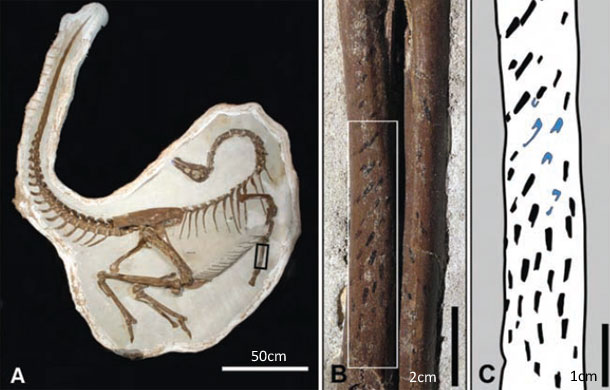
Ornithomimus edmontonicus specimen with traces of wing feathers, Royal Tyrrell Museum


The ostrich-like dinosaurs in the original Jurassic Park movie were portrayed as a herd of scaly, fleet-footed animals being chased by a ferocious Tyrannosaurus rex. New research published in the prestigious journal Science reveals this depiction of these bird-mimic dinosaurs is not entirely accurate —ornithomimids, as they are scientifically known, should have had feathers and wings.

The new study, led by paleontologists Darla Zelenitsky from the University of Calgary and François Therrien from the Royal Tyrrell Museum of Palaeontology, describes the first ornithomimid specimens preserved with feathers, recovered from 75 million-year-old rocks in the badlands of southern Alberta, Canada. This discovery represents the first feathered dinosaur specimens found in the Western Hemisphere.

"Despite the many ornithomimid skeletons known, these specimens are the first to reveal that ornithomimids were covered in feathers, like several other groups of theropod dinosaurs," says Zelenitsky, assistant professor at the University of Calgary and lead author of the study. Until now, the absence of feathers in previously discovered ornithomimid specimens has been a mystery. It was not known if these animals were simply featherless in life or if feathers were just not preserved in these other specimens."

The researchers found evidence of feathers preserved with a juvenile and two adults skeletons of Ornithomimus, a dinosaur that belongs to the group known as ornithomimids. Like other groups of theropod dinosaurs, such as tyrannosaurs and raptors, ornithomimid dinosaurs would also have been covered in feathers.


Skeleton of juvenile ornithomimid dinosaur from Alberta preserving fossil feathers.
The specimens reveal an interesting pattern of change in feathery plumage during the life of Ornithomimus. "This dinosaur was covered in down-like feathers throughout life, but only older individuals developed larger feathers on the arms, forming wing-like structures," says Zelenitsky. "This pattern differs from that seen in birds, where the wings generally develop very young, soon after hatching."

This discovery of early wings in dinosaurs too big to fly indicates the initial use of these structures was not for flight. "The fact that wing-like forelimbs developed in more mature individuals suggests they were used only later in life, perhaps associated with reproductive behaviors like display or egg brooding," says Therrien, curator at the Royal Tyrrell Museum and co-author of the study. " Such a idea for the role of early wing feathers has been proposed previously, although fossil evidence was lacking until now."


Until now feathered dinosaur skeletons had been recovered almost exclusively from fine-grained rocks in China and Germany. "It was previously thought that feathered dinosaurs could only fossilize in muddy sediment deposited in quiet waters, such as the bottom of lakes and lagoons," says Therrien. "But the discovery of these ornithomimids in sandstone shows that feathered dinosaurs can also be preserved in rocks deposited by ancient flowing rivers."

Because sandstone is the type of rock that most commonly preserves dinosaur skeletons, the Canadian discoveries reveal great new potential for the recovery of feathered dinosaurs in North America and elsewhere.


Zelenitsky, Therrien, Erickson, DeBuhr, Kobayashi, Eberth & Hadfield. 2012. Feathered Non-Avian Dinosaurs from North America Provide Insight into Wing Origins. Science http://dx.doi.org/10.1126/science.1225376

Press Release: Canadian researchers discover fossils of first feathered dinosaurs from North America 
: Significant find provides clues on early wing uses

A new feathered dinosaur shows we still have lots to learn http://gu.com/p/3bcy6/tw 

Images: top reconstruction by Julius Csotonyi; middle by Royal Tyrell Museum; 
phylogeny from paper; Zelenitsky by Riley Brandt
‘Bird mimic’ dinosaur hints that wings evolved for show not flight http://shar.es/cd6hu

Canadian researchers discover fossils of first feathered dinosaurs from North America | @UCalgary http://www.ucalgary.ca/news/releases/october2012/first_feathered_dinosaurs 

[Paleontology / Ootaxa • 2008] Montanoolithus strongorum • A unique maniraptoran egg clutch from the upper Cretaceous Two Medicine formation of Montana reveals theropod nesting behaviour


Abstract
Egg clutches of non-avian maniraptoran theropods (Dinosauria) are rare, particularly in North America where those of Troodon formosus are the only maniraptoran clutches known. Here we describe a new partial maniraptoran clutch and nesting trace referred to Montanoolithus strongorum oogen. et oosp. nov. (Montanoolithidae oofam. nov.), from the Upper Cretaceous Two Medicine Formation of Montana. Based on a cladistic analysis of reproductive traits, we infer that this clutch belonged either to a caenagnathid or to a dromaeosaurid, which makes it the first clutch known of either taxon. This specimen preserves impressions and eggshell fragments of at least five eggs on a nest structure. The eggs are asymmetrical, paired, and lay radially in a ring configuration on the sloped sides of a bioturbated, flat-topped sandstone mound. Geology of the locality indicates the female nested in a poorly-vegetated area of freshly deposited sand, possibly near an active river channel. This clutch reveals that the egg-layer of Montanoolithus strongorum had a unique suite of reproductive characteristics and nesting behaviours among maniraptorans.

Keywords: Theropoda; Maniraptora; eggs; eggshell; nesting trace; Montanoolithus; Two Medicine Formation


If it looks like a duck-billed dinosaur nest, it's probably from a duck-bill—unless it's a newly identified clutch of fossilized eggs from a private collection in Calgary, Canada.

The eggs, originally found in Montana in the 1990s, actually belong to a carnivorous dinosaur—either a creature related to the fearsome velociraptor (seen above, top right) or a birdlike, upright-walking dinosaur called a caenganathid (top left), a new study says.

Nests for neither of the predators have never been found, making the discovery a major one, according to University of Calgary paleontologist Darla Zelenitsky, who led the study in the journal Paleontology.

When Zelenitsky and colleagues first examined the eggs, they noticed some irregularities that did not point to plant-eating duck-bills, which are not directly related to birds. (See a duck-bill illustration.)

For one, the ancient parents left their eggs open to the elements, probably so the creatures could brood their young as a bird would. The eggs were also pointed, like bird eggs.

The nest is also the first to be found that preserves the mound (above, bottom) on which the eggs were laid, added Zelenitsky.


Zelenitsky, D. K. and Therrien, F. 2008. A unique maniraptoran egg clutch from the upper Cretaceous Two Medicine formation of Montana reveals theropod nesting behaviour. Palaeontology. 51(6):1253-1259.

PHOTO IN THE NEWS: Birdlike Dinosaur Eggs Found

Wednesday, October 24, 2012

[Botany • 2012] Germinated this way: New Genus of Ferns Named for Lady Gaga | Gaga, a New Fern Genus Segregated from Cheilanthes (Pteridaceae)

Lady Gaga and the fern gametophyte.


Abstract
Ongoing molecular phylogenetic studies of cheilanthoid ferns confirm that the genus Cheilanthes (Pteridaceae) is polyphyletic. A monophyletic group of species within the hemionitid clade informally called the “C. marginata group“ is here shown to be distinct from its closest relatives (the genus Aspidotis) and phylogenetically distant from the type species of Cheilanthes. This group is here segregated from Cheilanthes as the newly described genus, Gaga. In this study, we use molecular data from four DNA regions (plastid: matK, rbcL, trnG-R; and nuclear: gapCp) together with spore data to circumscribe the morphological and geographical boundaries of the new genus and investigate reticulate evolution within the group. Gaga is distinguished from Aspidotis by its rounded to attenuate (vs. mucronate) segment apices, minutely bullate margins of mature leaves (vs. smooth at 40×), and less prominently lustrous and striate adaxial blade surfaces. The new genus is distinguished from Cheilanthes s. s. by its strongly differentiated, inframarginal pseudoindusia, the production of 64 small or 32 large spores (vs. 32 small or 16 large) per sporangium, and usually glabrous leaf blades. A total of nineteen species are recognized within Gaga; seventeen new combinations are made, and two new species, Gaga germanotta and Gaga monstraparva, are described.

Keywords: Cheilanthoid ferns; hybridization; reticulate evolution; matK; Mexico; polyploidy; spore measurements


Pop music megastar Lady Gaga is being honored with the name of a new genus of ferns found in Central and South America, Mexico, Arizona and Texas. A genus is a group of closely related species; in this case, 19 species of ferns will carry the name Gaga.

At one stage of its life, the new genus Gaga has somewhat fluid definitions of gender and bears a striking resemblance to one of Gaga's famous costumes. Members of the new genus also bear a distinct DNA sequence spelling GAGA.

Two of the species in the Gaga genus are new to science: Gaga germanotta from Costa Rica is named to honor the family of the artist, who was born Stefani Germanotta. And a newly discovered Mexican species is being dubbed Gaga monstraparva (literally monster-little) in honor of Gaga's fans, whom she calls “little monsters.”

"We wanted to name this genus for Lady Gaga because of her fervent defense of equality and individual expression," said study leader Kathleen Pryer, a Duke University biology professor and director of the Duke Herbarium. "And as we started to consider it, the ferns themselves gave us more reasons why it was a good choice."


For example, in her performance at the 2010 Grammy Awards, Lady Gaga wore a heart-shaped Armani Prive' costume with giant shoulders that looked, to Pryer's trained eyes, exactly like the bisexual reproductive stage of the ferns, called a gametophyte. It was even the right shade of light green. The way the fern extends its new leaves in a clenched little ball also reminds Pryer of Gaga's claw-like "paws up" salute to her fans.

The clincher came when graduate student Fay-Wei Li scanned the DNA of the ferns being considered for the new genus. He found GAGA spelled out in the DNA base pairs as a signature that distinguishes this group of ferns from all others.

Celebrity species abound in science. There's a California lichen named for President Barack Obama and a meat-eating jungle plant named for actress Helen Mirren. In January, an Australian horse fly described by its discoverer as "bootylicious" was named for singer Beyonce.


But those are just individual species. This is an entire genus that so far includes 19 species of ferns.

Except for the two new species, germanotta and monstraparva, the rest of the Gaga ferns are species that are being reclassified by Pryer and her co-authors. They had previously been assigned to the genus Cheilanthes based on their outward appearance. But Li's painstaking analysis of DNA using more than 80 museum specimens and newly collected plants showed they're distinct and deserving of their own genus.

Graduate Student Fay-Wei Li at the moment he discovered Gaga germanotta alive in Costa Rica.

New tools for genetic analysis are reorganizing the family tree of ferns, said Pryer, who is currently president of the American Fern Society, and president of the American Society of Plant Taxonomists, the scientists who name and categorize plant species.

Like most ferns, the Gaga group is "homosporous." They produce tiny spherical spores that drift to the ground and germinate into heart-shaped plants called gametophytes. These independent little organisms can be female, male or even bisexual, depending on growth conditions and what other kinds of gametophytes are around. When conditions are right, they exchange sperm between gametophytes, but when necessary they sometimes can also self-fertilize to produce a new fern.

"The biology of these ferns is exceptionally obscure and blurred by sexual crossing between species," Pryer said. "They have high numbers of chromosomes and asexuality that can lead to offspring that are genetically identical to the parent plant."


Pryer freely admits that she and her lab are big Gaga fans. "We often listen to her music while we do our research. We think that her second album, 'Born this Way,' is enormously empowering, especially for disenfranchised people and communities like LGBT, ethnic groups, women -- and scientists who study odd ferns!" Pryer said.

"What a remarkable, unexpected, perfect tribute to name a genus of ferns for Lady Gaga," said Duke faculty member Cathy N. Davidson, who was involved in the MacArthur Foundation's Digital Media and Learning Initiative that helped Lady Gaga to create the Born This Way Foundation, a national anti-bullying initiative.  "Encouraging her fans and kids everywhere to be brave, bold, unique, creative and smart is what Lady Gaga is about," Davidson says. "It's rare that a celebrity so young gives back so much to society." 

Nineteen Species of Fern Named for Lady Gaga http://today.duke.edu/2012/10/gagafern
19 Species of Ferns Named for Lady Gaga: http://youtu.be/V1g8DASNrbE via @youtube

Fay-Wei Li et al. 2012. Gaga, a New Fern Genus Segregated from Cheilanthes (Pteridaceae). Systematic Botany. 37(4), 845-860 DOI: http://dx.doi.org/10.1600/036364412X656626

A total of nineteen species are recognized within Gaga; seventeen new combinations are made, and two new species, Gaga germanotta and Gaga monstraparva, are described.

Sunday, October 21, 2012

[Herpetology • 2012] Morphology, function and evolution of the pseudothumb in the Otton frog Babina subaspera | endemic frog to the Amami Islands of south Japan


Abstract
Frogs and toads normally have four toes on the forelimbs and five on the hindlimbs. An exception is the Otton frog Babina subaspera, which has regained the pseudothumbs. The morphology and use of pseudothumbs in Otton frogs were compared between the sexes. The pseudothumbs, which are longer and thicker in males than in females, encase a prepollical spine that occasionally cuts through the tissue as it is projected from the sheath. The males had visible spines and demonstrated a jabbing response more often than did females. Males were observed to use their pseudothumbs in male–male combat over females or breeding nests, as well as during amplexus. There was no evidence that females use their pseudothumbs. It is suggested that pseudothumbs first evolved as an anchor for amplexus, but that they are now used as a weapon in combat as well, giving males higher fitness. The study of pseudothumbs in the Otton frog will facilitate further study of related topics of interest, including extra fingers in vertebrates, self-damaging structures and developmental constraints in the hands.

Keywords: Babina subaspera; hand morphology; male–male combat; prepollical spine; sexual dimorphism

Japanese's Otton frog Babina subaspera

Japanese Otton frog Babina subaspera, claw close-up 
The Otton frog’s hidden claw is exposed. (Image: N. Iwai)

Figure 6. A couple of Otton frog Babina subaspera captured just after egg-laying. A spine projecting from a pseudothumb was jabbed into the side of the female.

The innocent looking “Wolverine” frog conceals its hidden claws (Image: N. Iwai)

The Deadly Thumbs of Japanese Flick Knife Frogs http://on.natgeo.com/Vo7ZaC
Iwai, N. 2012. Morphology, function and evolution of the pseudothumb in the Otton frog. Journal of Zoology. DOI: 10.1111/j.1469-7998.2012.00971.x/ 

[Herpetology • 2012] Development of the pseudothumb in frogs


Figure 1. Comparison of prepollex morphology between the Otton frog, Babina subaspera and other anuran species. (a) An adult Otton frog in the field of Amamioshima, Japan. (b) Radiograph of an adult male B. subaspera (snout-vent length ¼ 132.9 mm), focusing on completely ossified prepollical spine (arrowhead). (c) Ventral view of right-hand skeleton stained with Alcian blue (for cartilage) and Alizarin red (for bone) of Glandirana rugosa at stage 45. (d) Ventral view of right-hand skeleton of Bsubaspera at the same ontogenetic stage.

Frogs have highly conserved hand and foot morphology, possessing four fingers and five toes. As an exception, two Japanese ranid frog species, the Otton frog Babina subaspera and the dagger frog Babina holsti, possess a unique thumb-like structure (the pseudothumb) in the forelimb,giving an appearance of a total of five fingers on the hand. To obtain insights into the developmental mechanisms that generate this novel character, we investigated the hand morphogenesis of the Otton frog. The unique morphological pattern of the pseudothumb was already established in juveniles. Surprisingly, the bud-like structure, which is similar to the area of inductive activity (e.g. feather buds in birds and the carapacial ridge in turtles), was detected over the site where the future prepollex develops in larvae. By contrast, this bud-like structure was not found in larvae of other ranid species. We discuss possible scenarios that would favour the evolution of this very unusual trait in frogs.

Keywords: Anura; limb morphogenesis; morphological novelty; prepollex; Ranidae

Tokita, M. & Iwai, N. 2010. Development of the pseudothumb in frogs. Biol. Lett. 6, 517–520. http://rsbl.royalsocietypublishing.org/content/6/4/517

[Paleontology • 2012] Guidraco venator • New toothed flying reptile from Asia: close similarities between early Cretaceous pterosaur faunas from China and Brazil


Guidraco venator 
Wang, Kellner, Jiang & Cheng 2012


Abstract 
Despite the great increase in pterosaur diversity in the last decades, particularly due to discoveries made in western Liaoning (China), very little is known regarding pterosaur biogeography. Here, we present the description of a new pterosaur from the Jiufotang Formation that adds significantly to our knowledge of pterosaur distribution and enhances the diversity of cranial anatomy found in those volant creatures. Guidraco venator gen. et sp. nov. has an unusual upward-directed frontal crest and large rostral teeth, some of which surpass the margins of the skull and lower jaw when occluded. The new species is closely related to a rare taxon from the Brazilian Crato Formation, posing an interesting paleobiogeographic problem and supporting the hypothesis that at least some early Cretaceous pterosaur clades, such as the Tapejaridae and the Anhangueridae, might have originated in Asia. The association of the new specimen with coprolites and the cranial morphology suggest that G. venator preyed on fish.

Keywords: Pterosauria, Guidraco, Jiufotang Formation, Early Cretaceous, China


Pterosauria Kaup 1834
Pterodactyloidea Plieninger 1901
Pteranodontoidea Marsh 1876, sensu Kellner 1996, 2003

Guidraco venator gen. et sp. nov.

Etymology: Gui, malevolent ghost in Chinese culture combined with draco, from Latin meaning dragon; venator, the Latin word for hunter.

Fig. 1 Guidraco venator gen. et sp. nov., holotype (IVPP V17083), 
from the Jiufotang Formation (Early Cretaceous) of western Liaoning, China: a complete specimen, b cervical vertebrae, and c and d coprolites. copr Coprolite, pla plant. Scale bars 5,3,1,1 mm


Fig. 2 Guidraco venator gen. et sp. nov., holotype (IVPP V17083), 
a line drawing of the specimen and b reconstruction of the skull.

Fig.3 Reconstruction of Guidraco venator (Image by Maurilio Oliveira)

Xiaolin Wang, Alexander W. A. Kellner, Shunxing Jiang and Xin Cheng. 2012. New toothed flying reptile from Asia: close similarities between early Cretaceous pterosaur faunas from China and Brazil. Naturwissenschaften. 99. doi: http://dx.doi.org/10.1007/s00114-012-0889-1

Guidraco venator: 120-Million-Year-Old 'Ghost Dragon' Pterosaur Discovered in China  http://www.wired.com/wiredscience/2012/02/guidraco-flying-dinosaur/

Friday, October 19, 2012

[Herpetology • 2012] A Phylogeny and Taxonomy of the Thai-Malay Peninsula Bent-toed Geckos of the Cyrtodactylus pulchellus complex (Squamata: Gekkonidae): combined morphological and molecular analyses with descriptions of seven new species


Abstract
An integrative taxonomic analysis using color pattern, morphology and 1497 base pairs of the ND2 mitochondrial gene and its five flanking tRNAs demonstrated that nine monophyletic species-level lineages occur within the Cyrtodactylus pulchellus complex (Cyrtodactylus pulchellus sensu strictu and C. macrotuberculatus) of the Thai-Malay Peninsula that have a sequence divergence between them ranging from 5.9–16.8%. Additionally, each lineage is discretely diagnosable from one another based on morphology and color pattern and most occur in specific geographic regions (upland areas or islands) that prevent or greatly restrict interpopulation gene flow. 

Six of these lineages were masquerading under the nomen C. pulchellus and are described as the following: Cyrtodactylus astrum sp. nov. (ตุ๊กกายประดับดาว) from northwestern Peninsular Malaysia and southwestern Thailand; C. langkawiensis sp. nov., at this point endemic to Langkawi Island, Malaysia; Cbintangrendah  sp. nov., a lowland species surrounding the Banjaran (=mountain range) Bintang of northwestern Peninsular Malaysia; C. bintangtinggi sp. nov., endemic to the upland regions of the Banjaran Bintang of northwestern Peninsular Malaysia; C. trilatofasciatus sp. nov., endemic to upland regions of Cameron Highlands in the central portion of the Banjaran Titiwangsa in Peninsular Malaysia; and C. australotitiwangsaensis sp. nov. from the more southerly upland regions of the Banjaran Titiwangsa. 

An additional species, Cyrtodactylus lekaguli sp. nov. (ตุ๊กกายหมอบุญส่ง) from Satun, Trang, Surat Thani, and Phang-nga provinces in southern Thailand, was identified on the basis of morphology and color pattern and is hypothesized to be part of a clade containing C. astrum sp. nov. and C. langkawiensis sp. nov.

Key words: Taxonomy, Phylogeny, Cyrtodactylus, Gekkonidae, Malaysia, Thailand, Molecular systematics, New species


 L. L. Grismer, Perry L. Wood, Jr., Evan S. H. Quah, Shahrul Anuar, MohD. A. Muin, Montri Sumontha, Norhayati Ahmad, Aaron M. Bauer, Sansareeya Wangkulangkul, Jesse L. Grismer and Olivier S. G. Pauwels. 2012. A Phylogeny and Taxonomy of the Thai-Malay Peninsula Bent-toed Geckos of the Cyrtodactylus pulchellus complex (Squamata: Gekkonidae): combined morphological and molecular analyses with Descriptions of Seven New Species. Zootaxa. 3520: 1-55. mapress.com/zootaxa/2012/f/z03520p055f.pdf 


[Ichthyology • 2012] ปลากัดมหาชัย | Betta mahachaiensis | Mahachai Fighting fish • a new species of bubble-nesting fighting fish (Teleostei: Osphronemidae) from Samut Sakhon Province, Thailand


Betta mahachaiensis 
Kowasupat, Panijpan, Ruenwongsa & Sriwattanarothai. 2012
ปลากัดมหาชัย | Mahachai Fighting fish


Abstract
Betta mahachaiensis, a new species of fighting fish belonging to the Betta splendens group, is described. The fish inhabits specifically sites with brackish water and nipa palms in the Samut Sakhon Province, Thailand. It is distinguishable from other members of the B. splendens  group in having an iridescent green/bluish-green appearance on the brown-to-black body background. The opercular membrane has brown-to-black colour without red streaks or patches. The opercle has two parallel iridescent green or bluish-green vertical bars. Its dorsal, caudal, and anal fin rays are brown to black, contrasting with the iridescent green or bluish-green of the interradial membrane. Black transverse bars are present on at least the proximal twothirds of the dorsal fin, but not on the caudal fin. The colour of the pelvic fins is brown to black with an iridescent green/bluish-green front margin and a white tip. Females possess similar characters but are less colourful than males.
Key words: Betta mahachaiensis, Bubble-nesting fighting fish, Thailand


FIGURE 4. Close-ups of heads & opercle patterns of live males: (a) Betta splendens, THNHM-F-01703; (b) Betta imbellis, THNHM-F-01560; (c) Betta mahachaiensis, THNHM-F-01632; (d) Betta smaragdina, THNHM-F-01778; (e) Betta stiktos, THNHM-F-01824.

FIGURE 5. (a) Map of Thailand showing Betta mahachaiensis catch sites (encompassed by the small rectangle in the middle) in the central part of Thailand (C-Central, N-North, S-South, W-West, E-East, and NE-Northeast); (b) Catch (stars) of Betta mahachaiensis between years 2007 and 2012, twenty-eight sites in Samut Sakhon province and two sites in west of Bangkok. 
FIGURE 6. Habitat of Betta mahachaiensis in Samut Sakhon province, Thailand: (a) Nipa palm forest behind a food factory (Type Locality) (30 Apr. 2011); (b) Water held in the pocket phytotelma of the nipa palm bract as spawning space and the fish (THNHM-F-01632) caught from it (30 Apr. 2011); (c) The fish (THNHM-F-01655) and bubble nest in a pocket of a nipa palm bract (29 May 2011).


Kowasupat, C., PanijpanB., Ruenwongsa, R. & Sriwattanarothai, N. 2012. Betta mahachaiensis, a new species of bubble-nesting fighting fish (Teleostei: Osphronemidae) from Samut Sakhon Province, Thailand. Zootaxa. (3522): 49–60.

Thursday, October 18, 2012

[Herpetology • 2010] กิ้งก่าเขาหนามยาวจันทบูร | Acanthosaura cardamomensis • A new cryptic species of Acanthosaura Gray, 1831 (Squamata: Agamidae) from Thailand and Cambodia


Cardamom Mountains by Jeremy Holden
Cardamom Mountain Horned Agamid
Acanthosaura cardamomensis
Wood Jr., Grismer, Lee Grismer, Neang, Chav & Holden, 2010

Abstract
A new species of Acanthosaura (Gray 1831), A. cardamomensis sp. nov. from eastern Thailand and western Cambodia is described based on having a combination of unique morphological characteristics. It most closely resembles A. crucigera but differs in having significantly longer postorbital spines, occipital spines, nuchal spines, and dorsal spines; more scales between the fifth canthals; longer maximum dorsal scale length; longer maximum nuchal scale length; a significantly smaller diastema between the nuchal and dorsal crest spines; and significantly more supralabials. Mitochondrial DNA was used to calculate percent sequence divergence between samples of A. crucigera from southern Myanmar and western Thailand and samples of A. cardamomensis sp. nov. from eastern Thailand and western Cambodia. The uncorrected pairwise sequence divergence between populations of A. cardamomensis ranged from 1.2–3.1% and the range between populations of A. crucigera was 3.8%. The percent sequence divergence between A. cardamomensis sp. nov. and A. crucigera ranged between 10.0–14.6%. 

Key words: Acanthosaura, armata, cardamomensis, crucigera, Cardamom Mountains 

FIGURE 6. Morphological differentiation between adult females of (A) Acanthosaura crucigera from western Thailand and (B) Acanthosaura cardamomensis from Phnom Aural, Cambodia.

FIGURE: Color pattern variation within Acanthosaura cardamomensis. 
(upper Left) Adult female from Khao Khitchakut National Park, Chanthaburi Province, Thailand 
(upper Right) Sub adult male from Phnom Dalai, Cambodia
(lower Left) Adult female from Phnom Aural, Cambodia


Wood, P.L.; Grismer, L.L.; Grismer, J.L.; Neang, T.; Chav, T. & holden, J. 2010. A new cryptic species of Acanthosaura Gray, 1831 (Squamata: Agamidae) from Thailand and Cambodia. Zootaxa. 2488: 22–38

[Herpetology • 2009] Acanthosaura bintangensis & A. titiwangsaensis • Two new montane species of Acanthosaura Gray, 1831 (Squamata: Agamidae) from Peninsular Malaysia


Bukit Larut Mountain Horned Agamid  
 Acanthosaura bintangensis Wood, Grismer, Lee Grismer, Ahmad, Onn & Bauer, 2009
Malayan Mountain Horned Agamid
Acanthosaura titiwangsaensis Wood, Grismer, Lee Grismer, Ahmad, Onn & Bauer, 2009

Abstract
Two new montane species of the agamid genus Acanthosaura (Gray, 1831) from Peninsular Malaysia are described based on having unique color pattern and scale characteristics. Acanthosaura bintangensis sp. nov. from Bukit Larut, Perak most closely resembles A. titiwangsaensis sp. nov. from Fraser’s Hill and Cameron Highlands, Pahang but differs from it by having more subdigital lamellae on the fourth finger; the presence of a row of enlarged keeled suborbital scales beginning and terminating with an elliptical keeled scale; by having more scales surrounding the occipital spines; having more spots in the dorsal pattern; and by having a black gular region with a yellow medial stripe. Both species closely resemble A. crucigera but, can be separated from it by having higher numbers of subdigital lamellae on the fourth finger and toe; higher numbers of trasverse scales in the canthus rostralis-supraorbital ridge; higher numbers of scales bordering the rostral scale, and lower numbers of scales between the fifth canthals. The discovery of a two new agamid lizards from montane forests in well-known areas of Peninsular Malaysia underscores the importance of continued field work in these regions.
Key words: Acanthosaura, crucigera, bintangensis, titiwangsaensis, Banjaran Bintang, Banjaran Titiwangsa, Montane, Peninsular Malaysia, description

FIGURE 1. The distribution of Acanthosaura armata, A. bintangensis, A. crucigera and A. titiwangsaensis in Peninsular Malaysia (Boulenger 1912; Chan 2008; Diong et al. 1995; Grismer et al. 2001, 2006b, 2004a; Ibrahim et al. 2008; Lim et al. 2002; Tambylyn, 2005) and the extent of the Banjaran Bintang and Banjaran Titiwangsa.


Bukit Larut Mountain Horned Agamid  
 Acanthosaura bintangensis Wood, Grismer, Lee Grismer, Ahmad, Onn & Bauer, 2009

Malayan Mountain Horned Agamid
Acanthosaura titiwangsaensis Wood, Grismer, Lee Grismer, Ahmad, Onn & Bauer, 2009


WOOD JR., PERRY L.;JESSE L. GRISMER, L. LEE GRISMER, NORHAYATI AHMAD, & CHAN KIN ONN & AARON M. BAUER. 2009. Two new montane species of Acanthosaura Gray, 1831 (Squamata: Agamidae) from Peninsular Malaysia. Zootaxa. 2012: 28-46