Thursday, November 10, 2022

[Botany • 2022] Vitex pomerana (Lamiaceae: Labiatae) • A New Unifoliolate Species from the Brazilian Atlantic Forest


Vitex pomerana Fraga, Antar, J.Freitas & Lírio, 

in Antar, de Lírio, Freitas & de Fraga, 2022. 

Summary
Vitex comprises c. 250 species in a pantropical distribution, with 34 species recognised for Brazil. During fieldwork in remnants of the Atlantic Forest showing vegetation associated with inselbergs in the state of Espírito Santo, Brazil, a unique, unmatched unifoliolate species of Vitex was found. Based on herbaria consultation and literature review, we propose this as a new species, Vitex pomerana. The new species is unique in the genus due to the presence of unifoliolate leaves, a rare feature in the genus, together with brochidodromous venation of leaflets, dorsifixed anthers, shape and size of leaflets, and petiole and peduncle sizes. We compared the new species with V. gardneriana and V. snethlagiana, the only two other unifoliolate-leaved Vitex species occurring in Brazil. The new species is known from only a few individuals so far and is micro endemic to a biodiversity hotspot that suffers from habitat loss and degradation, and would likely be considered Endangered (EN), based on the criteria of the IUCN red list. This finding increases the number of angiosperm species endemic to the Atlantic Forest and inselbergs in the state of Espírito Santo and highlights the urgency of conserving this highly threatened vegetation.

Key Words: Flora, Labiatae, State of Espírito Santo, Taxonomy, Threatened species


Vitex pomerana Fraga, Antar, J.Freitas & Lírio, sp. nov. 

RECOGNITION. The new species resembles Vitex gardneriana and V. snethlagiana by the unifoliolate leaves, from which it differs by presenting a unique combination of elliptic leaflet with apex obtuse to retuse, venation brochidodromous, petiole 4.9 – 8.5 mm long, peduncle 1.45 – 2.6 cm long, and dorsifixed anthers.

ETYMOLOGY. The epithet pomerana (in Portuguese) refers to Pomerania, a historical area in Europe inhabited by a people known as Pomeranians, who spoke the Pomeranian dialect derived from German (not the one derived from a Slavic language, known now as Kashubian, and still spoken in Poland). This region, located in the Southern portion of the Baltic Sea, currently belongs to Germany and Poland. Due to multiple factors, including the WWs and other territorial invasions, the Pomeranians immigrated late in the XIXth century and early in the XXth century mostly to the U.S.A. and Brazil (Clemens 1976; Savedra 2020). Pomeranian descendants are predominant in the mountainous region of Espírito Santo, particularly in the municipalities of Santa Maria de Jetibá and Santa Leopoldina, where there was a significant Pomeranian immigration from 1873 onwards. Nowadays, people from this region still use Pomeranian as their language and maintain part of their cultural traditions (Savedra 2020). Because the new species is restricted to the Espírito Santo mountains, we have decided to honour with the specific epithet the Pomeranian people of Espírito Santo, from which the author EJL is descendent. The use of this epithet is permitted by the Article 23.2 of the International Code of Nomenclature for algae, fungi, and plants (Turland et al. 2018).


Guilherme Medeiros Antar, Elton John de Lírio, Joelcio Freitas and Claudio Nicoletti de Fraga. 2022. 
 Vitex pomerana (Lamiaceae; Viticoideae), A New Unifoliolate Species from the Brazilian Atlantic Forest. Kew Bulletin. DOI: 10.1007/s12225-022-10064-x
 espiritosantonoticias.com.br/pesquisadores-descobrem-nova-especie-de-taruma-das-montanhas-do-espirito-santo-e-a-batizam-em-homenagem-a-populacao-pomerana

Wednesday, November 9, 2022

[Entomology • 2022] Oecanthus beameri • A New Species of Tree Cricket (Orthoptera: Gryllidae: Oecanthinae) from Chihuahuan Desert Gypsum Dunes in the United States and A Key to the nigricornis Species Group


Oecanthus beameri  
Collins & Lightfoot, 2022


Abstract
A new species of tree crickets, Oecanthus beameri sp. nov., is described from the gypsum dunes of White Sands National Park in New Mexico, United States. The new species is currently known only from the type locality, where it appears to be specific to the gypsophile plant hoary rosemary mint (Poliomintha incana). This new species has the narrowed tegmina and calling song that are found in the nigricornis species group. Although it has morphological similarities to O. quadripunctatus and O. celerinictus, there are differences in the subgenital plates, tegminal measurements, coloring, tibial markings, song frequency, and song pulse rate. This new species has been given the common name White Sands tree cricket. We provide a key to all species in the nigricornis group. Video and song recordings are available online as Suppl. materials 1–8.

Keywords: bioacoustic, biodiversity, gypsophile, Oecanthus, Poliomintha incana, White Sands National Park

Family Gryllidae Laicharting, 1781
Subfamily Oecanthinae Blanchard, 1845

Tribe Oecanthini Blanchard, 1845

Genus Oecanthus Serville, 1831

Oecanthus beameri sp. nov.
A. Male habitus, dorsal view; B. Front view of a singing male; C. Antennal markings. Photo credit James Bailey, iNaturalist; D. Ventral abdomen color of adult male. Photo credit Jared Shorma, iNaturalist; E. Ventral abdomen color of adult female; F. Faint horizontal lines on proximal portion of hind femora. Photo credit James Bailey, iNaturalist.

 Oecanthus beameri sp. nov.
 
Diagnosis.— The antennal markings of O. beameri sp. nov. can total two, three, or four, with the medial mark on the scape usually broken into two pieces (Figs 3C, 4), while O. quadripunctatus has either two or four marks with the medial mark on the scape being a solid post, and O. celerinictus always has a solid medial mark on the scape and never lacks the upper outer mark on the scape and is never round. The two antennal marks on the pedicel of O. walkeri (Collins and Symes 2012) touch, and those of O. argentinus touch or nearly touch, while the marks on O. beameri sp. nov. do not.
 
Etymology.— Specific epithet in recognition of Raymond Beamer who collected the specimens in 1932 that were discovered in the ANSDU collection in 2019. The common name, White Sands tree cricket, is for the location where this species was discovered with high potential for endemism.


Nancy Collins and David C. Lightfoot. 2022. A New Species of Tree Cricket (Orthoptera, Gryllidae, Oecanthinae) from Chihuahuan Desert Gypsum Dunes in the United States and A Key to the nigricornis Species Group. Journal of Orthoptera Research. 31(2): 181-189. DOI: 10.3897/jor.31.79036

[Botany • 2022] Thottea beungongtanoeh (Aristolochiaceae) • A New Species from Aceh, northern Sumatra, Indonesia


Thottea beungongtanoeh Mustaqim, 

in Mustaqim &  Arico, 2022. 

Abstract
A species new to science, Thottea beungongtanoeh Mustaqim (Aristolochiaceae), is described based on a specimen collected from a lowland mixed dipterocarp forest in the eastern part of Aceh Province, the northernmost province in Sumatra. This species differs from all previously described species in having 33-lobed style, the highest count for the genus. Morphological description, distribution, phenology, comparison with the similar species, and the photographs of the living plants are provided.

Keyword: Acehnese Language, cauliflory Indonesia, the lowland mixed dipterocarp forest, Thottea grandiflora, West Malesia


Thottea beungongtanoeh Mustaqim.
A. Living plant. B. Leaf, adaxial side. C. Leaf, abaxial side. D. Inflorescences. E. Flower, lateral view. F. Flower, top view. G. Perianth, outer surface. H. Perianth, inner surface. I. Stamens. J. Style and stigma. K. Immature capsule.
Scale bars: B–C, F = 1 cm, D–E = 1 cm, G = 5 mm, H–J = 1 mm, K = 5 mm. 
Photographed by Wendy A. Mustaqim


Thottea beungongtanoeh Mustaqim, sp. nov. 

Diagnosis: Thottea beungongtanoeh can be recognized from other species in the genus by the 33- lobed style. It is similar to T. grandiflora Rottb., besides having more numerous style lobes (33 vs 20), this species differs in having inflorescence close to ground level (vs not from the ground level) and tubular perianth tube (vs campanulate).

Distribution and Ecology: Indonesia, endemic to northern Sumatra (Aceh Province), only known from the type locality (Fig. 2). Found in the lowland mixed dipterocarp forests on undulating terrain at the elevation around 60–80 m asl, on clay mixed with humus soils.

 Etymology: The specific epithet is derived from the Acehnese Language, beungong tanoeh, which means ‘flower of the ground’, indicating the position of the flowers.


Wendy A. Mustaqim and Zulfan Arico. 2022. Thottea beungongtanoeh (Aristolochiaceae), A New Species from Aceh, northern Sumatra. Taiwania. 67(4); 587-590.

Tuesday, November 8, 2022

[Crustacea • 2022] Pseudohelice annamalai • A New Pseudocryptic Species of the Genus Pseudohelice (Crustacea: Brachyura: Varunidae) from India


Pseudohelice annamalai
Prema, Hsu, Shih & Ravichandran, 2022  
 

A new pseudocryptic species of the varunid crab genus Pseudohelice Sakai, Türkay & Yang, 2006, is described from India based on morphological and molecular evidence. The new species was collected from higher intertidal zones in the Vellar River estuary, Tamil Nadu, southeastern India, in a habitat composed of muddy and sandy sediment. Pseudohelice annamalai n. sp. is similar to P. subquadrata (Dana, 1851) and P. latreillii (H. Milne Edwards, 1837) in general form, but can be distinguished from the congeners by the characters of the infraorbital ridges, male first gonopod, and female vulvae. In addition, the mitochondrial cytochrome oxidase subunit I sequences also support the new species. The occurrence of Pseudohelice from India links the distribution gap between the western Indian Ocean and western Pacific Ocean. The new species provides additional evidence for the geographic isolation of the eastern Indian Ocean for some marine organisms.

 Key words: Mitochondrial cytochrome oxidase subunit I, Morphology, Pseudohelice annamalai, Taxonomy, Tamil Nadu.


Pseudohelice annamalai n. sp.

Etymology: This species is named after Annamalai University, in honor of 100 years’ service in education and research as a state university of India. In addition, the present specimens were collected from the intertidal areas in front of the Faculty of Marine Science, Research Centre (Centre of Advanced Study in Marine Biology, Annamalai University), Vellar River, Tamil Nadu. The name is used as a noun in apposition. 

Distribution: Currently known only from the type locality, the Vellar River estuary, southeastern India. 


Mani Prema, Jhih-Wei Hsu, Hsi-Te Shih and Samuthirapandian Ravichandran. 2022. First Record of the Genus Pseudohelice Sakai, Türkay & Yang, 2006 from India and Description of A New Pseudocryptic Species (Crustacea: Brachyura: Varunidae). Zoological Studies. 61:56. DOI: 10.6620/ZS.2022.61-56

[Botany • 2022] Thismia cordata (Thismiaceae) • A New Fairy Lantern Species from the Brazilian Atlantic Rainforest


Thismia cordata  

in da Silva, Ríos, Visini da Cruz, de Souza  & Braga, 2022. 

Abstract
A new species of Thismia (Thismiaceae) from the Brazilian Atlantic Forest is described and illustrated. Thismia cordata belongs to T. subg. Ophiomeris sect. Ophiomeris, and is mainly characterized by its flowers zygomorphic with gibbous perianth tube which is densely pilose on the inner surface, annulus surrounded by a prominent star-shaped ornamentation of 6-lobes with apex acute, densely pilose, outer perianth lobes ovate with base cordate, stamens with connective falcate, ovary glabrous, and stigma sharply trilobed, densely pilose. Detailed description, illustrations, notes on distribution, and preliminary conservation assessment are provided below.

Keywords: Monocots, achlorophyllous, Brazil, Dioscoreales, mycoheterotrophic, neotropics


Thismia cordata


Diego Ferreira da Silva, Román Carlos Ríos, Vinicyus Jorge Mordaski Visini da Cruz, Inti de Souza and João Marcelo Alvarenga Braga. 2022. Thismia cordata (Thismiaceae), A New Fairy Lantern Species from the Brazilian Atlantic Forest. Phytotaxa571(1); 76-84. DOI: 10.11646/phytotaxa.571.1.6 
 twitter.com/thismiaguy/status/1587349405555998722

[Botany • 2022] Hippeastrum abatinguara (Amaryllidaceae: Hippeastreae) • A Remarkable New Species from the Serra da Mantiqueira, Southeastern Brazil


Hippeastrum abatinguara Campos-Rocha & A.S.Medeiros, 

in Campos Rocha, da Silva Medeiros, Meerow, et al., 2022.

Abstract
Serra da Mantiqueira is the most important mountain range in eastern South America, known for its high levels of species richness and endemism. A new species of Amaryllidaceae endemic to the region was recently identified, described and illustrated herein. It can be recognized by its rupicolous habit, large bulbs, reaching 12 cm in diameter, annual, lorate leaves, white flowers with pink striations and perigonal tube up to 1.5 cm long. Comments on its habitat, conservation status, phenology data, photographs and illustrations are provided, as well as comparison with the most morphologically similar species. Known by only a single population, exposed to several types of threats and with limited guarantee of protection, Hippeastrum abatinguara is considered Critically Endangered. Additionally, a key to the species of Hippeastrum occurring in the Serra da Mantiqueira is presented, accompanied by photographs of these species in their natural habitats.

Keywords: Asparagales, Endemism, Hippeastreae, Minas Gerais, rock outcrop, threatened species, Monocots


Hippeastrum abatinguara Campos-Rocha & A.S.Medeiros

Hippeastrum abatinguara can be considered similar to H. brasilianum (Traub & Doran 1976: 40) Dutilh in Meerow et al. (1997: 17) due to its habitat and flower color pattern, but is readily distinguished by having a smaller perigone (up to 9.5 cm long vs. 14–23 cm in H. brasilianum), with pink striations on the tepals, absent in H. brasilianum. 

Etymology:—The specific epithet refers to an indigenous people who inhabited the southern region of the state of Minas Gerais and were decimated as a result of the colonization of their territory. The Abatinguaras would have lived on the banks of the Grande and Sapucaí rivers, and offered a strong resistance to the advance of the Bandeirantes (colonial crusaders) at the end of the 17th century (José 1965, Guimarães 2017). Awati-wára is a word of Tupi origin, an indigenous language, being a translation of ‘white man eaters’ (Guérios 1948, Michaelis 2015). It is also a call for the defense of Brazilian indigenous people, in a context of violence against these peoples and their territories (Bonilla & Capiberibe 2021, Ferrante & Fearnside 2021, CIMI 2022). The specific epithet is used here as a noun in apposition, in accordance with Article 23.1 of the International Code of Nomenclature (Turland et al. 2018).


Antonio Campos Rocha, Alexandre da Silva Medeiros, Alan William Meerow, Priscila Andre Sanz-Veiga, Ingrid Koch and Julie Henriette Antoinette Dutilh. 2022. A Remarkable New Species of Hippeastrum (Amaryllidaceae) from the Serra da Mantiqueira, Southeastern Brazil. Phytotaxa. 571(2); 197-208. DOI: 10.11646/phytotaxa.571.2.6

[Ichthyology • 2022] Odontesthes crossognathos • A New Species of Silverside of the Genus Odontesthes (Atheriniformes: Atherinopsidae) with Hypertrophic Lips from a High-Altitude Basin in Southern Brazil


 Odontesthes crossognathos
Wingert, Ferrer, Neves, Baumgartner & Malabarba, 2022


Abstract
Odontesthes crossognathos, new species, is described from the Pelotas River basin, upper Uruguay River, southern Brazil. The new species is easily diagnosed by the possession of hypertrophied lips bearing numerous dermal papillae, a character absent in other species of the genus. The new species is also distinguished from congeners, except O. humensis, by having the upper jaw distinctly longer than the lower jaw and a subterminal mouth. These mouth morphology adaptations are probably related to the foraging behavior of the new species, which inhabits rivers with rapids and rocky bottoms in a high-altitude basin.

Head of  Odontesthes crossognathos, in lateral view.
(A) Holotype, UFRGS 27180, 183.7 mm SL; (B) paratype, UFRGS 28745, 103.2 mm SL.
Arrow indicates the dermal papillae.

 Odontesthes crossognathos, new species

Etymology.—From the Greek krossos (= fringes) and gnathos (= jaw) in reference to the fringed lips due to the presence of the dermal papillae. A noun in apposition.


Juliana M. Wingert, Juliano Ferrer, Mayara P. Neves, Dirceu Baumgartner and Luiz R. Malabarba. 2022. A New Species of Silverside of the Genus Odontesthes (Atheriniformes: Atherinopsidae) with Hypertrophic Lips from a High-Altitude Basin in Southern Brazil. Ichthyology & Herpetology. 110(4):680-689. DOI: 10.1643/i2021136

Odontesthes crossognathos, espécie nova, é descrita da bacia do rio Pelotas, alto rio Uruguai, sul do Brasil. A nova espécie é facilmente diagnosticável por possuir lábios hipertrofiados com numerosas papilas dérmicas, caráter ausente em outras espécies do gênero. A nova espécie também se distingue das congêneres, exceto de O. humensis, por ter a mandíbula superior distintamente mais longa do que a inferior e a boca subterminal. Essas adaptações na morfologia da boca provavelmente estão relacionadas ao comportamento de forrageamento da nova espécie, que habita rios de corredeiras e fundos rochosos em uma bacia de altitude elevada.

[Botany • 2022] Hemipilia avisoides (Orchidaceae: Orchidoideae) • A New Species from Sichuan Province, China


 Hemipilia avisoides Y.Tang, X.M.Wang & H.Peng, 

in Wang, Tang, Peng & Peng, 2022.
雁字舌喙兰  ||  DOI: 10.3897/phytokeys.213.90377

Abstract
A new orchid species, Hemipilia avisoides, is described from Songpan County and Maoxian County, Sichuan Province, China. Morphologically, H. avisoides is most similar to H. hui, but can be distinguished by the combination of its involute middle lip lobe that is smaller than the lateral lobes, floral bracts that are 5 mm long and are always shorter than the ovary, a leaf that is appressed to the substrate and is adaxially green with white lines along 7–9 principal veins and the subterranean stem with a solitary sheath at its base. The floral morphology of H. avisoides is presented by utilising in vivo micro-CT scanning and 3D visualisation.

Keywords: Arid valley, Minjiang River Valley, Orchidinae, taxonomy


 Hemipilia avisoides Y.Tang, X.M.Wang & H.Peng, sp. nov.
   
Diagnosis: Similar to Hemipilia hui (Tang & F.T.Wang) Schuit., from which H. avisoides can be distinguished by a set of characteristics: mid-lobe involute, suboblong in apical view, 2.2 × 1.2 mm, trapeziform when flattened, smaller than lateral lobes; floral bracts 5 mm long, always shorter than ovary; leaf appressed to the substrate, adaxially green with white lines along 7–9 principal veins; stem subterranean, with one sheath at the base (Table 1).

Comparisons between living plants of  Hemipilia avisoides sp. nov. and H. hui in the wild
A–D habit, flowers, leaf and habitat of H. avisoides E–H habit, flowers, leaf and habitat of H. hui.
Photographs A–H by Y. Tang.

Leaves of  Hemipilia avisoides sp. nov. and some related species in H. sect. Hemipilia sensu Tang et al. (2015) 
 H. avisoides B H. thailandica C H. hemipilioides
D H. brevicalcarata E H. galeata F H. cordifolia.
Photographs A–F by Y. Tang.

Distribution and habitat: Hemipilia avisoides is currently known from two localities in Songpan County, which are ca 11.2 km apart along the Minjiang River Valley and one locality in Maoxian County according to the collection by S.-Y. Chen et al. in 1958. Individuals of the new taxon occur under arid-valley shrubs and on moss-covered rocks (see Discussion).

Etymology: Latin avis, bird, and suffix -oides, similar, alluding to appearance of flower arrangement simulating flying birds with flapped wings.

Chinese name: 雁字舌喙兰 (Chinese Pinyin: yànzì shéhuìlán).


Xue-Man Wang, Ying Tang, Pei-Hao Peng and Hua Peng. 2022. Hemipilia avisoides (Orchidaceae), A New Species from Sichuan Province, China. PhytoKeys. 213: 1-18.  DOI: 10.3897/phytokeys.213.90377

Monday, November 7, 2022

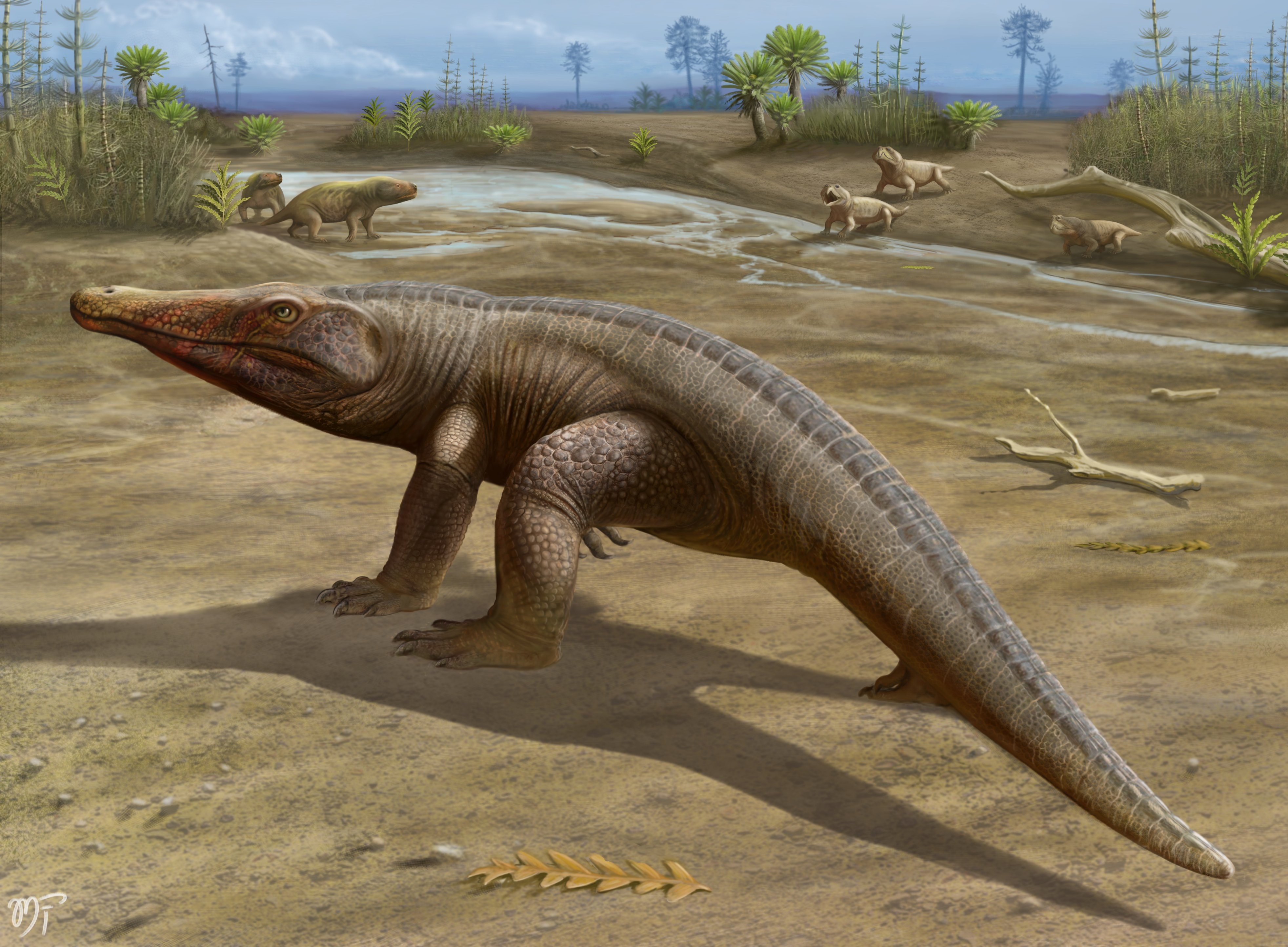
[Paleontology • 2022] Stenoscelida aurantiacus • A New Proterochampsid (Archosauriformes: Proterochampsia) from the Late Triassic of southern Brazil and the Emergence of Archosaurian Hind Limb Traits


Stenoscelida aurantiacus
Müller, Garcia & Oliveira Fonseca, 2022


 Abstract
Characterized by an elongated snout, proterochampsids are carnivorous non-archosaur archosauriforms. The clade is endemic to South America and its fossil record extends from the early Carnian to the late Carnian/early Norian. Nesting close to Archosauria, it is a key clade for understanding the origin and evolution of archosaurian traits. Unfortunately, hind limb elements are usually poorly preserved for the group. Therefore, the hind limb anatomy of proterochampsids still lacks detailed descriptions. In the present study, we partially fill this gap with the description of a new proterochampsid represented by a complete and well-preserved hind limb. Stenoscelida aurantiacus gen. et sp. nov. was excavated from the late Carnian/early Norian (Late Triassic) beds of southern Brazil. A phylogenetic investigation recovers the new taxon as a non-rhadinosuchine proterochampsid. The species bears an unusual set of traits for the group, which provides clues on the evolutionary origins of some muscle attachment structures. For instance, the femur of Stenoscelida aurantiacus gen. et sp. nov. possesses an anterior trochanter and an anterolateral scar. So far, these features have not been reported in other non-archosaurian archosauriforms. Therefore, the new specimen indicates that some typical archosaurian features evolved earlier than previously thought. The taxon also carries additional uncommon features for proterochampsids, such as an iliofibularis tubercle on the anterior margin of the fibula and a vestigial phalanx in digit V. In sum, Stenoscelida aurantiacus has one of the best-preserved hind limbs within Proterochampsidae and sheds light on the polarization of important traits regarding the evolutionary context of Archosauria.
 
Keywords: Archosauria, Archosauromorpha, Carnian, Gondwana, Proterochampsidae, South America

Provenance of Stenoscelida aurantiacus gen. et sp. nov. (CAPPA/UFSM 0293).
A, location and geological context of the Varzea do Agudo site (Agudo, Rio Grande do Sul, Brazil; modified from Muller et al. 2020a); B, general view of the site;
C, reconstruction of the skeleton of Stenoscelida aurantiacus gen. et sp. nov. (CAPPA/UFSM 0293) depicting the preserved elements.

 Holotype of Stenoscelida aurantiacus gen. et sp. nov. (CAPPA/UFSM 0293). Right hind limb in A, medial and B, lateral views.
Abbreviations: 4t, fourth trochanter; a, astragalus; als, anterolateral scar; at, anterior trochanter; c, calcaneum; cc, cnemial crest; f, femur; fh, femoral head; fi, fibula; ift, iliofibularis tubercle; mc, medial condyle; mt, metatarsal; pf, popliteal fossa; ph, phalanx; t, tibia.


 Results of the phylogenetic analysis depicting the position of Stenoscelida aurantiacus.
 A, time-calibrated reduced strict consensus tree (number on nodes represent Bremer support values higher than 1); B, strict consensus tree depicting the occurrence and distribution of the anterior trochanter (at) and the anterolateral scar (als) in the proximal portion of the femora of some panarchosaurs.

Stenoscelida aurantiacus gen. et sp. nov.
 

Rodrigo Temp Müller, Mauricio Silva Garcia and André de Oliveira Fonseca. 2022. A New Proterochampsid (Archosauriformes: Proterochampsia) from the Late Triassic of southern Brazil and the Emergence of Archosaurian Hind Limb Traits. Journal of Systematic Palaeontology. 20(1);  2128913. DOI: 10.1080/14772019.2022.2128913  

[Herpetology • 2022] Kolekanos spinicaudus • A New Species of Feather-tailed Leaf-toed Gecko, Kolekanos (Squamata: Gekkonidae) from the poorly explored Savannah of western Angola


 Kolekanos spinicaudus
 Lobón-Rovira, Conradie, Baptista & Vaz Pinto, 2022


Abstract
We here describe a new species of feather-tailed leaf-toed gecko, Kolekanos, from southern Benguela Province, Angola, based on morphological and osteological evidence, supported by phylogenetic analysis of mitochondrial data. The new species adds to the rapidly growing and newly-recognised endemic biodiversity of Angola, doubling the number of Kolekanos species, breaking the pattern observed within other closely-related African members of a clade of circum-Indian Ocean leaf-toed geckos – Ramigekko, Cryptactites and Afrogecko – all of which are presently monotypic. The new species is easily distinguished from K. plumicaudus, based on spine-like (as opposed to feather-like) scales on the margins of the original tail. Phylogenetic analyses also recovered the new taxon as monophyletic, with a well-supported sister relationship to K. plumicaudus, from which it differs by a substantial 24.1% NADH-dehydrogenase subunit 2 mitochondrial gene uncorrected p-distance.

Keywords: Biodiversity, ct-scan, herpetology, osteology, Reptilia, taxonomy

A dorsal view in life of  Kolekanos spinicaudus sp. nov. from Carivo
and B K. plumicaudus from Omahua.
Photos Javier Lobón-Rovira.


 Kolekanos spinicaudus sp. nov.

Diagnosis: Kolekanos can be easily differentiated from other circum-Indian leaf-toed and African leaf-toed geckos, based on its ornamented tail (versus non-ornamented tail in the remaining genera). The new species differs from K. plumicaudus, based on the following characters: different ornamentation of the tail, being composed by modified scales on the margins of the original tail which resemble white lateral spines (versus feathered-like tail in K. plumicaudus); broader head (minimum HW = 7.95 mm versus maximum HW = 7.35 mm in K. plumicaudus); more robust body, with shorter forelimbs (versus thinner and more slender body in K. plumicaudus, Fig. 5); proportionally larger snout to eye distance (SE mean 4.48 mm ± 0.34 s.e. versus 3.99 mm ± 0.22 s.e. in K. plumicaudus) and interorbital distance (IO mean 4.14 mm ± 0.34 s.e. versus 3.33 mm ± 0.28 s.e. in K. plumicaudus); and dorsal pattern is less contrasted, based on zig-zag black patches surrounded by lighter patches (versus dark blocks well contrasted, not surrounded by lighter patches in K. plumicaudus). The new species can also be differentiated from K. plumicaudus by the following osteological characteristics: 1) larger jugal bone (versus reduced jugal); 2) more prominent lateral process of the postorbitofrontal (versus less prominent lateral process of postorbitofrontal); 3) more compressed premaxilla and maxilla bone on its dorsoventral profile and wider in the lateral profile of the bones; 4) ascending process of the premaxilla shorter (versus more elongated); 5) braincase compressed dorsoventrally (versus more rounded in K. plumicaudus); 6) palatine length and width equal (versus unequal); 7) postero-lateral process of parietal rounded and slightly curved (versus flat postero-lateral process of parietal broad and flat that curves downwards posteriorly); 8) anterolateral process of the coronoid markedly enlarged (versus more reduced anterolateral process). Kolekanos spinicaudus sp. nov. also differs from K. plumicaudus by circa 24% (uncorrected p-distance) ND2 mitochondrial DNA.

Etymology: The name “spinicaudus” is derived from the combination of the Latin words “spina” and “cauda”, that refers to the spiny appearance of the tail of the new species. The species epithet is used as a singular nominative adjective “-us”.


Javier Lobón-Rovira, Werner Conradie, Ninda L. Baptista and Pedro Vaz Pinto. 2022. A New Species of Feather-tailed Leaf-toed Gecko, Kolekanos Heinicke, Daza, Greenbaum, Jackman, Bauer, 2014 (Squamata, Gekkonidae) from the poorly explored Savannah of western Angola. ZooKeys. 1127: 91-116. DOI: 10.3897/zookeys.1127.84942  

[Botany • 2022] Acilepis nakhonphanomensis (Asteraceae) • A New Species from Northeastern Thailand


Acilepis nakhonphanomensis Chatan & Promprom,

in Promprom & Chatan, 2022. 

Abstract
Acilepis nakhonphanomensis Chatan & Promprom, a new species in the Sunflower family (Asteraceae) from northeastern Thailand, is described and illustrated. It mainly differs from other previously known similar Acilepis species by the receptacle, leaf blade margin, involucre, floret, corolla tube, anther, style, and achene. Colour illustrations, line drawings, distribution map, and morphological comparisons with its allied species are provided. The conservation status of the new species was also assessed.

Keyword: Acilepis ngaoensis, Aster family, flowering plant, plant diversity, plant taxonomy

Morphology of Acilepis nakhonphanomenis Chatan & Promprom.
A. habit. B. inflorescence. C. phyllaries (from left to right: the first, third and fifth ones are adaxial sides; the second, fourth and sixth ones are abaxial sides). D. floret. E. stamen. F. achene (pappus removed).
 Drawn by Wannachai Chatan.


Morphology of Acilepis nakhonphanomenis Chatan & Promprom.
 A. inflorescence. B. involucre. C. receptacle. D. adaxial side of phyllary. E. abaxial side of phyllary. F. floret. G. ovary. H. Achene. I. achene (magnified).


Acilepis nakhonphanomensis Chatan & Promprom, sp. nov. 

 Diagnosis: The new species differs from A. ngaoensis (H.Koyama) H.Rob. & Skvarl by its inconspicuously ribbed stem, indistinctly serrate leaf blade margin, glabrous receptacle, subcoriaceous involucres, slightly tubular corolla tubes, obtuse appendage and cordate base of anther, and the longer anther, style and achene.

Distribution and Ecology: Acilepis nakhonphanomensis is restricted to the Phu Pha Yon National Park. The new species grows on rocky and dry soils in slightly shaded and shaded areas in the deciduous dipterocarp forest, mixed deciduous forest, and dry evergreen forest at an elevation of 300–350 m (Fig. 4).

 Etymology: The epithet references the Nakhon Phanom Province, Thailand, the locality where the species was collected and is, until now, endemic. 

Vernacular name: Muang Nakhon Phanom - ม่วงนครพนม.  


Wilawan Promprom and Wannachai Chatan. 2022. Acilepis nakhonphanomensis (Asteraceae), A New Species from Northeastern Thailand. Taiwania. 67(4); 571-575. taiwania.ntu.edu.tw/abstract/1876

Sunday, November 6, 2022

[Entomology • 2022] Protosticta francyi • A New Species of Protosticta Selys, 1885 (Odonata: Zygoptera: Platystictidae) from the Brahmagiri Hills, Kerala, India


Protosticta francyi  Sadasivan, Vibhu, Nair & Palot,  

in Vijayakumaran, Nair, Samuel, Palot & Sadasivan, 2022. 
Francy’s Reed-tail  ||  entomon.in/index.php/Entomon

ABSTRACT
A new species of  Protosticta Selys, 1885 is described from Brahmagiri hills of Coorg landscape of the Western Ghats in Peninsular India. The new species Protosticta francyi sp. nov., is a congener of  P. antelopoides Fraser, 1931 and  P. ponmudiensis Kiran, Kalesh & Kunte, 2015, occupying a similar microhabitat, but distributed north of the major biogeographical divide, the Palghat Gap. The new taxon is distinguished from all other Protosticta of  Western Ghats by the presence of long prothoracic spines in the males, the structure of the tip of the male cerci and genital ligula. A revised key to the species of  Protosticta of  Western Ghats is provided based on mature males.

KEYWORDS: Damselfly, hill stream ecology, endemic species, new taxon, revised key


Protosticta francyi sp. nov.  
 B-Live male; C-Live female.
photos: Vibhu V.

Protosticta francyi sp. nov.  Paratype female (TORG 1014).
A-Whole insect lateral view; B-Lateral view of the head, prothorax, and synthorax; C-Dorsal view of the head, prothorax, and synthorax; D-Close-up of head anterior view; E-Dorsal close-up of prothoracic spines; F-Lateral view of S7-S10 and anal appendages; G-Lateral view of S7-S10 and anal appendages.
photos: Kalesh Sadasivan

Protosticta francyi sp. nov.  Holotype male (TORG 1012).
A-Whole insect lateral view; B-Dorsal view of the head, prothorax, and synthorax; C-Close-up of head anterior view; D-Lateral view of synthorax; E-Close-up of head anterio-lateral view; F-Dorsal close-up of prothoracic spines; G-Ventral view of synthorax and head.
photos: Kalesh Sadasivan


Protosticta francyi
Sadasivan, Vibhu, Nair & Palot sp . nov.

Etymology:
The species is named after Dr. Francy K. Kakkassery (Retired Professor of Zoology, St.Thomas College, Thrissur), the pioneer in odonate studies in Kerala, for his contribution to odonate conservation and popularization of the subject inthe state.

Suggested Common Name: Francy’s Reed-tail. 


  the habitat at the type locality of Protosticta francyi sp. nov., in Brahmagiri Hills
photo: Vinayan P Nair


Vibhu Vijayakumaran, Vinayan P. Nair, Abraham Samuel, Muhamed Jafer Palot and Kalesh Sadasivan. 2022. A New Species of Protosticta Selys, 1885 (Odonata: Zygoptera: Platystictidae) from the Brahmagiri Hills, Kerala, India.  ENTOMON. 47(3); 265–276.  
  thehindu.com/news/national/kerala/new-damselfly-species-discovered-in-brahmagiri-hills/article66078173.ece