Wednesday, November 7, 2012

[Paleontology • 2002] Aucasaurus garridoi • A new close relative of Carnotaurus sastrei Bonaparte, 1985 (Theropoda: Abelisauridae) from the Late Cretaceous of Patagonia


Aucasaurus attacking titanosaurs at Auca Mahuevo, Argentina. 
Illustration: John Sibbick


Aucasaurus garridoi 
Coria, Chiappe & Dingus, 2002

Aucasaurus was a genus of medium-sized theropod dinosaur from Argentina that lived during the Santonian stage (Anacleto Formation). It was smaller than the related Carnotaurus, although more derived in some ways, such as its extremely reduced arms and almost total lack of fingers. The type skeleton is complete to the thirteenth caudal vertebra, and so is relatively well understood, and is the most complete abelisaurid yet described.

Etymology: ‘‘Auca,’’ from Mapuche language, in reference to Auca Mahuevo, the fossil locality where the specimen was found; ‘‘saurus,’’ from the Greek, lizard; ‘‘garridoi,’’ in homage to Mr. Alberto Garrido, who discovered the holotype.


Coria RA, Chiappe LM, Dingus L. 2002. A new close relative of Carnotaurus sastrei Bonaparte, 1985 (Theropoda: Abelisauridae) from the Late Cretaceous of Patagonia. Journal of Vertebrate Paleontology. 22: 460–465. doi: 10.1671/0272-4634(2002)022[0460:ANCROC]2.0.CO;2 

[Paleontology • 1985] Carnotaurus sastrei • A horned Cretaceous predatory dinosaur (originally carnosaur) from Patagonia, Argentina


Skull of Carnotaurus

Carnotaurus sastrei  Bonaparte, 1985

Carnotaurus /ˌkɑrnɵˈtɔrəs/ (Latin carno [carnis] = flesh + taurus = bull); meaning "meat-eating bull", referring to its distinct bull-like horns, a large predatory dinosaur. 
Only one species, Carnotaurus sastrei has been described so far. Carnotaurus lived in Patagonia, Argentina (La Colonia Formation) during the Campanian or Maastrichtian stage of the Late Cretaceous. It was discovered by José Bonaparte, who has uncovered many other South American dinosaurs.


Amargasaurus is fending off a pack of Carnotaurus in the land of Argentina of the early Cretaceous times.


Bonaparte 1985. A horned Cretaceous carnosaur from Patagonia. National Geographic Research 1: 149–151.
Persons, W. S.; Currie, P. J. 2011. Farke, Andrew Allen. ed. "Dinosaur Speed Demon: The caudal musculature of Carnotaurus sastrei and implications for the evolution of South American abelisaurids". PLoS ONE 6 (10): e25763. doi: http://dx.doi.org/10.1371/journal.pone.0025763

Tuesday, November 6, 2012

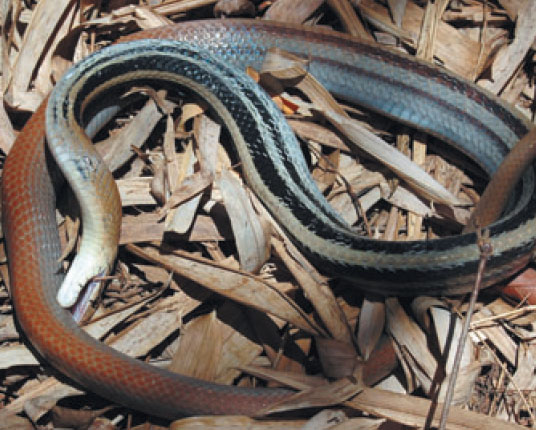
[Herpetology • 2011] Death Feigning behavior in two species of the genus Lycodon of Asia (Squamata: Colubridae); Lycodon cf. aulicus and Lycodon capucinus


Thanatosis meaning ‘putting to death’ in Greek is commonly referred to as Death feigning. Death feigning is a form of defensive behavior, in which an animal becomes immobile as if dead (McFarland, 1981) which has been reported from various group of animals including mammals, birds, fishes, reptiles, amphibians and arthropods (Vogel & Han-Yuen, 2010). This behavior has long been known from some snake species but no extensive work has been done to formally report  this behavior in Asian snakes. Among Indian snakes, death feigning has been known from the following two species: Xenochrophis piscator (Schneider, 1799) and (Coelognathus radiatus Fitzinger, 1843) (Vogel & HanYuen, 2010)


2011. Death feigning behavior in two species of the genus Lycodon of Asia (Squamata: Colubridae)
Death feigning behavior in Lycodon cf. aulicus and Lycodon capucinus

[Herpetology • 2010] Death Feigning Behavior in three colubrid species of tropical Asia ; Coleognathus radiatus, Macrocalamus chanardi & Xenochrophis piscator


Death feigning by Macrocalamus chanardi, Cameron Highlands, West-Malaysia, photograph by Allan Teo.

Death feigning was reported for the first time for the species Coleognathus radiatus and Macrocalamus chanardi. In Xenochrophis piscator this behavior is reported for the second time since 1947. These are the first reports on death feigning in snakes for the Indochinese and Malayan subregions. 

Keywords: death feigning, Coelognathus radiatus, Macrocalamus chanardi, Xenochrophis piscator, Oriental region.

Death feigning by Coelognathus radiatus, Tak Province Thailand.


Death feigning by Natrix natrix. Photograph by Petr Vlèek.


CONCLUSION
 Death feigning is a phenomenon in snakes that seems to be widely neglected in documentation. It is not really known which species show this behavior, and in which way. Nor have the different kind of death feigning “stages” been compared among species. It is our opinion, that there must surely be many more snake species that demonstrate death feigning behavior than what is presently known, and we encourage researchers to report such observations.

Vogel, G. and Han-Yuem, H.K. 2010. Death feigning behavior in three colubrid species of tropical Asia. Russian Journal of Herpetology. 17 (1): 15–21.

[Herpetology • 2010] ปาดเขียวตีนลายมลายู | Rhacophorus norhayatii | Norhayati’s Gliding Frog • New Gliding Frog in Rhacophorus reinwardtii group | Re-assessment of the Reinwardt’s Gliding Frog, Rhacophorus reinwardtii (Schlegel 1840) (Anura: Rhacophoridae) in Southern Thailand and Peninsular Malaysia and its re-description as a new species


(Upper & Lower right) Rhacophorus norhayatii sp. nov., (Lower, A) Rhacophorus reinwardtii from Java]

Rhacophorus norhayatii | Norhayati’s Gliding Frog
— New Gliding Frog in Rhacophorus reinwardtii group from Southern Thailand & Peninsular Malaysia


Abstract
Rhacophorus reinwardtii from Southern Thailand and Peninsular Malaysia is found to be morphologically distinct from Javan and Bornean populations and is herein described as a new species. Rhacophorus norhayatii sp nov. can be differentiated from R. reinwardtii by having a larger maximum SVL in males (64.7 mm vs. 55 mm); lacking spots on dorsum; higher degree of interdigital web pigmentation on hands and feet; and rusty brown markings on the flanks. This study adds to the growing list of taxonomic changes in Sunda Shelf taxa by demonstrating that species previously thought to be widely distributed across Sundaland are indeed distinct lineages worthy of species recognition.

Key words: Malay Peninsula, new species, Rhacophorus norhayatii, Sundaland, systematics


2010. Re-assessment of the Reinwardt’s Gliding Frog, Rhacophorus reinwardtii (Schlegel 1840) (Anura: Rhacophoridae) in Southern Thailand and Peninsular Malaysia and its re-description as a new species. Zootaxa. 

[Herpetology • 2010] Rhacophorus vampyrus | Vampire Flying Frog • A new tree frog of the genus Rhacophorus (Anura: Rhacophoridae) from southern Vietnam


[in Pic: in life diurnal colouration (on white background): adult male holotype & female paratype; adult male, non-vouchered specimen, in situ with nocturnal colouration, and adult male diurnal colouration (note modified skin under angles of jaw over paired subgular vocal sac)]

Rhacophorus vampyrus, Vampire Flying Frog
a Flying Frog inhabit a single, high-elevation patch of montane forest in Southern Vietnam, where it breeds in small, water-filled holes in trees.

Abstract
We describe a new species of rhacophorid frog from the Langbian Plateau in southern Vietnam. Rhacophorus vampyrus sp. nov. is distinguished from its congeners by a combination of: a pale tan to brick red dorsum; white throat, chest and belly; black flanks and anterior and posterior surface of thighs; grey to black webbing between fingers and toes; reduced finger webbing; and pointed projection at tibiotarsal articulation. At present, the new species is known from montane evergreen forest between 1470–2004 m elevation. Rhacophorus vampyrus sp. nov. is a phytotelm breeder, depositing eggs in foam nests in small tree-holes.

Key words: Anura, Rhacophoridae, Southeast Asia, Vietnam


ปาดแวมไพร์
• ปาดชนิดใหม่จากป่าเมฆ (ที่ราบสูง Langbian) ทางตอนใต้ของเวียดนาม
• ทำรังโฟมเพื่อวางไข่ในโพรงต้นไม้ (phytotelm breeder)
• ชื่อปาดแวมไพร์ (Vampire Flying Frog, P. vampyrus) ได้จากลักษณะของลูกอ๊อดที่มีฟันคล้าย เขี้ยว 2 คู่ที่ใต้ริมฝีปากบน


 Rowley, J.J.L., Le, T.T.D., Tran, T.A.D., Stuart, B.L., & Hoang, D.H. 2010. A new tree frog of the genus Rhacophorus (Anura: Rhacophoridae) from southern Vietnam. Zootaxa. 2727: 45–55. http://www.mapress.com/zootaxa/2010/f/zt02727p055.pdf

[Herpetology • 2010] Rhacophorus spelaeus • A new species of Rhacophorus (Anura: Rhacophoridae: Rhacophorinae) from Khammouan Province, Lao PDR


Rhacophorus spelaeus sp. nov., northeast of Thakhek District, Khammouane Province, Lao PDR. 
Photo by Nikolai L. Orlov.

Abstract 
A new species of rhacophorid frog of genus Rhacophorus Kuhl et van Hasselt, 1822 is described on the base of the morphological study of the material collected in Thakhek District, Khammouane Province, central Lao PDR. 

Keywords: Rhacophoridae, Rhacophorus, new species, Phou Hinboun, limestone, caves, Khammouan Province, central Laos.


Orlov NL, Gnophanxay S, Phimminith T and Phomphoumy K. 2010. A new species of Rhacophorus (Amphibia: Anura: Rhacophoridae: Rhacophorinae) from Khammouan Province, Lao PDR. Russian J Herpetology. 16:295-303

Monday, November 5, 2012

[Paleontology • 2012] Late Cretaceous restructuring of terrestrial communities facilitated the End-Cretaceous mass extinction in North America | pre-extinction disruption of food webs makes ecosystems more fragile


Lower food web diversity made the dinosaurs more vulnerable to mass-extinction a new study claims.
[Image Source: PNAS]

Abstract

The sudden environmental catastrophe in the wake of the end-Cretaceous asteroid impact had drastic effects that rippled through animal communities. To explore how these effects may have been exacerbated by prior ecological changes, we used a food-web model to simulate the effects of primary productivity disruptions, such as those predicted to result from an asteroid impact, on ten Campanian and seven Maastrichtian terrestrial localities in North America. Our analysis documents that a shift in trophic structure between Campanian and Maastrichtian communities in North America led Maastrichtian communities to experience more secondary extinction at lower levels of primary production shutdown and possess a lower collapse threshold than Campanian communities. Of particular note is the fact that changes in dinosaur richness had a negative impact on the robustness of Maastrichtian ecosystems against environmental perturbations. Therefore, earlier ecological restructuring may have exacerbated the impact and severity of the end-Cretaceous extinction, at least in North America.

Keywords: dinosaur diversity, extinction selectivity. paleoecology trophic cascade, cascading extinctions on graphs

----------------------------

Mass extinction study provides lessons for modern world


The Cretaceous Period of Earth history ended with a mass extinction that wiped out numerous species, most famously the dinosaurs. A new study now finds that the structure of North American ecosystems made the extinction worse than it might have been. Researchers at the University of Chicago, the California Academy of Sciences and the Field Museum of Natural History will publish their findings Oct. 29 online in the Proceedings of the National Academy of Sciences.

The mountain-sized asteroid that left the now-buried Chicxulub impact crater on the coast of Mexico's Yucatan Peninsula is almost certainly the ultimate cause of the end-Cretaceous mass extinction, which occurred 65 million years ago. Nevertheless, "Our study suggests that the severity of the mass extinction in North America was greater because of the ecological structure of communities at the time," noted lead author Jonathan Mitchell, a Ph.D. student of UChicago's Committee on Evolutionary Biology.

Mitchell and his co-authors, Peter Roopnarine of the California Academy of Sciences and Kenneth Angielczyk of the Field Museum, reconstructed terrestrial food webs for 17 Cretaceous ecological communities. Seven of these food webs existed within two million years of the Chicxulub impact and 10 came from the preceding 13 million years.

The findings are based on a computer model showing how disturbances spread through the food web. Roopnarine developed the simulation to predict how many animal species would become extinct from a plant die-off, a likely consequence of the impact.

"Our analyses show that more species became extinct for a given plant die-off in the youngest communities," Mitchell said. "We can trace this difference in response to changes in a number of key ecological groups such as plant-eating dinosaurs like Triceratops and small mammals."

The results of Mitchell and his colleagues paint a picture of late Cretaceous North America in which pre-extinction changes to food webs — likely driven by a combination of environmental and biological factors — results in communities that were more fragile when faced with large disturbances.

"Besides shedding light on this ancient extinction, our findings imply that seemingly innocuous changes to ecosystems caused by humans might reduce the ecosystems' abilities to withstand unexpected disturbances," Roopnarine said.

The team's computer model describes all plausible diets for the animals under study. In one run, Tyrannosaurus might eat only Triceratops, while in another it eats only duck-billed dinosaurs, and in a third it might eat a more varied diet. This stems from the uncertainty regarding exactly what Cretaceous animals ate, but this uncertainty actually worked to the study's benefit.

"Using modern food webs as guides, what we have discovered is that this uncertainty is far less important to understanding ecosystem functioning than is our general knowledge of the diets and the number of different species that would have had a particular diet," Angielczyk said.

Data derived from modern food webs helped the simulations account for such phenomena as how specialized animals tend to be, or how body size relates to population size and thus their probability of extinction.

The researchers also selected for their study a large number of specific food webs from all the specific webs possible in their general framework and evaluated how this sample of webs respond to a perturbation, such as the death of plants. They used the same relationships and assumptions to create food webs across all of the different sites, which means the differences between sites just stem from differences in the data rather than from the simulation itself. This makes the simulation a fundamentally comparative method, Roopnarine noted.

"We aren't trying to say that a given ecosystem was fragile, but instead that a given ecosystem was more or less fragile than another," he said.

The computer models showed that if the asteroid hit during the 13 million years preceding the latest Cretaceous communities, there almost certainly would still have been a mass extinction, but one that likely would have been less severe in North America.

Most likely a combination of changing climate and other environmental factors caused some types of animals to become more or less diverse in the Cretaceous, the researchers concluded. In their paper they suggest that the drying up of a shallow sea that covered part of North America may have been one of the main factors leading to the observed changes in diversity.

The study provides no evidence that the latest Cretaceous communities were on the verge of collapse before the asteroid hit. "The ecosystems collapsed because of the asteroid impact, and nothing in our study suggests that they would not have otherwise continued on successfully," Mitchell said. "Unusual circumstances, such as the after-effects of the asteroid impact, were needed for the vulnerability of the communities to become important."

The study has implications for modern conservation efforts, Angielczyk observed.

"Our study shows that the robustness or fragility of an ecosystem under duress depends very much on both the number of species present, as well as the types of species," he said, referring to their ecological function. The study also shows that more is not necessarily better, because simply having many species does not insure against ecosystem collapse.

"What you have is also important," Angelczyk said. "It is therefore critical that conservation efforts pay attention to ecosystem functioning and the roles of species in their communities as we continue to degrade our modern ecosystems."

Jonathan S. Mitchell, Peter D. Roopnarine and Kenneth D. Angielczyk. 2012. Late Cretaceous restructuring of terrestrial communities facilitated the End-Cretaceous mass extinction in North America. Proceedings of the National Academy of Sciences. http://dx.doi.org/10.1073/pnas.1202196109

Researchers: If Meteorite Hit 13 Million Years Earlier, Dinosaurs Might Still be Around

[News 2012] Amur Falcon Falco amurensis Massacre in Nagaland


Shocking Amur Falcon Massacre in Nagaland 
by Shashank Dalvi and Ramki Sreenivasan @conserve_ind 

This is a documentation of the shocking massacre of tens of thousands of migratory Amur falcons (Falco amurensis) in the remote state of Nagaland in India’s northeast. We estimate that during the peak migration 12,000 – 14,000 birds are being hunted for consumption and commercial sale everyday. We further estimate that a mind-boggling 120,000 to 140,000 birds are being slaughtered in Nagaland every year during their passage through the state.

This is probably the single largest congregation of Amur falcons recorded anywhere in the world and it is tragic that they meet such a fate. Our team has alerted all appropriate authorities in Nagaland. Government officials we spoke to have committed to put an end to the slaughter and have initiated specific action steps outlined below. Conservation India will continue to monitor and report on the situation.


Saturday, November 3, 2012

[Ichthyology • 2010] Descriptions of new Sharks and Rays from Borneo


 Descriptions of new sharks and rays from Borneo 

Recent publications from CSIRO have described the Chondrichthyes (sharks and rays) of Borneo. Several new species described for the first time were discovered by the Darwin Sabah Elasmobranch Biodiversity Project which ran from 1995 to 1999.


Friday, November 2, 2012

[Mammalogy • 2005] Ecomorphological diversification among South American spiny rats (Rodentia; Echimyidae): a phylogenetic and chronological approach


Fig. 3. Phylogram inferred from the maximum-likelihood analysis of a gene supermatrix combining the vWF, cyt b, 12S and 16S rRNAs markers. Numbers above branches are ML bootstrap values. Black circles and white squares indicate polyphyly for, respectively, the Heteropsomyinae and Echimyinae subfamilies (McKenna and Bell, 1997).
The main ecomorphological characteristics are given on the right, with black, hatched, and white rectangles for scansorial or arboreal, semi-fossorial, and terrestrial taxa. Myocastor (∼) is semi-aquatic.
Pictures represent from top to bottom: Capromys piloridesEuryzygomatomys spinosusTrinomys setosusThrichomys aperoidesMyocastor coypusHoplomys gymnurusProechimys guyannensisLonchothrix emiliaeIsothrix bistriataKannabateomys amblyonyx, and Echimys chrysurus. The scale is given in substitutions per site (s. p. s.).

Abstract
The phylogeny of South American spiny rats (Rodentia; Echimyidae) was studied using the exon 28 of the von Willebrand Factor nuclear gene (vWF). Sequences were analysed separately and in combination with a mitochondrial dataset (cyt b, 12S and 16S rRNAs) used in previous publications. The basal polytomy of echimyids was partially resolved and unexpected intergeneric clades were recovered. Thus, the intimate nested position of Myocastor within echimyids is evidenced. A well-supported clade is identified, including all the arboreal genera, and a group formed by Myocastor, Thrichomys, and Proechimys + Hoplomys. The clustering of Euryzygomatomys + Clyomys with Trinomys is also suggested. On the opposite, the phylogenetic position of Capromys as well as the relationships among arboreal genera remain unclear. Molecular divergence times were estimated using a Bayesian relaxed molecular clock and suggest a Middle Miocene origin for most of modern genera. The ecomorphological diversification of echimyids is discussed in the light of these new results and past environmental modifications in South America.

Keywords: Echimyidae; von Willebrand factor; Relaxed molecular clock; Arboreality; Vicariance


2005. Ecomorphological diversification among South American spiny rats (Rodentia; Echimyidae): a phylogenetic and chronological approach

Thursday, November 1, 2012

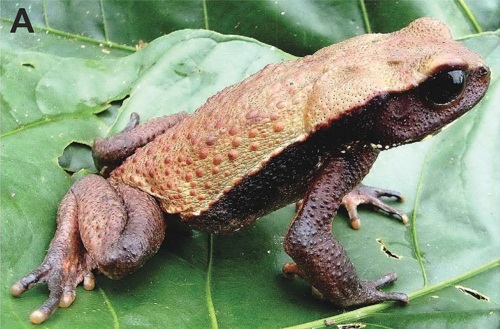
[Herpetology • 2012] The Amazonian toad Rhaebo guttatus is able to voluntarily squirt poison from the paratoid macroglands


Abstract
 Amphibian defence mechanisms commonly rely on cutaneous toxins produced in either isolated or clustered glands, such as toad parotoid macroglands. In contrast to the passive mechanism of poison liberation in other amphibians, we discovered that the Amazonian toad Rhaebo guttatus is unique because it can voluntarily squirt jets of poison from its parotoids.

Keywords: Amphibia, Anura, Bufonidae, defence, granular glands, poison glands.

Figure 1. R. guttatus. (a) Note the parotoid macrogland, which is full of glandular pores (arrow). (b) The typical defensive posture the toad assumes when expelling poison jets from the parotoid. 


2011. The Amazonian toad Rhaebo guttatus is able to voluntarily squirt poison from the paratoid macroglands. Amphibia-Reptilia. 32 (2011): 546-549 

[Herpetology • 2012] Rhaebo ecuadorensis • A new Amazonian species of Rhaebo (Anura: Bufonidae) | with comments on Rhaebo glaberrimus (Günrhwe, 1869) and Rhaebo guttatus (Schneider, 1799)


Abstract
We describe a new species of toad of the genus Rhaebo from the Amazonian lowlands of Colombia and Ecuador. The new species is characterized by have a large-size (SVL 156.7 mm in adult female, 92.8–127.0 mm in adult males), lacking a preocular ridge and most cephalic crests except for the low parietals crests; having the cloacal opening towards the middle level of thighs; rounded to slightly oval parotoids; and dark to cream brown groin. The new species was previously confused with Rhaebo glaberrimus, but the latter differs by having the cloacal opening at the ventral level of the thighs, small body size, skin texture mainly smooth, and a pink or yellowish color in the groin. The new species is also similar to Rhaebo guttatus that differs by having a preocular ridge and a different ventral coloration (throat, chest and belly with cream round spots). We also comment on the identity of R. glaberrimus and R. guttatus, correct some reports published in the literature, and present new information on their natural history and distribution.

Key words: Bufonidae, Rhaebo, new species, Rhaebo glaberrimus, Rhaebo guttatus, Amazonia


Mueses-Cisneros, J.J., Cisneros-Heredia, D.F., McDiarmid, R.W. 2012. A new Amazonian species of Rhaebo (Anura: Bufonidae) with comments on Rhaebo glaberrimus (Günrhwe, 1869) and Rhaebo guttatus (Schneider, 1799). Zootaxa. 3447:22-40.

[Herpetology • 2008] Rhaebo andinophrynoides • A new species of Rhaebo (Anura: Bufonidae) from southwestern Colombia and northwestern Ecuador | Rhaebo haematiticus: a species complex. With redescription of Rhaebo hypomelas (Boulenger 1913) and description of a new species


Abstract
Based on the examination of 520 specimens deposited in Colombian and Ecuadorian museums, and photographic analysis of some specimens deposited in other museums, I conclude that Rhaebo haematiticus represents a species complex that includes, at least, four externally similar species (R. haematiticus, R. hypomelas, and two undescribed species) in Colombia and Ecuador. Rhaebo andinophrynoides sp. nov. (a species with intermediate characteristics between Rhaebo and Andinophryne) is described from southwestern Colombia and northwestern Ecuador. This new species has been confused with Rhaebo hypomelas, which is redescribed and considered endemic to Colombia. The other undescribed species lacks the necessary sample size for an appropriate description. I recommend examining specimens from Central America and Venezuela currently assigned to Rhaebo haematiticus because it is possible that these populations represent additional undescribed species.

Key Words: Bufonidae, Rhaebo hypomelas, Rhaebo haematiticus, Species complex, Taxonomy.

Mueses-Cisneros, J.J. 2008. Rhaebo haematiticus (Cope 1862): un complejo de especies. Con redescripción de Rhaebo hypomelas (Boulenger 1913) y descripción de una nueva especie. Herpetotropicos. 5: 29-47.
[Rhaebo haematiticus (Cope 1862): a species complex. With redescription of Rhaebo hypomelas (Boulenger 1913) and description of a new species]


[Herpetology • 2007] Rhaebo lynchi • A new species of Rhaebo (Anura: Bufonidae) from the Cordillera Occidental of Colombia


Abstract 
A new species of the genus Rhaebo is described from the Cordillera Occidental of Colombia. Rhaebo lynchi sp. nov. differs from all others congeners in having a row of very prominent tarsal tubercles on the outer edge, a row of very prominent ulnar tubercles, short limbs, and smaller size in adult. R. lynchi is currently the smallest known Rhaebo.
Key words: Bufonidae, Rhaebo, Colombia, Antioquia, Cordillera Occidental


Mueses-Cisneros, A.A. 2007. A new species of Rhaebo (Anura: Bufonidae) from the Cordillera Occidental of Colombia. Zootaxa. 1662:53-59.