Sunday, April 29, 2012

[Mammalogy • 2011] Nuralagus rex | Minorcan Giant Lagomorph • an endemic insular giant rabbit from the Neogene of Minorca (Balearic Islands, Spain)


Abstract
We describe a new insular endemic lagomorph from the Late Neogene karstic deposits of Minorca (Balearic islands, Spain). Nuralagus rex, gen. et sp. nov., is characterized by an array of odd traits unknown for lagomorphs. Most outstanding are the gigantic size (average 12 kg), the robust postcranial skeleton with unique morphological traits (short manus and pes with splayed phalanges, short and stiff vertebral column with reduced extension/flexion capabilities), and the relatively small size of sense-related areas of the skull (tympanic bullae, orbits, braincase, and choanae). These morphological traits denote an important decrease in locomotor and neurological activities and, hence, a decrease in metabolic energy expenditure, which is concordant with the ecological conditions of the insular environment characterized by absence of predators and low levels of resource supply. Our discovery enhances the importance of the frequently neglected fossil record for our understanding evolution on islands, because it provides the perspective of time and adds valuable data from fossil insular ecosystems unaffected by anthropogenic alterations.


Nuralagus rex — Giant Extinct Rabbit was the King of Minorca http://bit.ly/Nuralagus-rex_Press


Reconstruction & Holotype

Josep Quintana, Meike Köhler & Salvador Moyà-Solà. 2011. Nuralagus rex, gen. et sp. nov., an endemic insular giant rabbit from the Neogene of Minorca (Balearic Islands, Spain). Journal of Vertebrate Paleontology. 31 (2): 231–240. doi:10.1080/02724634.2011.550367.


[PaleoMammalogy • 2011] 'bear otter' | Enhydriodon dikikae (Carnivora: Mammalia), a gigantic otter from the Pliocene of Dikika, Lower Awash, Ethiopia


Abstract
We describe here a new species of gigantic otter, Enhydriodon dikikae, sp. nov., from the Pliocene of Dikika, in the lower Awash valley of Ethiopia. The holotype consists of an associated snout and mandible, and is the most complete fossil specimen of a large bunodont otter. In some features, such as its very large size, the loss of anterior premolars, the tall protocone of P4, and the divided paraconid of m1, this species illustrates the culmination of general trends in this group, but the most remarkable part of its dentition is the broad incisor arch and powerful canine battery. The purported distinction between Enhydriodon and Sivaonyx is discussed, and the hypothesis of distinct African and Asian lineages is rejected. Postcranial remains confirm that Enhydriodon dikikae, sp. nov., was probably mostly terrestrial, but its diet remains uncertain, as none of the suggested preys fully explains the anatomical adaptations and relative abundance of this species.


The 200-kilogram 'bear otter' is one of several large carnivores that became extinct around 2 million years ago.
ILLUSTRATION BY VICTOR LESHYK


Extinct giant baboon (Theropithecus brumpti) and giant otter (Enhydriodon sp.) in the Omo River Valley, southern Ethiopia, 3 million years ago. Early hominids also lived in the Omo River Valley during this time period. 
Illustration from the California Academy of Sciences.

Enhydriodon dikikae, sp. nov. (Carnivora: Mammalia), a gigantic otter from the Pliocene of Dikika, Lower Awash, Ethiopia: DOI: 10.1080/02724634.2011.550356
Early humans linked to large-carnivore extinctions: doi:10.1038/nature.2012.10508

[Mammalogy • 2011] Evolutionary history and identification of conservation units in the giant otter, Pteronura brasiliensis


Abstract
The giant otter, Pteronura brasiliensis, occupies a range including the major drainage basins of South America, yet the degree of structure that exists within and among populations inhabiting these drainages is unknown. We sequenced portions of the mitochondrial DNA (mtDNA) cytochrome b (612 bp) and control region (383 bp) genes in order to determine patterns of genetic variation within the species. We found high levels of mtDNA haplotype diversity (h = 0.93 overall) and support for subdivision into four distinct groups of populations, representing important centers of genetic diversity and useful units for prioritizing conservation within the giant otter. We tested these results against the predictions of three hypotheses of Amazonian diversification (Pleistocene Refugia, Paleogeography, and Hydrogeology). While the phylogeographic pattern conformed to the predictions of the Refugia Hypothesis, molecular dating using a relaxed clock revealed the phylogroups diverged from one another between 1.69 and 0.84 Ma, ruling out the influence of Late Pleistocene glacial refugia. However, the role of Plio-Pleistocene climate change could not be rejected. While the molecular dating also makes the influence of geological arches according to the Paleogeography Hypothesis extremely unlikely, the recent Pliocene formation of the Fitzcarrald Arch and its effect of subsequently altering drainage pattern could not be rejected. The data presented here support the interactions of both climatic and hydrological changes resulting from geological activity in the Plio-Pleistocene, in shaping the phylogeographic structure of the giant otter.

Graphical abstract


Highlights
► In this paper we investigate the phylogeography of the endangered giant otter. ► We sequence mitochondrial control region and cytochrome b genes. ► We resolve four distinct phylogroups, constituting conservation units. ► We tested three hypotheses of Amazonian diversification. ► The Plio-Pleistocene origin of the phylogroups appears driven by changes in climate and drainage.

Keywords
Pteronura; Phylogeography; Mitochondrial DNA; Amazonia; Refugia; Paleodrainage; Conservation units


Fig. 1. The drainage system of South America and the geographic origin of samples used in this study. Watersheds are outlined by dashed lines and the positions of important geological arches are indicated. Black circles refer to sequences from this study, gray circles to sequences from Garcia et al. (2007).

Fig. 2. Statistical parsimony haplotype network based on concatenated cytochrome b and control region sequence data. Nodes are colored to reflect clustered phylogroups, with sub-clusters within each phylogroup identified. Node size corresponds to haplotype frequency. Gray nodes represent inferred mutational steps between haplotypes.

Fig. 6. Important regions of genetic diversity within the giant otter correlated with Pleistocene rainforest refugia in gray identified by Whitmore and Prance (1987) based on data gathered from birds, butterflies, and plants and accounting for soil and precipitation. The geographic extent of the four phylogroups are highlighted and the historical extent of the species’ range is also shown.


2011. Evolutionary history and identification of conservation units in the giant otter, Pteronura brasiliensis.

Thursday, April 26, 2012

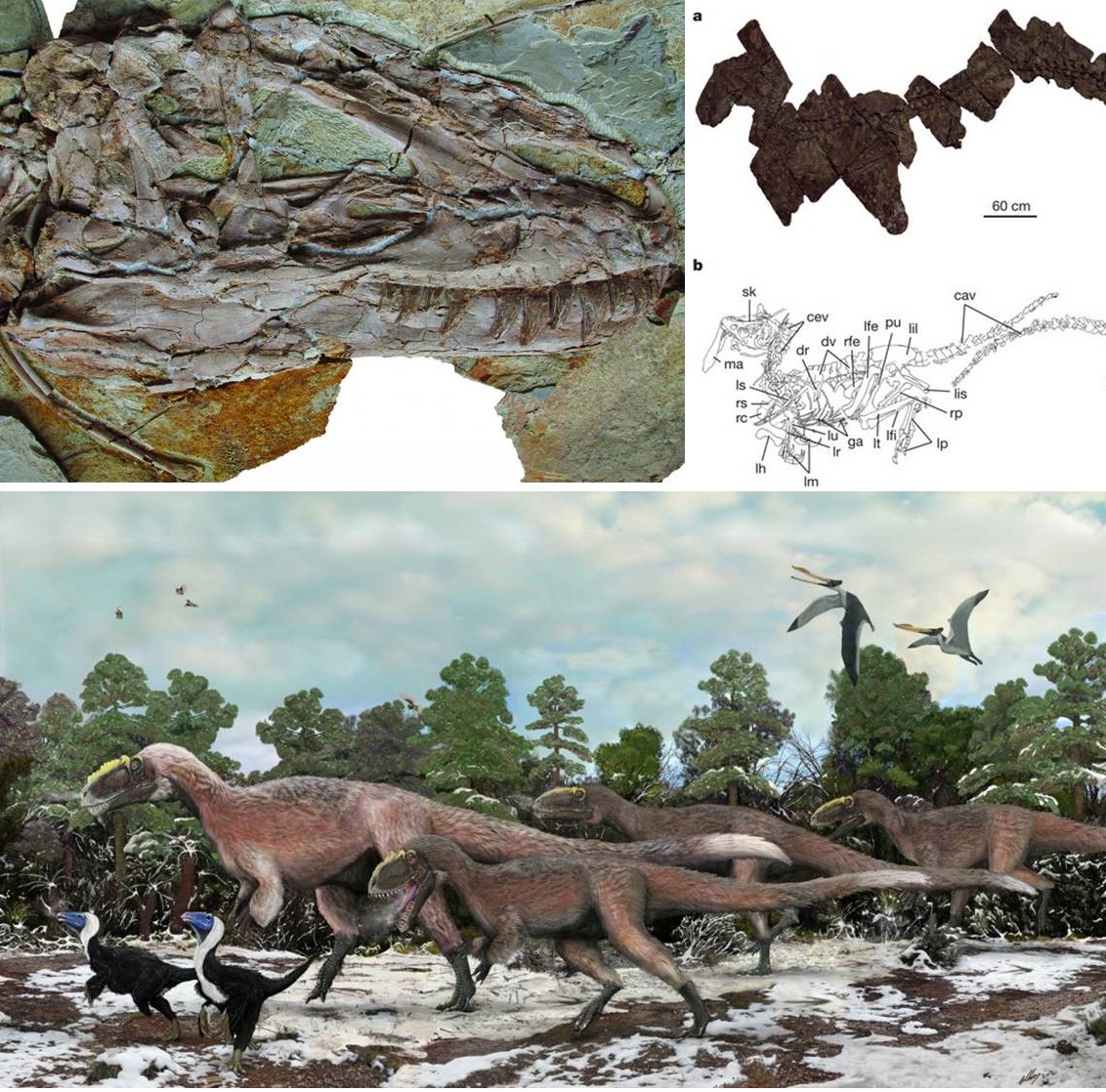
[Paleontology • 2012] Yutyrannus huali 'feathered tyrant' • A gigantic feathered dinosaur from the Lower Cretaceous of China


Abstract
 Numerous feathered dinosaur specimens have recently been recovered from the Middle–Upper Jurassic and Lower Cretaceous deposits of northeastern China, but most of them represent small animals1. Here we report the discovery of a gigantic new basal tyrannosauroid, Yutyrannus huali gen. et sp. nov., based on three nearly complete skeletons representing two distinct ontogenetic stages from the Lower Cretaceous Yixian Formation of Liaoning Province, China. Y. huali shares some features, particularly of the cranium, with derived tyrannosauroids, but is similar to other basal tyrannosauroids in possessing a three-fingered manus and a typical theropod pes. Morphometric analysis suggests that Y. huali differed from tyrannosaurids in its growth strategy. Most significantly, Y. huali bears long filamentous feathers, thus providing direct evidence for the presence of extensively feathered gigantic dinosaurs and offering new insights into early feather evolution.


An artist's impression of a group of Yutyrannus, the largest known frathered dinosaur, and two smaller Beipiaosaurus, the previous record holder.
Illustration by Brian Choo via Nature


Figure 1: Yutyrannus huali (ZCDM V5000 and ZCDM V5001).

Figure 2: Selected elements of Y. huali (ZCDM V5000, ZCDM V5001 and ELDM V1001).


Figure 3: A simplified cladogram showing the systematic position of Y. huali among the Tyrannosauroidea.

Xu, X., Wang, K., Zhang, K., Ma, Q., Xing, L., Sullivan, C., Hu, D., Cheng, S., and Wang, S. 2012. A gigantic feathered dinosaur from the Lower Cretaceous of China. Nature. http://dx.doi.org/10.1038/nature10906


[Paleontology • 2010] Xiongguanlong baimoensis • A Longirostrine Tyrannosauroid from the Early Cretaceous of China


Xiongguanlong baimoensis 


Li D., Norell M.A., Gao K.Q., Smith N.D. & Makovichy P.J., 2010. A Longirostrine Tyrannosauroid from the Early Cretaceous of China. Proceedings of the Royal Society B: Biological Sciences. 277 (1679): 183–190. doi: 10.1098/rspb.2009.0249


[Paleontology • 2004] Dilong paradoxus 'emperor dragon' • Basal tyrannosauroids from China and evidence for protofeathers in tyrannosauroids


Figure 1: Dilong paradoxus.

Figure 2: IVPP V11579.
a, Skeletal reconstruction showing preserved bones.

Figure 3: Integumentary structures of IVPP V11579.
a, b, Filamentous integumentary structures along the dorsal edge of the distal caudal vertebrae, photograph (a) and linedrawing (b). c, d, Close-up of the integumentary structures showing the simple branching pattern, photograph (c) and linedrawing (d). Not to scale.


^ Xu, X., Norell, M. A., Kuang, X., Wang, X., Zhao, Q., Jia, C. (2004). "Basal tyrannosauroids from China and evidence for protofeathers in tyrannosauroids". Nature. 431 (7009): 680–684. doi:10.1038/nature02855.  


China Dinosaur Fossils Article, Liaoning Province : http://science.nationalgeographic.com/science/prehistoric-world/china-fossils/

[Paleontology • 2010] Cannibalism in Tyrannosaurus rex


Abstract  
Background
Tyrannosaurus rex was one of the largest terrestrial carnivores of all time, and consequently its ecology and diet have been the focus of much discussion. However, there is little direct evidence of diet or feeding habits in this species.

Methodology/Principal Findings
Examination of museum collections has revealed four specimens of Tyrannosaurus rex that bear tooth marks made by large, carnivorous dinosaurs. Because Tyrannosaurus is the only large carnivore known from the Late Maastrichtian of western North America, we infer that Tyrannosaurus made these tooth marks.

Conclusions/Significance
The marks are interpreted as feeding traces and these fossils therefore record instances of cannibalism. Given that this behavior has a low preservation potential, cannibalism seems to have been a surprisingly common behavior in Tyrannosaurus, and this behavior may have been relatively common in carnivorous dinosaurs.

Figure 1. Tooth marks made by Tyrannosaurus rex.
A, hadrosaurid metatarsal (UCMP uncatalogued) and closeup of tooth marks on distal articular surface. 
B, fragment of hadrosaurid pubis (CM 105) showing tooth marks on prepubic process. 
C, ceratopsid? frill element (TMP 1998.102.2) showing tooth mark. 
D, Triceratops right squamosal (YPM 53263) showing tooth marks on edge.

Figure 2. Tyrannosaurus rex bones bearing tooth marks made by Tyrannosaurus rex.

Longrich NR, Horner JR, Erickson GM, Currie PJ (2010) Cannibalism in Tyrannosaurus rex. PLoS ONE 5(10): e13419. doi:10.1371/journal.pone.0013419

T. Rex Was a Cannibal, Bone Gashes Suggest

[Paleontology • 2010] Tyrannosaur Paleobiology: New Research on Ancient Exemplar Organisms


Tyrannosaurs, the group of dinosaurian carnivores that includes Tyrannosaurus rex and its closest relatives, are icons of prehistory. They are also the most intensively studied extinct dinosaurs, and thanks to large sample sizes and an influx of new discoveries, have become ancient exemplar organisms used to study many themes in vertebrate paleontology. A phylogeny that includes recently described species shows that tyrannosaurs originated by the Middle Jurassic but remained mostly small and ecologically marginal until the latest Cretaceous. Anatomical, biomechanical, and histological studies of T. rex and other derived tyrannosaurs show that large tyrannosaurs could not run rapidly, were capable of crushing bite forces, had accelerated growth rates and keen senses, and underwent pronounced changes during ontogeny. The biology and evolutionary history of tyrannosaurs provide a foundation for comparison with other dinosaurs and living organisms.


Stephen L. Brusatte, Mark A. Norell, Thomas D. Carr, Gregory M. Erickson, John R. Hutchinson, Amy M. Balanoff, Gabe S. Bever, Jonah N. Choiniere, Peter J. Makovicky, and Xing Xu. Tyrannosaur Paleobiology: New Research on Ancient Exemplar Organisms. Science, 2010; 329 (5998): 1481-1485 DOI: 10.1126/science.1193304

Tyrannosaurus redux: T. rex was more than just a large carnivore at top of food chain, new findings reveal: http://www.sciencedaily.com/releases/2010/09/100916145131.htm

[Paleontology • 2009] Raptorex kriegsteini • Tyrannosaurid skeletal design first evolved at small body size


Fig. 1: Skull, endocast, and premaxillary teeth of the Early Cretaceous tyrannosauroid R. kriegsteini. 

Nearly all of the large-bodied predators (>2.5 tons) on northern continents during the Late Cretaceous were tyrannosaurid dinosaurs. We show that their most conspicuous functional specializations—a proportionately large skull, incisiform premaxillary teeth, expanded jaw-closing musculature, diminutive forelimbs, and hindlimbs with cursorial proportions—were present in a new, small-bodied, basal tyrannosauroid from Lower Cretaceous rocks in northeastern China. These specializations, which were later scaled up in Late Cretaceous tyrannosaurids with body masses approaching 100 times greater, drove the most dominant radiation of macropredators of the Mesozoic.


Fig. 2: Postcranial features of the Early Cretaceous tyrannosauroid R. kriegsteini.


Fig. 4: Temporal, geographic, and phylogenetic patterns among tyrannosauroids. 
(A) Temporally calibrated phylogeny of tyrannosauroids based on phylogenetic analysis, showing an early diversity of basal tyrannosauroids (shaded) from localities across Laurasia and plotted on an Early Cretaceous paleogeographic map. Proceratosaurus and Xiongguanlong were excluded from this plot because of limited available morphologic data and age uncertainty, respectively. 
(B) Phylogram scaled to the amount of character change (delayed transformation) 
Circled nodes 1 to 3 outline major transformations in tyrannosauroid evolution. Taxonomic definitions of Tyrannosauroidea, Tyrannosauridae, and other taxa follow. 
Abbreviations for biogeographic area and localities: A, Asia; E, Europe; NA, North America; 
1, Stokesosaurus; 2, Proceratosaurus and Eotyrannus; 3, Aviatyrannis; 4, Guanlong; 5, Dilong; 6, Xiongguanlong; 7, Raptorex.


Sereno, P.; Tan, L.; Brusatte, S. L.; Kriegstein, H. J.; Zhao, X. & Cloward, K. (2009). "Tyrannosaurid skeletal design first evolved at small body size". Science. 326 (5951): 418–422. doi:10.1126/science.1177428