Wednesday, December 6, 2023

[Botany • 2019] Aeschynomene chicocesariana (Leguminosae: Papilionoideae) • A Striking New Unifoliolate Legume Species from the Brazilian Chapada Diamantina and its Phylogenetic Placement in the Dalbergioid Clade


Aeschynomene chicocesariana D.B.O.S.Cardoso & G.Ramos,  

in Cardoso, Ramos, São-Mateus et de Queiroz, 2019.

 Abstract
Unifoliolate leaves are relatively rare in the species-rich dalbergioid clade of papilionoid legumes (Leguminosae, Papilionoideae). For the pantropical, diverse genus Aeschynomene (ca. 180 species), the only known record of unifoliolate species described so far is the savanna-inhabiting A. simplicifolia from Chapada dos Veadeiros in Goiás, Brazil. The current work provides a description, illustrations, and a distribution map of another unifoliolate species, Aeschynomene chicocesariana , which was newly discovered in the rupestrian grasslands of Chapada Diamantina in Bahia, Brazil. Bayesian phylogenetic analyses of DNA sequence data (nuclear ribosomal ITS/5.8S and the plastid genes matK and trnL intron) have unequivocally placed A. chicocesariana with the rest of Aeschynomene species that are traditionally placed within Aeschynomene sect. Ochopodium. This result agrees with the shared morphology of A. chicocesariana and members of that section.

Keywords: Leguminosae; Ochopodium; Papilionoideae; taxonomy


General morphology of Aeschynomene chicocesariana.
A. Habit. B. Detail of the branch showing the non-peltate, basifixed stipules and unifoliolate leaves appressed against the erect stem. C. Detail of the terminal raceme to show the flowers. D. Indehiscent, single-seeded loments with the basalmost aborted article; note that the loments are borne on a very long stipe.
All photographs by Domingos Cardoso, from the specimen Cardoso et al. 3640 (HUEFS) at the type locality.

Aeschynomene chicocesariana D.B.O.S.Cardoso & G.Ramos, sp. nov.


  Domingos Benício Oliveira Silva Cardoso, Gustavo Ramos, Wallace Messias Barbosa São-Mateus and Luciano Paganucci de Queiroz. 2019. Aeschynomene chicocesariana, A Striking New Unifoliolate Legume Species from the Brazilian Chapada Diamantina and its Phylogenetic Placement in the Dalbergioid Clade. Systematic Botany. 44(4); 810 - 817. DOI:  10.1600/036364419X15710776741530 

[Fungi • 2023] Tulostoma hungaricum, T. shaihuludii, etc. (Basidiomycota: Agaricales) • Exploring Diversity within the Genus Tulostoma in the Pannonian Sandy Steppe: Four fascinating Novel Species from Hungary


 Tulostoma shaihuludii Finy, Jeppson, L. Albert, Ölvedi, D.G. Knapp & Dima,
 T. dunense Finy, Jeppson, L. Albert, Ölvedi, Dima & V. Papp,

in Finy, Jeppson, Knapp, Papp, Albert, Ölvedi, Bóka, Varga, Kovács et Dima, 2023.

Abstract
Steppe vegetation on sandy soil in Hungary has recently been revealed as one of the hot spots in Europe for the stalked puffballs (genus Tulostoma). In the framework of the taxonomic revision of gasteroid fungi in Hungary, four Tulostoma species are described here as new to science: T. dunense, T. hungaricum, T. sacchariolens and T. shaihuludii. The study is based on detailed macro- and micromorphological investigations (including light and scanning electron microscopy), as well as a three-locus phylogeny of nrDNA ITS, nrDNA LSU and tef1-α sequences. The ITS and LSU sequences generated from the type specimen of T. cretaceum are provided and this resolved partly the taxonomy of the difficult species complex of T. aff. cretaceum.

Key words: Gasteroid, hot spot, molecular systematics, Pannonian inland sand dune thicket, phylogeny, taxonomy, Tulostomataceae

Tulostoma dunense:
a, c–f FP-2020-10-18 (BP112640, holotype), Németkér b FP-2021-01-02, Tázlár a–c basidiocarps d, e basidiospores f capillitium with basidiospores.
Scale bars: 1 μm (d); 10 μm (e); 10 µm (f). 
Photos: a, b, e, f P. Finy c L. Albert d K. Bóka.

 Tulostoma dunense Finy, Jeppson, L. Albert, Ölvedi, Dima & V. Papp, sp. nov.
 
Etymology: The epithet refers to the continental, open, bare sandy habitat of this species, similar to coastal dunes.


 Tulostoma hungaricum Finy, Jeppson, L. Albert, Ölvedi & Dima, sp. nov.
 
Etymology: With reference to Hungary where it was discovered.


 Tulostoma sacchariolens Finy, Jeppson, L. Albert, Ölvedi & Dima, sp. nov.

Etymology: The epithet refers to its unique sweetish floral smell reminiscent of that of, for example, Hebeloma sacchariolens.

Tulostoma shaihuludii:
a FP-2020-12-01-3, Fülöpháza b, d–g FP-2016-12-11 (BP112643, holotype), Tázlár c AL-2021-01-24, Bócsa h FP-2017-12-09, Orgovány a–c basidiocarps d, e basidiospores f, g capillitium with basidiospores h thin-walled, septate capillitium hyphae.
 Scale bars: 1 µm (d); 10 µm (e); 20 µm (f–h). 
Photos: a, b, e–h P. Finy c L. Albert d K. Bóka.

 Tulostoma shaihuludii Finy, Jeppson, L. Albert, Ölvedi, D.G. Knapp & Dima, sp. nov.
 
Etymology: The epithet refers to its being reminiscent of the sandworm Shai-Hulud of the fictional planet Arrakis from the science fiction novel series Dune by Frank Herbert.


Péter Finy, Mikael Jeppson, Dániel G. Knapp, Viktor Papp, László Albert, István Ölvedi, Károly Bóka, Dóra Varga, Gábor M. Kovács and Bálint Dima. 2023. Exploring Diversity within the Genus Tulostoma (Basidiomycota, Agaricales) in the Pannonian Sandy Steppe: Four fascinating Novel Species from Hungary. MycoKeys. 100: 153-170. DOI: 10.3897/mycokeys.100.112458


Tuesday, December 5, 2023

[PaleoEntomology • 2023] Libanoculex intermedius • The Earliest Fossil Mosquito: A New Genus and Species (Diptera, Culicidae) from the lower Cretaceous Lebanese Amber


Libanoculex intermedius
Azar, Nel, Huang & Engel, 2023
 
 
Highlights: 
• Earliest-diverging lineage and oldest occurrence of mosquitoes
• Male mosquito with well-developed, denticulate, and hematophagous-type mouthparts
• New extinct subfamily of mosquitoes
Summary: 
Female mosquitoes are among the most notorious blood-feeding insects, sometimes causing severe allergic responses or vectoring a variety of microbial pathogens. Hematophagy in insects is likely a feeding shift from plant fluids, with the piercing-sucking mouthparts serving as suitable exaptation for piercing vertebrates’ skin. The origins of these habits are mired in an often-poor fossil record for many hematophagous lineages, particularly those of sufficient age, as to give insights into the paleoecological context in which blood feeding first appeared or even to arrive at gross estimates as to when such shifts have occurred. This is certainly the case for mosquitoes, a clade estimated molecularly to date back to the Jurassic. The known Mesozoic Culicidae are Late Cretaceous, assigned to the modern Anophelinae or to the extinct Burmaculicinae, sister to other Culicidae, all with mouthparts of a modern type. Here, we report the discovery, in Lower Cretaceous amber from Lebanon, of two conspecific male mosquitoes unexpectedly with piercing mouthparts, armed with denticulate sharp mandibles and laciniae. These male fossils were likely hematophagous. They represent a lineage that diverged earlier than Burmaculicinae, extending the definitive occurrence of the family into the Early Cretaceous and serving to narrow the ghost-lineage gap for mosquitoes.
 
Keywords: Culicidae, Lower Cretaceous, Lebanese amber, male hematophagy, new family, developed mouthparts

Systematic paleontology
Order Diptera Linnaeus, 1758
Family Culicidae Billberg, 1820

Libanoculicinae subfam. nov. 


Libanoculex gen. nov.
 
Etymology: The generic name is a combination of the Latin Libanus, meaning “Lebanon,” and the generic name Culex L. (Latin, meaning “gnat” or “mosquito”). Gender of the name is masculine.
 
Libanoculex intermedius sp. nov.

Etymology: The specific epithet is the Latin adjective intermedius, meaning “intermediate” or “between,” and refers to the early diverging position of the fossil relative to other Culicidae and its unique combination of culicid apomorphies and symplesiomorphies with Chaoboridae.
 
Outcrop and horizon: Mdeirij-Hammana outcrop, Caza (= District) Baabda, Central Lebanon, lower Barremian. 
 

Dany Azar, André Nel, Diying Huang and Michael S. Engel. 2023. The Earliest Fossil Mosquito. Current Biology. DOI: 10.1016/j.cub.2023.10.047
https://phys.org/news/2023-12-earliest-known-fossil-mosquito-males-bloodsuckers.html

[Entomology • 2023] Aenictus kadalarensis • A New Species of Army Ant Genus Aenictus (Hymenoptera: Formicidae) from India


Aenictus kadalarensis
Sahoo, Ramakrishnaiah, Dharma Rajan & Datta-Roy, 2023


Abstract
A new species, Aenictus kadalarensis sp. nov., belonging to the army ant genus Aenictus Shuckard 1840, is discovered from Kerala, India. The species is described based on the worker caste, and it belongs to the Aenictus pachycerus group. This paper provides a detailed discussion of its morphology and the characteristics that distinguish this species from its closely related species within the A. pachycerus group.

Keywords: Western Ghats, Kerala, A. pachycerus species group, A. kadalarensis sp. nov.


Bikash Sahoo, Sahanashree Ramakrishnaiah, Priyadarsanan Dharma Rajan, Aniruddha Datta-Roy. 2023. A New Species of Army Ant Genus Aenictus (Hymenoptera: Formicidae) from India.  Journal of the Entomological Research Society. 25(3); 615–622. DOI: 10.51963/jers.v25i3.2504

[PaleoMammalogy • 2024] Large-sized Mammalian Coprolite containing Ground Sloth Osteoderms from the Upper Pleistocene Touro Passo Formation of Brazil


in Jacob, Diniz, Kerber, Dentzien-Dias et Francischini, 2024.
Artwork: Júlia d'Oliveira twitter.com/tupandactylus

Abstract
Coprolites provide information about the presence, diet, and feeding behavior of the producer, besides the trophic relationships between extinct taxa and the regional paleoclimatic context where these organisms lived. Here, we present a paleobiological and paleoecological investigation of a Late Pleistocene carnivore coprolite found in southern Brazil (Touro Passo Formation, Rio Grande do Sul). Our analyses include morphological and morphometric approaches employing scanning electron microscopy, energy-dispersive X-ray spectroscopy, and CT-scanning. The analyzed coprolite is cylindrical, measuring 180 mm in length and 40 mm maximum in diameter, and contains a high proportion of phosphorus and calcium. Interestingly, it presents a large quantity of 102 osteoderms attributed to a Pleistocene ground sloth (Mylodontidae indet.). The size and contents of the coprolite suggest that it was produced by a large carnivorous animal comparable to representatives of Smilodon or another large carnivore mammal. The structure of the osteoderms resembles the morphological pattern found in Mylodontidae, but they are smaller than those described for adult individuals, suggesting that the coprolite producer possibly fed on a juvenile ground sloth. Palynological analysis was also performed, and the low pollen content indicates accidental consumption of plants or pollen, through the viscera of the prey or with the ingestion of water. These paleoenvironmental data suggest that the coprolite producer may have inhabited floodplain regions near river courses, where the coprolite was deposited. These results help to understand the ecological dynamics during the Late Pleistocene of South America.


Coprolite producer
The coprolite MCP-5176-PV was evidently produced by a carnivore, given its cylindrical morphology, whitish-gray color, and phosphatic composition. Moreover, the producer, which ingested (at least) the osteoderm-bearing portion of a giant sloth skin, was of a considerable size, based on its feces large dimensions.

Animals from the Late Pleistocene of South America that were big enough to produce the coprolite MCP-5176-PV include mammals (mainly canids, felids, and ursids) and crocodilians (e.g., ...

Conclusions: 
This study reveals new evidence on the food chain dynamics in the Late Pleistocene of southern Brazil. The coprolite described here was produced by a large carnivorous animal, probably a felid comparable in size to Smilodon populator, Panthera onca, and Puma concolor. This animal fed on a ground sloth, as revealed by the presence of more than 102 osteoderms in the coprolite. These ossicles are regarded as Mylodontidae osteoderms, but smaller than those associated with adult ground sloths, ...


Thândara Jacob, Débora Diniz, Leonardo Kerber, Paula Dentzien-Dias and Heitor Francischini. 2024. A Large-sized Mammalian Coprolite containing Ground Sloth Osteoderms from the Upper Pleistocene Touro Passo Formation of Brazil. Journal of South American Earth Sciences. 133, 104715. DOI: 10.1016/j.jsames.2023.104715

[Ichthyology • 2024] Phylogenomics of the narrowly endemic Eurycheilichthys (Siluriformes: Loricariidae): Sympatric Species with Non-sister Relationships suggest mainly Allopatric Speciation


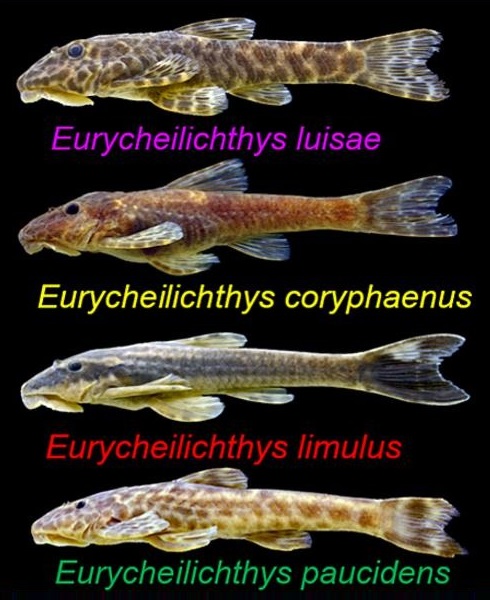
Armored catfishes of the genus Eurycheilichthys

in Delapieve, Rocha & Reis, 2023. 

Highlights
• Phylogenomic inference for Eurycheilichthys based on ddRAD sequence data.
• Monophyly of most, but not all, morphospecies corroborated by genome-wide data.
• Most sympatric species are not sister lineages, suggesting allopatric diversification and secondary contact.
• Higher diversity among lineages in the Taquari-Antas basin indicates a more dynamic landscape.
• Eastern clade species should be target by future studies to assess the presence of cryptic species or hybridization.

Abstract
Armored catfishes of the genus Eurycheilichthys are endemic to Southern Brazil and Misiones (Argentina) comprising nine species of small size, with a high degree of sympatry and species diversity distributed in two river basins. Here we use new genome-wide data to infer a species phylogeny and test species boundaries for this poorly known group. We estimate 1) the phylogenetic relationships of the species of Eurycheilichthys based on 29,350 loci in 65 individuals of nine species plus outgroups, and 2) the population structure and differentiation based on 43,712 loci and 62 individuals to estimate how geography may have acted on speciation and formation of the sympatric species groups. Analyses support the monophyly of the genus and suggest two species-inclusive clades (East and West) with high support and very recently diverged species. Western clade contains E. limulus (from upper Jacuí River basin) that is sister to Western species of the Taquari-Antas basin plus E. paucidens. The Eastern clade contains E. pantherinus (from Uruguay River basin) sister to the Eastern species of the Taquari-Antas basin E. coryphaenus, plus the central-distributed species E. planus and E. vacariensis, and the more widely-distributed species E. luisae. Eurycheilichthys luisae is not monophyletic and may contain one or more cryptic species or hybrid individuals. A stronger diversity on structure of lineages on the Taquari-Antas, when compared to upper Uruguay and Jacuí River basins, and the fact that most of the sympatrically distributed taxa have non-sister relationships suggest a scenario of mainly allopatric speciation and may indicate a more dynamic landscape with headwater capture events among these tributaries.
 
Keywords: Neotropics, Biodiversity, Cascudinhos, ddRADseq, Phylogenetics


Maria Laura S. Delapieve, Luiz A. Rocha and Roberto E. Reis. 2023. Phylogenomics of the narrowly endemic Eurycheilichthys (Siluriformes: Loricariidae): Sympatric Species with Non-sister Relationships suggest mainly Allopatric Speciation. Molecular Phylogenetics and Evolution. 190, 107970. DOI: 10.1016/j.ympev.2023.107970

[Paleontology • 2024] Paleoenvironment and Paleoecology associated with the early Phases of the Great American Biotic Interchange based on Stable Isotope Analysis of Fossil Mammals and new U–Pb Ages from the Pampas of Argentina


in Sanz-Pérez, Montalvo, Mehl, Tomassini, Fernández et Domingo, 2024. 
Artwork: Manuel Hernández Fernández  twitter.com/hdezfdez

Highlights: 
• First zircon dates from Neogene classic sites in central Argentina are provided.
• An increase of C4 plants values is recorded in mammal diets from Early Pliocene.
• The δ13C values of Lycopsis and Thylacosmilus suggest prey partitioning.

Abstract
The analysis of stable isotopes in fossil mammals is useful for reconstructing paleoenvironmental and paleoecological conditions, but has been rarely applied to the Neogene of South America. In this study, we perform an integrative analysis (including U–Pb zircon dates and mammalian stable isotopes data) for the Late Miocene–Early Pliocene of central Argentina. We provide radioisotopic ages for some classic fossiliferous localities in this region, including an age of 9.7 ± 0.3 Ma for Arroyo Chasicó and 4.5 ± 0.2 Ma for Farola Monte Hermoso, and address the interval covering the Chasicoan (Late Miocene), Huayquerian (Late Miocene–Early Pliocene), and Montehermosan (Early Pliocene) stages/ages. In the Chasicoan Stage/Age, taxa with mixed C3–C4 diets are recorded, suggesting the existence of favorable conditions for the C4 photosynthetic pathway before its full expansion. However, taxa represented across most of the Huayquerian Stage/Age show a preference for C3–based diets, which changes in the latest Huayquerian–Montehermosan stages/ages when an increase in the percentage of C4 plants in the diet of notoungulates, rodents, and xenarthrans is recorded, coinciding with the global expansion of C4 plants. For the first time, the dietary behavior of two South American endemic sparassodont metatherians (Lycopsis and Thylacosmilus) has been evaluated from using stable isotope; analysis of these hypercarnivores show differences in δ13C values, suggesting prey partitioning, partly due to the difference in body size. The fossiliferous sites studied, and the new isotopic and chronological information obtained, provide more detailed paleoecological and paleoenvironmental contexts for the Argentine Pampas during the last stages of the isolation of South America and the first pulses of the Great Biotic American Interchange. In addition, the new ages allow to better adjust the arrival of the first Holarctic immigrants in the region.
 
Keywords: Carbon, Oxygen, Radiometric dating, Miocene, Pliocene, South America


Dánae Sanz-Pérez, Claudia I. Montalvo, Adriana E. Mehl, Rodrigo L. Tomassini, Manuel Hernández Fernández and Laura Domingo. 2024. Paleoenvironment and paleoecology associated with the early phases of the Great American Biotic Interchange based on stable isotope analysis of fossil mammals and new U–Pb ages from the Pampas of Argentina. Palaeogeography, Palaeoclimatology, Palaeoecology. 634, 111917. DOI: 10.1016/j.palaeo.2023.111917

Monday, December 4, 2023

[Botany • 2016] Diplycosia platyphylla (Ericaceae: Gaultherieae) • A New Species from Mindanao, Philippines


 Diplycosia platyphylla P.W.Fritsch, 

in Fritsch and Victor Amoroso. 2016. Diplycosia 
(. PhytoKeys. 69; 31-38. 

Abstract
Diplycosia platyphylla P.W.Fritsch, a new species from Mindanao Island, Philippines, is described and illustrated. This species is most similar to the Bornean D. urceolata but differs by its green or slightly flushed pink petioles 4–7 mm long, wider leaf blades, acute calyx lobe apices, and lavender mature fruiting calyx. The new species is known only from a single collection made from Mount Apo in North Cotabato Province, southern Mindanao.

Keywords: Diplycosia, Ericaceae, Gaultherieae, Mindanao, Mount Apo, new species, Philippines

 Diplycosia platyphylla P.W.Fritsch.
A Habitat B Habit C Branchlet with inflorescences D Inflorescence E Immature fruit. (D.S. Penneys 2302).
Scale bars: C = 10 cm, D, E = 1 cm. Photos P.W.F.

Diplycosia platyphylla P.W.Fritsch, sp. nov.
 
Diagnosis: 
Haec species Diplycosiae urceolatae simillima, sed ab eo petiolo viridi vel viridi ex roseo 4–7 mm longo, lamina 7–7.5 cm lata, lobis calycis acutis, calyce fructus maturo lavandulo differt.


  Peter Fritsch and Victor Amoroso. 2016. Diplycosia platyphylla (Ericaceae), A New Species from Mindanao, Philippines. PhytoKeys. 69; 31-38.  DOI: 10.3897/phytokeys.69.9466


[Botany • 2023] Eugenia sarahchazaroi (Myrtaceae: Myrteae) • A New Species from the Cloud Forest of Mexico


Eugenia sarahchazaroi Cházaro, Franc.Gut. & J.R.Carral, 

in Francisco-Gutiérrez, Cházaro-Basáñez, Carral-Domínguez, Narave-Flores et Islas-Tello, 2023. 

Abstract
Following the description of Eugenia naraveana in 2016 from the cloud forest of the Cofre de Perote volcano, Mexico, the doubt about the existence of another unlocalized and sympatric species of Eugenia remained. After years of searching, the second endemic species of the Cofre de Perote volcano, Eugenia sarahchazaroi, is presented here. It belongs to the section Umbellatae, and is described, illustrated, and compared with E. naraveana and E. coetzalensis, recently described from Veracruz, the second state with the highest diversity of Eugenia in Mexico. The species is only known from the type locality and is classified in the Critically Endangered CR B1+B2(a,biii) category of the IUCN Red List conservation assessments.

Key words: Cloud forest, Cofre de Perote, endemic species, Eugenia naraveana, Umbellatae, Veracruz

Eugenia sarahchazaroi
A inflorescence B twig with fruits C detail of flowers D fascicles E floral budsF staminal disc G adaxial surface of a leaf H abaxial surface of a leafI immature fruitJ ripe fruit, and K seedling.
All photographs were taken by Rodrigo Carral-Domínguez and edited by Antonio Francisco-Gutiérrez.

 Eugenia sarahchazaroi Cházaro, Franc.Gut. & J.R.Carral, sp. nov.
 
Diagnosis: Eugenia sarahchazaroi is morphologically similar to E. naraveana but differs by having shorter and smaller leaves (37.3–59.7 × 14.4–21.3 mm vs. 57–116 × 22–55 mm in E. naraveana), reduced number of flowers per fascicle (4–6 vs. 3–16), absence of bracteoles (vs. presence), shorter pedicels (1–1.7 × 0.6–1 mm vs. 6–12 × 1–2.6 mm), smaller staminal disc (1.6–2 mm vs. 3–5 mm wide), presence of central cavity in staminal disc (vs. absence), shorter style (3.4–7 mm vs. 7.5–9.7 mm), and shorter fruits (1.4–1.8 cm vs. 1.1–4.3 cm). The species is also similar to E. coetzalensis but it can be distinguished by its inflorescence (axillary fascicles vs. axillary racemes in E. coetzalensis).

Etymology: The specific epithet honors Sarah Magyari Cházaro-Hernández, the beloved daughter of Miguel Cházaro-Basáñez, who has accompanied him on numerous botanical expeditions. As a child, Sarah Cházaro developed an interest in botany by learning to identify several plant genera on field trips with her father (Fig. 4). This new species is the third dedicated to his children, with Agave paskynnellchazaroi Arzaba, Cházaro & Franc.Gut. (Arzaba-Villalba et al. 2023), and Valeriana rudychazaroi Cházaro, Franc.Gut. & J.R.Carral (Francisco-Gutiérrez et al. 2023b). These eponyms were the last will of Miguel Cházaro before he passed away on April 04, 2023. The obituary with a review of his life and work can be found in Francisco-Gutiérrez and Vázquez-García (2023).


Antonio Francisco-Gutiérrez, Miguel Cházaro-Basáñez, Rodrigo Carral-Domínguez, Héctor Narave-Flores and Luis Islas-Tello. 2023. Eugenia sarahchazaroi (Myrtaceae, Myrteae), A New Species from the Cloud Forest of Mexico. PhytoKeys. 236: 53-64. DOI: 10.3897/phytokeys.236.111421

[Botany • 2022] Aspidistra nikitensis (Asparagaceae: Nolinoideae) • A New Species from Vietnam


 Aspidistra nikitensis Kalyuzhny & Vislobokov,  

in Kalyuzhny, Vislobokov, Luu, Plugatar, ... et Vin'kovskaya, 2022.

Abstract
Aspidistra nikitensis is described and illustrated as a new species from Gia Lai province of Vietnam. The new species possesses linear leaves and trimerous flowers with a mushroom-shaped pistil. In these features, the new species is morphologically similar to A. hainanensis species complex but differs in its convex stigma with projections. In stigma structure, A. nikitensis resembles A. longanensis but differs in shape of leaves and flower merism.

Keywords: Gia Lai, IUCN, projections, Kon Chu Rang, stigma, Monocots

 Aspidistra nikitensis.
 A. Flower, front view. B. Flower with partly removed perigone, side view. C, D. Longitudinal sections of flower. E. Plant with flowers. F, G. Habit.

Aspidistra nikitensis Kalyuzhny & Vislobokov sp. nov. 

Diagnosis: Aspidistra nikitensis is morphologically similar to A. hainanensis species complex but differs in convex stigma with projections.


Sergey S. Kalyuzhny,  Nikolay A. Vislobokov, Hong Truong Luu, Yury V. Plugatar, Andrey N. Kuznetsov, Svetlana P. Kuznetsova, Vladislav V. Korzhenevsky and Oksana P. Vin'kovskaya. 2022. Aspidistra nikitensis (Asparagaceae, Nolinoideae), A New Species from Vietnam. Phytotaxa. 574(4); 289-294. DOI: 10.11646/phytotaxa.574.4.4 
 

Sunday, December 3, 2023

[Herpetology • 2023] Dibamus tropcentr • A New Species of the Genus Dibamus Duméril & Bibron, 1839 (Squamata: Dibamidae) from the Driest and Hottest Place of Vietnam


Dibamus tropcentr Kliukin, Nguyen, Bragin & Poyarkov, 

in Kliukin, Nguyen, Le, Bragin, Tran, Gorin et Poyarkov, 2023.
Ninh Thuan Blind Skink || DOI: 10.11646/zootaxa.5380.4.1 
Thằn lằn giun Ninh Thuận  ||  facebook.com/TanNguyen91VN
Ninthuanskayacherveobraznaya yascheritsa ||  Researchgate.net/publication/376110506
 
Abstract
A new species of the genus Dibamus Duméril & Bibron, 1839 is described based on seven specimens collected from Nui Chua National Park, Ninh Thuan Province, southern Vietnam, the hottest and driest place of the country. Dibamus tropcentr sp. nov. is superficially similar to Dibamus smithi Greer, 1985, but can be distinguished from the latter by: the presence of a rudimentary labial suture; by larger number of subcaudal scales; by comparatively longer tail; by generally larger number of midbody scale rows; by having the interparietal scale not enlarged, subequal to the nuchal scale; by having frontal and frontonasal scales subequal in size as compared to almost twice larger frontal scale in D. smithi; by having three scales posterior to interparietal; by having the medial scale posterior to mental not enlarged; by having three to four scales on the posteromedial edge of infralabials; and by having supralabial scale larger than ocular scale. We suggest the new species should be considered as Vulnerable (VU) following the IUCN’s Red List categories. The new species occurs in dry maritime mixed low evergreen forests at elevations of 200–280 m a.s.l. and was recorded in association with termite species Globitermes sulphureus (Haviland). Our study brings the total number of species of the genus Dibamus to 25; this is the seventh species of the genus recorded from Vietnam.

Keywords: Reptilia, Dibamus tropcentr sp. nov., Nui Chua National Park, Ninh Thuan Province, Blind Skinks, conservation, Southeast Asia, morphology, systematics,

Distribution of the genus Dibamus in southern Indochina.

Holotype of Dibamus tropcentr sp. nov. (ZMMU Re-17443, female) in life in situ (A) and prior to preservation (B).
Photographs by Nikolay A. Poyarkov. Scale bar equals 5 mm.

Skeletal morphology of the male paratype of Dibamus tropcentr sp. nov. (ZMMU Re-17444).

Photographs (A–C) and line drawings (D–F) of head scalation of the holotype of Dibamus tropcentr sp. nov. (ZMMU Re-17443, female), and line drawings (G–I) of the paratype of Dibamus smithi (NHMUK 1946.8.21.24, female).
Head is shown in lateral (A, D, G), ventral (B, E, H), and dorsal (C, F, I) aspects.
Scale bar equals 1 mm. Small dots on the rostral and labial area indicate sensory papillas. Photographs A–C and line drawings D–F by Nikolay A. Poyarkov; line drawings G–I modified from Greer (1985).
 
Dibamus tropcentr sp. nov.
 Kliukin, Nguyen, Bragin & Poyarkov


Etymology. The name of the new species is a noun in apposition and is therefore invariable; the species name is given in reference to the Joint Vietnam - Russia Tropical Science and Technology Research Centre (VRTC).This international organization has been conducting research on ecology and biodiversity of Vietnam for over 35years (1989–2023). Herpetological studies by VRTC staff have resulted in the description of over 60 new taxa of amphibians and reptiles from Vietnam. We recommend the names “Ninh Thuan Blind Skink” “Ninthuanskayacherveobraznaya yascheritsa” and “Thằn lằn giun Ninh Thuận” as common names of the new species in English, Russian, and Vietnamese, respectively. 

Natural macrohabitat (A) and microhabitat (B) of Dibamus tropcentr sp. nov. at the type locality in Da Vach Mountain, Nui Chua National Park, Ninh Thuan Province, Vietnam. The rotten log shown in (B) was the habitat where the holotype of the new species was found together with Globitermes sulphureus (Haviland) colony.
Photographs by Nikolay A. Poyarkov.


Nikita S. Kliukin, Tan Van Nguyen, Son Xuan Le, Andrey M. Bragin, Tin Trong Vo Tran, Vladislav A. Gorin and Nikolay A. Poyarkov. 2023. A New Species of the Genus Dibamus Duméril & Bibron, 1839 (Squamata: Dibamidae) from the Driest and Hottest Place of Vietnam. Zootaxa. 5380(4); 301-320. DOI: 10.11646/zootaxa.5380.4.1 


Saturday, December 2, 2023

[Entomology • 2023] Semanopterus kingstoni • A New, but possibly extinct, Species of Semanopterus Hope, 1847 (Coleoptera: Scarabaeidae: Dynastinae) from Lord Howe Island, in the southwestern Pacific Ocean


 Semanopterus kingstoni 
 Reid & Tees, 2023


Abstract
A new and brachypterous species of Semanopterus Hope, 1847 (Coleoptera: Scarabaeidae: Dynastinae: Pentodontini) is described: S. kingstoni Reid & Tees, new species. The species is based on a single female specimen, collected on Lord Howe Island in the southwest Pacific Ocean. It is the sixth species of dynastine known from Lord Howe Island; a key is provided for identification of all of the species known from this small island.

Keywords: Coleoptera, scarab, brachyptery, extinction, oceanic island, Australia

 Semanopterus kingstoni new species, holotype.
1, dorsal habitus; 2, lateral habitus; 3, dorsal of head; 4, anterior of head; 5, antenna; 6, labels.

 Semanopterus kingstoni new species, holotype.
 7, ventral habitus; 8, prothoracic leg; 9, metathoracic leg; 10, posterior.


Chris A.M. Reid, Natalie A. Tees. 2023.  A New, but possibly extinct, Species of Semanopterus Hope, 1847 from Lord Howe Island, in the southwestern Pacific Ocean (Coleoptera: Scarabaeidae: Dynastinae).  Zootaxa. 5306(5); 563-570. DOI: 10.11646/zootaxa.5306.5.4

[Herpetology • 2023] Cyrtodactylus vairengtensis • It‘s all in the Name: Another New Cyrtodactylus Gray (Squamata: Gekkonidae) from northern Mizoram, North-east India

 
Cyrtodactylus vairengtensis
Lalremsanga, Colney, Vabeiryureilai, Malsawmdawngliana, Bohra, Biakzuala, Muansanga, Das & Purkayastha, 2023

 
Abstract
A new species of Cyrtodactylus is described from Vairengte town, situated in the Kolasib District of Mizoram State, north-eastern India. The new species is found to be a member of Indo-Burman Cyrtodactylus khasiensis clade based on ND2 gene sequences and morphological parameters, such as number of precloacal pores, mid-ventral scale rows, paravertebral tubercles on the trunk, dorsal tubercle rows, subdigital lamellae on pes and subcaudal scalation, making it the sixth endemic Cyrtodactylus from Mizoram and twenty second from north-east India. Moreover, phylogenetic evidence suggests the new species to be sister to the recently described C. aaronbaueri, and morphological analyses also reveal marginal separation between the two species based on the PCA of infralabials, lamellae on fingers and toes, paravertebral tubercles on the trunk, and dorsal tubercle rows.

Keywords: North-east India, taxonomy, ND2, lizard, reptile, systematics


Cyrtodactylus vairengtensis sp. nov. in life
 [A: holotype (2903); B: MZMU2626, C: Uncollected individual and D: MZMU2742)].


Cyrtodactylus vairengtensis sp. nov.


Hmar Tlawmte Lalremsanga, Zosiamliana Colney, Mathipi Vabeiryureilai, Fanai Malsawmdawngliana, Sanath Chandra Bohra, Lal Biakzuala, Lal Muansanga, Madhurima Das and Jayaditya Purkayastha. 2023. It‘s all in the Name: Another New Cyrtodactylus Gray (Squamata: Gekkonidae) from northern Mizoram, North-east India.  Zootaxa. 5369(4); DOI: 10.11646/zootaxa.5369.4.5 

Friday, December 1, 2023

[Mammalogy • 2023] Mesechinus orientalis • A New Species of Forest Hedgehog (Eulipotyphla: Erinaceidae: Mesechinus) from eastern China


Mesechinus orientalis
Shi, Yao, He, Bai, Zhou, Fan, Su, Nie, Yang, Onditi, Jiang et Chen, 2023  
 
Eastern Forest Hedgehog, 华东林猬  

Abstract
The hedgehog genus Mesechinus (Erinaceidae, Eulipotyphla) is currently comprised of four species, M. dauuricus, M. hughi, M. miodon, and M. wangi. Except for M. wangi, which is found in southwestern China, the other three species are mainly distributed in northern China and adjacent Mongolia and Russia. From 2018 to 2023, we collected seven Mesechinus specimens from Anhui and Zhejiang provinces, eastern China. Here, we evaluate the taxonomic and phylogenetic status of these specimens by integrating molecular, morphometric, and karyotypic approaches. Our results indicate that the Anhui and Zhejiang specimens are distinct from the four previously recognized species and are a new species. We formally described it here as Mesechinus orientalis sp. nov. It is the only Mesechinus species occurring in eastern China and is geographically distant from all known congeners. Morphologically, the new species is most similar to M. hughi, but it is distinguishable from that species by the combination of its smaller size, shorter spines, and several cranial characteristics. Mesechinus orientalis sp. nov. is a sister to the lineage composed of M. hughi and M. wangi from which it diverged approximately 1.10 Ma.

Key words: Anhui, mammals, phylogeny, taxonomy

A living Mesechinus orientalis sp. nov. (XC 2205003) from Xuancheng, Anhui.

 Mesechinus orientalis sp. nov.
 
Suggested common name: Eastern Forest Hedgehog, 
华东林猬 (Huadong Linwei).

Diagnosis: This is a small-bodied hedgehog (GLS = 49.95 ± 1.69 mm), similar to M. hughi, but smaller than other Mesechinus species. It has the shortest spines in the genus (18–20 mm); the spines have four-colour rings, similar to the spines of M. dauuricus and M. hughi, but different from those of M. miodon and M. wangi (Fig. 8). The parietal is higher than the frontals, which differs from that of M. hughi and M. wangi (Fig. 9). The P2 is two-rooted and not completely fused (Fig. 4). The protocone of P3 is vestigial, which differs from that of M. hughi, and smaller than P2, which distinguishes it from M. dauuricus. The dental formula of M. orientalis sp. nov. [I 3/2, C1/1, P 3/2, M 3/3 (×2) = 36], which distinguishes it from M. wangi. 
 
Etymology: The specific name orientalis is derived from the Latin oriens, “the east”, and suffix -alis, “pertaining to”, in reference to the new species’ eastern distribution in Anhui and Zhejiang provinces in eastern China.


 Zifan Shi, Hongfeng Yao, Kai He, Weipeng Bai, Jiajun Zhou, Jingyi Fan, Weiting Su, Wenhui Nie, Shuzhen Yang, Kenneth O. Onditi, Xuelong Jiang, Zhongzheng Chen. 2023. A New Species of Forest Hedgehog (Mesechinus, Erinaceidae, Eulipotyphla, Mammalia) from eastern China. ZooKeys. 1185: 143-161. DOI: 10.3897/zookeys.1185.111615