Monday, March 9, 2015

[Herpetology • 2013] Asthenodipsas lasgalenensis • Cryptic Speciation within Asthenodipsas vertebralis (Boulenger, 1900) (Squamata: Pareatidae), the Description of A New Species from Peninsular Malaysia, and the Resurrection of A. tropidonotus (Lidth de Jude, 1923) from Sumatra: An Integrative Taxonomic Analysis


Mirkwood Forest Slug Snake | Asthenodipsas lasgalenensis
Loredo, Wood, Quah, Anuar, Greer, Ahmad & Grismer, 2013

Abstract

A review of the taxonomic status of the Asian Slug Snake, Asthenodipsas vertebralis (Boulenger, 1900) based on an in-tegrative taxonomic approach using molecular, morphological, color pattern, and ecological data indicate it is composed of three well supported monophyletic lineages: (1) Pulau Tioman and Fraser’s Hill, Pahang and Bukit Larut, Perak; Pen-insular Malaysia; (2) its sister lineage from Northern Sumatra; and (3) the remaining basal lineage from Peninsular Malaysia. Furthermore, we consider the high sequence divergence (6.3%–10.2%) between these lineages (especially in areas of sympatry) and discrete differences in their morphology, color pattern, and microhabitat preference as evidence they are not conspecific. As such, we resurrect the name A. tropidonotus (Lidth de Jeude, 1923) for the Sumatra populations, re-strict the name A. vertebralis to the populations from Pulau Tioman, Genting Highlands, Fraser’s Hill, Gunung Benom, and Bukit Larut that contain terrestrial, banded adults; and consider Asthenodipsas lasgalenensis sp. nov. to be restricted to the populations from Fraser’s Hill, Cameron Highlands, and Bukit Larut that contain arboreal, unbanded adults.

Keywords: Malaysia, Bukit Larut, Fraser’s Hill, Pulau Tioman, Cameron Highlands, Genting Highlands, Sumatra, Asthenodipsas, integrative taxonomy, new species, cryptic species


Asthenodipsas lasgalenensis sp. nov.
Mirkwood Forest Slug Snake 

Distribution. Asthenodipsas lasgalenensis sp. nov. is known only from Genting Highlands, Fraser’s Hill, Cameron Highlands, Pahang and Bukit Larut, Perak (Fig. 1). It is likely A. lasgalenensis sp. nov. and A. vertbebralis range throughout the montane cloud forests of northeastern Peninsular Malaysia as well as throughout similar habitats in southern Thailand south of the Isthmus of Kra.

Natural History. The localities from which Asthenodipsas lasgalenensis sp. nov. was found are montane cloud forests above 800 m in elevation. All specimens were found at least 1 m above the ground at night foraging or resting in vegetation.

Etymology. The specific epithet lasgalenensis is derived from the name Eryn Lasgalen which means in the “Wood of Greenleaves” in the fictional Sindarian language from J.R.R Tolkien’s The Lord of the Rings (1955). It was the name used by the Wood Elves for the Mirkwood Forest after its cleansing following the War of the Ring. This name was chosen because Tolkien’s (1955) description of this forest showed great similarity to the cloudy, upland forests within which this species is found.


Coloration of a hatchling Asthenodipsas vertebralis from Fraser’s Hill, Pahang (LSUHC 9100)

FIGURE 5. Asthenodipsas vertebralis.
Upper left; adult female (LSUHC 10920) from Fraser’s Hill, Pahang. Lower left: adult male (LSUHC 9138) collected by L. Lee Grismer and Chan Kin Onn on 16 November 2008, specimen lost in transit.
Right: adult specimen of unknown sex (LSUDPC 6233) from Cameron Highlands, photograph provided by Gernot Vogel. 


Loredo, Ariel I., Perry J. L. Wood, Evan S. H. Quah, Shahrul Anuar, Lee F. Greer, Norhayati Ahmad & L. L. Grismer. 2013. Cryptic Speciation within Asthenodipsas vertebralis (Boulenger, 1900) (Squamata: Pareatidae), the Description of A New Species from Peninsular Malaysia, and the Resurrection of A. tropidonotus (Lidth de Jude, 1923) from Sumatra: An Integrative Taxonomic Analysis. Zootaxa. 3664(4); 505-524. DOI: 10.11646/zootaxa.3664.4.5


In search of herps http://fw.to/MMxDdbH

[Ornithology • 2014] The Rediscovery of Myanmar’s Jerdon’s Babbler Chrysomma altirostre altirostre in the Ayeyarwady floodplain, Myanmar


Jerdon’s Babbler Chrysomma altirostre altirostre, Udo, Yangon region, 31 May 2014.

.........

One of the least-known species adapted to life in Asia’s grasslands is the Vulnerable Jerdon’s Babbler Chrysomma altirostre, first found by T. C. Jerdon in January 1862 near Thayetmyo, Magway region (19.326°N 95.182°E) in the Ayeyarwady floodplain, Myanmar (Jerdon 1862). Other races were soon found— griseigulare (Hume 1877) from the lower Ganga and Brahmaputra plains of northeast South Asia and scindicum (Harington 1915) from the Indus watershed in Pakistan and Punjab. Despite being the first population to be discovered, Myanmar’s Jerdon’s Babbler C. a. altirostre has spent most of its existence lost somewhere in the Ayeyarwady–Sitaung plain; after its initial discovery the bird quickly disappeared back into the long grass. Eugene Oates (see BirdLife International 2001) collected a few more specimens in the late 1870s and even suggested that it was common in the area between Wau (17.477°N 96.677°E) and Taungoo (18.934°N 96.433°E), Bago region. When Bertram Smythies, Herbert Smith and Peter Garthwaite published the Birds of Burma in 1940, the bird had not been seen again and they stated that the vast grasslands of Jerdon’s and Oates’s days had already been converted to rice paddies, admitting that no-one knew if Jerdon’s Babbler was still present. Fortunately, soon after the book was published, Smith decided to find out. On 9 July 1941 Smith collected a single specimen in the remnants of a huge wetland near Myitkyo (17.605°N 96.809°E), in the Sitaung floodplain. Within a year of this rediscovery Rangoon (now Yangon) was occupied by Japan, and both Smith and Smythies had left Myanmar. In 1953 Smythies added Smith’s discovery to the next edition of his book, admitting that the bird had once again disappeared, perhaps for good.

.........

Frank E. Rheindt, Robert Tizard, Nila Pwint and Naing Lin. 2014. The Rediscovery of Myanmar’s Jerdon’s Babbler Chrysomma altirostre altirostre. BirdingASIA. 22 (2014): 13–15. http://orientalbirdclub.org/wp-content/uploads/2015/03/BirdingAsia22-pp13-15.pdf


Jerdon’s Babbler Chrysomma altirostre altirostre in the hand, Udo, Yangon region, Myanmar.
photo: Robert Tizard/WCS | 31 May 2014


'Extinct' Bird Rediscovered in Myanmar, Surprising Scientists http://on.natgeo.com/1KueqCn via @NatGeo

Sunday, March 8, 2015

[Herpetology • 2015] Pareas vindumi • A New Montane Species of the Genus Pareas Wagler, 1830 (Squamata: Pareatidae) from Northern Myanmar


Abstract
A new species of the genus Pareas is described from northern Myanmar. It differs from all other known species of the genus by coloration, which is mainly uniform, and its size (one of the largest species in the genus). Furthermore it is characterized by a low number of supralabials (six), a loreal that touches the orbit, presence of a presubocular and absence of a preocular. The new species was found at an elevation of 1890 m a.s.l. and is regarded as an inhabitant of high elevation mountainous areas.

Keywords: Asia, Colubroidea, Oriental region, Pareas vindumi sp. nov., taxonomy


  Gernot Vogel. 2015. A New Montane Species of the Genus Pareas Wagler, 1830 (Squamata: Pareatidae) from Northern Myanmar. TAPROBANICA. 7(1); 1–7. DOI: 10.4038/tapro.v7i1.7501

[Herpetology • 2015] Amphiesma clerki | Revalidation of Natrix clerki Wall, 1925, An overlooked Species in the Genus Amphiesma Duméril, Bibron & Duméril, 1854 (Squamata: Natricidae)


Amphiesma clerki (Wall, 1925)

Abstract

Natrix clerki Wall, 1925, previously known from its sole holotype and considered a synonym of Amphiesma parallelum (Boulenger, 1890), is resurrected in the genus Amphiesma on the basis of the analysis of morphological variation in 28 specimens of “Amphiesma parallelum” auctorum, plus six living, unvouchered specimens discovered in Arunachal Pradesh and Nagaland, India, and one vouchered specimen from Talle Valley in Arunachal Pradesh. Specimens from northeast India (Nagaland), northern Myanmar, and China (Yunnan), previously identified as Amphiesma parallelum either in the literature or in museum’s catalogues, are also here referred to A. clerki. The holotype of Amphiesma clerki is redescribed. As a consequence, the definition of Amphiesma parallelum is modified. A. parallelum inhabits the Khasi Hills and Naga Hills in Northeast India, whereas A. clerki has a wider range in the Eastern Himalayas, northern Myanmar and Yunnan (China). Amphiesma clerki differs from A. parallelum by its longer tail, dorsal scales more strongly keeled, scales of the first dorsal scale row strongly keeled vs. smooth, a postocular streak not interrupted at the level of the neck, and a much more vivid pattern on a darker background colour. Characters of species of the Amphiesma parallelum group, i.e. A. clerki, A. parallelum, A. bitaeniatum, A. platyceps and A. sieboldii are compared. A key to this group is provided.

Keywords: Reptilia, Nepal, India, Myanmar, China, taxonomy


David, Patrick, Ishan Agarwal, Ramana Athreya, Rosamma Mathew, Gernot Vogel & Viral K. Mistry. 2015. Revalidation of Natrix clerki Wall, 1925, An overlooked Species in the Genus Amphiesma Duméril, Bibron & Duméril, 1854 (Squamata: Natricidae).
Zootaxa. 3919(2): 375–395. DOI: 10.11646/zootaxa.3919.2.9

[PaleoIchthyology • 2015] Janusiscus schultzei • Osteichthyan-like Cranial Conditions in an Early Devonian stem Gnathostome


The 415-million-year-old fish fossil (Janusiscus schultzei) has a well-developed external skeleton (shown in blue), a feature that is seen in the common ancestor of bony fish and cartilaginous fishes, such as sharks.
images: Sam Giles; Placoderm image: K. Trinajstic
DOI: 
10.1038/nature14065

The phylogeny of Silurian and Devonian (443–358 million years (Myr) ago) fishes remains the foremost problem in the study of the origin of modern gnathostomes (jawed vertebrates). A central question concerns the morphology of the last common ancestor of living jawed vertebrates, with competing hypotheses advancing either a chondrichthyan- or osteichthyan-like model. Here we present Janusiscus schultzei gen. et sp. nov., an Early Devonian (approximately 415 Myr ago) gnathostome from Siberia previously interpreted as a ray-finned fish, which provides important new information about cranial anatomy near the last common ancestor of chondrichthyans and osteichthyans. The skull roof of Janusiscus resembles that of early osteichthyans, with large plates bearing vermiform ridges and partially enclosed sensory canals. High-resolution computed tomography (CT) reveals a braincase bearing characters typically associated with either chondrichthyans (large hypophyseal opening accommodating the internal carotid arteries) or osteichthyans (facial nerve exiting through jugular canal, endolymphatic ducts exiting posterior to the skull roof) but lacking a ventral cranial fissure, the presence of which is considered a derived feature of crown gnathostomes. A conjunction of well-developed cranial processes in Janusiscus helps unify the comparative anatomy of early jawed vertebrate neurocrania, clarifying primary homologies in ‘placoderms’, osteichthyans and chondrichthyans. Phylogenetic analysis further supports the chondrichthyan affinities of ‘acanthodians’, and places Janusiscus and the enigmatic Ramirosuarezia in a polytomy with crown gnathostomes. The close correspondence between the skull roof of Janusiscus and that of osteichthyans suggests that an extensive dermal skeleton was present in the last common ancestor of jawed vertebrates4, but ambiguities arise from uncertainties in the anatomy of Ramirosuarezia. The unexpected contrast between endoskeletal structure in Janusiscus and its superficially osteichthyan-like dermal skeleton highlights the potential importance of other incompletely known Siluro-Devonian ‘bony fishes’ for reconstructing patterns of trait evolution near the origin of modern gnathostomes.


Gnathostomata Gegenbaur, 1874

Janusiscus schultzei gen. et sp. nov.

Etymology. Generic name refers to double-sided nature of the specimen, with an osteichthyan-like dorsal skull roof, but a braincase that displays an array of plesiomorphic gnathostome characters (Latin Ianus, the god of doorways and transitions, often depicted as having two faces; [p]iscis, fish). Specific name in honour of Hans-Peter Schultze (University of Kansas), who first described these specimens.

Holotype. GIT (Institute of Geology, Talinn, Estonia) 496-6 (Pi.1384), skull roof and braincase, both missing anterior region 


 Giles, Sam; Friedman, Matt; Brazeau, Martin D. 2015. Osteichthyan-like Cranial Conditions in an Early Devonian stem Gnathostome. Nature. doi: 10.1038/nature14065L3


Birth of Jaws: Tiny Fish May Be Ancient Ancestor http://shar.es/1fHsYF via @LiveScience

Saturday, March 7, 2015

[Ichthyology • 2015] Barilius ardens • A New Species (Teleostei: Cyprinidae) from the Western Ghats, India, with redescription of B. malabaricus and B. canarensis


Barilius ardens  Knight, Rai, D’souza & Vijaykrishnan, 2015

Abstract
The identities of Barilius canarensis and B. malabaricus have hitherto been confused. An attempt to resolve their identities by examining fresh collections from their respective type localities, i.e., southern Karnataka and northern Kerala, yielded a new species, which is herein described as Barilius ardens. The new species differs from B. canarensis and B. malabaricus by the presence of a row of 7–9 large vertically elongate blotches on the flank, in large adults the first three blotches broken into a smaller row of intercalate spots (vs. two rows of spots: the first consisting of 9–11oval spots, the second with 3–4 smaller spots); and 5+4+3 (vs. 5+4+2) pharyngeal teeth. The new species is distinguished from B. bakeri by having 5+4+3 (vs. 5+4+2) pharyngeal teeth; and the dorsal and anal fins margined with bright orange (vs. white). Barilius malabaricus (hitherto in the synonymy of B. canarensis) is shown to be a valid species distinguished from the latter by having 11½ (vs. 10½) branched dorsal-fin rays and 14½–15½ (vs. 13½) branched anal-fin rays; both species are redescribed.

Keywords: Opsarius, bakeri, gatensis, Western Ghats, Canara, Kerala


Knight, J. D. M., Ashwin Rai, Ronald K. P. D’souza & Balaji Vijaykrishnan. 2015. Barilius ardens (Teleostei: Cyprinidae), A New Species from the Western Ghats, India, with redescription of B. malabaricus and B. canarensis. Zootaxa. 3926(3): 396–412. DOI: 10.11646/zootaxa.3926.3.5

[Mammalogy • 2014] A Summary of the Taxonomy and Distribution of the Red Giant Flying Squirrel, Petaurista petaurista (Sciuridae, Sciurinae, Pteromyini), in mainland Southeast Asia with the First Record from Lao PDR


Abstract

The occurrence of the red giant flying squirrel, Petaurista petaurista, in Lao PDR is confirmed on the basis of a single adult male specimen obtained from an informal food market in Thatlouang village, Xekong Province in the south of the country. This individual was reported to have been collected from close-by Thatlouang in the mixed deciduous forest or dry dipterocarp forest on the Bolaven Plateau. The record extends the known distribution of this species by approximately 700 km eastwards. Information is provided on the external, cranial, dental, and bacular characters of the new Lao specimen. It is compared with the holotypes and/or type descriptions of seven taxa, namely, barroni, candidula, cicur, melanotus, penangensis, taylori, and terutaus, described from mainland Southeast Asia, all of which are currently included in the synonymy of P. petaurista. On the basis of its external pelage colour, the Lao specimen is referred to P. p. barroni, which was described from southeast Thailand and is considered here to be a valid subspecies.

Keywords: local market; red giant flying squirrel; Southeast Asia; taxonomy


Daosavanh Sanamxay, Bounsavane Douangboubpha, Sara Bumrungsri, Chutamas Satasook and Paul J.J. Bates. 2014. A Summary of the Taxonomy and Distribution of the Red Giant Flying Squirrel, Petaurista petaurista (Sciuridae, Sciurinae, Pteromyini), in mainland Southeast Asia with the First Record from Lao PDR. Mammalia. DOI: 10.1515/mammalia-2014-0005

Friday, March 6, 2015

[Mammalogy • 2014] Callicebus miltoni • A New Species of Titi Monkey, Genus Callicebus Thomas, 1903 (Primates, Pitheciidae), from Southern Amazonia, Brazil


Milton's Titi Monkey, Firetail Titi Monkey | Callicebus miltoni 
Figure 10:
Family group of Callicebus miltoni sp. nov. in the undercanopy of the ombrophilous forest at Panelas, right bank of the Roosevelt River, northwestern Mato Grosso, Brazil.
Photo: A. Gambarini.

ABSTRACT

The genus Callicebus is one of the most diverse Neotropical primate groups, with 31 recognized species. However, large knowledge gaps still exist regarding the diversity of this genus. Such gaps are gradually being filled due to recent intensification of sampling efforts. Several geographic distributions have been better delimited, and six new species have been described in the last 15 years. The goal of the present study is to describe a new species of Callicebus belonging to the Callicebus moloch species group, recently discovered in an area previously considered to be part of the geographic distribution of C. cinerascens. Data collection was conducted through direct observations, specimen collection and interviews with local residents during four expeditions. Specimens were deposited in the mammalian collection of the Museu Paraense Emílio Goeldi.. For a comparative evaluation, we examined specimens of the other species of the Callicebus moloch species group, especially the geographically neighboring forms, C. bernhardi and C. cinerascens. We examined 10 chromatic characters of the fur. In addition to body mass, we verified the conventional external variables and 26 craniometric variables. The new species differs from all other Amazonian Callicebus by an exclusive combination of characters, being easily distinguished by the light gray line of the forehead, dark ocher sideburns and throat, dark gray portions of the torso and flanks, and uniformly orange tail. The geographic distribution of the new species is limited by the Roosevelt and Aripuanã rivers, in the states of Mato Grosso and Amazonas, Brazil. Approximately 25% (1,246.382 ha) of this area falls within conservation areas, with five areas of sustainable use (746,818 ha) and three of integral protection (499,564 ha). Furthermore, a considerable portion of the distribution area is located within indigenous lands (1,555.116 ha - 32%). Therefore, 57% (2,801.498 ha) of the occurrence area of the new species falls within protected areas.

Key-words: Pitheciidae; Callicebus moloch species group; Taxonomy; Geographic distribution; Morphology.

Figure 6: Callicebus miltoni sp. nov., compared to geographically neighboring species (C. bernhardi and C. cinerascens) belonging to the Callicebus moloch species group.
Illustration by Stephen D. Nash.

Etymology: The new species is named in honor of Dr. Milton Thiago de Mello in recognition of his contribution to development of Primatology. In particular, we note his essential participation in the creation of the Brazilian Primatology Society and of the Latin American Primatology Society, and in the education of most primatologists currently active in Brazil and abroad, among them one of the authors of this paper (JSSJ), through specialized Primatology programs that begun in the 1980s at the Universidade de Brasília.

Vernacular names: "Zogue-zogue" is the term used by the residents of the Reserva Extrativista Guariba-Roosevelt, as well as in all Brazilian Amazonia, to identify primates of the genus Callicebus. Initially, the new species was termed "Firetail Titi Monkey" due to its light orange tail, which distinguishes it from other Callicebus in Amazonia. After selection of the scientific name, the common name became "Milton's Titi Monkey".

Figure 11: Adult Milton’s titi monkey eating Cecropia fruit while carrying a baby at Roosevelt River, Mato Grosso, Brazil.
Photo: A. Gambarini.


Figure 8: Callicebus miltoni sp. nov., adult male observed in the undercanopy of open ombrophilous alluvial forest, right bank of the Roosevelt River, Mato Grosso, Brazil.
Photo: J. Dalponte.


RESUMO

O gênero Callicebus é um dos grupos mais diversificados entre os primatas neotropicais, com 31 espécies reconhecidas. Contudo, ainda existem grandes lacunas no conhecimento acerca da diversidade contida neste gênero. Tais lacunas vêm sendo paulatinamente preenchidas graças a uma intensificação recente dos esforços de amostragem. Diversas distribuições geográficas foram melhor delimitadas, e seis espécies novas foram descritas nos últimos 15 anos. O objetivo do presente estudo é descrever uma nova espécie de Callicebus pertencente ao grupo de espécies Callicebus moloch, recentemente descoberta em uma área previamente considerada como parte da distribuição geográfica de C. cinerascens. Foram realizadas quatro expedições. A coleta de dados foi realizada através de observações diretas, coletas de espécimes e entrevistas com moradores locais. Os espécimes foram depositados na coleção de mamíferos do Museu Paraense Emílio Goeldi. Para uma avaliação comparativa, foram examinados os exemplares das demais espécies do grupo Callicebus moloch, principalmente as formas geograficamente vizinhas, C. bernhardi e C. cinerascens. Foram examinados 10 caracteres cromáticos da pelagem. Além da massa corporal, foram verificadas as medidas externas convencionais e 26 medidas cranianas. A nova espécie difere de todas as outras espécies amazônicas do gênero Callicebus por uma combinação exclusiva de caracteres, sendo facilmente distinguida pela faixa grisalha clara contrastante na testa, costeletas e garganta ocre-escuras, partes superiores do tronco e flancos grisalho-escuras, e cauda uniformemente laranja. A distribuição geográfica da nova espécie é limitada pelos rios Roosevelt e Aripuanã, nos estados de Mato Grosso e Amazonas, Brasil. Aproximadamente 25% (1.246.382 ha) desta área constituem unidades de conservação, sendo cinco de uso sustentável (746.818 ha) e três de proteção integral (499.564 ha). Além disso, uma porção expressiva da área de distribuição da nova espécie está localizada dentro de terras indígenas (1.555.116 ha - 32%). Assim, 57% (2.801.498 ha) da área de ocorrência da nova espécie encontram-se dentro de áreas protegidas.

Palavras-chave: Pitheciidae; Grupo de espécies Callicebus moloch; Taxonomia; Distribuição geográfica; Morfologia.


Julio César Dalponte, Felipe Ennes Silva and José de Sousa e Silva Júnior. 2014. New Species of Titi Monkey, Genus Callicebus Thomas, 1903 (Primates, Pitheciidae), from Southern Amazonia, Brazil. Pap. Avulsos Zool. (São Paulo). 54(32);  DOI: 10.1590/0031-1049.2014.54.32

Monkey species discovered by WWF-Brazil expedition receives scientific description http://shar.es/1fmZDA  
New monkey species discovered in the Amazon Rainforest fauna-flora.org/news/new-monkey-species-discovered-in-the-amazon-rainforest/
New Species of Monkey Discovered In Amazon Rainforest | IFLScience.com/plants-and-animals/new-species-titi-monkey-confirmed-amazon-rainforest
New monkey species discovered in the Amazon rainforest http://phy.so/344682420 via @physorg_com

Thursday, March 5, 2015

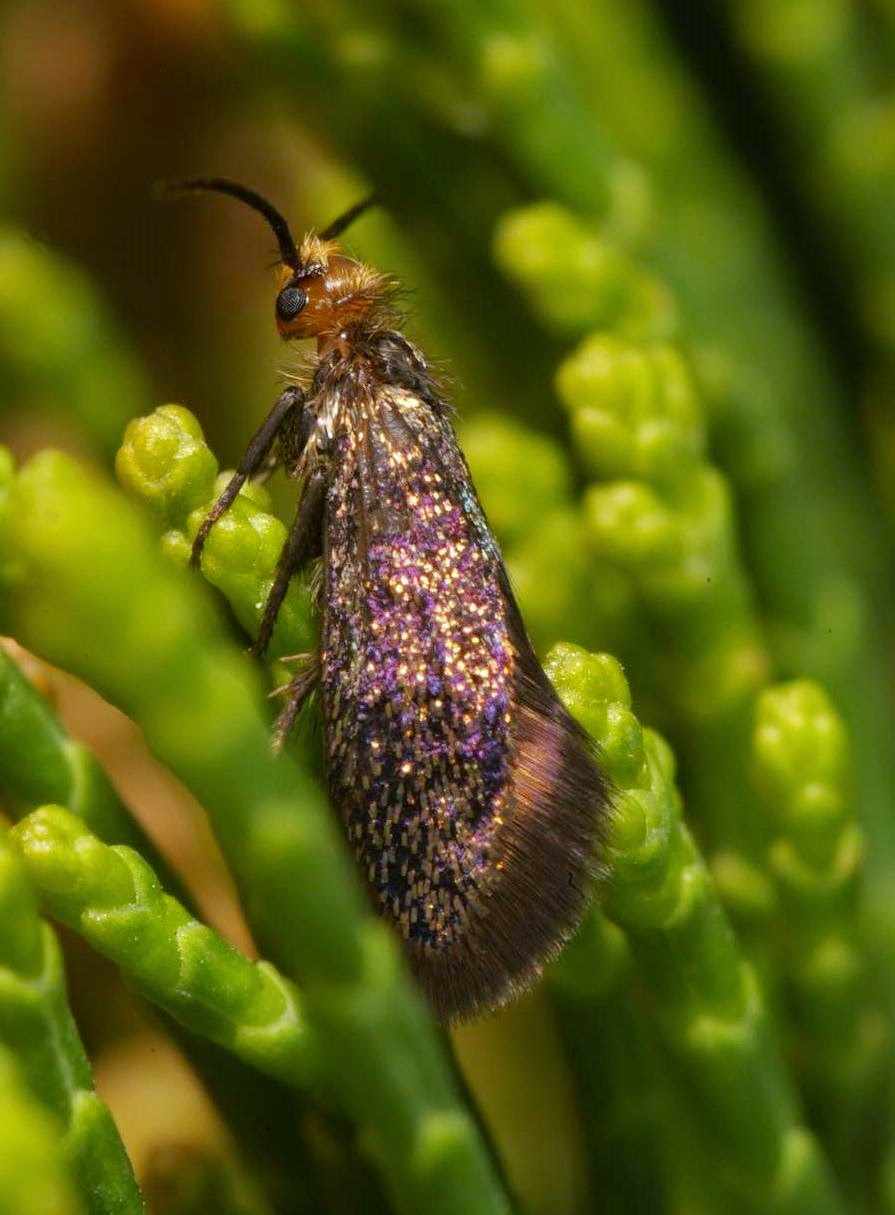
[Entomology • 2015] Aenigmatinea glatzella | 'enigma' moth • A New Extant Family (Aenigmatineidae) of Primitive Moths from Kangaroo Island, Australia, and its significance for understanding early Lepidoptera evolution


 'enigma' moth | Aenigmatinea glatzella Kristensen & Edwards, 2015
(a) Male holotype; (b) female in typical upside-down posture on young foliage of host (Callitris gracilis).

Abstract
We report the first discovery since the 1970s of a new extant family (Aenigmatineidae fam.n.) of homoneurous moths, based on the small Aenigmatinea glatzella sp.n. from Kangaroo Island off southern Australia. It exhibits a combination of extraordinary anatomical characters, and, unlike most homoneurous moths, its larva is a conifer-feeder (stem mining in Callitris, Cupressaceae). While the adult's mouthparts are strongly regressed, evidence from other morphological characters and from a Bayesian analysis of 25 genetic loci convincingly places the taxon among Glossata (‘tongue moths’). An unexpected tongue moth clade including Acanthopteroctetidae and Neopseustidae, suggested with low support in recent molecular analyses, remarkably becomes strongly supported when Aenigmatinea is included in the molecular analysis; the new taxon becomes subordinated in that clade (as sister group to Neopseustidae) and the clade itself appears as the sister group of all Heteroneura, representing the vast majority of all Lepidoptera. Including Aenigmatinea into the analysis thereby strengthens the surprising indication of non-monophyly of Myoglossata, and the new phylogeny requires an additional number of ad hoc assumptions of convergence/character reversals in early Lepidoptera evolution.


Taxonomy: 
Order LEPIDOPTERA, homoneurous grade

Aenigmatineidae Kristensen & Edwards, fam.n.

Aenigmatinea Kristensen & Edwards, gen.n.

Aenigmatinea glatzella Kristensen & Edwards sp.n. (type species by monotypy.)

Diagnosis: Adult moths (Fig. 1a) small, forewing length ≈ 4 mm, immediately recognizable by unique combined presence in the forewing (Fig. 3f) of a prominent jugal lobe, an only two-branched radial sector and a single-branched medial vein.

Etymology: Gender feminine, referring to enigmatic character combination; the Linnean Tinea comprised the many small moths, including the small homoneurans, whose wing posture in repose made them appear cylindrical (‘Alis convolutis fere in cylindrum…’) (Linné, 1767); glatzella: Adjective, gender feminine, honoring the moth's discoverer R. V. Glatz; the name also alludes to the unusual dearth of head scales, Glatze being German for a bald head.


Figure 5. Cladogram of basal (non-ditrysian and lowest-grade ditrysian) Lepidoptera. Trichopteran outgroups shown in grey. Branch support is as follows: *, posterior probability (PP) = 1, maximum likelihood bootstrap (ML BP) = 100; •, PP = 0.99–1, ML BP = 90–99; or as shown on branches themselves. ‘Jaw moths’ shown in black, and ‘tongue moths’ in blue. Width of terminal triangles approximates the number of described species (van Nieukerken et al., 2011) in each lineage: Micropterigidae (160 spp.), Agathiphagidae (two spp.), Heterobathmiidae (three spp.), Lophocoronidae (six spp.), Exoporia (636 spp.), Eriocraniidae (29 spp.), Acanthopteroctetidae (five spp.), Aenigmatineidae (one sp.), Neopseustidae (14 spp.), and Heteroneura (156 568 spp.).

Niels P. Kristensen, Douglas J. Hilton, Axel Kallies, Liz Milla, Jadranka Rota, Niklas Wahlberg, Stephen A. Wilcox, Richard V. Glatz, David A. Young, Glenn Cocking, Ted Edwards, George W. Gibbs and Mike Halsey. 2015. A New Extant Family of Primitive Moths from Kangaroo Island, Australia, and its significance for understanding early Lepidoptera evolution.
Systematic Entomology. 40(1); 5-16. DOI: 10.1111/syen.12115

New 'enigma' moth helps crack evolution's code http://phy.so/344671102 via @physorg_com

[Ichthyology • 2012] Discordipinna filamentosa • A New Deepwater Goby of the Genus Discordipinna Hoese & Fourmanoir, 1978 (Teleostei: Gobiidae) from Kumejima of the Ryukyus, Japan


Discordipinna filamentosa Chen, Suzuki & Shao, 2012
(New Japanese name: Naginata-haze) 


Abstract
A new goby species of Discordipinna was collected by trawling from the deep waters off Kumejima, the Ryukyu Islands, Japan. The new species, Discordipinna filamentosa, can be well distinguished from the only other described species, D. griessingeri Hoese & Fourmanoir, 1978, by the following unique combination of features: (1) fins: first dorsal fin rays VI; pectoral fin rays 16; and first dorsal fin with the longest, filamentous first ray in male extending far beyond caudal fin base when adpressed; (2) squamation: longitudinal scale rows 26; transverse scale rows 8 and predorsal naked; (3) dorsal pterygiophore formulae 3/122101/9; (4) head lateral-line system: a longitudinal pattern of infraorbital papillae and both anterior oculoscapular canal and preopercular canal present, lacking posterior oculoscapular canal; and (5) its distinctive coloration. An artificial key to species of Discordipinna is also provided. 

Key words: Discordipinna, Gobiidae, new species, Kumejima, Japan


Discordipinna filamentosa Chen, Suzuki & Shao, 2012
(New Japanese name: Naginata-haze) 


Distribution. So far, the single specimen was collected from the deepwater trawling of up to 82 m depth off Kumejima, Ryukyu, Japan. However, some underwater photographic records taken by Japanese scuba divers have provided live images of this species around Kashiwajima, Shikoku, Japan; Okinawajima, the Ryukyu Islands, Japan; and Malaysia. Based on scuba diving witness and current trawl specimen record, it seems to live in 30 to 82 m depth water with substratum of coral-reef hard debris. 

Etymology. The specific name referred to Latin-“filamentum” meaning the thread-like elongation of fin, a diagnostic feature, as very thin and long extension of the anterior two spinous rays of first dorsal fin.


 Chen, I.-S., Suzuki, T. & Shao, K.-T. 2012. A New Deepwater Goby of the Genus Discordipinna Hoese & Fourmanoir, 1978 (Teleostei: Gobiidae) from Kumejima of the Ryukyus, Japan. (In: Naruse, T., Chan, T.-Y., Tan, H.H., Ahyong, S.T. & Reimer, J.D. (2012) Results of the Marine Biodiversity Expedition — KUMEJIMA 2009) Zootaxa. 3367: 274–280.

Scientific Results of Kumejima Marine Biodiversity Expedition – KUMEJIMA 2009 is now on Zootaxa RafflesMuseum.wordpress.com/2012/07/07/kume_2009_zootaxa

[Ichthyology • 2015] Taxonomic Review of the Species of Mugil (Perciformes: Mugilidae) from the Atlantic South Caribbean and South America, with Integration of Morphological, Cytogenetic and Molecular Data


Mugil margaritae  
Menezes, Nirchio, Oliveira & Siccharamirez, 2015


Abstract

Analysis of morphological, molecular and cytological data helped to define and more precisely characterize the species of Mugil from the Atlantic coasts of South Caribbean and South America, allowing a correction of prior misidentifications and distributional ranges. A new species from Venezuela is described and all the species from the area are redescribed. It is demonstrated that the apparent similarity in morphological traits, which contradicted the results from recent molecular studies, is the result of the misuse of traditional morphological characters, and thus both the molecular and cytological data instead are congruent with the morphological differences that are found among mullet species. The presence of Mugil hospes Jordan & Culver in the western south Atlantic is refuted based on the comparison of type material of this species with specimens from this area that also indicated a very significant morphological difference, what on the other hand justifies the recognition of these specimens as Mugil brevirostris (Ribeiro). The distribution of Mugil incilis Hancock is restricted and the similarities among the species formerly depicted in a prior dendrogram is modified following the inclusion of recently obtained molecular data for Mugil curvidens Valenciennes.

Keywords: Mugil species, Taxonomy, Caribbean and South American Atlantic waters, Molecular and Cytologic evidence


Menezes, Naércio A., M. Nirchio, Cláudio De Oliveira & Raquel Siccharamirez. 2015. Taxonomic Review of the Species of Mugil (Teleostei: Perciformes: Mugilidae) from the Atlantic South Caribbean and South America, with Integration of Morphological, Cytogenetic and Molecular Data.
Zootaxa. 3918(1):1-38. DOI: 10.11646/zootaxa.3918.1.1

Tuesday, March 3, 2015

[Herpetology • 2015] Tylototriton anguliceps • A New Species of Tylototriton Anderson, 1871 (Amphibia: Salamandridae) from Northern Indochina


Angular-headed Newt - Tylototriton anguliceps
Le, Nguyen, Nishikawa, Lan, Nguyen, Pham, Matsui, Bernardes & Nguyen, 2015

ABSTRACT 
We describe a new species of Tylototriton from northwestern Vietnam and northern Thailand based on morphological and molecular evidence. Tylototriton anguliceps sp. nov. is distinguishable from all the other congeners by the bright to dark orange markings on the head, body, and tail, prominent dorsal and dorsolateral ridges (crests) on the head, skeletal connection between maxillary and pterygoid, and unique mitochondrial and nuclear DNA sequences. Our molecular data show that the new species is nested within the clade comprising T. uyenoi, T. shanjing, T. verrucosus, and T. yangi. The new species is expected to be recorded from other countries in the Indochina region such as southern China, western Myanmar and northern Laos in the future.

Keywords: Tylototriton, Molecular phylogeny, Morphology, New species, Vietnam, Thailand


Dzung Trung Le, Tao Thien Nguyen, Kanto Nishikawa, Son Lan, Hung Nguyen, Anh Van Pham, Masafumi Matsui, Marta Bernardes and Truong Quang Nguyen. 2015. A New Species of Tylototriton Anderson, 1871 (Amphibia: Salamandridae) from Northern Indochina. 
Current Herpetology. 34(1): 38-50. DOI: 10.5358/hsj.34.38


Loài cóc mới được phát hiện ở Việt Nam - VnExpress http://bit.ly/1MrjtPE

Scientists find new amphibian species in Vietnam

Sunday, March 1, 2015

[Ichthyology • 2015] Rhamphichthys heleios • A New Species of Rhamphichthys (Gymnotiformes: Rhamphichthyidae) from the Amazon Basin in Brazil


Rhamphichthys heleios T. P. Carvalho & Albert, 2015

Rhamphichthys heleios, new species, is described from the Amazon Basin in Brazil, being known from lakes and channels associated with the floodplains of large rivers. The new species is readily distinguished from all other congeners by a unique color pattern, composed of a series of dark irregular rounded blotches along the lateral body surface over the lateral line, and by the absence of clearly formed saddles across the dorsum. Comments on the taxonomy and use of color pattern for the systematics of Rhamphichthys are made based on examination of extensive materials in museum collections, and a key to the species of the genus occurring in the Amazon Basin is provided.


Rhamphichthys heleios, espécie nova, é descrita para a Bacia Amazônica no Brasil, sendo encontrada em lagos e canais juntos a planície de inundação de grandes rios. A espécie nova se diferencia das demais espécies de Rhamphichthys pelo seu padrão de colorido único que é composto por uma série de manchas escuras arredondadas na lateral do corpo ao longo da linha lateral e pela ausência de selas escuras no dorso. Comentários sobre a taxônomia e o uso do padrão de colorido na sistemática de Rhamphichthys são feitos basedo em uma extensa revisão de material em coleções e é fornecido uma chave de identificação das espécies do gênero da bacia amazônica.


Carvalho, T.P. & Albert, J.S. 2015. A New Species of Rhamphichthys (Gymnotiformes: Rhamphichthyidae) from the Amazon Basin.
Copeia, 103(1): 34-41. DOI: 10.1643/CI-14-066